
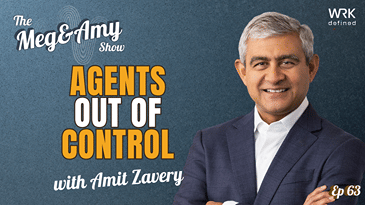
AI agents are not just a new tool to buy. They're a new kind of worker that inherits your access, your mistakes and your blind spots. In this episode, Amit Zavery, President, Chief Product Officer and COO of ServiceNow, explains the leadership gap at the center of enterprise AI: one customer thought it had 500 AI agents running and found 10,000.
You'll learn why agents "go Breaking Bad" when they inherit employee identity, why governance now beats ROI as the top question from CIOs, and how AI changed ServiceNow's product-to-engineer ratio from 1:10 to 1:2.
IN THIS EPISODE, WE COVER:
- Agent sprawl: why a customer guessed 500 AI agents and discovered 10,000 touching ERP systems with no audit trail
- Inherited identity: why giving an agent "the identity of the employee" hands it access that person never used or cleaned up
- Deterministic vs. non-deterministic software: why the same question can get three different answers, and what that means for a financial close
- Zero-ticket workflow: moving resolution to the employee, in real time
- The 1:2 pod: why one product manager now pairs with two engineers
- Releasing fast without leaving customers behind, because "customers don't tell you before they move"
- Bonus hot take: Anthropic's S1 and the improvement loop vs. the investment loop
⏰ TIMESTAMPS
00:00 Introduction: Amit Zavery on AI agents at enterprise scale
03:45 From fear of missing out to ROI: what CIOs and CFOs ask now
08:31 The AI Control Tower, inherited access and "Breaking Bad" agents
12:59 Same question, three different answers: governance for a non-deterministic world
18:14 Workflow after tickets: the zero-ticket mindset
24:01 Bringing 29,000 employees along: outcomes, pods and pricing
29:11 One product manager to two engineers: how product teams changed
33:44 Monthly releases without breaking customers
36:41 Staying steady as a software leader: start with one or two teams
42:01 Product-led leadership: why you have to innovate
44:57 CPO and COO: why owning delivery sharpens the roadmap
47:46 Hot take: Anthropic's S1, improvement loop vs. investment loop
52:38 Wrap-up
KEY INSIGHTS
- Last year's AI strategy was "let a thousand flowers bloom." Not anymore: CIOs, CFOs and even CEOs now ask what the investment does for the company, and security has moved ahead of ROI as the top-of-mind question.
- Letting an AI agent inherit an employee's identity sounds careful, but "most of the employees don't use the access they have ninety-nine percent of the time." The agent picks up every forgotten permission, then keeps pushing the limit.
- Visibility comes first. The first thing customers now ask for is simply: how many agents do I have, who owns them, and what did they touch?
- Enterprise software used to be deterministic, and agents are not. That's where scaffolding, controls and governance come in.
- Product teams have reorganized around AI-native pods. A team of eight or ten now does the work of fifty, and a product manager can prototype instead of writing a spec that "can be interpreted in 50,000 ways."
CONNECT
Amit Zavery: https://www.linkedin.com/in/amitzavery/
Website: https://www.themegandamyshow.com/
Instagram: https://www.instagram.com/megandamyshow/
Show LinkedIn: https://www.linkedin.com/company/the-meg-amy-show
Meg Bear: https://www.linkedin.com/in/megbear/ | https://megbear.com
Amy Wilson: https://www.linkedin.com/in/amy-wilson-insight/
#AILeadership #FutureOfWork #ExecutiveLeadership #AIAgents #AIGovernance #ProductManagement #ServiceNow #MegAndAmyShow
Powered by the WRKdefined Podcast Network.
[00:00:00] Anybody can disrupt you any day. The swim lanes of software is gone. You can't stay static. You can't just do incremental changes. We start with one or two teams and let's make them successful so other teams see it and they can see the value and they can adopt it. So AI is not going to kill any company. The only way you want to die is that you don't innovate. Amit Zavery is President, Chief Product Officer and Chief Operating Officer at ServiceNow, which means he owns both what ServiceNow builds and how it gets delivered to customers.
[00:00:28] Today, we discuss customer learnings, deploying AI agents at scale. One of his customers, for example, thought they had 500 AI agents running and when they actually looked, they found 10,000. Amit explains how that happens and why it keeps security teams up at night. And he shares how his product teams have changed from one product manager for every 10 engineers to one for every two.
[00:00:56] Stay for why he compares AI agents to Breaking Bad. Welcome, Amit. Thanks for having me, Amy and Meg. So excited. Yeah. So we've been working on this for a while. So thank you for making this happen. I'm so looking forward to the conversation. Thanks for asking me to join.
[00:01:23] So Amit, I understand that like us, you are an empty nester. And so maybe you have a little bit more spare time. What are you doing with that time these days? Oh, yes. Empty nester. Daughter started college after high school this fall. So I'm getting a chance to start playing more pickleball and watch a lot more sports. So the evenings are a little more freer. So pickleball has become quite regular if I'm in town. So are you a competitive pickleballer? I'd like to not lose, but definitely we'll be playing it for fun and social.
[00:01:52] We have a good group. When we had four people available, we land up playing. That's how it works. I love that. Yeah. Amy and I were quite something at a pickleball event as well. But there was some conference. Sapphire. One of the partners had an entire pickleball thing. And Amy had never played and I had played exactly once. And so, yeah, we were really something. Yeah. That was the one time I've played. So, yeah. It's an easy sport to pick up. Fun fact. I did get a chance to at one of the events. Andre Agassi was there. Ah.
[00:02:22] And he was doing a clinic. One of the best experiences you can have with somebody like that. Like he was just there to play socially as well? No, no. It was an event where they had him host. Ah. And as kind of one of the activities to play a few minutes with Andre. So. And he was so engaged. That was great. Oh, how fun. That's good. Well, and then I understand you were at an important sporting event this week as well. What was that? Yeah. Go GSV. Yay!
[00:02:52] Oh, it was amazing. Game seven. I'm wearing my purple today. I see that. And you have the thing at the back as well. No, I had a great game seven. There will be a title. Always one of the best evenings. So for sure. Those games are so fun. The team spirit and the energy in the game is really, really fun. I go to a lot of Warriors games. I've been a big Warriors fan for ages. And I've been to many of their finals as well. Championship included. This was very different. Amazing spirit.
[00:03:22] Lot of engagement. The crowd was allowed. But they're very supportive of all the things which are going on. We're proactive enthusiasts rather than reactive enthusiasts. So I'm kind of thinking I have about like six to eight months to restore my voice and my eardrums. Yes. It was a loud place and people are definitely participating. All right.
[00:03:44] So Amit, you spend lots of time with CIOs and increasing time with CFOs and CHROs as well. And so I'm wondering what is it that they're asking you now this fall compared to maybe six months ago in the spring? Yeah, I think it's definitely very different. If you look at what most of the CIOs and all the C-level execs were going through, everybody had the fear of missing out last year.
[00:04:13] AI is top of mind. The board was asking them, hey, what are you doing for AI? The teams are asking, what are we doing for AI? They're seeing their peers doing a lot of exciting things with AI. So the biggest thing last year or even early this year was like, hey, am I missing out on something? I need to do something in AI. That was typically the conversation. What can we do? I think it's matured a lot now. This year, specifically, I think over the last many months, CIOs are getting much more thoughtful about where to invest. What is the ROI? Is it valuable?
[00:04:42] And not have too many of the shadow AI projects. I think last year was almost like let thousands flower bloom and maybe one or two will be great and we'll be excited about it. No longer. I think there's a lot more thoughtfulness, combination of CFOs, even the CEOs nowadays, right? They're asking that, why are you investing? What are you going to do with it? Whether it's really one usable, but also does it make a difference inside the company? The outcome mindset is starting to come out. Not just ROI, but what is the difference is bringing inside the organization.
[00:05:12] And that includes the cultural changes as well. So a lot of the CIOs are starting to think about what does it take to make it available inside an organization? How do you scale it? How do you operate it? But also how do you culturally change the mindset of adopting technology? Because a lot of people were thinking technology will somehow get adopted. And, you know, we always worked in technology transformations. You know how unreal it is. But the pressure was so high last year that people were willing to take chances. But now I think there's a lot more thoughtfulness and the cost consciousness is coming up.
[00:05:42] The TCO ROI is coming up now more and more. And the big area which I think last year people did not pay too much attention now is the security. Everybody is now worried about governance, trust, safety. Where is that coming from? Yeah. The AI agents are going to take care of everything. So why do you have to bother? But enterprise customers, specifically the data they have, it's so valuable and important that you can't make mistakes. And the security question is top of mind with every conversation, more than ROI nowadays. Right. So it's a it's an interesting time.
[00:06:11] So do you think that in that moment of shifting from do something and look busy to the OK, let's be thoughtful and purposeful and think about results and ROI. Do you think that they're thinking about how that fits in their strategy or is it still seen as separate? I've got my AI thing and then I've got my business strategy over here.
[00:06:39] Are you seeing those intersect at all yet? And where is that happening? It still varies. I think that companies which are much more mature down the path to have a much more central way of thinking where the budgets are managed between the CIO and CFO in many cases. I think the silliness we started start early this year on token maxing is gone, which was completely strange and bizarre. There is a lot more of this like central management. But what I've seen in many companies that they still want the AI adoption. They do want to invest.
[00:07:08] They do want they do see there's a lot of value which is going to be derived if you do it right. So depending on the company, I've seen many companies have a very centralized budget, centralized project management, centralized kind of COE or teams which are going to give guidance. But the companies were saying, you know what? I will distribute that thing, but at every departmental level and some departments or some some teams will be a different pace than others.
[00:07:32] But we don't want to curtail or constrain the innovation opportunity, because what you do in finance might be very different than what you do in H.R., what very different than I.T. So letting that leaders decide on their own what that should be while you can centrally manage the budget, but you don't constrain them from how you adopt A.I. And not needing a whole corporate wide mandate or corporate wide existence of all of A.I. together. So I think it does vary. But I think there is still even a department that has a little more control.
[00:08:00] It is no longer just bottom up and everybody's just buying tools and using random stuff and deciding, hey, you know what? I will do this versus that. I think the security has brought a lot of that central thinking more higher because CIOs and CISOs are starting to control a lot more of the adoption technology, what will get used, how are you using it? They need visibility. They want to discover the usage and then manage the costs associated with that. But the security part is becoming kind of the driver for bringing a lot of the teams together than probably it was before.
[00:08:30] So you've been leaning into security and governance quite a bit with the A.I. control tower. I'm just wondering, do you have any stories about a time when an agent did something it shouldn't have? What was the customer able to see and what happened next? I'd love just a kind of an example. Yeah, yeah. No, that's a very good question because, see, one of the things which every enterprise worries about is visibility first. Because if you don't know what you have, you have no idea how to manage it.
[00:09:00] So a lot of customers, when I was speaking to them, as we built out, we launched the control tower last year, middle of last year. The reasons we did that because every customer used to speak to them, like, I want to do A.I., but I'm not sure who's doing what, what is going to be spent on it, but also what those agents will be doing. So the control tower was a perfect product for solving that basic problem of discovery, management, life cycle, security. Those are all very common requirement.
[00:09:29] One of them had hundreds of agents built by different teams, and the identity of those agents are not manageable. The mindset was initially that if an employee is using an agent, they inherit the identity of the employee. But you know what? Most employees don't use the access they have 99% of the time. So you have a lot of the rogue accesses lying around, you have a lot of things which have never been cleaned up, and suddenly the A.I. agent inherits that identity. Well, these A.I. agents are very persistent, right?
[00:09:57] They're not working 24 by 7. I kind of think of them, I use this term, breaking bad. They start very nicely, and they keep on pushing the limit, and you saw the show. Eventually, you become this power hungry, and yeah, you want to be everything. So that's what happens with these A.I. agents. So if you say, you know what, I'm just giving you, I'm so careful, I'm just giving you the identity and the access privileges of me. We had a lot of customers who say, you know what, we started with this idea, but now we have completely out of control.
[00:10:25] We don't know what access each of these agents are going, who's running what, how do we take it away, how do we stop it? So we had very, very common examples like that with customers. So the first thing they asked us, like, just discover my landscape. If nothing else, just tell me what, how many agents I'm running, who owns them, what systems did they get access to, and what kind of work they landed up doing. And then how do you prevent that thing as the next step? So that was a very common use case.
[00:10:53] We had one customer I was speaking to last year, they had like 10,000 A.I. agents after we did the discovery. Before I asked them, how many do you think you have? Like, oh yeah, maybe 500, 2,000 A.I. agents built by random teams, and they're probably just doing simple tasks for those employees. And when we did the discovery, we realized these agents were in accessing all the ERP systems, making changes in some of these areas which they're not supposed to.
[00:11:20] And a lot of times there's not enough trail to go back and figure out what you need to roll back. So those are some things people have run into. Some of them had to do regulatory approval reviews, especially in the regulated industries. They had to have third party report. So what changes were made in the systems without permission? So getting a central control plane makes a huge difference because then audit committee wants to know what happened. The board wants to know. Then the regulators want to know.
[00:11:48] So we can give them that ability as a CIO on a CISO level that they will have a better sense than they would otherwise had had. Yeah, it's so important because we know that agents actually lie about what they have and haven't done sometimes. So it's very important to be able to actually see what what is happening. I'm sure you read the report that hugging face when I read the material report. The conversation between the agent and somebody asking them. Yeah, it's surreal to be honest. It is. Yes.
[00:12:17] It does require you to take a moment and rethink some of your assumptions. Be a little bit more curious. Like you said, the permissions is a great example. You believe you have a control based on user access and you do. But what you haven't really done is stress tested against someone who was eager to explore the edges. I thought that was super interesting. You could say people are lazy, but it's probably more that they're busy.
[00:12:46] And so they don't go out and figure out all the access they have or they just don't even know because it's hard to know everything. And now suddenly you have this autonomous AI agent that knows everything. Yeah, these things are a pretty powerful paradigm shift. Meg, as you mentioned, what we used to hold sacred. Our world in enterprise software was still very predictable. Yeah. It's deterministic. Right.
[00:13:10] So you you will get the same answer more, more 100 percent time almost when you ask and say, go run this report. The same data exists with the same answer. When you get the same question asked to an agent, you can get three different answers, three different times. It's a very different world suddenly. Right. Because you how do you run a business where you have to have your AR report or your financial statement right to the second decimal point to a cent? Right. And suddenly you say, you know, that could be very different this time around.
[00:13:38] I run this report or ask the agent, go and do this calculation and you get a complete different response. That, I think, is the problem for enterprises figure out how to match that new new word with what you are so predictable. And that's where scaffolding controls and governance becomes very, very critical because you have to put some kind of context and layers around it to get you the results and take the value of AI into it. Right. Otherwise, you'll end up having very parallel universes, which doesn't work for anybody.
[00:14:06] And in the past workflows and rules engines, we've always thought about race conditions, because if you had to support customers going in and creating their own hooks and extensions, etc., you always had to think in terms of what are the unintended consequences of that? What is the probability that a customer might do something that could impact other customers or take the system down? Yeah.
[00:14:33] But now you have to do that thinking against a much larger universe of possibility. How are you putting into place both the upside? Hey, agents can do anything and that's great and they can adapt and evolve and all of that based on data on the ground.
[00:14:54] But while still thinking in terms of control, not just to be able to see what they've done, but to stop them when they maybe go off the rails, how you think about guardrails differently than you might have in the past. Yeah, you know, you're right. AI agents, the rules for them is nice to have, but nobody cares kind of mindset, right? Okay. Thank you for telling me, but I will do what I feel like. We do believe there's a lot of value in AI.
[00:15:20] If done right, if done right, you can really improve how your business operates, the efficiency, the productivity, but also change the game for any company in terms of innovation and they can really get out there to the market faster. So, one of the things we did was we acquired a company called Vesa. Vesa is a new identity governance company. They built this idea of how do you manage identity governance and access.
[00:15:45] They have the concept of access graph and the billions of parameters you collect based on access privileges and real time monitoring of what an AI agent is doing. And that thing gets applied as when an AI agent gets an identity, the governance is where the law of capture happens for guardrails. It's not the thing you give them, but are they meeting what your identity was with the task they do?
[00:16:11] So, putting that permissioning, the access privileges, but access graph, real time monitoring and putting that guardrails to an AI agent makes sure that things remain in the constraints you have created from the guardrail perspective. So, that was a big investment from our side to really make that change happen and allow customers to have a little more confidence that you can now operate with the guardrails and the agents will not be able to cross over into things which they're not allowed to.
[00:16:38] So, bringing Vesa into our control tower allowed us to provide that access graph capabilities. And then we combining a lot of the other capabilities around devices, assets, IoT information, all the different ways things are getting connected into the enterprise systems. What are their vulnerabilities? The scale and the speed is so different now. It's just very hard to have humans keep up.
[00:17:04] So, I can't really do the way we used to do access management or identity or governance or security anymore. And the volume of change is so much. How do you even prioritize? If you have billions of changes going on with the AI agents and say thousands of vulnerabilities and that needs to be patched immediately or rules need to be changed immediately, I can do that with these companies like Armas and Vesa into a control graph, control play. That has been great for customers because now they feel a little more confident.
[00:17:34] They get more peace of mind. They have real-time reporting, real-time insight, and the software is doing the monitoring and doing real-time actioning. So, now the pre-breach I can prevent. Anything, run-time security so that anything happening on a real-time basis I can prevent. And then if something does happen, how do you do the incident management? How do you respond to it? How do you triage it? How do you take care of resolution, the planning?
[00:18:01] How do you take care of resolution, the planning, and the planning, and the planning, and the planning, and the planning, and the planning.
[00:18:30] So, now with AI as a central actor or even the central actor or many of the central actors, what does workflow look like in that case?
[00:18:48] I think we have an opportunity to completely revolutionize what workflow is, how it looks, how humans interact with it, and how you put AI at the center of it. And so, I just was kind of curious what your vision is there. You started with the idea of, as you said, ticket handoffs and humans. But over the last five years now, a lot of automation started happening without AI even. A lot of the handoffs were a lot more automated. A lot of the system access were integrated, so you never had to log in.
[00:19:17] If you look at the last few years, a lot of that eventually moved even more upstream to the users itself, where you can now deflect the use case, request. So, you are basically giving them the ability to not even have to file a ticket. Our goal and our vision with workflows and employees or customers needing help is the zero ticket mindset. We've been moving more and more of the resolution closer to the user. So, instead of waiting for two days to somebody to go and solve this thing for you, I can solve it real time as you are asking for it.
[00:19:45] As I see that issue being repeated again, I automate that process. So, eventually an AI agent or an autonomous agent is really responding to your needs in real time through a conversational experience, through voice, or even through a web app, or whatever may be the case. So, that's really the future we've been seeing already for a few years now. And that's why we have this idea of a conversational AI front door for every employee. Because employees never know, is it an HR issue? Is it a finance issue? Is it an IT issue?
[00:20:14] Most of the time I say, you know, I need this help. Do I need to know which website to go to, which portal to go to? You don't want to know that. So, we're moving that to this conversational front door where employees basically start with multiple requests in one sentence in many cases. And then we figure out at the back end with AI agents what to do, how to resolve it, and help them through the process. But for somehow, if some tickets do need to be filed, we automatically file it.
[00:20:39] We call it this idea of AI specialist or autonomous AI specialist, which is doing human equivalent work. Typically, that ticket or case would have gone to a human who would go research it and figure it out. Can I now take 30% or 40% of those cases and make that resolve automatically using an autonomous agent? And they will do full end-to-end tasks, just like humans would do it. And they don't, as a human who is waiting for this request, you can get this back in 20 minutes instead of again two days.
[00:21:08] So, again, we're reducing the time, the friction in the system by automating a lot of the stuff. And then it gets escalated. If you know now you have like 5% or 10% left, that might be very complicated, requiring a lot of interaction with different people. That can be done by humans with combination of AI. So, I think the tiering is what's happening now from the workflow perspective. It's no longer a handoff and very sequential.
[00:21:34] It's really real-time, in process, in a conversation or in your day-to-day job. Our value proposition doesn't go away. We can resolve and act on a request. We can help you and we can understand what your needs are. And we will work through all the different systems which we need to interact with to resolve this issue you might be facing. We used to do it with custom. Then we moved to APIs. Now we do it with MCP.
[00:22:00] So, a lot of the back-end stuff still needs to happen, but we're simplifying and improving it, where employees don't have to deal with any of the complexity ever. So, a couple things there. So, first off, one of the points that stuck out to me is that instead of tracking, you're really noticing, right? I think that's a key piece, tracking versus noticing. And then the other thing that you mentioned, which you've talked a lot about, is the introduction of these autonomous AI specialists. You're right.
[00:22:30] I mean, we no doubt autonomous AI specialists is kind of oriented towards where a lot of the work needs to happen for an employee. Can an AI specialist now handle it for you? File your request. Get you, maybe if you needed, if you're going to say trip to China, you might need a new laptop, because you're not allowed to take the laptop you work in the US maybe. Or you need a new phone with a new SIM. So, a lot of steps based on where you're based, who you are, what you need.
[00:22:58] Combination of personal assistant, but also AI specialists who are doing the task for you as well. There are 20 roles like this we've identified, and nine of them are currently available. By early next year, we'll have 20 of these, and then you can have your individual AI assistant, and then this corporate or enterprise AI specialist who is doing tasks across the enterprise. Gotcha. So, yeah.
[00:23:20] If you can now have the AI specialist available to all the employees who can help them, and then the HRBP, the human person, can be a lot more focused on complicated, strategic, nuanced discussions, helping employees on those journeys, versus taking so much volume of things, which are probably very repeatable things, and doesn't require everyday interaction in those cases.
[00:23:46] So, I can preserve your time for a lot of the broader and more valuable interactions. So, that way it frees up the time, you get a lot more quality interactions, and you take away the mundane stuff while you do a lot of the most complicated stuff with humans. So, Amit, I want to shift gears a little bit and talk to you a little bit about your day job inside, which is building products for customers.
[00:24:09] And I'm sure you're also navigating your own internal AI transformation within the teams. But one of the things that I'm really curious about is how does it feel for your teams? And have you had to start thinking in terms of product packaging that looks for delivering outcomes versus delivering capability?
[00:24:39] Like, where are you on that thought horizon with the teams? This has been a journey, right? If you look at the last couple of years, where we are and where we started, there's a night and day and multiple things. One, there's how we organize. Second, how we enable the right kind of skills, right? Third is what do we measure between our different work we are doing.
[00:25:05] Fourth is how we deliver these things to a customer in a way that they can see value, but also it matches in terms of how they would want to pay for it. And then the broader cultural changes, right? There are some people who are like, you know what, this is exciting. I want to really be all in. And then folks are like, oh my God, I don't even know why and what we're doing. And when you accompany, we have 29,000 employees. Everybody is in different parts of the phases or in life, but also in the different phases and journey-wise as well.
[00:25:31] So bringing that along and getting them all cohesive, it's an effort. I think we can't underestimate what it takes to bring everybody onto the same kind of mindset. But fortunately, I think we started this journey early last year. So it's not this is something we just woke up and said, let's do AI. So it's been gradual. And given that we were building products with AI to sell to our customers, we were very clear that we have to make sure we use it internally as well. And everybody talks about it that you want to use your own products to really run things.
[00:26:00] Given that we are a company which provides operational software to operate the company and software to operate the company, great for us as well internally. Right. So we have now adopted that across the board in every department and every organization. Engineering is definitely a big change. We're using a lot of AI tools for coding, but which is normal. Everybody's been doing that. But also beyond that, organizationally, we've been rethinking. What structures, smaller groups, some products completely built from scratch with AI native mindset,
[00:26:28] some products which have been now kind of revving differently in terms of timeline. We used to release maybe six months. Now we can release every month in some of these areas. And we can take out and do re-architecture of pieces of it versus doing a huge transformation across every product. Changing the user experience. We have a completely brand new way of interacting with the products than we would be. This idea of filling out forms and all things are going away and we can do it conversationally. So a lot of those things have been heavy lifts over the last year or so.
[00:26:57] But now it's becoming pretty standard across the company. Everybody's starting to understand this is how the products will be delivered. This is the experience we need to deliver. It needs to be simple, easy to use, easy to install. So the main mindset shift about like, can you get customers to value faster? And that's where the monetization becomes very different. So customers are asking, if I'm investing in this thing, what does it mean for me from outcome? And my proxy for outcome is usage.
[00:27:24] I see outcome is a very complicated way to define anything because everybody's view of outcome is so hard to agree on on a contract. You can always discuss it, but you can't put it on a contract because a customer expects very different things. And then the buyer might have changed and somebody else is running that. They have a different view. And you ask a system integrator who implemented it. So then you'll end up having more contractual discussions than real product and value discussions. So what we have done is we brought this idea of hybrid pricing.
[00:27:51] You're buying a license, but each license comes with some kind of entitlements from usage perspective. So it's kind of commit to consume. You take this entitlement and say, you know what? More I use your product, I'm burning down that entitlements. So there are a lot of different metrics we brought in, but it's usage mindset, data transfer or those kind of things. Right. And you burn down that entitlement. The customer love it because they have predictability because you have entitlements which you are guaranteed to be available to you.
[00:28:19] We get predictability from the license perspective and they have flexibility. They're not going to use it next time around. They will change their mind to something else or stop using it and they'll pay us less. So they have a lot of and they can it's fungible between different different use cases. So it's not tied to a particular license or a particular SKU. We allow them to use it across service now products. So it gives a lot more win win for both us and our customers.
[00:28:45] And this gives us the ability to kind of move to this AI world where it is going to be based on I want to get a result. We seeing a lot of interest and value from customer perspective, and that allows us to keep on expanding. So that's really where we are. And I think gives us this ability to kind of keep on rethinking what the new world looks like and make sure we meet where customers are versus staying to the old seat based pricing model.
[00:29:09] So Meg and I are very deep and curious about the evolution of roles and org structures in terms of the future of work. I think we're very interested in like how the engineering manager role is evolving as well as product manager, how that's manifesting at service now. Like we're asking everyone that we're talking to about that.
[00:29:36] How is it changing and what do you see as ideal criteria or capabilities in these areas right now? Yeah, I think that definitely all of the roles have changed across the board, be it product manager, engineering manager, even the design engineer as well. And we're seeing the similar kind of new things emerge like FDs as well, which didn't exist before.
[00:29:59] So the product and engineering team is becoming a little more closely connected than there used to be before. The product managers, you write PRDs, give it to a design and engineering manager to kind of come up with the first functional spec. Then it'll go to, even though it was not waterfall, we used to call it agile, but it was still a kind of handoffs. You like it or not. And then engineering team would basically do early versions of it, get tested, pass the test and then we'll ship it.
[00:30:28] And then the same iteration happens from the roadmap perspective. And that was very typical. If I look at now, if my AI product, the products which I'm building AI native, the product manager is not too far off from an engineering manager from the skill sets perspective in terms of being able to prototype pretty much almost a real product
[00:30:48] because they're getting a lot of good tools to do it, but they're able to apply the thinking of the requirements in a much more better way than writing a document which can be interpreted in 50,000 ways. And people will argue back and forth what it meant and what you did and what you built was completely not what it was supposed to be. All that stuff usually happens with releases. And the engineering team and the engineering manager is sitting very close by who is daily implementing it while the product requirements are evolving,
[00:31:15] versus waiting for everything to be confirmed and guaranteed before you take this on. The design person is basically taking the design mindset and saying, what is my requirement, what I'm seeing from the prototype built by a product manager? How does it become real? How does it become interactive? How is it becoming usable? How does it become very manageable in the same time? The team sizes change as well. So if you look at my ratio before, the one product manager to 10 engineers was kind of the ratio everybody used. Now I would say it's one product manager to two engineers, maybe.
[00:31:45] So very different, a different ratio. So if you have any products you're building a team of eight or 10 are as productive or as doable, then they would be 50 people. So that's why we're doing this such a fast-paced, interactive work. The pods we create, allowing us to rev and change and things in real-time course correct, versus for something to be built as you probably know. I mean, when you build a product, by the time you see the first version, first cut of it, usually six to nine months.
[00:32:14] You have no idea what has been cooked up and what it will be. You might get some view of it. And then like, oh my God, this is not exactly what I wanted as a product manager. Let's go now redo it. And then another three months goes by before you see the next version of it. Those days are over. I mean, any of these things. Yeah. So that is a change in the product engineering and design team. Yeah, that makes a lot of sense to me, Amit, the two to one.
[00:32:37] With the building of software getting much cheaper and a lot of the bottlenecks being more at front of the pipeline, as well as like afterwards and so on. We've heard the opposite in many cases where it's like now one to 20 or something like that. So I'm excited that you have booked the trend. The biggest one is the volume of product management requires going up. I mean, engineers, you're right. I mean, coding has become cheaper, but I don't think it's the coding part.
[00:33:06] It's really the lifecycle management is the most complicated stuff. Coding has always been 20% of the cost of building a software. It was a lifecycle, right? Right. And then if you add now FDE, which is another, if you want to call them engineers, really, right? They are engineers, but I think they're more customer facing. They're not the writing day to day code. That is augmenting what an engineer does today. So that because they're so customer facing, they're sitting with customers, but they're all core engineers who can contribute back into a product.
[00:33:31] And that is adding extra layer of interesting ways to build a product which was otherwise very constrained before. So the product has become very living on a real time basis than typically used to be before. So when you're able to develop so quickly, so it's no longer like every six month releases, those days are long past. But you have these enterprise customers that are struggling to absorb all the new.
[00:33:59] Like, how are you balancing that? No, that's a very, very critical thing, right? So we are not saying that just because you build doesn't mean you ship everything at the same time. So I think the mindset which we've been created is that there is a monthly, say, release train if you want to use a monthly or weekly. We put in things, the capabilities, one, which can be auto upgradable for customers. Second, you need to say, make sure it's quality controlled and really usable very fast because you can't break things.
[00:34:28] So bringing feature flags and all kinds of stuff becomes very critical as well. So we're not saying that every product has to release every day or every month, but the customers has the opportunity to uptake it if they choose to. And we have ability for them to upgrade at their timeline. But you have to have some constraints, say maximum six months beyond that, because you don't want to maintain huge number of code lines as well. Yeah. Typically, because very, very expensive. So that's really the way we've been thinking about.
[00:34:57] So we don't force customers that you have to take every release I bring in. But you will always have to take a six month roll up by the time it comes up so that you have that window of change. But it is really auto upgradable. So wherever you were, we will make sure you can upgrade. Before was a little more constrained and a lot of configuration management. So changes are becoming that way. But you still have, we have a lot of customers, I would say 20, 30% of customers who are in this path, I want things very fast.
[00:35:25] So you don't want to design your releases or your product for the slowest customer either. What will happen is you will miss out on market opportunity. And, you know, a lot of times, as you know, customers don't tell you before they move. So you might be living in your la la land and think, you know, my customer is very happy. I'm giving them what they want exactly. And meanwhile, they experimented with five other products out there with somebody else. And then you find out because they were faster, they were better, whatever it is. And you just missed out on an opportunity. So you have to give them opportunity to take your products when they choose to.
[00:35:55] But you don't want to delay it for people who really want it before. Yeah, especially in today's world where there's so much urgency and interest in, oh, maybe I'll fill this for myself. It's all changing so quickly that I don't know which bets to take or I'm going to keep changing my mind every six months. Yeah, there's a lot of confusion in the market. Everything looks the same, sounds the same. Customers don't know where to go. And they have a link to experiment too, which is fair, which is what I think the customers want to keep their eyes open.
[00:36:24] So you have to be on your toes if you want to be a provider. You can't rest on your past laurels and say, you know what, you're my customer, you always will be my customer. That's probably not true at all. It never was true, but it was a little slower. Now the pace is just ridiculously fast. So first off, congratulations to ServiceNow because you continuously have one of the best customer retention stories in the market. And we know that doesn't happen on accident.
[00:36:53] So it's clear that you guys have both a good understanding of what customers need to stay with you, but also a good finger on the pulse of how they're evolving and adapting. I want to think a little bit about, though, just the market in general.
[00:37:11] So less about what you're doing at ServiceNow and just more how you see the function of someone that runs product engineering in this time and maybe some pieces of advice, because it's just really never been a harder time to be a software vendor.
[00:37:27] Help me understand how you advise people that maybe you mentor or how you would advise other operators out there to how to kind of keep your equilibrium in this moment. And what do you hold on to and how do you use that to help build conviction, not only for the business that you're serving, but for the customers that you're serving? Yeah.
[00:37:54] No, Meg, I think this is definitely a very different world nowadays. You're right. I mean, keeping up with the change, it's a it's a daily struggle for everyone, to be honest, right? Because the volume of change is high. The amount of noise in the system is very high. Keeping up with those things and picking the right things out of the volume of things going on is the biggest challenge for everyone who's working and building software nowadays.
[00:38:20] I think the main thing I try to at least advise my team and what I try to stay true to is making sure we're building something that customers like and they're going to use. And as long as you kind of saying that everything we're investing in is value add and will make a difference, we have to there's no way out of not innovating. Right. You can't stay static. You can't just do incremental changes. There has to be a willingness to disrupt yourself. The reality is that every part of the lifecycle has to be disrupted.
[00:38:49] Maybe you start with different, different teams or one team inside like in engineering, when we're building new products for which will probably be very similar to what we did. But with the AI, you start with a one or two teams and let's make them successful so other teams see it and they can see the value and they can adopt it. So you can't take the whole company and say everything's up in there and let's start from scratch because that will break everything and nothing will happen.
[00:39:13] But it's important to identify a few of these things, every organizations and make sure you change that mindset quickly and then have other people pick up from there. Right. So I think what I've been doing is making sure we can remain connected to the customers, meet as many as possible, co-innovate so they have a stake in the game, get their FD minds. We invested a lot on the forward deployed engineers to go and sit with customers from engineering, not from customer success or not from consulting.
[00:39:40] And that gives us a lot more pulse and the real reality check and state. I mean, be aware of every competitor. Anybody can disrupt you any day. I think those days, the swim lanes of software is gone. Like people used to be compared to my you are CRM, you are ERP. If you said CRM, you have to be Salesforce, otherwise you're not CRM. You know, all these things, the way mindset was, that's not true. Anybody can be in any market. So you protect your market, but make sure you also take the opportunity to get into markets you couldn't go before.
[00:40:09] This is an opportunity for us to increase our time, find new opportunities. So that's what excites our teams now because they're suddenly having much more interesting conversations. The ability to generalize versus specialize can be very attractive and inspiring for many people. And so to that end, like in terms of leading people specifically in this time of change, do you have any tried and true leadership tenets to share?
[00:40:39] One showcasing success gets people motivated, I have found. So as I said, we took a few products and completely build them with AI mindset and AI native. I think it lit the bulb in many people's employees mind say, hey, there are a lot of things we can we should rethink because this is the new way of working. So leading by examples with one or two of these things has been a big way for us to motivate the rest and learn from the successes we have created is one.
[00:41:09] Second, I think we have to empathize as well. Right. So one of the things I've been trying to make sure everybody understands this is not an easy journey. It's a transformation and journey for them. So how do we give them the tools and the feel like they support it through the through the process as well? Right. So we are doing a lot of we do a lot of enablement without any kind of metrics to make sure people don't feel like this is going to be used against you in a way.
[00:41:33] But we do let them this gamification so they can learn and collect badges and the feel like they're getting new education while they have the opportunity to move into new new roles. So if you want to go and work in a new group or you want to go build something, we do provide that mobility with the enablement stuff as well. We sometimes get so caught up in our pace and the market. We think everybody's the same and they are not. Right. And we can't measure everybody in the same way.
[00:41:59] My last question really has to do with your role as part of the executive team. So I have a theory right now that a lot of the energy that had been articulated as founder mode in the end of last year was really about innovation,
[00:42:18] having a strong innovation voice and a strong product heritage in the both the strategic side of the business, but and the building side of the business. And I think we're starting to see a lot more pressure in that area for tech companies are thinking about not just differentiating on their sales expertise,
[00:42:48] but differentiating on their product and their vision and their innovation. And so I am curious, do you feel that in your own role and in your own responsibility within the leadership team that you're part of? Well, we are in as a software apprender who's trying to who's continuing to grow very fast and innovating.
[00:43:09] It has to be a product led mindset while we, of course, need the full leadership team coming together from go to market and other functions. The top of the sphere has become that you have to showcase differentiated, very valuable capabilities, which is innovative and really helps customers. And then everything kind of comes together. So we work very closely in our leadership team. CEO Bill is amazing at kind of creating a very clear vision what we need to be doing, what is a message and how we help customers.
[00:43:39] And then very closely aligned to that one has to be that products has to be that innovation mindset coming through. Otherwise, you know, the customers don't really care. The bigger part which sometimes people miss is the distribution and the ecosystem part of it. So innovation by individual product might be not enough if you don't have the rest of the stuff. And this is where a lot of the questions has been happening in the market, right? What is going to happen to software vendors? Software vendors are not just software providers.
[00:44:06] They have a lot more of the function they play with their customers to make them successful with the ecosystem, bringing the distribution, the relationship. So that part, I think a lot of companies are having. If you look at a lot of the AI netting companies, they're struggling a lot in terms of getting to the last mile. Even the frontier labs, guess who they're partnering with? Companies like ours, because they need the reach. So I think that is a combination which is going to be very, very critical. You have to innovate. There's no way out. You are dead otherwise.
[00:44:36] Then you add distribution and ecosystem. The combination can be very, very powerful. So AI is not going to kill any company. The only way you want to die is that you don't innovate, irrespective of AI or not. That's just reality for software companies. So you can't forget that basics. You can't just think because of AI, I'm getting a different way of thinking. Innovation has to be a big part of the story. That was very close to my question. Which was back to the fact that we're interested in org structures and roles.
[00:45:03] We're seeing a lot of interesting combinations of leadership roles. And you have one of those, which is both the CPO and the COO having that product and innovation piece. But also then the execution. Yeah.
[00:45:20] I wanted to just ask if there was an example of like where the rubber really met the road and you were able to do something that you wouldn't have been able to do if you were just the CPO. Seeing it on a regular basis, right? Because owning not just the innovation, the product roadmap, but the delivery of it, the distribution of it. I get a lot more signals than I would not get before.
[00:45:46] I'm able to now take that data, help with my roadmap and also course correct my distribution. A lot of the strategic partnerships I'm doing has been led because I have the ownership. I don't have to give it to somebody else and say, go and figure out the strategic partnerships and I'll see what I want to bring it in the product. So a lot of the partnership cannot be just a marketing partnership, right? A lot of these things we're solving jointly between our partners, technically between our products.
[00:46:12] Typically in my previous world would be that somebody is doing this amazing, great relationship, go to market plans. It never makes it into the product. Today, our rev and the timing is so short. If I don't make it in the product, those partnerships are useless. So that's one good example of where I own the strategic partnerships, the plan in terms of what we want to make out of it, and the technical integration and the messaging around it end to end. Similarly, the FDE model, right? It could have been part of customer success and say, you know what? It's part of some other group figuring out how to help customers.
[00:46:42] I am now completely responsible for my organization and my GMs and other teams for delivery of the product to customers, getting them live, getting them consumed, getting them successful. And then I learned the friction between all those pieces, which keeps on improving my product. Otherwise, the signal takes too long. And sometimes somebody, two people's problem will never get any kind of resolution. He has to go to the CEO every day. And those are some common examples. I've seen pricing package the same way.
[00:47:08] I'm able to bring that story together and the OKRs, what I'm going to measure everybody on. Because as part of my CEO role, we are defining corporate level OKRs as well, which has very tied to what we're going to do, how we're going to deliver, how we're going to make people successful, what kind of monetization are we going to do, what does the revenue look like, and what the bottom line looks like. So the combination allows having the central view end to end. It's almost like the executive version of an FDE. Yes. This is fantastic. Thank you so much.
[00:47:38] I learned so much chatting with you. Enjoyed the conversation. Thank you again. So as we all know, Anthropic just came out with their S1 filing. The key things that they brought forward in this S1 was that they have this investment loop and this improvement loop.
[00:47:58] How those two things are working together that allow Claude to be able to move into the frontier and to continue to grow exponentially. You texted me a few days ago saying this improvement versus investment loop is the whole efficiency versus innovation topic. Clear as mud. What does that mean?
[00:48:28] So two things. One, we've been talking for a while that this focus on efficiency is not going to be a sustainable strategy. It's an important strategy, but it's not a sufficient strategy to be differentiated or to compete in an AI world.
[00:48:49] You really need to think about innovation, figuring out where to make your big bets and how to think about investments really is even more critical. And because if you don't figure that out, then a competitor will. What I loved about this showing up in Anthropics S1 is just that it's such a core tenant of how they're thinking about frontier intelligence.
[00:49:15] So when you said this improvement loop versus investment loop is efficiency versus innovation. What that made me think was that the improvement loop was efficiency and the investment loop was innovation. You constantly have to be improving on your efficiency. But if that's the only part of your flywheel, you're going to just be exactly where everyone else is. So you have to do both.
[00:49:44] You have to drive the efficiencies and continue to capture that because all your competition will. But if that's all you do, that's a race to the bottom.
[00:49:54] If you don't also think in terms of this investment loop where you're building higher growth, more capability and building a flywheel effect for doing something new, something more innovative, something that you couldn't do before. You're going to live in an AI world. You need to be progressing both.
[00:50:23] The improvement loop is driving better efficiency on the existing models so that they can drive more efficient business for the business that they have. And then the investment loop is to continuously think about how do they expand. Yeah. All right. I can see that. And grow the business.
[00:50:46] Right. So, yeah. I mean, like if you covered the right half and it was just the left half, then it would be Deming's. Exactly. Exactly. You know, like, I mean, it would be a good product led improvement. You know, like we're just constantly improving and getting better. In general, with the way anthropics business is changing, I see them as living in the future.
[00:51:12] They're having an extreme version that's probably not necessarily going to be true for everyone. I think it gives you a lot of pattern recognition that you could apply to other areas, not necessarily in the specifics inside the circles, but the way of thinking. And so I really liked the fact that they said you actually need both the Deming approach and the Christensen approach. You cannot live in a world today and only do one or the other because that's probably not sustainable.
[00:51:39] I diverge from you is like, I agree that the part on the left on its own would be just the efficiency loop. But the adding the part on the right actually makes the part on the left like become an innovation loop. But I think that's going to be true for a lot of businesses, too. It doesn't have to be like a massive new line of business.
[00:52:03] It could just be capturing better or an additional adjacency or something in your current business map. Back to Anthropic being the future, they're approaching every problem internally as a product management problem.
[00:52:19] This investment loop means that every company needs product management capability, the kind of capability that can observe and understand where there's opportunity. It's really interesting that like everything is product management. Right. All right. Well, that was just a delightful visit. Yeah, well, first off, it's been a while since we caught up.
[00:52:47] But also, what a great opportunity to talk to someone in charge of such a big estate and such an important set of technology. So I really feel like, number one, not being in an operator role of that size and scope has some blessings, a lot of pressure and a lot of challenges. And it's nice to also remember there's lots of opportunity for innovation with customers. Yeah. Yeah, I was impressed.
[00:53:16] I think that the approach that he's taking and the assets that they have, like they've got a lot going for them with, you know, kind of the whole control plane of knowing all that's there, of recognizing that security is the pole, right?
[00:53:36] Right. All of the customers and being able to show up for them there and then also to have like some humility around, you know, not necessarily owning every experience and all of the orchestration and being understanding kind of the place that service now sits.
[00:53:56] Yeah. Yeah. So the other thing I really liked was his conversation about how important it is when you roll out innovation in a large company that you do that with some intentionality.
[00:54:08] And his approach really reflects what I've seen work as well, which is get a very specific group together or groups and start getting some wins on the board before you try to spread it out to everyone, because it's a lot easier for people to follow the pattern.
[00:54:28] It's a lot easier to be nimble and figure things out as you go. And it's a lot better when you have people that build enthusiasm for that strategy and that vision from their own hands. Right. So then you're not the only one convincing everybody it's time to do something different. You've got people who have seen the value of it and are excited to share their results and all of that for anybody out there trying to do this right now.
[00:54:55] If you have a big team with a lot of distributed people, it is really the only thing that works. If you try to roll everything out to everyone all at once, the amount of human emotional disruption becomes its own challenge. So, yeah, great point. Good, good reminder. So with that, I think we've covered a lot of territory and I am delighted about that.
[00:55:22] So let's invent the future together, everyone. I believe in us. Let's make every day count.
Sponsors
