
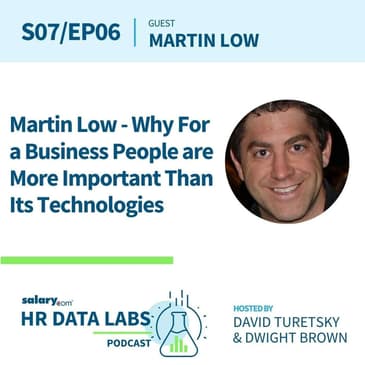
Martin Low is the Founder and CEO of On Plane Consulting, a consulting firm that helps small businesses and startups optimize and scale. Having held HR Director positions at multiple successful companies, Martin bring a wealth of experience to the table.
In this episode, Martin talks about the fact that despite the evergreen landscape of new and emerging technologies, businesses still need one essential resource: people.
Chapters
• Welcome, Martin!
• Today’s Topic: Why A Business’ People are More Important Than Its Technologies
[9:18 - 18:23] Why can’t businesses just rely more on technology and less on people?
• If you rely less on people, those you do rely on will matter much more
• Emerging technologies likely won’t replace people so much as improve their productivity
[18:24 - 27:15] As someone in HR, how do you facilitate technological change within your business?
• Good data and insights into a business’ current state are essential
• Why HR practitioners should be business minded (and vice-versa)
[27:14 - 38:00] How HR practitioners can drive progress within their business
• Data will help you identify problems and build a business case for the solution
• Building a solution for reducing the people cost of a business
• Thanks for listening!
Quotes
“[HR] data will do a couple of things for you: . . . it’ll tell you if you really have a problem, and it’ll help you show others that it might be.”
“If you can [reduce the people cost of a business] by 1 or 2%, it’s night-and-day for the profitability because that can all drop straight down to the bottom line.”
Contact:
Martin's LinkedIn
David's LinkedIn
Dwight's LinkedIn
Podcast Manger: Karissa Harris
Email us!
To schedule a meeting with us: https://salary.com/hrdlconsulting
For more HR Data Labs®, enjoy the HR Data Labs Brown Bag Lunch Hours every Friday at 2:00PM-2:30PM EST. Check it out here: https://hrdatalabs.com/brown-bag-lunch/
Produced by Affogato Media
Powered by the WRKdefined Podcast Network.
[00:00:02] Here's an experiment for you. Take passionate experts in human resource technology. Invite cross-industry experts from inside and outside HR. Mix in what's happening in people analytics today. Give them the technology to connect, hit record, pour their discussions into a
[00:00:20] beaker. Mix thoroughly and voila! You get the HR Data Labs podcast where we explore the impact of data and analytics to your business. We may get passionate, and even irreverent, that count on each episode challenging and enhancing your understanding of the way people
[00:00:38] data can be used to solve real world problems. Now here's your host, David Turetsky. Hello and welcome to the HR Data Labs podcast. I'm your host, David Turetsky, alongside my co-host, trusted friend and partner, Dwight Brown from souri.com. Dwight Brown,
[00:00:55] how are you? David Turetsky, I am absolutely wonderful today. Good to be with you guys. Is it warm? Well, you know, it depends where you're originally from. To me, it's warm, but you know, we're probably in the 66 is what my 66 double what it is here. Yeah,
[00:01:15] it's surely by Phoenix standards, but you know, Massachusetts standards that would be a heat wave. Yeah, that's like bathing suit weather. It would be. It would be. And I would literally go outside the bathing suit if it was 66 right now, but it is not. But
[00:01:30] Dwight, we have with us a brilliant person. We have with us Martin Lowe, who's the founder and CEO of Onplane. Martin, how are you? I'm fine. I'm fine. We're not quite to 66, but we're better than 33. So you're between their split and in the middle, aren't
[00:01:48] it? That's right. It's sunny outside. So I'm going to pretend that it's warm. Hey, there you go. Listen, that's a blessing right there. Let's just stick with it. It's sunny outside. So Martin, tell us a little bit about yourself and how you got to this point. Yeah. So,
[00:02:02] you know, I didn't lose a bet. Oh, it would be much more interesting topic if I did lose a bet. But that was my backstory. I like business a lot. I went to undergrad,
[00:02:22] was an econ major and really loved the theory. And what you get out of econ, I also don't love math. And when I started thinking about like, what am I going to do after I get this
[00:02:32] econ degree? You know, I didn't want to go on and do like a PhD and that sort of stuff. I really wanted to do something that was more applied than that. But I didn't
[00:02:41] feel like I understood people and felt like it was left out of a lot of the business curriculum, right? So you had like a, you learned a lot about econ, you learned a lot about finance, you know, a lot about accounting. But I didn't really feel like
[00:02:51] I understood the people side. I thought, you know, if I can get the people in a business to do what I wanted to do, like I could probably do really well for myself. And so I went on, I got a master's in HR because I want to understand
[00:03:02] that better than I went and worked in automotive manufacturing for a number of years and did that for Ford and for Lier, who's a tier one supplier for Cummins, who makes big diesel engines. And then I had someone from Amazon reach out and
[00:03:18] say, hey, you know, we're growing and we really need people to help us grow and which can help us. And so did a number of different things for them around landing processes and how they would operate that monstrous
[00:03:31] business that that thing's grown into and learned a lot there about just, you know, how do you develop talent? How do you manage performance? How do you stop building? How do you run and measure employee engagement, those sort of
[00:03:44] things. Went from there for P-back business. And we took that business forexed it in five years and sold it. But they had all the same kind of issues that Amazon had, right? So they didn't have good process. They
[00:03:58] didn't really understand how they were going to manage their people and their people were the big reason why we're able to forex that we're able to sell it for really a multiple when we did. And so that was like this
[00:04:08] light bulb moment. Like, you know, there's a lot of people out there who cheer for the HR or the people side of the business where they're like, you know, that's really important. You should really invest in it. But they
[00:04:18] never seem to have a lot of money. And so it always seems to be underfunded, right? And this was the first time where I saw like, Hey, wait a minute, this company paid up for that company because of the
[00:04:29] people side of the business. And then I made that connection like, Hey, there's really money here. So I then I went, I worked for Blue Apron, they were $900 million after four years and they had all these same like
[00:04:41] Amazon challenges, right? Like so they didn't have the people side of the business nailed down, it was costing them a lot of money. And at that point, I've been doing this for more than 10 years. Same challenge, all these different businesses. And you know, I was
[00:04:55] tired one day, I'm like, why are there no consultants that are in here, like setting the strategy and like telling me everything that's not right in the business, right on the people side so I can like
[00:05:05] get in there and prioritize it to fix it. And so that was the start of on plan. So about six years ago, that's the company that started. That's so cool. Yeah. Nice. Now that we know you so much better,
[00:05:18] one of the things that we always ask our guests is one fun thing that no one knows about Martin. Yeah, yeah. So my random fun thing. When I was a kid, we would go up to my grandmother's house and she lives up by Traverse
[00:05:32] City, Michigan, in Traverse Cities near Frankfurt. And Frankfurt is right on Lake Michigan. And the interesting thing about Frankfurt is it sits atop of kind of these sandy bluffs. And what happens there is the water comes across Lake Michigan, hits the
[00:05:48] bluff and creates this massive updraft. So they have all these people to fly gliders out of Frankfurt. And one day somebody landed one of those gliders in my grandmother's wheat field. And you know, they're out there literally middle of nowhere,
[00:06:02] nearest towns got a couple hundred people in it. And we're out in the yard and somebody just comes walking out of the field. Where did this person come from? Sounds like a Stephen King novel. 100% not like a Stephen King novel like right, like this
[00:06:17] random person just walking out of the field. Yeah, the nearest neighbors a mile away, right, like people don't just walk out of the field. And she had landed crash landed her glider out out in the field and you know, they had all this weed out
[00:06:31] there. So we had to drive a truck out there and get it out. It was this thing that she said, I'm really sorry, I landed in your field. I didn't have a better place to put it down.
[00:06:39] Come on out and we'll we'll give you a couple of glider rides to make up for us. We're like, okay, cool. So we go out there. And what they do is it's, you know, gliders just this kind of small plane that's towed up by
[00:06:51] another plane, no engine. And so they tow you up to like 20,000 feet, then they let you go. Right. And so I'm like, this is pretty cool. I'm young. This is some people who are like, I'll never do this. And so we we get in this glider and the
[00:07:05] instructor pilot and I he's like showing me how to fly it and find it. And I'm doing my best to like not crash this thing. Right. And, and you know, so I'm kind of like I'm making a small move in doing this thing, but I'm not
[00:07:17] really doing anything. And he goes, Hey, you want me to fly for a minute? I said, Yeah, that'd be fine. He goes, you like rollercoasters? I'm like, I love rollercoasters. And I suddenly took the stick and he went like that. And he went
[00:07:29] from like 15,000 feet to 12,000 feet. Like it just went and then just like you would with a paper airplane, like if you ever throw a paper airplane down, it goes like this. Right. And then the next thing you do is you just
[00:07:43] crank that thing back and we just gained like 500 feet just, you know, right out of that. So it was awesome. So I got to go and he what he does is he's an instructor, but he
[00:07:52] also does stuff flying. And so I got to ride in a glider with somebody that does stuff flies. It's pretty cool. And the reason I'm shaking my head is now you've given Dwight something else to kill himself over. Because this
[00:08:06] guy is a absolute adrenaline junkie. And I could see I can't really see him well because it's a little blurry. But I can see in his mind he's going, hmm, you should do it. 100% you should do it. You should absolutely. I would highly recommend it. It's fantastic.
[00:08:22] And it's kind of we've ever done in the history of the HR data lab. So thank you so much for David just shaking his head. See, I'm a pair glider Martin. So and gliding is definitely on the bucket list. So I'm right there with you man.
[00:08:41] Yeah, highly recommended. All right, well, on that note back to the studio. Now let's talk about what we're going to actually talk about today. Yeah. So today's topic is going to be a really fascinating discussion around how technology has changed the
[00:09:04] business but yet there is still one resource that's really required. And that's its people. So Martin, our first question is why do people really matter? Why can't we just do everything with technology and just use fewer people? Yeah.
[00:09:30] Look, you know, I think that I think you can use fewer people but I think the people that you have are going to matter a lot more. Right. So and I kind of think about this is like, if I were going to dig a ditch
[00:09:44] with a shovel, right? Like it's hard. And if I had a ditch digging company only had a shovel like to use to dig them, you know, it wouldn't matter who I got. There wouldn't be a lot of variation and how much
[00:09:58] somebody could do because it's hard work. There wouldn't be a lot of value that that person could add. But if all of a sudden I have steam shovels, right, my new company now has steam shovels. They have a tool that can be leveraged. I don't need
[00:10:11] 100 people to dig a ditch. I might be able to get the same amount of productivity out of one or two. But now those one or two really matter in the infrastructure around them and the need for infrastructure completely changes in terms of the
[00:10:23] impact from my business. So yeah, I better train them right before I put them in a big piece of expensive equipment. I better be thoughtful about what I put in there because the mistakes they make are going to be bigger for the value they
[00:10:34] can drive is going to be a lot more. So I think that the people that are in those businesses because of the tools they can leverage with technology really, really matter. And that's the differentiator because I can go get the same technology tools as most other
[00:10:49] places. It's just the people running them that are going to make the difference in my business. So when I was just starting out of my career, I think it was my second job. I had taken an interview with an automobile manufacturer.
[00:11:04] And this was the time then we were starting to introduce or that we were starting to introduce computers into the world of business. And I went to interview at this company and I had been a consultant for a few years already and I had a personal computer
[00:11:19] on my desk and I was actually using a personal computer. Don't call it a laptop, but it was like 10 pounds that I could take it with me if I needed to. I've all had to break my back. I could take it
[00:11:29] everywhere. Yeah. But at least I had a computer on my desk and I could leverage it if I needed to remotely or take it with me. Well, when I went to this interview, there was one computer in this HR department for this major automobile manufacturer and
[00:11:43] it sat in the middle of the HR office. And I was sitting next to it. I would be sitting next to it and they said, oh, yeah, that's a computer that we all share. And I said, no, no, no, where's mine?
[00:11:55] Yeah. And the person looked at me as if I had five heads, they're like, we don't need a computer for each of us. We share this because everything was still very manual then. And that's 30 something years ago. But the same thing applies today is
[00:12:12] every technology isn't the same. And I think we might be talking about some of the technologies that have been used a lot lately, that has a two letter acronym that everybody talks about today, that it's going to take everybody and everybody's going to get replaced
[00:12:28] by it and you know, we're all going to be sitting in a chair and getting fat. And these robots are going to be taking over for us. It's not the case, though, is it? I mean, it can't be that easy
[00:12:40] because we're not at the place that we were back then, obviously, where it's 30 years ago, but we're also not at a place where we can get rid of everybody, right? Right, right. Or or that you're or that you're necessarily going to want to, right? Like, I think people
[00:12:56] I think people need a sense of purpose, right? Like, I don't think people are meant to sit at a pool and just eat junk all day. Like, I think people have been doing it wrong, you mean? Actually, but I think that there's I think there's certainly an element
[00:13:13] of over promise there, right? Like, you know, we were supposed to have when I was kid, we're supposed to have like robots and jet packs and all sorts of stuff right now that we don't have, right? Now you could make the case that they've kind of chipped away
[00:13:26] at certain things that we don't do as much of, right? So like, you know, automatic bill pay instead of writing a check and dropping it in below or running around town. Like there's stuff out there like that that you can find,
[00:13:37] but it's not all going to go away. And I would also make the case that when certain things do go away, they're going to be replaced by other stuff. It's not like there's a bunch of people walking around
[00:13:46] in corporate America trying to find something to do with their free time. Right. Absolutely. Absolutely. That's why I like to see these things as productivity tools. Right? Yeah. I mean, you think about that transition from manual to computers and the workload that we've taken on with computers
[00:14:04] because we can, it's more efficient. You know, yeah, the paper filers may have lost their jobs, but the rest of us, we just took on a more workload. That's right. Kind of the way it's worked. But even Dwight, even saying that, you know, back then
[00:14:19] we were taking those manila envelopes, those very secure manila envelopes with the little twisty tie thing. Yeah, with the white, with the red ties. When we were processing those personnel change forms, right? Yeah. PCFs or whatever they were called.
[00:14:34] And then, you know, we would write all the really confidential stuff like what's their current pay, what's their new pay, what's their current grade, what's their new grade, what's the promotion, how cool is that that they're getting promoted? OK, well now everybody in the mail room knows
[00:14:46] that that person's getting promoted. Right. But that stuff still happens today. In fact, we were just priming now the CRO of this company and we're still processing changes on a PCR, personal change requests. It's still happening today, although it's all electronic. It's not workflow electronic.
[00:15:04] We're still sending those via email, not manila envelope, thank goodness, these days. But it's still replicating that same old crappy process that we were doing back then. Mm hmm. That's right. That's right. Well, and here's the funny thing about that for me is
[00:15:17] you think about the high value activities that a company should be doing for their people, whether that's training, leadership development, having good development conversations, mentoring, like those sorts of things. And they don't have the resources to invest in that
[00:15:32] because they're spending a bunch of time paying somebody to to move a TPS form around. Right. And like that sort of stuff, like if that if that gets sped up and if that goes away, you can take that time
[00:15:45] and energy resources that are invested there and start to shift them up into the organization. Well, and everybody's worried about being eliminated. And to me, it's not going to happen. It's not really about getting eliminated. It's about gaining new skills that enable you to do different things.
[00:16:01] So even if we're talking about that acronym, you know, there are a lot of people who don't understand how. OK, I'll say it, artificial intelligence. Sorry. Just had to go there, didn't you? Had to go there. Yeah. But even that, you know, to be a person
[00:16:15] who understands how to build prompts, you're getting really, I mean, that's a great skill to have these days because those people are getting huge premiums to, you know, I know somebody who has one. Wow, that's really cool. You really know. Yeah. Great. OK, wonderful. Right.
[00:16:31] But now they're valuable. Yeah, no, absolutely. There's some some really interesting studies out there. There was it was Deloitte did one maybe in 2018. And they basically said like, hey, look, what happened? We went from typewriters to computers
[00:16:46] and they have this visual of like what happened to the labor force and, you know, these jobs went away and these jobs came in. And the interesting thing for me about this is the skill change.
[00:16:57] Right. So like the first thing that could go to is like, oh, my gosh, all those jobs are going to go away. True. Right. So there are a whole bunch of people that used to work in typing pools that don't have that job anymore.
[00:17:07] But what opens up for them? Right. So all of a sudden, they can move into, you know, computer programming. Well, how much am I going to pay a computer programmer versus how much am I going to pay somebody that's typing in a typing pool?
[00:17:18] Right. So significant premium on pay. And when you looked at the the difference, right? So there were, I don't know, making them to try to remember the numbers. But it was like a like a one to five kind of shift in terms of employment
[00:17:32] into a similar industry because of the increase in demand because the lowering of the cost of getting stuff done. Right. So for every one-ish person that came out of that typing pool, there were five kind of jobs created by computers,
[00:17:47] whether it was in manufacturing or whether it was in computer repair, or whether it was in training or whether it was in programming. All of those jobs are going to pay more than that person that was sitting in the typing pool.
[00:18:00] So like overall, I think we have a huge opportunity to improve the human condition as we go through this. We just got to have a way to kind of help people reskill so that they can move up, you know. And let's talk about that.
[00:18:13] Like what you hear so far? Make sure you never miss a show by clicking Subscribe. This podcast is made possible by salary.com. Now back to the show. If you do run a business or you're in HR, so how do you facilitate that change?
[00:18:29] Yeah. So like, how do you how do you think about it? I think it starts with just having good data and good information about where you are today. Right. So do you have a good baseline of HR metrics that you can pull from to say here's what's happening
[00:18:45] on the people side of the business? Here's how it relates back into the business. And then you can use that to start building that ROI case for why you deserve money that someone else also wants out of the business rate, why you should get the investment.
[00:19:01] I think you got to start with some data around that. And those things can target, you know, turnover. It could target productivity. It could target supporting revenue growth of the business. It could target R&D. You know, all of these things, all of these intangible value
[00:19:16] drivers inside the business is what's going to drive the valuation of that business. So whether you work in a public company that shareholders is trying to increase their value, whether you're working for a private owner. The number one thing they're trying to do
[00:19:32] is to preserve and grow the value that's in that business. And the number one place that value is going to grow is in intangibles, that intangible valuation for the business. So if you have some metrics and if you have a starting point
[00:19:44] that you can start to have a conversation that says, hey, I take this from here to here. Right. That is going to make us more profitable. More profitable means more value. Right. And that means more options for the business and all of those things.
[00:19:57] So to me, it starts with data. And I think the biggest reason why HR teams and the people function inside of a business is underfunded is because they don't have that ROI case. And so when someone as an owner or a CFO is trying to figure out,
[00:20:13] well, I got two million dollars in my budget, where am I going to put it? They're putting it in the place that they can understand the value versus on saying, hey, I want this team to work better. Right. Because there isn't a number underneath it,
[00:20:27] but there isn't a connection back. And the funny thing is from talking to these owners, like when I started this business, I just assumed that like the the PE folks that are out there didn't care about people or the owners that were out there
[00:20:38] didn't care about their people. They all care a ton about their people. And in fact, they're just looking for someone to give them a business justification because they have their fiduciary hat on. Right. So I'm a fiduciary of this business. I need to allocate this capital
[00:20:53] in a way that's best for the business. And they may be like, if you're a PE guy, right? You've got LP money. So you're a fiduciary to bring that money back to them. They want to do this stuff. They all want to do this stuff,
[00:21:05] but they don't have a good business case. And so they take the better business case that they have and they go chase that down because they know how they're going to get that money back. And that's not been a core strength of HR. Let's be honest.
[00:21:18] It's never been a core strength of HR to build business cases. And even worse, when they do build business cases, it's usually a really soft or unproven ROI. Where we assert things without actually having really good metrics or really good statistics behind it.
[00:21:38] And one of the big problems is because it's always been looked at as the cost center that's just the must have, right? Whether it's compliance, because of regulatory issues, it's a compliance thing. It's a touchy-feely thing. I hate when they call it that,
[00:21:54] but it's a touchy-feely thing because they're the people who keep our people happy. We're the people. Yeah, the people people. And one of the things I found phenomenal was when I worked at Morgan Stanley, they used to take a lot of business people
[00:22:11] that wanted to move on and change their lives. And they took those business people and they put them into HR. And I used to joke with a few of them to say, hey, what did you do to piss someone off to get demoted?
[00:22:22] And they're like, you know what? This is the coolest job I ever never wanted because I get to help people. I get to do what I love. I know all this about the business and now I can see it from a different perspective.
[00:22:37] So, you know, HR people can be business people. They can, but it's a hard lift for them. It's a total shift in thinking because they, HR people think that by building a business case, you're essentially turning people into widgets. You're deep personifying them.
[00:22:54] There are so many of them do. I mean, I think there are people that get it, but yeah, I mean it's a hard mind shift. Yeah, but like let me ask you this, what's harder? Is it harder to stay in this like position
[00:23:06] where, because I talked to plenty of HR people where they're not doing things in the best way they can or they're kind of, I don't wanna say doing things halfway because they're not able to act in an effective way inside the business. That's hard too, right?
[00:23:25] Like I would rather say, if I got one hard thing to do, I'm gonna go do this one that gets me out of it. If I can make a good business case for the things that I want, if I can make a good business case
[00:23:36] for an investment in a new HRIS or cash for training to get my leaders to be better leaders so that they stop bringing me all these people problems that they're causing, right? Let's go get good business people because yeah, that's hard,
[00:23:51] but it's not easy being an HR person if you're not able to make a business case for the things that need, because you end up with like really bad tools and really bad processes and dealing with that problem. And the satisfaction scores with HR reflect that, right?
[00:24:08] They're, I'm not getting the things I need out of HR. Well, HR is going well, the HRIS we have doesn't enable us to do this or we don't have the data or I don't have people who have the skills to do it.
[00:24:22] And so it's a little bit of self-fulfilling and it further dissipates our view in the business. So, Ron, when you're living in the middle of it, sometimes you can't see that there's any other way of doing things. You don't know what you don't know.
[00:24:40] I think that can factor in too. Oh sure. But if you go back to that idea of having the data, right, so this first started for me when I started working with Amazon, I had a building that had kind of had a lot of HR turnover.
[00:24:57] They never really had processes and procedures in place. I was at like four months, the longest tenure to HR leader that had been in that building for three years. Wow. I mean it was just, and of course you have somebody leave it stays open
[00:25:11] then somebody gets there like, what is this? And then they leave and it stays open. You know? And so what would happen with that is that, maybe once a week, maybe more often, someone would show up at my door with an ass that was a pretty reasonable ass
[00:25:26] like the business needed it. It was legit thing the business needed. Well, you know, after a month of that, you have more on your plate than you're ever gonna get to. And you can't prioritize it, right? Because it's all coming in piecemeal form.
[00:25:39] And because of that, you can't focus. And so you never really get to knock the big root cause stuff out. Whereas if you can get it all in one place, you can say, hey listen, there's 40 things that are busted here. I'm gonna do these three.
[00:25:55] And even when your leaders push back and say, no, no, no, I want a 40, they're like, you gotta look at them, go your team can't handle a 40, your team's got a day job. Like doing the stuff I need them to do, it's not a supervisor's only priority, right?
[00:26:08] Let's get this list of 40 things. Let's say that it's there. Let's all look at it in the eye and know that it's there. But let's get down to like two or three things that we can do a really good job on this year.
[00:26:18] And you can make significant progress on that and you can start feeling better as an HR professional cause you're gonna move the business forward. Your business is also gonna start getting the stuff that they really need from you and they're gonna see that progress
[00:26:32] and they're gonna wait on some of those other things. May not love it, but they'll understand it and they'll support it. So yeah, it's tough, but it's tough, right? It's tough, it's tough without any data. Because this is all coming at you. You smell.
[00:26:49] Hey, are you listening to this and thinking to yourself, man, I wish I could talk to David about this. Well, you're in luck. We have a special offer for listeners of the HR Data Labs podcast. A free half hour call with me
[00:27:01] about any of the topics we cover on the podcast or whatever is on your mind. Go to salarie.com forward slash H-R-D-L consulting to schedule your free 30 minute call today. So let's get to question number three cause I think we might be able to answer that question, right?
[00:27:19] How do you bring this to life and what lessons can you give to the listeners to be able to say, hmm, I can make progress, I can do this. What's your advice? Yeah, well, I mean, back to this idea that it all starts with data, right?
[00:27:32] So the data will do a couple of things for you if you have a way to kind of, you know, understand, hey, first off, what are my key metrics? What are the things that I need to drive? Then how can I get some data around it?
[00:27:46] And the data will do a couple of things for you. One is it'll tell you if it's really a problem and two, it'll help you show others that it might be, right? So what I do inside my businesses, we've got a framework and we use that for benchmarking,
[00:27:59] right? And that was something I never had at Amazon or at this PE company. And that's what I really needed is I needed to have something that said, show me what good looks like, let me baseline to that. And then I can use that baseline
[00:28:13] to bring it back to my leaders and say, hey, here's what we look like. In the moment that you show a leader that they're not doing some of the things that they think are going really well, that they're not going the way that they want them to,
[00:28:26] they're gonna be 100% behind you. Like you're not even gonna have to tell them it's a problem. You're just gonna like, hey, how do you think about this metric? They're gonna go, I don't like it. What do we need to do to fix it?
[00:28:36] How much money do you need? Right? And they'll start to help you drive it, but they'll see that there's an issue. You'll be able to take those issues, gather them up and prioritize it. And then you can start to drive that work inside your business.
[00:28:50] I think you've gotta constantly educate your leaders because they're not HR people. So for as much as they might, kind of dump on you for not knowing the business or maybe not knowing finance, they'll also, if you're good at HR, they'll also come to you and go,
[00:29:05] I don't know this stuff. And they don't wanna know that stuff. Right? So if you can kind of take that information, get it down to prioritize stuff and then just start to pull those things away from them. You're gonna fix those hurts like really fast.
[00:29:18] You're gonna build a lot of credibility inside of the business and they're gonna start to bring you more and more stuff and each one of those wins helps you get that funding, helps you drive the next thing, helps you get buy-in for some of those fuzzy things
[00:29:31] that are out there, right? Where maybe the first one you do has a lot of really established agency inside the business for what you want, right? Like they'll see and they go, oh yeah, we all know that that's the problem. Let's go fix that.
[00:29:43] Great, let's go fix it. Knock two or three of those things off and then you might get to Dwight's thing that's a little bit fuzzy and a little unsure and nobody's quite sure if it's really gonna go.
[00:29:54] But you know what, the last three things I did for you really changed how this business operates. Let's try this one together too and see what we get. Right? And then you can start to move some of those things forward.
[00:30:05] It's so much fun when you get a chance to do it but it all starts with data to identify the problem, prioritize your problems and then show that you actually got fixed. Martin, what are some examples of those benchmarks that you were talking about before
[00:30:20] and where might people get them? Yeah, yeah, so there's some pretty straightforward ones. There's a million of them out there. But one of the things that we like to use is we like to think about employee engagement.
[00:30:33] And you can go out, as simple as just going out to Gallup. Gallup's got a ton of stuff out there on employee engagement. They've got some great questions out there. I used to run the employee engagement surveys for Amazon for their operations side.
[00:30:46] So like from that, when we run that we use a lot of questions that I used at that point to run those but you don't have to come to us to those, you can just go out, check out at Gallup, there's a bunch of other
[00:30:59] great research out there to just start kind of picking off some of those. I think that'll give you a sense for employee engagement, how your employees are feeling. I think that talking to your leaders about some metrics that really matter to them, so they're gonna care about turnover.
[00:31:13] They're gonna care about time to fill, right? So butts and seeds mean I can get my work done. Butts and seeds mean I can't, like not having those people mean I can't get my work done, which means I can't deliver was a problem for me
[00:31:24] as a leader, right? So some of the staffing metrics, I think understanding with them how productive their people are, if you can start to get underneath some productivity measures, especially in areas where you've got a lot of consistent performance. So if you've got 50 engineers,
[00:31:43] can you start to understand what the best engineer looks like and maybe some of the people that are behind and what makes the difference between the two? And can I start to take some of those things that those best engineers do
[00:31:54] and move those down to some of the people that are in the middle or in the bottom? That's gonna pull your performance up, right? So you can look at performance stuff. You can look at financials. So we think that it's really important to look at
[00:32:06] what's my overall people cost as a percent of revenue. And if I can drop that people cost as a percent of revenue by having better productivity, maybe being faster at onboarding and how long it takes somebody to go from being 20% effective as a new hire
[00:32:24] to being 100% effective as a new hire. That's a place where I can get it. I can look at things like how are we spending our compensation dollars, whether it's variable comp programs or benefits programs. They can be shocked at how many times
[00:32:39] you can dive into some of these programs and people aren't even aware of the benefits that they have that the company's spending sometimes millions of dollars on. Maybe they don't need those benefits. Maybe there's a better set of offerings for them or maybe they don't understand
[00:32:54] the benefits that they have. And you're spending a lot of money on something that someone doesn't value and just communicating that better. Like so getting a handle on how well do people understand those benefits and how much are they using those?
[00:33:06] That's a good place where you can start to kind of take things out of the business and then take that, you don't give it all back to the business, right? So like if you save a million bucks off that
[00:33:15] you're not gonna go say, hey, here's a million dollars. You're gonna say, hey listen, I'm gonna save you $200,000. I need 800 to go back to the employees in this strategic thing that everybody's asking for. And then you've funded it and you've given people stuff they want it.
[00:33:28] All you've done is traded out something that they don't want for something that they do and maybe you've saved a little money in a long way. Well, and you're proving out the ROI because you're now measuring it and you're showing them what the outputs are gonna be.
[00:33:40] Got tangible numbers, yeah, yeah. That's right. And that's a key that we've talked about a few times here on the HR Data Labs Podcast that I think it really comes and it hits home when you actually mentioned those specific metrics because HR is not really good
[00:33:58] at sticking ROI in the front end of any conversation. But when you have something that you can specifically tie whether it's productivity and revenue per employee or other things, that's something and it's specifically a language that other people can talk to.
[00:34:16] And so it makes HR's jobs so much easier. Well, and here's the other thing. You really wanna get a gold star on Monday morning as the HR person. And if you don't know this, go figure out, take the costs inside of the business,
[00:34:32] take all the costs and then put them in the big buckets that finance uses and then figure out what number is compensation and benefits. So if you line out all of them, how much out of our big expense buckets, so cost of goods, marketing, sales and marketing expense,
[00:34:54] what property, plant equipment or whatever they're gonna use. So get those big buckets and then look at your compensation and your benefits costs and see where that parade goes in there if you stack rank it. It's almost always gonna be in the top five costs, almost always.
[00:35:10] And if you're in a service business, so if you're running an engineering firm or a CPA firm or legal firm or a tech firm, it's gonna be in the top like two or three. And it's not even like the next ones aren't even gonna be close.
[00:35:23] I was talking to a CFO last night we were talking about like the people costs and how that parade is and like, you know, either in there in a service business. And we talked about how much distance there was between wages which was their top costs
[00:35:37] and like the next one. And then we said, well, how much could we squeeze out of that next one that was down there? Like there's nothing left. They've been squeezing up all those other kind of quantifiable costs for so long. There's nothing in there to squeeze out of
[00:35:51] and even if you get one or 2% it doesn't matter. But if you get one or 2% better on the people costs side of the business, it's not in day for the profitability because that can all drop straight down to the bottom line. Right.
[00:36:05] So if you can start to have that conversation with your CFO, with the person that's watching the money and it's as easy as saying, hey where does this, we're just totally right. It's like I'm interested in knowing when it sits. It's gonna be in the top five.
[00:36:19] What are we doing to control those costs? The way that the business typically controls those costs is they say, no you can't hire a person. They probably need anyway, but no you can't hire a person or no I'm not giving raises.
[00:36:30] Those are the two ways that they control those costs. Right. And you think about like all the other opportunity there is out there like, could we make people more productive? Could we make them a little bit happier? How do we get this very,
[00:36:41] yeah, could we make sure that like, we're not doing stupid meetings? Can we make sure that we're clear on what we're asking people so that they don't do all the silly stuff? Can we remove some technology tools that make it really hard for them to do stuff?
[00:36:54] Like a change form. Right. Like there's all these great opportunities in this huge bucket of money for the company. So as you're thinking about as an HR person, if you want to quickly build a good rapport with those folks in finance
[00:37:08] and trying to figure out whether to give you money or not, it's a great place to start the conversation. Help them understand where the numbers sit and that. That's right. Comparison, yeah. Yep. So the first action I'm going to take
[00:37:20] after we publish this is I'm going to send it to my CFO and hopefully she and I can sit down and have a good conversation about it too. Yeah, I mean totally should, right? And like, hey what happens if we get 1% more productive?
[00:37:32] What if we can do 1% more revenue with the same account? And they'll model that and you'll be amazed what that does for the profitability of business. Well, one of the things that we're going to ask everybody to do is go and try and apply this
[00:37:46] to your business right now. Come up with some ideas. We'd love to hear about them and let us know what you think. Martin it's been fun. Thank you so much for being on the HR Data Lives podcast. We really appreciate it. Awesome. Thanks for having me.
[00:38:07] This was great. Yeah, we'll have to have you back and double click into trying to find the money. That's it. Make your CFO friends so much happier. Yeah. Dwight, thank you for being here as well. Thank you and thanks for joining us Martin. We appreciate it.
[00:38:22] Yeah, I'm happy to do it. And thank you all for listening. Take care and stay safe. That was the HR Data Labs podcast. If you liked the episode, please subscribe. And if you know anyone that might like to hear it, please send it their way.
[00:38:36] Thank you for joining us this week and stay tuned for our next episode. Stay safe.
Sponsors
