
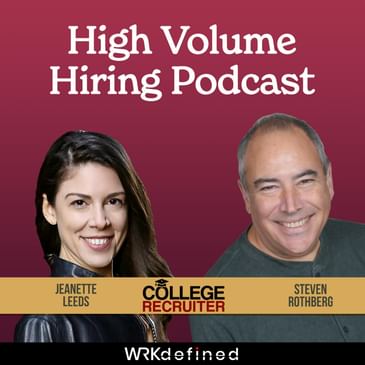
For some organizations, recruitment and retention are on separate islands. One team is responsible for recruiting and then lose visibility so have no idea if the people they helped to hire quit within days or stayed for years.
Applicant tracking systems (ATS) like Cadient, however, have a massive amount of data, including the likelihood of a candidate from one source being far more likely to stay for years than a similar candidate from another source.
In today's episode, guest Jon Puckett of Cadient and cohosts Steven Rothberg of College Recruiter job search site and Jeanette Leeds make the case that unattractive workplace policies negatively impact retention for all employees, but not equally. Improving those policies will help across the board but looking at retention data by source can also massively help not just with retention, but also with your recruitment strategies.
Powered by the WRKdefined Podcast Network.
[00:00:13] Welcome to Episode 80 of the High Volume Hiring Podcast. I am one of your two co-hosts. I'm Stephen Rothberg. I'm the founder of College Recruiter Job Search Site. And I am joined today on this cold and blustery day by my co-host, Jeanette Leeds. Jeanette, great to see you again.
[00:00:32] Hello, great to see you too on the last episode of the year. It's crazy, 2024. So we are here today with John Puckett, who, John, let's say you have over 20 years of experience in the HR tech industry and you are the CEO of Cadian. We're so happy to have you here on the last show of the year. So welcome, welcome.
[00:00:54] Thank you so much for having me. I really, I've been looking forward to this.
[00:00:58] Awesome. Well, why don't we kick it off with just give our listeners a quick background, like who you are, what is Cadian in case they're like, wait, what?
[00:01:09] Yeah.
[00:01:10] Easy for this question.
[00:01:10] So I started in this industry back in the late 90s, if I'm going to date myself. And at the time was working for Unicrew, which was really the pioneer in hourly hiring ATS business.
[00:01:29] And through the progression, I spent some time working through my career at Kronos, which I'm sure a lot of people know, which is now UKG.
[00:01:38] And then eventually evolved into Cadian and became the CEO of Cadian about a year and a half ago.
[00:01:48] So it has been an interesting ride, especially with all the changes in technology on the hiring side.
[00:01:56] And obviously with the pandemic and just the overall changes that we've seen on the hourly business, Cadian still focuses on the hourly, primarily on hourly hiring, mass hiring for large retailers.
[00:02:14] But we work with large enterprise organizations all the way down to SMB.
[00:02:19] So that is just a quick synopsis. I've been in the industry for many, many years and have worked a lot of different aspects of the organizations that I've been involved with.
[00:02:30] I think our listeners, whether they're like watching on LinkedIn or YouTube or listening to the audio only version on like Apple or Spotify, now they're like, oh, I totally get why he's on this show.
[00:03:09] I'm hiring.
[00:03:10] Talk at a high level, like employers that are having workplace problems of some kind. How does that impact retention and recruitment?
[00:03:17] Yeah. I mean, we've seen this, I'll call it a labor shortage on the hourly side.
[00:03:25] It's affecting retail, hospitality, manufacturing.
[00:03:29] I mean, there's just hardly any industry that's employing large numbers of hourly employees that's not been impacted by this.
[00:03:37] And, you know, I think it stems from just pay, which has definitely been, you know, in the headlines of, you know, higher demand for pay.
[00:03:47] Access to benefits.
[00:03:49] So many hourly employees are part-time and don't have access to benefits.
[00:03:53] They don't really have career growth options.
[00:03:57] And, you know, and then just, you know, flexibility in their scheduling, which I think stems a lot from flexibility.
[00:04:05] We saw with a lot of jobs during the pandemic and sort of brought that to light.
[00:04:11] So what I've seen is organizations are having to really change their policies and their direction on all these different areas to be able to attract and retain hourly employees.
[00:04:24] You know, it's interesting because in some ways, look, we're about to go into 2025.
[00:04:28] The pandemic feels like it was a while ago, but yet it also feels like it was a minute ago.
[00:04:33] But this is still this labor shortage for hourly work.
[00:04:37] It's still going on.
[00:04:38] So we know these organizations, so many have these, you know, if not, or what would be the word?
[00:04:44] Unattractive workplace policies for, you know, as a contractor.
[00:04:47] Okay.
[00:04:48] So you have them.
[00:04:48] Um, like, what are some strategies you're starting to see that people like some of this you can't change?
[00:04:55] I mean, you can, you know, try and change it, but if you can't.
[00:04:59] Yeah.
[00:04:59] What advice do you have for the TA leaders here?
[00:05:02] It's like, yeah.
[00:05:03] Combat that.
[00:05:04] How do they increase retention?
[00:05:06] Yeah.
[00:05:06] I think what we've seen is, you know, I'll look at this from two different aspects on the hiring side, as well as the retention.
[00:05:13] On the hiring side, companies, I think both, I think just from the overall challenges we're having at the labor market and just availability of candidates, you also have, you know, a social shift of people want to work for companies that match their beliefs, their cultural beliefs.
[00:05:34] And so what we've seen on the hiring side is companies are really having to promote what they do socially for the, you know, for the, for the world, what they, what their culture is.
[00:05:46] Having the ability to post videos of what a day in the life of this job is going to be, it's really been an important part of the attract side.
[00:05:54] And then obviously AI technology is coming heavily into play on both sides, but open, transparent communication to the applicants throughout the entire process.
[00:06:08] So they always know where, where do I stand in this process is, is critical.
[00:06:13] So once they're hired, I think it's just a matter of having, again, the tools in place to allow the flexibility with scheduling, ensuring that, you know, communication is transparent.
[00:06:28] You have a, you have a, you have the ability to have recognition programs, opportunities for growth in their career and, and still have that, some of that flexibility.
[00:06:42] Again, and I think there's lots of tools that have been put into place that have really helped organizations to manage a lot of those aspects to continue to help them retain these, these employees once they're hired.
[00:06:55] And, and, and obviously I think company culture and having an engaging culture is really key into keeping them.
[00:07:01] Hey everybody.
[00:07:02] I'm Lori Rudiman.
[00:07:03] What are you doing?
[00:07:04] Working?
[00:07:05] Nah.
[00:07:05] You're listening to a podcast about work and that barely counts.
[00:07:09] So while you're at it, check out my show, Punk Rock HR.
[00:07:13] Now on the Work Defined Network.
[00:07:14] We chat with smart people about work, power, politics, and money.
[00:07:19] Are we succeeding?
[00:07:20] Are we fixing work?
[00:07:21] Probably not.
[00:07:22] Work still sucks, but tune in for some fun.
[00:07:25] A little nonsense and a fresh take on how to fix work once and for all.
[00:07:29] One of the things that we were talking about just before hitting the record button was that Cadient, because of being an ATS, but beyond that, right?
[00:07:40] It goes beyond the point of hire.
[00:07:42] You have insight, I think at least with some of your clients, correct me wrong, maybe it's all of them, as to the retention.
[00:07:51] Yes.
[00:07:51] And that's something that a lot of employers don't have.
[00:07:54] The systems don't talk well to each other.
[00:07:56] So they might know that their lowest cost per hire or close cost per application is, and I'm just making this up, indeed.
[00:08:03] It might be LinkedIn.
[00:08:04] It might be career fairs, whatever.
[00:08:07] But a lot of them don't have very good visibility into then what happens.
[00:08:11] And from our conversations, you do.
[00:08:15] So spill the beans.
[00:08:20] So we have lots of data on this and many, many years of data on this and definitely provide insight to our customers around what is working.
[00:09:15] And so we have lots of data on this and many, many years of data on this and many years of data on this and many years of data on this.
[00:09:34] And so putting other methods in place to attract employees, whether it's referral programs or just having, again, sort of that information on your website about your culture and having them come directly to you to apply.
[00:09:51] We see that those applicants who get hired stay longer on the job.
[00:09:57] It's so interesting because one of the things I'm thinking about is I've had so many conversations over the years with, I would say, hiring managers at times who are, I would say, a little more old school.
[00:10:09] They're like, we're going to make this application process much more owners, right?
[00:10:12] So like someone listening might be like, oh, well, you know, it's so easy to apply in this job or I'm going to make this, forget all this other good stuff.
[00:10:21] Like I'm going to just make the application process so much longer because then those candidates really want to work.
[00:10:27] Like, can you maybe just talk about why that's not a good idea if someone just...
[00:10:31] Oh, yeah, I can definitely talk to that because that's what we've seen, especially over, I would say, the last five years.
[00:10:38] Yeah.
[00:10:38] We went from application processes that included, you know, 50 question surveys and assessments and to they want to be able to hire in the click of a button.
[00:10:53] They want the application process to be a click of a button.
[00:10:58] You know, we have reduced the overall size of the application process probably by 10 in most of the organizations we work with.
[00:11:07] We have seen it, you know, they come to us and say, what can we remove from the process but still get the information we need?
[00:11:13] And what we've also seen is the collection of the data that's needed is done in segments to keep the applicant engaged.
[00:11:21] You start out just by getting their name and their interest in the job and then you reach out to them and get a little more information about their skill sets or their work history.
[00:11:29] And then you reach out and get a little bit more until you get what you need to be able to make that decision.
[00:11:35] And that plays into just, again, keeping the applicants engaged through the entire process.
[00:11:42] I think we have time for one more question.
[00:11:44] I just want to follow up on what you just said, John, the segments, right?
[00:11:49] Nobody's saying that you cannot collect information from these candidates that you need to hire.
[00:11:55] It's a question of when, right?
[00:11:57] You don't have to do it all at the beginning, right?
[00:11:59] So here's the question.
[00:12:00] You're very data-driven, which is why I wanted you on the show.
[00:12:03] And that is, and if Janetta did or didn't, that's up to her.
[00:12:08] I'm just kidding.
[00:12:10] It's like, wait a second.
[00:12:11] Aren't we a team here?
[00:12:12] So anyway, the question I had for you, John, is when you've got these high-volume retail kinds of clients and they come to you, it seems to me that you're probably getting asked, how long should the process be?
[00:12:25] It's one thing to say it's too long.
[00:12:27] It's too little, right?
[00:12:29] What is the sweet spot?
[00:12:31] Do you say it should take five minutes, 12 minutes, 18 minutes?
[00:12:36] Is there a range where for those sorts of roles, it's like, that's a good spot to be in?
[00:12:42] Honestly, I think that's going to, it really does vary by organization.
[00:12:45] And it depends on what challenges we're trying to solve for them and what they need to be able to make that decision.
[00:12:53] So what we try to do is understand what it is they need in order to make a decision, provide them the tools, whether that is through AI technology, through carving the process up so it happens in segments.
[00:13:10] And I will say this, we consider AI technology augmented intelligence at Cadient because we don't ever see the human aspect being removed from hiring.
[00:13:22] Agreed.
[00:13:22] We are augmenting that process to try to make sure that we're keeping the applicants engaged, that we're keeping, we're providing the hiring managers the information they need to make a decision and to find the right candidate and to do that quickly, easily, efficiently.
[00:13:40] So it does vary.
[00:13:43] And we consult with each of our clients.
[00:13:45] And I think that that's really important to say what works for one organization might not exactly work for another.
[00:13:52] But overall, we absolutely have seen the apply process for applicants that's greatly changed in the last five years where you have to do certain things to get them the information they need to even get them to want to apply.
[00:14:11] And then you have to keep them engaged through the entire process or they're gone.
[00:14:15] They've got five other companies they're talking to potentially.
[00:14:18] Cool.
[00:14:18] Well, Jeanette, I think we're going to have to have John on another time so that he can explain to us.
[00:14:23] So he can explain to us why, come hell or high water, the application process needs to be somewhere between five minutes and 13 seconds and five minutes and 16 seconds.
[00:14:33] And that three second very, no, I'm just kidding.
[00:14:36] It's a big difference.
[00:14:38] It actually, I mean, look, we live in this world of so much like instant gratification and engagement.
[00:14:43] If we think about, you know, being on TikTok or, you know, maybe Facebook, a real little, like, it's just these constant real, like, so everything needs to be short, sweet, just like this podcast.
[00:14:55] Exactly.
[00:14:57] Exactly.
[00:14:57] Short, not necessarily sweet, but whatever.
[00:15:01] Jeanette, John, for all the J's involved in this podcast, thank you so much.
[00:15:07] Happy New Year.
[00:15:08] Yes.
[00:15:09] Happy New Year, everyone.
[00:15:10] Thanks to 2025 and all that it brings.
[00:15:13] Thanks for being with us today, John.
[00:15:15] Take care.
[00:15:16] Bye, everyone.
Sponsors
