
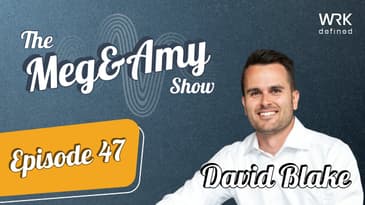
🚀 The AI rush of 2025 didn't move the skills agenda forward — it stalled it. That's the contrarian read from the founder of Degreed, the company built to make skills the currency of the workforce.
David Blake walks us through why he thinks 2026 is the most important year of your career, what leader-led learning looks like when agents can actually run it for managers who were never trained to teach, and why he survives the SaaSpocalypse by remembering Degreed has always been an education company — not a software company. Plus the disarming answer to how he's run this thing for 14 years: naps.
David is the co-founder and CEO of Degreed, the learning and skills platform he started in 2012 with a mission to "jailbreak the degree" — recognize the skill, not the credential. He's the co-author of The Expertise Economy and the co-creator of the Skills Quotient framework. He recently opened the Top of the Hill All Girls Secondary School in Kenya with Mary Murimi.
⏰ TIMESTAMPS:
00:00 Cold open — "Showing your soft underbelly"
00:31 Welcome and intro
01:39 The Kenya school — Mary Murimi and Top of the Hill GSS
06:01 The 12th Amendment, the VP election, and VICE.RUN
07:18 "Learners will inherit the earth" — Eric Hoffer and the original bet
10:11 The contrarian read — AI set the skills agenda back in 2025
13:13 Amy: AI has skills too — the human + AI hybrid
13:42 Meg: AI fluency to do what? + the simple-simple-simple skills trap
20:14 Sending agents through your corporate training — the corpus as guardrails
21:42 The most important corporate training is "who are we as a company?"
25:40 Edge cases: Singapore, Waymo, and the Disney complexity frontier
27:54 Three quick thoughts — full employment, "2026 is the most important year of your career," dynamic teams
32:29 The Degreed team call — showing your soft underbelly to your whole company
34:54 Parenting kids in the AI tidal wave — set a goal, work backwards
37:26 Meg: "Our experiences are not helpful for our children"
44:17 Maestro, Degree.ai, and the competing narratives on AI wrappers
48:00 Leader-led learning — agents for managers who were never trained to teach
50:30 The Murdoch sale, Vox Media, and where the economic rents actually go
52:00 Why Degreed is an education company, not a software company
56:15 The disarming answer to running this for 14 years: naps
58:01 Wrap
🔑 KEY INSIGHTS:
- AI didn't move skills forward in 2025. It sucked the oxygen out of the room — IT had to roll out AI, attention moved on, and the skills agenda paused across most enterprises.
- The most important "corporate training" content most companies are missing is their own mission. L&D's next role is custodian of organizational context — the corpus your agents actually need.
- Leader-led learning is the agentic system's biggest unlock. Line managers (who were never trained to teach) can now run training-on-demand for their teams.
- Economic rents in SaaS migrate back to the LLMs. The wrappers are exposed. Survival means knowing what kind of company you actually are.
- For kids navigating this: maintain a love of learning AND the meta-skill of knowing how to learn. Your maps don't apply to their territory.
📚 RESOURCES:
Degreed: https://degreed.com
David Blake's LinkedIn post on Learning Rewired: https://www.linkedin.com/in/davidblake/
The Expertise Economy (book): https://www.amazon.com/Expertise-Economy-Smartest-Companies-Succeed/dp/1473677009
Top of the Hill All Girls Secondary School: https://topofthehillgss.org/
Mary Murimi (Top of the Hill founder): https://www.linkedin.com/in/mary-murimi-9402b82a/
Patti Constantakis (Walmart.org, on the skills cold-start): https://www.linkedin.com/in/patti-constantakis/
VICE.RUN — bipartisan VP election reform: https://vice.run/
Eric Hoffer — "Learners inherit the earth": https://en.wikipedia.org/wiki/Eric_Hoffer
Sangeet Paul Choudary's Reshuffle (referenced by David — see our Ep 18 conversation with Sangeet): https://www.youtube.com/@TheMegandAmyShow
NYT on the Vox Media / James Murdoch sale: https://www.nytimes.com/2026/05/20/business/media/vox-media-james-murdoch-sale.html
🔗 CONNECT:
David Blake: https://www.linkedin.com/in/davidblake/
Submit Leadership Questions: megandamyshow@gmail.com
Instagram: @megandamyshow
LinkedIn: https://www.linkedin.com/company/the-meg-amy-show
YouTube: https://www.youtube.com/@TheMegandAmyShow
#SkillsAgenda #AIStrategy #LeaderLedLearning #SaaSpocalypse #Degreed #EdTech #FutureOfWork #LeadershipInTheAIEra #MegAndAmyShow
Powered by the WRKdefined Podcast Network.
[00:00:00] What AI has done to so many of us is asked us to learn something foundationally new and requires that we go to zero on a learning curve. And I find learning is one of these kind of amazing things because it's so vulnerable. Like to really be bad at something in front of your peers, to be bad at something in front of your team for whom you are supposed to be leading. If you're really going to learn it, you have to give up this false sense of, I know what I'm doing.
[00:00:28] You sort of are showing your soft underbelly. David Blake is the co-founder and CEO of Degreed, the learning and skills platform he started in 2012 with a mission to jailbreak the degree. Recognize the skill, not the credential. He's the co-author of The Expertise Economy and the co-creator of the Skills Quotient Framework. Today, David talks with us about why he believes the AI Rush of 2025 actually set back the skills agenda.
[00:00:55] What leader-led training looks like when agents enable learning in the flow of work. And why NAPS are the answer to being a CEO for the long run. Welcome, David. Thank you. So glad to have you here. I'm excited for it. I've been told through our sharks.
[00:01:21] So, you know, I've come prepared for the hard-hitting questions and excited to get into it. Very cool. Well, so before we dive into our hard-hitting questions, I hear that you've recently visited overseas, Kenya in particular, and have quite a story to share. Do you want to talk about that? So I just got back from Nairobi where I had the opportunity to attend the grand opening of the Top of the Hill All-Girls Secondary School.
[00:01:49] And this has been one of the great privileges. I've had a chance to see a few things in my life go from idea to reality. As an entrepreneur, most of those were my dreams that I was working on to become a reality. And I'm so very grateful for the very many people who have helped bring alive my vision. And this was the vision of a woman named Mary Marimi. And I met her in South Africa in 2018 at a World Economic Forum event. Her story is really compelling. I'll give you a very quick version of it.
[00:02:19] But she's the oldest of 11 kids. Her father worked uneducated himself, worked as a driver for a British landowner. Girls got to go to elementary primary school, but not to secondary school without having to pay for it. That tuition was more than the entire family income. But her father approached his employer and said, if you'll pay for my daughter to go to school, I'll do that in exchange for my salary.
[00:02:47] And I'll sort of work for free if you'll pay for her to go to school. And the British landowner agreed, paid for Mary to go to school. She got an education, would go on to get a Ph.D., become a professor at Texas Tech. And when her father passed, he left her a family plot of land and said, turn it into a girl's school. I met Mary just not that long after her father had passed and had kind of given her this charge.
[00:03:16] Mary, I suppose, in me saw someone who cared about education and as an entrepreneur maybe knew something about building things in the world. But, you know, for the truth be told, I felt quite unqualified to help build a school in Kenya where I had never visited and, you know, had never built a school. But I agreed to help. And since 2018, we've been at work on bringing this kind of dream and vision to life.
[00:03:45] And I had the great privilege of getting to be there at the grand opening just a week. How many kids are in the school now? So we've fundraised and built this phase one. So it's dorms, kind of like the cafeteria meeting space and then the classrooms. And that capacity can fit kind of 150 to 200 girls.
[00:04:14] And then as we're able to raise more funds, could eventually fit as many as kind of 600 plus girls. Wow. And so there's a school and then there's David Blake's idea of a school. So how did you bake in some of your philosophies into this? So it really is just serendipity that we both have a very competency-based view of education.
[00:04:42] I, prior to Degreed, consulted for a university that was moving to a competency-based model. So I had kind of up close personal experience just in that part. She came to the philosophy of it on her own. But this is one of the first competency-based education curriculums being run in Kenya. And so, you know, very skills-based, application-based, project-based.
[00:05:07] Mary, I met her in South Africa and then she lived in Lubbock and would be in Kenya quite a bit. I lived in San Francisco and then later Salt Lake City. It was only the second time I'd ever met her in person at the grand opening of the school. So it's such a, it's like one of the very meaningful relationship in my life that's been almost exclusively virtual. And so given, again, we had no prior kind of contacts for each other's backgrounds or life, it really felt just very simpatico that we both shared this kind of competency-based worldview on education.
[00:05:37] The curriculum is very cool that they are getting to use out there as well. So amazing. I really do love the idea that when we're, when we have these passions and when we like are just open to see where they take us, you end up doing really amazing things. So thank you for sharing that story. It's like really inspiring. Yeah. Yeah.
[00:06:00] I just love your entrepreneurial spirit and how you've applied it to so many things. I saw that you had run for vice president, which I didn't even know was possible. Oh, my cast notes in right there. Yeah. Every check and balance on divided government that the founding fathers gave us, every single one of them is vested in the vice presidency.
[00:06:22] And so that's what drew me to the vice president is kind of a fulcrum point in our, in the, in the framing of our government as a opportunity to help affect kind of the tribalism and polarity that we have right now in the country and in kind of our politics. And so, yep, we have a constitutional right to directly elect our vice president. We don't.
[00:06:48] The how and why of that is a story of political influence over the ballot and partisan, partisan influence over the ballot. Vice.run was an effort to kind of wake Americans up to that particular right that's already been granted to us by Thomas Jefferson and, you know, use it as one of the ways in which we can reclaim the health of our democracy. But anyways, yeah, that's a big causes. Big causes to start off the Meg and Amy Show.
[00:07:17] Well, let's talk a little bit about your origin story for, for Degreed and, and how maybe that is changing or not. So you've made, you know, you made this early bet the future belongs to learners. And, and then you've also said the future doesn't care how you became an expert.
[00:07:38] And right now with AI rewriting this future and what expertise even means, have either of these bets changed for you or are they just further sharpened? What's your sense here? Yeah, the, the first one is a reference to a quote by an American philosopher named Eric Hoffer. And the quote in its entirety is,
[00:08:13] And I've always loved that quote. I've always loved it.
[00:08:16] And, uh, just inside this week, even I've, I've quoted it yet again in different conversations because I believe it really, there hasn't been a change this big in our lifetimes, you know, and, and between the three of us, we've all shared many transformative moments and, and, you know, in our society and our careers and politics and national events, black swan events.
[00:08:45] So, you know, I mean, just the world has been under great change. And yet kind of what AI is doing to the world and careers, I think is going to prove to be the biggest one yet. And so it is the type of change with which that quote is especially true. That, you know, if you dig in your heels in this moment in time, you're gonna, you're gonna be living in a world, you know, that just isn't around that much longer.
[00:09:12] And so, you know, it's, it absolutely is a moment where learners are, are who will make it to the other side and, and, you know, it's learners who will inherit the earth. And of course, the other main tenet that, that you had was that skills would be the currency for, for all, right? Competencies and then turning into skills. And that was one of the, the foundational principles of DeGreed.
[00:09:39] And we're also kind of wondering if, if that's going to potentially be left by the wayside with the focus on outcomes. And, you know, talking about like outcome-based pricing of goods, but also, would it be also outcome-based pricing of services? So anyway, we're wondering kind of twofold is, is the skills-based economy, is that actually happening?
[00:10:09] And where is it headed? It's a good question. I watched a SpaceX documentary on Netflix and in it, you know, there's kind of this vignette of Elon Musk. There's the types of technology that has sort of inevitability to it. No matter what happens, TVs are going to get cheaper. But we tend to take that Moore's law, you know, TVs will get cheaper and think about anything with technology with that kind of inevitability.
[00:10:35] And he, you know, and the point he was making was, especially in the case of, you know, Mars and space travel and getting back to the moon, like it's not an inevitability. And if anything, sort of the political will was diminishing, sort of the window in which, you know, it would be achievable in many ways felt like it was closing. And so, you know, it was just to me a reminder that we shouldn't always default our thinking to things being inevitable.
[00:11:04] I think skills are one of those. I think it is the better way. We've gotten mature enough in this idea. It's had enough research that we've gotten to see, you know, World Economic Forum and Deloitte and McKinsey publish on it. And we've gotten to see some of the evidence that it is the better way. Don't confuse that with it being inevitable. And I actually think that 2025 and AI largely set the skills agenda back.
[00:11:30] This was a heavy lift and kind of organizing it as an idea, as a concept, mobilizing research and organizations. I remember Patty from Walmart.org talking about one of the reasons why it's so challenging is that if you wave a magic wand and get all of Walmart to operate this way, kind of everyone can see the benefit. But the challenge is, is you have to start somewhere.
[00:11:53] And so if you make skills, the sort of atomic unit, the organizing unit of performance management, but just performance management. Well, if the talent org isn't using it and the learning org isn't using it and the rest of HR isn't using it. And so it's this, you know, singular pocket where you're trying to make skills be the way of organizing. Well, it doesn't unlock sort of the system to operate this way yet. And so it's this challenge. There's a chicken and egg dynamic to it.
[00:12:22] And so that doesn't mean we can't get through it, but it means that there is this cold start problem to getting an organization to work this way. And 2024 was like, OK, big organizations have made commitments and strides and we're starting to do it. And then I feel like 2025 was the year of IT had to roll out AI across the whole org. All the oxygen got sucked out of the room. All of the attention went other places.
[00:12:49] And the skills agenda, I think in most organizations ground, you know, it's not that they said it's done, it's over, it's dead. It just the attention fully moved on. And so we're going to have to see, you know, inevitably, I think AI will be an enabler of getting skills data on people and teams and organizations. It will be helpful in ways. And yet in this moment, I think it's mostly put the skills agenda on pause. Well, it's interesting, too, because, you know, AI has skills.
[00:13:18] I would conjecture that the future of the skills conversation is going to be, you know, human and AI skills combined. And, you know, that's going to be what people are really caring about and thinking about. And so it's not, you know, it's not just the human skill conversation of 2024 anymore, but it's just it's a completely different one.
[00:13:42] It builds on the same foundation, which is understanding your capability as an organization and how to apply that capability to the most important things is important. And I think that's probably where people have maybe lost the plot a little bit because they were spending so much time thinking about skills as as the solution, as opposed to recognizing how skills were helping them solve the bigger problem.
[00:14:11] And just sort of the thing that constantly got under my skin a little bit on the skills conversation. And most organizations kind of had this idea that, oh, well, we're going to figure out what are the three most important skills and then we're going to say, oh, everybody needs to build that skill. And so I think AI is kind of in addition to sucking the oxygen of attention span and budget and all of that.
[00:14:34] It's also caused everybody to be like, well, the only skill that matters is that we get everybody AI equipped and AI enabled. And even that they're falling into the same trap because it's like to do what? Right. Like just because you have AI fluency, if you don't know how to apply that AI fluency to something valuable in your business, you're going to see the blowback of like, oh, tokens cost too much. We're doing it wrong. All of these other things.
[00:15:00] And so I think, again, back to the like, maybe it is in our all of our best interest to just lean into making the the solution that we're thinking about bigger and the problem bigger in. OK, we really do need to tease out what are the things that are getting in our way of achieving whatever is critical for the business?
[00:15:24] And what are the the levers that we can use to mobilize towards those goals? And again, I think skills has a really important place to play here. But if we don't if we don't help, you know, get more people equipped with that bigger vision, we're going to just keep chasing our tail to try to do something that's not really going to be sustainable because it is it is a lot.
[00:15:51] It is a lot. I was on a panel with the head of the corporate academy of Bank of America, you know, and he cited how they've organized around 200 skills. And like just that comment, I think, is fairly prototypical of a lot of organizations of that size and scale.
[00:16:08] And, you know, I think we're at a moment. The comment I made following it and we partner with Bank of America is skills in the old world was such a complex problem that it led to trying to make it as simple, simple, simple, simple as possible. Getting a whole organization to think this way, getting the technology to adopt it, getting the taxonomies to talk to each other, getting the, you know, talent org and the learning org and the char org to kind of all adopt an approach.
[00:16:37] It was all complex enough when B of A says, you know, we organize around 200 skills. Well, of course, in an organization, this the scale and complexity of Bank of America, there's probably hundreds of thousands of skills ultimately inside the organization and it's the diversity of its people. But because it's such a complex problem, it leads to this kind of let's make it simple, simple, simple.
[00:16:57] I think one of the things that AI is potentially going to do is AI can handle so much context and richness in the complexity in what it can ingest and what it can output. So, you know, we've been on this trend of making skills a very simple idea. And I think AI is going to enable a world where it can actually have more context and richness to it.
[00:17:22] And so I think the journey we're going to go on with skills inside organizations will inevitably be affected by AI. One of the other things I'll say just going back to you talked about the human AI hybrid that is sort of organizations increasingly. And how do we think about the capacity of the organization? You know, just this week, we've started to talk about when we do skills reporting inside an organization, can we bring back, you know, the clad skills and not just, you know, how many skills exist, but how much are those skills being used?
[00:17:50] And it would be a very telling thing already inside our own work. We're trying to find, so how many skills, clad skills do we have inside of Degreed? And who has authored them? How many do I, have I pulled down and use? And in what frequency, you know, and it's not a perfect measure. So far, none of these, you know, token maxing, kind of no one measure is perfect.
[00:18:14] But it would be very telling to know, you know, this person has two skills and uses them, you know, once every six months. This person has, you know, 31 skills, you know, and they're using them thousands of times per month. Like, you obviously have a different level of capacity built with your AI, you know, in person A versus person B. And I think we're going to see more of that. And inevitably, we'll see more of the hybrid kind of lens of on the capacity of an organization.
[00:18:44] What's interesting there, too, like just continuing to pull on that thread is, you know, what about the skills improving? You know, the AI skills improving, you know, in a sense, right? Like, how can you start to track that? And then at the same time, you know, understanding what skills people are gaining from, you know, how they're interacting with the harness and with, you know, with the skills themselves. I don't know.
[00:19:13] It's kind of like this ongoing loop, but getting into skill development and also, you know, kind of training, right? Like, you're training people and you're training the AI, too. I wanted to pull the opposite side of the thread. I would be really interested to understand how many of those skills contradict each other and how many of those skills overlap with each other.
[00:19:37] Because I actually think that would be super interesting to really get curious about that, right? People are creating these skills to accomplish these things and these skills become kind of a foundational element that start to build up. Where is the best of us in that? And then where are we recognizing places we've accidentally introduced friction or inconsistency?
[00:20:04] I think there's just so much power in getting curious about how we're developing and evolving skills in this world and what does that mean for how the business is run? I love that. I've said it a few times. I still don't know of good technology solutions, but like skills management, so AI skill management is very quickly going to become a thing, you know, because we are, the greed is relative to the clients we serve. We're a very small organization. We're not overly complex organization.
[00:20:32] And yet the number of skills already that overlap between, you know, which designer built it. So, you know, what bias does it give to the design file and the output? We are absolutely going to need help organizing and keeping that track at scale. And this morning, just a fascinating thought. I traded emails with a startup that is working on having agents take all of your corporate training. So smart.
[00:20:59] You know, if you think of your corporate training, that corpus is at some level everything you want your employees to do, what you don't want them to do, what considerations want them to mind, what guardrails and rules you don't want them to cross. Like as a corpus, it is in many ways the embodiment of what you want out of the out of your employees and their output and productivity.
[00:21:24] And so it's an interesting set of context and guidance to give all the agents you inevitably are going to have and the skills that our AI is using. And so go send all your AI through all the corporate training. Yeah, that's brilliant. That makes complete sense. Yeah. We had a conversation about our own sort of like five coding rabbit holes and the compounding value is where that light bulb hits.
[00:21:54] So you're just describing a way to get to that compounding value more quickly. And it lines up really nicely with where I think the role and responsibility of the L&D department might be evolving or I'm hoping I'm putting this out into the world so it happens. All your training corpus that's been built up over these years by really smart and focused individuals to help support the business.
[00:22:20] Like that's a tremendously valuable asset. But we all also know that things change and over time and keeping it up, it becomes very complicated. And then in this world of AI, the idea of ever getting ahead of again of like what's the most important thing to be building learning for, it just it gets much more complicated.
[00:22:41] And the role of learning and development as the place that centralizes and bottlenecks all of the corporate learning like that, those days are over. But I do think that there is this kind of core context that that group would be especially well equipped to help engage.
[00:23:04] And what I mean is that when we start to talk about, you know, reducing spans and layers and changing the roles to be these hybrid roles. And, you know, we're just putting more on a smaller number of people and expecting that the benefit of technology, they become significantly more productive.
[00:23:23] Where I think the gap is, is that we're believing that these context engines, these sort of central repositories are going to be sufficient guardrails for a smaller number of people to do bigger amount of things. And anybody that's worked in a big organization or understands how bureaucracies work in general recognizes that there is a lot of bad things about bureaucracy.
[00:23:49] But there is something that it does help with, and that is the long term institutional knowledge of where things have gone bad and maybe some guardrails that are slow things down. When you take all of that off and assume that the context engine is going to do it, you recognize that there's going to be some really hopefully comical, maybe tragic places where these agents just take the algorithm and go to town without any oversight.
[00:24:17] And most of it because how could you have predicted? And so I wonder if the L&D group could really step up into helping to build the corpus of what is our business? What is the soul of our business? What is the mission of our business? What are the values that need to be the kind of embedded? And how do we as a business serve customers, make money?
[00:24:46] All of these things, right? These things that like get really lost in translation in a big organization where most people don't really understand the specifics of how their actions line up to the bottom line. And yet they're penalized for it because everybody's looking for revenue per employee to be growing at this moment.
[00:25:05] And so if there was a way for L&D to step forward and say, like the most important content that we should be making sure to be building and supporting and maintaining is the content that is who are we as a company? What is our mission? How do we exist? What does success look like? And is that in the corporate training today or is that tending towards more like don't sexually harass anybody?
[00:25:34] And there's an opportunity to transform that corpus of it. Reading a book right now called Reshuffle. He opens on Singapore during COVID and how ahead of the curve they were and then how the outbreak happened all the same. And essentially because they didn't anticipate all of the edge cases and this case, the late night business socializing that happens and these clubs in Singapore.
[00:26:01] And that and that alone was like this edge case enough to be a vector and for it to spread. You know, right now in the headlines, we're seeing Waymos keep driving into deep bodies of water just because the LIDAR can't do depth of water and don't have that context. Like there are going to be edge cases. I think organizations, there's a big difference between the complexity frontier that organizations are working against.
[00:26:25] You know, if you are Disney World, you build the system such that literally you can hire anyone and it should be successful. You know, the system is the product. The human is almost this interchangeable sort of cog because they have to operate at such scale. And the experience that they are trying to create is is consistent. It's really well defined and you can train people in the Disney way.
[00:26:50] There's other businesses for which the task is itself so complex that the best you can do is state the goal, give a North Star as to what we're trying to accomplish and maybe some principles to guide the way. And AI is going to play very different roles inside of the complexity of the job that kind of sits behind each one. You know, inevitably, as hard as we think, we aren't going to be able to think of all the edge cases.
[00:27:14] And will the central brain really be how intelligent will a centralized brain be and being able to guide us? And yes, but inevitably, you know, there's going to be some cracks. On the org design, Jack Dorsey's flattening and all these things that are happening. I was curious if you had a particular point of view on org design and roles going forward. You said that like this is the biggest change that we will have in terms of careers and everything.
[00:27:44] And I'm just wondering from your own experience within your own organization, as well as working with, you know, Fortune 500, et cetera. Do you have a point of view there? I have three very quick thoughts. I mean, one, I've been on the record now since the beginning. My thesis of the world is the rate at which technology is scaling is outpaced the rate at which humans can develop. That leaves the skills gap. And that is widening. And that dynamic, that macro dynamic is actually going to mean that there's always demand for more.
[00:28:14] We're in a world where the context is there's an insatiable demand for skills. So I think we will remain at full employment plus or minus some macro economic ups and downs. But I do not believe AI is going to displace humans on the record. Still believe that. Thought one. Thought two. And also, there's a viral post very beginning of the year, January, February, about how AI is coming. And if you don't see it yet, you don't get it. Like this is going to wipe out your job and your neighbor's job and your uncle's job. The tsunami wave that's about to hit you is going to be so big.
[00:28:43] Like, and then it said, you know, 2026 is going to be the most important year of your career. Act accordingly. I still believe that line. I do believe 2026 is going to be the most important year of your career. Act accordingly. Like, I think we'll stay at full employment, but it is radical to change. And, you know, often it takes a generation to, you know, it's read a report yesterday on how net AI is expected to create. In America, you know, sort of twice as many jobs as it's going to eliminate.
[00:29:13] That's great in macro. But if you're one of the jobs that gets displaced, it doesn't feel good. You know, we need to be nimble. We need to be agile. You need to, learners will inherit the earth. You need to be adapting to this. Third, and then in terms of org design and even at DeGreed, I brought back a principal. I'm on my second tenure as CEO. I led it for the first seven years, stepped down to do the vice presidency, came back after, came back into ed tech two years later, and DeGreed acquired one of my startups two years after that to bring me back.
[00:29:39] Second tenure at DeGreed, the principles of the organization had evolved. And early on, we had this principle that there was no org chart and that everyone belonged to one team, but often several. And so early on, I tried to make team formation the organizing unit rather than a pyramid in hierarchy. And I left it alone. When I got back, DeGreed had its org chart. It had its many layers. And there's pros and cons. I left it alone. But when AI showed up and we really began working on our internal AI transformation,
[00:30:09] it was the first time that was like, we need agility that in the org chart is getting in the way. If every time I need to mobilize you to a new task, I need to retitle you and change the org chart, it's just too slow. We've reintroduced this idea of team formation is our organizing unit. And so you will always belong to one team and you will often belong to several. It makes it so how we operate is when something needs to get done, you just circle the people in who you want to work on it and name the leader.
[00:30:39] That's not your new, you don't get a salary change. That doesn't change your job description on LinkedIn or on your resume. But, you know, being able to circle people into problem solving is a much more agile way of, you know, progressing your way through a dynamic, you know, changing field of play. Concept of dynamic teams. Yes. Amy. I've been a proponent of that for a while. I did not know that of you. But, yeah, very simpatico.
[00:31:08] The other thing I've always loved about the dynamic team thing, if we get back to the learners will inherit, most of us learn best by doing.
[00:31:18] And so having the opportunity to join these different teams and take on different challenges and hurdles not only helps with agility writ large, but it also helps with individual confidence in skill development, practice, and proficiency in general.
[00:31:42] Because what you're learning in that moment is oftentimes not just the thing, but also some ability to start in the middle and jump in and try to figure it out and come out the other side successful. And when you force yourself into that kind of motion, what you're really building is confidence in change.
[00:32:03] And change agility, to me, is the thing that we need to be building in organizations right now if we're going to have any chance of surviving this without doing so much individual harm around psychological safety and sort of the human response to it. Because otherwise we're just asking for a lot of trauma experiences in the workforce, I think. I really believe in that.
[00:32:58] And I find learning is one of these kind of amazing things because it's so vulnerable. Like to really be bad at something in front of your peers, you know, to be bad at something in front of your team for whom you are supposed to be leading and you are supposed to know. And it really calls on each of us to, you know, if we pretend that we know it, it leaves us sort of hampered in our ability to really learn.
[00:33:23] And if you're really going to learn it, you have to give up this false sense of, I know what I'm doing. And one of my favorite degreed team calls this year, one of the women on our team came on in front of the whole company, you know, just in the spur of the moment. And it was obvious that she was in the middle of kind of grappling with this problem and learning how to do it.
[00:33:50] And it really was just like such a, to me, a beautiful moment of like that is learning. And to show to the whole company that like you don't have it all figured out yet, but you are in progress of going on that journey. It inspired me as a learner and I think it inspired a lot of others. But you sort of are showing your soft underbelly to do it. Yeah, it's all about showing your work, right?
[00:34:16] Because the work is easy to get done with AI and it's kind of hard to know who's doing it and who's thinking it through and where the work's really coming from. But being able to show your work, warts and all, is the beautiful part. So back to kind of skill development and then also, you know, the planning for the future, preparing for the future.
[00:34:43] Meg and I each have a kid in college and I believe you have one headed there as well. And so I was wondering kind of your take as we are trying to provide guidance and, you know, to deaf ears, to be quite honest, to our children. But we still want to provide advice. It's really hard because, you know, nothing from our own experiences really apply.
[00:35:10] But we're just wondering, you know, in university, you know, what to learn, how to approach it, how to take AI into consideration, but, you know, not overuse it. And then thinking about, you know, how to thrive in the world. What's your perspective on that, David? David I would happily take your perspectives because I think we are all in this together with imperfect answers and an imperfect view of the future and wanting the very best for our kids.
[00:35:40] And, you know, one meta comment I think is an interesting one. The Pew has a longitudinal question that I've asked Americans forever. And in it is sort of, do you believe in the value of higher education? David So that's the first question. And against that question, the value, the respondents have fallen off dramatically. We've lost like 20 points in, I don't know, 15 years. It was like 60% of Americans said yes. They saw the value in higher ed 15 years ago.
[00:36:08] And now it's like 40% of Americans say it. It has fallen off dramatically. But then they have a question, which is, do you want your child? And that one has persisted at like 90 whatever, 6%. And so it's sort of this broad recognition of like, it's a failed system. I want the best thing, you know, best chances for my kid. My household degree's mission is to jailbreak the degree. You know, I'm the one household where I don't want my children to feel parental pressure not to go to college. I'm proud of my oldest daughter who has decided to go to college. She's rebelling, huh?
[00:36:37] That disgusting way. She's rebelling against her father and headed to college. And one of the things with their education, we ran a micro school for four years, kind of took their education into our own hands, you know, in ways. And the best recipe I've come up with for the moment is what is your goal and how do I help you work backwards from it? I'll maintain a love of learning and maintain the meta skill of knowing how to learn. And, you know, past that, I don't know what tidal waves are going to come trying to knock you over in your career.
[00:37:07] And I don't know what jobs are going to exist and I don't know what you're going to need to learn. But, like, if you can know the journey of setting a goal and doing the learning to help you unlock the goal, you know, that meta recipe is kind of the best I feel like I can do to equip, you know, my kid in this world. I definitely love that reverse engineer.
[00:37:28] I think that, like, more people understanding how much agency they actually have and thinking that way would be net beneficial. I personally, this is such an interesting area of being conflicted. So, you know, I'm first in my family to go to college and I'm a Pell Grant student. So imagining a future without college sounds awful to me. And for a lot of reasons, you know, not just educational.
[00:37:55] I don't think I just got learning out of college in the textbook sense. I figured out how to exist in the world. And so, you know, I want that for others in sort of a big way. But as you look at the cost curve and the opportunity curve, I see myself as so fortunate to have kind of threaded that needle in a net beneficial way.
[00:38:18] I try to imagine someone in my situation coming forward today and recognize it's really not the same. And one other thing that I think is so interesting, our experiences are not helpful for our children. And it's not just about the college question. The world isn't the same as it was before.
[00:38:41] And so I think of this often in the same way that a lot of leadership advice is counterindicated when applied to women versus men. And so some of the things that we know to be true of how to train leaders actually doesn't work when you try to do it for women versus men. Understanding that, you know, we all live the world and learn to exist in the world through our own lens.
[00:39:05] And so it's very hard to step back and focus on the metacognition of where my experience not be universally applicable and where might someone else's experience be more material to this thing that I think I know. I'm just really curious, how do you bring some of the same advice to the corporate lens and to the corporate customer? Several thoughtful pieces in your comments. Try and answer the question directly back to where we started.
[00:39:35] I just got back from opening an all-girls school in Kenya. You know, the power of education and the fulcrum that it is in the world is immense. And also it's uneven. And so there's a lot of work that we have to do. I'll say my next great ambition is to start a university. I believe the world has more demand for learning education and skills than everything we've ever invented. It's still insatiable.
[00:40:01] That's every university, every online course, everything we've ever invented. We've thrown at the problem and still the demand far outstrips the supply. And there's no solution set where universities aren't part of the solution. I'm very pro-university. I'm just very anti-terminal degree being this all or nothing binary kind of terminal degree framework that we operate inside. But we need higher education to be part of the solution set.
[00:40:27] As we bridge into career, I think, you know, an interesting, a crazy stat, one that I don't hear talked about enough, which is the employment rate right now on high school grads versus college grads. And, you know, we've got to be careful whenever we cite anything with higher education. Most often it's a trailing look back.
[00:40:46] And so it's sort of it compounds the, you know, different decades into the number and it muddies it in a way that often isn't giving us a crystal look at what is happening right now. The employment rate is a snapshot number. It's a here and now number. And, you know, further we are seeing.
[00:41:09] So while a lot of the AI dystopia isn't borne itself out in the ways that the most pessimistic have said, we are seeing the early career ladder, you know, really kind of get reshuffled. I forget what university president I was talking to at a recent conference, but he said it's now mandatory that everyone has an internship. And that sounds like a small change and in many ways it is.
[00:41:34] But like in so many of us did do internships, but just the shift from it being encouraged to it being required, I do think is a step in the right direction. We essentially have to merge more of the learning and earning. We need it to be less discrete learning period than the expectation that I'm now full time in application and working to apply that learning. And it's got to blend itself together more.
[00:42:01] We need we need a more porous wall between universities and work, between learning and earning, you know, easy to say, hard to do. I feel like we could do this, right? Like we could corporations could care about early talent and internships more. And I think universities could help facilitate that more. I think that I think that's within within our grasp. We just have to want it bad enough, I think.
[00:42:28] I've always been optimistic and hopeful that we will see employers take on more and more of the role of educator. I know this like sounds like this sort of aberration of a of a classical liberal arts education to let the employers through the gates. And, you know, but working for someone for free for a year is still less expensive than the tuition I pay in higher education. You know, there's been this backlash of unpaid internships. And I think it's a bit dangerous.
[00:42:56] And unpaid internships have been in sort of this unequal wedge. Those who have safety nets and the support of parents or money can take them. Those who don't can't. But I do think it's a part of the conversation I would challenge because I think part of what we've got to do is make getting your first job. The barrier needs to come down. One of the ways of bringing the barrier down is to work for free.
[00:43:25] We should always just remind ourselves that that is cheaper than tuition anywhere. I don't see any reason why we couldn't figure out scholarships for that as well. Having been somebody that was very poor, I actually never did an internship. And I think it was most because I'd never heard of that as an option. It just tells you how young and naive I was. But, yeah, I think there's ways we could we could figure out how to make that at least, you know, survivable by someone in, you know, we have student loans.
[00:43:54] We have grants we have like why couldn't we come up with some endowments that focus on need based. And I know some schools do it, but usually they're like the elite schools, which those kids probably already have pretty good routes to most of the things. Right. I'd like to see it in more places where there's there's less less privilege already baked in, if you will. I wanted to switch gears entirely for the last bit of this episode.
[00:44:21] So I wanted to really get a sense of where DeGreed is headed next, David. So I know you have a new product out called Maestro that's doing really well. And I was thinking a little bit about, you know, some of the competing narratives about like, well, you know, can't you just do that using a foundation model? You know, can't you just vibe code that yourself and in your company? Why would you need to buy something?
[00:44:51] That's one. And then another is that actually if we look historically at every technological change, the wrappers are the winners, right? Like, you know, it's not going to be the foundation model. So so you actually, you know, being in a position to have the thing on top is better.
[00:45:10] There's also the SaaSpocalypse and, you know, that narrative around, well, even even if SaaS companies are trying to build AI, there's you know, they have 60 percent adequacy, which is is not at all enough to, you know, keep the business going. So anyway, there's all these competing narratives.
[00:45:32] And and you're sitting in this seat right now where you've had this extremely successful SaaS business with a great product market fit of learning experience platforms. And now you are moving into the AI age. And I just wanted to pick your brain a little bit in terms of your product. You know, what's what's resonating? What's what's not what we're you know, how's the adoption going?
[00:45:57] And how are you navigating some of these narratives in terms of your own thinking and where you're going? SaaSpocalypse, the relationship between sort of vertical applied software and IT build it ourselves relative to the foundation models themselves attacking more and more of the software sort of stack. So we'll hit that and then then just what is degree up to in the market? I'm happy to hit that as well.
[00:46:25] Degree to saying degree dot AI, which is our agentic system and version of degree. And so in referencing that we have Maestro and degree dot AI. And Maestro is the experiences that we are building for learning. And so it's multi persona role playing. It's AI leadership coaching.
[00:46:52] It is AI personalized development plans. It is skill reviews. It is generative assessment. There are lots of experiences to build. And I think ultimately there's infinite. The power of it is building up from the LLMs. You can build now just really incredible learning experiences, the type that we wrote about in our science fiction books, you know, in decades past. And there won't just be a dozen of these.
[00:47:21] There will ultimately be thousands and millions of them. And has it gotten easier to build those experiences? Yes, it has. But that doesn't take away the thoughtful care that ultimately does need to go into a good learning experience. And now we get into, you know, andragogy and pedagogy and good learning science, as well as then layering it with an enterprise scale regulation.
[00:47:46] And you've got, you know, your European work councils that you have to mind relative to your regulations in other places. So building these experiences thoughtfully well that produce great outcomes and that can be compliant at scale. It's hard work. It's thoughtful work. We and others will do it. And it serves a purpose and is worth something to the world. So that's the experience layer of kind of the AI learning experiences.
[00:48:14] And then sitting below the LLMs is really these, the workflows and can, how can we orchestrate learning across organizations and new and more autonomous ways using agents and sort of the agentic mesh that is emerging in these, these large corporations. And that also gets really exciting. I think where it's going to matter the very most. So it's going to make the jobs for L&D easier and HR in many ways. But they've been doing that job.
[00:48:43] And now they're going to have some extra tools to help them do it with more ease and scale. But I think where it's going to make the most radical difference is with leaders. Because leaders, for the most part, were never trained to be educators. You know, your average manager inside of, you know, your corporate is not trained on how to turn around and train others. They came up doing the job themselves and they've demonstrated some level of sort of EQ and leadership capabilities.
[00:49:13] But that doesn't mean they know anything about training. And the ability for leader-led learning to happen, I think, is going to be the most radical kind of gain. Because in an agentic world, a leader can turn around and say, hey, I need, you know, these four people on my team to get trained and enabled in this thing by this date.
[00:49:34] And shoot off an email into, you know, AI at Degree.com, which ingests it, understands the syntax, gives the right agents the right tasks that go and find the right context, see what the people have learned, find the right resources. In many cases, it generates live in real time the AI experience that would best fit the task. And bring it back to those employees, see them through it, feed, close the loop with the manager.
[00:50:00] Like, I think the ways in which we're going to be able to empower our leaders to be learning leaders is going to be a huge kind of stepwise advance. And I'm excited for it. To step into just like the SaaS-pocalypse, the role that vertical software has to play and the role I think the LLMs will take on. We are seeing their march through verticals.
[00:50:26] And we are seeing the release of features and functions that are essentially wiping out entire categories of software. I do believe that the LLMs are in a position to command an enormous sort of portion of the software spend. And the role they are going to play is, I think, immense.
[00:50:47] We're seeing, was it Murdoch who just did a big asset sale in the media space kind of two or three weeks ago of kind of a bunch of the podcasts and the Vox media? And I was listening to a podcast on that purchase and kind of the thesis of it all where it went wrong is that the economic grants all just went to Google. So, yes, these media properties were getting bigger and bigger and bigger. They had paid handsome prices for them originally and they did indeed grow.
[00:51:15] But that the economic grants all went to Google. You know, I think we need to be thoughtful as software providers. Our wrapper and sort of the premium we are charging on top of the compute, it leaves us very exposed over time that the economic rents are just going to continue to go back to the LLMs. We have to believe that at some level the price of compute is still being subsidized. And at some point they're going to have to charge more. When the time comes for them to charge more, it's going to fall on us.
[00:51:44] How well are we going to be able to turn around and increase the prices with our customers and end users? And it's a very vulnerable position to be in. So the last thing I would say to, you know, for us and for others is we need to use the value add position that we are in to diversify kind of the partnership and how we add value to our clients.
[00:52:11] It's good news for DeGreed in that I've always seen us as an education company, not a software company. I think when you give yourself that framing, the need for skills inside an organization, the need for enabling your workforce has never been greater. And so the demand for what we have to contribute, I think, is only going up. I'm not worried at all about the need for human development is going to go away.
[00:52:36] We need to think broadly about who we are as a partner to our clients and how we serve them. And that's how I intend to survive for decades to come as sort of the economic, you know, equation shifts over time. I don't know if you totally realize this, but you just completely role modeled for all software leaders out there today how to reverse engineer where you want to be and find your way to it. So you articulated so beautifully.
[00:53:04] You want to be in helping human development and you want to reverse engineer that in a way that is both sustainable for DeGreed but adding value to your clients. Super, super cool. I really, really love that. One other thing to add to your AI vision, which is, again, just reinforcing what you're saying. We've talked for years in the learning discipline about learning in the flow of work and, you know, just-in-time learning and all these sorts of things that people kind of aspired to.
[00:53:34] I think you're flipping that on its head a little bit by this leader-manager-defined need and filling that need. And what I think is really powerful there is, again, recognizing that it's no longer viable for anyone to sort of centralize, figure out what people need to be productive.
[00:53:59] It's better to get that closer to the point of need and to add the value there because people need to be building those skills as they go. And so flipping that on its head isn't just about solving that in-the-flow-of-work problem that we've always been going after. It's solving the thinking of what is important into that as well.
[00:54:23] So as opposed to pushing something in this, like, magical workflow moment that you've predetermined somebody would need, you're actually crowdsourcing and co-creating what is the need and then how do we deliver it. So really, really cool. Sorry to get geeked out, but that makes me happy. Thank you. I appreciate the comments. And, you know, on your latter point, I'd say it's an and world.
[00:54:49] You know, when you think of the power of great public transportation and bullet trains in Japan, you know, versus the power of Uber and being able to pinpoint me anywhere and go to anywhere, you know, there's kind of a role for both. And, like, universities are kind of like the trains, you know. I mean, it's heavy infrastructure and there's a role for it to play. And we want trains that go 300 miles an hour are better than trains that go 100 miles an hour. Like, we want good versions of it also.
[00:55:19] And, yes, is in-the-flow-of-work learning gone? No. But we're also living through an era where, like, foundational learning, all of a sudden, all of us have a foundational thing we have to go learn. Because if you aren't learning it, again, learners are going to inherit the earth. You're sort of going to find yourself in the old world. All of us have been tasked with going back into a foundational learning curve. And it's been humbling, even for me. And this is what I do for my job.
[00:55:41] It really has taken some courage and bravery for me to appreciate and say in front of many, many others and audiences all the stuff I don't know about AI and just go on the journey. But we're going to need both. What this moment has exposed is different than what we were solving for in 2015. You've been in this role in various states for 14 and a half years and done all these other things. Like, you're a very busy and ambitious man.
[00:56:10] How do you keep your energy up? I've rarely been accused of brevity. But naps is the long and short answer I have to this one. I'm a big advocate for napping. And early in Degreed's history, when we're all in one little room, there was no place to hide my napping. So everyone very early on got to witness.
[00:56:32] I'd pull my chair down to the floor, kind of use the back of my office chair as a pillow and nap on the floor in front of everyone. And I've always been a napper. Did George Costanza, like, build the little space underneath the desk? Yeah, no, I wish my desk had no front to it, so it wouldn't have really helped. As we've grown, our offices all have a nap room. I really do believe education is a great fulcrum and lever in the world.
[00:56:59] And as we're able to do the work, I hope it's able to provide leverage in people's lives and careers and to our clients and partners and in the world. It does get stressful and I'm very prone to sort of being an anxious. I come by it honestly. It's in my genes, but I'm an anxious sort. I've also found that when I get really stressed, nothing does better than a good nap.
[00:57:28] So lots of napping. All right. I love that. Well, that was a lovely hour to get to spend with you both. Thank you so much. Like, I really think you both gave us a lot to think about. But also, again, you role modeled some really important things. Leadership in this moment requires, first and foremost, intellectual humility. And I think you both described it and modeled it beautifully. So thank you for that. You really inspired us. Appreciate the compliment. Well, that was fun, Amy. What did you think?
[00:57:57] Oh, what a delightful man David Blake is. Wow. I want to be him when I grow up. Totally. And how cool that he's reading Reshuffle with Sanjit. How about that for us? What a feedback. That was so cool. Yes. What a great time. Yeah. I feel like it's so nice to check in with somebody who's thinking of it both top down and bottom up. And that was really joyful for me. So glad we made it happen.
[00:58:24] It seems maybe like he almost reads as much as you do and is connecting all the dots and doing all the convergences and thinking through all the things. So I just love that. More podcasts than I do even, I think, based on some of his little drops there. That was pretty impressive. So hopefully we get into his listening habit as well. That's a goal. A stretch goal for the Megan Amy show.
[00:58:52] Oh, well, this has been delightful. Thank you to all of our followers. Please tell a friend. We're still working to get our Q2 goal of some follower numbers. So appreciate all the help. Let's invent the future together, everyone. I believe in us. Let's make every day count. Let's make every day count. Let's make every day count. Thank you.
Sponsors
