
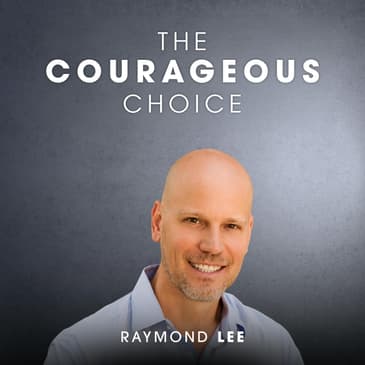
Raymond Lee, president of CareerMinds, author of Clocking Out, and host of the Clocking Out podcast, explains what courage really looks like in leadership and career change.
You’ll learn why handing over the CEO role to someone else was the hardest—and best—decision he made; how his definition of success shifted from raising venture capital to building something that outlasts him; and how to lead when you cannot give your team clear answers.
He also breaks down the warning signs that it’s time to leave a job, why we’re now in a skills economy rather than a job security economy, and the small daily practices that create clarity before big decisions.
Key takeaways:
- Courage is rarely the dramatic leap. The hardest choices are the ones with no plan B.
- Stepping aside as CEO can be the right call when the company needs skills you don’t have.
- Trust and transparency, agreed upon upfront, make shared leadership work.
- Success moves. Funding, the first customer, and acquisition are milestones—not finish lines.
- Chasing an exit while neglecting your health and relationships creates an imbalance you eventually have to fix.
- Leaders who can operate without certainty are the ones who rise above the rest.
- Say plainly that you don’t have the answers yet rather than manufacturing false clarity.
When the pain of staying the same exceeds the pain of change, you’ve stayed too long.
Ignoring that signal can lead to burnout, substance use, and missed moments with family.
In a skills economy, you have skill security—not job security. Audit your skills against AI disruption.
Timestamps
- 00:34 — What The Courageous Choice is about
- 02:32 — The choice that took the most courage
- 04:48 — Being asked to step aside as CEO
- 05:40 — Why giving up the CEO seat was the right call
- 08:16 — Building trust with an incoming CEO
- 10:01 — How the definition of success changed
- 11:44 — Acquisition as a milestone, not an ending
- 13:56 — Neglecting yourself while building a company
- 14:56 — From product company to workforce solutions
- 17:20 — Leading without having the answers
- 19:22 — Why the pandemic validated virtual delivery
- 21:32 — Signs it’s time to make a change
- 22:59 — The tumbleweed metaphor for career inertia
- 24:54 — What burnout actually looks like
- 26:25 — Fear of sales and business development
- 28:25 — Practicing 15 minutes of morning silence
- 30:31 — Skill security in the AI economy
- 31:48 — Imposter syndrome and starting a podcast
- 33:29 — Final advice: Start small; don’t wait
Connect with Raymond Lee
https://www.linkedin.com/in/raymondmlee/
Thanks for listening to The Courageous Choice. Leave us a review and subscribe so you don’t miss future conversations.
For more information, visit gigtalentagency.com or email podcast@gigtalentagency.com.
#StartupCulture #OrganizationalTransformation #StrategicLeadership
Powered by the WRKdefined Podcast Network.
[00:00:05] Welcome to The Courageous Choice, a podcast about what it really takes to lead at the edge of change. Because here's the truth, strategy isn't enough anymore. The world of work is moving faster than ever, and the leaders who stand out aren't the ones with all the answers. They're the ones willing to make bold decisions in moments of uncertainty. This podcast is about those moments, about those leaders, and because leadership today isn't about certainty, it's about courage. The courage to see differently, act decisively, and step forward anyway.
[00:00:33] Welcome to this episode of The Courageous Choice. The Courageous Choice is about moments that define our lives, not because they're easy, but because they require us to step into uncertainty with purpose. Few people understand that better than Raymond Lee, president of Career Minds and author of Clocking Out. He also has a podcast called Clocking Out. He spent over more than two decades in human resources, career consulting, and leadership. And he's helped thousands of individuals, organizations navigate career change with confidence.
[00:01:03] Today we're going to get real about why courage isn't the absence of fear. It's the willingness to make intentional choices that align with your values and create lasting fulfillment. Thanks so much for joining me, Raymond. I'm really excited to have you here today. Jamie, thank you so much. Thanks. We have the pleasure of both having a podcast, and it creates these opportunities to just really have authentic conversations. And I felt really honored to meet you. We met in the field, I'll say, networking.
[00:01:32] And when you were here in San Diego. And little did I know really how much our stories would have parallels, but also differences where we could learn from each other. And I'm really excited to start to dive into some of that today for our audience.
[00:01:48] Yeah, I appreciate you saying that. I am as well. I feel like we're kindred spirits because of our background and what we've been building. And really excited to have our conversation and share more about my journey. Maybe some things you didn't know about. I'm really excited to learn. In fact, that's my goal today is to just ask good questions and be inquisitive because I feel like you have layers and we haven't gotten there yet. So I'm excited. That's great.
[00:02:17] Okay, good. Let's just kick it off. As you look back on your career, this is the courageous choice. So really, is there a specific moment that you think about that moment that took the most amount of courage and why? That, so you mentioned the word layers and I have to say the word layers is so appropriate because I thought about just the idea of being courageous and making courageous choices.
[00:02:43] And what I want to share is something that I feel took a lot of courage and was really difficult. And I have to say first, I spent 15 years in an HR career and ultimately got to a place where I wasn't fulfilled in that.
[00:03:01] And people who look at me from the outside may say, oh, you just left this 15 year corporate HR career to start a company from scratch. That must've taken a lot of courage. And on the surface it did. But at the end of the day, I could have, I had a plan B. I could have gone back and worked in HR, right? Like I wasn't, while it took a lot of courage and it was scary.
[00:03:26] It wasn't, I wouldn't say that was the most courageous thing that I did. And something else that I shared on another interview was giving away over 50% of my company to investors who wanted to invest in the business.
[00:03:43] And that was an example that I shared that I felt, oh my gosh, I'm going to give away over 50% of the company to take in venture capital to continue on the journey. And while that was really courageous, I would say that the thing that I feel like for me, when I reflect back, there was a moment in the company's journey where we had raised venture capital and we were probably two and a half years in.
[00:04:14] And we were burning through cash. We raised about two and a half million, which isn't a lot when you're trying to scale a company that's early to the market. And our investors, we had a really tough board meeting. We weren't hitting our numbers and we had to go out and raise more venture capital.
[00:04:31] And we had hired a CRO who was recommended by one of our investors and said, we really need a sales kind of commercial minded CEO to go out and do this fundraise. And the board made the recommendation that I step aside as CEO and someone else comes in to take the reins.
[00:04:59] And I'm like, oh my gosh, I just get goosebumps because it's, yeah, I'm like, this was the baby, my baby. I started it three years ago. Like, how dare you ask me to give the reins over to someone who comes from financial services? She has no knowledge of the outplacement industry. And, and while I knew in my heart of hearts, like, this is going to be the, what am I going to tell the team and how am I going to handle this?
[00:05:27] And I had to make a choice. Am I on board or not on board with this? And at that moment, I realized that this decision that I'm making is not about me. It's about the company and what's best for the growth of the company.
[00:05:39] And I have to tell you, Jamie, that was the best decision I made because yeah, because in hindsight and her name, Sabrina, she and I are dear friends today. She lives here in Philadelphia and she has an amazing sales and marketing background.
[00:05:57] She's scaled businesses in many industries. And I spent the next two years just absorbing everything that I could learn from her around sales and marketing. I came out of HR, like HR people aren't go to market people. Right. And so I learned a lot from her.
[00:06:18] And there was a moment two years later where she got tapped. She got recruited by a founder who was launching a new company and wanted her to come in to help launch it. And it was back in financial services. And so I had the opportunity, my board presented to them and I took the reins back, but there was a two year period where I was the chief product officer for the company. And, and it was really tough. Yeah.
[00:06:45] Yeah. That's interesting. And so I always go to my gut. Cause that's where I feel like tension. It sounds like you got over the hurdle of like, this is what's right for the company. This is, I'm making this decision on behalf of the company. And I'm sure you had doubts. Like, were you, were you, how did you know you could trust her?
[00:07:07] She was, when our investor came to us and said, we had a search for a CRO and one of our investors said, look, she's grown companies I've been a part of and she's amazing. She's a fast learner. And so while I almost couldn't say no, when we met, there was definitely chemistry there from the beginning.
[00:07:35] And she had actually started as the head of sales before she took over. So she was working in the role for a few months and I maybe even a little bit, maybe six months to a year. So I had time working with her and she was, she was good. We were growing, but we just weren't growing fast enough. We were early to the market. So it wasn't something she was doing wrong, but I had a chance to work with her and we had aligned values.
[00:08:01] She was fun to work with. And I just remember we were sitting at a Fridays T TGI Fridays for lunch. And I was getting ready to be like, all right, I'm going to do this call with the team and say, okay, guys, this is what's happening. And I knew they were going to be like, are you crazy?
[00:08:22] But I said to her, I said, the one thing that is important to me is trust and transparency. And I said, at any point, we always have to be really in sync with what's happening and just be open, transparent and trust. And I said, I have a tremendous amount of trust in you. And she's like, Raymond, I can't do this without you.
[00:08:41] And so we almost had this connection and just mutual agreement that we're in it together. This isn't the weight's not on her, the weight's not on me. And we both want each other to succeed because ultimately we're doing this for the company.
[00:08:58] It's like, this isn't an ego thing. And this isn't her looking to prove someone wrong. This is all about the company. And so it was a lot of trust and respect and vulnerability and all the things. It just felt right.
[00:09:14] You just have that, you mentioned gut feeling. I just felt like this is right. And you almost at that point, you have to put trust in knowing that, hey, if you go in with the right intentions, then the outcome will sort its way out.
[00:09:31] Right. And it's not about really the title, right? To me, it took trust to be able, because it's a control thing. But it doesn't matter the title. And if you're really looking at, it sounds like you guys combined synergy for the best of the organization in a way that just allowed you to give the confidence to future investors and to gain market share and all the things that you did. Yeah, exactly.
[00:10:01] When you think about your career, obviously, you've had multiple levels of success in different contexts, but success and courage are not always the same thing. So as you look back, how's your definition of success changed over time?
[00:10:17] That's a big word. It's a word that I think has meant different things to me over the years. Early on, early success was raising venture capital and feeling like there's people who believe in what we're doing. It's more than just what I think is a good idea. But when you raise venture capital and investors give you money because they think you have a good idea,
[00:10:44] that was a level of success when we won our first customer. So there was these milestones. But from the beginning, when we took in venture capital, I knew at that moment, there was a clock ticking.
[00:10:58] And there needed to be an exit. Because you have investors, they put in a good bit of capital in the company and they want a return. They want a transaction. And so now you've shifted this goalpost to a place in time when you need to grow big enough where a company is going to buy you.
[00:11:18] And for almost over a decade, that was my measure of success. I was head down, focused on growing this business, and then along the way figuring out how we're going to do it. But acquisition was always like, that's going to equal success. And at that point, I'm good. I am going to be this happy person and life is going to be grand.
[00:11:44] And we ultimately got to that. We scaled the business, we grew the business. And it took a pandemic to put our whole virtual delivery model on the map, which ultimately catapulted our growth for two years, which led to an acquisition. But what was interesting, Jamie, is that it was shortly after that acquisition that I realized this is just another milestone.
[00:12:12] And even though we sold, we were still a relatively small company and I felt like we still had a lot to achieve. And so for me, success was finding a new home, getting our investors their return. We had an incredible dinner, celebrated. Everyone was happy with the outcome. But for me, it was like we have a new sponsor who was going to put another level of investment into the business.
[00:12:41] And they wanted me to continue the journey. They didn't lay off anyone. They just basically said, hey, everyone's going to continue working and we're going to make investments. And so that was March of 22. And so now it became success is growing something that is going to far outlive your existence.
[00:13:04] And if we had sold to an acquirer for just the product, then ultimately career minds would have just become a moment in time. But now we're working toward being one of the largest human capital companies in the world, offering a variety of different services.
[00:13:27] And so success has become not just selling the company, but helping fuel and grow the company to become something so much bigger than me. But I'm a huge fan of Seth Godin and Seth Godin says success is is meaningful change. And impact over the course of your journey, your career, your ability to make meaningful change.
[00:13:54] And it's not on others. It's on yourself. And for me, when I sold career minds, I was so focused on the business that I completely wasn't taking care of myself, both mentally, physically, all the things relationships. Everything was about work and there was such an imbalance. And in that moment, I had to look inward and realize that I needed to change some things.
[00:14:20] And success is like balancing all of that as well. And it's it's it continues to be a journey. Success, I believe, is a moment in time. It does it never changes. I love that. You know, I'm super wired, like forward thinking wired. And so taking those moments to celebrate each of those points, I think, is important. And I agree with you. It's like it's not really a destination. That very sounds.
[00:14:48] But as you think about that, that's a big vision to become the largest human capital services company or what was the? Well, so we started career minds as a product company back in 2008. We were disrupting a very traditional brick and mortar outplacement industry, very specialized in terms of HR services. And over the 20 years, we just were building a business around this product of outplacement.
[00:15:17] And there's a handful of players in the industry who are very traditional. And we had a disruptive technology. And so we were pretty focused on building out this business, which for us, it was great because we became the best at this one thing versus trying to we got we had distraction opportunities throughout the journey to go into other things like recruiting other areas. But we just stayed laser focused on this one thing.
[00:15:42] Our investors, since being acquired, the PE firm that owns us now has been investing in broadening our scope of services. So now we do career development, leadership development that came through an acquisition. We're doing workforce design where we help companies establish their job architecture. So we think of ourselves as more of a category of workforce solutions within talent management. So we don't do recruiting.
[00:16:08] We're not doing other areas of HR, but we're really just focused on developing talent from the point of establishing the skills to develop all the way through to transitioning employees out. Interesting. Yeah. Yeah. I think that that focus and then how wide do you go is an interesting conversation when, as you grow. There's like, cause opportunities and opportunistic growth shows up, but like delivery and focus is so important just as someone who's living that right now. Yeah.
[00:16:38] Yeah. Yeah. One of the things that I think most organizations and leaders are navigating right now is something that we're not always comfortable with, which is making decisions before you have certainty. And a lot of times I see leaders or I've felt myself where I want to get it all figured out so then I can share with my team or with the organization.
[00:16:57] But in today's world, like you need to communicate and often act before we have that real feeling of we actually know exactly where we're going or exactly what's happening. Maybe you can share how you personally make those kinds of courageous decisions when you don't have all the answers. I don't know if that makes you think of a specific example or something that you've lived, but share how you might navigate that. Yeah. Yeah.
[00:17:21] It's such a great question because I feel like right now there's so much ambiguity in everything that we do. And the example, I had a call this morning with a leader in our company about just a bunch of change that's happening.
[00:17:40] And it's for me personally, it's just recognizing that sometimes in the moment you don't have the answers and in the certainty when I can connect it back to career minds, we were raising venture capital and we didn't know when the inflection point was ever going to be. And I think oftentimes, like when I was on this call, this leader was searching for answers.
[00:18:09] They wanted things black and white and they wanted the plan that was going to, you know, that they can see. And I said to her, I was like, successful leaders are able to operate without the certainty, without having things, everything buttoned up black and white. And I personally, over the course of the decade or so growing the company, you just never knew who your next customer is going to be.
[00:18:38] You never knew what industry was going to be the next industry that you were going to serve. Or at the same time, we were so early to the market, you didn't have certainty that the market was ever going to adopt this new delivery model because people were like hell bent on. You needed to meet face to face with a person. You had to go into an office and have a face to face meeting.
[00:19:02] And at the time, I'm like, is anyone ever going to adopt this idea of virtual? We were trying to convince the HR buyers that you don't need a meeting. Why are you going to spend all this money? You could do things virtually. And so we never had the certainty that actually was going to become a thing. And I mentioned a little bit, I hinted to it a little bit earlier that it just took a pandemic for the world to catch up.
[00:19:29] You had to have this pandemic where over the course of two years, every office around the world was closed and everyone was virtual. And that was our moment to shine. And so the lesson that I've taken from that example and then just throughout our continued growth of change that we're experiencing, like right now there's so much change happening. Change is constant. And I tell people that I can't give you the answers.
[00:19:59] Like you're searching for answers and we have to be comfortable and sit with the uncertainty and realize that we will have the answers in the next weeks or two weeks or whatever. And I'm pretty honest and say for you to be successful, you have to, we have to learn how to be comfortable in this because those leaders are the ones that will ultimately rise above, above the masses. Yeah. Yeah. Yeah.
[00:20:27] And I think there's just an opportunity to be part of that co-creation and figuring it out because the pace of change is fast. The landscape is dynamic and the best leaders can navigate that with agility. And like you started by saying, yes, it was courageous to start a new company, but the fallback was I could get a job or I could, there's, there's, you can always make another decision. Right. So if you start down a path, it's like the certainty is that, you know, you can make another decision. Right.
[00:20:57] I don't know how to, it's going to interest me. Yeah. And I can imagine that it's dynamic for your core business too, because even though people are comfortable, certainly with technology and remote and virtual meetings and all of that thing, you're still, the competitive landscape continues to shift. And you have to think about what aligns with your values. What's your competitive differentiator? What space do you just want to play?
[00:21:21] And that's like a continuous kind of conversation as well, because with both growth and just the landscape of what people want. It's interesting. Yeah. I talked to a lot of people that almost 50% of the workforce now is engaged in the gig economy in somehow, some way. And everything from Uber drivers and delivery folks to our executive entrepreneurs. And often I talk to people who are contemplating a change.
[00:21:49] And often people stay in a role that either isn't helping them grow. You describe that feeling of like you had a career in HR and been successful, and then you were ready for something new. You just, it wasn't necessarily fulfilling. And sometimes people stay longer because they're afraid of what's next, or they don't know kind of what's next.
[00:22:12] Maybe you could describe and share a little bit about kind of what that was like for you or how leaders might know when it's time to either stay and persevere through something or time to make a courageous change to something, even if they don't know exactly what that is. Hmm. I love that question.
[00:22:32] And when you look back, and I think as you get older, you become wiser and you look back and there are moments where you have that inflection point where you realize it is time to make a change. And there's a quote that I love that says, when the pain of staying the same becomes greater than the pain of change.
[00:22:55] That's when you ultimately know that you've been in that job too long, where the feeling that you have, because at the, in the beginning you're working and you're like, oh my gosh, the fear and the pain of making that change is just so daunting. I can never do it.
[00:23:12] But then as you, I love this, this metaphor of a tumbleweed where in your career you accumulate experience, you get degrees, certifications, all the things, salary, all this stuff. And if this tumbleweed gets bigger and bigger and as it's rolling and collecting stuff, the pain of change and walking away and unraveling that just becomes so daunting that you just never do it.
[00:23:38] But then at some point that tumbleweed becomes, it stops collecting stuff. And then that pain starts to shift. And then now you're like, it becomes the weight of that pain becomes greater than actually making the change. And that's, it's obviously at that point, it can become too late. And then what I see is people start, it impacts their mental health. It impacts their wellbeing.
[00:24:09] Sometimes they turn to substance abuse or alcohol or whatever, because that becomes now I'm going to mask that pain because that pain of staying the same is so great that it's harder to sit with. And then the change, because you can just say, I've just, I'll just deal with it next week. I got a great job. And you start making these excuses while you can't make the change. And so that's easier to deal with.
[00:24:37] But then when you now know that window is now closed and you, in your heart, you're feeling this new pain that is just more complacent than, and then you start doing other things to mask it. It could be eating. It could be anything that creates a mask for that. And then now your body's telling you. And then at that point, that's when people usually hit a breaking point.
[00:25:06] And there it's the crying in my car, stuck in traffic, or I miss my kid's baseball game, or there are things that start impacting your personal life that it's okay. I think I need to start listening to that voice. That hits home. I had just made the change to leave corporate. And I was sitting at a table of CHROs, and we were all sharing stories. And they were asking me, they were excited about what I was doing.
[00:25:36] And many of them said, I want to do what you're doing, but I'm afraid. I'm afraid of sales and business development. I just want to do the work I love. And a couple of them, like the next sentence was, but I hate my job. I cry on the way to work. I'm drinking more. It was exactly what you just said. And that was actually one of the catalysts to starting Gig Talent. But it was just like, it hit me.
[00:25:56] If we can do something to reduce those perceived barriers of entry, just for people to feel like there's an on-ramp or an off-ramp to their next decision, that, to me, reducing that fear was purposeful. Yeah. But I think a lot of people live in that space. So the way you described it might allow people to recognize what they're feeling. And what would you hope for somebody who might be sitting there without feeling?
[00:26:25] When you were just saying that the shift that I made in my kind of work habits is even after leaving corporate, which I didn't do at the time because I felt like I was on a hamster wheel. So I never really sat alone in quiet. I was always watching the news. I was always socializing, traveling, conferences, networking.
[00:26:51] It was just, it felt like it was 24-7 with a little time to sleep. And what I do today, I practice intentional meditation where I'm just in the morning. I spend 15 minutes just in silence. I don't, I used to get up and the first thing I would do is turn the TV on to see the local news. What the weather is, I don't turn the TV on anymore. And I grab my coffee and I just sit in silence.
[00:27:18] And I just think about what's important to the day, what's important to me, my family. And in that moment of silence provides me so much clarity. And it's hard to ignore that. When you're in silence with no interactions, no social media, no, it's just you sitting by yourself. I've tried breathing and it, I can sometimes get in a rhythm with the breathing, the breath work.
[00:27:47] It helps as well to connect things. But that moment in just silence where you're just sitting with yourself for more than 10 minutes is precious time. I think that's huge. And then listening and being willing to do something with what you hear. Sure. All right. So a couple more questions. You have a unique lens with career minds and kind of the landscape that you see around the workforce and how work is changing.
[00:28:17] What do you think specifically courage looks like across today's workforce for folks? I interact with people who have lost their jobs and some are completely blindsided. Some expected it coming. And I think the evolution of skills just in these last two years has, I believe it's a wake up call for people in general.
[00:28:47] In terms of how you're investing in yourself and your career. So irregardless of if you're happy in your career or you like the work that you're doing or you are engaged. The skills because of AI disruption or the introduction of AI is causing you really have to take stock of your skills today and how valuable your skills.
[00:29:14] I think about 20, 20 years ago, 30 years ago, you had a job description. You had roles in your job. But now companies are hiring you for your skills. So we're in a skills economy. It's like a not job security. It's skill security. And so if you can create a resume with skills, then a quick example is like you and I launching these podcasts. I've been doing it now for almost two years.
[00:29:42] And I was so nervous and had so much imposter syndrome when I started this. The first episode I did, I was sweating. I was talking about courage, right? Right. It's the first time like I'm no Joe Rogan. And I was just like this. But two years later, I'm like, I am so glad I did this because just the skill development in having these kind of conversations and what I've learned along.
[00:30:09] Like there's so much that I've gotten that has allowed me to be a better leader today and have more clarity around how I'm leading career minds. This podcast has been incredible, has been an incredible skill that no one can take away from you. So my kind of coming back to your question around just career minds and the workforce and the landscape of the workforce.
[00:30:35] I think people really need to take a hard look at what their skills are today and then also what interests them, what really excites them. Because just if you're a software engineer and you're seeing this AI disruption with writing code and now there's prompt engineers who can write the same code that you were trained in school to write, going and getting software engineering licenses. Maybe it's something related to prompt engineering. Who knows?
[00:31:05] But you have to really start thinking about what's my value today as it relates to skills. Yeah. I love that. I think, you know, really recognizing that people have valuable skills and they might apply them in a different way. There's an opportunity there, but they have the agency. Right. It's not. I encourage people to think through to your point, what lights them up?
[00:31:31] How could they use those in a way that actually it psychs them, not just in a way that by default is happening to them. Right. Yeah. Final thought here is I find you very inspirational and you've been so candid in kind of your personal journey, some of your practices that I find very helpful. And I would love to just get one either word of advice or maybe courageous choice or challenge that you might want to leave our listeners with. And it doesn't have to be work. It could be work, career or life.
[00:32:01] What would you like to share? You have one life to live. And if there's a burning desire that you feel like there's something you want to achieve and you're working in a job or you have a career. And let's just say you're in that job because you need insurance or you have bills to pay. Don't let that be the excuse as to why you can't do the thing that you want to do. And part of it can be fear.
[00:32:59] But what do they say? It doesn't give me the purpose that I'm looking for. That time is the moment that you have to make the choice and be courageous to put some energy. And I use that word energy meaning that it doesn't have to be big. It could just be a little bit of energy into something. And you could just push something along that is a hobby or something you're interested in and just give that some time. A little bit of time.
[00:33:28] And then over the course of months and a year, that little something that you put energy to will become a bigger something. And so my message is that don't wait. Take action today and have a small amount of courage to make that choice to invest in something that ultimately will be something maybe much bigger. And you can then make the decision later. Yeah, don't wait.
[00:33:57] I love it. Thank you so much, Raymond. And I really hope that our I know I enjoyed the conversation. I hope our listeners did, too. And I hope that I can have you back at some point. So thank you. Absolutely, Jamie. I love our conversations. I feel like I can go on forever. So I appreciate that. Me too. I know we are going to I'm going to stop recording and we're going to keep going. So thanks, everyone, for listening. We'll see you on the next one. Thank you for listening to The Courageous Choice.
[00:34:26] If you enjoyed this episode, please leave a five star review to help get the word out about the podcast. And don't forget to subscribe so you don't miss out on any of our future conversations. If you'd like to know more about gig talent, please visit gigtalentagency.com or email us at podcast at gigtalentagency.com. See you in the next episode. Bye. Bye.
Sponsors
