
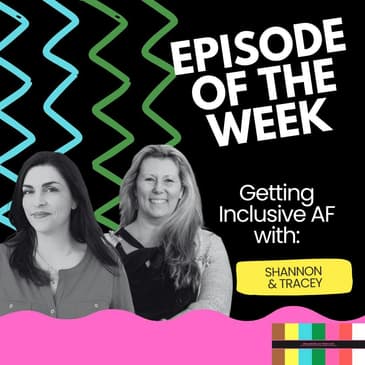
🌟 Welcome to the "Inclusive AF" Podcast hosted by Jackye Clayton and Katee Van Horn! 🎙️ Join us as we welcome Shannon Lucas and Tracy Lovejoy, catalyst leaders driving positive change in organizations and the power of inclusivity in the workplace. In this episode, we explore the impact of neurodiversity, emotional intelligence, and the importance of adaptability in creating a more inclusive environment. Don't miss out on our engaging conversations and personal anecdotes that will inspire you to make a difference in your own organization! #InclusiveLeadership #DiversityandInclusion #PositiveChange #EmotionalIntelligence #Neurodiversity #Adaptability #WorkplaceInclusion 🎧 Listen now and be part of the inclusive revolution! ✨
Powered by the WRKdefined Podcast Network.
[00:00:00] You're listening to Inclusive AF with Jackie Clayton and Katie Van Horn.
[00:00:07] Hi, Jackie.
[00:00:11] Hi.
[00:00:12] How are you doing, Katie Van Horn?
[00:00:14] I am good, Jackie Clayton.
[00:00:16] Hey, Inclusive AF Podcast, here we go.
[00:00:21] It's time to start this party because, you know, we're spending all kinds of quality
[00:00:24] time together this week.
[00:00:28] It's actually, you all don't know this and are listening, but Jackie and I have been on
[00:00:32] hiatus from each other unfortunately because we've both been traveling and working way too
[00:00:36] much.
[00:00:37] So we haven't seen each other and now this week we're trying to record a couple of episodes
[00:00:42] in a row.
[00:00:43] So we're getting all kinds of quality time together.
[00:00:45] So we're caught up.
[00:00:46] Yeah.
[00:00:47] If you all hear us recording on Saturday, please know that if we start like, bakerying,
[00:00:52] it's just because we're sisters and that's what we do.
[00:00:55] Right?
[00:00:56] So it works out well for everyone.
[00:00:58] But welcome, welcome to everyone.
[00:01:02] We have some amazing guests with us today and so I'm going to, without further ado, turn
[00:01:07] it over to Tracy Lovejoy and Shannon Lucas to introduce themselves and then we'll jump
[00:01:13] right in.
[00:01:14] Katie, Jackie, thank you for having us with you and thank you for jumping in and
[00:01:19] making me giggle right away.
[00:01:20] I so appreciate it.
[00:01:22] My background I am come straight out of graduate school into the corporate environment where
[00:01:28] I went from studying social science and anthropology into being a researcher in technology, totally
[00:01:33] a random connection.
[00:01:35] Ended up spending 12 years at Microsoft where I love to study why do people do
[00:01:40] what they do?
[00:01:41] How do we embed this knowledge into innovation?
[00:01:44] But really my love was always that people side.
[00:01:49] And so once I started being able to be a manager of individuals and then later of teams,
[00:01:54] that's where I started to light up.
[00:01:56] I fell into a coaching class because I wanted to use this as a way to grow my leadership
[00:02:02] and it was a very disruptive moment in my life.
[00:02:05] You know the things you hear like the clouds part, the angels were singing of this is
[00:02:10] something you're meant to do which I was not looking for.
[00:02:14] So after about three years staying at Microsoft once I started that path I finally left started
[00:02:20] a consultancy that was in 2013.
[00:02:23] And once I went into consultancy where I was working with organizations supporting leaders,
[00:02:27] I wanted to figure out who do I specifically want to work with and so I started doing
[00:02:31] a research project because that's what researchers do.
[00:02:34] And I was thinking about who are my favorite clients that I've had at that point I'd
[00:02:38] been coaching for five years and there was this incredible set of trends that
[00:02:43] was a through line.
[00:02:44] There were people who set huge audacious goals that they were scared at first to talk about
[00:02:49] but then they'd come back to our coaching session next time and they had totally gotten
[00:02:53] on the track and they had done their homework and they were so excited to make big powerful
[00:02:57] change.
[00:02:58] And they started to look in the literature for people like this who are those fire
[00:03:02] starters who are the people at the front end of innovation.
[00:03:05] I didn't see anything on the bookshelves I saw the books about how to do innovation
[00:03:09] but this time in 2015 who they were within it was not much talked about.
[00:03:15] And so then I started a second research project of really studying them.
[00:03:20] Income Shannon Lucas.
[00:03:22] At the time she was one of my very favorite clients and I was like hey Shannon I'm doing
[00:03:27] this research project studying people just like you.
[00:03:30] Would you be willing to let me interview you for that project?
[00:03:34] Cliff Hanger.
[00:03:35] Cliff Hanger.
[00:03:36] Did I say yes or no?
[00:03:39] I'm going to go back.
[00:03:40] I have a degree in art history but when I graduated if you could spell TCPIP you were
[00:03:46] allowed to be a network engineer.
[00:03:48] I remember that year.
[00:03:49] That was a very good year if you could spell TCPIP.
[00:03:53] So I also ended up working at Microsoft although we never crossed paths there and just really
[00:04:00] quickly ended up following the tech career always thinking getting further away from
[00:04:04] the tech and more into the why.
[00:04:05] Like why how are people using this?
[00:04:07] Why are they using it?
[00:04:09] When I landed my dream job and I got to build out an innovation program from scratch at the
[00:04:14] world's largest, one of the world's largest mobile telephony companies Vodafone.
[00:04:18] The hypothesis that we were building that innovation program on was that we wanted to
[00:04:22] find the natural positive troublemakers all around the world because Vodafone is truly
[00:04:26] global.
[00:04:27] Unite them, connect them, help them stop reinventing the wheel, give them a shared
[00:04:31] language, some processes and remove as many barriers as we could and get that fly
[00:04:35] wheel going.
[00:04:37] We were wildly successful by and I was super naive about the success honestly.
[00:04:41] We were wildly successful tens of millions of in-year revenue, 12% ARR uplift for companies
[00:04:46] that went through our program completely changing who we were talking to from IT and
[00:04:50] procurement to the C-suite.
[00:04:53] But coming into year four I was burning out.
[00:04:55] Now we had from eight Ragtag innovation champions to this certified gamified CEO
[00:05:00] sponsored innovation champion program.
[00:05:04] I was traveling around the world trying to unlock the problem of why even though it was
[00:05:07] a volunteer program you could not be voluntold to participate in this, people showed up
[00:05:12] differently.
[00:05:14] And I was like if I could just double, let's say it was 100 at that point, if I could
[00:05:17] just double the 30% to the 60%, we would more than 10x the impact.
[00:05:22] It would have just unlocked such insane potential.
[00:05:25] I was burning out.
[00:05:26] I was a single mom at the time too and my college roommate when I studied art
[00:05:29] history, it was back in my life and she said have you ever thought about
[00:05:32] a coach?
[00:05:33] And I was like no, I've never thought about a coach.
[00:05:35] And literally someone compared Aura's and matched me with Tracy and here we are today.
[00:05:40] And so when she sat me down and said can I interview this, it was like being hit by
[00:05:44] a bolt of lightning.
[00:05:45] I remember where I was sitting.
[00:05:46] It explained my entire life.
[00:05:48] I was like oh my God, they don't want change.
[00:05:51] Like they operate differently.
[00:05:52] I just, I really didn't understand.
[00:05:55] And I had created this external executive community that was hand picking change
[00:05:59] leaders that I thought were like me and I was like well, co-created.
[00:06:02] I don't want to own another community.
[00:06:03] Right?
[00:06:04] And the same thing was happening there.
[00:06:06] So I said to Tracy, I said I've been thinking about doing a retreat with these
[00:06:09] people in Northern California with some hot tubs and good wines, good food and
[00:06:13] you know, recharging because this group needs it.
[00:06:15] And I said, do you want to do that with me?
[00:06:18] And she said yes.
[00:06:19] And so that was the beginning of our company.
[00:06:21] I stayed in the corporate world leading innovation efforts at Cisco
[00:06:25] and Ericsson after in 2020.
[00:06:28] We came together and write a book, started our podcast that year too.
[00:06:31] Turned out to be a great year to write a book.
[00:06:33] So our book is Move Fast, Brakeship Burnout.
[00:06:35] You can see it behind Tracy, the catalyst guide to working well.
[00:06:39] And so I hope your listeners can hear that we are very spiritually
[00:06:41] aligned with the work that you're doing.
[00:06:44] Awesome.
[00:06:45] Awesome.
[00:06:45] So I just, I did not realize both of you are Microsofters.
[00:06:50] So I am a prior GoDaddy.
[00:06:52] So we have a lot of mutual connections, all of the folks that moved over
[00:06:55] to GoDaddy after they were spent their one of their lifetimes in Microsoft.
[00:07:00] So we have some mutual connections for sure.
[00:07:03] Love all of this.
[00:07:04] So tell me a little bit about, you know, how do you identify
[00:07:10] who those people are that are the breakers or the, you know,
[00:07:14] whatever you call them?
[00:07:16] Yeah.
[00:07:18] One way is that.
[00:07:19] You call them catalysts just for super clarity.
[00:07:22] Yes.
[00:07:22] Thank you.
[00:07:22] Thank you.
[00:07:23] Yeah.
[00:07:24] Thanks.
[00:07:24] But one way is you can just ask people around you, who are the folks
[00:07:30] that you think are starting the ideas and jumping into action?
[00:07:35] And a lot of the time people will start pointing to the same people.
[00:07:39] So once you begin to look in the organization or organizational
[00:07:43] setting, they're kind of known, if not talked about.
[00:07:47] And breaking down from the research, we know the key attributes
[00:07:51] that really make who we are.
[00:07:53] So you can hear it in the way we're talking about it.
[00:07:56] We are folks that create lots and lots of ideas of how to make
[00:08:00] the world around us better by just walking around and experiencing
[00:08:04] the world.
[00:08:05] And so we're doing it then at a pace that's a little faster
[00:08:09] than everyone else, putting together that information.
[00:08:11] And once we have this idea, we really do, even if we haven't
[00:08:15] articulated it to ourselves, well, we see a vision of how the world
[00:08:18] could be better.
[00:08:19] So it's not just it's broken, it's broken, it's broken.
[00:08:22] But wouldn't it be better if it were like this?
[00:08:26] And before sometimes we can say that out loud, we are tripping into action
[00:08:31] to make it so often.
[00:08:34] Did I just describe you, Jackie?
[00:08:37] Well, I don't.
[00:08:38] So I get nervous because I'm the type of person who like,
[00:08:41] I don't want to deal with anyone.
[00:08:43] I don't want to deal with anyone.
[00:08:44] Someone's going to try to put those things together and then
[00:08:47] full of malarkey right now, whatever.
[00:08:49] It's a good trade.
[00:08:51] I can't help but find the nicest.
[00:08:54] It doesn't mean that it comes from a fun place.
[00:08:56] I can't help that.
[00:08:57] Right.
[00:08:57] That's just, that's just my rearing.
[00:09:00] Right.
[00:09:01] I'm a nice Southern woman.
[00:09:02] However, sometimes it's like a mood day.
[00:09:06] Like I'm like, uh, like I had to figure out when I woke up in the morning,
[00:09:10] I think I can do it today.
[00:09:12] Do I have enough energy today?
[00:09:13] And then there's some days where it's like, nope.
[00:09:16] I mean, literally, I think one of my favorite times, Katie, and you
[00:09:18] remember this very, I know you remember this.
[00:09:21] It was me and Katie.
[00:09:23] And then we, there's another half of me and Katie and there's John and Robin.
[00:09:27] We were all out when we were doing all this stuff.
[00:09:29] And then literally we were at a table for like an hour.
[00:09:33] Nobody talking.
[00:09:34] We were all sitting like this at this table for like an hour.
[00:09:40] And people kept walking by.
[00:09:41] Do you remember Katie?
[00:09:42] People are walking by and I was like, don't, I don't want to talk to them.
[00:09:45] Okay.
[00:09:45] They're like, oh, that guy was looking for you earlier.
[00:09:47] I was like, I don't want to talk to them.
[00:09:48] Okay.
[00:09:48] Don't look at them.
[00:09:49] So we're all just like sitting.
[00:09:52] So it's like a roller coaster, but now it's like maybe it's because I've
[00:09:55] been connecting with the wrong people and I'm exhausted.
[00:09:59] I think there's the right people and the wrong people.
[00:10:01] They saw a hundred percent, a hundred percent.
[00:10:03] So I'm just going to finish the definition and I'll come back to that, Jackie.
[00:10:06] So so that people can sort of self identify on the thing.
[00:10:08] Tracy was like, we move into action.
[00:10:10] We can't help ourselves from moving into action.
[00:10:12] And Jackie, some just sort of building on your point where we haven't
[00:10:16] already, we haven't always primed those around us for the action that we're
[00:10:20] about to do.
[00:10:20] And as Tracy said, sometimes we don't even realize that that's what we've done.
[00:10:25] The research also says we show up with that experimentation mindset.
[00:10:28] We have to because almost by definition, everything we're doing is net
[00:10:31] news.
[00:10:31] So that level of ambiguity isn't like, I don't know, I'll start a
[00:10:33] podcast, we'll figure it out.
[00:10:35] I'm, yeah, we need the world needs the podcast, right?
[00:10:38] The last piece is interesting because it's people will describe us.
[00:10:42] This is the one where it's like not how we self identify, but how
[00:10:45] other people identify us, which is they'll say that they're comfortable
[00:10:48] with risk and ambiguity.
[00:10:50] Now if you ask catalyst and there's a range.
[00:10:52] So like I am an adrenaline junkie, like motorcycle, rock climbing, skydiving,
[00:10:55] all the things.
[00:10:56] Tracy's a researcher.
[00:10:57] So like we do come with personality, different personalities and relationships
[00:11:00] to risk, but more it's like if you ask the catalyst or the catalyst
[00:11:04] might ask you or say it's risky not to do this thing.
[00:11:07] So it's not that I don't see that there's not risk, but I see the
[00:11:11] bigger risk actually in not making that change.
[00:11:14] Um, and so going back to what you're saying, Jackie, there's so many.
[00:11:17] And I was going to say this sort of at the beginning of Tracy was like, if
[00:11:21] you ask people in the organization who those people are, they might all
[00:11:24] point at the same person, but they also might point at the same person
[00:11:27] because they're like that person is a fucking pain in the ass.
[00:11:30] They are constantly breaking stuff.
[00:11:32] They're totally unself aware.
[00:11:34] Right.
[00:11:34] And so, and so we can have this reputation where we are actually
[00:11:38] causing more friction in the system because we don't understand.
[00:11:41] That's why when Tracy shared it with me, that bolt of lightning,
[00:11:44] I was like, Oh my God.
[00:11:45] No wonder I've been causing so much friction in the system.
[00:11:49] And so they've been moving to doing performance reviews like that.
[00:11:54] Like, oh, who's the person who does all the stuff?
[00:11:56] And I'm like, now that doesn't mean that that's positive.
[00:12:00] That does not mean I mean people are like, oh, that's the real
[00:12:02] influencer within your organization.
[00:12:04] So let's figure out what they're doing.
[00:12:05] It's like that.
[00:12:07] I mean, that's good.
[00:12:08] Oh, it doesn't mean that's good.
[00:12:09] And so we're called troublemakers and problem children and all of the
[00:12:12] things and we can wear the badge of disruptor like it's a good thing.
[00:12:15] But that's not often how people are actually what they're saying
[00:12:18] about us behind our back.
[00:12:19] Right.
[00:12:20] Breaking dishes.
[00:12:22] That's it.
[00:12:24] Now that so your thing about the energy though is spot on because
[00:12:28] there's a big piece of us that are that are catalysts that are
[00:12:31] energy givers, like we're putting energy into a system to create change
[00:12:36] during our first retreat that we were talking about one person was
[00:12:39] like, I don't know if I belong here after people were doing intros.
[00:12:42] She's like, I'm really an introvert and I just feel like everyone
[00:12:45] here with everything they've done, they must be so extroverted.
[00:12:48] So we just stopped.
[00:12:49] Well, like, hey, time out who hears an introvert half the people raise
[00:12:52] their hand.
[00:12:53] And then there's just this emotional management like that.
[00:12:56] Like we call like my favorite one is where the sharpest of change.
[00:13:00] And I think now related to like an inclusivity piece, there's a huge
[00:13:03] emotional toll.
[00:13:04] There's an emotional labor.
[00:13:05] If you want to create change, those people don't need to create
[00:13:09] change.
[00:13:09] They're not asking for the change.
[00:13:11] So if you want to create change, you have to bring them along.
[00:13:14] And so then Jackie, we get depleted.
[00:13:16] The burnout is real.
[00:13:17] It's really high in this sort of population.
[00:13:20] And so then you're just at your table with your friends going,
[00:13:22] I just need another wine.
[00:13:24] Don't talk to me.
[00:13:25] Yeah.
[00:13:26] This feels like a safe place.
[00:13:28] But I was gonna say, but I think that's part of it is it
[00:13:31] sounds like what you're doing is actually building a community
[00:13:35] of these folks that can feel safe and come together and have
[00:13:40] like the examples Jackie gave you.
[00:13:44] Yes, I do remember it.
[00:13:45] It's actually happened a few times when we've all been at
[00:13:48] conferences because we go three hundred miles per hour.
[00:13:51] Here's what we should do.
[00:13:52] Here's what we should change.
[00:13:53] Here's how we should change the world and make it better.
[00:13:56] And then we hit a wall and all of us sit at a table and go,
[00:13:59] oh my goodness, I can't talk to one more human today.
[00:14:03] But I love that you're creating this community.
[00:14:05] So what do you do with this energy, with these folks
[00:14:11] that are doing this work and are these troublemakers and catalysts?
[00:14:16] So I'd love to build on the comment that you said we build
[00:14:19] community really intentionally in two ways.
[00:14:22] So our goal is to help accelerate big bold change
[00:14:25] in the world sort of through empowering catalysts.
[00:14:29] And so we look at catalyst leaders because it is lonely
[00:14:32] at the top like you think it's lonely at the top.
[00:14:34] It's really lonely when you're a catalyst leader.
[00:14:36] A lot of us don't ever get the self-awareness to actually make
[00:14:39] it that far. That's true.
[00:14:40] And also we can be noisy and destructive and all the things.
[00:14:43] So we have a catalyst leadership trust where we support
[00:14:45] the executives and create that safe space.
[00:14:47] And this is the community I wish I had been able to have
[00:14:50] access to when I was in EVP in the tech world, right?
[00:14:53] Because I couldn't share all of my thoughts and uncertainties
[00:14:56] about the future with my peers.
[00:14:57] They would have been like, you don't know what you're doing.
[00:14:59] They would have been like, well, not really because it's all net new.
[00:15:02] You were asking me to unlock a new market that you guys have
[00:15:04] never unlocked. Who has that playbook? Nobody does.
[00:15:07] So getting to create the safe space for them is like,
[00:15:09] that is God's gift to me.
[00:15:11] That was just saying to Tracy, like I'm just so grateful
[00:15:13] to be able to bring that into the world.
[00:15:15] We also work with organizations, though, to help them.
[00:15:18] So you asked a great question, Katie, at the beginning,
[00:15:20] which I want to let Tracy answer, which is,
[00:15:22] how do you help organizations identify these people
[00:15:25] and just the bringing them together?
[00:15:27] I still get goosebumps.
[00:15:28] So like we create these like networks,
[00:15:30] informal networks across the organization.
[00:15:33] But when they're in class,
[00:15:34] they're also with catalysts from other industries,
[00:15:36] from other countries, from other backgrounds.
[00:15:38] And we tell them, OK, the skills improve,
[00:15:41] all 20 skills improve every single class.
[00:15:43] It's a phenomenally high impact class.
[00:15:46] The thing that the catalyst love every single time
[00:15:49] and it just happened today,
[00:15:50] I was talking with Sarah, the program sponsor for them.
[00:15:52] She said, you told me that I would,
[00:15:53] that would be my number one thing
[00:15:54] is being in community with the other catalyst
[00:15:56] because it's not just a safe place.
[00:15:58] It's energy giving.
[00:15:59] She's like, we were doing so much work.
[00:16:01] We were doing this in addition to our day job.
[00:16:03] And she said, but the time,
[00:16:04] the second we got together and the second that we left,
[00:16:06] I had more energy.
[00:16:08] So, but Tracy, I'd love for you to talk about
[00:16:11] how we find them.
[00:16:13] We have an assessment that people can answer
[00:16:16] that align to the six attributes
[00:16:18] that we know kind of make us who we are.
[00:16:21] And so we can use that with groups.
[00:16:23] And this is what we use in organizational settings
[00:16:26] so that we can look at it
[00:16:28] and kind of get that sense of where do people fit
[00:16:30] on that scale of catalyticness.
[00:16:33] And then we build out groups
[00:16:35] that begin to work on strategic problems
[00:16:39] and ideas that the organization really wants to make so.
[00:16:43] And so we're training the catalysts
[00:16:46] to see themselves so that they can recognize
[00:16:50] when they were disruptive in ways
[00:16:52] that were positive versus negative, right?
[00:16:54] The ways that we want to be.
[00:16:56] You're going to tell the people.
[00:16:58] What's that?
[00:16:59] You're going to tell the people.
[00:17:01] That time.
[00:17:03] Right. Exactly.
[00:17:05] That, you know, when you when you got angry
[00:17:07] and yelled at everyone,
[00:17:08] that probably wasn't the way to keep your job.
[00:17:12] That is hilarious.
[00:17:13] I understand why you were mad.
[00:17:14] Cracking up one time.
[00:17:16] I am the last for performance feedback.
[00:17:18] And I will never forget it was like,
[00:17:20] Jackie, you haven't given Gordon feedback in like three months.
[00:17:23] I was like,
[00:17:25] Lattice, you need to talk to Gordon.
[00:17:27] Like, I don't know why you're talking to me.
[00:17:29] That was probably not.
[00:17:33] Yeah.
[00:17:34] So then we can find these folks
[00:17:37] and we build out cohorts
[00:17:39] that also fit within the values of the organization
[00:17:42] because someone who's a catalyst
[00:17:45] won't always be a successful
[00:17:46] in one organizational climate,
[00:17:49] then they will in another.
[00:17:50] So Shannon was
[00:17:52] she's speaking about her
[00:17:53] time as executive vice president
[00:17:54] with a hundred year old Swedish company.
[00:17:57] Hundred and forty.
[00:17:59] Hundred and forty, which has a set of social norms.
[00:18:01] It has a pace that it's ready for, right?
[00:18:04] Versus someplace like Go Daddy or Microsoft
[00:18:08] where the pace and the cultural values
[00:18:10] can be really different.
[00:18:12] And so to your point, Katie,
[00:18:13] of like, how are we building community?
[00:18:15] We're building community in ways
[00:18:16] that are going to work within that organization
[00:18:19] to not only connect the catalyst
[00:18:20] but connect them to
[00:18:22] the executives and the strategy
[00:18:24] because what do catalysts want to do?
[00:18:25] They want to make change.
[00:18:28] They don't just want a leadership development program
[00:18:30] that's like, learn, you know,
[00:18:31] what your values are
[00:18:33] and what your goals are.
[00:18:34] They want to take their skills
[00:18:36] and their energy and dive in
[00:18:38] and be able to show
[00:18:40] the impact that they've made.
[00:18:42] So that's awesome.
[00:18:44] It was awesome.
[00:18:45] Yeah.
[00:18:47] So the concept like you do this assessment.
[00:18:51] What about the folks that are not catalysts?
[00:18:53] What do you do?
[00:18:53] Like what happens to them?
[00:18:56] They get promoted to guest.
[00:18:58] OK, that's me.
[00:19:01] No, OK.
[00:19:03] Yeah, she's referring to our
[00:19:05] I worked at Target for a while
[00:19:07] and that was our not appropriate
[00:19:09] in any way, shape or form.
[00:19:10] A. If you were not working out,
[00:19:13] you got to promote it to a target guest.
[00:19:14] So yeah, it worked out.
[00:19:16] So.
[00:19:16] All right.
[00:19:18] Yeah, it's a permanent phrase now for me.
[00:19:20] Anytime. Exactly.
[00:19:21] Yeah.
[00:19:21] I can't. Yeah.
[00:19:23] Within any cohort,
[00:19:26] like Shannon was talking about,
[00:19:27] there can be a spectrum of what it is to be catalytic.
[00:19:30] And so we're looking at not only
[00:19:33] where you fall on that spectrum.
[00:19:34] And so there's folks that we can say
[00:19:36] they're just not going to fit, right?
[00:19:38] They have identified that their
[00:19:40] relationship to change is not a positive one
[00:19:43] or they feel like they don't.
[00:19:44] They can't really contribute new ideas.
[00:19:46] And so there's some things that will make it
[00:19:48] that you're not going to be invited
[00:19:49] to be part of a catalyst cohort.
[00:19:51] But there's not one way, right?
[00:19:54] Like there's the range.
[00:19:55] And so we end up having beautifully diverse groups.
[00:19:59] So for those who aren't a catalyst,
[00:20:00] they don't participate in those programs.
[00:20:04] And we work with the organizations
[00:20:05] to provide training to if you think
[00:20:07] about a normal distribution curve
[00:20:09] and the catalysts are on the sharp end,
[00:20:11] you have the early adopters after
[00:20:12] and there's probably a range of people who
[00:20:14] that I mean, the beautiful thing is
[00:20:15] like for any catalyst program,
[00:20:17] you have to nominate yourself.
[00:20:20] So there's already a self-selection process there
[00:20:22] and this is different from a lot of
[00:20:24] high potential programs where it's like,
[00:20:26] did you crush your KPIs
[00:20:27] and were you good at managing up?
[00:20:28] Right?
[00:20:29] And so this is like, hey,
[00:20:31] I've been flying into the radar
[00:20:32] because the impact I drive is across
[00:20:34] the organization in silos
[00:20:35] with something that nobody had an exact sponsor for, right?
[00:20:38] So anyway, so there's a self-selection process
[00:20:40] but surely we want to also then
[00:20:42] the people who raise their hand
[00:20:43] and are interested in supporting it,
[00:20:45] we're gonna bring the same tools,
[00:20:47] the same language like the things
[00:20:48] that we're teaching catalysts are helpful for everyone.
[00:20:51] They're just essential for catalysts
[00:20:53] because we'll lose people as soon as we leave the,
[00:20:55] I got a vision on moving into action.
[00:20:58] It's really, I like that you said that
[00:21:00] but it's especially hard at startup companies.
[00:21:03] I think we say that we're a startup
[00:21:05] but I always think about various startups
[00:21:07] and it's hard when you're trying to
[00:21:09] change multiple things
[00:21:10] when you have multiple catalysts
[00:21:12] that wanna do multiple things
[00:21:13] because you have the autonomy to be able to do that.
[00:21:20] That's just what stood out.
[00:21:22] I guess, you know, never need to respond.
[00:21:24] Just a thought.
[00:21:25] Oh, we feel you as, you know,
[00:21:27] we came together officially in 2018
[00:21:29] and we have, we've been very excited
[00:21:32] the last two years.
[00:21:33] Like one of our celebrations
[00:21:35] is that we've had the same strategy for two years straight.
[00:21:40] That was a huge shock.
[00:21:42] I guess we were, our original sense of
[00:21:46] kind of our mission statement
[00:21:48] was that we give 360 degree support for catalyst
[00:21:51] because we're naming a category, right?
[00:21:53] And so we want, we love catalysts in the world
[00:21:56] and we wanna help them in all the ways.
[00:21:58] That's not a really good way to scale a business.
[00:22:02] No, I doubt it.
[00:22:03] It's our catalytic desire to serve
[00:22:06] and to really help folks
[00:22:08] that we're seeing how deep needs
[00:22:10] and often are in pain
[00:22:12] have gotten us to exactly that same issue
[00:22:14] that you're pointing to, Jackie.
[00:22:15] We feel you.
[00:22:16] Got it, okay.
[00:22:18] So you mentioned something earlier, Shannon, about,
[00:22:20] you know, the, you know, when you are raising your hand
[00:22:24] or calling something out that maybe isn't working
[00:22:27] and how sometimes that is not received
[00:22:30] or people have a perception of that
[00:22:33] because of the direct communication style
[00:22:34] or whatever that might be
[00:22:36] is part of the work that you do also
[00:22:38] just helping to manage some of those communication tools
[00:22:42] or whatever you wanna call it
[00:22:44] because, you know, to get people onto the bus
[00:22:46] that you're trying to drive
[00:22:47] to get people to come to whatever similar conclusion
[00:22:52] that you have, are those some of the tools
[00:22:54] that folks learn with this program?
[00:22:57] Yeah, totally.
[00:22:58] So there's a thing that's called the catalyst formula
[00:23:00] which is probably helpful to get out right now
[00:23:02] which is vision action iteration.
[00:23:04] This is how we move through the world
[00:23:06] and without intentionality
[00:23:08] we move through those cycles insanely fast.
[00:23:11] Like different levels of fastness as Tracy was saying
[00:23:13] but like catalyst in general
[00:23:15] are much faster than the average bear.
[00:23:18] That causes a lot of problems.
[00:23:19] So that's the name of our book,
[00:23:20] Move Fast, Brakeship, Burnout.
[00:23:21] That's our default position
[00:23:22] if we're not bringing some intentionality to our process.
[00:23:27] So the first thing we have to help them understand
[00:23:29] is like A, just the awakening
[00:23:31] that they're catalyst
[00:23:32] and the understanding the difference
[00:23:34] is like, oh I do need to treat and engage with people
[00:23:37] differently because they're not moving at my speed.
[00:23:38] They will have felt that intuitively.
[00:23:41] But then teaching them the self-awareness
[00:23:43] to know when they're losing people
[00:23:45] and when they're like moving off of vision too quickly.
[00:23:48] So a lot of what we're teaching them
[00:23:50] is to just slow down the process
[00:23:51] and giving them the tools.
[00:23:53] The communication piece,
[00:23:54] we have basically like one whole week out of six weeks
[00:23:57] and it's really more than that in the end
[00:23:59] of communication, communication, communication
[00:24:02] because it makes us, well, again,
[00:24:05] this is my thing.
[00:24:06] I was one of like poke by eye out with a stick.
[00:24:07] It's like it makes me split up so much.
[00:24:10] Like I have to say that a 10th time
[00:24:12] to the team to help them understand, but I will.
[00:24:15] The other interesting thing,
[00:24:16] the other interesting pivot
[00:24:17] that we try and help them understand though
[00:24:19] is a lot of the journey
[00:24:22] is really about more deeply listening.
[00:24:25] And so it's great to have a seat of an idea.
[00:24:28] But the first thing you need to assess is
[00:24:30] is your team organization,
[00:24:31] whatever ready for that kind of change?
[00:24:33] Like what's the organizational appetite?
[00:24:35] And so we talk about a lot of like a listening tour
[00:24:37] and then a co-creation tour.
[00:24:39] And just this week,
[00:24:40] someone in the class and group coaching was like,
[00:24:42] well I really need to figure out
[00:24:43] how to sell my manager better on my idea.
[00:24:45] And I'm like, we need to stop that language.
[00:24:49] Where's the win for your manager?
[00:24:51] How are you helping your manager?
[00:24:53] And so this is the part where we can come across
[00:24:55] as like arrogant and we're doing it in service.
[00:24:58] We feel so misunderstood.
[00:24:59] Like I just want to make the world better.
[00:25:02] But if we aren't like really paying attention to first self
[00:25:05] and then sort of that social, using our EQ,
[00:25:08] we really again, that sends us straight into burnout
[00:25:11] because we've just increased resistance in the system.
[00:25:14] Absolutely.
[00:25:15] And I would guess like you mentioned EQ
[00:25:18] and that was my other question.
[00:25:19] You know, if folks are self selecting,
[00:25:22] you would hope that they would have a little bit of,
[00:25:25] you know, awareness of themselves
[00:25:27] or you know, that kind of thing to be able to say,
[00:25:29] yes I am a catalyst that might somehow transition
[00:25:32] or translate to emotional intelligence, that type of thing.
[00:25:36] And both of you are shaking your heads no,
[00:25:38] so I'm gonna go with probably not the case.
[00:25:40] Okay.
[00:25:41] Save on.
[00:25:43] It's not, in getting to study people
[00:25:45] who are this way in the world,
[00:25:47] our emotional intelligence is really variable.
[00:25:51] When we study executives,
[00:25:53] the folks that are part of our catalyst leadership trust,
[00:25:56] this is a key area that we see difference
[00:25:59] is that they're so good at first always walking in
[00:26:03] and saying, why not?
[00:26:05] Not just why, but why not?
[00:26:08] Why isn't it like this?
[00:26:09] You know, and then they listen, listen, listen,
[00:26:13] listen, listen.
[00:26:16] Our natural instinct is to see and do.
[00:26:19] See and do as Shannon said vision act, vision act.
[00:26:23] We have to intentionally pause.
[00:26:27] And so there was a woman,
[00:26:28] that Shannon mentioned,
[00:26:29] we're teaching one of our classes right now,
[00:26:30] we teach it twice a year.
[00:26:32] And she shared, you are helping me see
[00:26:36] all the ways I've been doing it wrong.
[00:26:39] Oh.
[00:26:40] Help her feel seen and validated and not broken.
[00:26:46] And help her see that there's a way
[00:26:48] that she can be who she is, fully own it,
[00:26:51] not have to hide it and not keep breaking
[00:26:55] the relationships around her.
[00:26:57] And you're exactly right in naming it out,
[00:26:59] Katie, EQ is at the heart of that.
[00:27:05] I wish I would have met all of you about 25 years ago.
[00:27:10] But sorry, Jackie, go ahead.
[00:27:12] No, yeah, maybe 25, 30.
[00:27:15] So I'm just thinking the thing that stands out for me,
[00:27:20] and I'm wondering how,
[00:27:23] maybe it's during the assessment.
[00:27:24] I think what's standing out for me is,
[00:27:29] with people that are neurodiverse and catalysts,
[00:27:32] and there has to be a little bit of a high crossover.
[00:27:35] And I was just talking about it today.
[00:27:39] I have ADHD and it's very similar.
[00:27:42] Like when you meet somebody who,
[00:27:45] I'm not an expert, I'm not a therapist,
[00:27:47] I'm not offering any advice,
[00:27:48] but there is always like,
[00:27:49] and you're high functioning autistic
[00:27:51] in one of these whatever labels,
[00:27:53] people get mad about it,
[00:27:54] but work with me here.
[00:27:56] Then sometimes it can be confused for one of these,
[00:28:01] like I'm a catalyst kind of,
[00:28:03] I'm like, I'm a catalyst adjacent,
[00:28:06] but then there's a breaking point
[00:28:07] is at different levels.
[00:28:09] And it probably,
[00:28:11] I think I was in my 40s
[00:28:13] where someone used a different phrase that,
[00:28:16] oh, I think you're highly sensitive
[00:28:18] to these types of things.
[00:28:19] Like use that phrase.
[00:28:21] And then I was like, what?
[00:28:23] And then I was like, oh, I am highly sensitive.
[00:28:26] Did you read the highly sensitive person book?
[00:28:29] No, because that was scary.
[00:28:30] No, I wasn't trying to learn about it.
[00:28:32] I took their word,
[00:28:33] it's much easier to just take their word for it.
[00:28:35] I get it and I cried my way through it.
[00:28:37] So my husband,
[00:28:39] but it helped my husband contextualize and understand.
[00:28:42] He already supported me that way,
[00:28:44] but sort of like,
[00:28:45] I mean we often get emails from people
[00:28:47] about just how seen they feel
[00:28:48] and what a relief it is to not be broken to Tracy's point.
[00:28:51] And there's,
[00:28:52] so there was an overlap we see anecdotally
[00:28:54] with all of these different sensitivities
[00:28:55] between the neurodivergence
[00:28:57] that we were talking about for sure.
[00:28:59] It just seems to go in there.
[00:29:00] That's what I just think about.
[00:29:02] But that's part of I think
[00:29:04] what is so exciting when you meet people
[00:29:05] and think, oh, there's something wrong with me.
[00:29:09] I didn't,
[00:29:10] and I think even as you learn,
[00:29:12] it takes a really long time to realize
[00:29:14] like we are both looking at the same thing
[00:29:16] and seeing two completely different things.
[00:29:19] There's so much that goes to that,
[00:29:22] and I don't think we teach that.
[00:29:24] And that's okay.
[00:29:26] Like that is why diversity and inclusion
[00:29:28] is so important of understanding
[00:29:30] that now we can get a better picture of what it is
[00:29:33] and how we can move forward.
[00:29:35] And I think it's been such a toxic journey
[00:29:38] of what leaders look like,
[00:29:40] that people try to fit into this box
[00:29:41] and they have absolutely no idea where to go
[00:29:43] because they were like,
[00:29:44] I don't wanna do that part.
[00:29:46] Does that mean I'm not a leader?
[00:29:47] And it's like, oh, well, it depends on who you talk to,
[00:29:49] I guess, you know, and where they are.
[00:29:51] I agree.
[00:29:52] Can I ask you a question, Jackie, building on that?
[00:29:54] Cause this is something that's come up recently,
[00:29:56] which is those different perspectives,
[00:29:59] like we're looking at the same thing
[00:30:01] and there's different perspectives
[00:30:03] and maybe one is more right than the other.
[00:30:07] I don't know, like,
[00:30:09] thinking particularly in like,
[00:30:11] and trying to build inclusivity
[00:30:12] and thinking about systemic patterns that we bring in.
[00:30:16] And I'm just wondering like,
[00:30:18] do you guys have advice for how to navigate that complexity?
[00:30:22] Cause I go back to the emotional labor.
[00:30:25] It's like, am I thinking about it in every interaction
[00:30:29] or only when it starts to become problematic?
[00:30:31] Like how much, yeah.
[00:30:34] How do you guys think about that?
[00:30:35] I will tell you, the thing that saved me a lot of grief
[00:30:39] is going into is accepting other people's truth.
[00:30:43] And that's it.
[00:30:44] Makes it, you're free now.
[00:30:48] Instead of thinking, I have to fully understand exactly
[00:30:51] what it's like being, you know,
[00:30:53] little baby Kathleen Catholic girl at age 12.
[00:30:57] I have to know what that feels like,
[00:30:59] looks like, smells like in order for me to understand
[00:31:02] 45 plus year old Katie.
[00:31:05] And you don't.
[00:31:06] If I just told you this was hard,
[00:31:08] so it's like for me, that's what seems to be helping
[00:31:11] and allows us to continue moving forward
[00:31:13] and not getting stuck in the past or stuck in trauma.
[00:31:16] It's just so when someone says,
[00:31:19] I hate Texas because everybody's there is racist.
[00:31:22] And they're like, oh, okay.
[00:31:24] Now I know the lens that you're going through.
[00:31:26] So what are we gonna do moving forward?
[00:31:27] And you have to keep reminding myself,
[00:31:30] remember they think everyone here is racist.
[00:31:31] So that's the lens and we just have to keep moving forward
[00:31:35] with that.
[00:31:36] That's what has worked.
[00:31:37] What do you say, Kate?
[00:31:38] Yeah, I think it's a listening.
[00:31:40] I recently attended this extremely random luncheon.
[00:31:47] I don't even know how to describe it.
[00:31:49] And it was this gentleman who was a part of the translator
[00:31:55] slash and interrogators over in Iran.
[00:32:00] And so he has done six gazillion interviews
[00:32:04] of different people and he talks about some of these
[00:32:07] like context clues and how you put some of these things
[00:32:12] together.
[00:32:12] And so it goes to what you said,
[00:32:14] both of you said earlier about listening,
[00:32:16] but then it is also taking those tidbits
[00:32:19] and not just going, okay, yeah,
[00:32:22] it's Catherine, Catholic school girl
[00:32:25] at in fourth grade to be clear.
[00:32:28] But like taking that, okay.
[00:32:29] Oh, she grew up, she was Catholic
[00:32:31] or she went to Catholic school or okay.
[00:32:33] Well, what did that do?
[00:32:35] So taking the tidbits of something
[00:32:37] that someone's telling you to then build off of it later.
[00:32:42] And I think that's in my mind part of it
[00:32:45] is just understanding the, are you listening intentionally?
[00:32:49] Are you listening in a way that is engaging
[00:32:53] with the person?
[00:32:54] Not just like the repeating back what you heard,
[00:32:56] but truly saying you said this,
[00:32:59] what does that mean to you versus what it might mean to me
[00:33:01] versus how someone else might perceive it?
[00:33:04] So like that's, I think the listening piece,
[00:33:07] I say listening probably 600 times every episode
[00:33:11] because I think that for all of us
[00:33:13] is such a critical skill to build,
[00:33:16] but that would be my response,
[00:33:18] like just being able to listen
[00:33:20] and truly hear what people are saying.
[00:33:24] Thank you both.
[00:33:25] Yeah, of course.
[00:33:26] No, I appreciate that.
[00:33:27] I think that should be your next book
[00:33:29] or maybe me and Katie already,
[00:33:30] it's like the fallacy of empathy.
[00:33:33] So many people get that wrong.
[00:33:37] And let me tell you, my executive producer,
[00:33:39] I call my husband my executive producer.
[00:33:40] So my executive producer will say,
[00:33:45] do you want chicken artichoke pizza?
[00:33:49] I'm like, no, that's gross.
[00:33:50] He's like, well, why not?
[00:33:51] And if you're like, you don't have to worry about
[00:33:53] why not?
[00:33:55] Does it, we're just getting into an argument
[00:33:58] over something really stupid and we can't move forward.
[00:34:01] And it's the same where somebody's like,
[00:34:03] I want to make this change.
[00:34:04] Do you want to make it?
[00:34:05] No, I don't think that's a good change.
[00:34:06] Well, why?
[00:34:07] Well, now it doesn't matter.
[00:34:09] We're just not going to move forward.
[00:34:11] Now we're not going to move forward.
[00:34:12] And I hate you.
[00:34:13] When it could have just been like,
[00:34:14] oh, different, we could have moved to something adjacent
[00:34:18] because you're not accepting
[00:34:19] that this is how I feel about it.
[00:34:21] And that's okay.
[00:34:22] We don't have to feel the same way
[00:34:24] but we can still find ways that we can connect
[00:34:28] if we want to.
[00:34:29] I hear that and I'm like, I want to be that awesome Jack.
[00:34:35] Remember when I was introducing and telling my story?
[00:34:38] Like for me, the through line is like understanding people
[00:34:41] and like why does it work like that?
[00:34:44] So not being able to ask the, what?
[00:34:48] Oh, you don't like artichokes?
[00:34:49] You don't like the texture?
[00:34:50] That's what I get.
[00:34:52] Yeah.
[00:34:53] But until I have a little bit of that,
[00:34:56] it's like painful.
[00:34:58] It's like there's a book I've been reading
[00:35:00] and I don't get to read the ending.
[00:35:02] So I hear you and I'm like, can I challenge myself?
[00:35:04] And I'm like wanting to like rock in my chair,
[00:35:07] imagining just hearing all people from Texas are racist
[00:35:10] and we're just not going to touch that.
[00:35:12] I'm like, we're not.
[00:35:15] That's a fun part of bias.
[00:35:16] You can make up a different story every single day
[00:35:19] knowing that none of them are true.
[00:35:21] Yeah.
[00:35:22] You just make it up and just, you know, you'll feel better.
[00:35:24] You're not wrong, but I'm like challenging
[00:35:27] my own bodily response.
[00:35:30] I think it is a really interesting question
[00:35:32] that Tracy and I actually have never really had
[00:35:34] this conversation about which is also like,
[00:35:37] what is, I feel like there's a dial,
[00:35:39] like I'm using my pen to like make a gauge sort of thing
[00:35:42] because like maybe on the pizza, it doesn't matter.
[00:35:45] Maybe on the, you know, racism in a whole state
[00:35:47] in the country, it does matter.
[00:35:49] But so that's one metric.
[00:35:51] And then the other metric is sort of like,
[00:35:53] what capacity ultimately does that person have to change?
[00:35:57] Because they may be saying right now, I'm good.
[00:36:01] I'm never going to eat that pizza again,
[00:36:02] but there might be a place where, you know,
[00:36:05] the schools that were, the skills that we're teaching
[00:36:07] catalysts is to find where the shared value is.
[00:36:11] You know what I mean?
[00:36:11] So I don't know that I can extrapolate that
[00:36:13] to an artichoke chicken pizza,
[00:36:14] but I think there's places in change
[00:36:16] where you're just like, I'm invested.
[00:36:19] You think you can or you can't?
[00:36:20] I think you can.
[00:36:21] I think you specifically Shannon Lucas can.
[00:36:25] Yeah.
[00:36:26] But I just think about how like, I think you're right.
[00:36:29] I think we're saying the same thing.
[00:36:31] It like it feels like it to me where it's like,
[00:36:34] we just have to get to where we,
[00:36:35] where we can connect, especially at first.
[00:36:38] Yes.
[00:36:39] And what I was first nervous about
[00:36:41] when we first started talking about having conversation
[00:36:45] to me, it was like, oof,
[00:36:47] how can you get all these things together?
[00:36:49] Then I was researching and learning more.
[00:36:51] And it's like, oh, okay.
[00:36:53] So we can find the gray area
[00:36:55] and a comfort in that gray area.
[00:36:58] And I think that's what I kind of got
[00:37:01] from just the information that's online
[00:37:03] and finding out about catalysts
[00:37:06] and catalyst populations
[00:37:07] and the things that you were implementing.
[00:37:09] Cause it was like, well, you know,
[00:37:12] it's one of those things again,
[00:37:13] there's a moment where it's like,
[00:37:14] well, I feel seen, but I've never met these people.
[00:37:17] So I don't know if they saw me or why they knew,
[00:37:20] but there must be something to that.
[00:37:24] And then it's like, okay, so what does that mean?
[00:37:26] Where else are we?
[00:37:27] And of course, because I do work in it
[00:37:30] like a people function,
[00:37:31] help, yeah, I'm always thinking about the world of work
[00:37:34] and how we can make it better,
[00:37:35] make people feel,
[00:37:36] what will it take to get somebody
[00:37:38] to be able to do their best work?
[00:37:39] And can we ever?
[00:37:40] And I think for some, this might be the answer.
[00:37:43] Yeah, that's actually where I would love
[00:37:46] for us to go next.
[00:37:47] And I know we don't have a ton of time.
[00:37:48] And so I would love to say like,
[00:37:50] how do you transition or how do you take this information,
[00:37:54] pull this team or this group of individuals together
[00:37:57] and create positive change in an organization
[00:38:00] and kind of, you know, harness whatever leverage,
[00:38:04] whatever word you want to use
[00:38:05] to create that positive work environment.
[00:38:10] I'd say the top level where it all throw in
[00:38:12] and it's such a beautiful, you know,
[00:38:14] connection point across is curiosity.
[00:38:17] That rather than me, you know,
[00:38:19] I was kind of playfully with you, Jackie,
[00:38:21] saying I can't ask why,
[00:38:22] why is a hard question?
[00:38:23] Cause it really does put people on the defensive at times.
[00:38:27] But to say like, oh, that's so interesting.
[00:38:30] You know, what's up with chicken and artichoke pizza?
[00:38:34] If, you know, like if we can get to the point
[00:38:36] where we're really interested
[00:38:38] in where someone else's point of view is,
[00:38:42] that's what allows us to not just share,
[00:38:45] find the shared value as Shannon said,
[00:38:47] but to create that understanding of what is it
[00:38:50] that we all really want to be doing here?
[00:38:54] And do we have agreement on the steps
[00:38:57] that will take in the type of change we want to move in?
[00:39:00] The need for change today is no longer up for debate.
[00:39:04] Every organization on the planet constantly
[00:39:06] is in a place where change has to happen.
[00:39:08] And so the more we can help
[00:39:11] and the reason we love working with catalysts
[00:39:14] is kind of the front end.
[00:39:15] If you think about the adoption curve,
[00:39:17] they're the very early folks
[00:39:19] that have that positive relationship to change.
[00:39:22] And so we see them as the fireflies
[00:39:24] around the organization to begin to create that spark
[00:39:28] that then you can have that tipping point.
[00:39:31] And so you'd ask both of you in different moments of like,
[00:39:33] so what about the rest of them?
[00:39:35] Right?
[00:39:36] It's the infection that happens as that continues to grow.
[00:39:40] And so if you can have those people
[00:39:41] with that positive relationship to change,
[00:39:43] come in with that genuine curiosity to say,
[00:39:47] let's make it better for all of us
[00:39:49] and let's include your perspectives on what that is,
[00:39:52] especially if you're resistant,
[00:39:54] then I think that's the magic.
[00:39:59] I love that.
[00:40:00] Just that onto that,
[00:40:02] the curiosity adds a sensing capability
[00:40:05] and one of the problems we can have as a catalyst
[00:40:07] is like this idea that this is the best idea.
[00:40:10] This is the vision of the change
[00:40:11] that we have to make push through.
[00:40:13] And two things that we teach in the class,
[00:40:16] you use the word listening,
[00:40:17] we use it all the time too,
[00:40:19] expectation alignment is the other big one
[00:40:22] because it helps you navigate.
[00:40:24] It's like you have to,
[00:40:25] we tell them the best idea isn't the best idea.
[00:40:28] The best idea is the winningest idea,
[00:40:30] the one that's gonna have the chance
[00:40:31] to actually make it in this cultural context
[00:40:33] and the only way you're gonna do that,
[00:40:35] Katie, is by listening as you go along
[00:40:37] and being able to adapt.
[00:40:38] And that unlocks so much stuff in the way that Tracy,
[00:40:41] because then it becomes inclusive, right?
[00:40:44] You were teaching them that they have to bring
[00:40:46] those other people
[00:40:47] and that's where that ripple effect
[00:40:48] that Tracy was talking about comes from.
[00:40:51] Yeah, like the equivalency
[00:40:54] or like what I'm thinking about is like the folks
[00:40:57] we always think of as like our culture keepers
[00:40:59] or the folks that are able to really drive change
[00:41:03] whether they're in leadership or not.
[00:41:04] Cause that was kind of one of the other thoughts
[00:41:06] I was having is what if they're not in leadership
[00:41:08] or how does it work if they're not in leadership
[00:41:10] but they don't need to be.
[00:41:12] I mean, if they are someone that kind of has
[00:41:14] that ability to bring people along
[00:41:16] and to bring people tell the right story
[00:41:19] and have those right conversations,
[00:41:21] they can drive a ton of positive
[00:41:25] or I guess on the other,
[00:41:26] on the inverte,
[00:41:27] not so positive changes depending on what's going on
[00:41:31] but I also thinking about what is that,
[00:41:35] what are those one or two?
[00:41:37] And the whole concept of,
[00:41:40] here this is our vision,
[00:41:42] let's go do it,
[00:41:43] let's take that action,
[00:41:43] let's iterate on it.
[00:41:45] I think that's one also that so many companies
[00:41:47] could just take that alone and think about it
[00:41:50] because I think so many folks,
[00:41:53] they go, oh, here's what we decided.
[00:41:56] So we're gonna do it
[00:41:57] and even if it crashes and burns
[00:41:59] halfway through the process,
[00:42:01] oh no, but we said we're doing it
[00:42:02] so we have to still keep going this way.
[00:42:04] Like you guys were saying
[00:42:06] we have a three year plan now
[00:42:08] and I laugh because I think every organization
[00:42:12] I've been with or done consulting for
[00:42:14] in the last probably five, 10 years.
[00:42:16] I'm like that's funny because every time they're like,
[00:42:19] oh yeah, we have a three year plan
[00:42:20] and then six months later,
[00:42:21] it's a different three year plan
[00:42:22] and you're like, that's not how this works.
[00:42:25] Not how this works.
[00:42:26] Totally, we have a cohort right now
[00:42:28] where it's a 16 week activation sprint
[00:42:31] after you do the class.
[00:42:32] They're actually like working on meaningful problems.
[00:42:34] As Tracy said that the executives said
[00:42:36] were the things that they wanted them to work on
[00:42:38] and at the exact same time,
[00:42:41] the executives brought in outside consultants
[00:42:43] to work on that and they were upset.
[00:42:46] Reasonably so, they were like,
[00:42:48] you sent me on this mission.
[00:42:48] I said guys, this is what we're teaching you.
[00:42:51] What part can you take?
[00:42:53] And this happened and the program sponsors
[00:42:55] and exec sponsors all acknowledged
[00:42:56] this work was meaningfully informed
[00:42:58] because you guys were the listening mechanism
[00:43:00] for that they were never gonna get.
[00:43:03] And then it becomes this real world situation.
[00:43:05] Like it's always gonna change, Katie.
[00:43:07] Like even in a 16 week sprint,
[00:43:09] it's gonna change.
[00:43:10] Executives are gonna leave.
[00:43:11] The market's gonna switch.
[00:43:13] And so it's that adaptability
[00:43:14] and being able to still celebrate
[00:43:16] what you brought to the organization.
[00:43:20] Absolutely.
[00:43:20] Also we just have to say about the culture keeper.
[00:43:22] The other thing that we try to help people do
[00:43:24] is to make it cool and fun.
[00:43:25] So like the catalysts,
[00:43:28] you wanna be part of that movement
[00:43:30] because they're the fun kids.
[00:43:31] I love it, I love it.
[00:43:33] Right?
[00:43:34] And bling, she loves bling.
[00:43:37] I love shiny things.
[00:43:38] I love full raccoon, anything shiny.
[00:43:42] I want it, whatever it is.
[00:43:44] I love it, I love it.
[00:43:47] Okay, so first off,
[00:43:50] if a company wants to bring you all in
[00:43:52] to help with this movement,
[00:43:55] with this work and to find
[00:43:56] and identify their catalysts and lovers them,
[00:44:00] where do they go?
[00:44:00] Where do they find you all?
[00:44:02] Certainly you can go to our website,
[00:44:04] but also just feel free to ping us on LinkedIn.
[00:44:06] Okay, awesome.
[00:44:07] All right.
[00:44:08] And the last question I think we have is just,
[00:44:12] what is the one thing
[00:44:13] or what are the couple actions
[00:44:15] or the couple things that if you're an HR person,
[00:44:18] if you're a leader listening to this episode,
[00:44:20] what do you want folks
[00:44:21] to have heard from this conversation?
[00:44:24] If the catalysts were listening, you're not alone.
[00:44:27] That's, you know, you are not broken.
[00:44:30] You are not alone.
[00:44:32] To the other folks listening out there,
[00:44:35] you have untapped potential
[00:44:38] that is the key to helping you be resilient and agile
[00:44:42] in the way that every organization needs.
[00:44:45] And just because you worked with one troublemaker
[00:44:47] that was more trouble than maker
[00:44:49] doesn't mean that they weren't an amazing,
[00:44:53] amazing investment with some fine tuning.
[00:44:57] And I would just add one of our visions
[00:45:00] is to have the top hundred catalyst friendly places to work.
[00:45:05] So you're all put on notice
[00:45:07] because the companies that find those catalysts
[00:45:09] and know how to embrace them
[00:45:10] are gonna outperform all their competitors.
[00:45:12] I would bet a lot of money on that.
[00:45:14] Awesome.
[00:45:15] Jackie, what you got?
[00:45:17] I just want everybody to know you're gonna be all right.
[00:45:20] It's really, you're gonna be just fine
[00:45:23] because like it is a lot.
[00:45:26] It's wild and wooly.
[00:45:27] It's already like changed.
[00:45:29] Now you're changing the way that we're making change.
[00:45:31] I know that's a lot of change for some people
[00:45:34] and I just want everybody to know
[00:45:35] you're gonna be fine.
[00:45:36] Everybody's gonna be just fine.
[00:45:38] You're gonna make it.
[00:45:39] I like that.
[00:45:40] I will say one of the things
[00:45:42] that I am gonna take away from this episode
[00:45:45] is I'm like a raccoon.
[00:45:47] I like the bling.
[00:45:48] So that is one I think all of us cherish, Jackie.
[00:45:52] So I appreciate you sharing that with us.
[00:45:54] One time if you ever have cocktails
[00:45:56] I'll teach you how to make a raccoon trap
[00:45:59] and it'll be all more clear.
[00:46:01] Only in Waco baby, only in Waco.
[00:46:03] Only in Waco, only in Waco.
[00:46:07] But I think that the piece for me
[00:46:09] or there were quite a few nuggets here
[00:46:11] but I think one of them that really stood out was
[00:46:14] being able to identify these folks
[00:46:17] and realize that helping them with the storytelling,
[00:46:21] with giving them the right tools
[00:46:23] to actually be able to deliver and drive change.
[00:46:26] And like you said Tracy, change is everywhere.
[00:46:30] This is not a new thing.
[00:46:31] And I always joke when people are talking
[00:46:33] about change management.
[00:46:34] I'm like oh you mean business as usual?
[00:46:36] Like it's just this is how we do this now.
[00:46:39] And so thinking about it of how you leverage
[00:46:42] and how you pull that energy
[00:46:45] and that insight and that intelligence together
[00:46:49] to be able to just rock the world.
[00:46:50] I love Shannon, I want you to come back with the research.
[00:46:54] After you've done the research, come back
[00:46:56] and tell us about the results from companies
[00:46:58] that are using this and how they are doing
[00:47:01] on different measurements.
[00:47:03] Cause I think you're spot on.
[00:47:05] If you can get folks aligned
[00:47:07] and hey this is what we can do
[00:47:09] and how much further we can push.
[00:47:12] And I think it is aligned so much to diversity
[00:47:14] because this is where we bring in those new ideas,
[00:47:18] those fresh ideas, those scary ideas
[00:47:21] and really make changes to companies that are big.
[00:47:26] The whole concept of the big, harry audacious goals.
[00:47:29] Like that is what this group can do.
[00:47:32] So awesome.
[00:47:33] So Shannon, Tracy thank you both so much
[00:47:36] for joining us today.
[00:47:38] So much, so fun.
[00:47:39] Yes, yes and thank you so much.
[00:47:42] So folks you don't know this
[00:47:44] but we have had to work hard
[00:47:46] to make this episode happen
[00:47:49] cause all of us have been going
[00:47:50] in 20 different directions, all four of us.
[00:47:52] So glad that we finally were able to connect
[00:47:54] and record this and we definitely need to stay in touch.
[00:47:59] So this is Katie Van Horn.
[00:48:01] And this is Jackie Clicton.
[00:48:04] Bye.
[00:48:06] The Jim Stroud podcast explores the discoveries
[00:48:16] and trends forming the future of our lives.
[00:48:19] Brain to brain communication, robot bosses,
[00:48:22] microchip implants for workers
[00:48:24] and artificial intelligence replacing human workers
[00:48:28] are all happening now.
[00:48:30] If you want to know what's happening next,
[00:48:32] subscribe now to the Jim Stroud podcast.
Sponsors
