
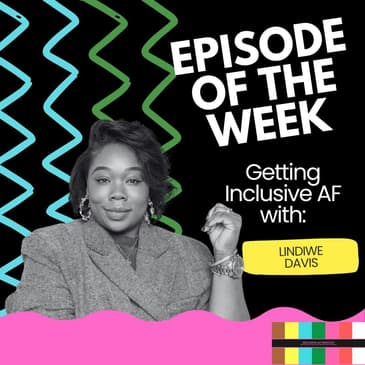
NEW EPISODE! Meet our latest guest, Lindiwe Davis.
Lindiwe is a multi-talented and multi-passionate individual. She is a founder, business creative, speaker, storyteller, and culture changemaker. As a Diversity, Equity, and Inclusion Leader, Lindiwe's daytime job in tech allows her to lead strategy and programming intended to educate and build awareness. She also mentors and coaches many professionals, with an additional focus on Black+ women. Lindiwe is known as The Couch Coach.
Lindiwe co-created, during the height of COVID, executive produced and co-hosted a storytelling podcast called "A Stranger Down The Hall," which focused on the experiences of New York roommates. Her skill for sharing stories and creating spaces for others to do the same is one of her defining gifts. As a speaker and media host, Lindiwe captures the silent corners of a guest's story that may not always be visible to others.
When she's not working on her projects, her business (FutureState Collective), the daytime job in tech, or building vision boards, Lindiwe enjoys spinning, kickboxing, and traveling.
Lindiwe has been featured as a speaker, panelist, and media host for NYU, Columbia University, Google Talks, Bloomberg Radio, SAG-Aftra, The Female Quotient, Women Tech Makers, Black Girls Code, WIN Summit, and more. She has interviewed talented artists such as actor Billy Bob Thornton, the cast of "Goliath," actor-comedian Jay Pharoah, writer-director Stefon Bristol, the cast of Broadway hit "Ain't Too Proud," and Pinky Coles, to name a few.
If you're looking for your next dynamic speaker, contact Lindiwe directly at lindiwedavis@gmail.com. You may also sign up for the "Coach Coach" here and follow Lindiwe on her journey via IG @lindiwe_speaks and @futurestate_collective
Powered by the WRKdefined Podcast Network.
[00:00:00] You're listening to Inclusive AF with Jackie Clayton and Katie Van Horn.
[00:00:09] Welcome, welcome to this solo episode of Inclusive AF. This is Katie Van Horn and my partner in crime is far, far away visiting and doing something very exciting and left me behind.
[00:00:25] But I'm actually very excited about that because I get to have a great conversation today.
[00:00:31] So we have the fortune of having a guest today that I think will have some really great insights into, you know, some of the education and awareness pieces that we all are looking at.
[00:00:44] And especially, you know, at this time in history, need to be talking about even more.
[00:00:48] And I already have a couple of questions that I've been thinking about all morning.
[00:00:53] So I hope you all are prepared and I'm going to turn it over to Lindiwe to introduce yourself and share a little bit about who you are.
[00:01:01] Thank you, Katie. I appreciate it.
[00:01:04] So my name is, of course, Lindiwe. Some people call me Lynn, last name Davis.
[00:01:09] I work in the tech space currently.
[00:01:12] I will tell you this, working in the tech space is a very interesting space to work in.
[00:01:17] But my background, I've been working for the past 30 years, but I've been in corporate America for about 26 years, working across various industries, including marketing, tech, little media, digital creative spaces, always within the niche of program management, business operations strategy.
[00:01:38] Very much a tactician.
[00:01:39] And so I've seen many, many things.
[00:01:42] I've gone from being everything from a fraud investigator at some point in my life to a quality auditor, to someone who teaches people how to be better communicators,
[00:01:52] all the way over to working in the DEI space, both informally when DEI was just getting started and not an acronym in and of itself,
[00:02:02] all the way over to now doing it at an official capacity for more than a few years at this time.
[00:02:07] So, but I will not take up too much more time because there's volumes to my story here.
[00:02:13] Yeah.
[00:02:13] I was going to say, I think that like the tip of the iceberg is always where we start with folks and then start digging in.
[00:02:19] So, I would love to hear a little bit about what you do today.
[00:02:23] Like, what are you working on and how do you support kind of the DEI space?
[00:02:28] Yeah.
[00:02:29] So, I think because I work in the function of program management as the foundation, right?
[00:02:38] That's the foundational tool that I use to kind of operate within a DEI space.
[00:02:44] And for me, a lot of my work is always anchored around the education piece.
[00:02:51] So, when you think about leaders, when you think about professionals just in general, the question always is, well, where are you in your journey, right?
[00:02:59] I think a lot of times we just throw these words and acronyms around, but we never consider where the person actually is with this thought process that they're just going to be able to activate, right?
[00:03:09] And that's not real.
[00:03:11] So, a lot of what I do, both internal to the tech space, but also external because I'm a coach, is always walking people through and helping them understand, like, where are you really in your journey?
[00:03:24] What is it that you're trying to accomplish, you know, with raising a hand and saying that you care about this work?
[00:03:29] And then also, what exactly do you want to activate on and how do you want to do that?
[00:03:34] What's your capacity?
[00:03:35] Because those things, if you're not answering those questions, then we're just kind of turning our wheels and we're just saying things, just to be saying things, you know?
[00:03:43] Absolutely.
[00:03:44] And I love the fact that you ask those questions because I think, yeah, it is one of, like, you can be a silent observer of things and go, oh, yeah.
[00:03:52] I, you know, I absolutely care about DEI.
[00:03:56] Absolutely.
[00:03:56] But if you're not willing to put in the work and, you know, I think this is also something that I really appreciate that you're acknowledging and honoring the fact that folks are at a different place.
[00:04:07] Every single person that you talk to is in a different place on their journey based on their experiences.
[00:04:11] So, yeah, I think that that's huge.
[00:04:13] So, I also think that you're a storyteller.
[00:04:18] I want to hear more about this, the stranger down the hall.
[00:04:23] So, tell me what was this all about?
[00:04:26] I need to hear about it.
[00:04:28] So, during COVID, I launched a podcast with one of my friends when I still lived in New York.
[00:04:37] And it just so happens that my co-creator and I, we executive produced, you know, created it, et cetera, on a shoestring budget when COVID launched.
[00:04:48] You know, that's a crazy, wild thing to say when COVID launched.
[00:04:51] But nonetheless, we put this podcast out that was meant to really share insights on what it means to have a roommate, right?
[00:05:00] No matter the situation, no matter your age, but using New York as the backdrop and almost as a character to each person's story.
[00:05:09] Because when people come to New York, they're coming for real reasons.
[00:05:12] They're coming to figure out who they really are.
[00:05:14] They're coming to make it to something, Broadway, music, theater, whatever it is, acting, dancing, business.
[00:05:22] But a stranger down the hall was really meant to capture some of those stories from the angles of which I was someone at that time, 30-something years old, leaning into 40 at the time.
[00:05:32] She was barely in her 30s, right?
[00:05:35] She was 20-something years old when she moved to New York.
[00:05:38] I was already in the 30s at the time when I moved to New York.
[00:05:40] And lo and behold, a lot of our stories had a lot of these cross-sections where we just met these very interesting people who used to do the wildest things that didn't quite make sense to our upbringing or where we were from, etc.
[00:05:55] But the joining string for all of those stories was the fact that all of these people had moved to New York for some form, some reason, school, etc.
[00:06:04] And so I urge everyone to please take a listen to that.
[00:06:08] We only did one season, but it was just a wonderful, wonderful experience listening to people's wild stories of people.
[00:06:17] I mean, we have stories about people who were roommates and disappeared.
[00:06:21] And then next thing you know, we hear from their parents.
[00:06:23] It was nothing like that, nothing nefarious where the person just, you know, something happened to them.
[00:06:28] No, it was just like, oh, they was here and then now they're not here.
[00:06:31] Okay.
[00:06:32] But you got the check, right?
[00:06:33] All right.
[00:06:34] Thank you, Mom and Dad.
[00:06:35] Appreciate you.
[00:06:36] Or like stories of, you know, people leaving cheese on countertops and wondering why there are creatures running around the apartment.
[00:06:45] Yeah.
[00:06:46] So to call it a stranger down the hall, we meant that.
[00:06:51] Like, oh, we got a roommate, but we don't know who the hell this person is.
[00:06:55] Yeah.
[00:06:55] I think I lived with the person that left the cheese on the counter in Arizona.
[00:06:59] So yeah, totally relate to that.
[00:07:01] You may not leave cheese or dairy nowhere on any counter and especially not in Arizona.
[00:07:07] Okay.
[00:07:08] No, yeah, no, absolutely not.
[00:07:09] Yeah, for sure.
[00:07:10] For sure.
[00:07:11] So tell me, you know, and I like that you're characterizing New York as its own kind of persona
[00:07:17] and its own story for sure.
[00:07:20] So tell me, what is your wildest stranger down the hall or your wildest New York story?
[00:07:26] Ooh-wee.
[00:07:27] I would say, I'm trying to think here.
[00:07:31] I think the thing, I think one of the things that, and this is something so small and maybe
[00:07:38] no one would even think twice about this.
[00:07:40] But for me, I feel like if you have to share a bathroom with someone, right?
[00:07:46] Oh, man.
[00:07:48] My mom was very much a stickler about, you know, you get up, you clean on certain days
[00:07:52] of the week, you know, you put yourself away, you make your bed up, all that stuff.
[00:07:56] So I grew up with that kind of mindset.
[00:07:58] You know, once you're in the shower, you rinse the shower down and you're done with
[00:08:01] it.
[00:08:02] Yeah, no.
[00:08:03] I had an experience where I would walk into the bathroom and it felt like Chewbacca.
[00:08:10] Had been in there.
[00:08:12] And I said, maybe Chewbacca live here.
[00:08:15] Maybe the Wookiees live here, you know, and I'm not aware.
[00:08:19] But the hair would sometimes look like it was going to get me, you know, in the bathroom,
[00:08:26] in the shower, on the soap.
[00:08:28] I don't know what it is about hair on soap, but I'm just saying.
[00:08:31] These are small pet peeves that, again, I know may not seem big, but in your mind in the
[00:08:38] moment when you didn't come from living with a roommate before having a roommate, right?
[00:08:43] Remember, I was in the 30s.
[00:08:44] I wasn't in the 20s.
[00:08:45] I had already bypassed all the roommate stuff earlier.
[00:08:48] I was a true grownup who had been working for 15 years at that time.
[00:08:52] Yeah.
[00:08:52] And I was starting my life over.
[00:08:54] So yeah, that's a wild story.
[00:08:57] Wild.
[00:08:57] That reminds me of a story, one of the episodes of Friends.
[00:09:01] I don't know if you ever watched Friends, but Joey and Chandler were fighting over something
[00:09:06] and they were talking about the soap, you know, using the shower.
[00:09:10] And Joey made the comment, well, what's the first thing you wash when you get in the shower?
[00:09:14] What's the last thing I wash when I'm done in my shower?
[00:09:18] And it was like, you know, okay, yeah.
[00:09:21] Yeah.
[00:09:21] But, you know, I think that's part of the fun, but I think we all probably have, you know,
[00:09:27] those stories that are the, like, who raised you stories?
[00:09:32] What's going on?
[00:09:35] And I kept thinking maybe it's an age difference thing.
[00:09:37] Maybe it's an experience thing.
[00:09:39] You know, I get it.
[00:09:40] Like, you know, everyone grows up differently.
[00:09:42] I get that.
[00:09:43] But I think as we become adults, the hope is that you absorb some of those best practices
[00:09:48] from other people, you know, and you put them into your repertoire.
[00:09:53] Yes, absolutely.
[00:09:55] Absolutely.
[00:09:55] So, you know, when you are looking for folks to mentor and coach.
[00:10:01] Yeah.
[00:10:02] Tell me, you know, who are you looking for?
[00:10:04] Who are the folks that you are helping that you're supporting in, again, in this space?
[00:10:10] Yeah, I think a lot of times I often get people that are probably within that first five years,
[00:10:17] first 10 years.
[00:10:19] And then, you know, in my day-to-day, I may have, you know, a VP or a director,
[00:10:25] both externally and internally.
[00:10:27] But as far as, like, my regular people, these are people who are just trying to figure out
[00:10:33] how to get their footing together, right, in the workspace.
[00:10:37] Because if you haven't been in the workspace for a long time, you may not have a navigation
[00:10:41] system just yet.
[00:10:42] And as you get older and the more experience you have, especially in corporate America,
[00:10:46] which is a training ground for people, you start to understand how you need to move.
[00:10:52] Because how I need to move, Katie, is very different than how you need to move, right?
[00:10:56] I'm a dark-skinned Black woman, you know, with this voice, this nose, these eyes.
[00:11:01] I know people can't see, but go look it up.
[00:11:03] But, you know, for the most part.
[00:11:06] And so for me, I typically have that base of people that are seeking out that assistance
[00:11:13] and really looking to have someone who's already done it to a certain extent.
[00:11:18] Whether, you know, it could be a number of things.
[00:11:20] It could be, how do I stand up for myself?
[00:11:22] It could be, I saw something happen the other day.
[00:11:26] I didn't really like it, but I didn't say anything.
[00:11:27] It could be, I'm so tired of this person mistreating me.
[00:11:31] What do I need to do?
[00:11:32] You know, it could be a number of things.
[00:11:35] But a lot of times I would say these are just the constant professionals, whether they're
[00:11:41] interns or getting ready to jump into management.
[00:11:44] Yep.
[00:11:44] No.
[00:11:45] And I think it's interesting because I, yes, I think you're spot on that you and I have
[00:11:50] very different roles of engagement.
[00:11:52] And, you know, every group does it, unfortunately.
[00:11:56] But I want to go, I want to ask you more about the coaching, but I also want to go the
[00:12:00] opposite direction and ask you when you're coaching and mentoring someone, what do you
[00:12:06] tell the leaders of those people that you're coaching on what they need to do to help support
[00:12:12] that person in a different way?
[00:12:14] Yeah.
[00:12:15] So that's really interesting conversations over the years.
[00:12:20] I once had a leader ask me, for example, you know, why do Black plus women leave companies?
[00:12:28] Right.
[00:12:29] And I said, well, it could be a myriad of reasons why they leave companies.
[00:12:33] But one of the big ones you might want to pay attention to is understanding what they need
[00:12:38] and understanding that when they come to you and tell you that there is an issue or a challenge
[00:12:42] or concern, that more than likely they're telling the truth.
[00:12:45] And you've got to take the time to really dig into the story of what it is that they're trying
[00:12:50] to express to you.
[00:12:52] Right.
[00:12:52] That's that's just a small thread.
[00:12:56] Right.
[00:12:56] That I've had to pull on.
[00:12:58] I would say thematically, a lot of times I get the question around, I don't know what
[00:13:06] I need to do for this group of people.
[00:13:08] And I don't want to come off as someone who's doing busy work or someone who's just trying
[00:13:14] to check the box.
[00:13:15] So what do I do?
[00:13:16] And so my question is always, well, are you asking this question because you want to feel
[00:13:23] better about these things?
[00:13:24] Are you asking this question because you're really ready to activate?
[00:13:28] Because if you're not really ready to activate, then we need to start all the way at the beginning.
[00:13:32] Right.
[00:13:33] And so, yeah, I get a lot of questions around how do I activate?
[00:13:38] What should I be thinking about right now, you know, in terms of my actions and movement?
[00:13:44] And my response to that is always, again, you need to figure out where you are right now.
[00:13:49] Are you at the beginning stages of understanding your own bias?
[00:13:53] Have you been someone that has impacted someone on your team or past teams that you've been
[00:13:59] on in a negative way?
[00:14:01] Do you ask your teams regularly about how they feel about the culture of the team?
[00:14:06] And if you have asked them, did you put a plan together for those insights?
[00:14:11] Did you put a timeline together?
[00:14:14] But those are some of the ways in which, like when I'm talking to people, I don't, there is
[00:14:19] no sugarcoating.
[00:14:20] We don't have time for sugarcoating.
[00:14:22] We have time to figure out what we're going to do, but we don't have time for sugarcoating.
[00:14:27] Like this is not that time.
[00:14:28] It wasn't that time five years ago.
[00:14:29] It wasn't that time 50 years ago, 100 years ago, 256 years ago.
[00:14:34] Like this is the time to figure out where you really are, especially if you're in a leadership
[00:14:41] role that has button pushing power.
[00:14:43] And then thinking about how you are actually going to set a standard, because that's very,
[00:14:48] very key.
[00:14:49] How are you setting a standard for the ways in which you and your other leaders are moving
[00:14:54] and activating and wanting to actually participate in the culture?
[00:14:59] Because a lot of times, you know, people are removed, right?
[00:15:01] You're in a leadership role, but you're in your mind.
[00:15:04] You're like, oh, yes, I'm doing just enough.
[00:15:07] I'm doing great.
[00:15:08] But you don't really know what's going on with the team.
[00:15:11] You haven't talked to Joe or Joanna or whoever the next person is to understand each of their
[00:15:18] journeys, right?
[00:15:19] You're just making a judgment call based off of maybe some data or something that your HR
[00:15:26] partner might have told you, you know, but you're not in the weeds and into the situation.
[00:15:30] And so I always want to remind people that in order for you to really know what's going on,
[00:15:35] know how to activate, make sure you're digging into the people because that's what this is
[00:15:40] really about.
[00:15:42] Do you love news about LinkedIn, Indeed, Google, and just about every other recruitment tech
[00:15:48] company out there?
[00:15:49] Hell yeah.
[00:15:50] I'm Chad.
[00:15:51] I'm Cheese.
[00:15:52] We're the Chad and Cheese podcast.
[00:15:54] All the latest recruiting news and insights are on our show.
[00:15:57] Dripping in snark and attitude.
[00:16:00] Subscribe today wherever you listen to your podcasts.
[00:16:04] We out.
[00:16:05] Love that.
[00:16:06] And, you know, I think I'm going to add a piece to what you said at the very beginning
[00:16:10] of your answer.
[00:16:11] I think it's, you know, listening to folks, believing them and realizing also the courage
[00:16:16] and the amount of pain someone must have gone through to actually go, I need to go to my
[00:16:22] manager about this.
[00:16:23] Because I think that's the other part that folks, you know, I'm sure you have the same
[00:16:29] experience.
[00:16:30] The amount of times that I, you know, when person, someone comes to HR and it's like,
[00:16:34] oh, I don't, you know, I've been thinking about this or this has been going on for so
[00:16:37] long and it's been, and you're like, oh my goodness, why didn't you come to me?
[00:16:41] At the very beginning.
[00:16:42] And we could have, but it's like, no, that I would never in a million years would I be
[00:16:46] going to HR.
[00:16:47] Never in a million years would I be coming and talking about this with my manager or throwing
[00:16:51] this at someone else's feet?
[00:16:52] Because there is that, again, fear of, but what, you know, are you going to believe me?
[00:16:58] Are you going to listen to me?
[00:16:59] Many things are coming to mind right now.
[00:17:02] Like when you think about how people stand up for themselves, I'm really in this space
[00:17:07] right now, especially when it comes to the coaching aspect or just giving insights when
[00:17:12] people come up to me at a conference or a panel or whatever the thing may be that, you
[00:17:16] know, you have to find whatever your level of courage is, you know, because my level
[00:17:20] of courage has been probably at a, if it's on a scale of 10, I'm probably sitting at an eight,
[00:17:26] seven and a half, eight, other people may be sitting at a three, right?
[00:17:31] So we also have to remember that too, that someone's level of courage may not be the same
[00:17:35] as yours.
[00:17:36] And so their approach might be slightly different, but the hope is that when you do decide to
[00:17:41] speak up for yourself or even just share what it is that you need, that it's truth,
[00:17:47] right?
[00:17:47] Because that's very, very key.
[00:17:49] Courage can be nothing else without the truth.
[00:17:51] It's got to be the truth.
[00:17:53] And so with that being said, you know, it is hard for a lot of people to kind of step
[00:17:59] themselves up into that space because even they may not know they have it.
[00:18:04] That's the other part that I've recognized too, when I'm talking to people, they may
[00:18:07] not know that they have this thing inside of them that's serving as their protector, but
[00:18:12] also their guide, you know?
[00:18:15] Absolutely.
[00:18:15] And I think, you know, it's the thought that as you were speaking kind of came to my mind
[00:18:21] was also, you know, we are of a certain age.
[00:18:24] And so I think there's also the courage that comes with that, of like, okay, yeah, kind
[00:18:28] of that, I won't say been there, done that, but you know, the ability to say, I won't take
[00:18:33] this.
[00:18:33] Like I think about myself in my twenties and what I allowed leaders, team members, whatever
[00:18:41] to do to me, you know, in front of me, whatever it might be.
[00:18:44] And now I'm like, oh no, no, no, this will not fly.
[00:18:49] And we're going to discuss this now.
[00:18:50] So I think that's part of it too.
[00:18:52] Yeah.
[00:18:53] I think the twenties was, gosh, man, I had a, I've always had a bullseye on my back somehow,
[00:18:59] some way, because I just couldn't stand this idea of someone making a fool of a person.
[00:19:04] Like I, that is probably one of my biggest pet peeves when, you know, people come after
[00:19:10] other people who may be the quote unquote more vulnerable person or maybe the person that just
[00:19:16] keeps their head down.
[00:19:18] But yeah, in the twenties I was speaking up, you know, it just wasn't what it was.
[00:19:23] I may not have had the strategic verbiage that I have now.
[00:19:31] Um, but I could tell you right now, like there is, we, again, we don't have time to be playing
[00:19:37] games and we're all living the life that we're trying to live for ourselves right now in
[00:19:43] the future, et cetera.
[00:19:45] And so the more time people are taking up, trying to take from you or harm for you or,
[00:19:49] or stop you from elevating and growing, it's like, we've got to, we've got to move all that
[00:19:54] out the way.
[00:19:55] We've got to move it out the way, you know?
[00:19:57] Um, from a, from a coach, uh, kind of mentor perspective, what are the challenges?
[00:20:05] And, you know, I, I know the answer to this question.
[00:20:08] I'm going to ask that question anyhow, though.
[00:20:09] What are the challenges that your clients are facing right now?
[00:20:14] And I mean, right now in July, 2024, knowing that we have a presidential election coming up
[00:20:20] that, and we have a, uh, Supreme court that hates women hates anyone that isn't a white
[00:20:29] male.
[00:20:29] Yeah.
[00:20:30] What, what are you working on with folks?
[00:20:34] What is kind of what's coming up for your, your clients right now?
[00:20:37] Yeah.
[00:20:38] So I, I, matter of fact, I was just at a conference, um, a few weeks ago and, um, I had some folks
[00:20:45] come to my coaching session because I was asked to be one of the coaches for this conference.
[00:20:49] And thematically, one of the things was how do I show up, right?
[00:20:54] How do I show up to ensure that I can be myself?
[00:20:57] That's one.
[00:20:59] Um, how do I show up to be myself and not feel like I'm giving away too much information?
[00:21:03] There's a trust factor here.
[00:21:06] We are in a time right now that at any point, what you say could somehow amalgamate itself
[00:21:13] into something that has nothing to do with who you really are as a person.
[00:21:17] Right.
[00:21:18] Um, and so that is a lot of people's fears that they can't even just be personable, that
[00:21:24] they can just, that they only can come to work and just do the job and then not say anything
[00:21:30] and then just go home.
[00:21:31] And I'm trying to let folks know, no, no, no, because now you're trying, now what you're
[00:21:37] doing is isolating yourself.
[00:21:39] Isolation, I don't think is ever good for a person.
[00:21:41] Yes.
[00:21:42] We all need our time to ourselves, go to an Island, go to a beach, go to a retreat, but
[00:21:47] not every moment of every single day.
[00:21:49] That is not, I don't think healthy.
[00:21:52] Right.
[00:21:52] And so that is one of the biggest things that I have, um, spoken to people about where
[00:21:58] it's like, how much of myself should I share?
[00:22:01] Because ultimately it could be used against me.
[00:22:04] Right.
[00:22:05] Um, the second thing is what am I going to do about the job that I'm in?
[00:22:11] Right.
[00:22:12] So across all industries, we've seen layoffs, we've seen quiet quitting.
[00:22:17] We've seen a myriad of things happen over the last, um, three years, two or three years.
[00:22:24] Um, and so, you know, we've seen the rise of remote work, even though that's the weirdest
[00:22:28] thing to say, because 20 years ago I was remote working story for another day.
[00:22:34] Um, so, you know, with that being said, a lot of people are thinking about, and at least
[00:22:40] the folks I've talked to and spoken to in sessions or just in passing, um, that they're
[00:22:45] trying to figure out, should I stay in this job or do I jump and do the thing that I really
[00:22:49] want to do?
[00:22:50] And so it's almost like this, um, we're in a time of what's the word I'm looking for,
[00:22:56] where you're kind of standing still.
[00:22:59] I'll call it the standing still moment.
[00:23:01] Like a lot of people are in that, okay, I'm just going to stand still and take the bird
[00:23:04] in the bush and not, I'm going to take the bird in the hand and not the one in the bush
[00:23:08] because I don't know what's out there.
[00:23:10] So I'm just going to stay here.
[00:23:12] And so my mindset is when I hear that kind of thing is, um, okay, well, if you stay at
[00:23:17] the position that you're in right now, how does that support the future state of you?
[00:23:22] Right.
[00:23:23] Um, and if you think it supports the future state of you, then stay put and create a plan
[00:23:27] for yourself because day one of any job, you should always have an exit strategy, no matter
[00:23:31] what.
[00:23:32] Not exit strategy when you get to five year mark or two year mark.
[00:23:35] No, your exit strategy should be ready to go the day that you're hired at a job.
[00:23:38] Um, so between those, those are probably the two main things I get.
[00:23:44] Should I jump, you know, to another space?
[00:23:47] Do I stay where I'm going to stay?
[00:23:49] And then how personable do I need to be, um, in jobs right now?
[00:23:54] Do I share what I think?
[00:23:55] Do I wear what I want to wear?
[00:23:57] What about my hair?
[00:23:58] You know, it's, it's everything across the spectrum of things, right?
[00:24:02] Oh, I work in the DEI space, but I don't know if I should say that all the time, you
[00:24:06] know, et cetera, et cetera.
[00:24:08] Yeah.
[00:24:08] I, I was recently on a panel with three other women.
[00:24:12] They're a CMO from a tech company.
[00:24:15] Um, my, uh, interim, uh, CRO and another woman that works for one of the industry groups
[00:24:23] that I'm a part of.
[00:24:24] And so we were on this panel and beforehand we did our, you know, prep call of course.
[00:24:28] And one of the women said, you know, Oh, I, I'd have to go to the board meeting and I,
[00:24:33] you know, it's black suit, you know, have to be the buttoned up and I have to show up
[00:24:38] that way.
[00:24:39] And, you know, the guys can show up in jeans and a blazer or golf shirt or whatever, but
[00:24:44] I have to take it, you know, that kind of next step up.
[00:24:47] And so we all kind of made a decision together.
[00:24:50] We're going to wear our, you know, brightest, loudest, uh, I wrote, I wrote a vote, uh, like
[00:24:56] Ruth sent you shirt.
[00:24:57] You know, like it was one of those, like, like we actually can show up as ourselves.
[00:25:01] Absolutely.
[00:25:01] That is a scary thing for folks.
[00:25:03] And, you know, and I think it does impact everyone because it is, especially for black
[00:25:09] and brown women, it's the proving yourself over and over and over again in every single
[00:25:16] room, every single day, all day long.
[00:25:19] And so I think that's the, I think people don't understand that or understand like why
[00:25:25] that, like, well, why do they have to do that?
[00:25:28] Talk a little bit about that and kind of talk about, you know, your thoughts on kind of why
[00:25:34] that is and what that does to folks.
[00:25:37] Yeah.
[00:25:37] Um, I think with feeling like you have to show up a certain way, you know, over the
[00:25:44] years, we've always heard these arguments about, oh, you can't wear your hair a certain
[00:25:49] way.
[00:25:49] You can't, um, wear your earrings a certain size, you know, et cetera, et cetera.
[00:25:54] And your makeup should look a certain way.
[00:25:56] Your skirt has to be at this length or that length, et cetera, et cetera, et cetera.
[00:26:01] But it's a lazy man's argument on the outside because it keeps that lazy man argument person
[00:26:07] able to categorize people.
[00:26:10] Okay.
[00:26:10] Um, so, you know, if I'm, if I come to work and I don't speak with this good talk, as I've
[00:26:18] been told, um, it'll be easy for someone to categorize me and put me into a box of being
[00:26:23] a stereotypical black woman.
[00:26:25] Um, and they lift that stereotype by adding more adjectives to that box, uh, because I
[00:26:32] am dark skinned because I have this nose because I'm not, um, the traditional look of what someone
[00:26:40] would accept as pretty, you know, et cetera, et cetera, et cetera.
[00:26:44] Now I know what's true about me and about amazing black and brown women across the spectrum, no
[00:26:50] matter what shade they are.
[00:26:51] But in real life, I'm just giving you the example of how people kind of build this narrative,
[00:26:58] right?
[00:26:58] Of what somebody is, which is why we as black and brown women and women in general feel
[00:27:04] like we have to show up ever so sleek, ready to talk in the conversation and the meeting,
[00:27:10] got to be overly prepared and ready to go.
[00:27:13] You've got to be prepared for the meeting and you've got to be prepared for the naysayers.
[00:27:18] So that's just double work and double energy already, right?
[00:27:22] Then on top of that, you got to be prepared for the person in the meeting who is going
[00:27:26] to try to steal your idea.
[00:27:28] Okay.
[00:27:28] So that's the third thing you got to be prepared for.
[00:27:31] Um, and now you have to also worry about how you look when you walk into the room, because
[00:27:37] heaven forbid you walk into the room with a great, amazing vintage t-shirt and a pair of
[00:27:42] jeans and a cute sandal.
[00:27:44] Right.
[00:27:45] But with this good talk and three degrees behind me, who cares about that?
[00:27:49] Right.
[00:27:49] Like people will try to play on your face many times over as a direct result of those categories
[00:27:56] and boxes and adjectives that they like to add amongst the stereotypes and biases that
[00:28:01] they've built up in their own minds, right?
[00:28:04] Per the environments that they come from, or just not having culture under their belt, not
[00:28:08] having lived experience, et cetera.
[00:28:11] Um, but having to come into the rooms to answer your question in this hypervigilant way is
[00:28:17] really about safety.
[00:28:19] What we are seeking on a regular basis is to be safe in every aspect of our life.
[00:28:24] If we walk into the boardroom, we need to feel safe.
[00:28:28] How do we do that?
[00:28:29] We arm ourselves with the things that I was just talking about.
[00:28:32] I'm prepared.
[00:28:33] I know what I'm talking about.
[00:28:34] I'm experienced.
[00:28:36] I look great.
[00:28:37] I feel great, you know, et cetera.
[00:28:39] But I want us to start to get into a space where it's like, I don't need to adhere to someone
[00:28:47] else's rule of thumb of looking a certain way.
[00:28:50] And someone, some people may say that's a fairytale land, but for me, I wear my big earrings.
[00:28:55] You know, I wear the jewelry that I want to wear.
[00:28:58] If I want to put a suit on and I've got a vintage t-shirt on under it.
[00:29:02] Oh, well, then that's what it's going to be.
[00:29:04] If I have a heel on or if I have a sneaker on, it doesn't change the fact that I came
[00:29:10] more prepared than you.
[00:29:12] And I actually do know what I'm talking about.
[00:29:14] And I do have the experience to back up what I'm saying.
[00:29:18] So, but this comes back to, again, how do we feel safe in rooms for the jobs that we've
[00:29:26] been assigned and earned?
[00:29:28] Mind you, let's put that on there.
[00:29:31] And ensure that we have space to live in that space and to actually take up space.
[00:29:38] Because a lot of times, again, those categories and boxes can make a person feel like they're
[00:29:43] not supposed to be there.
[00:29:45] Right.
[00:29:46] When you've actually earned your spot, you've actually earned your position.
[00:29:50] And again, there's nothing to prove.
[00:29:51] Another point that I like to bring up with people on a regular basis, you don't have,
[00:29:54] you're not living this life to prove something to somebody else.
[00:29:57] No, right.
[00:29:59] No.
[00:30:01] And I love that also, you know, the fact that you do work with folks of different ages and,
[00:30:08] you know, with different levels of experience, because I think that's part of it too, is that
[00:30:11] we have a group of folks that are joining the workforce or have recently joined the workforce
[00:30:18] that are in a very different world than when you and I joined the workforce in some ways in a very
[00:30:26] good way.
[00:30:26] And then in some ways in a not so good way.
[00:30:29] And so there's just so many different things to be thinking about and, and so many ways that folks
[00:30:34] can take this even one step further or go even, you know, go farther.
[00:30:39] So I love that.
[00:30:40] Um, so I, I would love to, you know, when you're thinking about your coaching clients, what are
[00:30:47] some of the tools or what are some of the resources that you find are really helpful?
[00:30:52] Obviously not giving away any of your proprietary information, but what are some things that,
[00:30:57] you know, if, if, if folks want to start looking at the way that you coach, what are some things
[00:31:02] that you offer and what are some things that folks can use today to kind of get themselves
[00:31:06] started?
[00:31:07] Yeah.
[00:31:08] I think the first thing, the, the very first thing I'm, I ask people typically is why did
[00:31:15] you even come to talk to me?
[00:31:18] Because a lot of times, you know, we've got a lot of amazing resources everywhere.
[00:31:23] You know, we all can take workshops and go to YouTube and, you know, go to this platform
[00:31:27] and that platform.
[00:31:28] But the question is, why did you, after reading my bio, decide to come and talk to me?
[00:31:35] You know, what was the allure?
[00:31:37] What is it that you are looking for?
[00:31:39] Because if you understand that, it'll make it a little bit easier for us to guide ourselves
[00:31:43] together in partnership through coaching.
[00:31:47] That's the first thing.
[00:31:48] The second thing is that when I get the answer to that, it makes it a little bit easier for
[00:31:52] me to really insightfully in an authentic way, give a response that is organic to the person
[00:31:59] so that they understand that I'm in the moment with them right now.
[00:32:03] Like I didn't have time to think about this 60 days before because you just signed up.
[00:32:08] So now that we're having this conversation, you can see me now thinking and chewing on
[00:32:13] the things that you just told me.
[00:32:15] And I'm spitting those things back out to you in a way that lets you know that I've not
[00:32:19] only taken it in, but I'm ready to hear what you have to say and organically build out
[00:32:24] some of the ways in which you can move for which it is that you're looking for.
[00:32:28] I think the third thing is that if there's something that someone's struggling with,
[00:32:33] for example, confidence.
[00:32:35] I like to tell people, and this is just one of those things, but I like to tell folks,
[00:32:39] listen, if there's a day of the week that you feel it coming up where you're like, oh,
[00:32:43] I'm having not the best week.
[00:32:45] Yesterday, this person was talking to me a certain way.
[00:32:48] I didn't speak up.
[00:32:49] I'm known for not speaking up for myself.
[00:32:53] And I just keep everything to myself.
[00:32:55] I let people know whatever that thing is that's coming to you on a regular basis, you need
[00:33:01] to treat that thing like a person and you put them right on the bench.
[00:33:05] We all have, think about the movie Inside Out, right?
[00:33:08] We have all these amazing emotions and thoughts and things like that that are running around.
[00:33:13] Sometimes they collide, you know, we're at one moment we're over here with a little wine.
[00:33:18] The next moment we're over here laughing, you know, but think about that thing, treat it like a
[00:33:23] person.
[00:33:24] And if you don't need it at that time, you can move that person right on over to the side because it's
[00:33:29] not serving you.
[00:33:30] And then the second part about that is if, for example, you have experienced that on a regular
[00:33:35] basis, let's just say you're someone who, you know, questions yourself and on a weekly basis at
[00:33:42] your job, then I want you to take one day out of the week and put it away.
[00:33:47] So Wednesdays is, we'll call it, I don't question myself, Wednesdays.
[00:33:52] You get up in the morning time, you put the outfit on you want to put on.
[00:33:55] You don't double check.
[00:33:56] Nope.
[00:33:57] You put the outfit on, you walk out the door because you're feeling good.
[00:34:00] You get into work, the meetings start.
[00:34:03] You have to deal with that one person because there's always one person at your job who's
[00:34:08] on your last nerve, okay?
[00:34:10] Where you're just kind of, okay, this person's got my eyebrow up already.
[00:34:16] But, you know, confident Wednesdays.
[00:34:19] You can't tell me nothing.
[00:34:20] I showed up.
[00:34:22] I'm a good person.
[00:34:23] I'm doing what I'm supposed to do.
[00:34:24] I'm not going to question myself.
[00:34:26] And every week I want you to do that until you get to a place that every day it's just
[00:34:31] something that becomes a part of your lexicon, right?
[00:34:34] Just a part of your routine, just like drinking water.
[00:34:37] But you start with one day so that you can build to two days.
[00:34:40] 30 days later, you build to three days until it's just a part of who you are as a person.
[00:34:47] We'd never admit it.
[00:34:48] But deep down, we all get at least some pleasure from bad things happening to somebody we don't
[00:34:53] like.
[00:34:54] History's full of stories about bitter enemies being mutually horrible.
[00:34:57] Usually nothing good comes of it.
[00:34:59] But sometimes, sometimes, you get soul singers James Brown and Joe Tex or 17th century nun
[00:35:06] Sor Juana and the entire Catholic Church duking it out and dramatically changing our world.
[00:35:11] On Beef with Bridget Todd, we tell the stories of those petty feuds behind some of the greatest
[00:35:16] art, innovation, and global events.
[00:35:19] Listen to Beef wherever you get your podcasts.
[00:35:23] I love that.
[00:35:24] Yeah, I think the idea of, you know, kind of the, you know, you said taking in what folks
[00:35:30] are saying, processing that and meeting them where they are and with what they have brought
[00:35:36] to the table.
[00:35:36] You know, you mentioned earlier, like what, where they are in their journey.
[00:35:39] I think that's something that, you know, sometimes we just overlook that, you know, you and I,
[00:35:44] you know, just met today.
[00:35:45] And obviously you and I have had very different backgrounds, very different experiences,
[00:35:49] very different perspectives.
[00:35:51] And being able to sit with someone for an hour and just say, let's talk and let's have
[00:35:56] a conversation and being able to go, tell me what's going on.
[00:35:59] Tell me, you know, tell me about you.
[00:36:01] Tell me about all of the things that kind of are on your mind.
[00:36:03] I think it's huge.
[00:36:04] But I love also the, you know, taking that, that confidence and having that confident
[00:36:10] Wednesday or, you know, whatever it is to be able to go, I can do this.
[00:36:15] Because I think it's something that, yeah, we all have that one person that, yeah, gets
[00:36:20] on our nerves or you feel like they don't buy it or whatever it might be, you know, then
[00:36:25] you say to them, Hey, actually, no, today they, they are going to buy it because they,
[00:36:29] I am good at this.
[00:36:30] I do know what I'm doing.
[00:36:31] You know, whatever, whatever.
[00:36:33] So I love both of those are great.
[00:36:35] When you, so I'm going to shift just a little bit.
[00:36:39] So, um, you do, so you've met some very interesting folks and you've done some different media items.
[00:36:46] So I want to talk to you a little bit about, um, the interviews that you have done.
[00:36:53] Um, and so, you know, the cast of the Broadway hit, Ain't Too Proud, uh, Jay Farrow, cast
[00:37:00] of Goliath, you have quite the, the, the, uh, resume, if you will, of folks.
[00:37:06] Oh, thank you.
[00:37:06] Yeah.
[00:37:07] So tell me how, how those came about and how did you get involved in kind of having
[00:37:12] those conversations with folks?
[00:37:13] Yeah.
[00:37:14] So, um, that I have been a dreamer my entire life, right?
[00:37:20] When I was younger, I knew I was going to be three things in my mind.
[00:37:25] Right.
[00:37:25] I said, I'm going to be an attorney.
[00:37:28] I'm going to be a choreographer slash dancer.
[00:37:30] I'm going to be, uh, um, a designer, but like a computer designer, at least that's what
[00:37:36] was back in the day.
[00:37:37] Okay.
[00:37:38] Um, and so I was like, okay, I'm going to be all three of those things.
[00:37:42] My mom was such an encouraging person.
[00:37:44] She was a person who cared about our education and wanted us to have a good life.
[00:37:47] So she never, she was never that person.
[00:37:49] That's like, Oh, you can only have one dream.
[00:37:51] No, she was very much like, okay, yeah, yeah.
[00:37:53] Let's, let's see how we can culminate some of these things.
[00:37:56] You know, she was very much that person, which is why I'm like that now.
[00:37:59] Like, I don't think you should have just one dream.
[00:38:01] I think you can have many dreams and you just knock them down as you go.
[00:38:04] Um, and so I was going to school originally thinking I was going to become an attorney.
[00:38:08] I'm like, Oh yeah, I'm going to go into law enforcement at five foot two.
[00:38:13] I'm going to be, you know, some sort of superhero Marvel.
[00:38:16] Okay.
[00:38:17] Uh, fighting crime.
[00:38:19] And, uh, I'm going to be an attorney and I'm going to be helping people, you know?
[00:38:23] And then when I found out the crazy hours, that was probably secondary, but when my mom
[00:38:30] got sick and ended up passing away, it changed my trajectory because deep down inside, when
[00:38:37] I was a kid, I also saw a woman by the name of Oprah Winfrey who would interview people.
[00:38:43] And I said, Ooh, I want to do that.
[00:38:45] That's that looks good.
[00:38:46] That looks like a good thing to do.
[00:38:48] You get to talk to people all day.
[00:38:50] Okay.
[00:38:51] Let's see what I can do again.
[00:38:53] Thinking about, Oh, I want to be an attorney too.
[00:38:56] Okay.
[00:38:56] I got to make money to take care of myself.
[00:38:58] Ooh.
[00:38:58] I want to make sure I can take care of my mom.
[00:39:00] Like all of those things were just kind of running in my mind.
[00:39:03] And so, uh, going to school for the standardized way of being, so you could support yourself
[00:39:08] is where I was kind of headed.
[00:39:10] But when my mom passed away, I changed trajectories.
[00:39:13] I finished my political science degree.
[00:39:15] Um, and then I went and got an English degree.
[00:39:18] Right.
[00:39:19] Um, and then after that, I went and got into my dream school at NYU, um, for a master's
[00:39:25] in digital and print media media.
[00:39:27] And, um, I figured this is really going to help me get a foot in the door and I'm doing
[00:39:32] it in New York.
[00:39:33] So yeah, people are going to find me.
[00:39:36] I'm going to go right onto New York because it's my dream.
[00:39:39] I waited.
[00:39:40] It took me 20 years to get here.
[00:39:41] I'm 30 something years old now at the time.
[00:39:44] Um, and they're just going to know they're going to like my voice because people have
[00:39:47] always told me they love my voice.
[00:39:50] Um, and, uh, somebody is just going to find me on the street.
[00:39:53] Like again, I'm a dreamer.
[00:39:58] So that's not how it works.
[00:40:00] I'm still, but I still want that to be the case.
[00:40:02] That's not how it works.
[00:40:05] Listen, that's my plan.
[00:40:07] That's my plan for the man of my dreams.
[00:40:09] So, you know, I'm just hoping I could just be walking down the street.
[00:40:11] You wouldn't mean both.
[00:40:12] I'm over here like, okay, uh, Lord, make it happen.
[00:40:15] Okay.
[00:40:15] Hear me.
[00:40:16] I know you can hear me with this voice.
[00:40:18] So basically, you know, in my mind, I'm like, I'm going to walk down the street.
[00:40:22] Someone's going to hear me talking and be like, oh, girl, let's get you into the door.
[00:40:26] Um, so being in New York, getting my master's at the time at NYU, which was my dream school.
[00:40:31] It only took me 20 something years to get there.
[00:40:33] Uh, you know, I just thought, okay, I'm going to explore this.
[00:40:37] I'm going to be behind the camera though.
[00:40:39] If I can get behind the camera, then maybe I can develop a way for myself to get in front
[00:40:43] of the camera.
[00:40:44] And so next thing, you know, I went on some random audition, you know, uh, for something
[00:40:50] that AOL was doing at the time.
[00:40:51] And this is really right before digital really started to explode and social media was a thing,
[00:40:57] you know, et cetera, et cetera.
[00:40:58] It was like right at that beginning space.
[00:41:00] Um, and I went into some audition.
[00:41:02] I don't even remember the whole thing because I don't have my diary in front of me, but nonetheless,
[00:41:06] um, went into do this audition to be in front of a camera for some webisode that they
[00:41:11] were developing.
[00:41:12] I had no money.
[00:41:14] I didn't have a headshot.
[00:41:15] I went to Kinko's.
[00:41:18] Okay.
[00:41:19] I went to Kinko's the night before, spent little change that I had printed up a picture
[00:41:25] at Kinko's on the best paper that I guess a couple of dollars could buy.
[00:41:31] I put it into a little folder.
[00:41:33] I have my resume printed out and I was just hoping that I would have a shot.
[00:41:38] Right.
[00:41:38] And so I did my makeup.
[00:41:41] You know, I, to this day, I barely know how to do full face makeup.
[00:41:46] Um, you know, I would consider myself definitely ever learning on knowing how to put on makeup,
[00:41:52] but I do pretty well for myself now.
[00:41:54] Yes.
[00:41:55] Yes.
[00:41:55] Now I show up at the audition.
[00:41:58] I was always very, very stylish person.
[00:42:01] Um, that was the one thing I had going for me.
[00:42:03] I knew how to style myself.
[00:42:05] I knew how to do my hair.
[00:42:07] Um, and I just had a great voice.
[00:42:09] I knew that.
[00:42:10] So I get there, I get past round one.
[00:42:12] I'm like, all right, we're on the path.
[00:42:15] We're on the path.
[00:42:16] And then I get to round two.
[00:42:19] I'm in a room.
[00:42:20] It's a, the round two people, right.
[00:42:22] Who made it to round two.
[00:42:23] Then there's, um, a panel of people who were just kind of looking at us and I'm like,
[00:42:27] Oh, okay.
[00:42:29] All right.
[00:42:29] We about to get into something interesting.
[00:42:31] Let me just take a deep breath, uh, because this is what you hear about in the movies.
[00:42:36] Uh, and so they get to me and they start asking me questions.
[00:42:39] They're like, you don't sing.
[00:42:40] I said in the shower.
[00:42:42] Okay.
[00:42:44] Um, and so one of the panelists was like, with that kind of voice, we would assume that
[00:42:48] you are a singer.
[00:42:49] Cause you got a great voice.
[00:42:50] I said, you know what?
[00:42:51] Let's get that on the tape so I can prove it to my friends that people think that I can
[00:42:56] sing.
[00:42:56] Okay.
[00:42:57] Um, but, uh, I get it.
[00:43:00] I get past round two, um, uh, or the end of round one, which was leading into round two.
[00:43:07] And then I had to do the second part of round two, which was testing on camera with this,
[00:43:11] you know, second person who I believe was going to be the actual co-host.
[00:43:14] And they asked me a series of questions.
[00:43:16] I answered the questions in front of camera with him.
[00:43:18] I think like rapport.
[00:43:19] And then I didn't get a call back.
[00:43:21] And so, although I had received praise throughout the process, didn't get a call back.
[00:43:26] And I just said, well, all right.
[00:43:30] All right.
[00:43:31] And so I continued to finish up my degree.
[00:43:33] I was grinding, struggling in New York, taking on all the jobs you can think of as an intern,
[00:43:38] again, as a 30 something year old who had more than enough experience to have should have
[00:43:42] secured some sort of senior role, but did not.
[00:43:44] Um, and, uh, fast forward, I get a call, um, you know, for a job offer to be a contractor
[00:43:53] at Google.
[00:43:54] Um, and, uh, what ended up happening that careened into a full-time position.
[00:43:59] And then fast forward, um, someone, someone was looking for someone to interview a few
[00:44:07] folks, um, for Google talks.
[00:44:09] And so I said, well, it's a leap of faith.
[00:44:11] All right, Lord, we're going to take it.
[00:44:14] And so this lovely person reached out.
[00:44:16] I'm still a connect of hers to this day.
[00:44:19] And, um, that was how I got that first Google talks interview.
[00:44:24] But the, how I branched out of that was through a series of connections.
[00:44:30] Um, when I was interviewing a few folks for SAG, um, that was through one of my connections
[00:44:36] of another connection that I met again, people connections are super important.
[00:44:40] You never know.
[00:44:42] Um, and so again, be kind people be kind.
[00:44:47] Um, that was how I got, you know, those interviews with, um, like the SAG platform, the, um, Billy
[00:44:55] Bob, uh, and the cast of Goliath.
[00:44:58] That was a, that was a wild thing that just popped up and, you know, they were looking for
[00:45:05] someone to moderate the conversation.
[00:45:07] I had already had the relationship with the person that was kind of overseeing, um, you
[00:45:12] know, the platform.
[00:45:12] And I just said, yeah, put my name in out there.
[00:45:15] And if they accept, they accept, you know?
[00:45:17] And so of course they accepted.
[00:45:19] And, um, I just remember that day I was not having the best day working.
[00:45:25] Um, and, you know, I think sometimes God sends you signs, right?
[00:45:30] Whatever you believe in God, the universe, spirituality, whatever it is that is your thing.
[00:45:35] That you believe in.
[00:45:35] It's like, you always receive these messages if you're really listening and paying attention.
[00:45:40] And so I, you know, ended up getting the moderating job.
[00:45:44] Typically when I moderate or interview people, I'm very relaxed.
[00:45:48] Um, and it's because I know I'm in my element.
[00:45:51] Uh, let me throw that gem out there for everybody.
[00:45:53] When you know that you're, when you're doing what you're supposed to be doing, it feels very
[00:45:56] normal.
[00:45:57] It feels very calming.
[00:45:58] You're not nervous about it, right?
[00:46:01] You just love it and you just go and do it.
[00:46:04] And so for me, um, I'm never as nervous about meeting people and I meet him.
[00:46:10] He's everything that you would think he would be.
[00:46:13] And then some, he's very calm, right?
[00:46:15] Very calm, very kind.
[00:46:17] Um, we just had a brief conversation in the green room and then, uh, we get on stage and
[00:46:24] I interviewing him and I can't remember which season of the cast I was interviewing.
[00:46:28] I want to say it was season two, but I'll have to go back and look, but nonetheless,
[00:46:31] great show.
[00:46:32] If you haven't seen it, um, everyone on the cast was super gracious, super kind.
[00:46:36] And, um, down to the producer telling me, he's like, you might need to get a different
[00:46:42] job because this is your thing.
[00:46:44] Like, you know how to interview people.
[00:46:47] And so when we walked off the stage, of course, you know, people are like, Hey, you know,
[00:46:51] Hey, whoever the cast member, blah, blah, blah.
[00:46:53] Um, so I'm just kind of walking back to the green room.
[00:46:56] He's walking back with me and he's like, you're really good at this.
[00:46:58] And it was just like a really wonderful compliment to have received from this gentleman who has
[00:47:03] been acting for a very long time.
[00:47:06] Um, and I just kept thinking like that changed my whole day because I was having not the best
[00:47:12] day.
[00:47:13] Um, I knew I was going to do a good job with this because this thing I care so much about.
[00:47:17] I care about talking to people and getting their story out, but that's kind of how some
[00:47:22] of these opportunities have come.
[00:47:23] They've come through connection, but they've also come from people kind of seeing, you know,
[00:47:29] my interviewing style.
[00:47:31] I've been told that my style is very much a, uh, that people feel like they, uh, I'll just
[00:47:37] say it like this.
[00:47:38] A friend of mine said, when I watch you interview, it's like, you're on a date.
[00:47:41] I said, what?
[00:47:44] She goes, that's how you get these people to open up.
[00:47:46] I said, okay, you just be flashing your dimples.
[00:47:51] I'm like, I'm not flashing my dimples.
[00:47:53] What is going on here?
[00:47:54] Um, so.
[00:47:57] Hey, you gotta use your assets, whatever, you know, you gotta, you gotta use what you have
[00:48:01] and bring folks along on the journey.
[00:48:03] That is it.
[00:48:04] So I was like, let me flash them some more and see if we can get some different guests
[00:48:08] and figure out some initial projects.
[00:48:10] But yeah, when I do this, when I interview, when I moderate, it's just my thing.
[00:48:15] And, um, because I care so much about people owning their story.
[00:48:20] That's the biggest thing for me.
[00:48:21] It's like, whatever your story is, I don't, I don't want to be able to tell the story better
[00:48:26] than you.
[00:48:27] You should be able to tell the story better than me.
[00:48:30] I'm just trying to bring it out of you so that you know that it's valid, that you're
[00:48:34] acknowledged and that you got somebody listening to it.
[00:48:38] Yeah.
[00:48:39] Yeah.
[00:48:39] So love that.
[00:48:40] Yeah.
[00:48:41] All right.
[00:48:42] Linda, we, let me ask you, what is one thing or one or two things that you want our folks
[00:48:47] to have heard during this conversation?
[00:48:52] I want them to know that their level of courage is so much higher than they ever could imagine.
[00:48:57] And whatever adversity they may be faced with in their job and in their life, that they deserve
[00:49:04] so much more than what may be presented to them.
[00:49:07] And that they can seek out a tribe if they need a tribe.
[00:49:11] And if they need to walk the dance by themselves, you're only dancing by yourself for a little
[00:49:15] while.
[00:49:15] Typically people join in after they see you.
[00:49:18] That's the first thing.
[00:49:19] The second thing is that, um, you deserve to be happy.
[00:49:25] And your level of happiness is not what someone else says it is.
[00:49:28] It's what you say it is.
[00:49:30] Um, and so if you're the dreamer, then be the dreamer.
[00:49:33] If you are the person that needs to be the strategist so that you can dream, be that.
[00:49:39] Um, if you are the person at the job that speaks up because no one else does be that.
[00:49:44] Um, but whatever it is, just be authentic to you.
[00:49:48] Awesome.
[00:49:49] I think, you know, that you've given a ton of gems during this conversation.
[00:49:53] I think, you know, the, the courage part is one that I think, you know, has kind of come
[00:49:58] through this entire time we've been speaking.
[00:50:00] But I, I also, I love the idea of.
[00:50:04] You know, what you just said of.
[00:50:06] You'll know when you're in the right space, cause it'll feel right.
[00:50:10] It'll feel comfortable.
[00:50:11] It'll feel like this is what you're supposed to be doing.
[00:50:13] So, no, I love that.
[00:50:15] Uh, so thank you.
[00:50:17] Thank you for joining me.
[00:50:18] Uh, and again, uh, we, we missed out on Jackie today, but we'll definitely get her, uh, for
[00:50:25] the next time we all check, check in and have a conversation.
[00:50:28] Oh yeah, for sure.
[00:50:29] So, uh, thank you all for listening.
[00:50:31] This is Katie Van Horn from the Inclusive AF podcast.
[00:50:35] Bye.
[00:50:41] Imagine how fast we could solve the world's biggest problems if more SaaS startups would
[00:50:46] gain traction sooner.
[00:50:48] Welcome to the Tech Entrepreneur on a Mission podcast.
[00:50:51] This podcast is dedicated to sharing experiences from B2B SaaS CEOs who are going above and beyond
[00:50:57] to deliver change that is noticed.
[00:50:59] You will hear their secrets and learn what is required to build a SaaS business that the
[00:51:04] world starts talking about and keeps talking about and how to overcome the roadblocks to do
[00:51:10] so.
Sponsors
