
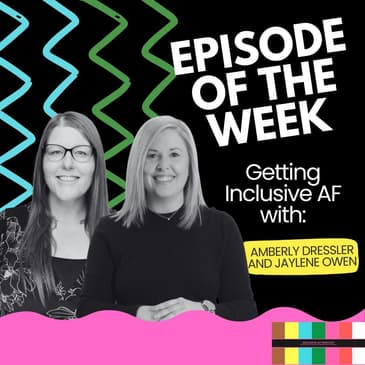
🌟 Welcome to another episode of The Inclusive AF Podcast! This week, hosts Katee Van Horn and Jackye Clayton are joined by special guests Amberly Dressler and Jaylene Owen to dive into the unique world of HR in remote Alaska. 🌟
🛖 Amberly Dressler, corporate marketing lead at isolved, and Jaylene Owen, the HR Director at Hames Corporation in Sitka, Alaska, share incredible insights on handling HR challenges in rural areas. From the fascinating environment of Mount Edgecumbe Boarding School to the resilience required for recruitment and retention in isolated communities, this episode is packed with valuable information! 🌐 Discover how isolved's solutions have empowered Jaylene and her team to digitally transform their operations, and hear heartwarming stories about community support during critical times like the 17-day Internet outage in Ketchikan. 🏞️ Whether you're interested in HR, community building, or the breathtaking wilderness of Alaska, this episode has something for everyone. Don’t miss out on Amberly's book "Center of the Pendulum" and learn about the inspiring work of the Key Training Center in Florida.
🔗 Tune in now and join us for a journey into the heart of Alaska's HR dynamics! And don't forget to like, comment, and subscribe for more Inclusive AF content!
#InclusiveAFPodcast #HRChallenges #RemoteWork #CommunityBuilding #HumanResources #iSolv #MountEdgecumbe #SitkaAlaska #WorkforceDiversity #OrganizationalTransformation #AlaskaLife #iSolvSolutions #AmberlyDressler #JayleneOwen #RuralRecruitment #EmployeeEngagement #DigitalTransformation
💬 Got feedback or questions? Drop them in the comments below! We'd love to hear from you. 💬
Thank you for watching! ✨
Powered by the WRKdefined Podcast Network.
[00:00:00] You're listening to Inclusive AF with Jackie Clayton and Katie Van Horn.
[00:00:09] Hello, hello, Jackie.
[00:00:11] Hello, Katie. How are you doing?
[00:00:13] I'm good. I'm very good. I am not at all concerned about getting food on the table on Thursday for Thanksgiving.
[00:00:20] That's not a concern I have with, you know, 24 people showing up at my house on Thursday.
[00:00:25] Good.
[00:00:26] Everything's going to be fine. It's fine.
[00:00:28] And it'll be fine when I eat everything in the refrigerator to make space for all the groceries that we have to put in the refrigerator.
[00:00:34] For reals.
[00:00:35] Including the gingerbread pigs that we had to eat this past week.
[00:00:39] Gingerbread pigs. Okay. I like that.
[00:00:42] It's a tradition. And, you know, it was my yellow coupon at the HEB. And that's what we did.
[00:00:48] All right. I like it. I like it a lot.
[00:00:50] Yeah. We are doing the full on traditional Thanksgiving here.
[00:00:57] But, you know, we'll see how all that goes.
[00:01:00] But this is the Inclusive AF Podcast, folks.
[00:01:03] Jackie and I are here and we have some friends we would like to introduce you to.
[00:01:08] Not including Penny, who is putting her nose into the picture just to show off that she's here as well.
[00:01:14] But I am going to turn it over to, well, let's start with you, Amberlee, if you want to introduce yourself and share a little about who you are.
[00:01:22] Yeah. Thanks so much for having me and our other friend who we're going to introduce shortly.
[00:01:26] My name is Amberlee Dressler and I lead corporate marketing at iSolved.
[00:01:30] And I have a little friend out the door named Barkley, who is really eager to get inside.
[00:01:37] Hello. My name is Jaylene Owen.
[00:01:38] I'm the Human Resources Director for Hames Corporation based in Sitka, Alaska.
[00:01:44] And folks, if you don't know where that is, you're going to have to get out your maps for this episode.
[00:01:49] So, you know, we know it's in Alaska.
[00:01:52] That's as much information as we have right now.
[00:01:54] And we know it's a ruler.
[00:01:56] You need a ruler.
[00:01:57] A ruler as well?
[00:01:58] Yeah.
[00:01:59] That's fair.
[00:02:00] And probably a boat and helicopter and an airplane and all.
[00:02:09] So, let's just start us off with, you know, Amberlee, if you want to share a little bit about kind of what the working atmosphere was that you started with Jaylene and how you got started together.
[00:02:22] I feel like we've been on such a journey.
[00:02:25] So, Jaylene is a customer of iSolves.
[00:02:28] She uses most of our solutions, so both software and services.
[00:02:32] And a couple years ago, we were on the road.
[00:02:35] We did 50 customer roadshows throughout the United States.
[00:02:38] And while we didn't make it to Sitka, one of the main stories that we shared throughout the country was Jaylene's story.
[00:02:45] Because so often when we're talking to customers, we're not talking about, like, total overnight transformation of their employee experience.
[00:02:51] We're talking about what's the next strategic step that you can take to better the employee experience for both the employees and the employer.
[00:02:59] And Jaylene just has a brilliant story of taking really strategic steps in order to make that happen.
[00:03:05] And so, it was a great story because Jaylene's a wonderful storyteller and has done wonderful work.
[00:03:11] But also just the island of Sitka, Alaska, becomes its own character, right?
[00:03:16] Because there's bears and there's 14 miles of road and 8,300 people that she's recruiting from.
[00:03:21] So, we've been really fortunate to share Jaylene's story over the last few years, both on the road and then now in a book that we just published as well.
[00:03:30] Awesome.
[00:03:31] Very cool.
[00:03:32] Well, Jaylene, we'd love to hear from you.
[00:03:34] What are some of the challenges that you have with, you know, kind of recruiting or culture overall in Sitka?
[00:03:43] Oh, that's a really good question.
[00:03:45] Oh, gosh, I have a lot of problems and a lot of challenges, but nothing that isn't achievable.
[00:03:51] The biggest issue is the remote ruralness of the island.
[00:03:55] The only way to the island is by boat, which can take about a week and a half or like a ferry or plane.
[00:04:01] And it's big planes that do land here.
[00:04:03] It's a beautiful strip that lands right onto our island.
[00:04:06] But the ruralness and that creates challenges for many of my populaces.
[00:04:10] People here don't have access to things like the Social Security Administration office.
[00:04:16] We have one hospital.
[00:04:18] A lot of resources here are very limited.
[00:04:20] So, the challenges here are unique in that sense.
[00:04:25] Do you love news about LinkedIn, Indeed, Google, and just about every other recruitment tech company out there?
[00:04:32] Hell yeah.
[00:04:33] I'm Chad.
[00:04:34] I'm Cheese.
[00:04:34] We're the Chad and Cheese Podcast.
[00:04:36] All the latest recruiting news and insights are on our show.
[00:04:40] Dripping in snark and attitude.
[00:04:43] Subscribe today wherever you listen to your podcasts.
[00:04:47] We out.
[00:04:48] Awesome.
[00:04:49] And so, tell me a little bit about kind of how you think about those challenges and how you overcome them.
[00:04:59] Well, the challenges are really a day-to-day.
[00:05:01] I have been now at this for about eight years.
[00:05:05] I came here at the end of 2016, sight unseen.
[00:05:09] I had a kind of a unique personal transformation that was going on.
[00:05:12] But at the time, I decided I'll give Sitka two years.
[00:05:16] I landed the day I went to a Christmas party and the entire town welcomed me.
[00:05:21] And I've never looked back.
[00:05:22] I now have my mother, my father, my son.
[00:05:26] I now have a grandchild that was just welcomed along the way.
[00:05:29] And so, Sitka is home to me.
[00:05:31] But the challenges are unique because we have a very high populace of nepotism.
[00:05:37] We don't do drug screens.
[00:05:38] We don't do background checks.
[00:05:40] Everybody knows everybody.
[00:05:41] And so, when you're challenged with some of these unique environments, you have to look at some of the problems differently.
[00:05:50] You don't have the ability to just go, you know what?
[00:05:53] Let's scratch this and start over.
[00:05:55] My populace or my pool of applicants are the same people that live here day in and day out.
[00:06:02] And I don't have very many people to choose from.
[00:06:05] And so, some of those challenges can be like if I've had a person who has wronged us, maybe stolen from me.
[00:06:11] I've actually had to rehire them.
[00:06:13] I've had people who they get into fights because internally they have their own nepotism issues from generations.
[00:06:20] Maybe they live next door to each other and they're fighting and now they can't work with each other.
[00:06:25] These are things that you don't really realize until you're in a very inclusive environment like a fishbowl.
[00:06:31] You can literally land in town.
[00:06:33] We have 14 miles of road.
[00:06:34] You can go to my grocery store, go downtown and run into the same people along that same route.
[00:06:40] And our location at our grocery store is like a main hub for all of the rumors, the gossip, and the socialite.
[00:06:48] I love it.
[00:06:49] I love it.
[00:06:49] So, you have too much inclusion, which is not normally a topic that we talk about on the Inclusive AF podcast.
[00:06:55] But it sounds like everyone knows everything about each other.
[00:06:59] And yes.
[00:07:00] I will tell you, just so you know.
[00:07:03] So, my father is from St. Thomas.
[00:07:05] We're like from the island.
[00:07:06] Anytime when my kids meet somebody from the Virgin Islands, I'm like, they're probably your cousin.
[00:07:11] Don't fall in love until you can do a DNA test.
[00:07:14] Like where you're talking about the island population is just so small where you just give people last names and they go back years and years and years and years.
[00:07:24] And once you get to the point where you can maybe overlook some things or have a discussion about what you're going to do moving forward based on the relationship, then you have to deal with the own internal piece.
[00:07:36] It sounds like how do you manage employee engagement when those types of things come up?
[00:07:44] I'm just curious as what that looks like.
[00:07:47] Yeah, I know.
[00:07:47] That's a really great question.
[00:07:48] And it's not easy, actually.
[00:07:51] The most important thing is being there for your employees.
[00:07:54] When I first started iSolved, it was a new product.
[00:07:57] And this was back in 2016, 17.
[00:08:00] So, the idea of the interconnected world that we now have with all of these video virtual conferencing wasn't really popular.
[00:08:08] Not even apps on phones.
[00:08:09] So, the idea of me saying, I'm going to introduce this app so that people could see their information on their phone.
[00:08:15] I got such backlash from people saying, no way.
[00:08:18] There's no way people would understand how to do that.
[00:08:20] You're going to struggle.
[00:08:21] And to a certain degree, I have.
[00:08:23] I've had myself available so that individuals can come to my office.
[00:08:27] I have an open door policy.
[00:08:29] I make myself available even if it's after hours.
[00:08:32] And that's just the culture of the islands because everyone knows everybody.
[00:08:36] I might have a person who, unfortunately, is struggling because they moved to the island.
[00:08:40] They fell in love with the beauty.
[00:08:42] And they decided that they wanted to stay there for the winter.
[00:08:45] The winter is not easy.
[00:08:46] We do have a very large, disproportionate time frame of darkness and light.
[00:08:50] So, when you get into the winter, it's about an 18-6 split.
[00:08:54] So, you can have 18 hours of darkness and only six hours of light.
[00:08:59] And even then, that can be clouded by some dark gray skies with the clouds.
[00:09:03] Because we are a temperate rainforest.
[00:09:06] I've had employees and managers open up their couches and their rooms to help people so that they can have a place to live.
[00:09:13] Because something's happened to their home that they live in.
[00:09:15] We have a very big, large crisis of child care needs.
[00:09:19] We have a housing crisis right now.
[00:09:20] So, there's a lot of challenges there.
[00:09:22] But the island itself is very much so a community of one where we all look at each other like we're family.
[00:09:30] That's awesome.
[00:09:31] And so, Amberlee, you came into the picture.
[00:09:34] And tell us a little bit about kind of how the relationship started and kind of, you know, what iSolved has done to help out Hames.
[00:09:43] Yeah.
[00:09:45] So, Jaylene has rooms and rooms and rooms of documents dating back decades and decades.
[00:09:53] And so, we worked with Jaylene to help digitize their employee experience, as she mentioned, helping to like free up some of her admin time too, rather than folks coming to her and asking, what's my PTO balance?
[00:10:05] You know, what's my projected pay?
[00:10:06] And so on.
[00:10:07] We were able to digitize that for her as well.
[00:10:10] The small team and I were actually able to go to Sitka and film their customer story, which was amazing to see.
[00:10:17] And when we talk about engagement, going back to the last question, I, you know, we actually changed the date that we were going to go because Hames was going to throw a town celebration for their 75th anniversary.
[00:10:30] And we thought, okay, yeah, it'll be a small party and maybe some of the community will show up.
[00:10:35] It seemed like the entire community showed up to their grocery store to, you know, get balloons and get fed.
[00:10:40] And it really was a town celebration.
[00:10:43] So, they're not just engaging the employees, they're engaging their customers in that way too.
[00:10:48] But Jaylene has worked with iSolved over a variety of different efforts and everything from like professional services to the software, of course.
[00:10:59] And we hope to like get rid of all of those paper documents.
[00:11:03] She pulled out some, dating back seriously into the 1950s.
[00:11:08] And they have generations working for her now as well.
[00:11:12] And then in addition to engaging the customers and the employees, one thing that stood out to me was the way that Jaylene and the family that owns Hames Corporation engaged the Coast Guard that is on the island as well as their spouses.
[00:11:27] I was a Navy wife for 15 years.
[00:11:29] And so, it really struck out to me that they were also giving employment to the spouses on the island who may not otherwise have had an opportunity to get employed.
[00:11:41] That's very cool.
[00:11:42] And I think that's something that a lot of folks are always, you know, they want to help out veterans and that type of thing.
[00:11:49] But I think sometimes the spouses and partners get lost in the mix on that.
[00:11:54] And so, being able, even if it's a temporary, you know, hey, they're going to be there for two years or four years during their, you know, their tour.
[00:12:05] They're, you know, able to work.
[00:12:07] So, that's great.
[00:12:08] So, how did you engage that group of folks like the partners or spouses of the Coast Guard?
[00:12:17] Well, those people are our cherished gold because living on an island, confidentiality is very big.
[00:12:25] Unfortunately, that inclusion and that nepotism can really skew people's point of views.
[00:12:30] And the professionalism of coming into a role like HR really requires you to have that confidence, that ability to have the confidentiality and to know that you're not going to violate it.
[00:12:41] And that's something that, unfortunately, a lot of the individuals who live on the island struggle with because they haven't had that professional experience or exposure in the lower 48.
[00:12:52] So, I actually look towards the Coast Guard as, like, my cream of the crop.
[00:12:56] You're going to be here for three to four years.
[00:12:58] I've been an HR team of one for quite some time, and that's where iSoft has really been able to help me.
[00:13:04] But even then, I have grown, especially with the pandemic and COVID and everything that's transpired over the last few years.
[00:13:10] My role has really evolved to a point where doing a lot of the administrative work is very difficult, like my payroll.
[00:13:17] I do about a $250,000 payroll for three companies every two weeks.
[00:13:22] And to be able to share people's pay or to share people's information and to know that that person who I'm hiring is not only qualified but experienced and educated and is going to be able to do the job, well, that's not always possible.
[00:13:36] So, we look towards those individuals.
[00:13:38] But the owner of the company, Roger Hames, takes it very, very serious about the community and about the wellness of providing and giving back.
[00:13:46] He's very big into the nonprofits.
[00:13:49] Many people will ask for things.
[00:13:51] And so, he connects with a lot of those groups, and that's just a part of our culture.
[00:13:55] Awesome.
[00:13:56] And how do you engage with the indigenous tribes that are there on the island?
[00:14:03] Again, the family has had such an established relationship for so many years.
[00:14:08] The Hames family has been around for 75.
[00:14:10] But prior to that was Barbara Hames, who's the matriarch's parents, the Rands.
[00:14:15] And they're the original starters of the entire operation.
[00:14:19] And the story is really rather unique because you have to imagine, for example, a refrigerator didn't exist in the 40s.
[00:14:27] And so, to get things like fresh fruit and vegetables and things that could rot while it's traveling that 7 to 10 days on the water was a very, very big feat.
[00:14:37] And so, you're living on an island where we have a very large bear populace.
[00:14:41] So, you can't really bring in livestock.
[00:14:45] They tried over the years, but that can cause a lot of ecological damage.
[00:14:50] And so, just in general, the struggle can be real.
[00:14:58] I'm literally thinking, like, from an HR perspective, the challenges that I'm going to say someone in the lower 48 would have versus some of the things that you have to come up with solutions on have got to be very interesting from day to day, as you've already just kind of shared with a couple examples that you've shared.
[00:15:15] So, when you think about diversity in a small community, what have you all done in regards to diversity and how do you approach diversity?
[00:15:27] Very carefully.
[00:15:29] There's a lot of uniqueness in the different cultures that we serve here.
[00:15:34] I have a large Filipino population that comes up here to work.
[00:15:38] Many of them have thoughts and processes that are different than the American culture.
[00:15:43] Men don't like to speak to women in a more higher fashion.
[00:15:48] It's caused a lot of headbutting when I've had to come into a room and address a man who speaks only Filipino and or I need to get a translator.
[00:15:58] And sometimes the translators, even the men, won't do it.
[00:16:00] So, it's another female.
[00:16:02] I've had situations with the indigenous population where they don't have social security cards.
[00:16:06] They've never had a job.
[00:16:08] We have a state-run boarding school called Mount Edgecum.
[00:16:11] So, many of the Alaskan indigenous populaces throughout Alaska will have a tribe, maybe very rural area where there's a school.
[00:16:20] It kind of goes up through, think of Little House on the Prairie where you have one schoolhouse and lots of grades.
[00:16:26] But to get the traditional experience of a high school environment, you can apply to the state board running school.
[00:16:33] You leave your family behind.
[00:16:34] And these kids are very, very brave, in my opinion.
[00:16:38] But they'll go and live at this state-run boarding school.
[00:16:40] And as an example, on Thursdays, because many of these kids have never seen a store, a grocery store of that,
[00:16:46] we pick them up on a bus and bus them to our grocery store for two hours so they can shop and just experience what it's like to be a little bit out of the rural area,
[00:16:54] considering that we're still rural.
[00:16:58] Awesome. Very cool.
[00:17:00] And, you know, I think being able to pull from, you know, just such a small population probably has its challenges as well.
[00:17:09] And, you know, so how have you approached bringing on new team members or sourcing for open roles that you have with such a small community?
[00:17:21] And what has iSolve done to help with that?
[00:17:24] Actually, iSolve's done a lot.
[00:17:26] So living on the island, you have only a few resources.
[00:17:29] You have our radio station.
[00:17:30] We have a newspaper.
[00:17:32] But a lot of it is word of mouth.
[00:17:34] There's a Facebook page, a big group about every person who lives in this town belongs to.
[00:17:40] But to be able to reach out and grab people outside of this island is very important.
[00:17:45] And so one of the things through the applicant tracking system that I'm a part of with iSolve opened that up.
[00:17:51] I can post a requisition that then gets spit out all across the United States and it allows me to reach those people that I normally wouldn't have.
[00:17:59] It's a struggle here, though, because there are some laws.
[00:18:02] A lot of the logging and a lot of the just general business bringing people up to Alaska to work backfired over the years.
[00:18:12] And so there was a rule put into place that says if you move someone here to Alaska for work and it doesn't work out, you must send them home.
[00:18:18] So if it's a $10,000, I'll get you up here.
[00:18:21] And let's say they show up and they're not very great.
[00:18:24] I'm going to have to pay to send that person back.
[00:18:27] And when you have things like housing issues, how do you get a vehicle up here?
[00:18:31] Well, I got to pay thousands of dollars to put that on a barge.
[00:18:34] Then I'm going to have to buy plane tickets to get the person up here.
[00:18:37] Then I have to find out if we have a house that's big enough for them and if it's a house that they're going to like and that they can afford.
[00:18:42] And if you have animals and oh, my goodness, there's just so many different variables that could really impact bringing someone up here.
[00:18:48] So challenges like that through iSolved, having the services through that applicant tracking system has allowed me to really do a lot of the footwork ahead of time doing interviews, even face-to-face interviews and connecting.
[00:19:01] So I haven't had that issue of possibly throwing the dice, making that chance of bringing them up here and then losing out.
[00:19:09] I want to know how you do that pitch.
[00:19:13] Yeah.
[00:19:14] Hi, do you want to live in the middle of nowhere?
[00:19:17] Like, well, a lot of it is questions that are to ask them whether or not they're they they can handle the nature.
[00:19:25] Do you like fishing?
[00:19:25] Do you like the outdoors?
[00:19:27] How do you handle stress?
[00:19:29] Are you because if you're not an outdoorsy person, 14 miles of road, you can't drive faster than 35 miles an hour.
[00:19:36] You're going to run people over.
[00:19:38] And so that's another like reality check.
[00:19:40] Just to give you an example right now, I've been watching.
[00:19:43] There's a little baby bear, a mom, a sow and two cubs were born and showing up at the end of the island.
[00:19:50] A lot of people were going out there to take pictures.
[00:19:52] And eventually she started moving closer to town and actually got into someone's garage and their their frozen food.
[00:19:59] And so the mom and one of the cubs was killed and the other one ran away, but they can't catch it now.
[00:20:06] And it's literally going around town to the schools in the middle of the day, attacking people's trash cans, trying to find food because he doesn't understand or know.
[00:20:15] So challenges like that to be like, hey, you might live on a part of the island where when you exit your door, you might have to have a gun or protection or safety or be bear aware.
[00:20:24] So you're not getting caught in a situation where you could possibly be mauled to death, unfortunately.
[00:20:31] The people you have become super important, right?
[00:20:34] She just tells you what the sales pitch was and you said they're going to walk outside and possibly be mauled.
[00:20:40] That is not how you're going to do it, Kayleen.
[00:20:42] I'm sorry.
[00:20:43] That is not going to help the house coming there.
[00:20:46] Nope.
[00:20:47] You might think about finessing that a little bit.
[00:20:52] The beauty here is unreal, though.
[00:20:54] So a lot of times that that solves it.
[00:20:57] You might see right behind me.
[00:20:58] This is actually Mount Edgecum.
[00:20:59] This was our inactive volcano until about a year into COVID and it became an active volcano.
[00:21:06] But I mean, within minutes from our roads, you can be at waterfalls.
[00:21:10] Waterfalls.
[00:21:11] I've watched bubble net feeding right from my grocery parking lot.
[00:21:15] And so you see sea lions and eagles.
[00:21:18] Oh, my goodness.
[00:21:18] Eagles everywhere.
[00:21:19] So the nature and the beauty really do call people here.
[00:21:23] Yeah.
[00:21:24] Definitely a persona.
[00:21:25] Yeah.
[00:21:25] That there is a very particular persona of adventure and things like that.
[00:21:30] Because I heard it's like the most beautiful city.
[00:21:33] It is.
[00:21:34] Yeah.
[00:21:35] Just within a few days that we were able to visit Jayleen, we were able to hike in the rainforest.
[00:21:40] We were able to see like thousands of salmon running through the stream.
[00:21:45] We were able to like feel like we were part of the community just in a few days.
[00:21:49] So it is very welcoming.
[00:21:51] I know there's some nuances of culture clashes and everything of new folks coming in.
[00:21:56] But it just seemed very welcoming to us.
[00:21:59] I felt like Jayleen told the whole town we were coming because everyone opened up their business to us.
[00:22:04] And it just felt like a community.
[00:22:07] And coming from bigger cities, I just had never experienced anything like it.
[00:22:11] And the Hames Corporation, the Hames family is just so ingrained in the community to the point that they donate food from their grocery stores to the Bear Sanctuary.
[00:22:21] They are involved in the Raptor Center.
[00:22:24] And they just are really, really involved in the community.
[00:22:27] And the matriarch had said, you can't just run a store.
[00:22:29] You have to be involved in the community.
[00:22:31] And that just really stuck with me, as did the owner saying before Jayleen came on board, the employees had to go directly to their manager or the owners.
[00:22:39] And Jayleen gave them an in-between, right?
[00:22:42] She was like that stabilizing force between the employers and the employees that they just didn't have before.
[00:22:48] How have you adjusted, Jayleen?
[00:22:51] Oh, goodness.
[00:22:52] It's been hard.
[00:22:54] The first few years, I struggled with kind of getting into the routine.
[00:22:58] Once you're here a full year, you understand the ebb and the flow of the seasons.
[00:23:03] So, like, for us, the season ends around September to the beginning of October.
[00:23:08] But that's when all the locals party.
[00:23:10] So, the month of October starts off with our Alaska Day celebration on October 18th.
[00:23:15] Many people don't know that's the day that the United States purchased the Alaska property or territory.
[00:23:23] And so, we celebrate that.
[00:23:26] We all dress up in 1867 regalia.
[00:23:28] It's quite fun.
[00:23:29] And then that goes into several months throughout, all the way up into about February, March, as we start to ramp up again for the new season.
[00:23:38] Tourism here is very big.
[00:23:40] We get big ships.
[00:23:40] Sometimes the ships will come in and be as big as our town.
[00:23:43] So, you have 5,000, 6,000 people unload from a boat.
[00:23:47] You can imagine the internet connectivity becomes weakens.
[00:23:51] It's just like if you were to go to the Super Bowl.
[00:23:53] You're trying to get a – you can't reach anybody.
[00:23:55] To give another example of some of the struggles we've had, at the end of August, there were some really bad storms.
[00:24:02] Some of these storms had affected a city called Ketchikan, and there were some landslides.
[00:24:06] The very next day after those landslides, when one of my businesses was sort of affected but not majorly affected, our internet goes out.
[00:24:13] Well, that's not unusual.
[00:24:15] Like I said, we might have a pool, and all of a sudden it just becomes kind of like sucking cement through a straw.
[00:24:20] But this particular day, the internet was completely gone, and it didn't come back for 17 days.
[00:24:27] Most people don't realize this, but you cannot even make a phone call with wireless on an island because that all was routed through the fiber optic cables in the underground sea.
[00:24:35] And so when the fiber optic cable broke due to the storms, they actually had to send out this really, really big – it was called the cable innovator.
[00:24:43] And it took them about a week because they had to dive down into the water, and they had to fix it.
[00:24:48] And so literally nobody in town had internet.
[00:24:50] And there was this big, huge push.
[00:24:52] We had – not cell phones, but the old landlines.
[00:24:55] Since we've been around for a long time, we were able to get a phone call out to our owners in Seattle and was able to get them to gold streak us or try to get access to Starlink.
[00:25:05] And the tribe, I want to put a big shout out to the Sika tribe because they actually had reached out and actually provided us with some Starlinks that were a part of a project that were being stored in Juneau.
[00:25:18] And so luckily we weren't down too much, but for 17 days, like to be able to just process credit cards, to process EBD cards, anything that's digital, you don't even realize that if you have the internet connectivity loss as a business, you're dead in the water.
[00:25:32] But on an island, it's not like you can just go down the road.
[00:25:35] You're the life and blood of this town.
[00:25:38] So how are people going to get their food and their needs and their supplies met if you're not going to stay open and be able to accept that?
[00:25:44] When this happened, we were going into the Labor Day weekend.
[00:25:47] It was Thursday before Labor Day, so nobody had gone and got their money out and got prepared for the holiday weekend.
[00:25:53] So all the banks had to shut down.
[00:25:55] They didn't have cameras to be able to keep them open.
[00:25:58] Luckily, we knew people and we were able to make a phone call and said, hey, can we get all your cash out of your bank so that we could be able to keep the store running?
[00:26:06] You would have thought it was the apocalypse because people didn't know what was going on.
[00:26:10] Some thought Russia was attacking us and World War III happened and other people were like, toilet paper, go grab it.
[00:26:15] And we had lines going all the way out the back.
[00:26:18] So sometimes things here can be a lot more challenging.
[00:26:22] Again, I just don't think you're really selling it the way you mean to, Jaylene.
[00:26:30] Just kidding.
[00:26:31] Like, I think, yeah, it's such a balance.
[00:26:33] It's such a different way of life.
[00:26:34] And to your point, you know, it probably is very challenging to come from anywhere else and adjust to that.
[00:26:40] But also, like, such different challenges and such different things to be thinking about.
[00:26:47] So how many stores does the Hames Corporation have?
[00:26:52] Welcome, change agents, to your go-to place for stories that ignite your spirit, fuel your purpose, and connect us all.
[00:26:59] We believe in the incredible power of the human spirit, its boundless resilience, and the inspiration it brings to our lives.
[00:27:07] On the Driving Change podcast, we'll journey together through the extraordinary, yet very relatable experiences of some of the most amazing people on earth.
[00:27:16] Our mission?
[00:27:17] That through these stories, we might just spark change within you and awaken a newfound motivation to harness your unique gifts to make a real difference in the world.
[00:27:27] So get ready to be inspired and join us on this incredible adventure.
[00:27:31] You can find the Driving Change podcast on Apple Podcasts, Spotify, iHeartRadio, or wherever you love listening to your favorite podcasts.
[00:27:43] So it's, well, it depends on how you're looking at.
[00:27:47] So we have the Hames Corporation umbrella.
[00:27:48] And the main store, what we call is our flagship store, is C-Mart Quality Foods.
[00:27:54] And that's a 24-hour grocery store.
[00:27:57] We also have Market Center, which is the original grocery store of the family.
[00:28:02] And that's still in operations kind of in the middle neighborhood market.
[00:28:06] We've had a couple of other ventures with a boat company.
[00:28:11] We had kind of a tourist little shop.
[00:28:13] But for the most part, that's the Hames Corporation.
[00:28:15] We have all of our administrative.
[00:28:17] And then the company actually owns or the family owns two other businesses, one called Triple C Ventures,
[00:28:22] which includes gas stations, liquor stores, a couple liquor stores, and Ketchikan.
[00:28:28] We have a liquor store that's down there.
[00:28:29] They used to own a big mall and have a lot more, but they've downsized over the years and really consolidated into Sitka.
[00:28:36] Awesome.
[00:28:37] Very cool.
[00:28:39] So, you know, I'm going to ask a question.
[00:28:42] Amberlee, cover your ears.
[00:28:44] How did you choose iSolved over, you know, another option?
[00:28:49] Like what sold you on iSolved?
[00:28:52] That's a really great question.
[00:28:54] So I originally came from, I worked with Goodwill Industries of Middle Tennessee for quite some time
[00:29:00] and actually was a Workday customer, went through the training and understood HRIS systems
[00:29:06] that could really be customized and robust.
[00:29:08] But those are for big Fortune 500 companies, in my opinion.
[00:29:11] They can flop out a few million dollars on implementation, not a small company like mine.
[00:29:17] When I first arrived, there was literally nothing.
[00:29:20] They had had ADP for about 20 years.
[00:29:22] But back in 2014, 2015, when I wasn't a part of it, ADP was really pushing a lot of their customers towards a cloud-based system.
[00:29:30] And the operations that we had with multiple EINs and these kind of an aggregated larger employer setup,
[00:29:37] that really wasn't going to work for us.
[00:29:40] And so in the middle of this forced implementation, we had to pull out.
[00:29:43] And so this is where I kind of came in because the person who I replaced was retiring,
[00:29:48] not really looking at trying to get into something new.
[00:29:51] And literally, I had to print checks on an Adobe print template that was like tap, tap, tap, tap, tap.
[00:29:59] And then I would have to copy them on a copy machine because if someone needed a copy of their paycheck stub,
[00:30:04] for any purposes, I would be able to have it.
[00:30:06] And that was a nightmare because copy machines don't like to copy checks.
[00:30:10] So there was a lot of struggles.
[00:30:12] But one thing that the company did have in place was a thing called Time Force.
[00:30:16] Time Force 2 was actually a third-party time piece that they used.
[00:30:20] And I really was like, you know what?
[00:30:22] That looks even better than nothing.
[00:30:24] But that opened the door to iSolved.
[00:30:26] And I really started to realize that all the modules, they were set up in such a way that featured what I needed.
[00:30:33] So if my employees grew, then the price per model would grow.
[00:30:38] And if my employees shrank, which they do, then the costs would shrink.
[00:30:42] And I really liked the ability that the price point was good.
[00:30:45] But I had kind of a wash, rinse, repeat with anything that I needed to implement.
[00:30:50] I could do it.
[00:30:51] And if it wasn't working for me at the time, I could take a step back and really just approach that one more time.
[00:31:00] Very cool.
[00:31:01] Sorry, my mute button wasn't unmuting.
[00:31:06] So from your end, Amberlee, what has this relationship been like?
[00:31:10] And what are the challenges that iSolved has had working with a company that is on a fairly remote island that loses the internet for multiple days on end, things like that?
[00:31:23] What were the challenges that you've been able to solve?
[00:31:27] Yeah, that's a great question.
[00:31:28] So when Jaylene mentioned the internet outage, she was in touch with us.
[00:31:33] You know, she has a named customer success manager.
[00:31:35] So somebody who really knows her story.
[00:31:37] Of course, us in marketing have gotten to know Jaylene.
[00:31:40] We're great friends now.
[00:31:42] But it was how can we help?
[00:31:44] And when the internet goes out, it's going to be a challenge.
[00:31:47] But they were able to get connectivity.
[00:31:49] Of course, we're cloud-based.
[00:31:50] And they're able to run payroll and do everything they needed to.
[00:31:55] When we have had opportunities for Jaylene to join us at HR Tech or our customer and partner conference, she's become a celebrity in its own, right, among our people heroes, which we refer to as our benefits HR and payroll professionals who work with us.
[00:32:12] And so some of the challenges is, hey, you want to come to iSolve Connect?
[00:32:15] It's going to be in Orlando.
[00:32:16] How many hops is that going to take you to get there?
[00:32:19] And so being really mindful of her time there, too.
[00:32:22] Or even to HR Tech, she had joined us in person there.
[00:32:26] And it's trying to be very cognizant of her time and that it's a lot different of a time commitment than it would be for somebody else.
[00:32:34] Absolutely.
[00:32:35] And I can add a little to that just to kind of give an example.
[00:32:39] When I first started, so iSolved was really in a transition of remarketing themselves.
[00:32:44] So when I first started, a lot of things that I was able to give them was the perspective of what it was like to be in Alaska.
[00:32:51] I had an implementation team that was on the East Coast.
[00:32:54] So if I got in at 8 o'clock, it was noon their time.
[00:32:57] By the time that that first couple of early morning hours, I'm checking emails.
[00:33:01] If I didn't reach someone, it was about 5 to 6 o'clock.
[00:33:05] They were on their way home for dinner.
[00:33:07] And I'm thinking, okay, how am I going to get this solved by tomorrow?
[00:33:10] And so there was a lot of phone tag.
[00:33:12] The customer service manager being able to assign that to me, even developing other call centers that were closer to the West Coast was something that iSolved made a priority.
[00:33:22] And that was something that I worked with them.
[00:33:24] Eventually, the clientele on the West Coast grew, in my opinion.
[00:33:28] So I was able to really develop a lot of relationships over the years with those connects that they provided.
[00:33:36] Awesome.
[00:33:37] Very cool.
[00:33:38] And Amberlee, I know that you did highlight Jaylene and the Hames Corporation in your book.
[00:33:44] What are some of the other stories of kind of what you all have done in regards to diversity and inclusion?
[00:33:52] And, you know, what are some of the other wins that you've had?
[00:33:55] Yeah.
[00:33:56] So within Center of the Pendulum, the book, we have several case studies, upward of eight.
[00:34:02] And they take a very similar approach to Jaylene in that it's not an overnight transformation.
[00:34:07] But one of the inclusion stories that comes to mind is more on the neurodiversity spectrum in that we have a lot of customers who work with populations who are underserved,
[00:34:19] who may not, you know, have the opportunity to live independently or to get a job.
[00:34:25] And those corporations help find their clients' positions out in the community.
[00:34:32] And what's interesting is we have this one customer.
[00:34:35] They're not featured in the book, but it's a great story.
[00:34:38] A key training center out of Florida.
[00:34:40] And so they help folks find jobs.
[00:34:42] They give them apartments.
[00:34:44] And they just give them independence that they may not have otherwise experienced.
[00:34:48] And those same folks are on iSolve, too.
[00:34:51] And so there's such, like, pride to go in and get your paycheck for the first time because they may not have otherwise had the opportunity to do so.
[00:34:59] And I like the story, too, because it shows just how user-friendly it is, that it's accessible to anyone.
[00:35:06] And just we really take pride in growing not only our people heroes' careers and companies, but also the communities that they serve.
[00:35:15] And there's lots of examples like key training center that work with underserved populations and really give them the sense of pride and ownership over their careers.
[00:35:25] And so it's kind of a full circle moment of the employer uses iSolve, but then they can go out in town and use it as well.
[00:35:33] That's great.
[00:35:35] So I would love to know, you know, what is one thing that you would like folks to know and that you want to make sure that folks here on this episode of kind of, you know, I know we've talked a lot about Sitka, but what are the things that you want folks to have heard during this episode?
[00:35:53] Well, I definitely want to change my ploy pitch.
[00:35:56] The biggest thing I would have to say is even though there's a lot of what I would reference as darkness, a lot of people are going through a challenging time right now.
[00:36:07] Mental health is not in a good place for many.
[00:36:10] Being kind, being receptive and understand that there is unique challenges out there that everyone may not think alike, but we still all have to come together and make sure that we are doing things for the betterment of us as a humanity.
[00:36:26] And so the biggest message I would say take away and especially living on a small like fishbowl island is that it's important to care for the people that you are serving.
[00:36:37] Absolutely.
[00:36:40] I, Jackie and I definitely shared the opinion of like, we don't like the whole idea of calling work a family, but you almost kind of have to when you're in an environment that is that close and is that small and kind of united.
[00:36:54] So very, very cool.
[00:36:56] Amberlee, what about you?
[00:36:58] Yeah, I think Jaylene kind of touched on it that I saw we're really trying to build a community.
[00:37:03] HR, as you both know, or all three of you know, can be a very lonely job, especially when you're on an island, literally.
[00:37:09] And so we really pride ourselves in having a very active online community giving our people heroes the resources they need to grow their careers, companies, communities and really trying to break down those walls so it doesn't feel as lonely.
[00:37:24] So I know Jaylene is connected with so many fellow people heroes and in our community folks will ask everything from have you created a handbook in Alaska to you know I'm having this employee relations challenge, how can I solve it and the response and the engagement has just blown us away in the last about two and a half years to the point where our community members are logging in every day they're being very responsive.
[00:37:47] And just this is a community that you know our people heroes and they like to help each other and we want to make sure that we give them the platform to like source advice and share their experiences and also step in as well when needed.
[00:38:01] Awesome.
[00:38:02] It sounds like just from a community perspective, you know, HR community perspective that I solve just doing some great stuff there just to, like you said, provide answers and just create that community, which is fantastic.
[00:38:12] Jackie, what about you?
[00:38:14] I just think that you should rely on your partners like whatever vendor or whatever you have different challenges going on if they might seem insurmountable then they should be able to do what Amberley does like be able to partner up and figure out that you know I don't think we rely a lot on people that we're working with these tools.
[00:38:35] To come up with those and we're not in a vacuum right so it's like reach out and partner and see what you can do probably it sounds like you can come up with some pretty creative solutions that way.
[00:38:47] Absolutely.
[00:38:48] You know, and I think that the point that you just made Jaylene about you know, building that community and having those folks that you can now reach out to another time zones or in other places that you know I solved has been able to help with.
[00:39:00] But also I think it's just your mindset shift that you have to make in that environment where you have to come up with more creative solutions, more, you know, different ways of doing things.
[00:39:11] And even you know, I know we have been joking with you about you know the sales pitch of Sitka, but it is I mean it's just a very different mindset and a very different persona that you're recruiting for that can come into that environment and and be successful.
[00:39:27] And to your point, you know, that you don't have to relocate them back, you know, back to, you know, the lower 48.
[00:39:34] And so you know, I think that's something that is just it's a very different concept that I think a lot of the HR folks that are listening have to think about and be concerned about.
[00:39:44] So I think this is just very eye opening and different for folks.
[00:39:47] So thank you for sharing your stories and all of the things and Jackie and I will be taking a boat to visit you soon and checking out Sitka.
[00:39:58] Please.
[00:39:58] Yeah.
[00:39:59] Actually, we might take the plane because I don't know if we can do two weeks on a boat.
[00:40:02] Jackie and Michael stir crazy.
[00:40:04] So a plane might be our best solution there.
[00:40:07] But thank you for joining us.
[00:40:09] And thanks for sharing everything that you that you shared.
[00:40:13] And Amberlee, thank you so much for being here and connecting us and then also sharing a little bit more about I solved.
[00:40:18] We really appreciate it.
[00:40:19] So this is Katie Van Horn.
[00:40:22] And this is Jackie Clayton.
[00:40:24] Bye.
[00:40:30] Hi, my name is Sarah.
[00:40:32] And I want to tell you about my podcast called Can I Offer You Some Feedback?
[00:40:35] I'm a business consultant and executive coach with over 20 years experience in change management, leadership development, and naturally providing feedback to high performers.
[00:40:44] My podcast is for those of you who have a complicated relationship with feedback, whether giving, receiving, avoiding or seeking.
[00:40:51] Feedback is essential for our development.
[00:40:53] In each episode, you'll hear from real people across industries with their ideas, perspectives and best practices on feedback.
[00:41:00] I'll also be sharing business bites with you.
[00:41:03] Simple explanations of organizational tools, management techniques and leadership philosophies that will help you and your businesses thrive.
[00:41:10] You can listen to Can I Offer You Some Feedback?
[00:41:13] on your favorite podcast app or learn more at evergreenpodcasts.com.
Sponsors
