
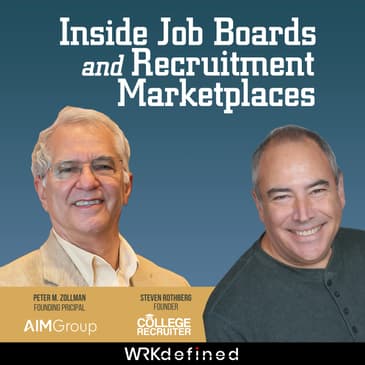
Today's guest on the Inside Job Boards and Recruitment Marketplaces Podcast is Saïd Eastman, a 20-year industry veteran and former executive at Monster and CareerBuilder.
Cohost Peter M. Zollman of the AIM Group is in Budapest, Hungary for its annual RecBuzz conference, so our other cohost, Steven Rothberg of College Recruiter job search site, talks with Saïd about how the stealth start-up that he is leading is aiming to bring much needed improvement to the industry by providing the tools and incentives so that candidates become active participants instead of products.
Saïd and Steven discuss how there's no simple solution. Some of what is required is a change to how we think about the process, and some requires some technology such as blockchain to validate credentials and engagement.
Powered by the WRKdefined Podcast Network.
[00:00:13] Welcome to episode 131 of the Inside Job Boards and Recruitment Marketplaces. I am one of your co-hosts, Steven Rothberg, with College Recruiter. I'm the founder. And I am flying solo today. My usual co-host, Peter Zollman, is at the annual RecBuzz conference that his company, AIM Group, produces. This year, it is in Budapest, Hungary, where I have never been and have always wanted to go. Maybe next year.
[00:00:40] I am joined for today's episode by somebody who I've had the pleasure of knowing for, I think, about 15 years, Lee Cage Jr., former executive at Monster, CareerBuilder, some other organizations. And Saeed, I think our paths first crossed when you were at CareerBuilder, if I remember correctly. Correct.
[00:01:00] So to help the audience kind of better understand, you know, who the heck you are, tell us a little bit, you know, 15 seconds, like, what's your background? And also a little bit about kind of what you're working on now. Sure. First of all, you know, I've been in the industry for, you know, 20 plus years. I hate to say 20 plus because it sounds like it's infinite. I have no idea how long it's been.
[00:01:22] But, you know, my career has always been in the human capital space in various aspects, you know, HRIS, time and attendance, things related to HR. Got into the job board space with Monster, spent seven years there, spent a stint at CareerBuilder, did some consulting work at Indeed, and did some consulting work at Dice.
[00:01:44] Really earned myself a lot of respect by being in the space extensively, I guess. And over, you know, over the years, I've just realized that there's still lots of work to do in the space. And now what I'm working on is I'm working on something that hopefully changes the treatment of or modifies the treatment or improves the treatment of candidates, creates some sort of benefit or outcome for the job seekers, caring about the job seekers.
[00:02:13] I know it's anti what the job board platform is about, but it's still something that I think is it's time. I think it's time that we do something where the seekers feel a little bit more appreciated. Yeah, you and I were talking in the green room just before hitting record. And I think that the expression we used was, if you're not buying the product, you are the product.
[00:02:36] So think, you know, Facebook, Instagram, just about any kind of social media site where they're collecting your data, selling that data. And to a very large degree, I think that that is how the job board industry works. Right. Overwhelmingly, employers pay to post and search. Candidates use it for free. And essentially, job boards are selling candidate data to the employers. And you want to change that. I know you're working on something.
[00:03:06] It's a little bit stealthy. There's not a company name that we're going to be sharing or anything like that. But give us like a high level. What would be different? I mean, the biggest difference in what I'm trying to build is two things. One is that the candidate has some level of control over their information. And the other part is this is because they have the control. The information is validated and qualified. So the employer is seeing information that they can count on.
[00:03:33] So in other words, there is no false increasing of skills or improvements. It's basically what you see is real and legit. Right. The other aspect about what we're trying to build is aligning incentives. Right. So right now, the way I see it is this, is that the incentives are all for the paying customer. The paying customer is the employer. It's not a bad thing.
[00:04:02] The lack of alignment in incentives, it's not a character flaw. It's not an integrity flaw. It's a system design thing. Right. And so this is where I'm approaching it. I'm approaching it from the perspective of, I don't want to charge the job seekers or the candidates. I still want to offer a value to the employers. But I want to make sure that the job seeker knows that I'm invested in their outcome, whatever that may be.
[00:04:30] In the end, the hope is that the job seeker gives us the signals that we want that says that they're looking for a job. And they interact faithfully with the employer. And at the same time, I want to see the employer do the same thing on their end. Because ghosting by the employer is one issue. Right. And that has the cost to that is a brand problem. It's a PR problem for the employer. But they don't really feel it because the thinker is so distant. Right.
[00:04:59] At the same time, there is zero penalty for ghosting the candidate. Right. Like if you ghost the candidate, nothing happens. Nobody says anything. So what I'm hoping is to fix this incentive alignment and create a system using the latest and greatest in technology. And by the way, I mean, I'm going to drop the B word. So that's artificial intelligence and blockchain, but also the current UX UI model that businesses are familiar with.
[00:05:29] I'm not trying to change how people do and how people interact with systems because I see what's going on. But I want to use the most powerful tools available to us for good. So let me play devil's advocate. Job board says it's true within the overwhelmingly the case in the job board industry that it that their revenues come from the employers, sometimes literally directly, sometimes through an agency of some kind.
[00:05:55] But it it comes from the employer paying to advertise search, whatever. But job boards typically operate in a double sided marketplace. Right. We have the employers. We treat them as customers. We have the candidates. We treat them as customers, even though they're not paying usually. And so a job board would say, well, we do care about the job seekers. We do care about the outcomes. We are providing those signals.
[00:06:24] It's called here as a job that you're interested in. You apply. Hopefully you get interviewed and hired aside from the technology that you're talking about. Blockchain, which we'll get into. What's different?
[00:06:41] What's different about this process is really around the concept of what is the job seekers priorities in participating in this process between the employer platform and their experience. Right. Their priorities to get a job. They're not bad actors. Right. So usually, usually.
[00:07:09] We're not talking about some of the ones that we've seen in the news. You had a conversation yesterday and there was a certain country rhymes with North Korea that may have come up. But OK. But what I'm saying is this is job seekers align, do the things that they do in the ecosystem because the system encourages them to do that. So in other words, if you give me a lot of hurdles, I'm going to figure out how I'm going to navigate those hurdles.
[00:07:38] Am I going to jump over them? I'm going to go underneath them. Am I going to go around them? Right. And now what we have done in the space is we haven't changed the hurdles. We haven't changed the obstacles that the job seeker has to do. Right. The employer has is using agentic AI as ways of creating, you know, nice, fancy job descriptions. But now the job seeker is able to figure out I can game the system by figuring out how to get around those filters.
[00:08:08] I can get I can game the system to figure out at which point should I jump and which point should I go under and which point should I go around to get to the other side? Now, when they get to the other side, they still have to they still have to make sure that the information is validated. What I'm saying is this is I want to make it so that the path forward for the for the candidate is smoother. Right. But by having it be smoother and and the systems are aligned, the incentives are aligned.
[00:08:37] The information that they provide is also validated. And in other words, when I get to the other side of the hurdles, they don't go, hey, you know what? You're not six three, as you said, that you could jump the hurdles. You're really five feet tall. So, OK, I got it. I want to get the information to the employer that the employer needs to make a hiring decision. But I also want to make sure that the job seeker is getting through without having to jump through hoops. Optimize your business with a workforce.
[00:09:05] A.I. edge powered by Vizier. Make smarter decisions and achieve better outcomes with real time. A.I. insights delivered to every people leader. Explore more at B.I.S. I.E.R. dot com. So I think I think this brings us to the B word. As you said, blockchain. Blockchain, in my mind, and I do think you know more about this than me. So I would love for you to to set me straight. Tell me where I'm off base in this.
[00:09:35] Blockchain, in my mind, from a technical perspective, has a lot of promise because of the validation, the authentication. From a practical standpoint, it's kind of everybody has to use it or nobody can use it is the way I perceive it.
[00:09:51] If you're going to say to candidates, we're going to use blockchain to validate that you actually did go to that school, that you did graduate such and such a year, that you did work in this job, that you do live in that city or something along those lines. Unless you have overwhelming adoption by those institutions, the schools, the employers, whatever. You're going to end up with candidates with very incomplete profiles.
[00:10:21] One employer might validate. Twelve others won't. One school might validate. Some candidates, including you. But, you know, so your undergraduate school says, yes, I did attend here, but your graduate school does not. Am I off base with that? I mean, to me, that's like a big problem.
[00:10:42] Look, when you're introducing a new technology to both companies, individuals, et cetera, you have to look at what the ecosystem is also doing. So universities are already looking at how to issue accreditation through blockchain, right? And employers are already looking at ways of how to use enterprise blockchain to make sure that they don't have any bad actors within their system, right?
[00:11:09] In this instance, what we're really trying to do is use blockchain as a way not to just, you know, validate and store. It's really about some degree of control. So as a job seeker, my intent is to allow job seekers or candidates to have a career wallet. That career wallet empowers them to control their information, right? They have a public and private key.
[00:11:37] When somebody requests their information, an employer requests their information, they can give that information because they're interested. That is a really powerful signal when you tell an employer, by the way, you requested my information. Yes, I want to work for you. This is my information. Or the employer says, I'm interested in you. And you say, I'm not interested in you. And therefore, I'm going to decline to share that information. Okay.
[00:12:06] Absolutely. Because now you no longer know the idea is your information not being sold to the highest bidder, right? But I'll give you an analogy. So I look at it this way. I'm thinking of blockchain for job seekers or candidates in the same way as we look at our bank accounts. We each have a bank account. Like, you know I have a bank account because if you and I go for a cup of coffee, I can pay with my debit card. Sure. By just seeing that.
[00:12:35] So what I'm saying here is this is everybody has an account. And also, I want to use a way to provide a view to the employer to see that there's validated information that can help them make good hiring decisions without telling them what's in there. And that's called knowledge proofs, right? So I can tell you that I have a degree and it's validated without showing you where the college is. So I'm removing some bias, right? By saying that.
[00:13:04] It's not Howard. It's not Harvard, right? You don't know which it is. But you know that I have a degree and I have skills and capabilities that you want me to hire. That's really what I'm trying to do. When I talk about blockchain, I'm not saying I have to teach you about crypto. I mean, the whole idea behind it is blockchain on an enterprise level can be very powerful. And what's interesting for me thinking about it as a technologist and I'm not a technologist is how we went from SaaS and basic.
[00:13:33] The current system, we skipped over blockchain because we found it was too complex. And then we went immediately to AI because what does AI do? It's amplify the noise that we're already seeing. It basically is saying more on the top of the funnel. We'll filter it down with more AI platforms. And there's nothing, like in other words, nothing has changed. Nothing has changed other than the scale. Right? We've scaled up a lot of the bad stuff.
[00:13:59] So in like 20 seconds, let's sort of bring the conversation home and then we'll leave off for another time. How does this system transform the candidate from being a product to being a participant? So the most important part about this process or this application or this platform is the fact that there is an incentive-based revenue model associated with the product.
[00:14:27] So there's incentives and clawbacks. So you can't game the system because there's a period of time that you have for getting a job. Every job has a window. Certain jobs can be filled, you know, in 30 days. Certain jobs take six months, a year, et cetera. So every job has that category. At the same time, right, what we want to do is make sure that the employer is acting appropriately, meaning they're giving signals. Yes, I'm interested. No, I'm not interested.
[00:14:56] Thank you for your interest. We've decided to move on. Not ghosting the job seeker is not acceptable. On the other side, if you indicate that you say I'm interested in working for XYZ company, you have to act appropriately. You have to show up for your interview, whether it's online or off, right? You have to make sure you give access where necessary.
[00:15:19] If there's additional information required that you're providing it and you're working collaboratively because the business or the platform is as invested in the behavior as it is in the outcome. So the job seeker has financial consequences, good and bad, right? If they apply, the employer's interested, the candidate doesn't ghost, et cetera. Even if they're not hired, they're financially rewarded.
[00:15:46] On the other hand, if they do exhibit some bad behavior, they ghost the employer, for example, or they provide false credentials, then there's a financial penalty for that. They lose the potential earnings. Correct. And there's mechanisms in place. So in other words, you can't be a lifetime applicant.
[00:16:08] People go, well, if I have a great resume, I can make a lot of money because a lot of people would be interested in my information or my, right? But you can't do that because once you activate, based on your role, you now have a window to act. If you don't act in that window, the clock restarts after the position, after the company hires somebody else or you don't get hired.
[00:16:32] And the incentives that are in the system are only based on you making the decision to transact and move. So the incentive is there. The money is held in escrow for you. When you make a move, you get notified that the account is now in your possession. But you have to, one, follow the criteria. You have a 90-day window. It's like a recruiter saying to you, the person failed 90 days.
[00:17:02] Do I have any warranty or guarantee on this? Now the candidate has a stake in their guarantee. And this is where, to me, it's really important. I'm invested in my own career. If I like this company and I love it, I'm going to do the best I can for 90 days. Because I know I want to be successful here. As opposed to, you know, strolling in when you want to stroll in or start asking for remote days on the second day on the job. Oh, so I'm definitely ineligible.
[00:17:32] Saeed, thank you so much. Very interesting. Everybody knows our industry definitely needs some improvement. The whole hiring industry. And it'll be really interesting to see how this goes. First of all, I appreciate you giving me this opportunity to do this, to have this conversation with you. And I want to also say this. I am not saying that the industry is morally flawed. Right? Right.
[00:17:57] What I'm saying is this is, from a design perspective, we have the resources and the technology to build something that is better than what is out there. And it is important that we do this for both the employer's sake, who's looking to hire people, and for the job seeker's sake, who's looking to, you know, take care of their family. As you say, you know, rising tide lifts all ships. Every person that gets a job benefits their family, the communities they live in, et cetera.
[00:18:27] So it's a bit of a responsibility and a purpose to build something new, given our experience. Awesome. Looking forward to seeing you in person the next time. Cheers, Saeed.
Sponsors
