
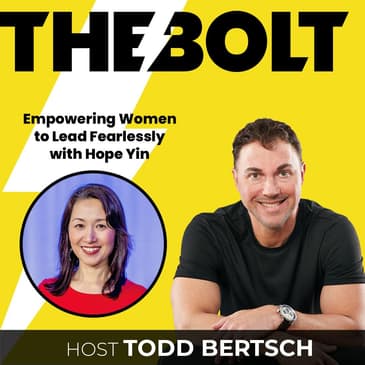
This episode explores how leaders can navigate personal hardship, career pressure, identity shifts, and rapid technological change without losing themselves in the process. The conversation covers resilience, empathy, women in leadership, intentional living, and the future of AI in the workplace. Listeners will learn practical ways to lead with more humanity, build confidence through difficult seasons, support working parents and women in leadership roles, and adapt to the growing influence of artificial intelligence while staying grounded in purpose and relationships.
Key Takeaways
- Resilience grows through difficult seasons
- Empathy makes leaders more effective
- Relationships matter more than status
- Flexible workplaces build trust
- Women leaders need better support systems
- Leadership is not one-size-fits-all
- Fear and growth often happen together
- AI fluency is becoming essential
- Intentional living creates clarity
- Self-trust drives personal growth
https://www.toddbertsch.com/podcast/empowering-women-to-lead fearlessly-with-hope-yin
Thanks for listening! We appreciate you.
Follow us at:
- https://www.linkedin.com/in/toddmbertsch/
- https://www.facebook.com/theboltwithtoddb
- https://www.instagram.com/theboltwithtoddb/
- https://www.youtube.com/@theboltwithtoddb
⚡ Ready to ignite lasting transformation in your team or event? Book me for keynotes, corporate training, or Positive Intelligence® coaching at ToddBertsch.com
Powered by the WRKdefined Podcast Network.
[00:00:05] Welcome to The BOLT Podcast. I'm Todd Bertsch, entrepreneur, mental fitness coach, and keynote speaker. I believe every person has a spark, but life, pressure, and doubt have a way of dimming it. Here's the good news. You can reignite it at any moment. That's what this podcast is all about. When you fuel your spark, everything changes. Let's ignite it together.
[00:00:28] Today, I'm joined by the incredible Hope Yin, an award-winning tech executive turned coach and speaker. And we're diving into what it really takes to grow both as a leader and as a person. Her journey is powerful from immigrating to the U.S. to leading inside Fortune 200 companies to now helping leaders all over the world step into their full potential.
[00:00:54] We explore identity, confidence, and the inner shifts that allow you to move beyond self-doubt, step into self-trust, and go from surviving to truly thriving. Listeners, get ready for an exciting conversation. Hope, welcome to The BOLT Podcast, my friend. Come on, Todd. I'm so glad I'm here. Let's go. Let's do it.
[00:01:22] Let's do it. Oh, it's so good to see you again. You know, you and I have had a couple conversations over the past several months, and I always like to kind of set things up with how we got to know each other. So we are both members of NSA Ohio, which is a national speakers association, and we are both on the path to honing in on that craft of being a professional speaker and getting to that main stage.
[00:01:51] But there are many other things that you and I both do and have kind of in common, right? Yeah. I just want to say, Todd, even though we haven't known each other for a long time, through one of the dinners at NSA Ohio,
[00:02:12] the first impression of you is you are just having that energy attracting people into your circle. You were very kind, generous, and I feel that we immediately connected on this continuous learning and personal development. And the rest is history. So I'm so happy to be here having a conversation with you. Yes. Thank you so much. I appreciate those kind words.
[00:02:42] And yes, you and I connected in many ways. And Hope, I think one of the main ways that we connected, and maybe it wasn't necessarily obvious, but going back through, I think, both of our kind of origin stories, what we connect on a lot is life transformation. You and I have both been through some major transformations, and your journey is filled with transformation. Thank you.
[00:03:10] And I'm sure we're going to touch on many aspects, but let's just kick off with one. Was there one moment in those transformations that truly changed the trajectory of your life or your career? There are so many of them, but I think I probably would go back to one of the most difficult time of my life,
[00:03:37] which is two years post my divorce of a 16-year-long marriage. And then I was raising my two children alone, and my father was having stage four lung cancer. Oh. So imagine a mom with two young children, a full-time job, leading global teams.
[00:04:04] And then I had to back and forth from the hospital to home, taking care of the children. And one of the particular moments was my lawn was like auto-grown, because I didn't have time to take care of the lawn. And I didn't have the, I would say, financial resources to hire someone else to do it at the time. So it was probably three feet long.
[00:04:32] And the city issued a warning saying, your lawn is too tall. I was really, I was crying. I'm like, you don't know what's going on in my life. And I, mowing the lawn is the last thing in my mind. And so that was really a difficult time in my life. However, what it taught me was that because I'm struggling, I was struggling with so many different things,
[00:05:02] I had to learn how to prioritize. Like which one thing is the most important to me? As long as my children are being fed, as long as my dad is being taken care of, as long as I'm delivering at work, I'm good. Everything else can wait. So it's always a learning process. Yes, indeed. Wow, that's a lot to take on at one time.
[00:05:31] And many people would have a difficult time managing all those things at once. Was there a tactic or technique, hope, that allowed you to really set the stage and prioritize all those things that were important to you in your life?
[00:05:55] Yeah, I think human beings innately have the ability to be resilient. And a lot of people would say, how did you do that? Yeah. And sometimes I would say, if you were in that situation, I'm sure you can handle it. And I think sometimes it's also this mindset of this is temporary.
[00:06:24] I know I'm in a very difficult situation. However good or bad is going to pass. And it did pass. Of course, I lost my dad, which is unfortunate, but it's part of life, right? And perhaps it really made me think about, how can I live a life without regret?
[00:06:48] And my dad did tell us before he passed, he didn't have regrets. So I want to follow his steps of living a life without regrets. And I would say that gradually, I was able to reach that point of living my life with no regrets. Of course, things got better later. So back to your question, how did I go through that?
[00:07:17] What was some of the mindset? It was hard. I wouldn't just lie saying, oh, I had the ability. I was so resilient. It was not like that. There are so many times that I would shed tears while I was working, having my hands on the keyboard. Or I would just go to the bathroom and cry and then dry my tears, come back to work.
[00:07:44] And I have some piece of paper I printed out. I pinned it onto my cubic wall. You work for a big company, you have your own cubicle. And those are some life lessons that other people have accumulated. One of the first one is life is not fire. Life is not fair, but it is still a gift.
[00:08:15] So if you look around, we can always find things or people that may not be fair to us, but it's still a gift. You can see the bad things. You can also see the good things, the beautiful things. Yes, absolutely. There's a lot that I want to kind of dig into there, Hope. A lot of good nuggets. One, right off the bat, gratitude. We talk a lot about gratitude on the show.
[00:08:45] And me personally, I'm a big proponent of gratitude starting and ending. If you can book cap, bookend your day with gratitude, great way to start, great way to end. I think as a society, we don't express gratitude enough. And I think it's a major problem. To your point, the fact that you and I are having a conversation right now is a gift. And we're alive.
[00:09:13] And yes, we can go down, right? And I think this is where we get in our heads. And I just published a newsletter this morning talking about the inner critic and getting out of your head, your own, getting out of your own way. And I think that's what we do as human beings. It's natural. It's our survival instinct. But it doesn't make it easy. And I think if you can continue to do the work and build that resiliency, like you said, we all innately have some resilience.
[00:09:41] But if we can build the resiliency, then when life gets hard and throws us a curveball, whatever it may be, and it'll be something that we can handle it a little bit better. And we don't let our inner critic take over. And we don't get stressed, derailed, and get into a negative mindset that really hurts our health and our time. We lose time because we're just expending all that energy on all the negative things.
[00:10:11] So I just wanted to start with the gratitude piece, but also empathy. And so I have two questions for you, Hope, going back to that story that you just shared. What was the note that you penned in your cubicle? Was there something specific? Yes. You said you penned something. Yeah. I have to find the economist's name.
[00:10:35] I think her name may be Rebecca, but I forgot the last name. And she had 50 lessons. At the time, she may have been 45. But then every year, she would add one more life lessons. So if you Google, like, 45 life lessons or 50 life lessons, you may be able to find her.
[00:11:02] And I remember one of the first life lessons is like that. And then other life lessons such as wear your purple or whatever your favorite clothing or color. Don't wait to say this is for special occasion. Every moment can be your special occasion if you make it so. I love that. Yeah. That's. Yeah. I've never heard that before. But seize the moment. Don't wait.
[00:11:32] To your point, don't have any regrets. And I love that message. And I do want to say I'm sorry to hear about the passing of your father. But I do love that he left you with that message. And I love that he, as a human being, had no regrets. That is an absolutely beautiful thing. Right? It really is. So many of us have regrets.
[00:11:58] And we see these people that, especially these very high level global leaders who accomplish amazing things over their career. And on their deathbed, they have tons of regrets. I didn't spend the time with my kids. I didn't spend time with my spouse, my partner. I didn't do the traveling that I wanted to do.
[00:12:22] I didn't engage in the hobbies that I really felt passionate about as a kid or in college. We don't want to do that. Life is too short. And it is so cliche. But life goes by so quickly. We need to seize the day. Wear your favorite color. Get it out there. Like Hope is wearing. This is her brand. The red. Tell us a little bit about it. This is a powerful ride. Yeah.
[00:12:51] So what is it about red? I know you and I had a conversation because I noticed it. I'm all about the details. And I said, Hope, I noticed that you have a theme here. When I see you, you're in this really vibrant red all the time. Yes. I will answer that question. But before that, I want to talk about what you mentioned about the regrets when people about to die. And the number one regrets is what you talked about.
[00:13:21] They didn't have time. They didn't spend enough time with our kids, their spouse, their family. They wouldn't say that I didn't spend enough time at work. Because they're so successful, they spend way too much time. Maybe more than enough time at work. But at the end, what matters is love, is a relationship. So now, come back to answer your question about ride.
[00:13:51] I love all the colors. So ride isn't just one color I love. So I tried all different colors. And because I work in technology, so if you ever go to a technology conference, you would still be able to easily notice that there aren't a lot of women senior leaders.
[00:14:15] So if I wear, like, a blue or black, I would be just blind in. You can't see. I'm a woman or man. So for that purpose, I start to wear, like, more bright color. So that, hey, here I am. I'm also in technology. I'm representing. But gradually, I think I started to think about my brand. As you know, my company name is Blueprint Coating.
[00:14:45] I could probably go with another blue. But I'm like, my brand color is already blue. I want to choose a different color. And red. And there is one story. I was speaking at a conference a couple years ago. And after speaking, you just go on your own way. People having lunch. While I was walking, a person, technologist, stopped me saying, I said, yay.
[00:15:15] She's like, I wanted to see your session. I have to stop you. I have to tell you how amazing you look in that red. I'm like, huh, okay, red it is. So my color. And I also think when you have a consistent brand, it's just easier. Like, when you see me, you think about red. I love it.
[00:15:42] Oh, yeah, you're talking to the marketing guy here who painted the door of his old mansion lime green. And my wife was so, it's a great segue. My wife was totally against it. So I own a company called Evolve Marketing, which is a digital marketing company. And our brand is that lime green or chartreuse. And the door when I bought the building that our company was going to be housed in was orange.
[00:16:11] And I told my wife, I said, well, we got to paint the door anyhow. Let's paint it chartreuse, this lime green. And she was totally against it. You have this beautiful mansion, 100 years old. I can't believe you're going to do that. I said, trust me, babe. Like, people are going to see that door. And it's on a main thoroughway in Akron, headed to downtown Akron. And here's the thing, Hope. You'll love this.
[00:16:32] So several people, if you're in town and you pass this house all the time, people will say, oh, they don't remember the name or me, which is fine. But they say, you're the company with that lime green door on Market Street. I'm like, yes. Yes, ma'am, I am. The key here is that consistency.
[00:16:52] So I was, like you, very intentional about choosing a color that, one, had meaning and purpose into the name of the company, Evolve and Growing and Evolution, but also something that was unique and different that no other company in our space was leveraging at the time. Love it. And it stuck. So anyhow, folks, I think that the lesson here is don't be afraid. Don't be shy to wear your favorite color to get out there.
[00:17:21] Stand out. And it reminds me, Hope, of a great book. I haven't read it in a long time. It's by the amazing author Seth Godin. And it's called Purple Cow. Oh. Stand out. Be unique. I love that. So kudos to you. We went down a little rabbit hole there. But still, it was great information. Story.
[00:17:43] And I want to go back, Hope, for a minute to just the heaviness of all those things that you were going through. And I do want to ask, did your employer, were they aware of all the things that you were going through at that time? They don't. Okay. And we don't need to dig in on who you were working for. Right. It's okay.
[00:18:11] I'm completely transparent about that. It's not their fault that they didn't know what's happening. Of course, my immediate manager and my teammates know what's going on. However. So they do. They did know. But, I mean, just close circle, right? If that's what you meant, then they do know. But it's not like I was being so open, so transparent about it.
[00:18:38] Not like right now I probably would have more people know about what's going on. Because at the time, I was still living in these two worlds of the Chinese culture and the American culture. The Chinese culture is you close your door. You don't want other people to know what's happening at your home. Even getting divorced was considered as somewhat shameful. What's wrong with you?
[00:19:08] You got divorced. Everybody else can maintain their marriage. I tried. I tried 16 years. It's not that I didn't try. Right. It took my parents a year to be able to tell other people, saying my daughter was divorced. So I wasn't telling my coworkers that I was divorced. I was a single mother. I was just handling it.
[00:19:33] And then when my dad was in the hospital, because I had to miss work, I had to take leave. Then I had to let my manager and some of the close friends know. They are very supportive. And the company I worked for also had great benefits. They have on-site psychologists that you can go to and talk about your struggles. And I did.
[00:19:59] And that's actually, right now, therapist is a norm, right? Everybody probably has a therapist or psychologist. Back then, I was almost like, I'm sneaking out. I'm going to see my psychologist. It was still, for me, considered as somewhat almost shameful. So you talked about the inner critic.
[00:20:28] All of that were because of not enough education about how important it is to have someone talk to, seek professional help. But also my culture influence of you're weak. You can't handle it yourself. That's why you're asking for professional help.
[00:20:49] Even today, I would say that there's still a lot of taboo in the Asian culture regarding therapists. But because of my own experiences, I knew how beneficial it was.
[00:21:06] And when I had a team member who needed that kind of help, I was able to suggest, I'm not going to force them, but I would suggest to say, hey, our company has such kind of great offer. You might want to try it out. And they did. So I think going back to every experience is our learning opportunity. Because of those, I was able to help other people, which is a good result. Yeah, absolutely.
[00:21:36] Yeah, I just finished reading Napoleon Hill's book, Think and Grow Rich. And one of the things that he talked about hope was being able to see challenges as opportunities. Like we can't grow without the challenges. Not that we seek out necessarily conflict or challenges.
[00:22:01] But as they come, be more open and approachable to them and see them as a way to learn and grow. And you're building resiliency in doing that. Because it's something new and likely you're going to fail. And that is one of the best ways to build that resilience. I love that. And it reminds me of what I was kind of fishing for in that story, Hope. And thank you for sharing those details.
[00:22:29] What was really kind of the reminder to everyone that's listening that empathy is one of the great character traits of a leader. And that every single person on your team is struggling with something. Every single person is human beings.
[00:22:52] And the more that I coach cohorts through positive intelligence and we dig into conversations about life, we always go back to kind of the home life. And see, as a human being at work, your home life bleeds into work and vice versa.
[00:23:13] So when you're good at home or as a leader, if you just understand, if you have that type of close relationship with your employees where you understand that they are going through some different things. Maybe it's a divorce or maybe you have your lawn that's two feet tall that needs cuts and you're getting letters from the city.
[00:23:36] Or maybe you have a parent that you're a caregiver like I am right now with my parents or somebody that's not doing well. But we're all dealing with something. So making that assumption and then being able to lead with empathy is one of the best things that we can do as human beings and especially as leaders. So I just wanted to call that out as a reminder in this episode. To your point, you were struggling with so many things and good.
[00:24:05] I feel really great that you were able to have that trust and have that inner circle. Because imagine if you didn't feel safe enough to be able to have that conversation with your report or your direct reports or your colleagues. And going in and about your day, that would be very difficult. It was already difficult enough. Yeah.
[00:24:29] So anyhow, so kudos to your company for the types of benefits that they supplied and that they made it safe enough to take advantage. Because it's one thing to have these perks and wellness programs. It's another thing to encourage it and create that safe space where we feel like we can take advantage of those things. So absolutely. So many things to talk about there, Hope. Yeah. Let's go back to- Go ahead. Yeah.
[00:24:57] I want to add some comments on empathy. And you are 100% accurate. The leaders need to be empathetic. What I learned throughout my journey, because I grew up in a more black and white environment. I grew up in China and it's either right or wrong. There isn't like this spectrum of gray.
[00:25:24] So in my early days, or even as a leader in my earlier journey, I had a judgment. And what kept me humble was I keep learning about life. As you mentioned, when I got divorced, I started to understand other people who might went through divorce.
[00:25:55] How painful that process is. And then I became a single mother. I was taking care of children. I never thought I would be a single parent. I didn't plan for that. And then I started to understand so many other single parents, what kind of life they were living.
[00:26:17] And then losing my dad and even going through all those hospital trips, all of that, it just added more empathy, capacity. So it's not necessary that you have to go through the same experience to be empathetic. But it has certainly helped.
[00:26:42] Because now you kind of imagine, oh, I have gone through that. I understand. But even that, right, two people may be going through the same thing. They still experience differently. So as a leader, we truly need to have such kind of conversation with our team and making sure they know you care because they can feel it. I had a team member who had a sick child at home.
[00:27:11] Every day, you go. Take care of your child. At 3 o'clock, you can leave work. Because I know once you have your child settle down, you're locked in back to work to finish the remaining work. I knew that. So I have trust in you. So they feel completely comfortable to do that. And they perform. So why not do that to your team? Yeah, I love it.
[00:27:40] Building that trust is key to having any great relationship, especially at work as a leader with your direct reports. And I think it is definitely valuable to have the same experience and be able to see yourself. We always say put yourself in someone else's shoes.
[00:28:04] But even just asking the question and being curious enough to say, hey, John, hey, Susie, how are you doing? How are you really doing today? Just asking and giving the time is a great first step. And that goes a tremendous way with people. It's being human. You're not just a number. You're not just a cog in the machine.
[00:28:30] We are all working together towards a mission. We all truly want to be the best version of ourselves and do the best that we can in our jobs and our daily lives. So yeah, love that. A lot of good lessons there, Hope. And so this takes us to your life philosophy. Be the change you wish to see in the world.
[00:29:01] Gandhi's quote. Probably, if not the most famous quote ever. So this is your life philosophy, your life mission. Why did you choose this? And what does that really mean to you? And what does that look like? Yeah. Yeah.
[00:29:21] I think for anyone who are fortunate enough to find their life purposes, they probably would be on the similar journey as myself. That is to change the world for the better. Because if we want to complain about what went wrong in this world, it's endless.
[00:29:47] But I believe no matter how tiny, how small our contribution is, we can make a contribution to make this world a better place. Whether that is you just smile at someone at the grocery store or you helped another person open the door. It doesn't need to be big.
[00:30:10] But for me, gradually, I realized that I want to do some bigger things. The bigger things means that I want to see more great leaders in the world. Because to me, the problems of a company, of a team, of a country can all contribute to some either good leadership or bad leadership.
[00:30:39] So I want to see more great leaders who care, who lead, who can make bold and futuristic decisions. And so that's one of the reasons why in 2024, I left my high-paid, high-profile executive job in technology. If you work in technology right now, it's really you got great opportunities to change the trajectory of a company.
[00:31:09] But I decided actually what I want is to support more leaders. So since then, I have been coaching hundreds of leaders, speaking in front of thousands of leaders to support them to be more authentic, to improve their communication skills, to be more empathetic, as we just discussed, to adopt AI, technology.
[00:31:39] So many things when you think about leadership. So that's what I am focusing on to create that ripple effect. If I can impact more leaders, and those leaders will be in turn to improve their family relationship, improve their team dynamic, and help their company grow. And I think that can be the impact can be multiplied.
[00:32:08] I love it. The ripple effect. It's real. It happens. It's contagious. When one person chooses change over comfort, others follow. And it's a beautiful thing to be able to really spread that light into everybody that we serve. And as leaders and as parents, it's not only our privilege. It's our responsibility to spread that light, to be the light.
[00:32:37] And I love that hope. And I want to go back to your mission. So your mission, you talk a lot about your mission being to empower women in tech. I really want to dive into that because it's important. It's an important message. It's important to me. I'm a big advocate of equality in the workforce. In fact, my company, my involved marketing company is ran by women.
[00:33:04] And I believe, and that's not intentionally I sought out to have women run it, but they were perfect for the role. So why not put them in a position, empower them to do what they do best, what they're passionate about.
[00:33:19] So I really want to spend some time here, Hope, and talk about what it means to empower women in tech, why you chose this route, and what you're doing or what we can do as leaders to help this cause. Yes. So I think sometimes people have a misconception of, oh, you empower women in tech.
[00:33:48] That means you only care about them. The answer is, I really care about everybody. But we all have limited capacity. There is a book called 80,000 hours, which means if we have 40 years of career and each year is 2,000 hours, then that's our whole career life.
[00:34:17] What do we want to do with those 80,000 hours? Oh, very interesting. You can't do everything, but you can do something, right? So as I started my coaching business in 2020, I was coaching everybody. I'm like, everybody needs to learn about the secrets of life. But gradually, it's a more...
[00:34:40] You know people also kind of organically to be attracted to people who they may just resonate. But I always know that I really care about little girls, care about women. I donated to the nonprofit that cares about girls and women, especially underdevelopment countries.
[00:35:05] Like even pregnant mother, I think there was an organization called Every Mom Count or something like that. I just genuinely want to help the people who really need some resources or empowerment.
[00:35:25] And my whole career in technology, in STEM, is really 30 years of witnessing how women uniquely struggle with certain things. Number one, all the systems are not built for women by women. We all know that, right?
[00:35:49] So the society needs to evolve to make the systems work for everybody, not just men and women. We're not a monologue race or gender. There's so many in the mix. Like some people may be neurodivergent. Some people may be introvert.
[00:36:10] The systems are now built for people who are loud, who are extroverted, who have some sort of confidence and showing up differently. Can we start to build the systems that works for everybody? So that's number one. The systems is not... They're not fair to everyone. Secondly, women, when they enter the workforce, it's roughly about 50-50.
[00:36:39] 48 versus 52. Not that much of a difference. But at the first level of a manager promotion, you see a huge difference of 60 men, 40 women. And as you go up to the senior levels, you only see 30% women in senior leadership. The remaining 70% are men. Wow.
[00:37:08] So I want to really support the group that need more support. Can I support everybody? Yes. But I choose to choose a problem for that 80,000 years, a problem that I can make an impact. Hmm. I love that. Well, good for you. And we need more Hopiens out there.
[00:37:37] Choosing, finding a nuance. And I love that. That's true purpose right there. Finding a nuance and being able to make an impact to have that ripple effect. Because yes, you could help everyone. And I could as well. And I'm slowly finding kind of, you know, my group, you know, my people and who really, who I resonate with. Or who resonates with me.
[00:38:06] And having those commonalities and being able to help people. And really just make a dent in all the issues. We can't solve every single issue, but we can have a purpose and intention and really go after, you know, a particular thing. So, so I'm. Yeah, Todd, if I can make a comment. And it is okay. We are still looking for the exact ideal clients.
[00:38:35] And sometimes some people don't have a niche per se. But I think the important thing is to noticing who are the people, like you just felt so much energized or satisfied. Like I often have my coaching clients, coaching clients. We entered a session. They were down. They were crying because there's so much going on.
[00:39:03] But then by the end of the session, they felt like weight lifted from their shoulder. They felt that, oh, I'm not stuck anymore. I actually have strategies to be able to handle what's going on in life at work. But also be able to have a strategy that I don't have to be so anxious. So that just gave me a lot of satisfaction.
[00:39:27] So, and even people, they would change their brand or their ideal clients. And that's okay. But we know we're making a difference, making an impact. I think that's the most important thing. Right. I would agree. And you are, Todd. Hey, I'm trying. You know, I'm trying. Every day I get up, my spark's lit.
[00:39:51] And I'm just trying to help people try to inspire, motivate, instill some hope that we can embrace change. Change is coming. It's here. It's not going away. So we can run from it or we can embrace it and see it as an opportunity and not a challenge and something to run from. So while we're still talking about women in leadership and we talked about some of the issues, systems being one of them. And yes, I agree.
[00:40:21] And I've seen that. We still have a ways to go. The numbers are still pretty off, right? 70-30, 60-40. And as you get down, you know, to the intermediate or beginner manager roles, those are going to be critical to get more women in those roles. Is there anything else, hope, that organizations can do to better support and develop women leaders in meaningful ways? Yes.
[00:40:50] So many things organizations can do. As I mentioned, the systems are built initially for men who had a wife at home, right? So they require you to be like 825 or 926, whatever that is designed. They need to be more flexible. Even today, you don't have to be a woman to take care of the child.
[00:41:16] Any parent would need such flexibility because our school systems are not designed to line up with the workplace. They get out of school at 3 o'clock. What are they going to do? I remember when my kids were younger, I had to send them to after-school care. The after-school care would automatically go to the school, pick them up, and they would stay there for a few more hours.
[00:41:42] And almost all the time, I was the last one to pick up my children. Imagine that the pressure, the feeling of exhaustion because you're constantly go, go, go. But I think if organizations can say, parents, we understand this time you may need to go back to home, pick up your child,
[00:42:09] and then you're going to continue to work from home. That's totally fine. And when I was leading global team, I know my team member will need to drop off their children around 9 o'clock. Picking up at 3, I would not have meeting during those times. I would only have meetings starting from 10 Eastern and end at 3 so that those are the times all the team member,
[00:42:38] no matter which time zone you're in, we are at work. So those are the things people need to think about. I think if you pay attention, going back to that empathetic, being empathetic of let's have a conversation. What are the best times works for all of us? Again, when we have a big team, maybe it's not possible to accommodate everybody. But at least we tried.
[00:43:07] Maybe we could rotate, right? For a month, this is our meeting time. Somebody else will be at Yen Convenient. For the next month, we're going to rotate so that Yen Convenient became convenient and so on. The other thing I think companies can do is they always say, just speak up. It doesn't work that way.
[00:43:30] For women who grow up being told to be other-centered, to be caring, to be submissive in a way, right? If you watch TV today and pay attention to how females are being projected, it's still like that slim, beautiful, tight clothing, high heels. It doesn't need to be that way.
[00:43:56] So because of all the societal expectations, how they were growing up, just telling women to speak up doesn't work. So you have to equip coaches, mentors, sponsors, and knowing that they have the ability, they just need some support to bring that power out, to bring that confidence out.
[00:44:22] So companies do need to have programs, coaching programs, mentoring programs, specifically for women. I understand today that DEI is under attack. But DEI isn't saying, I'm going to give you a favor. It's about each group of people may have some commonality. Like you can't treat a neurodiverse person just like us.
[00:44:51] Like I consider myself as a normal person. How I communicate is completely different than how they should be communicated. So how can you use one size fits all system or policies for the whole workplace? It's not possible. So those two things, like women specific flexibility or parent flexibility workforce,
[00:45:18] and then specific programs for women because their uniqueness. Yeah, I agree on all aspects of that hope. And it's funny, as we do in my marketing company, we do our employee surveys, you know, every quarter. The number one thing, you know, it asks the question, what do you like most about this company? And yes, it's typically the people we work with.
[00:45:45] But right up there, one, two is the flexibility. Almost every person on our team has young children. And to your point, being able to log in, log out, log back on, just to be able to have the time throughout the day to take appointments. We call it flex time. And I used to, years ago, used to have a cap on it. It was like only an hour of flex per day and certain times of the day. And now we just have full trust.
[00:46:14] And we just say, we know that you have a number of things on your plate and you love your job and this company. And you're going to do the best that you can and just work your way. Whatever works best for you. We trust you. Go do your thing. And it's amazing the retention that you will have when you build that trust and give that freedom and empower your people. It's, you know, all these things we talk about.
[00:46:40] I mean, I have so many shows and coaching and I've read books and it all really comes down to very simple things. Have gratitude. Treat people how you would like to be treated. The golden rule. Lead with empathy. Be curious. Like these are all just super simple, innate things as human beings. We don't need fancy leadership programs.
[00:47:08] But we do need to understand our people. Devote the time and invest. Invest in your people. Create the systems. Create the programs. Like you said, Hope, to build, to develop those people. That's what people want. People crave growth. They crave change. They may not say it. They may not show it. But we do as humans.
[00:47:37] We innately want to evolve. That's where we get that hit of dopamine. And that excites us because we get to stretch a little bit just beyond what we're capable of. So let's give our people the opportunity. Let's invest in them. I think everybody needs a coach. Everybody needs to be striving towards some level of growth or development. Otherwise, we get placents. We get into a comfort zone. And then growth stalls.
[00:48:06] And that's what leads to burnout and disengagement, which are our two biggest numbers. And Gallup, SHRM, everybody says the same thing. So anyhow, putting a bow on that, Hope. Absolutely. So there are two great tips, and I know there are many more tips that you can do within an organization to really better support everybody, but also those groups who need some specialized training.
[00:48:35] And that's not being fair to everybody. It's just noticing that there is a specific group of people that need something specific. That's smart. Let's spend the time there, especially if you want those people to stay and you feel like they have the capacity to grow within the company. Take the time. So anyhow. Yeah. So a lot. Yeah. I would want to just maybe elaborate on that.
[00:49:05] Because, you know, recently IBM was sued by their special treatment to women, the women-specific programs. I would say that men also need specific programs. You know what? Men, on average, do not know how to express their feelings.
[00:49:29] And the most applied approach is to become angry. Because that's how they know to express their emotions, right? Right. So I would say if companies say, well, we're going to have specific programs for some of our men, not all men, right? Nobody, like not all people are equal.
[00:49:56] For those people who may have challenges of expressing their emotions, let's have a specific program for that. Right. And that will benefit men as well. So do not just develop your women. Develop your whole workforce depending on their need. Then nobody should be sued for anything. Right. It's like if you have two children, let's say.
[00:50:26] I have, I gave birth to two children. They have the same parents, but they're different. I can't reason with the same approach. Why can't we do that to our workforce? Yeah. Yep. Very, very good. I love it. All right, Hope. We're coming to winding down here. But I did because you have such a background in AI.
[00:50:55] And I don't want to go down a huge rabbit hole here, but I do want to ask one question. With that strong background in AI and tech, how do you see leadership evolving over the next three to five years? So I have been into technology for almost three decades. And a lot of times in the past, it's a technology transformation.
[00:51:24] You know, you started from different languages in software engineering. And then you use on-prime infrastructure or cloud infrastructure. But AI is very different. It's a revolution. Just like agriculture revolution, industrial revolution, digital revolution, this is intelligence revolution. This revolution requires leaders.
[00:51:51] They can't just say, well, I'm going to go to my team, ask for answers. They should know the answer. The leaders, even at the very top, need to understand what is AI, what AI can do for the company, what is the harm of AI, and how can they lead the whole company, the workforce, through this AI revolution?
[00:52:21] And I would say that for the next four and five years for leadership, they have to become AI fluent. They can't just like clap for their team on the sideline. They have to go into the soccer field, play that game themselves.
[00:52:40] And that's why I am so passionate about sharing how I build my business on top of all the AI tools so that other people can see one person can run their entire company on top of AI. So they need to get their hands dirty and play the game. I love it. I love the metaphor. Get out on the soccer field. Get out there and play with it because it's not going away. Just like anything, the Internet came in and changed everything.
[00:53:11] These things are here to stay. So you can continue to run or you can jump in and just embrace it. You know, reframe the question from an obligation of, oh, I have to learn this or I'm going to be obsolete to, oh, I get to grow. I get to stretch. I get to try something new. And you'll be amazed at the gifts and opportunity that come from that. It's all in your mindset, folks. It's all there.
[00:53:40] You are a master of change management. Yeah, yeah. Yeah, master. I'm trying. So we've been through a lot of it. But, yeah, a lot of it is in our head. And positive intelligence, certainly any mental fitness program, highly recommend because it does help you reframe those challenges and turn those into opportunities. Yes. Hope we're coming down to the lightning bolt round. These are just quick. One hits, one, two word answers.
[00:54:10] Okay. Nothing, nothing really long here. What's currently igniting your spark as a leader right now? Scaling. Hmm. Okay. Scaling the impact and the influence. I love it. Love it. If you could describe leadership in one word, one word, what would that be?
[00:54:41] In one word. It's a simple lead. Lead. Okay. That's the first time we've got that response. Excellent. Is there, who is a leader that you admire and why? That could be somebody that's still here or somebody that's passed on. Who is a leader you admire?
[00:55:01] I have a lot of leaders that I try to get their nuggets, wisdom from them. If I have to use, choose one person. I would choose a former president Obama. Okay. Excellent. All right. Now we come down to the final closing.
[00:55:31] Powerful last message from Hope Yin. It could be a quote or something. What do you want to leave our listeners with today? Live your life intentionally. Design your own life. You deserve to live a bigger life.
[00:56:02] I love that. Absolutely love that. But I want to go back. I can't quite end yet. Yin. Hope. I want to go back to this message that I found on your website. And it says, my personal brand is hopeful. That ring a bell? Yes. It's mine.
[00:56:28] I absolutely, I think this is so, so powerful. I'm actually going to put this in a Word doc and print it out and paste it up. So let's end with that. Let me show you. Oh my gosh. Oh, I love it. We did not plan this folks, but I absolutely love it. Hope, take us, this is how we're going to end. I love what you said. Sorry, but I just wanted, we didn't get a chance to talk about this. Let's end with this.
[00:56:58] Take us through hopeful and each of those letters. Sounds good. I have it. It's in front of me all the time. Because when you asked me that question, if you use one word to describe a leader, how would you describe it? To me, it's very hard to just use one word because we have so many types of leadership and leadership means so much.
[00:57:26] So I had to use hopeful framework, seven letters, but each one has at least two or three attributes. So the H is humanity and humility. As we talked about, right? We as a human race, we are all contributing to its success or going backward, hopefully not.
[00:57:52] But that's how we as human beings can advance, can evolve. And let's do that. Change the world for the better. Humanity is more about we're just equal. I'm not better than you, Todd. You're not better than me or equal. You have something that I don't have. I may have something that I can share with you. Let's become friends. And that's the H. O is open-minded and open mystic.
[00:58:22] Like I mentioned, for my journey, I had to continue to open up my mind. Because otherwise, we have a lot of judgment toward other people. Oh, they don't look like me. They don't think like me. They don't talk like me. But when we have open mind, we have other perspectives come into our orbit. And really, it enriches our life.
[00:58:50] Optimistic is more about having a hopeful perspective toward the future. Yes, right now, there are wars. There are geopolitical conflicts. There are mass shootings. But we are moving forward. And hopefully, together, we can, again, make this world a better place.
[00:59:17] As a leader, it's so important for them to remain optimistic. Because at the workplace, you are always going to have a challenge. The world is changing so much. Where have you been changing, Todd? Right? So how do we adapt to the changes? But also know, as a team, we can go through this, no matter what kind of challenge it is.
[00:59:45] P is passionate and purpose. I think for us to be able to be excellent at anything, we need to have that passion. That passion doesn't mean that, oh my God, I am so passionate about this. It's about you have the drive to continue to do something small every single day. Like Todd, how many episodes you have recorded? How many books you have read?
[01:00:14] Maybe one book wouldn't make much of a difference. But consider if you read 100 books later, you become so much wiser, right? And purpose is this direction that you are going. It is so helpful when you have a purpose. Even mundane work becomes so meaningful.
[01:00:38] Because you know the reason you are doing that is to march forward to that direction. That purpose is going to add up to that effort. So it just becomes so easy for anyone to make a decision. Do I do this? Do I not? And then E is empathetic and energetic. We talk a lot about empathetic, so I'm not going to repeat that.
[01:01:05] Energetic is like, look at you and I today. We had such a meaningful conversation. I got to know more about you, about your philosophy, about your mindset. We are adding energy to each other's life. Energy is the force that can let us to have a productive day or, in the morning, I do not want to get up and I got into traffic.
[01:01:33] I just hate this. That's not the good energy, right? So if you notice yourself in the frustration or victim, you want to find out what are some of the strategies that you can leverage to get out of that mode so that you can be more productive, more really joyful. And then F, futuristic, fearless, and fun.
[01:02:03] So this related to AI. AI, of course, there's harm regarding AI. But if you look into the future, how nice it would be that for all the repetitive stuff can be done by AI and we can work with AI and co-create a future. That's, to me, it's very meaningful. And fearless. Fearless doesn't mean that you have no fear at all.
[01:02:29] It really means that you kind of notice that you are scared. You are fearful a little bit, but you choose to go forward anyways. And I think you talked about this mindset of, I'm being uncomfortable, but I know this is good for me. I'm going to stretch myself, do it anyways. And then fun. I think that's important too. Otherwise, it's like all work, work, work.
[01:02:58] And for what? For fun. So let's enjoy while we're doing the hard things. You is uplift yourself and others. I think this is one of the reasons we do our podcast is we want to uplift each other, uplift others, right?
[01:03:17] But as leaders, we need to continue to uplift ourselves, whether it's knowledge, whether it's wisdom, whether it's to have better mindset, whether it's more empathetic. All of that is a part of uplift ourselves. The last one is learn and lead. This is, for me, why when you ask me the question of, when you use one word to talk about leadership, what's one word?
[01:03:47] Well, as a leader, you have to be able to lead. That's why you're called a leader. And when you lead, you can't just stay where you were and leverage all the knowledge you already have, experience you already have. You need to proactively continue to learn. Because once you climb onto the peak of one mountain, you look around, like there are so many mountains, right?
[01:04:14] To me, that means there are other people who are great leaders than me. So I want to learn from them. Like Todd is an expert on marketing. Now I know who I go to for marketing questions. So that's how I think about leaders should have. Even this, the whole hopeful about 14 traits of leadership didn't really capture everything. But I think it's a good starting point.
[01:04:44] It is. And I think going back to the question, this is the answer. Hopeful. That's the word. But there's so much. There's so much inside that word. You answered my question. I should use hopeful. Sorry. It's a great way to end. Right? Great way to end. Hope, this has been such a great conversation. Thank you so much for what you do, for your purpose, your mission.
[01:05:14] Thank you for sharing your story. To me and our listeners and all the people that you go and speak to, I just look forward to continuing our conversation, supporting each other, and helping each other along our path and our journey. I love that too. Thank you so much. Have a great day. You too. Thank you, Todd. Thanks for spending time with us on The Bolt Podcast.
[01:05:39] If today's conversation sparked something for you, please share it with someone who could use it. That ripple is how we create impact and light the way for others. Remember, growth doesn't come from giant leaps. It comes from small intentional shifts that build over time. Ignite your spark. Fuel the fire and light the way. We'll see you next time, my friends. We'll be right back. Bye. Bye.
Sponsors
