
The re-election 1.5 weeks ago of Donald Trump was a shock to some, a relief to others, and sure to bring changes to the U.S. and global economies, therefore hiring, and therefore our job board / recruitment marketplace industry.
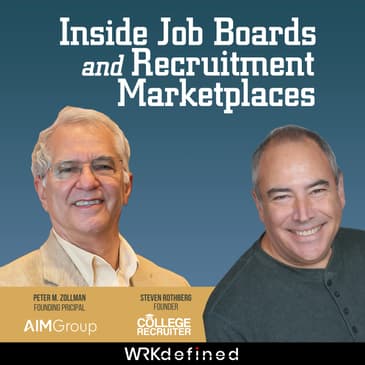
In today's episode, guest Joseph Stubblebine of Lensa and cohosts Peter M. Zollman of AIM Group and Steven Rothberg of College Recruiter discuss what leaders in our industry should expect over the coming months and years. Some, they believe, will be negative, some positive, and a lot uncertain.
The election was consequential and today's episode will help our listeners better understand its ramifications for our industry.
Powered by the WRKdefined Podcast Network.
[00:00:00] Kundenservice kontaktieren? Für viele Menschen ist das der beste Weg, einen schönen Tag zu ruinieren.
[00:00:06] Aber bei Zendesk sorgen wir für eine bessere Customer Experience. Besser für die Großmutter, besser für die Floristin, besser für den jungen Mann in Hausnummer 3A, besser für sie, besser für alle.
[00:00:17] Denn während einige behaupten, dass der Kunde immer recht hat, sagen wir, dass KundInnen immer Menschen sind. Und da wir auch Menschen sind, wollen wir etwas Gutes für uns alle tun.
[00:00:26] Zendesk. Customer Experience mit KI für Menschen gemacht.
[00:00:43] Welcome to Episode 86 of the Inside Job Boards and Recruitment Marketplaces Podcast.
[00:00:49] This is Steven Rothberg. I'm the founder of College Recruiter Job Search Site, where we believe that every student and recent grad deserves a great career and that it should be easy and inexpensive for employers to hire them.
[00:01:01] We have a potentially a difficult episode today for some, a great episode today for others.
[00:01:08] We're going to be focused more on outcomes and much less about the people who are going to be occupying various seats today.
[00:01:16] Bringing into the conversation at long last my awesome co-host, Peter Zollman.
[00:01:22] Peter, good to see you today.
[00:01:24] Well, thank you. I don't know how awesome I am, but thank you very much.
[00:01:27] I'm Peter Zollman with the AIM Group.
[00:01:29] We provide business intelligence and conferences for job boards and recruitment marketplaces worldwide.
[00:01:37] And one of those marketplaces is LENSA.
[00:01:41] And Joe Stubblebine is the Chief Revenue Officer at LENSA.
[00:01:45] Mr. Stubblebine, good of you to join us.
[00:01:49] Thank you very much.
[00:01:50] And we're going to talk about not the outcome of the election itself.
[00:01:55] That one has been decided and we move forward in the country and in the world for better or for worse.
[00:02:01] And I think all three of us have an opinion about that.
[00:02:04] But what we want to talk about is how are the changes that are obviously coming going to impact job boards and recruitment marketplaces?
[00:02:16] And it's important to note that the immediate impact of a Donald Trump presidency is going to be on the U.S., but it absolutely has global ramifications.
[00:02:27] The changes that are made in the United States carry through and so forth.
[00:02:32] So what's the one big change that you see for somebody operating a job board in the U.S., Joe?
[00:02:41] Well, first of all, thank you both for having me.
[00:02:43] It's great to see Peter, Steve, and I always appreciate the opportunity to talk to you.
[00:02:47] And I respect you both in this space.
[00:02:48] So thank you very much.
[00:02:50] Predicting President-elect Trump is certainly kind of like picking the lottery numbers for next Saturday to try and figure out what's going to happen.
[00:02:56] But I think if we look at his presidency, certainly in 2016, 2020, and we look currently at what he's been recently pitching on the road,
[00:03:05] I think there's a lot of really fundamental things that are going to be quite different.
[00:03:09] I mean, if you look at what happened in the stock market recently, and certainly he has in the past changed regulations.
[00:03:17] He has also indicated support for minimum wage, so it's hard to understand what's going to happen there.
[00:03:21] If there is potentially a deportation that might open up job opportunities to folks in the United States,
[00:03:27] I think that ultimately we will probably see a fairly interesting lift in the demand for employment in the United States.
[00:03:33] Prior to the presidency, in the months before the election, about 30% of companies, according to Liberty, had delayed hiring decisions
[00:03:42] because they wanted to see what was going to happen with the election.
[00:03:45] And manufacturing activity had also contracted.
[00:03:48] So now that the election is over, we see that post-election bump.
[00:03:51] I'm sure many of your listeners have seen some lifts to their 401k plans and things just because the anticipation of opportunities there.
[00:03:58] So anything that's good for business is always good for job boards and career sites.
[00:04:04] I also think that we have seen some regulation in the United States, mostly coming from California and now Colorado,
[00:04:10] like CCPA and other type of GDPR-like regulations.
[00:04:15] Donald Trump has consistently generally been an anti-regulation person.
[00:04:20] Now with Elon Musk heading up the business division to streamline the automotive legislation, IRS tax codes,
[00:04:28] even around space and loosening the AI executive order that Biden had put in place.
[00:04:34] I think all of these things are probably going to be a boon for business.
[00:04:37] Any boon for business is always great for career sites, talent communities and so forth.
[00:04:42] Hi, I'm Steven Rothberg.
[00:04:44] And I'm Jeanette Leeds.
[00:04:45] And together we're the co-hosts of the High Volume Hiring Podcast.
[00:04:49] Are you involved in hiring dozens or even hundreds of employees a year?
[00:04:53] If so, you know that the typical sourcing tools, tactics and strategies, they just don't scale.
[00:04:59] Yeah.
[00:04:59] Our bi-weekly podcast features news, tips, case studies and interviews with the world's leading experts about the good, the bad and the ugly when it comes to high volume hiring.
[00:05:10] Make sure to subscribe today.
[00:05:12] I dare say I would not want to be running a diversity job board right now.
[00:05:17] I think many companies have already pulled back from their diversity efforts and there will be an active anti-diversity program.
[00:05:28] I mean, Donald Trump has already said that.
[00:05:31] What do you do if you're a diversity job board?
[00:05:33] Well, I think you're absolutely on point.
[00:05:37] Trump's approach to DEI initiatives is not likely to be positive, obviously, especially in education.
[00:05:42] And certainly federally funded programs are at risk, which will put a lot of these types of organizations in a pretty challenging situation.
[00:05:51] I think that, obviously, I very positively support DEI initiatives.
[00:05:55] I think it's really just continuing to try and operate and continue to integrate DEI initiatives in your organization the best way you can, given that if you're relying on federal funding in the United States or if he does disband the Department of Education, there's going to be some pretty severe challenges there as well.
[00:06:17] I think the CEOs of most companies in America do support DEI for the most part.
[00:06:22] I think removing the regulation doesn't mean that we can't still focus on building a diversified workforce in our organizations.
[00:06:28] But, yeah, it's going to be quite interesting.
[00:06:30] I do agree with you.
[00:06:31] I'm not sure I would be wanting to run a diversity site at this point.
[00:06:36] But I think, again, if the CEO, if it's passionate about that CEO, they're still going to be buying job postings on diversity job boards.
[00:06:41] Yeah, I think, first of all, Peter, thank you for asking that question because I think that was a really good one.
[00:06:46] And, Joe, I agree with you.
[00:06:47] And one thing that we've seen at College Recruiter is that employers are still very interested in hiring candidates that they consider to be diverse.
[00:06:56] And that means different things for different employers, different roles, whatever.
[00:06:58] But they're doing it sort of more quietly.
[00:07:01] They're not trumpeting the programs as much.
[00:07:03] And that pun was intended, by the way.
[00:07:05] Let's talk for a minute about another big impact because I think it's fair to say that Trump tends to be more of an isolationist when it comes to foreign policy.
[00:07:16] That, I think, has some spillover effects into defense contracts.
[00:07:21] You know, if you're not involved in as many wars overseas, you don't need the munitions, the personnel, and whatever.
[00:07:26] I'm curious if you see a negative impact in the defense industry hiring and therefore job boards that serve them.
[00:07:34] Or is that offset perhaps by deportations, bigger presence on the border?
[00:07:43] It still might be military on the borders.
[00:07:46] Like, what are you thinking there?
[00:07:48] Traditional energy, I think, like oil and gas and manufacturing, I think we're going to see some pretty good lifts there.
[00:07:54] And I think generally the defense sector is probably quite safe.
[00:07:57] I think we have to remember that a lot of the funding to certainly Israel or Ukraine, a lot of those funds stay in the United States.
[00:08:05] So it's typically the Martins, the Boeings.
[00:08:09] When Zelensky came to visit the U.S. for the NATO conference, he visited a bullet manufacturing company in Pennsylvania.
[00:08:15] So I think that a lot of the funding that we are providing as part of our defense budget is still remaining in the United States, and it's lifting our economy.
[00:08:23] So if there is a situation where the funding to Ukraine is no longer available to them, there may be some negative impacts in the defense sector.
[00:08:33] But certainly our proactive approach towards defense around the world will continue to increase.
[00:08:39] It's really hard to tell.
[00:08:41] I do think industries dependent on international trade, though, may really be reluctant to hire because of the unknowns around changes to tariffs.
[00:08:50] And maybe, you know, he wants to perhaps raise tariffs to offset reductions in wages and taxation on wages and tips for restaurant retail hospitality.
[00:08:59] He's talked about not taxing Social Security benefits, which I think is a big boom for some of the older Americans.
[00:09:04] So I think there's definitely a lot of offsets.
[00:09:07] If there is a massive deportation, and I think there's approximately 12 million or so undocumented immigrants in the United States today,
[00:09:15] what that's going to cause is a demand for employers to go find more labor.
[00:09:19] However, they're going to have to raise their obviously wage offerings to sort of counter that.
[00:09:25] And that may then increase consumer pricing for goods and services.
[00:09:30] Brauchen wir wirklich noch einen Computer?
[00:09:32] Alle?
[00:09:32] Wahrscheinlich nicht.
[00:09:33] Aber wenn du Musik mit der Power eines Neuralprozessors neu erfindest,
[00:09:37] oder unterwegs Migrationsmuster mit einem ganztägigen Akku analysierst,
[00:09:40] oder deine Ideen mit dem KI-gesteuerten Co-Creator zum Leben erwächst,
[00:09:43] dann kann ein Co-Pilot Plus PC einen Unterschied machen.
[00:09:46] Nicht alle brauchen einen leistungsstärkeren KI-Computer.
[00:09:48] Aber wenn du versuchst, die Welt zu verändern, auch wenn es nur deine eigene ist,
[00:09:51] haben wir einen für dich entwickelt.
[00:09:53] Microsoft Co-Pilot Plus PC mit Snapdragon.
[00:09:55] Die bisher schnellsten und intelligentesten Windows-PCs.
[00:09:58] Die Akkulaufzeit variiert hier nach Nutzung und Einstellungen.
[00:10:00] Yeah, simple supply and demand, right?
[00:10:02] If there are fewer workers, then the supply goes down.
[00:10:06] Even if the demand for that labor is the same, you're going to have higher wages.
[00:10:10] Peter, I think we have time for another question.
[00:10:13] One, maybe two questions, yeah.
[00:10:15] Go for it.
[00:10:15] Putting aside the new administration a little bit,
[00:10:19] 2025 is upon us.
[00:10:22] I'm still signing checks 2012.
[00:10:24] That's because you're living in 2012, Stephen.
[00:10:29] I'm so sorry.
[00:10:31] What kind of generic advice and suggestions do you have
[00:10:39] for someone who runs a job board anywhere
[00:10:43] going forward for the next year?
[00:10:47] Is it all AI?
[00:10:49] Is it all customer service?
[00:10:51] Is it all sell like crazy?
[00:10:53] What is it?
[00:10:54] Great question.
[00:10:55] I mean, we were in an eight-hour planning meeting yesterday
[00:10:57] with our entire executive and product team for Lentsa
[00:10:59] to plan our 2025 goals.
[00:11:01] And you're going to share all of the details with us right now.
[00:11:04] It's probably not dissimilar to everyone else's,
[00:11:06] but AI was obviously a big topic of discussion.
[00:11:10] I think ultimately, I do believe in the short term,
[00:11:13] AI has the profound ability to change how job seekers
[00:11:16] and job boards interact with each other.
[00:11:19] I think it's the first time where we may be able to build
[00:11:22] personalized career concierge services
[00:11:24] that are truly valuable and effective in a real way.
[00:11:28] For us, we're focused on just trying to drive more connections
[00:11:32] between job seekers and employers, increase our registrations.
[00:11:35] The operation of job boards is a little bit mundane
[00:11:38] in the sense that we're looking for registrations.
[00:11:40] We want to match those people with great jobs
[00:11:42] and drive those candidates to employer websites.
[00:11:45] November is our highest revenue month this year,
[00:11:48] which is really exciting for us.
[00:11:50] But I think there's streamlining of a lot of process.
[00:11:53] Things are going to become less expensive
[00:11:54] in terms of cloud services and tools and technologies.
[00:11:58] They're going to help actually make the process
[00:12:01] between connecting job seekers and employers better
[00:12:02] and reduce that friction.
[00:12:05] So for us, we're pretty optimistic about 2025 ourselves.
[00:12:10] I'm very excited for what Lentz is doing,
[00:12:12] but also I've talked to a lot of peers in the space
[00:12:16] and they seem to be optimistic as well.
[00:12:18] I think that's great.
[00:12:19] And your optimism, I think, is shared.
[00:12:22] Takeaway for me and for the election,
[00:12:24] it's part of Trump's brand, right?
[00:12:27] Chaos for him is not a negative.
[00:12:30] It's a feature, not a bug,
[00:12:31] I think is how we would say it in tech, right?
[00:12:34] So I think for those who aren't really well plugged
[00:12:37] into the US elections, disruption is coming.
[00:12:40] It's going to be incredibly hard to predict.
[00:12:42] We need to kind of like hold onto our seats,
[00:12:45] but I think the wisdom that you shared
[00:12:48] with our viewers, Joe, is really great.
[00:12:50] And we thank you for having you as a repeat guest
[00:12:53] and we will definitely do that again.
[00:12:56] Joe, until next time, Peter, two more weeks.
[00:13:00] Hope to see you at RecBuzz, Mr. Stubblebine.
[00:13:03] It's in a wonderful location this year.
[00:13:06] So join us in April.
[00:13:08] It's in Vienna, just up the road from Hungary,
[00:13:10] where Lentz has so many of its people.
[00:13:13] Very, very nice.
[00:13:14] Well, Steve and Peter, thank you very much as well.
[00:13:15] Always enjoy listening to your podcast
[00:13:17] and certainly very honored to be a guest.
[00:13:19] If we don't talk before the holidays,
[00:13:21] I hope you and your families
[00:13:22] have a fantastic holiday season.
[00:13:24] As well.
[00:13:24] Thank you.
[00:13:25] Appreciate it, Joe.
[00:13:26] Take care.
[00:13:27] Bye-bye.
[00:13:28] Cheers, my friend.
Sponsors
