
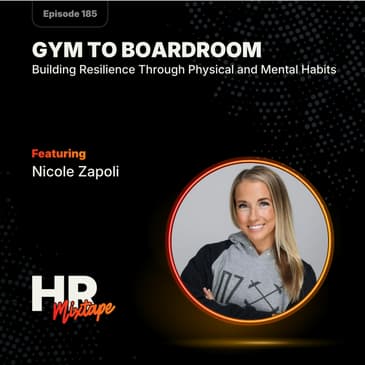
Too many people treat resilience like a switch: either you have it or you don't. But what if the real way to build it is by showing up for hard things again and again, even in your off-hours? In this episode, fitness and wellness coach Nicole Zapoli draws a direct line from the weight room to the workplace, sharing how the discomfort you push through in a tough workout is the same mental muscle you call on when work gets hard.
Nicole is a professional fitness coach, owner of NZ Fitness, and author of Live FIT From the Inside Out, with 25+ years of experience training athletes, busy parents, and working professionals around the world.
In this episode, you'll learn:
• Why "toughen up" is the least helpful thing you can say to someone struggling with resilience
• How consistent physical training builds the mental framework to stay steady under workplace pressure
• What leaders can borrow from great coaches: balancing honest feedback with genuine care to build trust that actually motivates performance
[00:00:34] Nicole's background: from competitive fitness to resilience coaching
[00:01:39] Why "just toughen up" misses the point of real resilience
[00:02:08] How tough workouts train the mental muscle of resilience
[00:03:37] Acknowledging discomfort vs. letting it stop you
[00:05:50] Nicole's SHIFTS Framework and the power of daily habits
[00:06:56] The stick-shift story: how steady, patient support changes everything
[00:10:30] How leaders can become the calm, guiding voice for their teams
[00:12:19] Balancing direct feedback with genuine care in the workplace
[00:17:01] Why people respond better when they know you actually care
[00:18:55] Closing thoughts: using trust to motivate and build resilience
Nicole Zapoli is a professional fitness and wellness coach, owner of NZ Fitness, and author of Live FIT From the Inside Out: The 6 SHIFTS to Living Your Strongest, Healthiest, and Happiest Life. With over 25 years of experience, a Pro card in natural bodybuilding (Figure & Sports Model), and ranking among the top 5% CrossFit Games Open athletes, Nicole is a leading expert in holistic wellness, having trained thousands globally.
Brought to You by Paylocity
Paylocity is the fastest growing unified platform for HR, Finance, and IT. Paylocity brings your people, processes, and data together in one place so HR leaders can spend less time managing systems and more time doing the work that actually moves their organizations forward. Learn more at paylocity.com
Keywords: resilience, workplace resilience, fitness coaching, mental health, HR leadership, daily habits, SHIFTS Framework, leadership development, employee wellbeing, performance culture, growth mindset, Nicole Zapoli, NZ Fitness, HR Mixtape, Paylocity
Powered by the WRKdefined Podcast Network.
[00:00:01] You're listening to the HR Mixtape, a podcast for leaders who want to understand people, strengthen culture, and navigate change with clarity. Today's conversation starts now. Joining me today is Nicole Zappoli, professional fitness and wellness coach at NZ Fitness. Nicole helps leaders build sustainable habits that support resilience, energy, and long-term performance.
[00:00:33] Nicole, thank you so much for jumping on the podcast with me today. Nicole Zappoli, Yes, thank you so much for having me. Nicole Zappoli, So you have a fitness and well-being background, but I really want to know what made you passionate about resilience in the workplace specifically? Nicole Zappoli, Yes, that as far as into my adulthood, I had things that I really had to work hard to overcome from my early adult life.
[00:01:14] Nicole Zappoli, Yes, that as far as I was able to continue to stay the course of my passion and what I have been working so hard at for so, so long. Nicole Zappoli, But there are so many parallels between the two. Nicole Zappoli, So yeah, I love that.
[00:01:40] Nicole Zappoli, You know, resilience, I think can be one of those terms that people can see as like, just toughen up. Nicole Zappoli, And I love if you can help us understand maybe what's a healthier way to think about resiliency. Nicole Zappoli, Yeah, so definitely, it is okay to acknowledge that whether you know, whatever emotion that you may be experiencing inside, but not allowing that to necessarily hold you back.
[00:02:07] Nicole Zappoli, Maybe take a time out or go do a workout. Nicole Zappoli, But the things that we run into, especially when doing tough strength training, and I love CrossFit and weightlifting and those style of training is great mental training as well. And it's great practice in developing resiliency.
[00:02:31] Nicole Zappoli, And so getting into workouts that are uncomfortable and they're tough, and maybe it feels like you have a really long way to go. It could be so easy to give up or sometimes you actually can experience emotion in the middle of the workout and not really understand why or know or be expecting that. Nicole Zappoli, And so it can kind of catch you off guard.
[00:02:53] But all of those things are the more frequently you are practicing getting in training, practicing the mental piece to that in your training, the better you get at it and the more you can apply it to the rest of your life.
[00:03:09] Nicole Zappoli, But as far as just almost in a callous way thinking of it, whether that's us talking to ourselves or thinking maybe that to ourselves about someone else or whatever that may be as far as just toughen up or just get over it. It's so much bigger than that. And if we don't deal with it or acknowledge that, that can really hold us back and it can show up in other ways too in the future.
[00:03:36] So it's definitely better to acknowledge or just observe and kind of, you know, be aware of it and then figure out, you know, I've had conversations in my head in the middle of workouts where I'm, you know, experiencing discomfort or something doesn't feel great.
[00:03:59] You know, just like your legs are burning or you're wanting to stop because, you know, it's your lungs are burning or whatever is happening. And you feel like, why am I even doing this? Or what is the point? And why am I trying so hard to finish this workout or do this or that or whatever?
[00:04:22] And it's almost like just that moment of acknowledging, well, because, you know, going back to our why behind why it is that we do anything.
[00:04:32] But the standards that we hold for ourselves and then also within that having grace and I guess giving ourselves space in those times that maybe we do need to take a moment and take some rest or take a breath or whatever that is to then, you know, just refocus. Bring it down a little bit.
[00:04:57] And then continue forward rather than letting that either, you know, completely discourage us or hold us back or get us stuck. And then we just completely decide to throw the towel in or or let it defeat us completely. That connection between working out and how your emotions respond.
[00:05:21] I love that you brought that up because I have definitely had my own moments in a tough Peloton session where you just were overwhelmed emotionally by everything that was going on. And it's such a good analogy to a lot of the things that HR professionals might have to deal with in in their line of work. And so how have you helped people think about using workout and moving our bodies to develop some small daily habits that can help us build that resiliency over time?
[00:05:50] Yeah. Well, actually, so. So my entire book is that I released a book last year and it's all about my six shifts to living your strongest, healthiest, happiest life. And it's really about building on those six shifts. Those daily habits are our foundation.
[00:06:10] And, you know, they may seem a little insignificant or maybe like they're, you know, there are bigger things that we need to be tackling or focusing on or working on. And the whole idea is that we're just that consistency, the foundation that we're laying allows us to build on that, continue to grow.
[00:06:32] And over time, we'll be able to look back and be like, wow, I've really, you know, been able to continue on and it hasn't been perfect. But I have stayed consistent within just those six shifts, those six daily habits and different ways to build on them and make them better. You know, whatever that looks like for each person.
[00:06:55] And I share a story in the book about learning to drive a stick shift when I turned 16 and I was I had just gone to the DMV and I was with my dad and we were in Houston in the summertime. And the air conditioning had gone out in this truck that my dad was letting me drive.
[00:07:18] And I was still learning how to drive this stick shift and I was getting really, really hot sitting in the car. And also when you're nervous, of course, like I was just pouring sweat and shaking. And I was the first car in line to get on the freeway and it kept stalling. And all these cars were honking at me and flying around, you know, throwing their arms up.
[00:07:43] And my dad just sat there calmly and patiently and just was, you know, he's like, just let him go. Do not worry. You know, they just let him go around you. We'll get through this. Everything's fine. And I eventually was able to get the car moving in first gear. And then I had no intention of actually shifting gears after that. I was totally fine staying in first gear the rest of the way.
[00:08:08] And he calmly again said, you know, we're getting on the freeway and I need you to push the clutch in and I'll help you shift gears. And so, you know, just that calm, steady, patient voice and person presence just right there with me. Not, you know, the emotion that I was experiencing.
[00:08:30] You know, he was able to kind of bring that down and just be that steady support alongside me during a very stressful, scary experience that, you know, I was completely fine, you know, staying in first gear. And so eventually, of course, learned how to actually drive and drive the standard.
[00:08:53] But with that encouragement and it was just gentle, patient, steady encouragement and support. And so with that, I share this story because it's so it's applies so well to life and it has stuck with me since that time. It was a pretty traumatic experience. But if I had just stopped there, I would have never been able to learn how to drive that truck. But it was bigger than that. It was learning.
[00:09:23] Oh, wow. I mean, I could have just completely not done that ever again and I would have been totally fine. But I learned how to drive it. I became confident in driving that in shifting gears, shifting up to fifth gear, shifting back down to first gear, you know, shifting from gear to gear. So all of that is applied to life as well. So we're not going to be moving at the same rate all the time.
[00:09:51] Sometimes we're going to need to take some rest and some moments of reflection or take some quiet time with ourselves. Or maybe it's time to pick it up and really begin to challenge ourselves and take it up a notch. And even when it's scary. And how do we do that?
[00:10:08] The best way to do that is with, you know, that steady, calm support that's there to, you know, help us have that courage to be able to continue to grow and to be able to shift gears and maybe level up or do something new that might be out of our comfort zone and all of those things. As I think about that connection between physical health, mental health, performance, anxiety, some of the things that you talked about in your story.
[00:10:38] How can leaders start to demonstrate that calming voice that your dad gave you in the example to help our own employees become more resilient in a way that's supportive, right? Like your dad could have yelled at you. Your dad could have been like, I showed you this a million times. Your dad could have not said anything. There's a whole bunch of not helpful things your dad could have done. But what are some of the things that you've helped leaders see to pull that into the business world?
[00:11:03] Yeah, I think definitely when there are that, I really believe that that was my, that was a gift, of course. My dad just being steady and patient and knowing that that is the support that, that I respond well to.
[00:11:24] And if that allows me to be able to overcome things, then how much more can I be practicing the same thing as a coach, as, you know, someone that is leading other coaches or other.
[00:11:43] And that's the only, of course, like my work experience is all in the gym and coaching and training, you know, other coaches along the last 25 years or so of my life. First starting as, you know, first starting as, you know, assistant coaching and knowing the different ways that I responded best and how I learned and how I grew best as a coach and as a person.
[00:12:07] And that was the same, you know, it's just as far as being gentle, patient, encouraging, supportive. Those are all great things. But also, you need to be able to take truth, different feedback and stuff like that just as well, of course.
[00:12:30] And so there's definitely a balance between as far as people, leaders in the workplace. We still need to be direct and straightforward and honest with what we need and how we need it, like within coaching, what the standard is and how we need to rise to that.
[00:12:54] But we also can't expect people or coaches, others to be able to rise to that standard first if we're not doing it ourselves. And then also, how are we actually providing them the best support to be able to rise to that and to the level that we want to see them performing at? And that applies to pretty much everything, too.
[00:13:20] I think back about in gymnastics as well and being coached by different coaches. And I loved coaches that gave me really solid, straightforward feedback so that I could improve and get better and grow and because I wanted to be the best. And then, you know, and I also had coaches that were, oh, yeah, good job, which was nice to hear. But then I also wanted to know how I could improve and how I could grow and how I could get better.
[00:13:45] And then I also had other coaches that were on the opposite end and did not provide productive critiques and also did not provide any sort of positive feedback either. So those were probably my least favorite.
[00:14:03] But I definitely, as far as taking all of those experiences that I've had personally and then, you know, how I am able to apply that moving forward. But then how just leading and growing a team of coaches, you know, taking all of that experience into that.
[00:14:27] And then still being open to me as a and as leaders in general in the workplace, how we can take our own experiences and apply that and then also still be open, know that we do not know everything. And that there is always room for us to grow. And the more that we're open to growing and learning and not feeling like we know we know it all. There's always that, I guess, that growth mindset that is super helpful to have.
[00:14:57] Just that we're continually staying a student, a lifelong student of whatever it is that we're in. And my craft is coaching and whatever our craft is, you know, continuing to master and go back to the basics and to the foundation and continue to master that. And then refine it and continue to improve it as we're like growing in all different directions.
[00:15:24] You know, your example of the leader being able to demonstrate the resiliency that you're looking for. You know, oftentimes we have leaders who may have done our jobs at some point in their career, but that's not their role anymore. Their role is to lead and inspire and make sure that we're meeting our business objectives. And that's important to know.
[00:15:46] But there is things that they can demonstrate around creating good habits, having good mental health boundaries, using things like, you know, mental health breaks in your day and those kinds of things. I think about my husband's in a very unique role. He's a battalion chief. And one of the things that he helps those who are coming into the fire service for the first time do is to climb the ladder on the truck. And it's, you know, many, many, many feet up in the air.
[00:16:13] So for some, you know, newer firefighters coming into that position, that can be very scary. And, you know, he prides himself and he'll demonstrate it. You know, let me go up first. I'll show you how to do it. And then I want you to do it. And he jokingly says, you know, hey, if the old guy can do it, you know, the young guy can do it. Or the young firefighter for sure can do it. But that being said, I think there you hit on something that's important is not everybody responds in the same way.
[00:16:40] You know, not everybody is going to enjoy the tough love. Not everybody is going to enjoy the encouragement. Some people might want the tough love instead. So as you've worked through coaching, how have you discovered with your clients that we can pull back into the business world? You know, what motivated that person and how did you work through discovering that? Yeah.
[00:17:02] So I definitely believe that when people know that how much you actually care about them, when they know that you care about them genuinely and want to see them get better, improve, they're going to respond that much more effectively. As far as working with clients, coaching others when they know that you genuinely care about them and want to see them improve,
[00:17:31] just that bit of trust in that relationship, they're going to respond that much better. And they're going to receive your feedback much better as well. Then, you know, there's a lot that everybody is working on to overcome from past experiences
[00:17:54] or whatever traumas they may be carrying into the gym or into, you know, whatever space they're in. And so the more we can just be aware of that and also have and hold space for that and just within empathy,
[00:18:13] but also having, you know, grace for those people, but also caring enough about them that we are going to let them know in an effective coaching manner. Like if they're coming in to receive coaching, your job is to coach and to let them know how to improve and how to get better.
[00:18:36] And so when that comes from a very genuine care and love to help people get better and grow and get healthier and stronger and fitter, then that's going to carry over and it will be communicated that way most of the time, hopefully. Well, Nicole, those were such good pointers around, you know, how can we build trust with our own team members and really think about using that in a positive way to help motivate and build resiliency.
[00:19:05] So this was a great conversation. It's good to hear from somebody a little bit outside of our industry and what they're doing and how we can learn from what they're doing and bring it into the workplace. So thanks for taking a few minutes to sit and chat with me. Yes. Thank you so much for having me on. Thanks for tuning in to the HR Mixtape.
[00:19:30] Like, share, review and subscribe to support the show and help more people discover these conversations. Until next time, keep the conversation going.
Sponsors
