
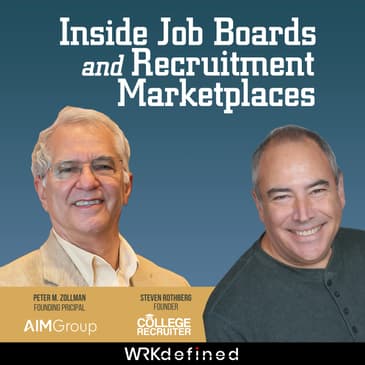
We're taking a little trip down memory lane on today's episode of the Inside Job Boards and Recruitment Marketplaces Podcast. One of our cohosts, Peter M. Zollman of AIM Group, is unavailable and so our other cohost, Steven Rothberg of College Recruiter job search site, is flying solo.
Steven talks with Jeanette Leeds, COO of College Recruiter, about applicant tracking systems (ATS), recruitment process outsourcing (RPO) organizations, and whether they used to and currently play nicely with job boards.
Do they view our industry a complementary, or competitive? Are those feelings reciprocal?
Powered by the WRKdefined Podcast Network.
[00:00:13] Welcome to episode 136 of the Inside Job Boards and Recruitment Marketplaces Podcast. I am Steven Rothberg. I am the founder, not the co-founder. I'm the founder. I'm pretty sure I know who the heck I am. College Recruiter job search site. I am most definitely not joined today by my co-host Peter Zollman of the AIM Group.
[00:00:36] I mean, you guys don't look anything alike, but Jeanette Leeds is the CEO of College Recruiter. I'm just going to promote it! Right? You deserve it. Peter is unavailable. He's doing something much more enjoyable than being on a podcast with me. And so Jeanette, you're stuck with me for the next 12 or 13 minutes. I will take it. Happy to be here. I thought it'd be really fun to talk with you because of the background that you have.
[00:01:05] Leading, you know, college and university recruiting for a couple of really big organizations, financial services, then going to this little company called Olio, then going to this other little company, little only in the number of letters in its name, AMS. But for the people in the audience that don't know what Oleo is, what AMS is, maybe tell them a little bit about that, what you did at those organizations, because I think that's going to provide some really good context. Yeah, absolutely.
[00:01:35] So let's see, when I was at Oleo, which was a million years ago, another three-letter company, WCN, which you rebranded. Oh, yeah. That was, you know, that is, not was, a company at ATS, but also a CRM and events management platform, but all really focused on campus recruiting or for those who are over on the other side of the pond, uni, university relations and all that, and high volume.
[00:02:02] Like was able to do and still is able to do all sorts of recruiting, but that was really the focus in the niche, like high volume, how can you do things in bulk in a really systematic way versus what I call like a regular ATS. And so ran that, was the first one in the U.S., expanded out that whole business. I don't know, all of that, which is great. And after nine years of growing revenue to 40%, I was like, oh, what am I going to do next?
[00:02:29] So then I was at AMS running the high volume RPO in America as that whole play, but also the hourly tech product, which is all about conversational AI and how you quickly capture candidates in a conversational way, typically on text, mobile, and then get them in combining in people, process, tech, but from the RPO side. So I've sort of been on all sides of the coin, whether it's first as a practitioner on Wall Street,
[00:02:57] campus recruiting, again, bulk, high volume, let me hire like four or 5,000 people, you know, in one year to then the tech side, you know, again, doing that, then let's do RPO and combine it all together. And well, now I'm here. And AMS is the biggest recruitment process outsourcing organization in the world. Yeah. And so people who know me at all know that I've been in sort of the employment space now for a long time.
[00:03:23] So we'd launched the very first version of College Recruiter 30 years ago in 1996. It was two years before Google. It was right when Yahoo was launching. The internet was completely wild west. It was so different. And one of the things that I think was pretty true in that era is there were ATS at the time, like what was it called? Like RecruitMax or something like that. Oh my God. Yeah. And some of them ended up kind of like changing names, merging, rebranding.
[00:03:53] But if you kind of trace it back. RecruitMax. RecruitMax. Yes. Thank you. That's exactly. And so there were a very small number of employers back in 1996 that even had websites, that even had a career site. Yeah. Having an ATS for a lot of large employers was their way of getting a career site. There wasn't a way of like going to a company site, searching for jobs and applying for it. Right.
[00:04:21] I remember back then, as they would say, back in the day, ATS did not play nicely with job boards. The ATS saw job boards as being competitors. And I think the thinking was probably candidates should just go straight to the employer website. They shouldn't stop on a job board. They should find us on Yahoo or Google or Lycos or Alta Vista. Oh my gosh. I'm definitely dating myself. Ask Jeeves. Ask Jeeves.
[00:04:50] Loved, loved to ask Jeeves. I mean, who couldn't use a butler? But before we get to the RPO piece, let's talk about the ATS piece. Because of, let's call it that baggage, which maybe I need therapy to get over, I kind of still have this feeling that the ATS used to, I don't think today, but they used to view job boards as competitors. And I don't know if you agree with, I think, let's separate out what they used to from today. So, you know, I think used to for sure.
[00:05:19] I mean, I remember, you know, years ago, right, being like, oh my God, we have to integrate with job boards. Again, this was when, before earlier, when it was still WCN and whatnot. And that was going back into the early 2000s again. So I'll date myself there. But what I think has been interesting just as like, you know, I feel like we're doing a history lesson of like the evolution is then it started, you know, at some point, I forget what year it is, like the CRM, you know, like, okay, let's, that's going to be
[00:05:45] the overlay or that's going to be sort of that kind of experience because the ATS experience isn't that great. And so then I feel like there was more of that competitive piece happening with like CRMs and job boards versus the ATSs because it was sort of like very two different budgets in many ways where it was like one, it's like you need an ATS to track your, right? Applicant tracking system. And so that's different than, okay, how do I source and get the candidates?
[00:06:14] So it was a very like separation. And so then the CRM was like, you know, sort of more of an attraction layer. Again, I'm going back a million years. And so I feel like there was more of that like head butting now, I mean, to me now looking at it, like, I don't know if anyone's really thinking or talking about it in this way, but like in some ways you could say a job board does compete with an ATS just from the standpoint of an ATS.
[00:06:44] And I would say also for CRM, like organizations have so many candidates like in their ATS or their CRM, right? Like hundreds, thousands, depending on how big they are. Now the data may or may not be stale, but like what a lot of organizations will do is are starting to do. And if you're not doing this, you should definitely do this. Obviously working out like jobs, but it's like you have a job who's in your already in your system that you can like reach out to, right? Versus going out to net new.
[00:07:13] So there's still always going to be a time and a place to go out for net new. And especially if you're doing entry level, early career, right? Your candidates in your pool are going to age out and get more experience and they're not going to be appropriate for the roles that you're recruiting for. So to me, there's like this ecosystem and imbalance of like, what are you trying to do? Right? Like everyone can be friends in this ecosystem. That's what you ask me all the time. What are you trying to do? What are we trying to do here?
[00:07:41] So in some cases, I think, you know, it's certainly competitive and, you know, there's a tension of like, we're competing for the same dollars, but in many cases, that's not. Everyone could be frenemies. Hi, I'm George LaRock and I'm looking forward to exploring the critical trends shaping the future of work and technology with you over on the WorkTech podcast. Now this podcast is a little different. I bring together industry leaders, innovators, and investors, and we go deep into market intelligence
[00:08:09] that matters to HR pros and tech providers alike. So give the WorkTech podcast a listen here on the WorkDefined podcast network, and please subscribe if you like it. See you there. Correct me if I'm wrong, but I think that you and I are on the same page here. We used to be more foe and now we're more friend. Yes. Like when we're working with the ATS now, first of all, they answer the phones. They return our emails. Well, I was like, who's on the phones? I mean, I think it's worth it.
[00:08:39] Slack messages, text. Right. But it is, the orientation is how can we work together? Yes. Sometimes it makes sense, sometimes it doesn't. For sure. But it's not like, it's not like they've slammed the door and double padlocked it like they did 20 years ago. Yeah. And that's, I think that's good for everybody. Absolutely. Job boards, ATS, I think mostly work together pretty well with the mindset of we have a
[00:09:07] common client and common interests. Absolutely. And if we can all play nicely together, rising tide lifts all ships. I don't think I can throw another analogy into this. Exactly. And the fact of the matter is with shared customers, like the customer is right, right? If there's a shared customer and they're like, hey, we want to be able to, you know, connect this job board, right? Or get, you know, and listen, you don't even need to connect in many ways, right? Because there's just like so many simpler ways to get things done. Yeah. From a tech standpoint, right?
[00:09:36] Versus years ago, it was like heavy lifting from that standpoint. But it's like, what can we all do together collectively to make a great candidate experience and to ultimately for that employer to be able to hire great candidates? And, you know, from an ATS perspective or job board, like we're all trying to do the same thing, right? Yeah. To help connect candidates to employers and everyone can get great jobs and live happily ever after, right? Like, and let's smooth it.
[00:10:05] And then if that happens, then well, from a financial standpoint, we all make money. So speaking of making money by having, by helping candidates find great jobs, let's talk about RPOs. Yeah. That's kind of the business model. Yes. Right? It's like, right, we help you get hires, you pay us more. Yeah. And obviously the financials, the commercials, as our friends in Europe would say, that varies deal to deal. But so now put your AMS hat on. Yes. The RPOs. Yeah.
[00:10:33] My thinking there is that they are going to be much more like their talent acquisition friends, where there are going to be times where they're going to want to use job boards, times where they're not going to want to use job boards. The product might be right. The product might be wrong, but it's not an adversarial relationship. No, no, not. I mean, not at all. And, you know, what's interesting is I've seen the RPO side from AMS, like literally an RPO, but also at Olio, a number of clients were also RPOs.
[00:11:03] So I've seen it also from like the tech side, like as well. So again, from that standpoint, if there's a, like definitely friends, job boards, RPOs, because if, you know, if there's a easier way to get the candidates into the pool, right, that's going to make the RPO like more efficient, more effective, lower costs, right? If they can have, if they can deliver the same result for, you know, lower costs, like that's even better.
[00:11:33] And if you can do it quickly and efficiently, again, it's like most of the, I shouldn't say most, a lot. I don't want to say all, but the customers of an RPO, the employers, they're basically, you know, outsourcing it. So they're like, okay, deliver it, like deliver it. Obviously there'll be some guardrails around it and how, you know, the hires happen. But if you can have that great quality candidate, get them hired, hitting the SLAs, you know,
[00:11:59] how you do it is for the most part, I don't want to say all, but with some exceptions, like they're happy for that. So the job boards and RPOs are aligned. There's no, there's no foe. So before we leave off, I want to dig into what you just said and you kind of like had your eyes going up, I think to the right. And it's like, for the most part. For the most part.
[00:12:24] So I have heard a few times, not a lot, but I wonder how much, if I'm just sort of hearing the tip of the iceberg or if I'm just actually seeing an ice cube floating in the ocean. I've heard executive recruiters, headhunters, people at RPOs essentially say, unless they put a lot of blood, sweat and tears into finding these candidates for their employer clients,
[00:12:51] the employer clients will say they're not delivering a lot of value add. If we don't show how hard it is, if we don't work really hard at this, the employer is going to say, well, that's not hard. We shouldn't be paying you as much. Maybe we shouldn't be paying you at all. Is there any truth to that? I mean, there is a touch of truth. But at the same time, I think if you're at an RPO and you have to show your value, right?
[00:13:17] Like someone is paying you and they're paying you like with a margin on top of it. Like it's not like a straight cost because everyone has to make a little bit of money. Right. So what are you bringing to the table? So to me, that's where I think RPOs can really shine. And you add on a bit of that like strategic advisory. Right. It's not like working harder. To me, it's working smarter. Right. So it's like, yeah, symptomatically, oh, if we could do it ourselves, but like you can.
[00:13:45] And so by having a streamlined process or saying, hey, we're doing this because we've seen this work really well and you're bringing that expertise. Like to me, that's what an employer pays for with an RPO. And they don't just they don't have to worry about it. Right. So it's less about like, oh, we could just do ourselves. But what is that RPO bringing beyond? I would just listen to a job because it's we all know it's more. So I think it becomes much more nuanced and complex.
[00:14:11] You can't just have, you know, gone are the days of the transactional type of I mean, I believe this to this day, like you can't just have transactions. It has to be that little bit more strategic conversations happening for the really good partnerships on the RPO side. Well, sounds like we're all friends. We're all friends. We're going to sit around a campfire. We're going to get some graham crackers, marshmallows and chocolate. We're going to make s'mores. And anybody. I love it. Anybody in the audience that doesn't know what a s'more is, you are dead to me.
[00:14:41] Oh, just fucking up. Great. Summertime. Exactly. Well, this was enlightening and having me. Yeah. And I guess I'm I need to sort of adjust my thinking. Maybe you say maybe you save some therapy. Yeah. Everyone's friends. It's fine. No. And truly, I mean, if I was just kind of coming into the space now on the HR side, ATS, RPO, job board, whatever. It is a lot more collaborative now. It really is. And that's a great thing.
[00:15:10] Well, until next time. Good stuff. Thank you for joining the Inside Job Boards podcast. Thanks for having me. Take care, everyone.
Sponsors
