
Most organizations assume they have resilient teams. What they actually have, in a lot of cases, are teams that have gotten good at tolerating hard things. The two aren't the same, and the gap becomes visible the moment something real changes.
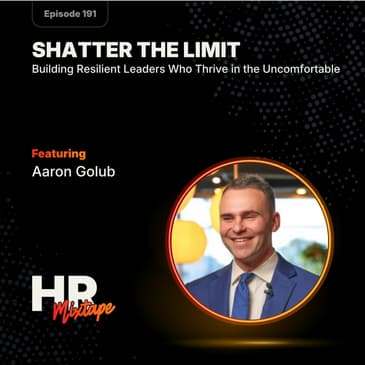
Aaron Golub, founder of Aaron Golub Consulting, made history as the first legally blind Division I athlete to play in a Division I game, serving as team captain at Tulane University before signing with the NFL as a free agent. He's been translating that lived experience into leadership development work since the age of 17.
In this episode, he covers:
• Why acceptance is the prerequisite to any real change, and how skipping it is the reason most leadership development doesn't stick
• How to read what each person on your team actually needs, and why applying the same leadership approach to everyone is the core mistake
• Why the next generation of leaders is too comfortable, and what that costs organizations when pressure finally arrives
Timestamps
[00:00:16] Aaron Golub's origin story: how becoming the first legally blind Division I athlete became a leadership framework, not just a personal victory
[00:01:10] Why the football story is the vehicle, not the point, and how Aaron translates a personal resilience model into organizational change
[00:02:16] The acceptance principle: why you can't form new perspectives around a challenge you haven't first acknowledged as real
[00:03:57] What leading a Division I football team taught Aaron about the danger of applying one leadership style to every person
[00:06:48] Why every engagement starts with a needs assessment, and why skipping it makes the work ineffective regardless of how good the content is
[00:08:18] Gratitude-based leadership: why positivity and negativity both spread through an organization, and the four-step framework that gets you there
[00:11:00] Why inclusion starts with asking, not assuming, and the airport wheelchair story that shows what happens when you don't
[00:13:10] Aaron's case against automatic visual descriptions in meetings, and why well-intentioned practices can create the tension they're meant to prevent
[00:17:14] Why the next generation of leaders is too comfortable, and what organizations lose because of it
[00:20:42] Aaron's final takeaway: reframing "I can't" to "I haven't been able to yet," and why the language shift is the strategy
Guest Bio
Aaron Golub is a professional speaker, entrepreneur, and consultant who specializes in helping to shatter perceived limitations. He made history as the first legally blind Division I athlete to play in a game, serving as a team captain at Tulane University before moving on to the NFL as a free agent. After his story captured the national spotlight on Good Morning America, Aaron realized his journey wasn't just about football, it was a blueprint for resilience. Since the age of 17, he has traveled the globe delivering high-impact strategies that challenge teams to rethink their "impossible" and take immediate action. Aaron doesn't just deliver a keynote and leave; he is a dedicated partner who works alongside leadership to implement lasting change and ensure insights turn into results.
Brought to You by Paylocity
Paylocity is the fastest growing unified platform for HR, Finance, and IT. Paylocity brings your people, processes, and data together in one place so HR leaders can spend less time managing systems and more time doing the work that actually moves their organizations forward. Learn more at paylocity.com
paylocity.com
Keywords
resilience, limiting beliefs, leadership development, gratitude-based leadership, inclusion, disability in the workplace, people management, team building, change management, performance management, employee engagement, psychological safety, workplace culture, HR strategy, personal development, adversity, blind athlete, resilient teams, organizational change, discomfort
Powered by the WRKdefined Podcast Network.
[00:00:01] You're listening to the HR Mixtape, a podcast for leaders who want to understand people, strengthen culture and navigate change with clarity. Today's conversation starts now. Joining me today is Erin Golub, founder and speaker at ErinGolub.com. Erin made history as the first legally blind Division I athlete to play in a game and now helps leaders and teams shatter limiting beliefs and turn resilience into real, lasting results.
[00:00:38] Erin, thank you so much for jumping on the podcast with me today. Erin Golub, MD, Yeah, thank you for having me. Excited to be here. Erin Golub, MD, So you have a pretty interesting story. First legally blind Division I athlete, team captain at Tulane, NFL free agent. But all of that really isn't the story. It's not about football. It's about something much bigger. And I'd love for you to tell us a little bit more when you learned like that it wasn't about football.
[00:01:05] It was something much bigger that you could bring to organizations to talk about. Erin, it's a great question. For me, it's about resilience and more importantly, building resilient leaders. You know, we all have challenges, adversities in our lives. And we all go through change and difficult scenarios and it's how you navigate them. Some of us have learned to navigate them in a way that allows us to make a difference to accomplish our goals and others don't.
[00:01:35] And for me, that's something that I was learning my whole life. And so when I wanted to get into the world of entrepreneurship and build my own business, you know, in the beginning it was a natural fit of how can I take that skill set and translate it to others? So many people sit in that space of limiting beliefs. And, you know, if you're curious about Aaron's story, we're not going to be able to get into the whole thing on the podcast. So definitely look that up in advance.
[00:02:04] But you kind of conquered that idea of those limiting beliefs. How do you bring that into organizations to help people get through some of the limiting beliefs that they have? People need to understand that their past doesn't always equal their future. And you can determine whatever you want for yourself by making choices. You know, yes, you might not have done well in certain areas in the past. You might have not been the smartest, the most athletic, whatever that is in your scenario.
[00:02:33] But that doesn't have to define who you are and what you can do. You know, for me growing up, my limiting belief was I'm not athletic. I'm not good at school. I'm not confident. And the second I decided to not allow being legally blind to control my entire life of what I thought what I could do, I was able to make that transition. And so for me, it's the same process with organizations.
[00:02:57] It's helping individuals understand and accept where they are, because I strongly believe that the second you accept your past, who you are, your challenge, that's when you can start to move past it. I had to accept the fact that I'm legally blind and there's nothing I can do about that. If you can't accept that for yourself, whatever that is, there's no way you're going to move past it. Once you can accept it, you can start finding ways to think differently about it and form new perspectives around it.
[00:03:24] That will eventually lead to that change and that break in those limiting beliefs. But if you can't accept it, you'll never be able to form new perspectives. I'm curious, when you stepped into that role of team captain, it's so fascinating to me because, you know, I think sometimes we think that leadership equals the most talented person in the room gets that role. That's usually not the case from what I've seen.
[00:03:51] What was your experience and what did you learn from that experience of leading the team that way? It taught me how to lead others from different backgrounds, from different settings, from different personalities. You know, I took it as a lesson to teach me when does someone need to be helped and supported? When does someone need to be pushed? And I use that, you know, if someone was in the weight room and they grabbed a weight that was too light for them, how do I push them to pick up a heavier one?
[00:04:16] If someone was in the classroom and didn't do well on a test, how do I help them and support them to study differently and do better on the next one? And people need to understand that when you are a leader, you need to be able to read people, not only their, you know, body language, their personalities, what works for them, because what's going to work for one person isn't going to work for somebody else or everyone. There's certain people that need to be helped and supported in a very calm fashion. There's certain people that need to be pushed in, you know, certain ways as well.
[00:04:45] You know, for me, my coaches learned very early on that, and this didn't work for every athlete. But if I'm in the weight room and we're lifting heavy weight and I was struggling, when they came over and screamed in my face and yelled at me, it worked very, very well for me. You can't do that to everyone. But it's understanding what someone's personality is and what they respond to. And I think that that's what leadership is because you shouldn't be, you know, soft and warm and helpful to every person.
[00:05:11] Yes, it's going to work for a lot of people, but there's certain people that that's just not how they respond. And you need to mold to be able to help them in what they respond to, in what way they can get it through their head. And I think that being a captain and leading up to that is where I learned those lessons of how to help different people in different ways. That adversity that you kind of described, the bean yelled at, right, that like friction that was created, that that really worked well for you.
[00:05:41] I think that there probably is a lot of spaces where adversity and that challenge can really help people rise to the moment. How do those in HR listening find that sweet spot for their employees? And really, how do they teach their managers to find that sweet spot? Yeah, and look, I'm not saying that at a company you should go yell at your employees. That's not the answer here. Everyone is, that's just an example. And you need to take the analogy from that, obviously.
[00:06:11] But it's understanding when you're having a conversation with someone. If, you know, someone isn't performing well, let's just say, how are they going to respond? There are certain people that will respond really well to that calm conversation and figuring out, you know, hey, this is what you've done wrong. This is how we're going to work together. This is how we're going to fix it. There's also certain people that are going to respond a lot better to a direct approach. Hey, honestly, you are underperforming. This isn't going well. We need to fix it and we're going to put a 90-day clock on it and work on it together.
[00:06:42] You never know what someone's going to respond to unless you get to know them as a person and you understand that about them. And so that's why I always talk about, hey, before you can accomplish this goal, if you want to increase revenue, if you want to increase growth, how do you fix, you know, and understand the culture, the people, the environment that you have around you?
[00:07:03] Every time I go into speak or do a workshop, I do a very extensive what I call needs assessment process because if I don't understand those aspects, if I don't understand the people, if I don't understand the culture, the environment, what's going on there with everyone, not just as a whole, but try and understand teams and individuals as much as I can. And I can't be effective unless I know that because that allows me to figure out when I'm doing certain things, certain activities, certain groups, how do I handle certain situations? How do I respond to what they're doing and what's actually going to get the point across?
[00:07:33] Because there are certain activities that I bring to keynotes, that I bring to workshops that for one team might go over really well and for others won't and I need to shift what I'm doing. Being able to pivot is so important. And I'm not sure if I've shared this on the podcast before, but I definitely have been on stage and told a joke or used a reference that did not land with the audience. And you have to very quickly pivot and figure out what resonates with them.
[00:07:58] And it makes me, you know, think about the framework that you've talked about in the work that you do around gratitude-based leadership. So maybe you could talk a little bit about what does that look like to lead with gratitude in a way that really does have the business impact that we all talk about, right? Performance, not necessarily just morale. Yeah, look, both positivity and negativity are infectious. If you are a positive leader, that's going to spread throughout your organization.
[00:08:27] If you are negative, that's going to spread as well. And you're going to see that in your growth, in your numbers, in your performance of people around you. I believe that everybody has something to be grateful for. Even if you're someone who doesn't practice gratitude in certain ways, you can find something to be grateful for. The fact that you woke up this morning, you put your feet on the floor, you opened your eyes, like that's already three things that you can be grateful for. And I'm not someone who says that, oh, you should wake up and write down three things that you're grateful for. I don't really believe in that type of stuff.
[00:08:56] But I believe in figuring out every single day, you know, what are you grateful for and how can you identify things that you care about? You know, the fact of the matter is I'm grateful, you know, today that I have the opportunity to have, you know, calls with lots of different companies that I can, you know, start after this, have a call about an event with a company that I'm having a speak engagement with next week. I'm very grateful for that chance, that opportunity tomorrow. It might be I think I have a much more flexible schedule.
[00:09:25] It might be gratitude for the fact that I have time that I can spend five hours doing deep work and focusing on projects that I couldn't do today or I couldn't do over the past few weeks. But I think that you can find gratitude in so many situations when you can learn to do that. You can eventually learn to have that within your challenges, within your roadblocks, within your adversities. And so, you know, look, I'm not saying that someone who's legally blind, for example, should wake up tomorrow and be like, I'm so grateful I'm legally blind now.
[00:09:55] But what I am saying is you need to ask yourself in every situation, how can I learn from this and how can I grow from this? Because that leads to gratitude. It's a line. It's the acceptance is what starts it. Then that causes you to start thinking differently and having a new perspective. When you can start thinking differently and having a new perspective, you can start asking yourself how you can learn and grow from each challenge, each situation.
[00:10:20] And when you can understand how you can learn and grow from each challenge, each situation, that's when you find gratitude within them. Man, it's so inspiring to look at that framework from that just very tactical perspective, right? Like how do we build this muscle in ourselves? You know, with your background and being that team leader, I'm sure you had to figure out how do you leverage all the differences in the room?
[00:10:46] How do you make everyone feel like they belong in that space and in that time? And that's something, you know, we as HR leaders definitely struggle with. How do you think about, you know, inclusion and policies that impact those types of things? Yeah, you know, great, great question. There's there's a couple sides to it. It starts with that needs assessment, like I talked about a little to understanding what's going on, who's in the room, what their personality is like, what their goals are. That's that's the base of it.
[00:11:13] When you actually get into the room, it comes down to making sure you have a mix of different activities, different ways to engage people. Because, for example, for me, one activity I oftentimes do is I have these goggles that simulate my vision. People come up, they try and throw and catch a ball. Oftentimes it's going to, you know, smack them in the chest or wherever and they're not going to hit it. And we're using it to teach different things, whether it be understanding and empathy, whether it be resilience, whether it be teamwork and communication. There's lots of ways to take it.
[00:11:41] But at the same time, there's going to be a certain percentage of people who think that that's incredible and they jump at the opportunity to do it. And there's a certain percentage of people who are like, no, I don't want to get in front of the group. And that's fine. But you need to have other ways to engage those individuals through other activities, through other things throughout that keynote, throughout that day. Because if you're just focusing on one side of people who are more extroverted, you're going to miss 50% of the people there.
[00:12:05] Now, the other thing I always ask and I always say is, you know, when something like that, you know, inclusion comes up, it's asking people what they want. So often we assume, we assume what's best for someone because we think we know what's best. And I always give the example of, you know, when I go to the airport, I get a mean assist. They help me get through security, get to my gate. If they didn't, I'd, you know, never find where I'm going.
[00:12:31] You know, there's a couple airports that, you know, my home one, the terminal that I travel out of, I know like the back of my hand. But besides that, you know, most airports I need, I need help, you know, finding my way to where I'm going. And most times they come out and they have someone with a wheelchair and they're like, Aaron, take a seat. And it's this back and forth for a couple minutes being like, I don't need it. I just need to walk with you. Can't see the signs or my way. And they put it back and they say, okay, here, come with me. They automatically assumed what I needed because they didn't know.
[00:12:59] But if they took the two seconds to ask what I needed, ask how they could help, they would avoid that situation, which for me, I don't mind. But for a lot of others, you know, they do. And so one example I give in the corporate world is, honestly, I feel like I haven't seen it as much the last six months. But there was a solid few year period where people were doing in companies what I like to call visual descriptions. I am strongly against them. Very much so.
[00:13:27] Now, that doesn't mean that I'm against them for, you know, everyone. If someone wants them who's blind, visually impaired, be my guest. If that's what you want, then who am I to tell you not to? I personally am of the belief if you sit there and you say, hey, I'm a white man with brown hair and blue eyes. It's like you're bringing more attention to something that doesn't need attention to. Like I know I'm legally blind. Why are you calling this out in this way? And I would see it oftentimes on one-on-one calls of people.
[00:13:57] I'd get on a call like this, a sales call with a company, and, you know, they thought that that was the right thing to do. And I'm very much against it because my belief is why create more tension, more awkwardness than needs to be. Now, if you want to ask if someone wants that, great. Some people might say, yes, that would be super helpful. But automatically assuming someone wants that, I completely disagree with.
[00:14:23] It's such a good point that I hadn't considered because I definitely have gone down that road, have talked to people who have suggested that you do that in meetings. And you're right. I haven't seen it as much, you know, the last probably year as well. But you bring up a good point that it's not just about those scenarios. It's in totality that we need to think about asking people how they want us to support them.
[00:14:48] That could be everything from performance to recognition to, you know, support, like you said. What makes it less awkward or how have you coached managers to have those conversations when they are in scenarios where it's not maybe a performance or recognition, but it is dealing with maybe somebody who's deaf or, you know, has a vision impairment or some of those things. Because I think people do get scared about what to do and want to do the right thing.
[00:15:16] It's the simple thing that you just mentioned and I mentioned as well. It comes down to just asking. We're so afraid to ask. We don't want to do it. But asking is what actually helps. And so here's another example. I grew up skiing and snowboarding my whole life. I volunteer, my sister does, my dad does, as skiing and snowboarding instructors for people with different disabilities. And growing up, my sister and I would have this, we call it, sophisticated way of going down the mountain. I'd go first.
[00:15:46] She'd go after me and she'd yell, Aaron left, Aaron right, Aaron free. And it would work. And, you know, today, now we have like Bluetooth stuff in our helmets and it works, you know, a lot better. But one day she was going up the chairlift with this 10-year-old kid and he was legally blind. And she's like, I know exactly what to do. I do this with Aaron all the time. Thankfully, she took two seconds to be like, how can I help you? What can I do to make this the best experience for you?
[00:16:10] And he looks at her and he goes, I want to follow you down the mountain so close that I can see every turn and follow you everywhere you go. Two people, same challenge, complete opposite ways of how they want to be helped. Now, for me, part of that also goes with the trust factor of it's my sister versus, you know, other people. But same thing. It's two people, same challenge, opposite ways they want help. And you could have 15 people who are, you know, blind, 15 people who are deaf.
[00:16:38] And unless you actually ask them individually how you can help and support them, you'll never know. Because they might want something completely different than what you assume. Yeah. We talk about clarity being kind in performance expectations. It's the same thing here, right? Clarity and asking the question is actually the kind thing to do. You've worked with a lot of teams, a lot of different leaders. I'm curious, as you've had these conversations and you're seeing these changes, what do you think the next generation of leaders are going to be like?
[00:17:07] And what do they seem to be leaning towards that we can be cognizant of? You know, one thing that, and it's funny because I actually just, and I have a conversation today later about this event I'm doing in about a month from now. But I recently signed an agreement to speak at an event in mid-May. And they really wanted about getting uncomfortable and, you know, how to thrive being uncomfortable and how there's a lot of growth there.
[00:17:36] I personally believe that, you know, look, everything in the world of inclusion, of helping and supporting others is fantastic. And we need that. But I also think there are certain environments where it gets to a point where people are too comfortable. And when we can learn that it's okay to be uncomfortable, that's when we become better leaders. Not every conversation is going to be comfortable. Not every situation you deal with is going to be comfortable. Not every client who's yelling at you.
[00:18:06] That's not always going to be comfortable. And I think the next generation of leaders needs to learn how to get uncomfortable more. Whether you're in high school or college, whether you're right out, whether you're in your late 20s, early 30s, the more you can learn that it is okay to be uncomfortable, that we crave certainty in life, but it's okay to be uncertain, the better of a leader you will be. Because if you can't deal and learn change management, learn to deal with uncomfortable situations,
[00:18:34] you won't be able to thrive in them when they come up. Yeah. And that goes into building resilient teams. You know, as you've worked with people, how have you uncovered the leaders who say, yeah, I have a really resilient team, but then you start to dig into it and you realize, oh, you just have a team that's really good at tolerating hard things and you're calling it a strength instead of actual resiliency. It's challenging them through different activities. And so I gave you an example of the goggles.
[00:19:01] I last year, I did like a six hour training, I think in October, with this, you know, team of like 15 leaders of a company. And whenever I do that and I have that much time, and it's a smaller group, we get really fun with the activities. And so I basically had a few people leave the room and we set up this entire obstacle course with just like tables, chairs, bags. Honestly, it probably wasn't the safest thing. Thank God no one from HR was actually there. But it was so fun.
[00:19:30] We brought these two people back in and they were blindfolded. And they had to find a way to navigate through this room and get to the other side. And we had one person who could see who had to help them do it. And it's showing very quickly, are there going to be arguments? Are there going to be controversies? Is someone going to trip on a chair? Or are they going to learn that, A, if you have a blindfold on, you need to ask for help because if you ask for what you need, you will receive what you need.
[00:19:58] If you don't ask for what you need, you won't. Is the person who can see going to learn that they need to be a leader, they need to communicate? And the more they communicate, the easier it will be. Or are they going to let their teammate fall over a table? And it shows really quickly, it reveals those weaknesses within groups. Such a good example. And I love the things that you're bringing to your workshop because that idea and some of the examples you gave really kind of tap into that play that adults don't get a lot of.
[00:20:29] And that's a good opportunity for us to let our guard down and do some things that way. You know, as we wrap up our conversation, what's one takeaway that you really hope our audience will take away from your story and the work that you're doing? Yeah, you know, it's a really good question. I think it's understanding that the limitations you face don't have to define who you are. The same way we talked about your past doesn't have to define your future. It's the same thing with limitations. Just because you have a challenge, you have a disability, you have an adversity, that doesn't mean that you can't do something.
[00:20:59] It means that maybe you haven't been able to in the past, but you can reshape your thinking about how you can in the future. And the language we use is really important. And so instead of saying, oh, I can't play football because I'm legally blind, and maybe it's, hey, I haven't been athletic in the past. I haven't been able to play these sports, but how can I find a way to do what I want to do? And reframing it in a way that allows you to find success instead of assuming you can't. Such a good takeaway, Aaron. Thanks for sitting down and chatting with me for a few minutes.
[00:21:29] Yeah, thank you for having me. Thanks for tuning in to the HR Mixtape. Like, share, review, and subscribe to support the show and help more people discover these conversations. Until next time, keep the conversation going.
Sponsors
