
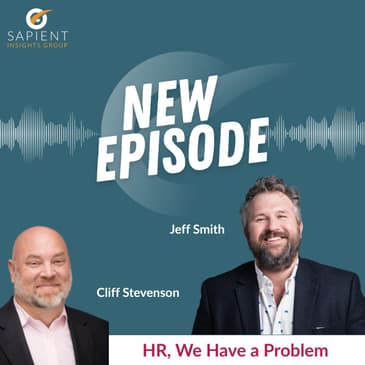
[00:00:01] Welcome to the HR Huddle Podcast, presented by Sapient Insights Group, the ultimate resource for all things HR. It's time to get in the huddle. Hello, everyone, and welcome back to the HR Huddle. I'm your host, Cliff Stevenson, Director of Research at Sapient Insights Group.
[00:00:31] Terry will not be able to join us today. She is in Belgium right now exacting our revenge for the U.S. World Cup loss, tearing through the Maginot Line. So I'll be your host for another episode until you figure out that I'm the permanent host now. We'll just work with you together. HR, We Have A Problem. This is the show where we break down the big and most relevant HR issues of the day, help you make sense of what they mean and what you might do about them.
[00:01:01] Our host today is Jeff Smith, CEO at 15Five. Jeff, it is wonderful to have you. I've known you personally for a long time and really excited to see you in this new role. Yeah, thank you so much, Cliff. It's great to see you as always. I'm looking forward to the conversation. I feel very fortunate, you know, to be in this new role.
[00:01:28] I'm still really enthusiastic about HR tech, about working in tech in general, about performance management, about people management. So really looking forward to the conversation. Yeah, that is really wonderful. Jeff and I in the sort of green room beforehand were discussing, you know, well, we were talking about the U.S. loss, unfortunately. But also on the more positive side, talking about some of the great experience you've had since you joined up,
[00:01:58] you said something that, well, actually now you said two kind of things that might be surprising to listeners. One was that you're excited about performance management. A lot of people don't find that topic as exciting. But I agree. I, having worked with 15Five and some of the companies that are on sort of more, I guess we'll call it cutting edge of that discipline, it's pretty fascinating.
[00:02:22] And if you haven't really looked at what's possible in performance management and the technology surrounding it, I suggest you do. But you also mentioned you were excited about SHRM. A lot of people find it sort of could be overwhelming and there's just so much going on. What did you see there that kind of got you fired up? Yeah, thanks. Other than Christian Aguilera, who was amazing, as you would expect at SHRM.
[00:02:50] First, just being around people who work in HR is really energizing for me. I spent most of my career actually in R&D, but I did have a stint in HR myself, where I was running performance management and L&D, and we were using spreadsheets to do these reviews. And the reviews are really intended, of course, to ensure that we made the right decisions about people and their performance and all the downstream things like compensation and where to invest and growth plans. But also, it was intended to be a conversation that really recognized what was going well
[00:03:20] and what needed to be improved for a person in order to help them grow. You know, someone on my team actually just hit me with this phrase that I loved, where she said, you know, if I don't know, I can't grow. And now I've been saying that all the time about, you know, performance management is about giving that feedback. You know, you have goals and priorities. You're giving feedback. Feedback's not just critique. It's recognition and encouragement. It's, you know, the opportunity to really uplift people as well.
[00:03:49] So at SHRM, just being around HR for me is great. You know, watching HRBPs like up close and personal whenever I worked in, you know, in HR, we called it people services. At my previous company, Bandwidth, which was a great place for me to learn and grow, by the way. Watching the impact that that function can have. And it's not just like a bunch of, you know, police, you know, running around like enforcing policy. But they're actually helping people through really serious situations oftentimes.
[00:04:17] And also, you know, helping serve the needs of the stakeholders that are not just the employees, but the business as well. So for me, just being around those individuals, talking about them, about what's going on, like learning about their priorities. You know, everyone's talking about AI, of course. And just, but just being in that, you know, in that atmosphere. Yes, it's overwhelming. So many people, I think it was something like 19,000 people this year.
[00:04:45] But just, you know, being on the expo floor, talking to people was really energizing for me. Wonderful. Did you get a chance to see Susan Richards from our team? She was down there as well. I don't believe that I ran into Susan. So many people. Yeah, there's so many people. I just, I almost like physically bumped into one of our customers, actually. And it was great to see her. And she was just like, Jeff, oh, my gosh. And I was like, oh, my gosh, like there's 19,000 people walking around here. And we just like walked into each other, basically.
[00:05:14] So, but again, just being around HR, thinking about how complicated people are, how complicated executives are, you know, the situations that HR finds themselves in all the time. You know, how they're trying to serve the needs of the business and people. And just, again, seeing them, you know, everything from, again, like being excited to be at a Christina Aguilera concert, you know, to talking about the future of their businesses and how AI fits in and where the world of technology is going.
[00:05:43] Like it was just really energizing to be a part of it. Yeah, that is really fun. And it's funny because I think Christina Aguilera had mentioned at her press conference afterwards, she said, the most exciting thing for me was learning about the three new AI features that 15.5 had put into their systems. That's what it says in my notes anyway. Yeah. That may not be, that may not be what it says. It was something to that effect, though. Yeah. Yeah, that sounds right, you know.
[00:06:12] And she actually sang, by the way, because you could tell she was stretching the limits of what Sherm had set up from an audio perspective for her. But she sang. She was amazing. You know, walking out, someone was like, she was effing iconic. But yeah, you know, as it relates to what we're investing in, I think we're really focused on how can AI elevate people, you know, and not replace them. Like there's so much going on right now where organizations are replacing, trying to replace people.
[00:06:41] And then they're, you know, riffing people for AI reasons. Like that's the explanation of the day. And then having to rehire. And they're realizing like, hey, these humans actually have expertise we need. And, you know, as a human factor psychologist myself, like really my focus is understanding human capabilities and limitations and then applying that understanding to the design of systems, work, and tech.
[00:07:04] And whenever you think about where AI is going, it actually could allow humans to be even more human at work. You know, there's things that humans uniquely do. Judgment, the creativity, empathy, compassion, exception handling, things like that. There's things AI does well. You know, if you've seen the robots, you know, comparisons against factory workers, it's like no bathroom breaks. You know, they're available 24-7. They have more perfect memory. Like they can do things at scale.
[00:07:34] They can do things routinely and repetitively. But if you combine the best of both worlds, you can actually do extraordinary things for the design of both work and tech. And then our focus at 15.5 as it relates to this has been we recently released this idea of work context, which finally connects the systems where work happens. So things like Slack, Teams, Salesforce, GitHub, you know, Claude, Codex, those types of systems with the systems where performance is managed like 15.5.
[00:08:03] So it's a really exciting step forward because with just a few connections, one, you can answer the question when the CEO says, hey, HR leader, what are you doing as it relates to our AI transformation? And it's like, you know, well, CEO, I actually just upgraded our performance management to be completely aligned with where AI is headed in just a few clicks with 15.5. Sounds like a great answer to that. And then also, it really allows for, again, like you just go ahead and work.
[00:08:33] And then 15.5 now serves up what we call moments and things like performance reviews and focus briefs. So on the next release that I want to mention is this AI assisted review. So it really does two things. It takes this context and these connectors and then brings that data as what we call moments into the review draft itself.
[00:08:53] So it's actually showing up to say like, you know, hey, Cliff did these things, you know, as evidenced by these things that we observed in 15.5, of course, with goals and priorities and high fives, but also in places like Slack. And then it serves up that information to deliver, you know, a first draft that's like 80, 90% complete. So instead of, you know, the weekend before reviews are due, you're just scrambling, looking through emails and Slack messages and calendar invites to see what someone did. It's actually just serving that up.
[00:09:23] And then as the review is written, AI is coaching you to make the review better as well. So it's noticing things like, hey, like you're actually rating this person at this level, but your review is kind of saying this. Or these two answers seem inconsistent. And this is an area we're going to continue to invest. And this is in beta for us right now, but the beta is actually severely oversubscribed. So I feel like we're on to something that, you know, because as you said, not everyone's excited about performance management.
[00:09:53] And then another agent that we've introduced is that what we call focus briefs, which, again, is taking the same context. So context from 15.5, context that you upload, like, hey, here's our principles. Here's our priorities. Here's our values. Here's our AI transformation strategy. And also things from these connectors. And then it serves them up in what we call a focus brief. And that focus brief shows up for a manager every week. And it says, hey, here's where to focus. Here's what each of your people need individually.
[00:10:21] And then also here's the overall areas that you should focus. So, again, as you're preparing for your week, then you're not just scrambling like, hey, what did I do last week? What did I talk to so-and-so about in that meeting? Like, you're just bringing all that to the manager themselves.
[00:10:35] And then, again, with all of this context in one place, we're planning to continue to invest in this area for the reason that, like, this is the chance for performance management, you know, by using AI effectively, by capitalizing on what humans do well as well, where people can actually get more from performance management by actually doing less. You know, the history here is oftentimes like, hey, you want to be a better people manager? You want to do better performance management? Like, just do more and more.
[00:11:03] Like, hey, HR, you don't have anything else going on. Just, you know, do these dozen practices. And by the way, convince all your managers to do them, too. And then now instead we're saying, like, hey, humans work like humans. How can we use AI to allow humans to work even more like humans and then still uplift and elevate, you know, the way you do performance management, the way you do people management, the way you talk about goals and priorities? The way you give feedback, the way you do reviews, the way you understand what's going on with employee sentiment in this new way. So I'm stoked about it.
[00:11:33] As, you know, as we just discussed, it's been out for about a month now. The feedback's been great and we're looking forward to continuing to invest in this area. Yeah, it's very prescient because it's I'm sure you guys did quite a bit of research on it. But, you know, I was looking at our own data from the, you know, HR systems report and performance management consistently has been one of the systems most likely for people who have changed.
[00:12:03] Right. So, you know, usually, you know, it's very, very unlikely when we ask, you know, are you planning on changing your system if it were like, you know, payroll or HRMS? Those tend to get fairly embedded within. But performance management systems, people do want to change. And one of the major reasons when we pressed them on why that was happening was that there was a lack of system integrations. Right. Because that's exactly it.
[00:12:31] Having another person, you know, I've also gone through this process and there's a big long period where I'm losing hours of the day, as is every manager going through and trying to find all this information to go through a process that, you know, I don't want to do anyway. Right. So to be able to have it and sort of guide you through it, because you're right. A lot of times in HR, you know, we're saying, especially with AI, right? They say, oh, you'll we'll free up some time so you can do other stuff.
[00:13:00] So it's like, oh, you're just going to be busier, you know, rather than say we're going to make your existing workload, you know, easier. So I think. Yeah, I think I think that you're really on to something there. I mean, to me, the villain, the villain here is the blank box, you know, so you stare at this blank box. And then there's more blank boxes that you have to type things into. And then, you know, to get nerdy a second. So there's this person I really admire. His work's amazing. His name is Anthony Alwick.
[00:13:29] He is, you know, one of the the founding fathers of jobs to be done theory. And then one of the phases that they talk about with jobs to be done is locating the things you need to do the job. And what you're describing, you know, Cliff, whenever you're saying like looking for things is the locating phase of reviews where you're like, what did so and so do? Like, how do I know? Like, OK, I'm going to go back through some one on one notes I have and I'm going to look here and there and I'm going to actually I don't remember anything about what they did in Q1.
[00:13:57] So I'm going to go back and like look at their calendar and try to figure it out and just scroll through Slack and other things. And instead, if you have, you know, this work context connected to a system like 15 five, then you have the ability to just automatically have moments served up that are tailored to the questions you're asking. So instead of that blank box, you're now getting like, hey, here's the moments. And then you click draft review and it does the review draft.
[00:14:24] And then instead of just like firing, you know, the review draft forward because you need humans in the loop. And by the way, like definitely when you're making decisions on performance compensation employment, like you should have, you know, legal security all involved in how this is done. But then you have the chance to actually think about like, OK, I didn't spend the, you know, three hours I committed to this locating the information and trying to overcome recency bias and other things.
[00:14:51] I instead spent the time getting this information presented to me. And I'm actually thinking about like what makes Cliff great? Like what, you know, did Cliff accomplish? What are the areas that Cliff needs to improve instead of like what did Cliff do on February 8th? What did Cliff do back in November?
[00:15:10] You know, so we're shifting the work, you know, to the part about, you know, the judgment, the feedback, the empathy, the understanding of context in a way from just like, hey, I'm just searching and tracking down all these things across all these systems in a way that's pretty exciting. Now, that is really cool. Like I said, I think anyone that's always been through it would, you know, their ears would perk up when they hear that.
[00:15:34] So, you know, one thing that, you know, we're kind of starting to hear more and more about AI, right, is this idea of trust. You know, you know, we probably spent all of 2025 just thinking about the capabilities and, you know, we worry a little bit about what's going on with AI. I'm in my last conversation with the chief AI officer over at iSIMS.
[00:16:00] And, you know, he's talking about how to develop trust, you know, people kind of being worried about, as you said, Jeff, there was still some concern probably early on about job replacement. You know, and now there's some concern about, you know, is the information accurate and, you know, how's it being used?
[00:16:17] Is that something that you guys at 15.5 or you all at 15.5 are seeing in terms of sort of the sentiment towards AI, you know, people kind of getting a little more nervousness about it or a lack of trust in AI? And if so, is there a way you guys are addressing it? Yeah, it is something that does come up. I think I would describe it as curiosity, maybe more than nervousness with the people that we're talking to.
[00:16:46] Like, but they do want to know, like, well, where does this information come from? Like, how do we know? And it's like, well, part of the reason, you know, is that we're attempting to triangulate this across multiple sources. So you have the ability to connect, you know, a dozen systems to 15.5 and in the future, it'll be more and more. So it's not just like, hey, like, we're only pulling from this one source of data and like we're taking it as a source of truth that what someone said in Slack is like the definitive statement on their performance.
[00:17:16] The second reason that or thing that we're doing is, again, a human experts in the loop. It's still on that manager to really assess, like, this is the impact this person is making against their expectations. You know, at 15.5, we talk about, you know, impact for compensation, like, but also with roles as context as an example of like how to keep that pretty simple. So the manager still has an important role to play. And then you build checks and balances into your process by asking the right questions.
[00:17:45] And then AI is providing these moments and helping you draft answers and craft them. AI is providing coaching along the way as the review is written. And then, you know, a self-review is a good thing to include because then the self, the person's contributing as well as their manager. And then oftentimes, you know, you have things like calibrations as part of that, too. And you're like, so there's a checks and balances to this that it's not just like, oh, AI said this person's or therefore fire it off.
[00:18:15] That's actually not OK to do in most jurisdictions in the first place. But then also not advised, you know, like there's context that can be out of these systems that managers need to apply judgment to and look for exceptions.
[00:18:28] But again, like the point is, if if the locating phase of this or the the blank box phase of this is reduced by potentially hours per person, then you have some time to give back to actually being thoughtful about what has this person accomplished and where do they need to improve? And then again, like by having like, hey, here's the inputs. Here's the criteria for how we evaluate performance here. Here's how we make decisions on things like compensation and promotion.
[00:18:57] Here's the checks and balances in this process. This actually can be done, I would argue, faster and and in a way that's simpler as well. And I'm very careful on the distinction between simple and easy because things involving, you know, people and their performance and their compensation or just people in general are complicated, not easy, almost on their face.
[00:19:18] But like these things can be in a place where AI is playing an important role that is done safely and securely that you can trust because you're not just handing this whole automated system over to AI. Yeah. Yeah. Yeah. That's that's pretty interesting. You know, one of the one of the features that we highlighted in the report last year was that 15-5 had a what's called at the time.
[00:19:47] Keep in mind this was last year's the sentiment trend analysis looking at sort of the human emotions that were coming through, whether it was the reviews or engagement surveys or anything of the like to sort of get a sense for the sort of human side of it. So it seems it's something that 15-5 has always been keenly aware of is this intersection between what's possible through AI and the sort of human sort of softer side of it.
[00:20:16] Right. How are people actually feeling and how do we get a sense of that? That I think just as a one-off reader, you know, even if even if you were somehow, you know, your job was just to read through all of the different performance reviews of an organization, you likely still wouldn't be able to catch these sort of sort of more technically analyzed sentiment trends.
[00:20:40] Well, yeah, I think that's a really great observation and exciting area for us to continue to explore more is that organizations spend a tremendous amount of time doing performance reviews. And then you have this rich source of data about what's going on in your organization that could be mined and could be analyzed to understand, you know, where you should make investments in HR or like, hey, amongst our high performing people, we're noticing that, you know,
[00:21:06] the thing that's holding them back is X, you know, like that shows up in 65 percent of our high performers reviews on what is keeping them from going to the next level. Like and while that type of sentiment analysis is very frequently done with employee engagement surveys, it's not done in the same way in reviews. Now, it's in part because review data, I think, is considered to be much more private, you know, and also it's it's HR tech vendors, you know, have convinced the world that you need employee engagement surveys, too.
[00:21:35] And I think employee engagement is important. And I actually think that the connection between performance engagement in one sense, I think, is is, you know, well stated where, you know, Gallup and others have put things out there. But then also if we connected back to positive psychology for a second and the idea of well-being. So the most foundational model of of thriving, you know, or flourishing is from Martin Seligman and it's called PERMA.
[00:22:03] And the A in PERMA stands for achievement. So there's actually this really, you know, there's this important connection between one sense of like well-being or engagement and also performance. And like people want to make progress. I mean, progress principles real. People want to achieve like, you know, very few people wake up every day and think like, oh, I don't care if I make an impact today. I'm just going to clock it in, you know, and it's like so like and again, this is why I think.
[00:22:30] For me, performance management is much more than just like a ratings distribution. It's a chance to make work more, you know, fulfilling and meaningful or even joyful for people if it's done well. And yes, you're going to encounter situations that require pips and and and critique and hard conversations, but also like works an important large part of people's lives.
[00:22:50] And like the way the way that you treat your employees, the way that you support them, the way that you ensure that, you know, their needs are met alongside your business's needs can make a tremendous impact on the quality of their life. And and if you design systems in a way where you are thinking about like, hey, here's what the business needs from this and here's what employee needs. And like, how can we both end that instead of pitting those stakeholders against each other?
[00:23:13] Like, I actually think this is an opportunity for for these for these systems and processes to be uplifting for for many, many employees. And again, that doesn't mean there aren't hard conversations. It doesn't mean that people aren't dissatisfied about their comp or their lack of promotion or, you know, sometimes there's a seasonal mismatch between someone and their role and that needs sorted out, you know, through a pip or something else.
[00:23:37] But the these things can actually like to your point, like really connect back to like the human feeling and the human sentiment around work and the role of work in one's life. Yeah. And I mean, you pointed out some of the hard conversations, but this also plays a large role performance management in getting that compensation aligned.
[00:24:00] Right. Where, you know, one of the sort of common complaints, especially among new hires, is feeling unrecognized, especially in larger businesses and the compensation not being aligned with it. There'd be some research recently from one of the comp providers looking at the mismatch between tenured employees and new employees that are in the same role. And that being a big cause of flight risk. Right.
[00:24:28] So having a system like this that, you know, you know, kind of helps create a more objective picture of your performance, you know, could very well lead to your compensation more likely being in line with the value that you're bringing to the org. So, you know, it's easy to focus. And again, I've been as guilty of it as anyone who's focusing only on those negative aspects of performance management.
[00:24:54] And really, the review process could be used as a, you know, force for good, I guess we'll say, with done correctly so that people are getting paid correctly. And yeah, and it's interesting because I was just thinking about that when you were talking about how performance management, you know, reviews are used. And you'll see them sometimes for flight risk, but even then, that's individual. It's not looking across the entire organization and getting a sense for organizational health and development.
[00:25:23] So yet another way that having these tools allows for that more holistic view of what's happening. And as you said, a data point, and as we all know, the use of AI and all these kind of cool and exciting tools is only as useful as the data that you're able to give it from your systems, right? So another source of rich data allows you to use your AI for any of its uses, right?
[00:25:52] In a more full way of a true sense of here are the problems we're trying to solve, right? Yeah. Yeah, I fully agree. I mean, even though, you know, LLMs are relatively new, this is an area that we've been investing in. So shout out to our CTO guy at 15.5. You know, we've been building what we call our data intelligence platform, you know, in support of these types of things for a while. You know, we released earlier this year what we call Amaya, which is an agent that allows, you know, ask me anything on the data.
[00:26:22] And we're connecting more and more sources of data together there. And really how all that connects to your point is there's all these systems where work is happening. And whenever you think about, you know, I can go pretty philosophical here, but when you think about how humans actually work, like we work, we're messy. We work in meetings, like we have conversations, you know, like we're temperamental, like we're all kinds of things, right? And having systems, you know, that are listening, like we have, of course, Kona Meeting Assistant.
[00:26:50] But like having meeting notes as a source of data that is coming into systems like this is so important because those conversations are important. You know, people don't love to update goals and priorities in a separate system, but they talk about goals and priorities all the time. You know, like there's meetings all the time where you discuss goals and priorities. People don't want to type, you know, it's similar to, you know, people don't always want to type things into their CRM.
[00:27:15] But like, wow, if you have a system like we use Gong as an example that records calls and then updates things automatically. And then we have a system called Vaughn on top of that. That's amazing, too, by the way. But it's like whenever whenever you have systems like that, it's you're allowing people to just work more like people. And you and then you start to notice things like to your point, like, oh, you haven't recognized so and so in two months.
[00:27:41] You know, you haven't said you haven't said something that recognized winter progress they've made in two months. Like you need to do something there or like, hey, you know, compared to expectation, like our organization is not doing, you know, this behavior. Like that's an area where maybe we need some intervention, you know, and there's themes that come up all the time. Something else that came up for me, too, is that, you know, of course, at 15.5, we have a compensation solution that connects to performance management because those processes are quite linked, you know.
[00:28:08] So but also compensation is only one part of someone's motivational signature. And for some people, like they may value something else about working at your company versus comp. And it's so important for managers to know that for HR to know that. And those things often come out in in reviews and review conversations, you know, as much as they come out of employee engagement surveys.
[00:28:29] So it is really exciting to think about how all this data can be joined together with, you know, the sawdust of just how humans work as well, you know, through these other connected systems to create context. And then it can help people answer questions like just like what's going on with the people in R&D or in go to market. Like and it's like, well, how would you know that? Well, you go and you have a bunch of status meetings and you do skip levels and like you run a survey and other things.
[00:28:56] But if you have this source of data that's coming in in an ongoing way, you can just ask the question what's going on in R&D and like get any get an answer or what's going on and go to market and get an answer. What's going on G&A get an answer. So this is this is exciting now, you know, like I'm really enthusiastic about it now, but I'm also even more enthusiastic.
[00:29:15] I think about the way forward. Right. Because just some of these fundamental questions that to the point you made earlier are like, you know, a multi quarter qualitative research project, like don't have to be like that anymore. You know, it doesn't have to be like, well, we we run a survey and then we spend, you know, four months just like analyzing every response. And then four months later, we have a report like it can everything can be much faster and more organic in real time than that.
[00:29:44] But, you know, without losing, you know, as somebody who loves qualitative research, without losing like the depth that is possible with that type of analysis. Like and again, this is an area where what's AI good at here, what's humans going to bring those things together? Yeah. Yeah, that's very well said. I remember there was some research. I'll have to I'll track it down if I can, Jeff, and send it to you because I think you really enjoy it.
[00:30:11] This is from almost a decade ago as Dr. John Turner and he was looking at the at this time he was working with one of the big defense contractors. And they had done a survey saying, you know, what what motivates you? You know, what you know, would you like to see? And, you know, not surprisingly, his compensation was the most common answer. Right. But when you actually looked at things like engagement rates or even if they stayed at the company and in certain cases,
[00:30:39] he could even look at performance when it was something like a factory floor. Right. Or anywhere there was some easier quantifiable performance output and looked at, you know, did the person receive a promotion the year before? Did they you know, did their compensation go up? Did they receive a bonus? Yeah. I and looked at a number of different factors and actually found that the number one predictor of both someone staying at an organization, at least at his organization.
[00:31:08] And, you know, and their performance going up was actually recognition because people, you know, if you just ask them a survey, what do you want? Yeah. Well, I'd like to get paid more. Of course, you know, that makes sense. But something would have come out during hundreds of, you know, these kind of conversations would have been, you know, I wish someone would just say something about what a great work I'm doing, you know,
[00:31:28] and they wouldn't realize that they're actually finding that their own motivations may be for that recognition or for, you know, some sort of just being noticed sometimes and seen for what you're doing. So, yeah, that's so important. I love that call out. Like we could do a whole nother episode on just the psychology of some of these things.
[00:31:52] But it turns out mattering matters. People want to know that what they did at work actually made an impact. You know, I think one of those common interventions that, you know, I recommend and I know others recommend in these situations, just stakeholder stories. Like who's on the other side of this work getting the value? Like, how do you how do you make sure that your R&D team hears how much a customer loves what they did?
[00:32:15] Now, they also need to hear feedback about how to make it better. But if all you do is just like fire bug reports, you know, over from your market facing teams into your R&D teams like that's that's not uplifting. You know, that doesn't help them feel the wins, feel the progress the way that they want. You know, Teresa Amabile's work on progress principle really lands with me here, too, where people want to feel that sense of like, but yeah, I'm better at my job this week than I was last week or organizations getting better.
[00:32:43] They want to see those things like it doesn't have to be just like we wait for the end of the quarter and then we highlight three wins and then we're on to the next thing. Right. And that doesn't mean like roll out a, you know, a parade and trophy for people all the time either. But there's a way to do this that's that's organic and normal. And that's one of the reasons why the people management is so important. Like whenever I think about feedback, you know, for managers, like it's recognition and encouragement as well as the critique and coaching. Like it's not it's not just feedback is not just critique.
[00:33:14] Yeah. Yeah, that's really well said. And collecting the stories is just so important. Right. Because it's just how humans learn. I think both of us have a psychology background. Right. So anytime you bring up Teresa Amabile, I'm like, oh, yeah, there we go. Yeah, there she is. Yeah. And I guess that's kind of what we're doing here. Right. Yeah. I think this I think the name the psychology podcast is taken by one of my idols, Scott Barry Kaufman.
[00:33:42] But, you know, we I'm sure we could find something if we wanted. But, yeah, I mean, and I think I think a key part of the of what you're describing, too, is just understanding more of the full picture of what's going on with someone at work, you know, and how important it is to see that full picture and not just, hey, my manager shows up, you know, every month to tell me what I'm doing wrong. You know, like I was doing an on site training, actually. That was awesome. And I'm grateful for the customer to let me do it.
[00:34:10] And we were talking about, like, what's the difference between good managers and bad managers? And they were saying, like, one of the differences for bad managers is every time they, you know, they call you, you're just like, here he goes again. I'm about to get chewed out, you know, and like you don't you just you don't want that to be the only like, yes, you do need to have accountability. But like you don't want to be like only showing up to do the chewing out of somebody.
[00:34:31] Right. And and that's one thing with the work context, too, again, on this complete picture is you have that people management, that performance management context in 15 five with reviews and goals. You know, Kona, one on ones, high fives, engagement surveys, HRIS integration. And then again, you have that context where work is happening every day. Slack teams, Jira, GitHub, Asana, Salesforce, you know, chat TPT, Claude, those things.
[00:34:58] And then you have context that you add, you know, like one of the conversations I constantly come back to whenever I'm talking to organizations about people management and they say, like, hey, we're dissatisfied with how our people managers are showing up in this situation. And I ask oftentimes like, well, what expectations have you set around how they should show up in that situation? And it's like, you know, oftentimes not not a lot of clarity there.
[00:35:23] Right. And and I think and also I really feel with the challenges of H.R. because H.R. can't be everywhere, you know. So but if you say like, hey, here's the seven things that we expect from our people managers and then you set up a system that has this more continuous work context, like the first line of coaching can happen automatically there. Like it doesn't have to be H.R.s in every meeting or the CEOs in every meeting.
[00:35:49] Like it can actually be just, hey, we have this work context and we have agents on top that are telling our managers, hey, here's what you're doing well and here's what you need to improve. And here's normalizing that interaction at scale. And then it frees up your managers to do, you know, elevated coaching or more complicated situations or actually get some work done and not have the Sunday scaries every week, you know, like so that that combination, again, is of like where the work is happening and how performance and manage is managed.
[00:36:19] Is just so important, you know, to your point on understanding the fullness of one's experience at work, not just like this little sliver twice a year, but like what's actually going on with them in a regular way and not just like, hey, everyone wants to be calm more. That's true. Like a phrase I say is you can't pay bills with meaning. And like I love meeting. I love some Viktor Frankl. He's my favorite psychologist.
[00:36:42] Like, but also like you need money matters to, you know, and like and I think the more you can support people as whole people, the better off you'll be. Yeah, that's really well said. Yeah. In the artist communities who can't pay our bills with exposure. Like, oh, we'll put your pictures up. We'll give you some of your writings. We'll stick it out there. Same idea. Yeah. Yeah.
[00:37:04] I mean, if you, Jeff, if you're able to reduce the Sunday scaries for the worker, you'll get CEO of the year. Because that's where, thank you. That's where we're aiming for. You know, we, we do try to, you know, eat our own dog food, drink our own champagne, whatever you want to say. Like, and, and we want, we want to build things that work for 15.5, you know, and we want to, but we also want to, of course, build things that work for our customers too.
[00:37:34] You know, one thing I want to make sure that anyone knows, because this will always come and shock people meeting Jeff in real life, is that he's about seven foot nine. Just, just, he'll just lift the ceiling off of the building you're in and step in. It's, it's, it can be a little frightening the first time. It doesn't always show up in the, in the video podcasts. Uh, and also, this is now two weeks in a row. I feel like this, there might be some sort of like reverse correlation. The most interesting people have just nothing in the background.
[00:38:04] I don't know. I don't know what if they, you know, part of my, thank you for allowing me to join the podcast. And part of my podcast prep was wiping off that whiteboard. Was there secrets up there? You had the old coding. Yeah. So there, there was a, there was a lot up there, uh, you know, prior. So, you know, I had to take it off. I thought about, you know, writing something about how great sapien is, but it's self-promoting. I can do that.
[00:38:30] That's, but yeah, like, um, I'm, I, I really have enjoyed the conversation. Thank you so much for making the time. It's always great to connect with you. Like this, these are all areas that I feel very fortunate that there's alignment between the work I get to do every day and things that energize me. So like, I'm always happy to chat performance management, people management, you know, where work is going, you know, this, this idea of human and agent teams and like many cliffs
[00:38:56] running around working with many Stacey's and many other members of sapien. It's really exciting. And it's a little scary, you know, depending on what angle you take on the future, but it's an exciting time, you know, to work in tech, to work, um, in HR with HR leaders. So I'm always happy to join anytime. Right. And where, where can people find you? And are, do we have a 15, five event? Are you going to HR tech? Uh, yeah, HR tech. We're not, um, we're not currently planning to go to HR tech with a booth.
[00:39:25] Um, we'll be at transform next year, uh, SHRM next year. You can always check us out at, um, 15, five.com, uh, linkedin.com slash I N slash Jeff Smith. PhD is me on LinkedIn. I'm sure you'll put links to things like that, uh, in the show notes. Um, we have webinars all the time. Our next webinar, uh, we have webinars like basically, um, you know, every month on topics like this. Uh, and then our next big event is thrive, which is our annual event.
[00:39:55] Um, one of which I met you in person at, which is great. Um, and it, the next one's on October 8th, 2026. We'd love to see you there, you know, talk more about the future of work and, and how HR can participate and lead, uh, AI transformation as well. Wonderful. That sounds really, really love you. Really lovely. I love you too. That was great. I appreciate it. Uh, and thank you listeners for joining us.
[00:40:23] Uh, the, I normally at this point, uh, ask everyone to take the, uh, annual, uh, HR system survey. That is actually off the table now. Uh, hopefully you got your chance to put in all of your information. Uh, it's super valuable. Good. Great. It's work that we cite all the time. You know, thank you. Thank you for, I know it's a tremendous amount of work to, you know, do the sourcing of responses and analysis. And we, we really appreciate the survey. Good.
[00:40:53] And, uh, yeah, we'll, we'll have that, uh, information start coming out. Obviously the big debut will be at HR tech. We'll be do the keynote and release the key findings. Uh, but, uh, we will be gathering that information in the forehand. So if you are, uh, looking for some specific work or if you want to get in on some early bird pricing, you can reach out to us. But I also want to thank, uh, obviously you, Jeff and your team for putting this together.
[00:41:20] Our marketing team, uh, Kelly Kuhn has been doing the editing, uh, the work to find family of podcasts, uh, HR channel.com. And as I said, mostly you, the listener, the viewer, thank you for tuning in, uh, for this episode of HR. We have a problem. Uh, you can subscribe, like, and subscribe all that fun stuff. Leave us a review. If you have a minute, uh, feel free to reach out. As Jeff said, all this relevant information will be in the show notes.
[00:41:47] So I'm trying to capture also all the, uh, names that we use. If you want to read more on these subjects, uh, and otherwise we'll be back in two weeks for another episode of HR. We have a problem. Thanks.
Sponsors
