
Thanks to HRBench for powering this episode. To find out more about the company building the future of people intelligence, reach out to book a demo at hrbench.com/directionallycorrect!
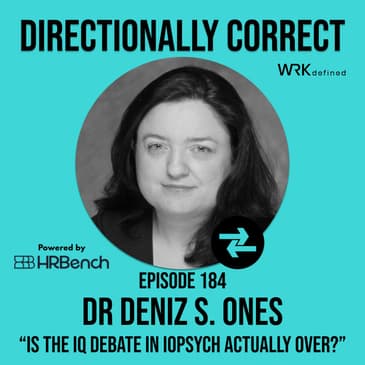
Check out this episode of the #1 people analytics podcast with special guest, Dr. Deniz Ones, Hellervik Professor of Industrial Psychology & Distinguished McKnight University Professor, University of Minnesota!
In this rich conversation on Directionally Correct, host Cole Napper and Deniz Ones dive deep into one of the most consequential debates in industrial-organizational psychology: the predictive power of cognitive ability tests for job performance, the role of range restriction, and whether classic findings from Schmidt and Hunter still hold. Ones, who never took a formal I-O psychology course yet trained under legends including Frank Schmidt and Jack Hunter, brings a unique perspective shaped by three decades at the University of Minnesota and close professional proximity to Paul Sackett. She recounts the origins of meta-analysis in the field, how sampling error, reliability differences, and range restriction were systematically addressed, and why the 1998 Schmidt-Hunter validity matrix remains foundational even as newer work questions the magnitude of corrections applied to concurrent validation studies. Listeners hear a careful unpacking of the “for whom, when, and where” of validity: operational validities must be interpreted against the variability of actual applicant pools, which have grown more restricted over time in the United States, while scientific estimates should reflect unrestricted population parameters so they can be tailored to different labor markets worldwide. Ones emphasizes that cognitive ability continues to predict the acquisition of job knowledge and task performance, that experience does not erase ability differences, and that dismissing general mental ability while simultaneously pursuing artificial general intelligence risks a contradictory “botification” of human talent. The discussion expands into individual differences research, including cybernetic trait complexes, meta-analytic profiles of life success, and the mapping of maladaptive trait combinations that drive counterproductive work behavior. Ones also reflects on her path as an eighth-generation scholar who emigrated from Turkey, the gateway role of cognitive ability for those without privileged lineage, and the broader societal levers needed to address adverse impact beyond selection systems alone. In Cole’s Corner the pair explore rapid-fire personal questions, the limits of off-the-shelf assessments for extreme performers under power-law distributions, why predictor-criterion correlations have remained modest given the multiply determined nature of performance, the political economy of academic publishing, and the accelerating challenges of integrating machine learning into legally and professionally defensible selection while the technology itself keeps moving. Throughout, Ones advocates letting the literature breathe across hundreds of studies, keeping the big picture in view, and recognizing that practice often leads science in I-O psychology. The episode offers both technical nuance and a humanistic reminder of why rigorous measurement of human potential ultimately serves organizations and individuals alike.
If you like this episode, you’d also love exploring prior episodes—visit colenapper.com for the full archive and show links.
Powered by the WRKdefined Podcast Network.
Sponsors
