
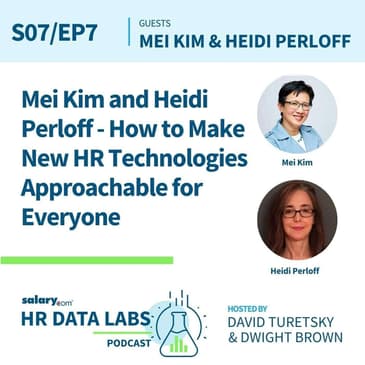
Mei Kim is the Executive Director of Global Workforce Analytics at the
Estée Lauder Companies, and Heidi Perloff is the SVP of Global HR
Strategic Initiatives and Delivery Solutions at the Estée Lauder Companies.
In this episode, Mei and Heidi talk about some practices that made
adopting new technologies easier, whether they believe AI-based
technologies pose a threat or present an opportunity to the workforce, and
why it’s important to embrace data mindfulness in HR processes.
Chapters
[0:00 - 4:25] Introduction
• Welcome, Mei and Heidi!
• Today’s Topic: How to Make New HR Technologies Approachable for
Everyone
[4:26 - 14:06] What’s the difference between “digital” and “technology”
• “Technology is a thing; digital is a way of doing things”
• It’s ok for new technology to be difficult to adopt
[14:07 - 27:03] AI: opportunity or threat?
• AI helped Mei’s team win back 10+ hours of their week by minimizing
tedious processes
• The major threat lies in HR not knowing how to use AI technologies or
being curious about it
[27:04 - 37:24] What is data mindfulness?
• Analyze not only the data, but also the data flow and input processes as
well
• Will AI lull us into losing our critical thinking skills?
[37:25 - 39:14] Closing
• Thanks for listening!
Quotes
“HR VPs who embrace being digital and embrace the use of technology . . .
tend to go farther ahead in their careers than others who don’t.”
“Yes, we can get automation from AI, but it’s really the augmentation of
what it enables us to do as human beings that is super exciting.”
Contact:
Mei's LinkedIn
Heidi's LinkedIn
David's LinkedIn
Dwight's LinkedIn
Podcast Manger: Karissa Harris
Email us!
To schedule a meeting with us: https://salary.com/hrdlconsulting
For more HR Data Labs®, enjoy the HR Data Labs Brown Bag Lunch Hours every Friday at 2:00PM-2:30PM EST. Check it out here: https://hrdatalabs.com/brown-bag-lunch/
Produced by Affogato Media
Powered by the WRKdefined Podcast Network.
[00:00:02] Here's an experiment for you. Take passionate experts in human resource technology. Invite cross-industry experts from inside and outside HR. Mix in what's happening in people analytics today. Give them the technology to connect, hit record, pour their discussions into a beaker.
[00:00:21] Mix thoroughly and voila! You get the HR Data Labs podcast where we explore the impact of data and analytics to your business. We may get passionate and even irreverent, but count on each episode
[00:00:35] challenging and enhancing your understanding of the way people data can be used to solve real world problems. Now here's your host David Turetsky. Hello and welcome to the HR Data Labs podcast. I'm your host David Turetsky alongside my friend co-host, partner in crime, sorry.com's own
[00:00:54] Dwight Brown. Hi Dwight, how are you? I'm good David, how you doing? I'm doing fine. I'm doing in the office for the first time ever recording the podcast. New environment for you? That's good. Hopefully we'll be good because today we have two very special
[00:01:09] guests, May Kim and Heidi Perloff and I'm going to ask each of you if you could give a little bit of background as to who you are. I'm Heidi Perloff. I'm the Senior Vice President of Global HR Strategic Initiatives and Delivery Solutions with the Estee Lauder Companies.
[00:01:25] I've been in the HR field for many years and lots of different roles and just thrilled to be here. Awesome, May how about you? All right, May Kim also from Estee Lauder Executive Director of Global Workforce Analytics. I am a self-proclaimed lover of data and anything digital.
[00:01:45] You fit right in here. You're one of our people then. We are self-proclaimed geeks that will make this conversation even more fun. But before we get to our conversation, we ask each of our guests what's the one thing that no one knows about you? We're going to
[00:02:02] start with you, May. This is your turn. What's one thing no one knows about you? Oh gosh, I think my roots for the love of data comes from my extreme nerdiness and form
[00:02:15] filling. I love filling in data and little boxes on pieces of paper. So I do all my taxes, all my legal communications and documentation. I do it myself. Wow. Love form filling which is totally... So in the past life were you a census taker? Is that why?
[00:02:36] Yes, I did have that job doing it surprisingly. I did. That's a perfect job. It is. Yes, it's perfect. Heidi, how about you? Well, I'm going to go in a different route. Actually, I love being out with nature,
[00:02:55] but we're a day, not multiple days. And last year, I was strongly pressured. I would prefer to use the word bullied, but my husband said no. Call it strongly pressured
[00:03:06] by my husband and friends of ours to go on a seven day hiking trek through the Andes Mountains in Peru. I reluctantly said yes, but it was amazing. It was the best trip ever. And so sometimes paving
[00:03:22] into peer pressure can turn into a good thing, which by the way, I do not or did not share with my kids until now. They'll probably hear this and... Probably. Yeah. Yeah. Nothing like diving into camping head first. You're a thrill seeker just like Dwight is.
[00:03:40] Well, I think Dwight is an extreme thrill seeker. I'm a little bit less on that spectrum, but yeah. That is one of the most accurate statements I've heard about Dwight in a long time. Yeah, the more adrenaline, the better. At some point we'll have to ask about the
[00:03:54] Sherpa and how all that worked. But this is one of those fun episodes because it gets us back to our roots with data and analytics around HR. Because today, our topic about the technical skills in HR, how can we make analytics, AI, digital technology
[00:04:13] approachable, relevant and engaging for everyone? And so let's dive into our questions. So the first question, digital versus technology, what's the difference? For me, I do think they're different. But the funny thing is I find a lot of people
[00:04:37] using them interchangeably. And someone I know, who many of you may know as well, often says technology is a thing. Digital is a way of doing things. And I think that's super important. And it's something that I often use when I speak to people
[00:04:57] because especially my HR colleagues or business people who, they hear technology and those are for those people and I don't do that. But when we start talking about digital as a way
[00:05:08] of doing things, and we talk about what they're doing at work and how they're working, even how they live their personal lives, shopping online, right? They are being digital and it's a mindset.
[00:05:24] And so for me, I think that's an important distinction and actually a first step in getting people comfortable with a more technical side of HR and business. May have at you. I chuckle because I have a perfect example of me using technology and not being digital.
[00:05:44] I have a Tesla and in the Tesla, they've recently got some new upgrades on their software and you can, when you click the turn signal, you get a little camera that tells you if the car's on
[00:05:58] the side on your blind spots, well, I don't use that. I just turn my head and look left and right or left or wherever I want to turn. And then my husband makes that observation, may you have all these technology at your fingertips but you don't use it.
[00:06:13] So that's a perfect analogy of having technology but not necessarily applying it in your life or even embracing the technology to improve your life. So I think that is the difference that Heidi was alluding to technology versus digital. We have technology
[00:06:29] all around us and we use it in our lives to embrace it and to really improve it. And can I add, when I think about digital, technology is a piece of it but we were talking
[00:06:40] before about data and how much, I just said she's a big data lover, right? Analytics and the algorithm, I mean, I work closely with May and she's using those things every day. That's all part of being digital. It's not just the technology piece of it,
[00:06:57] the naval body but not just. Well, I think a lot of us have a learning curve to be able to bring these things into the way we do things. And May, to kind of take your
[00:07:07] example a step further, you know, I've often, especially when I'm giving presentations on HR and analytics, I talk about something very simple in a car which is the fuel gauge. And the fuel gauge has evolved significantly since the early days. I have a 1954 Buick Century
[00:07:24] and the fuel gauge is a fuel gauge. It doesn't even have that light that comes on if you're almost empty but that light itself is training you that we're running out of gas and you need to go get gas. That was an innovation. People had to learn
[00:07:41] that if they see that light on the dashboard, that triggers a behavior. Well, because they've never had that before, people who get these little innovations, whether it's the turn signal triggers the video camera to go on or whether it's that light that comes on on your dashboard,
[00:08:00] those have to be learned in the process of driving and the analogy back into HR. Using more analytics to drive the things that we do has been something that we had to adopt but people felt pressure because they didn't know how to adopt it, right? From a practical
[00:08:19] perspective, technology versus digital, some people find it really hard to actually make those switches. Can I say that it's okay if you think it's hard and it's okay if it's hard in certain aspects
[00:08:32] and easy in other aspects, right? I find it extremely easy to embrace technology and being digital at work but at home I am useless at my Roku, right? And I'm useless on my Tesla
[00:08:45] but I think that it's okay and I feel like we don't want to make our HR BPs in our communities and HR feel inadequate or like oh I'm not good at it. I suck at it.
[00:08:58] It's a learned behavior and whether you're prioritized to learn it or not is that question, right? The interesting part of the observation I've made over the years as a practitioner is that HR BPs who embrace being digital and embrace the use of technology to change behaviors and
[00:09:16] develop insights, they tend to go farther ahead in their careers than others who don't. So I think it's a good observation where even when we look at high potential of succession planning, the HR leaders that have those tech savviness and the ability to use data and insights
[00:09:37] tend to float higher in that little nine box, right? And there's definitely a learning curve that goes with it. You talk about the Tesla and the side cam that goes with that. I think about
[00:09:51] the backup cam and how long it took me to get to... Those little white lines? Yeah, exactly. And you see the same thing with analytics in HR where you get the people who
[00:10:02] you try to help them understand the analytics and they just don't want to do it. And then one day all of a sudden they'll ask about a particular analytic and you're like oh my god, they're getting it. It's finally starting to sink in and become ubiquitous for them.
[00:10:16] Yeah. And I've learned to when I see that little nugget, I grab it with both hands and just say go after that interest, go after that curiosity and encourage them to do more.
[00:10:29] In May and I talk about this all the time, it's seizing that moment. I think the mistake we make many times is we just start throwing data analytics inside the people and say go use it.
[00:10:39] Right? Like oh my gosh. But when you find it's so interesting how like nobody cares, nobody notices until they have a specific need. And we're always listening for what's the business
[00:10:50] need that someone has and how can we bring them an insight or a piece of information in a way that they might not have thought about. And all of a sudden they're asking for more. Once it
[00:11:01] starts, it's not about the data itself, it's about the value that it's bringing. And it's funny how quick people suddenly adopt and once they're in, right May? They're in. They're the ones that keep coming back for more and it's super exciting.
[00:11:16] Well Heidi to that end, think about the analogy from before. So May you had that thing probably beeping at you saying that there was a car next to you and it distracted you from it. And you're
[00:11:28] like no I want to turn my head and I want to see the car coming at me. I don't trust it. Right. Well you shouldn't until you have that aha moment that says I'm going to
[00:11:38] trust the beeping that says there's a car coming. I'm going to look at that little video screen. That's the aha moment. And in the same way what we had, what we used to do, Heidi I think
[00:11:47] this is your point, what we used to do is send a dashboard that had 20 different analytics on it from HR that said hey look at all the great stuff. But people didn't have to get the noise
[00:11:59] out of their metrics. They weren't looking at a metric. They saw all of it and they got scared because it was just noise to them. They didn't see the signal that mattered to them
[00:12:09] at that moment. Nowadays the way I design, especially the way I design dashboards, I look at what's the five things that tell the someone and I make sure there's no more than five
[00:12:21] so they don't get distracted and it's about a topic to try and keep them on point. So I'm not sending them noise. David can I tell you my new year resolution? Absolutely. Is to stay as far away as possible from the word dashboard. Yeah.
[00:12:39] Because dashboards is everything and anything under the kitchen sink and what you think your partners want but it really may not be depending on the situation and the problem they're solving for dashboard may not be it.
[00:12:53] Right now talk about the technology versus digital that's one of those things we say it's a dashboard well it's a technology. Oh well no dashboard brings up other connotations so yeah no I love your right yeah that's like that's a really good.
[00:13:06] So David I dare you for the rest of this year you can't say anything about dashboard. I dare you. Yeah so it's February and the next time I have a client meeting. And you'll have to pay me a buck.
[00:13:17] You'll have to pay me a buck for every time you say dashboard. I don't want to know that. I'll be listening to your podcast David. Yeah wow. Get out your pocketbook David.
[00:13:25] I don't know if I earn that much money so I'll have to look at my W2 for last year to see if yeah that's so what's really interesting about everything you just said is that
[00:13:36] what we're trying to find is a way for HR to adopt these things into how they do what they do right but yet they have to to your point May in order for their career to grow in order for them to
[00:13:49] lead and grow they need to kind of build them into what they do right. Like what you hear so far make sure you never miss a show by clicking subscribe. This podcast is made possible by salary.com. Now back to the show.
[00:14:07] Let's go to the second question then artificial intelligence what do you guys think opportunity or threat. I see it as opportunity. I know that there are risks and things we need to be careful of but I think we have to approach
[00:14:20] it from an opportunity side and I've got so many great examples. I'll give one that I just love and may I go right to what you've been pushing on your team. So when May first joined us she's got a small but mighty analytics team
[00:14:38] and when we looked at how they were spending their time these are highly trained people who are really skilled at the predictive and the prescriptive side of like advanced analytics and yet they were spending probably 90% of their time on data on extracting data on cleaning data
[00:14:57] on engineering the data right. And May and I were talking about AI and about what I like to call the low code no code tools and May said I'm on it let me see what I can do and she gently cajoled her team
[00:15:13] maybe that's not quite maybe a little stronger than that but I strongly encourage them to learn the tool and to use it and there's one member of May's team who was working on something she's like yeah but I'm comfortable in Excel
[00:15:27] and you know well it's just I know how to do it and yeah it may take me you know some time but I know it's going to be harder and longer May forced her to learn the tool.
[00:15:37] She said it took her two weeks to master the tool coming out the other side. She saved I think in that one example she was saving like 10 hours a week let's say Wow but she also said I will never go back to Excel.
[00:15:52] Like she was converted from that one time and this tool has AI in it because what it does is it every time we're extracting our data we have to you know engineer clean it the same way every time the AI learns it and just does it for you.
[00:16:07] She has now brought her team I think where we are probably they were spending 90% of their time on data maybe we're at 50% and you know we're only scratching the surface right now. The slowest adopters are always the biggest evangelists in the end.
[00:16:20] Yeah all right I'm going to take the flaky way out I'm going to say it's both an opportunity and threat okay let me talk about the threat first and then the opportunity because I think they all kind of fold into each other in terms of the threat
[00:16:34] you know what's really a threat is HR not knowing what to ask right so let me give you an example of myself I went to HR Tech this year or was it last year and I was so blown away every vendor
[00:16:49] out there was saying we have AI let me show you and everything and at first I thought wow this is so impressive and then I went to the best one and I said let's do an early adopter
[00:17:00] they happen to be our vendor anyway so we said let's do an early adopter testing of your AI capability turns out it was not even like an infant it was like a newborn AI compared to a chat GBT version
[00:17:16] and so I learned that if you don't know much about it you tend to get hoodwinked by some of these businesses out there and so the more you learn the more you become good at what how to use it
[00:17:33] which is very easy to use I mean even grandmothers are using chat GBT to develop birthday party games for their grandkids right you can find practical ways of using it but the more you know
[00:17:45] about it the more you can actually assess some of the technologies that embrace AI in the HR business in the HR domain and be smart about your purchases and your partnerships yeah that's the threat
[00:17:59] but I think I want to ask you a question about that because I was at HR Tech too and we definitely heard the same things from a lot of the same vendors I think one of the things that bothers me
[00:18:08] the most is they're just taking a lot of buzzwords and the buzzword is artificial intelligence and they're trying to take a whole bunch of technologies that aren't really AI and use that term to say but we're doing it too so I guess the question is from your perspectives
[00:18:25] you know how do you cut through that noise and be able to uncover whether or not it's really truly things like generative AI or yeah I'm gonna I'm gonna continue the that response thank you for
[00:18:38] that little pivot there because I want to talk about the opportunity oh sure of course sorry so the opportunity now if you listen to uh in Davos Satya and Sam Altman Satya Nadella and so
[00:18:51] Sam Altman talked about their vision on generative AI in an interview and one of the biggest learning I had was that you can use generative AI or AGI in the future for general purpose so think of
[00:19:05] AI as your assistant someone that helps you with basic skills so the way you want to overcome the unknown and the scariness of this is really to just use it to help your work
[00:19:19] daily and that's how HR should be embracing it we are in our team we are taking image files with words in it and just saying AI make me a table from the list of names in this picture
[00:19:33] and it was able to right but it's the simple stuff or even you know it elevates the skills of HRBPs when they say oh my gosh I don't even know how to do this formula with a nested if and an if and a
[00:19:46] V lookup in Excel well let's ask AI to do it so we we happen to be one of our early adopters of the beta version of the enterprise chat GPT as SELotter so we have an opportunity to test
[00:19:58] this out with our own data we found it tremendously helpful with many of the very mundane and boring tasks that we have to do as the practitioners in HR right so in order to overcome the learning curve
[00:20:15] is to just think I always say have a phrase there's gotta be a better way when that term comes into your head then add can chat GPT help me right I want to answer your your I'll go to your question
[00:20:30] as well David because you know we're on the practical side of things so we're not selling the technology or the you know AI products or whatever if it's going to bring value to us if they're taking
[00:20:42] something they're calling an AI and it's not that's okay for me um you know if I need the value and I'm gonna leverage it great we all know AI has been around for a very long time it only got sexy
[00:20:55] when open AI like made it available to everyone and suddenly like even my 87 year old father you're gonna kill me for saying his age but uh is using it right and using it in really
[00:21:06] interesting ways and it's it's the power of the possibility and all these things that we're now trying to do with that but I think because people are because it's become this sexy word
[00:21:21] I mean it was all over HR tech I wasn't there this year but you know make him back and said oh my god everyone was talking about AI I went last year I was talking about skills like okay but uh how could
[00:21:31] you forget but the but the excitement of that is now we're getting excited about all the AIs even if it's not generative and people being curious that curiosity is super important to get
[00:21:45] people you were talking about this earlier what gets people to want to try to you know test something to see if there's value in it there's a curiosity and I think that's terrific and the question
[00:21:55] that we're now able to ask is as people are starting to get more comfortable in any form how do we then move them up the spectrum and really take advantage of all the opportunities
[00:22:05] including the generator to be able to you know bring value to individuals as well as our organizations I think there's a there's a level of curiosity that is going to get people there I mean the
[00:22:20] ability to take AI I've got a I've got a colleague that loves playing with chat gpt and trying different things you know write me a job description for such and such and seeing what
[00:22:32] gets spit out or being able to do kind of like the no-code low code you were talking about being able to tell chat gpt hey I want the rcode to do a linear regression on such and such data and that
[00:22:46] it sort of builds on itself and you know to that extent I think people are going to start to be able to recognize when they're talking with these vendors and sort of cry BS on some of the
[00:22:59] vendors they're looking at it like hey I know enough about this to know that that's really not AI that you're doing that's addition and subtraction that you're doing yeah debate or where right exactly
[00:23:11] but you got to build that acumen and a lot of times that takes the curiosity to get there yeah and and I think we're like to see people going as well as like I hear a lot of people
[00:23:19] you know say oh AI automation yes we can get automation from AI but it's really the augmentation of what it enables us to do with human beings that I think is super exciting and that element of it
[00:23:34] I think is is also what I'm hoping people will start asking as well great that we you know you're doing this but what is it enabling me to do differently or better I think one of the
[00:23:44] problems Heidi has been that the consumer versions of what AI has been over the last 12 years has been Siri Alexa hey Google and they're not really that much AI there as much as it is IVR
[00:24:01] but they've been disappointing at best and when you look at people saying what's the difference between something like that and the AGI that you mentioned or generative you know however you
[00:24:15] want to call it it's because they don't understand what questions to ask it you may going back to your point before you also need to be trained on how to actually be able to be responsive to
[00:24:29] generative AI in order to be able to get something out of it and that's training us not the artificial intelligence the artificial intelligence is brilliant we're not and so until we come around to that we're still going to be infants in this right I mean those are skills
[00:24:45] we have to learn you know it's interesting that you ask that because if you've taken some basic learning courses on how to prompt better you can actually ask the AI to teach you how to learn AI
[00:25:00] so it's like tell me what questions I should be asking you if I were to create a health plan for myself right instead of prompting and thinking of the questions they're asking AI to
[00:25:13] tell you what questions you should be asking so I think there's a as a new depth to how you learn because you don't have to think of the questions yourself that's a great point yeah it's a good
[00:25:25] point but you know it is about habit as well I'm used to doing things a certain way right here's some interesting things I've seen back to the turn signal huh yeah exactly exactly
[00:25:39] but we you know I've seen some interesting things you know practices you know even with people that we know who you know group of people who are going in and playing and testing and trying different
[00:25:51] things and then they're coming together and sharing and you know everyone says they think they've used the you know if it's chat gbt or you know that they've used the AI to the full
[00:26:04] extent and then they hear what someone else has done with it and they're like oh wow that's interesting and then the conversation wow now that you said that that makes me think about this and I'm watching
[00:26:15] people together like co-learn co-create like get smarter in a way that is to me very very exciting because it does take advantage of this opportunity and it's a scaling right a fast scaling the opportunity which is what we've seen with the speed with which people are going into
[00:26:34] you know chat gbt and the other aides right hey are you listening to this and thinking to yourself man I wish I could talk to David about this well you're in luck we have a special offer for
[00:26:45] listeners of the HR data labs podcast a free half hour call with me about any of the topics we cover on the podcast or whatever is on your mind go to salary.com forward slash hrdl consulting
[00:26:59] to schedule your free 30 minute call today let's talk about data mindfulness what do you mean by data mindfulness I was thinking about this this morning and I think people data is like
[00:27:13] gold and it's like mining for gold and when we mine for gold we take care in how we produce the gold refine it and you know make it into the jewelry that we want it to be but I think the idea here
[00:27:28] is to be very careful about how we think about data and I think the very common problem that we have is when we do data analytics is oh my gosh the data is wrong the first thing people pick
[00:27:41] on is the data's wrong right right but then you forget that mindfulness starts from the beginning of the journey did you enter your data right did you practice good data hygiene and discipline
[00:27:56] if you want to harvest your data in the at the end you want to make sure you sew the right seeds in the beginning and that means being mindful about how data flows through your entire
[00:28:08] ecosystem right also being mindful about how you protect the data and making sure that you understand the responsibilities of handling the goal so my as a practitioner I I tend to also help educate our HR community around data hygiene discipline and the ability for us to
[00:28:32] have to deal with sometimes imperfection until we get to a closer point right because sometimes the little minutiae of imperfection drives us crazy and drives a lot of people crazy but we we have to kind of learn to deal with that newspapers get it wrong sometimes football
[00:28:49] statistics are wrong we tend to be more forgiving there or when it comes to people data is not as forgiving perfect as the enemy of good sometimes that's my favorite expression as may is talking it's making me think you know when you're saying it starts at the beginning
[00:29:06] I'm thinking about how like the damage that can happen when we think we've asked a question but we're actually getting a different answer and then I think about as information in data it starts getting processed through algorithms right and do it and the AI is learning and
[00:29:23] we thought it was going in one direction but it lands us in a different place in this whole concept you know I I was talking to someone when when AI the generative AI and chat GPT was first coming
[00:29:35] out and there was a whole movement of people who were immediately talking about like we need to be responsible as we think about AI and how we use this and you know that there were these
[00:29:46] two camps of people maybe there still are in ones that see it going in a good direction and ones who see it going in a very bad doomsday direction and the reality is depending on where
[00:29:57] we end like the choices we make along the way could have an impact on that but my fear is that we lose our critical thinking that we just become so dependent on the AI machines and never question
[00:30:09] like well wait a second like is it even the right data is it is the algorithm giving me what I want and and right I'm just you know as a technical person I'm always asking that question I'm afraid
[00:30:20] that some people will just say well even the answer that is the answer and never question that and so I am thinking about from that lens yeah but that's never happened before like Google's never wrong
[00:30:31] right the internet's full of facts so but that's but that's and I'm being I'm exaggerating to some extent Heidi because that's what people rely on me to get their answers for things
[00:30:43] as a self-proclaimed hypochondria I can't tell you how many diseases I've had because I've gone on the internet and it's told me this is your problem exactly you're like oh my god I never knew
[00:30:54] right exact there was a time when we could not see a watches into the classroom because they the teachers wanted us to actually multiply and divide ourselves without actually having a device help and now they have Chromebooks on every desk so you're right I remember that
[00:31:11] but that doesn't necessarily mean that the machines are taken over and our AI overlords are going to you know you know tell us how and what we can do and I wanted to test one theory with you
[00:31:23] when you were talking May about the about data and events its origins one of the first episodes that we did on the podcast was about how HR data is is is poor especially poor quality
[00:31:36] and we don't necessarily own you know the people who run these systems we don't own the data the employees do and they don't do a very good job of keeping it up it's not their first thought in
[00:31:47] the morning when they wake up and so a lot of times I kind of have to talk to people about making sure that they practice good hygiene you know and making sure that the data is as
[00:31:58] up to date as possible but that's a really big struggle for most corporations and it isn't interesting that it's difficult in corporations and yet almost everybody's LinkedIn profile is up to date right like we go in and we right we're really like
[00:32:16] and you know we often ask like what why is that right well what's the motivation and maybe that's not a fair example but well I mean there might be social media pressures right
[00:32:26] because you don't want to be seen as being lazy and not updating your social media profiles but yet your your w4 hasn't been updated since your divorce so I was speaking about myself
[00:32:38] because I had to update it and you know that's important and sometimes I think visibility has something to do with you know with and how it's become visible I remember being like someone throwing me this huge like spreadsheet of information and saying is this right and I'm
[00:32:55] like I need some context for something in order for me to really be able to tell you otherwise just like numbers and information and it just feels messy I need a reason to go in and check my
[00:33:05] w4 but I'm not going to go in you got to give me that moment and do it at the right time and not just yeah right yeah so David it's interesting that you you started with the individual data of how
[00:33:19] people are not thinking that it's a priority from an organizational standpoint to bring it into the corporate systems but if you think about how we want the data for analytics it's more the organizational data that we care about right like whether we have promotions whether we've hired
[00:33:39] a number of new hires this year and we have to think about our culture and onboarding effectiveness or whether our leadership is effective in engaging and retaining workforce those are all data that is disciplined in the organizational aspects of data now the way to think about this
[00:34:00] is historically HR systems have never been there to collect the data for analytics it's always been just a transactional system exactly yeah so we've been HR sadly it has been kind of a little bit behind because we're all talking about selling revenue you know HR systems are usually
[00:34:17] the last in the line for investments right so if you think about how we want and in the rare occasions that we do have to upgrade our data our systems let's start with the end in mind
[00:34:32] right versus oh we got to just lift and shift our processes the way we've done it we've always done it there before this way let's just move into the new system so coming back to being digital
[00:34:42] versus using technology don't practice your old ways think about the technology and how it can take you to the end game and work backwards from there okay well we need to capture promotions okay what
[00:34:55] reasons do we need right so have your analytics partner on at the table as you design those systems so that you can think of the end in mind and I agree with mail also add to that right like a lot
[00:35:08] of people are even in like in the AI space people are just you know taking the AI and saying what can that do for me we also ask the question what are the experiences that we're looking for what are we
[00:35:17] looking to create and then how do we bring in the AI the technology to enable that right there's there's and could I agree with mail like a lot of the systems have been built on the lens of
[00:35:28] transact you need some very visionary people to be able to to draw what that picture is of the end that you have in mind because you do get so focused on one way of doing things you can't even
[00:35:41] see your way out of the out of the box on it and so sometimes that's a draw process that goes with the two that's right that's totally right next year in HR Tech I want to listen for vendors who can say
[00:35:56] how are you doing today David in the morning oh I feel shit because I just you know just had a divorce yesterday but then the AI said oh I'm so sorry to hear that here's some
[00:36:10] you know assistance in terms of some listening tools that you have or maybe some kind of therapy sessions that you can and also also let me help you with the paperwork so you
[00:36:22] don't have to do it yourself right what is when did this happen blah blah blah okay done right and that data goes into the system so I mean of course I'm just like painting a dystopian
[00:36:34] future but you know what if what if that was the case where AI can help us sense things that's one and also help us collect the data as a natural part of that stage and then bring it into the
[00:36:49] system and I think that would be a really cool topic may to bring up on another episode of the HR Data Labs podcast where we actually go into the practical applications and talk about
[00:36:59] how do we put them in so they do not become dystopian because we've all seen that movie you all know how bad it is for the humans in that and if you've never seen Battlestar Galactica believe me
[00:37:11] it ends poorly for humans so I think that's actually a really good place to end may and maybe we can have you back on a maybe even closer to HR Tech and we can talk about what we expect
[00:37:33] I'll be at HR Tech this year I don't know if both of you will say maybe you do it at HR exactly well now I feel like we have to go right Michelle see exactly well let's start driving
[00:37:44] now Heidi yeah that's that would be only if you use the side cam right exactly exactly the road trip to HR Tech yeah and we can as you're going and be the podcast that's
[00:37:58] what's your car again we gotta get take your car 1954 Buick Century yeah that is the car to take on a road trip yes and the technology is from 1954 no digital so thank you both very much you are
[00:38:14] both awesome we feel a kindred spirit here because we're the same same type of people we're all four of us very geekish especially when it comes to how all these things apply to the world
[00:38:25] of human resources so thank you so much for being here well thank you for having us and for letting us geek out with you guys this has been a lot of fun and we'd love to do it super fine love it
[00:38:37] so Dwight thank you for being here thank you and thank you both for being here this has been a fascinating conversation and thank you all for listening take care and stay safe
[00:38:45] that was the HR Data Labs podcast if you liked the episode please subscribe and if you know anyone that might like to hear it please send it their way thank you for joining us this week and stay tuned for our next episode stay safe
Sponsors
