
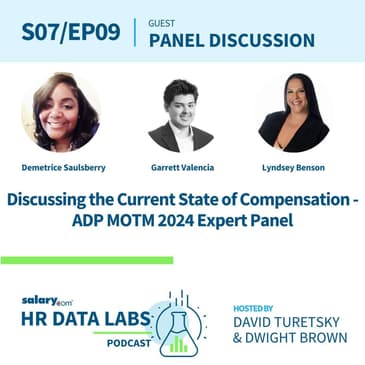
During ADP Meeting of the Minds 2024, David led a panel discussion about the current and future state of Compensation. He was joined by Demetrice Saulsberry, Sr. HRIS Manager at Trulite Glass & Aluminum Solutions, Garrett Valencia, Total Rewards & Payroll Manager at BSH Home Appliances Corporation, and Lyndsey Benson, VP of HR at Steve Madden.
In this episode, David and the panel of experts discuss some of the present day issues that Compensation practitioners face, upcoming events in 2024 that will
impact the world of HR, and how future technologies could help HR teams save valuable time and effort.
Chapters
[0:00 - 11:38] Introduction
• Welcome, Demetrice, Garrett, and Lyndsey!
• First, some context for the current state of HR
[11:39 - 26:33] Top 3 surprising HR events from 2023
• Surveys say that people do not think they’re being compensated fairly
• The relationship (or lack thereof) between compensation, cost of labor,
and cost of living
[26:34 - 41:52] Anticipations for HR changes in 2024
• How companies should approach job descriptions, pay ranges, and
career frameworks
• Total direct compensation and long-term incentives
[41:53 - 53:30] Looking forward to 2025
• How changes near the end of 2024 will impact organizations in 2025
• What about 2025 scares HR experts?
[53:31 - 54:12] Closing
• Thanks for listening!
Quotes
“If you haven’t published [geographic differentials for employee pay], then
it’s going to be a bigger problem for you because you’re making a one-off
decision if an employee decides to move.”
“When you’re deciding [an employee’s] pay, it’s the only time when you
have to reference the person [not the job].”
Contact:
Demetrice's LinkedIn
Garrett's LinkedIn
Lyndsey's LinkedIn
David's LinkedIn
Dwight's LinkedIn
Podcast Manger: Karissa Harris
Email us!
To schedule a meeting with us: https://salary.com/hrdlconsulting
For more HR Data Labs®, enjoy the HR Data Labs Brown Bag Lunch Hours every Friday at 2:00PM-2:30PM EST. Check it out here: https://hrdatalabs.com/brown-bag-lunch/
Produced by Affogato Media
Powered by the WRKdefined Podcast Network.
[00:00:00] .
[00:00:30] Hello and welcome to a live version of the HR Data Labs podcast. I'm your host David Turetsky. No clapping necessary. It's totally okay.
[00:00:55] We're going to be talking today about the complexities of pay. And with us today we have three esteemed guests. The beautiful part about this panel is each one represents a different industry.
[00:01:07] Each one represents a different discipline in the world of human resources. And you'll notice some of the names because these are household names.
[00:01:15] And what you're going to find is, is that a lot of the things we're going to be talking about are very common. And a lot of those things that we're going to be talking about, you're probably going to be facing too.
[00:01:24] So we're going to first go through and talk about who we are and why it's important for us to be giving this presentation. The second word to do is give a little bit of context for the world of pay today and why this is so important to talk about it.
[00:01:37] Then we're going to have three questions and they're really easy questions. We'll talk about them. You can ask questions if you'd like. And then any other questions that we don't cover, any topics that we don't cover, I'll help and they'll help.
[00:01:51] And so to try and start kick things off, I just wanted to say how this is going to work. It's going to be a little bit of a twist because we're doing this as a podcast. The podcast rules are there's no dumb answer. There's no wrong answer.
[00:02:05] And if there's a question that can't be answered, we'll tell you we can. We may not have all the experiences in the world, but I think I have three brilliant people here that should be able to answer them. But also if you have experiences, you can answer the questions too.
[00:02:20] Okay. And the last thing is please participate. It's so much more fun when we get a flow of traffic from the audience to our panelists. So let's talk about who we are. My name is David Cheretsky. For those of you who don't know me, I worked at ADP for 16 years.
[00:02:35] I was in compensation management at ADP. I also helped develop the ADP data cloud. Also now I'm with Salary.com. I'm their CHRO as well as one of the leaders of our consulting organization. And so some of you may know me from actually helping you. Others, you've probably heard of me.
[00:02:53] I promise the rumors aren't true. Okay, I've been doing the HR data labs podcast since October of 2020. I was pandemic thing. And in order to do thought leadership instead of going out and talking to people presentations like modem, we actually had to do things like podcasts.
[00:03:10] And so we have 159 episodes we've done talking to a lot of the thought leaders in the world of human resources, payroll, HR technology and even beyond. And so you might want to listen to it, react to it. I'd love to hear feedback. Let's start with Demetrius. I'm actually going to go to you since you're the first smiling face on that. Demetrius Salisbury, give us a little bit about your background.
[00:03:32] Okay, I have probably too many years to count in HRS. And anything related to the system, benefits payroll and HR. So that's pretty much my background for the last 20 plus years.
[00:03:48] And she's being very shy. She's also one of the leaders of TrueLight. So if you know TrueLight glass and aluminum, one of the finalists.
[00:03:58] Next person, Garrett Valencia from Bach Seemings Group.
[00:04:02] Yes, my name is Garrett Valencia. I'm the manager for total rewards and payroll for United States, Canada and Mexico for BSH home appliances, which is the home appliance division of rubber Bosch. So if you know a Bosch dishwasher, we make them refrigerators ranges and those things.
[00:04:19] But you can't support any warranty claims here right?
[00:04:22] No, please don't. Please don't come to me on that contact customer service.
[00:04:28] I actually saw one on Craigslist and I wanted to ask you whether I should buy it but.
[00:04:33] Well, you might get a good discount, but I can't guarantee you the warranty is good.
[00:04:36] Then I'll call you.
[00:04:38] Yes. So yes, I have that experience in those areas. And I am focusing from the compensation perspective since that is the majority of my role for the three countries.
[00:04:51] And next we have Lindsay.
[00:04:52] Hi, I'm Lindsay Benson. I'm the VP of HR at Steve Madden. I've been with Steve Madden for it's going to be 15 years.
[00:05:00] Wow. Yeah, so it's been a while.
[00:05:03] Just happy to be here. Oh yes, and we won.
[00:05:06] Yes. Congratulations Lindsay and Steve.
[00:05:08] Thank you. Thank you.
[00:05:12] And so we're going to talk a little bit about some of those experiences.
[00:05:14] And I think you were even talking about some of the compensation challenges when we were going through the listening to the video.
[00:05:19] So we're going to talk to such on those today.
[00:05:21] So first, let's get some context. I think everybody knows that after the pandemic, we started to see some very strange things happen in the world of compensation.
[00:05:30] First of all, some of you don't realize this, but work from home was a very, very big complication. Why?
[00:05:37] Well, because people took that as a way of being able to work their lives around their lives.
[00:05:45] And we hadn't had that for those of us who have been working in the workforce since the 80s.
[00:05:50] It was all command and control was all go into an office.
[00:05:53] It was all you have to be at work and you have to show your face.
[00:05:56] And if you were out, oh, are you sick today?
[00:05:59] Oh, you had to do something.
[00:06:01] Oh, when are you going to make that time up?
[00:06:03] Well, we started to see that shift because now work from home gave us an opportunity to work our world of work around our lives.
[00:06:12] And people took that as a compensation element.
[00:06:14] And we're going to get into this a little bit and a little a little later.
[00:06:18] But I've been hearing lots of thoughts from leaders on Tweet, look at Twitter or whatever it's called these days and some of the other places like LinkedIn.
[00:06:26] We're actually seeing people who are telling stories about company is telling people not only come back to the office, but they're also telling them they're going to get a pay cut.
[00:06:35] Why? Wait, when did that happen?
[00:06:39] And so again, if that's happening at your organizations, you don't have to say OK.
[00:06:44] Or all of yours, too, because you're all part of this as well.
[00:06:47] But one of the things that are key there is we're starting to see those organizations try and start to take control again and control the narrative and control people and where they work.
[00:06:57] Whether it's true or not, that they're not getting productivity.
[00:07:00] We actually saw a lot of productivity from people working from home.
[00:07:03] But now there's that thought process of let's get control back because some of the other things we're seeing is that people feel more empowered to ask for more.
[00:07:13] They're asking for more time off. They're asking for more pay.
[00:07:16] And we're seeing this, especially in unskilled labor.
[00:07:19] And so for those of us who do compensation every day, especially from people who do compensation every day for other companies, we're seeing when we do market pricing, we're seeing unskilled labor rates go through the roof.
[00:07:31] And it's not just because minimum wage increases. It's because we're seeing those jobs coming out of nowhere.
[00:07:37] We're also seeing a lot of skilled labor people who are nurses, people who are in stressful environments taking that unskilled work because they don't have to watch people die.
[00:07:46] Frankly, they don't have to wash bedpans and they can do things in an unskilled environment that don't really utilize their training.
[00:07:54] But it doesn't matter because they're still getting paid similarly to where they were in the skilled workforce.
[00:07:59] And what does that do? Then it put pressure on the skilled rates because then there's a dearth, there's an undersupply of those people.
[00:08:08] And so those rates start going up. And so it starts to spiral. Now we're seeing tons of compression.
[00:08:16] So that's the world of compensation. We're also seeing in the regulatory environment things like pay equity and pay transparency with new rules on a state level, sometimes on a municipality level that are driving corporations to go back to the old way.
[00:08:29] And corporations have to say, well, if I'm doing it for Colorado, why don't I just do it for everybody?
[00:08:34] Or I work in, I live in California and those rules are relatively hard. Why don't I just do that everywhere? We call that using the lowest common denominator.
[00:08:44] If it happens in a place where we have lots of employees, do it for everybody. Don't just do it for one place. Why?
[00:08:52] It will cost you more to do it for one place. And you're going to have to say to yourself thought process wise, wait a minute. Is this only for Colorado? Is this for California or do I do it for everybody?
[00:09:02] So the other problem with that is that when you start to think about the rates you're using, then you have to go back and start doing your market pricing again.
[00:09:11] But when was the last time you looked at your job descriptions? So this starts to get into a spiral of work that becomes almost out of control.
[00:09:19] Now, I know specifically there are a couple of people on the panel who keep very, very up to speed on job descriptions.
[00:09:24] And so for them, it's just a question of doing the market pricing and finding out what the latest rates are.
[00:09:30] But for a lot of us who haven't looked at our job description since before the pandemic, this gets into panic mode because now I need to go back to the beginning or even before the beginning to look at my job table, look at my titles, look at my grades, look at everything and begin from scratch.
[00:09:46] So compensation isn't just about how much you pay or what you pay. It starts getting into other things. Career frameworks.
[00:09:54] I was mentioning before about Colorado and their pay transparency legislation. Well, now they've said you have to publish career frameworks to people and be proactive about it.
[00:10:03] Just a show of hands, how many of you have career frameworks that you can show to people?
[00:10:09] This is hard stuff. It's not easy, but if you operate in Colorado, you have to. It's not a choice.
[00:10:16] It's now part of legislation. And again, if you don't have it for Colorado, then you don't have it for everybody else. But if you have it, then you can start to use it.
[00:10:25] By the way, what did people ask for a lot during engagement surveys? What do they ask for a lot?
[00:10:32] Where's my career going?
[00:10:34] What's my next step? How do I get there? Without that, what are they going to do?
[00:10:41] Leave. They're going to go on LinkedIn or they're going to go on Indeed and they go, hey, I just saw this really cool job.
[00:10:47] And when do you find out? You find out when you go to ADP's data cloud and analytics and you go and you look at your termination reasons report or app metric and it says, oh, they left because they got a better opportunity.
[00:10:58] Because you've done the work to clear up your termination reasons and you know that.
[00:11:04] Anyway, so but that's the problem is you find out too late that you could have saved that person and that person may have been the person that saves your organization or it saves a million dollars or makes a million.
[00:11:17] You don't know. But what this does is it creates another problem for you. And so compensation not just about how much you pay for a job.
[00:11:25] It has much more to do with a lot of things. And we haven't even started talking about pay equity yet.
[00:11:34] But I wanted to set that context to now go into some of the questions that are now going to uncover what are these folks dealing with and what are you dealing with in the world of compensation and pay that might be complex?
[00:11:54] Even from your perspective, it's totally cool.
[00:11:56] But the first thing we're going to do is we're going to start with what were the top three things that happened in 2023 that surprised you.
[00:12:07] We've heard a lot about pay transparency. We heard a lot about pay equity. So I'll start with you, Lindsay, since you have the microphone.
[00:12:15] Give us just one of your top three. What surprised you in the world of pay in 2023?
[00:12:22] Speaking of engagement, employee engagement surveys, we recently finished completed ours.
[00:12:29] And the lowest score for us was honestly that people feel do not feel compensated for their job and for their workload.
[00:12:41] You know, you think you're doing all right. But then you see that number and you're like, wow, like it was really like eye opening to see how many people thought that they were not being compensated fairly.
[00:12:53] I don't even know if it's true or not. Right. And that's the thing. Right. Like is it.
[00:12:56] But it's how they feel. But it's how they feel. But either way, it's how they feel. So, you know, how are we going to address that?
[00:13:02] But that was that was big for me. So let's ask the audience how many people have done engagement surveys and found out the compensation was high on the list.
[00:13:11] Hey, a lot of people. It's very true. A lot of people complain about their pay. A lot of people say they're not paid well enough.
[00:13:18] In fact, I've always said that the four letter word that people use for compensation is more right. They've never said I'm satisfied with that increase you gave.
[00:13:27] Now, OK, especially in twenty twenty three, we were dealing with very, very high inflationary rates and people always think we had this conversation to people always kind of equate high inflation with high merit increase.
[00:13:40] That's not always the case. Right.
[00:13:42] That's everybody thinks that like they can put comments on certain things and everyone's like, well, how come our merit increases aren't going to match the rate of inflation?
[00:13:52] The rate of inflation. I'm like, are you kidding me? Do you really think can you imagine if that's how we gave their increases? Right.
[00:13:59] But but I have heard this a lot though, Lindsey, that people think that we set our merit increases index to specifically index to cola.
[00:14:09] They think that because the inflationary rate is high, I'll put it this way, because they can't afford eggs.
[00:14:16] They want us to compensate them for buying more eggs. OK, and it's just not true. Right.
[00:14:21] It's just not true. And so I've always told people that if you look at the inflationary pattern that we've had over the last two decades, are they going to complain when inflation was less than two percent that they got three percent increases?
[00:14:36] David, can I make a comment? Absolutely.
[00:14:38] So I had a situation earlier in twenty twenty three, maybe in September time frame, going with the remote remote work where we have a remote work policy that we had to build because of the new era.
[00:14:50] And there is a trend that people are wanting to go back to the well, not people want to go back to us, but business leaders want you know, the C-suite usually wants them to come back to the office.
[00:14:58] So that's a new thing that's happening. But back in September, we did have, I don't know, like it was a manager, but like a higher level manager and marketing, and she wanted to move from Irvine, California to North Carolina because her husband got a new job.
[00:15:12] And so going off of what you're saying about how we don't pay well, most companies really should not be paying off of cost of living.
[00:15:22] We pay off the cost of labor. When this situation, this employee said it was unfair that we wanted to change her rate for the geographic differential that we pay for the cost of labor in North Carolina versus Irvine, California, which is above the national average.
[00:15:36] And we pay a premium for North Carolina because the majority of our workforce is there because if it's a factory, so we pay a little bit more than what we're supposed to pay on average.
[00:15:46] But she still didn't feel it's enough. And so she said that her personal whatever things that her kids go to a private school and things that that's makes it our problem, and it's not.
[00:15:56] And those are hard conversations you have that the HR have to someone handle and levy us in terms of this is facts.
[00:16:04] And so people's personal situations are getting into decisions that are really not business decisions. And those leads to harder conversations.
[00:16:11] Do me a favor. Talk a little bit about the difference between cost of labor and cost of living.
[00:16:15] So cost of living, as we know, is like the price of milk, eggs, fuel, those types of things.
[00:16:21] Cost of labor is what the market is willing to pay for a role in the geographical area that you're doing business in.
[00:16:29] So that is where there is a difference. And how you can find those rates or those differentials is through salary surveys.
[00:16:36] And so we have a bunch of salary surveys that we pull from to do assessments every year to find what makes sense for the ranges because it's actually not on a job.
[00:16:47] It's on the pay range, although some people can do it differently.
[00:16:50] Some of us can do a little different. We do it on the range itself.
[00:16:53] And so we look at those surveys and where we go is based on the state.
[00:16:58] We have a rate for the state and then we have deeper dives into metropolitan areas within those states.
[00:17:05] So like if you're in Texas, Texas is usually paid national average.
[00:17:08] And then we have differentials for Houston, Dallas, and those kind of areas that pay a little bit more or sometimes it's less.
[00:17:16] So unfortunately, we do have to compensate them for those situations as well.
[00:17:21] California is higher than the national average.
[00:17:24] But then in the Bay Area, we also come say even higher.
[00:17:27] There is a premium there to New York City has a premium higher than the state of New York and so on and so forth.
[00:17:33] So we look at those to make sure that those are aligned every year.
[00:17:36] And we actually have transparency. So we actually publish it.
[00:17:39] Employees can find out what their differential is. They do not know their range.
[00:17:43] That's a little bit of a thing that we're not there yet.
[00:17:45] But they do know what their differential is because we want them to be transparent in making decisions about where they are choosing to live,
[00:17:52] to make a decision that's informed before coming to us and say, if I want to move here, OK, well, this is what it could be.
[00:18:00] So we try to make sure that they are aware before they make a decision,
[00:18:03] because then we go into the issues where now we have to do reductions in pay potentially reassessments in pay.
[00:18:10] And then we have to make those choices because if once you make one type of decision that sets a precedent, it's really difficult to go back.
[00:18:18] And it's trouble.
[00:18:20] I want to touch on that for one second, which is that you need to have that policy known that you're paying geographic differentials based on where people live and where they're hired.
[00:18:30] And if they make if they're making a personal business decision to move, then their rates might change.
[00:18:38] Yes. If you haven't published that, then it's going to be a bigger problem for you because now you're making a one off decision.
[00:18:45] So you guys publish that as a as a policy? Yes.
[00:18:50] So let's go now to Demetris.
[00:18:54] Demetris, what's one of your top three that chopped you in twenty twenty three?
[00:18:58] The biggest one I have to say is this, because we're still dealing with that at the moment.
[00:19:05] But a lot has to do with this year, our CEO said, OK, ninety percent of our population can be now remote work.
[00:19:16] With that, we did have a lot of movement. Let me just clarify that we had a lot of movement.
[00:19:22] We had a couple C-suite moves to other states and we had to adjust their pay.
[00:19:29] And we are still dealing with that at the moment.
[00:19:32] So this is a hot topic for me. Yeah.
[00:19:36] And even when we provide all of the data to them to determine why we're changing their pay, we are getting a lot of pushback.
[00:19:46] And I say these are C-suite, so they do have a voice.
[00:19:51] Yes, that can overshadow. Yeah.
[00:19:54] But providing a lot of the data that we have on pay equity, providing the data for the GeoDivs and even we're a manufacturer.
[00:20:06] We're a manufacturer and to make sure that they know it's truly manufacturing, we're giving them apples to apples and not apples to oranges, making sure that they have the data that they need.
[00:20:17] That right now is for me one of the top things that we're working on right now.
[00:20:24] So one of the things that I've been talking to a lot of clients about for executives is paying at the national level, because I think maybe it might be true for some of you.
[00:20:34] But when we hire somebody who's in our C-suite, we hire them anywhere, anywhere they live, anywhere we can find them.
[00:20:41] We find the best person. And so we go national average.
[00:20:45] So we get out of the you're living in San Francisco versus North Dakota by saying we're going to pay you whatever the national.
[00:20:52] Now, because we're in Boston, that kind of hurts a lot of the executives that live in Boston.
[00:20:57] But at that point, we're talking about percentage points difference on very large pay packages.
[00:21:04] So correct. And for us, it makes a difference.
[00:21:07] It changes even further bonuses. It changes this.
[00:21:10] It's a huge difference. Even if you look at a 10 percent, that's a huge difference for them.
[00:21:16] And so the pushback right now is truly amazing that you don't realize that you get that.
[00:21:23] But in looking at the data and showing them what is going on, I think in the two people that is impacting, they're relocating back to where they are because it's such a big difference.
[00:21:36] Yeah. Now, what's interesting there is you talked about using the data.
[00:21:41] For a lot of us in the world to pay, we use data to sell our story and to tell what we think.
[00:21:49] We should be doing here. We use that as our business case.
[00:21:52] We also know that there's a little bit of art and science that goes into that data.
[00:21:57] And so what we try and do is use as many sources as possible.
[00:22:01] So my advice when you're going into conversations, especially with senior leaders, is have a lot of data.
[00:22:06] Yes. So that you can back up what you're doing.
[00:22:09] Because using one source to do that kind of analysis, I've heard this happen from leaders for my entire career.
[00:22:17] Hey, listen, I know all the people that are at all our competitors.
[00:22:20] I know exactly what they're paid and they're paid a lot more than that.
[00:22:24] Nobody's heard that conversation, right? Nobody's had that. No.
[00:22:27] When I worked at Morgan Stanley, they knew every investment banking leader knew the investment bank leader.
[00:22:33] They went to college with them. They went to their MBA with them and they would talk right when they play golf or whatever squash.
[00:22:41] And so that I usually had to give them a ton of data for that.
[00:22:45] Anyways, anybody want to talk about what your next top three might be?
[00:22:50] Pay transparency.
[00:22:53] And you're in New York City.
[00:22:54] So right. So we're in New York. I mean, we're in New York City. Right.
[00:22:58] And so and then we have California as well.
[00:23:00] Right.
[00:23:02] Currently, we are only doing it where it is required.
[00:23:05] But we are going to just do it everywhere because it's just not worth it.
[00:23:09] It's just it's just not worth it.
[00:23:10] And then, you know, it's a very litigious world out there.
[00:23:14] And so, you know, we had one job description that we forgot to post a range.
[00:23:20] OK. And it wasn't us that discovered it.
[00:23:22] It was, you know, a candidate who was like, hey, I think my lawyer required it.
[00:23:27] We were like, you know, full. Yeah.
[00:23:29] So we had an internal conversation like we just need to post the ranges on every single job posting.
[00:23:36] Because, you know, what if tomorrow it's somewhere else that we have a position and the lawsuit was something like that?
[00:23:42] It's just not something that we want to.
[00:23:44] And remember the old days, the old days used to go on Indeed or LinkedIn and used to say in Colorado, this is what it was paid in California.
[00:23:51] It was this in New York.
[00:23:54] Those days are gone.
[00:23:55] We're putting the national ranges or we're putting something on there and we're not saying it's just for that.
[00:24:02] And so starting rates from here to here usually takes that variance into consideration as well.
[00:24:07] But it's tough. It's very tough.
[00:24:09] Not only that, I'm not a lawyer.
[00:24:10] We're not giving out legal advice.
[00:24:12] Talk to your legal counsel about what you need to do when you're making these postings because there could be something in your municipality or in your state that might be different
[00:24:22] that you need to add to those postings.
[00:24:24] Right.
[00:24:25] Because New York City used to be different than New York State or.
[00:24:28] Yeah, New York City was it was first New York City and I think now it's all it's New York State.
[00:24:33] So but so it's just easier just to do it.
[00:24:36] Yeah.
[00:24:37] Yeah.
[00:24:38] So I live in New England, Connecticut.
[00:24:40] Yes.
[00:24:41] Rhode Island.
[00:24:42] Yes.
[00:24:43] Massachusetts.
[00:24:44] No, but it's working on it.
[00:24:45] So pay transparency is still happening.
[00:24:47] It's happening a little slowly more slowly than I thought.
[00:24:49] The one thing we did this year, actually last year, we are providing total compensation statements to everyone.
[00:24:58] So it's all electronic.
[00:25:00] They go and they can see truly everything that the company does.
[00:25:06] And it's it's catered to them.
[00:25:08] So and that's been a big cap like we have got a lot of kudos for that identifying that.
[00:25:14] So that's one of the big things that we did as well.
[00:25:17] And in fact, on total reward statements, I think it's really important to understand when the old days we used to get these pieces of paper once a year and it showed that entire relationship.
[00:25:26] Now that it's online, we have to tell people to keep going back there to tell them what the value proposition is between what we offer them, what we're paying them, what they have available to them that they may not remember on a daily basis.
[00:25:40] And if they are looking, this gives them that opportunity to at least stop and say, wow, you know, I'm getting a defined benefit here.
[00:25:48] Where's that happening?
[00:25:50] Right.
[00:25:51] Or, you know, we still do a pension for those of us who remember the pension days.
[00:25:55] You know, that's a big deal.
[00:25:57] And I actually think I saw something on LinkedIn yesterday or today that said that pensions are making a comeback.
[00:26:04] Are pensions really making a comeback?
[00:26:07] Eric, do you?
[00:26:08] Yeah, I haven't heard that either.
[00:26:11] So anything else about 2023?
[00:26:14] Because now we're going to have one.
[00:26:17] No way to get you to get to 2024.
[00:26:20] All right.
[00:26:21] Hold on.
[00:26:22] Like what you hear so far?
[00:26:24] Make sure you never miss a show by clicking subscribe.
[00:26:27] This podcast is made possible by salary dot com.
[00:26:30] Now back to the show.
[00:26:34] Are you anticipating any large change or anything that already happened?
[00:26:38] Because we're in we're in March now, right?
[00:26:40] This is March 1st.
[00:26:41] Holy crap.
[00:26:42] What are we anticipating in 2024?
[00:26:44] Well, for me and we were discussing just a little while ago about what the perception is for the business to know how their employees are getting paid versus how but they're really worth.
[00:26:57] And so we had done a study for all of our jobs for my entire region.
[00:27:03] So for me, it's all three countries and since July and it took six months to finish that analysis and we did read every single job description to make sure the match was correct in the analysis.
[00:27:18] And then you find that you don't have job descriptions.
[00:27:21] I don't know where they are.
[00:27:22] And that's another problem.
[00:27:24] So, yeah, that's a really tight on job descriptions too.
[00:27:28] Yeah.
[00:27:29] So these are really old old jobs like production line or some sort that I don't I don't know who how where somewhere right anyway.
[00:27:38] But for the most part we do have let's say 95 percent of them about because of that was a very small handful of missing.
[00:27:46] But without we did find and you know, we all have assumptions from what we actually do every day to know kind of how people are getting paid against the market.
[00:27:55] And then the managers and business leaders have their own opinion.
[00:27:58] And so through the analysis, I say there's a fair handful of roles that the businesses were correct.
[00:28:07] And sitting that there was an issue.
[00:28:09] What's interesting is that they were wrong.
[00:28:11] It was actually the reverse.
[00:28:12] And so where they think they were underpaid, they were overpaid.
[00:28:18] And for some other jobs, it came out to be some some variances that we didn't know.
[00:28:26] And so they have to be included in something we do in 2024 to do a proposal for an adjustment to get them to a fair market rate.
[00:28:35] The problem is, though, that some of these business leaders that we found don't take into account a full picture of their employees when deciding their pay because in every company has a different philosophy for compensation and ours is pay for performance.
[00:28:48] So you don't get a market rate just because you're there.
[00:28:52] You have to be competent in the role that you are assigned.
[00:28:55] And through performance evaluations, you're assessed on a variety of things, one of them being your actual job and if you have goals, et cetera.
[00:29:05] But if you're not meeting the common sense of the actual job, you are assigned.
[00:29:08] There is no way you should have a pay that's the same as somebody that is a driver or some type of exponential performer or something like that.
[00:29:17] And I think that's an important point because when people talk about even the starting rates and we look at, you know, we're talking about those rates that we put on the the requisitions, the post online.
[00:29:27] People say, well, why do you create that range?
[00:29:30] Well, it's because first of all, you're going to be looking experienced because you know their performance yet.
[00:29:34] But then when someone actually gets into the role, then you can actually judge their performance.
[00:29:38] That range is still there.
[00:29:39] And people say, well, we've got to get everybody the median.
[00:29:42] No, you don't.
[00:29:43] That's why there's a twenty fifth median and seventy fifth.
[00:29:45] And we do the analysis.
[00:29:47] You can put people between the twenty fifth and fifty.
[00:29:50] It's OK.
[00:29:51] Or there's no reason why they can't be or if we're talking about salary structures, there's no reason why they can't be around the minimum.
[00:29:56] It's OK.
[00:29:58] Yes, it's different by person.
[00:30:00] That's the only time where I where I would give the advice that it's dependent on the person.
[00:30:05] Absolutely. Because in our field, it's always no, it's not the person.
[00:30:09] It's the job.
[00:30:10] When you're deciding to pay, it's the only time where you have to actually reference the person and what's sometimes challenging that business, the business seems to have a hard time struggling with, which is where the data comes into play is making sure you have an actual picture of the employee population that you're doing an assessment on.
[00:30:29] So let's say it's I don't know, a service technician or something.
[00:30:32] That's just happened to be the one recently.
[00:30:35] There's a whole bunch of service technicians and they don't have anywhere to go.
[00:30:39] There's only one job for us.
[00:30:41] I can't make a senior.
[00:30:42] It's not a it doesn't have correct.
[00:30:44] It doesn't have levels.
[00:30:45] There's no there's a junior because maybe they're an apprentice, but there's no senior level service technician.
[00:30:51] You're you're fixing an appliance.
[00:30:53] What are you going to do to make you a senior?
[00:30:55] The business has to prove to us that there's a reason to do that change.
[00:30:59] And if they can prove it, then we will create it.
[00:31:02] But if you think about it, there is there's nowhere for to go.
[00:31:05] That's just the life of the job.
[00:31:06] The only next level would be a management position supervisor or a manager of that region or something to that effect.
[00:31:12] Challenge with that is it pushes a lot of those people in that role to the end of the range, the highest level where they're going to Max because there's nowhere else to go.
[00:31:22] So we do have a lot of people in that field that are paid very high skewing market data because they have experience of 30, 20, 30 years.
[00:31:31] The job only requires three.
[00:31:34] But there are other analogs, and I think you all might have analogs as well to this where you have a role that doesn't have a family.
[00:31:42] And unfortunately, we've had to create those levels just because you have people who have, you know, 15 years, 25 years, 30 years plus.
[00:31:51] And you're paying over the Max.
[00:31:53] And then you have to lump some of them all.
[00:31:55] But do you have an analogs to that?
[00:31:57] And so what we do to compensate that because that's exactly the nature of our business as well.
[00:32:03] So we've created a lead that role instead of management.
[00:32:08] Lee, it's you know, it goes to a team lead.
[00:32:10] We have a lead.
[00:32:12] So and all the leads who are in that maximum category are really in that where that's still a range is a higher range.
[00:32:20] They're still doing the same thing.
[00:32:22] It's just that they have the experience that the other people don't.
[00:32:26] Do they do coaching, though?
[00:32:28] Yes, we do.
[00:32:29] No, no. But I mean, did those do they coach the others?
[00:32:32] Yes. And it's not necessarily a mentor program.
[00:32:35] But yes, it is.
[00:32:37] They know that that's the next step.
[00:32:39] So there is some kind of like leap from one to the other.
[00:32:43] Not all jobs only when it's for us, you do service takes.
[00:32:47] But we call them loaders and unloaders.
[00:32:49] And then the next step up, it's a lead loader and unloader.
[00:32:52] So, yes, there is a mentorship, if you will, to get to that next step.
[00:32:57] Awesome.
[00:32:59] First of all, we have probably one of the highest paid receptionists in the world.
[00:33:03] She's been with us for 25 years.
[00:33:06] And so totally she's not a senior receptionist.
[00:33:09] Maybe maybe now we made it our senior receptionist just to try and like do something.
[00:33:15] But we do have a lot of tenured employees.
[00:33:18] And so we've run into that a lot.
[00:33:20] And one of the things that we actually discussed was, you know, when they get to that top of that range.
[00:33:27] Right. And sometimes they just they don't want to do anymore.
[00:33:30] And they're good and they're loyal and they're dedicated.
[00:33:33] And you're OK with that. Right.
[00:33:35] One of the things we discussed was the possibility of like bonus.
[00:33:38] Right. And so once they get to the top of a certain range, you're not going to get any more.
[00:33:45] But you can get a bonus.
[00:33:47] And so that's something we're going to look into for some for our highly paid receptionist.
[00:33:53] And that's an important thing.
[00:33:55] Just because they're not getting an increase doesn't mean they can't be seen as valued.
[00:33:58] So either lump sum them or give them incentives or change the nature of the role.
[00:34:04] Now, if someone wants to be a receptionist forever, it's totally OK.
[00:34:08] There's nothing wrong with that. If they want to be a service tech forever, it's OK.
[00:34:12] I think a lot of us seem to believe that people need to move on.
[00:34:16] They want to have career growth. Some people don't.
[00:34:19] And some people want to stay where they are.
[00:34:21] And the problem is, is that the way that we build compensation structures
[00:34:24] maxes them out because we're dealing with cost control.
[00:34:27] We want someone who has less cost. They're still serviceable.
[00:34:31] They're still experienced.
[00:34:33] But then when you lose those people who have all that knowledge and all that skill,
[00:34:37] then it hurts your organization.
[00:34:39] So but there's no reason why you can't keep them.
[00:34:43] Stop thinking about the cost control. Stop thinking about the rules.
[00:34:45] And maybe create new rules.
[00:34:47] There's no reason why you can't.
[00:34:49] Anything else that you're anticipating for 2024?
[00:34:53] So going off of what you were saying, again, through the analysis that we had done,
[00:34:58] we're a private company, which we're kind of big to be a private company.
[00:35:01] So it's kind of weird, but we still are.
[00:35:04] And with that, there are pay elements to our job structure that is missing.
[00:35:11] And all of us in the HR group, with the leadership knew that there's something missing.
[00:35:15] We're missing long-term incentives.
[00:35:17] And it is weird.
[00:35:19] It is abnormal for North America to have senior leadership roles without long-term incentives.
[00:35:24] And we don't have them.
[00:35:26] So through the analysis, it proved that they should have it at a certain level.
[00:35:30] And what the value is, is not really important.
[00:35:34] But the fact that it was not there does show,
[00:35:37] improved to the senior leadership board that it does need to be there.
[00:35:41] So we did have to propose to implement a long-term incentive plan for a certain level of employees.
[00:35:48] The sticker shock is horrific.
[00:35:51] It is expensive, but it doesn't have to be.
[00:35:54] It's just a plan.
[00:35:56] And so that's the thing that we're kind of doing now for 2024 is designing what long-term incentive plan makes sense.
[00:36:03] Because as you know, long-term incentive plans can be very simple to a fixed dollar and they get it in three years to $100,000 over three years.
[00:36:14] And they get a portion every year, but you have to meet a metric like it can be simple to very granular.
[00:36:21] And so that's just things we have to look into.
[00:36:24] But the value of that element is missing.
[00:36:26] And if you don't know, it's total direct compensation.
[00:36:30] Then there's total cash compensation and then just the base pay.
[00:36:33] So this total direct compensation analysis that we had done.
[00:36:36] Now I know there are people in the room who work for organizations that are non-U.S.
[00:36:40] I won't point anybody out by name, but there are other companies that also might have tracking stocks or might have private equity ownership.
[00:36:48] And they have the same problem.
[00:36:50] And there is that phantom share or there are actually shares that you get in those tracking stocks that those senior leaders do get.
[00:36:58] Organizations that miss that are missing a gigantic component of pay, like you said.
[00:37:04] Yes.
[00:37:05] And there's no way to fill that with cash.
[00:37:07] Cash is extremely expensive relative to that because of two things.
[00:37:11] First of all, cash doesn't grow.
[00:37:12] Cash gets spent.
[00:37:14] So when we're talking about long-term incentive, there are really two components of it that are important.
[00:37:18] Not only is it part of total direct comp, but it's also a handcuff to keep them there and to give them an ownership mentality to say we want you to be a part of the longer term growth of the company.
[00:37:30] We want you to make decisions that focus on the company, not just your business, and that give you an opportunity to share in the success of the business.
[00:37:38] Right?
[00:37:39] Yeah.
[00:37:40] That's why a lot of them have some type of metric that's related to a strategy that's a long-term strategy that the business has decided on.
[00:37:47] And usually each functional area has some component of that profitability or any other type of metric.
[00:37:55] Okay, go ahead.
[00:37:56] But what's fascinating about that, Garrett, is when you're a public company, who sets that for you?
[00:38:02] The market.
[00:38:03] There you go.
[00:38:04] Well, when you're a tracking stock, you have to have these metrics to be able to focus on how does this stuff grow or shrink, whether you earn it or don't.
[00:38:13] Right?
[00:38:14] These performance units.
[00:38:15] Yes.
[00:38:16] I think the one thing that's different for us because we're the private is that we don't have the shares and then the business is not willing to do something that's make a faux stock.
[00:38:24] So one of the options originally was to do a phantom stock kind of program where we could create a fake stock rate by taking the books liability versus the assets or assets versus liabilities, something like that.
[00:38:36] And that would create a fake stock and do the same kind of metric, but it's not worth it.
[00:38:40] And it wasn't a good buy-in.
[00:38:41] So we have to stick to something that's actual cash based.
[00:38:44] But in the public company, it's more RSUs, RSAs.
[00:38:48] Right?
[00:38:49] That's the majority of it.
[00:38:50] Then the cash is more maybe not the highest level and it's more lower level senior leadership.
[00:38:55] And by the way, everybody knows the tax accounting on restricted units and options and things.
[00:39:00] It's not like the old days where you could give it away and not have anything to worry about.
[00:39:04] You have to carry expense on your books.
[00:39:06] You have to carry tax liability.
[00:39:08] There's a lot of stuff now.
[00:39:09] So there's no free lunch here.
[00:39:11] Whether you're a private company, whether you're a public company, whether it's cash based or stock based.
[00:39:16] This is just part of running your business.
[00:39:18] If you're a large company for your senior leaders to have that kind of ownership of the company, it costs money.
[00:39:24] One of the things for us as a company we did is we took a look at everyone's pay across board and we separated our employees and we looked at their pay and look at accessing what ADP has globally for everyone who is in the same company.
[00:39:45] Same job description, the same job title.
[00:39:48] And to see where our employees were versus the national average of national rank and using all the GEO data.
[00:39:58] What we did is what our CEO said is, OK, it looks like we're right after 50 percentile.
[00:40:06] And what we want to do or what his goal is to get those locations up to 70 percentile.
[00:40:13] And so, yeah, it was a huge undertaking.
[00:40:17] And so and that's what we were doing.
[00:40:20] Presenting the data to the different locations and explaining to them this is where we're going to do.
[00:40:27] This is a time frame that we're going to do it in.
[00:40:29] Not necessary.
[00:40:31] We did it for longevity for those our employees, not necessarily given them such that we do for senior leadership, but giving them an opportunity to say, OK, this is the next step.
[00:40:42] And a lot of a lot.
[00:40:44] Eighty eighty eight percent of our eighty eight point three percent of our population, they were in the 50 percentile.
[00:40:51] We brought them to the 70 percentile across the board while in different locations where we also identify locations who were spot on and didn't receive any pay increases or anything like that.
[00:41:03] But we changed the conversation about being producing what they have to produce now.
[00:41:09] Right. So and so that was one of the big things that we did last year.
[00:41:13] And now we're doing that for salary.
[00:41:16] Oh, I think the deep dive into that.
[00:41:18] Wow. That's a big undertaking. Yes.
[00:41:21] But so let's now go and talk about 2025.
[00:41:38] Call with me about any of the topics we cover on the podcast or whatever is on your mind.
[00:41:43] Go to salary dot com forward slash H.R.D.L. Consulting to schedule your free 30 minute call today.
[00:41:53] Anybody know what's happening in the end of 2024 November?
[00:41:57] Thank you. There's an election happening.
[00:41:59] Well, it's going to be a big deal and it's going to impact all of us in HR.
[00:42:05] And I think there's a lot of people who are very nervous about it, especially people in HR, because there's another thing that's happening.
[00:42:11] I don't know if you've heard about this, the exemption level for exempt employees.
[00:42:16] Anybody not know about this?
[00:42:18] It's going up from about thirty five thousand to about sixty five thousand.
[00:42:22] Yeah. If you don't, I would freak out right now.
[00:42:24] They'll call your general counsel. It's OK to leave.
[00:42:26] I won't feel I will not feel at all offended because this is one of the biggest deals to happen to the world of compensation in a long time.
[00:42:35] The Department of Labor is going to increase the exemption rate from thirty five thousand annual to about sixty five thousand annual.
[00:42:43] But according to the practice that we have to do, we have to go with what's the most generous law.
[00:42:48] And usually it's California.
[00:42:50] But if the federal is more generous, you have to follow the most generous because you can always be more than what like for cover.
[00:42:59] You can be more than that because there are cities that have more higher minimum wage and it's still compliant as long as you do it.
[00:43:06] So if that's the case, you'd have to go.
[00:43:07] But I'm sure that other states would come up with something else because they're far below or at least matching the federal minimum wage.
[00:43:14] This is the exemption status.
[00:43:16] Yes. So at the same at the same time, the when we do the exemption says for the FSA, yes, they have the Fair Labor Standards Act rulings, but then each state might have a separate rule for the Department of Labor.
[00:43:29] And so Pennsylvania has a specific one that I am aware of.
[00:43:33] California has one which is two times the minimum wage New York.
[00:43:36] So it's not only when we do the exemption classifications, when we're reviewing the roles that we have to look at FSA on the federal level.
[00:43:42] We have to look at the Department of Labor specific ruling on the state or municipality if there is something there complex.
[00:43:48] But a lot of companies have not focused on it at all.
[00:43:53] They haven't looked at their FSA in probably a while as well.
[00:43:56] But this is going to force people to now reevaluate them.
[00:44:01] Yes. So what in preparation of this newest legislation push is to take a look at the rates of what the salary people are getting.
[00:44:12] Excuse me, the exempts, not salary, the exempt employees are getting paid to see if they're at least that threshold.
[00:44:18] For me, I don't have a problem.
[00:44:20] But but some of them are very close.
[00:44:23] So every year they do an index rate right and increase it.
[00:44:26] So I'm pretty sure that it's going to be a higher in the following year.
[00:44:30] But the other year they tried to do this too, unless that was California specific.
[00:44:34] I can't really remember where they tried to do that.
[00:44:36] And it didn't end up happening.
[00:44:38] No, you think it was in common period.
[00:44:41] Yeah. Now it's in quiet period.
[00:44:43] It's it's you know, in New York, we went to 58.5.
[00:44:47] And what a project it was.
[00:44:49] It was. I mean, I mean, to see how many you know, just even the communication around that is it was huge.
[00:44:56] And then like, you know, you have to tell your executive team the expense now.
[00:45:00] Yes. Right. That that it's that's going to cost.
[00:45:03] And sometimes some of it you're like, oh, they won't get the overtime and things like that.
[00:45:06] But it doesn't help.
[00:45:08] So let me ask a question for this, though.
[00:45:10] Any of you think that it's an OK strategy to just make people not exempt and manage their hours?
[00:45:16] Because, by the way, you're never going to get audited if everybody's not exempt.
[00:45:19] Right. That's a good point.
[00:45:21] Right. That'd be a bad idea.
[00:45:26] Yeah.
[00:45:27] Again, we're not talking about legal advice here.
[00:45:29] But there are there are things you need to consider in this.
[00:45:32] You will never get in trouble if you make everybody not exempt and if you pay overtime.
[00:45:37] But I always hear, well, wait a minute.
[00:45:39] Then I pay over. Why aren't you managing people's overtime then?
[00:45:43] Why aren't you managing their time?
[00:45:45] Like everybody thinks that it's free that exempt people work all the time.
[00:45:49] Like I take emails at midnight, you know, while I'm here and no, it's my time.
[00:45:54] Right. Well, the law hasn't caught up with that yet.
[00:45:57] It probably will. But we have to manage this stuff.
[00:46:00] If you're a manager of that kind of person, then you're doing the wrong thing.
[00:46:04] So making them not exempt doesn't change that.
[00:46:07] It just puts more cost against it.
[00:46:10] It puts more effort against it.
[00:46:11] So that's why I'm saying to people, you can do it.
[00:46:15] You're not going to get sued for it unless you're not paying the right thing.
[00:46:20] Right. I mean, you guys have the manufacturing populations.
[00:46:23] Have you ever thought about making everybody not exempt?
[00:46:26] Leading thought that it was OK.
[00:46:30] All right. Anything else for 2025?
[00:46:32] But by the way, you guys can ask questions of the panel if you want to.
[00:46:36] It's OK. Well, we'll repeat them.
[00:46:39] Anything else for 2025 that's scaring the crap out of you?
[00:46:42] The fast food workers in California minimum wage.
[00:46:45] You saw a faster restaurants in California?
[00:46:47] No, but I will tell you my concern.
[00:46:51] So just because it impacts one sector doesn't mean it doesn't impact the rest.
[00:46:57] So I will tell you historically, which we don't do this anymore for my company
[00:47:01] and I never did it at other companies.
[00:47:03] I only did it here for maybe two, three years when California started to do its minimum wage increase.
[00:47:08] And they said, oh, we'll get to $15 over three years or something.
[00:47:11] And they did every year. They didn't increase.
[00:47:13] Well, the first year they had to happen.
[00:47:15] What we did was every every non exempt employee in California,
[00:47:19] when the minimum wage increased a dollar, we gave them all another dollar to keep the spread.
[00:47:24] And then the following year, we said, let's do that for all the states,
[00:47:28] all the states that had a minimum wage increase, whatever the amount of the increase was,
[00:47:32] all the non exempts got an increase of the same to keep the spread.
[00:47:36] What it did was create a cut.
[00:47:38] Sometimes it created compression and then it also created inequities against the exempt people.
[00:47:43] And so we stopped that because then we had to do another assessment to see if it matched just for equity purposes.
[00:47:50] But with this big jump of the fast food workers going to $20 an hour,
[00:47:54] what the big question is, is how can I?
[00:47:58] And I'm just saying this as an example, right?
[00:48:00] A customer support rep only makes 18.
[00:48:04] How can I? How can a McDonald's person get paid 20 and my person make 18?
[00:48:09] And it's just a conversation.
[00:48:11] So if you look at that, it's skilled labor and it's you have a teenager going to McDonald's making more than some skilled laborer.
[00:48:18] As I said before, it's changing the very nature of compensation in the market.
[00:48:23] And it's going to impact everything, including management levels.
[00:48:26] And I think we may have actually talked about this when we've been working together,
[00:48:30] that if you look at your salary structures and if you all have one specific salary structure,
[00:48:34] there are going to be inconsistencies now built into those structures because you're going to have your not exempt levels
[00:48:41] and then you're going to have your professional levels and your managerial levels.
[00:48:44] If they're all in the same structure, then there's going to be gigantic overlaps for when you get from the not exempt to the exempt to the managerial.
[00:48:50] And you're going to be like, how the hell can I afford this?
[00:48:53] Well, that's the problem. That's the underlying problem.
[00:48:56] The entire cost structure has now changed.
[00:48:59] And there's nothing we can do about it because it starts out at the unskilled labor level.
[00:49:04] This has been a great conversation, but now we have to get to the bonus conversation.
[00:49:09] If we didn't discuss it enough, what's the one thing that scares the crap up?
[00:49:13] Sorry, the world scares about you in the world of pay.
[00:49:16] Demetrius, I'm going to start with you since you have the microphone.
[00:49:19] What's the one thing that scares the crap out of you?
[00:49:22] It is the for me, it's the expectation what people are saying that for bonuses they are.
[00:49:28] It's an expectation now. Yes.
[00:49:31] Because you're hiring people and we say, you know, come work for us.
[00:49:36] You know, you get a bonus, but it's an expectation.
[00:49:39] And we say when the business is good, we get a higher bonus.
[00:49:43] But when we don't do as well, it's like you hear people like I got more last year.
[00:49:50] It's become an entitlement now. Yes.
[00:49:53] So how many of you communicate your incentives as entitlements?
[00:49:57] Of course we don't.
[00:49:59] But does that change their perception of what an incentive is?
[00:50:03] So my offer letter, you owe it to me.
[00:50:06] All right. How about you, Lindsay?
[00:50:08] AI? Like what's that going to do the world to come?
[00:50:11] Awesome. The world of pay for AI.
[00:50:14] Right? I don't know. I have no idea.
[00:50:17] But I mean, you know, we were having conversations that AI is now, you know, we're on next gen.
[00:50:23] And it's going to be able to tell us like, hey, these employees are up for minimum wage.
[00:50:28] This is changing. Like change it.
[00:50:30] Like it's great. It's fantastic.
[00:50:32] But what then? You know, so it's kind of exciting to us.
[00:50:35] It's exciting. But one of the things you just mentioned is it said these employees may not be at the rate that they need for minimum wage.
[00:50:42] Right. What are the things that are necessary for that to be absolutely fact?
[00:50:47] Their data. So what feeds that data? The job table feeds or in the next gen terms, the job templates, the position records,
[00:50:56] all of the information about that employee needs to be accurate.
[00:51:00] What are the things that we've all talked about is data for HR is typically not that accurate.
[00:51:06] And so you may get these alerts that people may be underpaid, especially when it comes to minimum wage.
[00:51:11] Awesome. That's great. But don't necessarily freak out.
[00:51:15] Make sure that it's right. Right. Because if the data is not right, then it doesn't even matter.
[00:51:20] But I love the fact that you brought AI into this because you can't have a conversation of modem without bringing those two letters in.
[00:51:25] All right, Darren, how about you? What scares the crap out of you?
[00:51:28] Well, it's the AI as well. But but I wanted to.
[00:51:32] AI overlords or something else?
[00:51:34] I want to talk about the chat GPT.
[00:51:36] Oh, please do. We didn't bring that up either.
[00:51:40] It's just really quick because I actually used it.
[00:51:44] I used it for Mexico because there was a brand new entity that brand from the broke ground.
[00:51:51] Brand new, really. So they had to hire, I don't know, 200 people in a couple of months.
[00:51:59] And then by the end of this year, this will have a thousand.
[00:52:01] That's a lot of job descriptions that the team has to work on.
[00:52:04] Nobody has time for it. The managers don't have time for it. What did we do?
[00:52:09] Chat GPT. Yes. Yeah.
[00:52:11] Now, people may hate that, but guess what?
[00:52:14] The work still has to be done.
[00:52:16] How do we maximize the effort of people with the time that is relative?
[00:52:22] There's only 24 hours in a day and hopefully you only work eight hours.
[00:52:26] But you're still funny.
[00:52:29] We work more than that.
[00:52:30] But it did save a lot of time and the business, a lot of time in all they had to do was just review what was generated and make the tweaks.
[00:52:39] It's better starting with something than starting with nothing.
[00:52:43] Was it in Spanish as well as English? Did it translate to Spanish?
[00:52:48] It did, but not very good. That was also not my problem.
[00:52:51] That's the other problem.
[00:52:53] They had to review that.
[00:52:54] But at least again, starting with something versus nothing.
[00:52:57] And so I have no idea if the level was correct.
[00:53:00] I have no idea if some other aspects of the education was correct.
[00:53:05] They had, but that was their job as a leader to review it and make the tweaks as they normally would do with any job description.
[00:53:10] But at least they didn't have to start from their own brain.
[00:53:13] And as I said before, BSH does a really good job on their descriptions.
[00:53:16] So this must have been an emergency.
[00:53:19] Yes, it was part of this analysis I had to do too.
[00:53:24] Thank you so much for your attention. You're awesome.
[00:53:34] Thank you to our panelists. You've been wonderful. We love learning from your experiences.
[00:53:39] Thank you.
[00:53:44] That was the HR Data Labs podcast.
[00:53:47] If you liked the episode, please subscribe.
[00:53:49] And if you know anyone that might like to hear it, please send it their way.
[00:53:53] Thank you for joining us this week and stay tuned for our next episode.
[00:53:57] Stay safe.
Sponsors
