
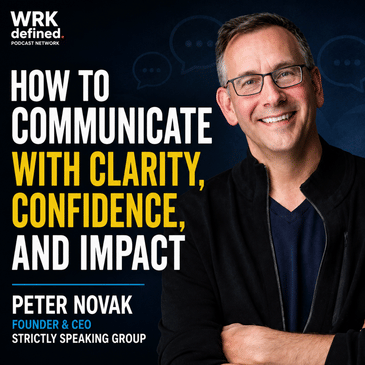
Strong communication isn't about using bigger words or speaking perfect English. It's about making ideas clear, building trust, and creating connections across cultures. In a world where teams span countries and time zones, the ability to communicate with confidence and clarity has become one of the most valuable professional skills anyone can develop.
In this episode, you'll learn why confidence often has a greater impact than flawless grammar, how unconscious bias influences the way we perceive accents and communication styles, practical strategies for simplifying complex ideas without losing meaning, how AI is helping non-native English speakers communicate more effectively, why storytelling remains one of the most powerful business skills, and what leaders can do to create more inclusive communication across global teams.
One of the most overlooked challenges in international business isn't language itself. It's the assumptions people make about competence, credibility, and intelligence based on how someone speaks. Those biases affect hiring, leadership, collaboration, and decision-making more often than most people realize.
The conversation also explores why simpler communication is often stronger communication. Removing unnecessary jargon, choosing clear language, and focusing on understanding instead of sounding impressive can dramatically improve relationships with colleagues, customers, and clients around the world.
Artificial intelligence is changing the way professionals prepare presentations, write emails, and communicate across languages. Used well, AI isn't replacing communication skills. It's helping people express their ideas more clearly and confidently than ever before.
Whether you lead global teams, work with international clients, or simply want your message to have greater impact, this episode offers practical insights you can apply immediately.
Key Takeaways
Why confidence often matters more than perfect English and how it helps reduce unconscious bias.
How accents, cultural norms, and communication styles influence trust, credibility, and collaboration.
Practical ways to simplify your communication so your message is understood by any audience.
How AI can improve writing, speaking, and overall communication for native and non-native speakers alike.
Why storytelling and clarity consistently outperform jargon in business conversations.
Actionable strategies for creating more inclusive and effective communication across global teams.
Guest:
Peter Novak, Strictly Speaking Group
Connect with Us :
William Tincup LinkedIn: https://www.linkedin.com/in/tincup/
Ryan Leary LinkedIn: https://www.linkedin.com/in/ryanleary/
Connect with WRKdefined:
Site: http://www.wrkdefined.com
TikTok: https://www.tiktok.com/@wrkdefined
LinkedIn: https://www.linkedin.com/company/wrkdefined
Facebook: https://www.facebook.com/WRKdefined/
Twitter (X): https://twitter.com/WRKdefined
Substack: https://wrkdefined.substack.com/
Powered by the WRKdefined Podcast Network.
[00:00:12] - [Speaker 0]
Tell the audience a little bit about yourself. Sure.
[00:00:16] - [Speaker 1]
I have I have, as as I've said before, probably the most obscure background, a weird background. You know, I I started young in theater when I was in high school and really enjoyed it, majored in it in college. Then I actually entered the Jesuit seminary after I finished my MFA in acting, and so studied to be a Jesuit priest for seven years.
[00:00:41] - [Speaker 0]
Yeah.
[00:00:42] - [Speaker 1]
I left that to go do my doctorate in this field called dramaturgy, which is an obscure field, only about six graduates a year. There's only one school that gives this this doctorate. And and it really is the study of storytelling and how we tell stories, how we structure them, how they exist in time and space, and and propel meaning of of what it really means to be human. And so, it's odd that I took a theater background. I was a professor for twenty five years.
[00:01:15] - [Speaker 1]
Yes. In in a in a program called Performing Arts and Social Justice. And and and got my way into coaching and working in large corporations by helping people tell their stories more effectively.
[00:01:30] - [Speaker 0]
Careers never make sense in the windshield. They always make sense in the rearview mirror. Yeah. Like every little stop that you made along the way. It's like, oh, yeah, of course.
[00:01:39] - [Speaker 0]
Totally. Of course. Of course, it makes sense.
[00:01:41] - [Speaker 1]
Yeah. It's just weird how it all comes together.
[00:01:44] - [Speaker 0]
Were you being on the Franciscan side? Were you a Pope Francis? Guy?
[00:01:49] - [Speaker 1]
I am, and I'm a Pope Leo guy. Yeah. But Pope Francis is the first Jesuit, which was really cool.
[00:01:55] - [Speaker 0]
Didn't suck. It's funny because I trip across a book that John Paul wrote the other day, and I'm like, I don't know this to be true, but I guarantee, or I don't think that Francis stopped to write a book. Yeah. You know what I'm saying? He was too I'm gonna be able to people.
[00:02:15] - [Speaker 0]
Like, that's right. Yeah. That's right. Which I like. I mean, I I like John Paul as well-being a cradle Catholic.
[00:02:22] - [Speaker 0]
I like all of them. However, they're all different. It's nice to have an American. We'll see how that goes.
[00:02:28] - [Speaker 1]
I'm really curious as he's I like him so far. I think he's been great. But this is it's
[00:02:33] - [Speaker 0]
a tough political time. Is very tough. Catholicism is is having a resurgence. My wife works at our church and she does adult ministry, so she'd bring in returning Catholics or new Catholics.
[00:02:46] - [Speaker 1]
Yep.
[00:02:47] - [Speaker 0]
And it's insane. Like, it's
[00:02:49] - [Speaker 1]
It is. I It's crazy. You know, I was at a Jesuit university for twenty five years and so Okay. Which one were you at? University of San Francisco.
[00:02:58] - [Speaker 0]
Yeah. Of
[00:02:59] - [Speaker 1]
course. USF, the Dons. And Yeah. Yeah. Before that, I also taught at Santa Clara University.
[00:03:04] - [Speaker 1]
And so
[00:03:04] - [Speaker 0]
One of my favorites. The the Oh, good. If if anyone listening or watching has never been to Santa Clara University, go. It's a beautiful campus. Just go.
[00:03:14] - [Speaker 0]
Just go and be on campus and just walk the campus, and it is fascinating.
[00:03:18] - [Speaker 1]
It is.
[00:03:19] - [Speaker 0]
It's so beautiful. My son did summer program out there for engineering.
[00:03:22] - [Speaker 1]
Oh, very cool. Okay. Yeah. Nice. Yeah.
[00:03:24] - [Speaker 1]
USF is also beautiful in a very different way.
[00:03:27] - [Speaker 0]
Where is is it downtown?
[00:03:29] - [Speaker 1]
No. It's in the middle of the city near the Haight Ashbury up high on a hill, up on a hilltop that's gorgeous with this beautiful church that sort of centers that you can see from everywhere.
[00:03:40] - [Speaker 0]
Right.
[00:03:40] - [Speaker 1]
It's really, really cool. So a beautiful campus too.
[00:03:44] - [Speaker 0]
Yeah. But the that doesn't that doesn't bother me. I I mean, last time I was in San Francisco, just a couple weeks ago, we we never we made it where the fort is on the other side on on the bridge where a Marine is.
[00:03:58] - [Speaker 1]
Fort Mason? Fort. Oh,
[00:03:59] - [Speaker 0]
yeah. Fort Mason.
[00:04:00] - [Speaker 1]
Yeah. Yeah. Gotcha.
[00:04:01] - [Speaker 0]
They've they've got a resort over there. Oh. And so Oh, yeah. Cavallo. Yeah.
[00:04:08] - [Speaker 1]
Yeah. Cavallo Ranch.
[00:04:09] - [Speaker 0]
Something like that? Yeah. Yeah. I didn't even get into the city. I could see the bridge.
[00:04:14] - [Speaker 0]
Yeah. So there's a bridge going into the city. I'm like, there's a city, but I couldn't I didn't go and get in. It's the only time I've been in San Francisco and not gotten into the city.
[00:04:22] - [Speaker 1]
Oh, that's fascinating. That's interesting. Beautiful out there, though. I love it.
[00:04:27] - [Speaker 0]
The only thing that's cost a living for me, because I grew up in Texas, I live in Texas, so that's the only thing. That's my only That's my only thing. I'd have to live in Fresno or Bakersfield or something like that to make the money I may go.
[00:04:46] - [Speaker 1]
Go farther.
[00:04:47] - [Speaker 0]
Yeah, yeah, yeah. Sacramento going, Okay. What's the town's right on the border of Nevada? Probably. Because you can't go I can't go up to Tahoe because that's all it's That's all extremely
[00:04:58] - [Speaker 1]
well Affordability is is insane in the in the Bay Area specifically. It's just it's nuts. And now with AI, it's it's getting even worse.
[00:05:06] - [Speaker 0]
100%. 100%. Yeah. Because more people are making higher dollars. It's getting even more insane.
[00:05:12] - [Speaker 0]
That's right. So your current work that you're doing now, tell me a little bit about what you're doing these days with your coaching business and your kind of consulting business as well.
[00:05:22] - [Speaker 1]
Yeah. So it's a it's a small communications coaching firm, basically. We've we've got a series of coaches who are trained in our model and what we do. And we work on high stakes events for major corporations. And so we coach a lot of executives.
[00:05:43] - [Speaker 1]
You know, when you've got something important to say, it really makes sense to invest in first the content in the way that you say it, and second in the way that you deliver it. And so, we really help people feel more confident both in their storytelling and in their delivery, but but we specialize, I do, in working with non native speakers to give them the same level of confidence. Because there's a whole range of of studies and stories around how confidence actually works. And as native English speakers, we don't even know what we're looking at and judging when we talk about when we tell somebody to be confident. And so
[00:06:22] - [Speaker 0]
Yeah, there's all kinds of bias or unconscious bias that's underneath that.
[00:06:27] - [Speaker 1]
Huge amount of unconscious bias.
[00:06:29] - [Speaker 0]
And it could be, know, I'll go backwards. One of the things I think Ted did really well, especially at the beginning, the original Ted, not TEDx's, the original Ted Talks, is they manage quality. So, they manage the process of, okay, what are you guys you're not just going jump up on stage much for people. That's right. So, what are you going to say?
[00:06:50] - [Speaker 0]
How are you going to say it? What's the impact? I thought that probably better than any other thing like that, they did that really well, just the management of quality and making sure that the audience, whether or not someone's talking about parking signs or genetic mutations, doesn't matter, they're going to get something out of it.
[00:07:11] - [Speaker 1]
I agree. I agree. I think they did a really fantastic job of elevating what the role is of communication in that way, and really good, strong communication that has a point of view that gets the message across easily that people can understand. It's why it's got so many downloads because it's accessible, it's interesting, it's topical, all of those things all at once.
[00:07:32] - [Speaker 0]
So the non native speakers that you're working with, I'm assuming that you're working with the rest of the team that, let's say, it's English speaking, and you're trying to kind of deconstruct or get them to understand kind of what's going on and what type of biases they might have, etcetera, etcetera. Well So, let's unpack some of that.
[00:07:52] - [Speaker 1]
Sure. Well, I I think we all have bias around the way people speak. We all do. Yeah. And there are lots of studies that show that people who speak in a way different from the majority, different from the way everybody else speaks, don't get promoted as often, aren't as trustworthy, whatever that means, don't have the same access to to, you know, promotion and advancement in the in the workplace.
[00:08:22] - [Speaker 1]
And and so that has a significant impact, especially on global teams. Right? Especially when you've got a US based company that is global and how they actually communicate with teams in other parts of the world. So it's not just cultural intelligence. That's one aspect of it.
[00:08:43] - [Speaker 1]
This is actually how people communicate with one another and what that means. And so
[00:08:49] - [Speaker 0]
Are you dealing with some of the cultural norms as well?
[00:08:52] - [Speaker 1]
Absolutely. Absolutely. You you you need to. But AI is also now trained on cultural intelligence models, which can be really helpful. What what I think is important to recognize that is we've always put the burden onto the non native speaker.
[00:09:07] - [Speaker 0]
Right. Shitted it to them. It's like, you don't know English? It's obviously your fault.
[00:09:13] - [Speaker 1]
Or or you're not communicating as clearly as as I do. You need to get better at it. Right? It's
[00:09:20] - [Speaker 0]
Without treating that. Without saying that.
[00:09:22] - [Speaker 1]
Saying saying it, but those are the expectations. Those are the expectations. And so, what I like to say is that, you know, I talk about Fred Astaire and Ginger Rogers that that Ginger Rogers did everything Fred Astaire did, only backwards and in high heels. Right? That's the same thing that's happening with non native speakers in in a a room, is they are interpreting, they are translating, they are figuring out their vocabulary as they're speaking.
[00:09:46] - [Speaker 1]
Am I you know, sometimes they'll repeat themselves because they'll find themselves trying you know, the message didn't land the first way maybe.
[00:09:53] - [Speaker 0]
Right. Right.
[00:09:54] - [Speaker 1]
And so, they're unsure. So, they're doing a hell of a lot more work in the moment. A lot more cognitive work that needs to be recognized. And I can tell you this, that non that native speakers don't clearly understand what's going on. And so, I do No.
[00:10:09] - [Speaker 1]
Workshops for teams, it's really great to see this sort of moment, both in the non native speakers, in the recognition of what's going on, but also for for native speakers to really recognize the way that they're using English isn't as helpful as it could be.
[00:10:27] - [Speaker 0]
I think, you know, for me, it's it's also the quickness of a conversation. The speed, the velocity, etc. You get some people together and they're just used to going through things really, really quickly and here I am again in Paraguay or Buenos Aires or whatever, and all of a sudden, I've gotta stay with you, much less, know of what
[00:10:48] - [Speaker 1]
to say? Exactly.
[00:10:50] - [Speaker 0]
Right.
[00:10:51] - [Speaker 1]
Well, so there's a really interesting study, and I'm glad you brought up Latin American countries because a lot of global companies in the that are based in The US have Latin American teams. And Latin American teams often are speaking trilingually. They're speaking in Spanish, they're speaking in Portuguese, they're speaking in English. And, and what happens is as soon as a monolingual person comes into the room, right? As soon as an English only person comes into the room
[00:11:19] - [Speaker 0]
Everything's got to come to them.
[00:11:20] - [Speaker 1]
Everything's got to come to them. So, of the linguistic flexibility and prowess and skills that they have in being multilingual and asking more questions of each other and giving each other more time to think and speak and and doing it trilingually, all of it now reduces to English only and it becomes more competitive for them. Turn taking becomes faster just like you said. All of those elements now sort of evaporate when there's a monolingual person in the room.
[00:11:54] - [Speaker 0]
And it's Most Americans are monolingual.
[00:11:57] - [Speaker 1]
So Most Americans are monolingual. Most British are monolingual. Australians are monolingual. Same thing.
[00:12:02] - [Speaker 0]
Good point. Good point.
[00:12:04] - [Speaker 1]
And there's more non native speakers in the world than there are native speakers.
[00:12:07] - [Speaker 0]
Turns out. Turns out. Yeah. 8,000,000,000 people in the world. Turns out isn't the primary language of all of those folks.
[00:12:15] - [Speaker 1]
That's right.
[00:12:17] - [Speaker 0]
So teaching people that maybe never knew this was a thing, and it is a thing, so you're sitting around at a C suite executive meeting and you're like, Okay, here's the thing. Is it positioned as inclusion? Is it positioned as like what's the best way to position in today's political market? Right?
[00:12:38] - [Speaker 1]
The best way to position it is that this is a business issue. That you need your communication to be as clear as possible to everyone, not just to a select few. And so, the better that you are using English to clarify what you're saying, to make sure the intention is there and that everyone throughout the globe understands it, that is a business decision. So English
[00:13:06] - [Speaker 0]
isn't just English. Like, again, as you said, British English, Australian English, Canadian English, United States. Then you got like 11 different United States. And so you have culturalisms, you've got slang, curse words, you've got all of this stuff in there that even we don't agree on.
[00:13:27] - [Speaker 1]
Well, interesting because all languages have that. Spanish has that as well. You know, my friends from Columbia will say they speak a really good pure form of Spanish. Know, it's just really interesting. So we all to have
[00:13:37] - [Speaker 0]
Spain and find out how not pure it is.
[00:13:41] - [Speaker 1]
But we all have these biases around no matter what language we speak, there's there's someone who's been sort of told that they don't have a standard way to speak. And that standard is developed usually by people in power and people who establish these norms for what it means. I had that, in school actually. I I came from the Midwest and had a really sort of flat sound when I was speaking. Yeah.
[00:14:05] - [Speaker 1]
I was told in in in theater school and in grad school to not not speak that way anymore.
[00:14:11] - [Speaker 0]
Right. Right. Right. Right.
[00:14:12] - [Speaker 1]
And so I was trained, you know, three or four
[00:14:14] - [Speaker 0]
days I can a week for that in character development. Like, they want you to play a certain character.
[00:14:21] - [Speaker 1]
Yep.
[00:14:21] - [Speaker 0]
Okay. You're an English or you're an Irish mobster. You've got a yeah, I can see that bit. Yep. Yep.
[00:14:27] - [Speaker 0]
But not just like, okay, don't be you, be this.
[00:14:31] - [Speaker 1]
That's it. And so, what we say is it's not an accent, it's an identity. Right? No one should actually be forced to change their accent or feel that their accent is somehow inferior. Right?
[00:14:43] - [Speaker 1]
And so, and so, there's a really interesting study that was done in Canada at McGill University. And basically asked this, maybe, you know, let's say you're in a town that you don't know, your cell phone battery is dead and your car isn't working. And so, you ask two people and you say, where is the closest garage? And one of them tells you to go this way and the other one tells you to go that way. Who do you believe more?
[00:15:10] - [Speaker 1]
Do you believe the person who has an accent like you and speaks and sounds like you? Or do you believe the person who has a foreign accent more? And lots of studies like this, but basically what they show is you tend to believe and trust the person who sounds like you.
[00:15:29] - [Speaker 0]
And so in hiring, they call it a like me bias. That's right. So that's seven different biases in hiring. That's a like me. So, would trust whether or not I would ever say that.
[00:15:43] - [Speaker 0]
It's almost like silent or invisible biases that happen. That's right. So, I would trust that more for absolutely no reason other than my bias. That's right. Someone who speaks like me.
[00:15:55] - [Speaker 1]
That's right. But here's the interesting thing about the study though. It showed that that that bias actually gets diminished and almost eliminated if the person who has the foreign accent or the outgroup accent speaks with confidence. And so then the question is, what the hell is confidence actually? Right?
[00:16:19] - [Speaker 1]
How do native speakers register what confident speech actually sounds like? And when I asked this, I did this this week in a in a workshop for a huge corporation. I asked, What does it mean? And they said, you know, strength. And I'm like, What do you mean strength?
[00:16:35] - [Speaker 1]
And they would give me these qualities that didn't have anything to do with what the study actually measured in terms of confidence. Right.
[00:16:44] - [Speaker 0]
Because you can throw in tone and then decibel level, you can, you know, look at body language and stuff like all this stuff.
[00:16:52] - [Speaker 1]
All of that stuff. Yeah. And there's some really simple things to do as well. You're right. Tone is really important and tone is very difficult for non native speakers oftentimes.
[00:17:03] - [Speaker 1]
They may be saying the right words and have chosen the right words, but if their tone isn't right, sometimes it can come across in a different way that that they might not have intended. Tone is one of the biggest challenges.
[00:17:14] - [Speaker 0]
So they could be louder than thought they were or, you know, whatever, or softer. And either way, either of those spectrums, it leaves the other person going, Yeah, I'm not sure.
[00:17:27] - [Speaker 1]
I'm sure I believe or not sure I trust, etcetera. Which is why having really good audio, especially on virtual calls is incredibly important.
[00:17:36] - [Speaker 0]
Oh, yeah. And I
[00:17:38] - [Speaker 1]
can't tell you how many crappy audio Zoom calls are still out there. Right? And, and teams calls because people don't have a good quality microphone. And it changes everything subconsciously. Right?
[00:17:50] - [Speaker 1]
Let the tech do the work in the background. If you sound good, people will assume more things about you because of the clarity of your audio.
[00:17:59] - [Speaker 0]
Yeah. And again, I like the way you positioned it as a business. This is a business initiative, a business problem, a business objective. If If you say you're a global company, great, fantastic, then prove it. That's right.
[00:18:15] - [Speaker 0]
And, you know, here's some of the things that we as Americans, we just have these biases. It's no big deal. Like, to act like we don't have them, okay, that's kind of a big deal. It's once someone makes you aware of, okay, this happens. It happens to all of us.
[00:18:31] - [Speaker 0]
It's okay. But here, let's go and rewire these things. How do we get And again, executives, it's a tough group.
[00:18:40] - [Speaker 1]
You know, it's interesting because my relationship with executives is such that take advice from me. They listen to Right. And and I can, you know, within an hour setting, make them feel so much better about what they're delivering. And so, it's it's nice because I work with executives and then their teams. And once I work with their teams and they know that I'm working with the executive oftentimes, they take the work seriously and Right.
[00:19:13] - [Speaker 1]
Because it does matter. Yeah. But but let me give you some if I can, give you some examples of things that most native speakers don't realize that they're doing. You've talked about, you know, sports metaphor. Right?
[00:19:27] - [Speaker 1]
We do it US people tend to do it constantly. All In the the way that we add. It drives non native speaker, people who are not from The US, know, up the wall because it's You
[00:19:39] - [Speaker 0]
just need to get a base hit. Just get a base Right.
[00:19:42] - [Speaker 1]
It's a real Hail Mary. I'm telling you, you know, we're batting a thousand. Don't want be one
[00:19:48] - [Speaker 0]
Indians. Right.
[00:19:49] - [Speaker 1]
Right. Right. So so but but here's here's one thing that I like to do. Sometimes, I'll talk about what are called phrasal verbs and I guarantee you, somebody who's a non native speaker in the room will say, Oh, phrasal verbs. They're they're I learned them.
[00:20:07] - [Speaker 1]
They're the worst. And every single American or a US speaker or native English speaker has no clue what a phrasal verb is. So let me let me explain because I think it's really great. There was a, this is what it is. A phrasal verb is a verb that adds a preposition to it usually, sometimes another adverb, and it changes the meaning of what that verb was initially.
[00:20:32] - [Speaker 1]
So there's a great comic in the eighties named Yakov Smirnoff. He was actually Ukrainian. And he would say English is such a strange language. Let's say you have a tree and first you chop it down and then you chop it up.
[00:20:48] - [Speaker 0]
Right? You chop it down, and then
[00:20:50] - [Speaker 1]
you chop it up into into smaller pieces. And so it makes no sense. That's what a phrasal verb is. Let me give you an example. Take.
[00:20:57] - [Speaker 1]
The word take. I take, you take, really easy. But if I say take off, take up, take over, take down, take apart, take a part in Right. Meaning to participate in, all Even of those have completely different worse, let's just take take off. I can say she took off her sweater, so she removed it.
[00:21:22] - [Speaker 1]
Right? The plane took off at noon. The doctor took me off antibiotics. Take off. I told him to take off.
[00:21:33] - [Speaker 1]
Yeah. Get out of here.
[00:21:34] - [Speaker 0]
Take off.
[00:21:35] - [Speaker 1]
What? Yeah. They took off 20% from the the price. All of those mean completely different things. And so, non native speakers have to sit there and interpret in context all of the meanings for all of the and there are 5,000 of them in our speech that we use every single day, and are oblivious to, which is why AI can help.
[00:21:59] - [Speaker 1]
So let's say you're doing a talk to a global audience. We have a prompt that's a global English prompt that removes phrasal verbs and replaces them with stronger verbs instead of take off sore. Instead of, you know, take 20%, reduce it by 20%. All of those things that just make the it's so much clearer, so much easier for people to interpret.
[00:22:24] - [Speaker 0]
That's And stuff people that would fight this, I think it'd probably be, some of the scientists or technologists, some of the people from the hard scientists, intellectuals, pseudo intellectuals, they don't wanna dumb themselves down. But this isn't that. This is being clear for the audience because in communication, there's a sender, there's a receiver, and if the receiver is not getting your message, it doesn't matter.
[00:22:49] - [Speaker 1]
It doesn't matter. Doesn't matter. That's right. Simplicity simplicity is one thing, clarity is another. Clarity, I often say, is the structure behind what you say.
[00:22:59] - [Speaker 1]
Simplicity is the language that you use. And and let me let me tell you this. We so one of our coaches is also a professor. He's a physicist. He has his PhD in physics.
[00:23:11] - [Speaker 1]
And as he was coaching with us and working with all these major tech companies in, in Silicon Valley, he was realizing there wasn't really an effective tool for researchers, scientists, engineers to help them understand that the complexity of their language needs to be much simpler. And really interesting research around this too that shows that the more complicate the less complicated your language is, the more citations you get for your research.
[00:23:43] - [Speaker 0]
Right. People people
[00:23:55] - [Speaker 1]
and it's like, what are you actually saying? It's favorite my favorite my favorite thing to say for people who are presenting to me or I'm doing a pre you know, a high stakes presentation is, I'm sorry, what are you trying to say here? And then they say, Oh, well basically what I'm saying is this. And I say, Say that. Yeah.
[00:24:15] - [Speaker 1]
Say that. It's just, it's so much easier.
[00:24:17] - [Speaker 0]
I've done that test too with when someone does kind of where they're working on messaging, I'll go, Do you have a grandmother or grandfather? Have they ever worked in this industry? Great. Go tell them. Go run it past them
[00:24:31] - [Speaker 1]
real That's right.
[00:24:31] - [Speaker 0]
And then ask them, Did you understand what I was saying?
[00:24:34] - [Speaker 1]
That's right.
[00:24:35] - [Speaker 0]
And if they don't, you're talking above their head. It's not them, you're talking above other people's heads. That's right. Right? Think it's a big jump for a lot of the hard scientists because I work with a lot of IO psychiatrists and they have their own language.
[00:24:54] - [Speaker 1]
They do.
[00:24:54] - [Speaker 0]
And they're used to talking to one another. That's right. And the problem is, it's like, okay, but there's a consumer part of your product that has nothing to they have no knowledge of what you speak of.
[00:25:05] - [Speaker 1]
Know, I I would say even that although there's this shorthand that happens all the time, that those people who can actually speak more humanly about what they're doing, even to colleagues of the same reputation and status and things like that, actually are appreciated much more for that work. Right. Because they've made it easier for people, even just in daily conversation. But yeah, you're absolutely right.
[00:25:30] - [Speaker 0]
We Well, I've I've told Go ahead.
[00:25:33] - [Speaker 1]
Go ahead.
[00:25:34] - [Speaker 0]
Well, I've told people in the past, if you wanna be if you wanna be understood, so Oscar Wilde will give some some famous references. Oscar Wilde wrote for about six people.
[00:25:44] - [Speaker 1]
That's good. That that was
[00:25:47] - [Speaker 0]
his bit. You know, if the six people got it, that was his job. Hemingway wrote for everyone. Yeah. Okay.
[00:25:55] - [Speaker 0]
So if you look at his text, it's very simple, it's very straightforward, it's very
[00:25:59] - [Speaker 1]
descriptive. Everyone,
[00:26:01] - [Speaker 0]
you could be a mechanic, you could a PhD, could be
[00:26:03] - [Speaker 1]
this, You that can understand. That's true.
[00:26:04] - [Speaker 0]
You can understand Hemingway. Oscar Wilde, because of all reference, because of all the inside baseball Jokes. That's right. Jokes and stuff like that. No, you had to actually have a vague explained to you.
[00:26:17] - [Speaker 1]
That's right.
[00:26:17] - [Speaker 0]
Because you weren't one of the six people he was writing for.
[00:26:19] - [Speaker 1]
That's right.
[00:26:22] - [Speaker 0]
Don't be on
[00:26:22] - [Speaker 1]
the register
[00:26:23] - [Speaker 0]
at this particular. Yeah. Oh, my God. In the register. Oh, that's an altogether different thing.
[00:26:29] - [Speaker 0]
But like, when talking to people about communicating to others, don't be Oscar Wilde. Choose to
[00:26:36] - [Speaker 1]
be Choose to be Hemingway.
[00:26:38] - [Speaker 0]
Maybe not Mitchener, but Right. Not in this day and age, but you'll get some glossy eyes. But choose to be Hemingway, still get your point across, Mhmm. And begin it across at so that any level and any person can read it and understand That's right.
[00:26:57] - [Speaker 1]
That's the ultimate goal. And I think I think it's really interesting when we sit there in a room of both native and non native speakers and say, well, how what does that what does that look like? Why do we rely on jargon so much? Yeah. Why do we think it's it's applicable?
[00:27:15] - [Speaker 1]
And so, I
[00:27:16] - [Speaker 0]
It's a crutch.
[00:27:17] - [Speaker 1]
Yeah, it is. It and and It's crutch? It is a crutch. And and it hides, you hide behind that language, which really means nothing. And so, I did a I did a workshop yesterday where I I took the whole leadership team and gave them dense a dense paragraph.
[00:27:34] - [Speaker 1]
And said, I want you to actually, you know, based on what their role was. I said, I want And you I said, Yeah. And I would put it up on the screen. I would say, Does this language look familiar? And they're like, Mhmm.
[00:27:44] - [Speaker 1]
Yeah. We do this all the time. And I said, Why?
[00:27:48] - [Speaker 0]
Well, some of it's to prove it's bona fides, right? It's to prove that they've been in the industry a long time. There's Part the club. The parter club. There's some anthropology and archaeology going on.
[00:27:59] - [Speaker 0]
They've got history, etcetera. That's right. None of it means anything. Nope. Because what you've done is brought it back to the central part of do you want to be understood?
[00:28:08] - [Speaker 0]
That's right. It's a yesno question. It is binary. Do you want to be understood? Yes?
[00:28:14] - [Speaker 0]
Okay, great. Let's work on that. Yep. And let's kind of deconstruct all of this stuff that you've accumulated in the way that you speak, the way that you put sentences together, etcetera, because you now want to be understood. Maybe before you're into all the jargon because you wanted to be respected.
[00:28:32] - [Speaker 0]
That's right. That's a bit different.
[00:28:34] - [Speaker 1]
Which but but it but the the jargon actually doesn't make you respected. That's the thing. You you know what I mean?
[00:28:41] - [Speaker 0]
I deduct IQ points for people that There's
[00:28:44] - [Speaker 1]
a level at which it's just ridiculous, and people recognize that you're saying a lot without saying anything. And so
[00:28:51] - [Speaker 0]
At the end of the day, though, what I love is you can walk into any room and talk to any executive and just very simply, Do you want to be understood? Mhmm. If you want to be understood, fantastic. Let's work on that.
[00:29:07] - [Speaker 1]
I do One of the things that I do that really helps everybody actually is to teach them how to read from a script, but not make it look or sound like they're reading from a script.
[00:29:20] - [Speaker 0]
That's harder. That's harder than than it looks.
[00:29:24] - [Speaker 1]
It is harder than it appears.
[00:29:26] - [Speaker 0]
Yeah. But I love seeing actors on TV or in movies kind of go through the bit. I'm like, God, make that shit look so easy. And every time I get it, I mean, this is just on a very small scale, but we'll get ads that are ad reads. It takes me fifteen, twenty takes.
[00:29:44] - [Speaker 0]
Really? I don't speak that way. I don't I don't speak that way the way that they've written it. I don't speak like that.
[00:29:50] - [Speaker 1]
So here's here's what can help. And this is what where AI we're not using AI to its full potential and we really can. So one of the things we do is you create a voiceprint for yourself, A DNA voiceprint, which is you've got you've got how many hours of the way that you actually sound. Right? I've hundreds and hundreds of hours of that.
[00:30:10] - [Speaker 1]
You upload those transcripts because I'm sure you've got transcripts for everything as well. And you have AI analyze the way that you speak. What you speak about, your syntax and structure, favorite phrases that you use, all of those things, your timing, how fast you all of that. And then, you can ask it to generate a script that actually sounds like you.
[00:30:32] - [Speaker 0]
Here's what they sent me. Here's here's how I would approach that.
[00:30:36] - [Speaker 1]
That's exactly And then you and then you deliver that and all of a sudden, that conversational quality that feels like you this is the issue with executives. Oftentimes, they get things that they have to say that they stumble over because it's not the way they would say it. And so, that's part of my job is to helping them helping them reframe it and rephrase it in a way that feels more comfortable for them so they can feel more confident.
[00:30:59] - [Speaker 0]
Well, is off topic, I could see this actually helping in marriage counseling. Because it's a telephone game, right? It's the telephone. That's so funny.
[00:31:11] - [Speaker 1]
Well, you recognize this, that when you come home from a long day at work or whatever, and you're exhausted or your partner says something and you try to solve it for them in the moment, it's like, I don't want you to solve it. I just want you to empathize with me. Just want you to listen.
[00:31:28] - [Speaker 0]
I just want to communicate. Yeah. This is what I was doing. Was communicating. And you're in problem solving mode because you just went through an hour commute.
[00:31:35] - [Speaker 0]
That's right. So, you can move on to the next thing. And again, communication, it's one of those things. It's one of the pillars of a good relationship. It is.
[00:31:46] - [Speaker 0]
Working relationship or private or personal relationship. You gotta be able to communicate.
[00:31:52] - [Speaker 1]
You do. It it what's funny is that my my partner and I have a short hand now where, he'll say, do you want to be helped, hugged or heard? Oh, that's genius. And I'll say, I just want to be heard and then I a combo. Got a combo.
[00:32:06] - [Speaker 1]
Yeah. That's right. I would love a combo. But but it's so funny because when I say, just want to be heard and then I'll complain about something and he'll say, oh, that sounds really difficult. Yeah.
[00:32:16] - [Speaker 0]
Yeah. I'm like, damn it. But you know what? Mean, first of all, for you to know that So, it's both sides, right? Yeah.
[00:32:23] - [Speaker 0]
For the person to actually ask, Hey, listen, I can handle this a number of different ways. What's the best way for you? Then for you to be able to articulate that, it takes both of you recognizing, okay, we have responsibility. Exactly. We know what we need.
[00:32:39] - [Speaker 0]
Did you need a That's right. But you said I want to be heard? Yep. There's a responsibility there. And I think that translates into for the executives.
[00:32:47] - [Speaker 0]
You want to be understood? Well,
[00:32:51] - [Speaker 1]
here's the other thing, is that, let's say a new exec comes in, and there's a new team that's never worked with this exec before. Right. Like, how do you know how they like to be communicated with? And I'm not talking about personality profiles. I'm not talking about all those things.
[00:33:06] - [Speaker 1]
I'm talking about the nuts and bolts of how they like to be communicated with. And so, one of the things we do is I'll do a half an hour questionnaire with them. It's 20 questions. And it's like, how far in advance do you want to preread? Do you want to preread?
[00:33:20] - [Speaker 1]
You know, what should be in the preread? Do you like more context or do you like the recommendation upfront? How, you know, tactical, specific, and I'm telling you, and then I generate this profile for the team and everyone's like, oh my god, this is I wish I had had this when we first started working with Right. Now we know. And so it's an incredible tool that we that we develop that people love because
[00:33:44] - [Speaker 0]
Again, there's a self awareness there. That's true. Executive has to know what they want. I worked with a a hundred years ago. Couldn't put a meeting on his calendar unless there was an agenda and a desired outcome from the agenda, right?
[00:34:01] - [Speaker 0]
And so, I learned from that. That's how he likes his meetings. Thirty minutes meeting. That's right. Let's just go through a three point agenda, but what you want from this That's right.
[00:34:12] - [Speaker 0]
And again, it's that self awareness.
[00:34:15] - [Speaker 1]
Yep.
[00:34:15] - [Speaker 0]
Being self aware of what you want.
[00:34:17] - [Speaker 1]
And funny because sometimes when I go through the questions, can tell they're like, Oh, that would be good if I chose that answer. It's like, No, no, no, no. I want you to choose the one that actually describes you. Not the one you want to be.
[00:34:30] - [Speaker 0]
Yeah. Yeah.
[00:34:31] - [Speaker 1]
But the one that describes you.
[00:34:32] - [Speaker 0]
You're not picking out a personality array of other people.
[00:34:35] - [Speaker 1]
That's right.
[00:34:36] - [Speaker 0]
It's who you are and how you like the communications. It's I grew up in Texas, but I spent some time in the South, went to the University of Alabama for undergrad, and I remember my first couple jobs, I was calling the Northeast, New York and Boston in particular, and a broad generalization of both those areas, but they are quick, like get to the point very quickly. And being in the South, I'm used to being, especially at that time, slower. Like, hey, how's your family? How are you doing?
[00:35:07] - [Speaker 1]
You know, this, how's work? Relationship based.
[00:35:10] - [Speaker 0]
Right. To begin. So, they're like, yeah, I'm doing well. Yeah. What what do you want?
[00:35:16] - [Speaker 1]
Task based. Exactly. Task based. It's very different, yep.
[00:35:20] - [Speaker 0]
And then when I traveled all over Central And South America at a point in my life, and business is different, done differently there, in the sense of it was more like the South for me, at least my experiences, where when I went out to dinner, it was all relationship, and then at one point, maybe the next day
[00:35:39] - [Speaker 1]
That's right.
[00:35:40] - [Speaker 0]
You talked about business, but it was after you talked about all this other stuff you're talking about. That's right. You're about your family They and who you
[00:35:47] - [Speaker 1]
wanna know Yeah. Who you
[00:35:49] - [Speaker 0]
And then the next day or the day after, then you get into business. But I could see other Americans kind of like, okay, you know, we're here. Let's let's do the deal. It's like, that's not going to work.
[00:36:02] - [Speaker 1]
These are classic cultural intelligence issues that you face when you're moving into your communication has to be the same. It's got to be, you know, some cultures really want to argue with you.
[00:36:14] - [Speaker 0]
100%.
[00:36:15] - [Speaker 1]
They want to be incredibly direct and That's how hard learning
[00:36:18] - [Speaker 0]
actually shows Yeah.
[00:36:20] - [Speaker 1]
Yeah. Exactly. Shows a respect because they're deal grappling with your issues and you're grappling with theirs and it's it's a really healthy thing. And in other cultures, you would never do that. Right.
[00:36:31] - [Speaker 1]
So The first time
[00:36:32] - [Speaker 0]
I went to Tokyo, I had a consultant here in Fort Worth who knew Japanese culture really well. So, I sat down with her for a week and she goes, Okay, here's some dos and don'ts. So, you're not going learn at all and you're going to make mistakes and it's okay. But here's some things to avoid, here's some things to not avoid, etc. Basic stuff.
[00:36:54] - [Speaker 0]
And I think that just having that playbook of when you're in Dubai, hear the rules. You're in a certain place, but you're talking about an American business has English as its language, and how do you bring in all this other talent really, really effectively motivate That's right. Want them to perform. You want their performance to That's be right. How do you then become more understood?
[00:37:26] - [Speaker 1]
Well, it's it's also let me let me just also make the business claim one more time because what's happening now is that all of investor relations people and investors in businesses, they listen to the quarterly earnings reports and all of the things that an executive is saying, the CFOs, the CEOs, everybody. And they put them through AI. And they analyze the language choice that they use now versus what they've used in the past.
[00:37:57] - [Speaker 0]
Right.
[00:37:57] - [Speaker 1]
And then they listen to the tone of voice to see how confident they are. And so, this becomes actually a really important dynamic in how those businesses are presenting themselves. Now, they can't always do it with non native English speech as well, which is another advantage that non native English speakers, if they're an executive might have, in terms of AI, but I don't know when AI is gonna crack that code. It'll be really interesting to see.
[00:38:24] - [Speaker 0]
Well, we could talk forever. I absolutely love what what you what you're doing and how you're helping How do how can people find you?
[00:38:31] - [Speaker 1]
Well, you know, so on LinkedIn, Peter Novak, and Strictly Speaking Group is the name of my company. Strictly Speaking. Alright. Yep. Strictly Speaking Group.
[00:38:40] - [Speaker 1]
And so our our website is there and connect with me on LinkedIn. It's a great way to get to know folks and and to put more information out there and and really help connect and try to make a difference for for folks' lives.
[00:38:55] - [Speaker 0]
Well, are making a difference because again Thank you. It gets back to that, do you wanna be do you wanna be misunderstood or do you wanna be understood?
[00:39:02] - [Speaker 1]
That's right.
[00:39:03] - [Speaker 0]
If you wanna be understood, we can get you there. That's right. It's gonna take some change. It's gonna be take some awareness and some other types of things, but we can get you there. It works.
[00:39:11] - [Speaker 0]
You just gotta want it. That's right. You gotta want it. If you don't want it, let's just let's not start. Peter, this has been wonderful.
[00:39:19] - [Speaker 0]
Thank you so much for your time.
[00:39:20] - [Speaker 1]
Know you're busy. Appreciate your time. Thank you so much, William. It's great to meet you and see you and to learn more about you too.
Sponsors
