
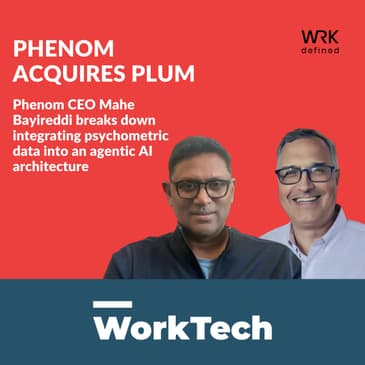
In this episode of the WorkTech Podcast, host George LaRocque sits down with Mahe Bayireddi, Co-Founder and CEO of Phenom, to unpack the strategy behind the company's recent acquisition of Plum. Marking Phenom's second assessment-focused deal in ten weeks following their acquisition of BeApplied, this conversation explores how behavioral science is rewriting the future of talent acquisition and talent management. Beyond Commodity Intelligence
Bayireddi explains that as generalized AI and Large Language Models (LLMs) become heavily commoditized, simply generating answers is no longer a corporate differentiator. True technological value now lies in an engine's ability to establish context, context-driven understanding, and human judgment. While technical skills are easily cataloged in traditional resumes and job descriptions, deep psychometric and behavioral data sets have historically been missing from automated HR ecosystems. Phenom is bridging this gap by leaning into cognitive science, combining computer science, neuroscience, linguistics, and psychology, to unlock data that traditional AI models cannot provide.
Historically, psychometrics were siloed into high-volume hourly roles or C-suite executive hiring. Phenom’s vision is to democratize this data across all talent workflows. By connecting Plum’s role-modeling technology, which maps behavioral blueprints across 40,000 real-world jobs with four times greater predictive success, to Phenom's skill ontology, enterprise buyers can accurately forecast candidate and employee performance on a global scale. Delivering Insights in the Flow of Work
A primary historical challenge of assessments was user friction, but Phenom’s agentic AI framework solves this by embedding these insights directly into the daily flow of work. Rather than using a one-size-fits-all approach, Phenom applies a "five-dimensional context" matrix that evaluates organizational needs by industry, role, location, business unit trajectory, and workflow automation level. This ensures behavioral insights are served exactly when needed—whether that means instant screening in high-volume retail or post-screening evaluations in healthcare.
The Single Code Base Advantage
Unlike legacy vendors that run acquisitions as siloed business units, Phenom buys strictly for product velocity and acceleration. Every acquired tool is completely rebuilt into Phenom's native, single code base and single data integration flow. For enterprise customers, this eliminates fragmented databases and clumsy integrations. A psychometric marker captured during automated screening remains natively active throughout the entire employee lifecycle, seamlessly powering internal career pathing, retention, and workforce development.
Key Takeaways
The Shift to Contextual AI: As general AI becomes a commodity, the ultimate value lies in creating context and human judgment via psychometric data Democratizing Behavioral Science: Integrating Plum allows Phenom to scale validated behavioral blueprints across 40,000 jobs, elevating hiring accuracy globally. The Single Code Base Mandate: Natively rebuilding acquisitions into one code base ensures that candidate data flows seamlessly into long-term employee retention and growth workflows Hyper-Targeted Workflows: Using a five-dimensional context matrix, businesses can deploy assessments precisely where they make sense based on specific industry and role dynamics.
Learn more about your ad choices. Visit megaphone.fm/adchoices
Powered by the WRKdefined Podcast Network.
[00:00:02] HR tech, work tech, and investment are transforming the future of work. Are you in the know? Welcome to the WorkTech Podcast. Join host George LaRock for expert insights on the trends, M&A activity, and strategies shaping the workplace. Brought to you by OneWorkTech.com and the WorkDefined Podcast Network. Hey, everybody. Welcome back to WorkTech. It's me, George LaRock, and I'm excited for today's conversation.
[00:00:30] You may have seen in the last couple of weeks, Phenom announced another acquisition, the acquisition of Plum. There were two acquisitions Phenom announced in the world of behavioral science and assessments. And so I'm excited to have the CEO of Phenom here to talk about the deal, the strategy, what all this means. Mahi, welcome. George, great to be here. Love to share where we are, how things are really going, and what this deal is all about. Cool.
[00:00:58] I'm really excited because I've known Plum for a while, so I have an appreciation of the value that they can bring to a platform like Phenom. So I'm looking forward to learning more. Before we do that, for anyone who might not be aware, could you give us the 30 seconds of, you know, what is Phenom, a little bit about yourself, and then we can get into the conversation. Perfect.
[00:01:25] Phenom is an HR tech company specifically focused on applied AI in HR space, and our purpose is to help a billion people find the right work. That's the only reason why we exist. Today, we have about like over 700 companies who use our product across the globe, and we have over 1,000 employees who work within the company. We are really growing really rapidly, but we really solve the spectrum from talent acquisition,
[00:01:50] onboarding, and talent management in terms of how intelligence can be applied in every particular segment so that you can automate and really make the whole agent work in that particular space is how we are thinking for the last couple of years, but like we are in business for the last over 10 years. Yeah. It's been really interesting to watch the company evolve. I remember when you launched, and even then, it was about, you know, providing intelligence
[00:02:18] into the process, you know, with a better experience for users and candidates, and you've expanded into talent management. And, you know, you were early on with AI. So it's been, as an analyst in the space and someone who tracks a lot of the innovation, it's been great to watch. So let's, I want to dig into the deal and start with, you know, the thesis, if you will.
[00:02:43] So two assessment-oriented acquisitions in a span of what looked like about 10 weeks. B applied, I think, was February, and then Plum announced in the last few weeks. So what's happening in the market that led you to this? Or, you know, why is behavioral science and assessments, what, you know, what led you to this? What's the market signal, I guess? So for a while, we're really looking at behavioral data and psychometric data as two
[00:03:12] additional data sets in recruiting and retention process where people can really use. If you really look at like psychometric data today, it's used in two different spectrums. One is the jobs in the frontline use case where an hourly job where people will show up to the work or not. Or again, the other spot is in the C-level suite, like where people will really see like, what are their weakness and strength? How do we really correlate? Like as a, we really get those details about each person who is joining the company.
[00:03:41] Those are the only two areas people are really using effectively. And that's what we have really seen. But what we really start really realizing is as AI and like LLMs are becoming relevant right now, the intelligence and the inference is getting outsourced because it's becoming abundant. The real differentiator is no longer generating answers on pure intelligence. It's about understanding, creating context, creating judgment.
[00:04:07] Creating context, creating like understanding and judgment is not actually really comes out of just pure, like what you call as how you really think about intellect, but it's much more than refined than that. So what are the data elements which we can really look towards? It's behavioral data and psychometric data. So which we have this particular thought process for a while, how we can really bake into. The reason for this is not because this is cool. We believe every company really operates on three different levels.
[00:04:36] Culture and purpose, work structure and workflows, strategy and direction. How do you really bring them together? Not just by pure skills, the technical skills, but how do you really bring that together in a much more refined process in terms of psychometrics, behavioral? Those things become very relevant is what is our opinion. And this is not today. This is what is our opinion for the last couple of years. And we are really working on that particular strategy for the last four years.
[00:05:03] And we are looking for the right things to really look at and apply. Both we felt bring two different use cases and that can really merge into what we really building. Yeah. I, you know, I go way back in this market. And there was a time where I was general manager over a platform that had assessments and behavioral science embedded. And I've seen it work when it's implemented, you know, properly.
[00:05:29] But the challenges tend to be or used to be getting it into the flow of work, you know, sort of meeting folks where they are. I think today with AI and, you know, you've launched an incredible agent studio and sort of getting Phenom into the flow, sort of meeting users where they are, candidates and employees as well. That's got to be a big promise of this is making it easier to capture that data, even over time. The life cycle of the employee.
[00:05:58] Am I, am I, I don't want to put words in your mouth or anything. Am I, am I on the right track? Yeah, there is no doubt. Like, so right now, the kind of automation and intelligence you can apply, whether it is screening, sourcing, interview, or like onboarding, or really bringing into the spectrum of postboarding, then really growing career pathing, all these areas, different levels of data sets we're really bringing, which are very different. But that's all really written in resumes. That's all written in job descriptions.
[00:06:28] That's all written in performance, like reviews. But what is the additional data that we can offer that is not available today, even in LLMs? So, and that additional data can give a new inference, which can be applied to an understanding of a being. So, can we really bring that to the table? And will that really add more value in the overall ecosystem of talent? So, that's what we're really looking at.
[00:06:52] And we see like my strong opinion, even I tell to my kids, I have a 16-year-old kid, and I constantly say like, go into cognitive science. And she says like, why? And I'm not saying from today, like I was saying for a while. If you're not interested, you can ignore it. But the primary reason is cognitive science is five elements. It's computer science. It's neuroscience. It's linguistics. It's psychology. And you're basically really going after the core element of how humans think, like
[00:07:22] phenomenology, which is a word by its own existence. Those things will really combine to form the future because the data sets are getting richer, the data analysis becoming cheaper. So, what we really used to think about analyzing people is actually going to really multiply in multiple different ways. Yeah. Incredibly, you know, consistent. You know, a lot of what you're, you know, the, what you're talking about. I think I had seen you on another podcast or introducing something and you had said that
[00:07:50] the quote, I've got it here. AI is making general intelligence a commodity and human skills have never mattered more. And this is sort of, this is very consistent with everything you've been saying here. And is that, given the span of your platform, this isn't just about hiring signals, but this is also in, you know, the traditional category was talent management. It's on the performance. It's on the career management learning path as well.
[00:08:20] Are you embedding this throughout that side of the platform or in the future? Yeah. The whole point is it's not like really using only for talent acquisition. It's about like talent retention and talent growth. How do we, like, that is the need of the hour right now in many markets. But we constantly think about this as a five-dimensional problem. Which industry should apply to which particular role, which location?
[00:08:45] And you also apply to like specifically which particular business unit within the company. Is that business unit growing or shrinking? And now what is the workflow you have at hand? How much of it you will really turn into agent tech versus still human handholding? It depends on where that particular equation really sits. The context and the understanding of each company in these hypercells is what we call the five-dimensional context is what makes the whole thing work.
[00:09:13] So for that, we need to add a lot more different datasets than what is available today. And like we have to keep on testing, but in every particular hypercell, a psychometric or behavioral need not be required. In certain industries, they might not care. In certain roles, they might not care. But in certain others, they might have higher priority. So how do you really determine by understanding those areas is very important, not in talent acquisition, but also in the talent management and growth. Yeah. Yeah.
[00:09:40] So back on this particular deal, you know, I talked to a lot of CEOs and the conversation is always build by partner right now and trying to, and the market's moving so fast that that has, that's always been a big, difficult decision. It's even more difficult and challenging right now. But what are we going to keep in the roadmap? Where are we going to lean on a partner? Where do we go buy? What put Plum in the buy column?
[00:10:09] What was it about the business, the team, the product, or any or all of the above? Yeah. The combination is like, actually, we were looking into the psychometric space for a while. And we were thinking, and we built a sizable infrastructure net, and we are thinking about expanding that. And what we saw at Plum as the Plum's role model technology, which is mapping behavioral blueprints across 40,000 real world jobs. That we found is interesting.
[00:10:36] The reason is, it is a scientifically validated prediction of candidate success, proven like four times more accuracy. We thought like, okay, those things are really interesting. Now, how do we apply this towards where phenom agentic world is really going? Which is, folks, we live in a crazy world. And with each new headline, it is harder and harder to find the signal through the noise and understand if that annoying wannabe keyboard warrior in your office is actually a national security expert or just blow in smoke. Do you want to know the truth?
[00:11:05] Well, come join us on the At The Water's Edge podcast, hosted by retired Green Beret turned geopolitical analyst Scott Kelly, where we explore insights beyond the headlines to take a practitioner's view on national security and geopolitics. Join us at the At The Water's Edge podcast. The context of a hypercell. Every enterprise has multiple, and how do we really bring them together in a very authentic format so that we're combining the plump psychometric science and the behavioral science of applied
[00:11:34] and attach it to the Phenom skill ontology and then connect that with an orchestration of workflows, what we really build in the background. That is what will enable every customer of ours to really predict their performance consistently, accurately on a global scale. And that's the future of hiring and retention is what we're really seeing. And we thought like that's important than ever. Yeah. Yeah. That makes a lot of sense to me. Staying along the lines, you know, of making those buying decisions.
[00:12:01] Another thing that I found really interesting, I've had the pleasure of talking to your, I'm not sure the proper title, but VP or SVP over corp dev and strategy, Samil Gandhi. And one of the things that I really appreciated about the conversation with him was he talked about not just, you know, what Phenom might be interested in or the NA thesis, but really post-acquisition, the fact that every acquisition you make, you're not just integrating the
[00:12:31] platform, you're rebuilding these products into your single code base. And I know based on my experience, that's powerful. But can you talk a little bit about for the audience, you know, why that's important and why you're so committed to that path? So there is a fundamental point of view. Most of the products, what we buy are for product velocity. We've invested on a specific product already. And we thought like this is the direction the company will move. And we have investor.
[00:13:00] And then we are really looking at, can the product velocity go up by two years or three years if we acquire something? And we always constantly look at, is our point of view matching to what's out in the market? If they're too out in the market, like then we won't really go after it. But if it is closer and they're aligned to it, if you take like what we really did in terms of Plum, Kathleen, Scott and Neil, they are super aligned to where we are really going. And what we thought about is, okay, if we bring them together, now we can really project where
[00:13:29] our execution, we thought about product velocity can really apply in a very different format at a different pace and acceleration. But the most important thread, what we think is a single code base is not for just for a code. It's for the data integration, the data flow, where exactly it should come. And can we, like right now, orchestration is the primary engine, what we really run in the back end and the automation engine sits along with it.
[00:13:55] So we want to constantly look at how do we rewrite into the stack what we have built so that it becomes seamless and super strong in integration. Most of HR tech companies, when they acquire, they run as separate units, which is the biggest flaw of what I have really seen over a period of time. You really get revenue faster, but product velocity will become slower. So we created our own thought process about like, we need a product velocity so that integration becomes seamless.
[00:14:22] And if that costs revenue a bit, like, but it actually gives us validation in a much more stronger format. And that's what has proven in all the acquisitions what we made. And some of them actually fail miserably and we're okay with it. Okay. Yeah. Failure's a part of life, right? So it's, and you've made a lot of quite a few acquisitions. Is it, I think it was, was it 10 in the last six years or something like that? Yeah. Yeah. We, we, we made like good number of acquisitions, but like, it's all about where the product
[00:14:51] has already set our eyes on and what can come along that we can. So there is no two code bases at all in the company, a single code base, single data integration flow. That is actually flowy. The modules are built on top of our existing infrastructure, which gives us the unique element of what we're really doing. Yeah. And for the customer that pays off in a big way because you're not, you're not integrating across, you know, 10 products on top of your platform. It's one code base.
[00:15:21] The ability to, if the behavioral data is going to be valuable in another part of your product, it's, it's, it's in that sole code base. And I, these, these are things that I hope buyers are thinking about in this world of AI, because, you know, having that data when and where it's needed and making that flow easier. So it's so important, but so on that point about, you know, sort of putting it into your, you're building it into your code base.
[00:15:48] Is there a, I know the ink's barely dried on the contracts here, I'm sure, but is there a timeline for integration or what, what can customers expect? You know? Yeah. So from a customer perspective, like the whole roadmap actually originate out of the customer request. They really give us like, what is the pain they're really going through? And for that pain, what is the resolution, what we can offer or what is the products that our use case said that we can really apply towards.
[00:16:15] So we were working on what we call as the psychometrics and the behavioral science for a while. So the Plum acquisition, what we really made, we know clearly which parts will be integrated within three months, six months, a year. And those integrations, how they migrate within the timeframe is what we really plan way before even acquisition. You can really have a slide here and there, but not more than 18 months, the product will be completely merged into the infrastructure.
[00:16:43] And then, but the customers start really getting benefit of it within six months. Yeah. So, so the, when, when you look forward, is there, there, there isn't a completion date. It's not like the platform's finished. It's as the customers evolve, this will evolve. So there, there isn't like an arc that we're looking at. This is, this is more about look at the way the world has changed in the last few years. Right. And so you're, you're keeping up with that.
[00:17:13] Is that, is that. Yeah. Let me give an example. So let's say in retail industry, you use psychometrics. Do you use psychometrics in sourcing or do you use psychometrics in screening? Or do you use psychometrics after interview? It depends on what is a company hiring at what level, where, what do they believe in, in which particular flow? Or do you do a psychometrics right before onboarding? So it depends on where the company is, where it is located, how they really think about this particular problem that's on retail. Now you apply this to healthcare.
[00:17:43] You cannot do it at sourcing. You cannot do it at screening. You have to start only after screening. But now in healthcare, what type of healthcare jobs are you talking about? Are you talking about nurses or physicians? Or are you talking about what you call as the jobs which are predominantly for office care or home health services or behavioral services? For that, where do you really apply? Maybe in that particular sequence, you will apply way before.
[00:18:08] And now you apply this to manufacturing or you do this in financial services. Now you go to executive hiring. So within the workflows, you are actually using in different spots. And we want to give that ability for every customer in which particular spot you want to automate or you want to deliberately do, or you want to make a human in the loop to make sure this experience is delivered so that you have an additional data set. Those use cases are what we constantly study. And based on that, we buy the product. Okay.
[00:18:38] That makes a lot of sense. Now let's zoom out a little bit with a little bit of time that we have left. I know this is one deal. This is one category, very strategic. But let's think about Phenom as a whole and the market as a whole. What are you excited about for Phenom, for your customers, you know, based on where you're headed more holistically right now? So like for us, the fundamental point of view is understanding the customer,
[00:19:04] where their pain points are based on their growth rates and based on where they're shrinking as a business. And if we can really understand every business in a very thoughtful format and can really give them a use case services, like which can really help them to solve the pain for their growth rates. We are really very unique in what we're really building. And our constant thought process, how do we build these things into ontologies so that
[00:19:29] we can build this context and understanding into every company what we really work with. So we're super excited right now, the whole orchestration layer, but what we call as high volume hiring, what we call as screening through AI interviews, AI agents, like what we're really building with respect to onboarding, what we really built with employee experience. These are the areas where we are super excited. But we also are super excited. The reason is applied AI is not the traditional software what's been built in the last 30 years.
[00:19:59] The code basis has to be really rebuilt. You have to rethink about the whole notion in a very thoughtful format. And we are investing on that day in and day out. Yeah. Yeah. That's great. So is phenom.com the best place for folks to stay aware of what's happening, keep track of all of these developments? Yeah, exactly. Phenom, LinkedIn, other areas, but also like we actually do our conferences. I'm phenom. We do it in US. We do it in Europe. We also do it in Asia.
[00:20:28] Like all those three conferences actually work really well. That gives like a lot of insights. We also do like phenom AI day, you know, customer experience day. Like we actually look at like different aspects of how our customers are using, how AI is utilized. We actually go in detail about like how we are deploying these models, how those models are impacting each customer at the use case level. And we are super excited to share what we got, but at the same time want to learn as much as we can. Those events do get really high marks.
[00:20:57] And anybody I know, customer side, analyst side, partner side that's ever attended always feels very much like it was, you know, worth their time and effort. They always leave with something. So I'm glad you mentioned those. Mahi, thank you. I know how busy you are. I know that you've got a lot on your plate. Thanks for coming to WorkTech and telling the story about this acquisition and more about phenom here. Thank you so much. Thank you, George. Thank you. It's a pleasure to talk to you and all the best. All right.
[00:21:27] Well, and thanks all of you that are watching or listening anywhere on the Work to Find podcast network. Until next time.
Sponsors
