
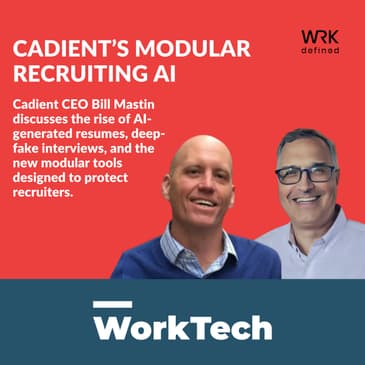
Cadient CEO Bill Mastin discusses the rise of AI-generated resumes, deep-fake interviews, and the new modular tools designed to protect recruiters.
In this episode of the WorkTech Podcast, host George LaRocque is joined by Bill Mastin, the CEO of Cadient, a highly seasoned operator with a career-long history in HR tech, learning, and talent management spaces. Mastin dives into the staggering pace of change in the recruitment sector, noting that the industry is experiencing an evolution akin to looking past the veil of the Industrial Revolution. While Cadient has a rich history as a high-volume applicant tracking system (ATS) for marquee retail and healthcare brands like PetSmart and Genesco, the platform is undergoing a radical transition into an AI-first, portable smart suite ecosystem.
Mastin introduces what he terms the "AI hiring crisis," a phenomenon where candidates and employers find themselves locked in an active arms race. Empowered by generalized tools like ChatGPT and Claude, job seekers are pumping job descriptions into AI models to instantaneously churn out hyper-optimized, "unicorn" resumes. This has triggered an administrative avalanche for recruiters, who are suddenly flooded with hundreds of homogeneous, AI-exaggerated applications where no individual stands out. At the extreme end, Mastin reveals that enterprise clients are even encountering deep fakes during remote video interviews, driving some back toward face-to-face screenings.
To level the playing field, Cadient is delivering agentic tools that fight AI with AI. Mastin showcases SmartShield, a free Chrome plugin that instantly cross-references submitted resumes against public profiles and external data points. Instead of automating hiring decisions—which risks algorithmic bias and legal trouble—SmartShield operates like "automatic steering" while keeping the recruiter's hands on the wheel by flagging discrepancies, credential gaps, and purely AI-generated text.
Auditing the Pipeline and the Evolution of SaaS
The conversation shifts to Hiring Scorecard, a free, standalone automated auditing tool that utilizes AI agents to run "mystery shopper" evaluations on an organization's career sites and talent pipelines. By simply entering a company's URL, the tool grades application completion times, SEO visibility, mobile-friendliness, and job board distributions against industry benchmarks, generating a downloadable business case for HR leaders looking to optimize budget allocations.
Crucially, these modular capabilities operate independently of Cadient's core backend platform, allowing them to plug natively into any existing legacy ATS or Human Capital Management (HCM) software. Mastin notes that this architecture underscores a massive philosophical shift away from traditional SaaS. Historically, enterprise tech vendors forced all buyers into a rigid "one product fits all" model under the guise of "best practices," often overwriting unique workflow nuances or cultural highlights that made a company distinct. By leveraging an ecosystem of individual agentic modules, providers can now implement what Mastin calls "tuning SaaS"—swiftly customizing workflows and pricing structures to fit the exact parameters of a client's specific business unit, timeline, or frontline hiring criteria.
For HR technologists and talent acquisition executives trying to navigate a market defined by ghost jobs, automated application loops, and rapid compliance shifts, this discussion offers an invaluable masterclass on where enterprise recruitment infrastructure is heading next.
Key Takeaways
- The Rise of the AI Hiring Crisis: Candidates are heavily leveraging generative AI to create tailored applications and resumes, triggering a quality crisis where recruiters are flooded with identical-looking "unicorn" candidates.
Democratizing Pipeline Audits: Tools like Hiring Scorecard deploy agentic AI to benchmark career pages and drop-off points, allowing talent teams to diagnose ghosting and build business cases for tech updates without hiring costly external consultants.
The Transition to "Tuning SaaS": The legacy multi-tenant SaaS model of forcing single, rigid software workflows onto all enterprise buyers is giving way to modular architectures where platforms can be custom-tuned around a company's unique cultural and operational framework.
Decentralized Agentic Ecosystems: Modern enterprise tech buyers no longer need to execute painful rip-and-replace software overhauls; portable smart modules can overlay seamlessly on top of existing ATS and HCM systems.
On this episode Bill and George discuss AI hiring crisis, high-volume applicant tracking system, resume verification Chrome plugin, agentic recruitment technology, custom tuning SaaS solutions, automated talent pipeline audit, Cadient SmartShield review, enterprise recruitment software modularity, candidate experience benchmarking.
Learn more about your ad choices. Visit megaphone.fm/adchoices
Powered by the WRKdefined Podcast Network.
Sponsors
