
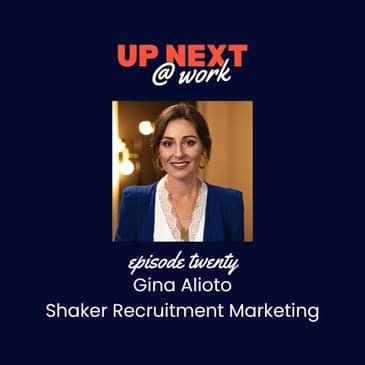
[00:00:12] Hello and welcome to this episode of Up Next at Work. I'm your host, Jean Achille, and we are proud members of the Work Defined Network. I have a very special guest today, and I think you're going to learn quite a bit from her.
[00:00:30] Not only am I in total awe of her career and its trajectory, I am in total awe of anyone who has 19-month-old twin boys and balances career and family with great aplomb. So please help me welcome Gina Alioto. Gina, please introduce yourself to our listeners today.
[00:00:56] Yes, hi, I'm Gina, and I lead brand and marketing for Shaker Recruitment Marketing. Shaker is a recruitment marketing agency that's been in the business for nearly 75 years now, and they've trusted me to build their brand and marketing engine internally. And we service Fortune 10 companies to some of the smaller companies local to Chicago to global businesses.
[00:01:23] And it's really an honor to be a part of that amazing family-owned business. It's amazing to work for a company that's been in business 75 years. But I know that's not where your career journey started. Weren't you in consumer marketing initially? Yes, I was.
[00:01:43] So for about 10 years of my career, I led brand and marketing for various consumer brands like Heineken, iHeart Media, the Tribeca Film Festival, Emirates, others. And then now I've been in work tech, HR tech for about 10 years now. Wow. Okay, so first of all, why the pivot from consumer marketing into recruitment marketing? What attracted you to make that change?
[00:02:11] So I actually never knew that recruitment marketing existed. And arguably, 10 years ago, the term recruitment marketing barely existed. So I came into a role seeking brand and marketing to help a startup. And I fell in love with this industry.
[00:02:31] Once I learned about the people that are in this industry, I learned that it's a very unique type of person who is a talent acquisition, employer branding, or recruitment marketing leader. They're a very special group of people. It takes a lot of grit and dedication to do that role. And a lot of skills also. I think it's a role that encompasses many skills. You know, it's not a narrow cast.
[00:02:58] You really have to have a lot of business experience to be effective in it. So true. Yeah. And so I've fallen in love with this industry. And I'm so, so happy that I can apply my passion for bold brands and marketing to an industry that has such a great, deeper meaning and purpose to helping people find work and work that they love.
[00:03:25] So how does recruitment marketing express itself? If I'm a job candidate and I'm going, you know, I'm looking for a job, I'm on job boards, blah, blah, blah, I'm bouncing around. How do I know there's recruitment marketing behind the scenes messaging to me? In my experience, the best brand and marketing are those that you don't recognize that it's there.
[00:03:50] And you feel a connection to what you're being communicated that you feel compelled to join that organization. So I think that the best brand and marketing period, whether it's consumer marketing or recruitment marketing, is the type of messaging that you don't even know that you're being marketed to. I love that.
[00:04:15] So it's not as overt as kind of being hit upside the head with something. It's in front of you. It's perhaps in everything that you're touching. You mentioned some pretty big brands on the consumer side, like a Heineken and such. You know, I would imagine that consumer brand experience helps you design programs to attract talented candidates as well.
[00:04:43] You and I have chatted a bit, and you mentioned recruitment marketing being a game changer. What does it mean to be a game changer? And how does that, like from a metric standpoint, if that is part of the equation, how is that meaningful to your buyer? What does that look like? Absolutely. I completely agree with you.
[00:05:09] And now that I've been in this industry for quite some time, recruitment marketing is the driving force. It's that undercurrent that enables talent acquisition leaders, employer branding leaders, recruitment marketing leaders to connect with, hire, and retain the best talent. And that statement has been said for years, as we know.
[00:05:37] But I feel like it's more crucial now in this rapidly changing workforce, plus our rapidly changing world in general. Yeah. Yeah. Oh, absolutely. You know, what is that saying? May you live in interesting times. I don't want it to get any more interesting. It's so overwhelming these days. Right. We're good. We're good. We're good. Let's just tap it here.
[00:06:04] But so, you know, if I'm a talent leader, you know, and that expresses itself, I know, in a number of different potential titles, everything's being measured these days, Gina. So I know as a marketing professional, that's always been the bane of my existence is, you know, where are the analytics? Where are the measurements? Did we move the needle? So what do the analytics look like for recruitment marketing? Yep. Yep.
[00:06:32] That is my number one piece of advice for talent leaders today. And this comes with my experience in consumer and recruitment marketing. Number one, get your arms around the analytics. Like your life depends on it. Because your life in the context of your role as a leader does depend on it. And in my experience, often I feel like analytics and reporting, they're often an afterthought.
[00:07:01] We kind of say, okay, I'm going to get in. I'm going to stand up these first campaigns, right? Your first 100 days, your first 90 days are super important to show success. I'm going to come in there. I'm going to build the team. I'm going to get things up and running. And then analytics is an afterthought. Whereas I'm urging everyone to think about analytics and reporting as the number one most important thing you should do right now.
[00:07:25] If you don't have it already built out, stop everything else that you're doing and build out your analytics. Because that is the only way that we can genuinely lead boldly and make informed decisions. It's when you connect your analytics and have your reporting buttoned up.
[00:07:45] And the better you can connect your recruitment marketing metrics to financial outcomes, where you focus on the business outcomes, not marketing activities. Like, yes, you and your team should focus on your marketing activities and all of your KPIs. But the better you can connect your focus on business outcomes, that is key for this point. Yeah.
[00:08:10] I love what you said about leading with that because I think a lot of people fall in love with bells and whistles. And then what happens is their boss is standing in the doorway saying, hey, I need this report. I need this slide. We're going to put it in the board report. I mean, aye, aye, aye, aye.
[00:08:28] If you're not prepared for those discussions, if you haven't looked at, you know, what is it I'm measuring and what is it I'm being judged on also from a performance standpoint, that is a career-limiting decision that you've made not to put analytics at the forefront. But, you know, to your point earlier, it's a very dynamic market we're living in.
[00:08:54] And even, you know, we're recording towards the end of January. This month has been head-splitting already in terms of the number of changes we're seeing in the labor markets. How can a recruitment marketing executive or a talent leader, like, what's their north star? What can they hold on to to make sure that they're delivering value to their organization,
[00:09:20] but still building in some agility since we are under such dynamic circumstances? Exactly. I completely agree with you. And when I find and having experience in leading through change, because I've oftentimes, if not throughout my entire career,
[00:09:40] I've always been part of involved in startups, mergers and acquisitions, major external events like the recessions or, you know, the rise of AI now. These are points of inflection and great points of change. And it's difficult to lead during times of change. And my next point for talent acquisition leaders is that when you're leading through times of change,
[00:10:10] like that are upon us now, you must have a clear vision and drive towards that north star. And just because you have that clear vision and you should stick to it and you're driving towards it, you must be flexible. So you're going to have a plan that's built for flexibility. And what I always tell my team is that it's all about rigor. So it's about rigor, not rigid.
[00:10:39] So we're not set in stone. Oh, I love that. I don't think I've ever heard that before. I tease that they're going to put that on my tombstone. That's going to be what it's going to say, rigor, not rigid. It's either going to say that or it's going to say cohesive across all touch points because that's the other one. Well, as the mother of twins, yes, I'm sure you have firsthand experience also with, you know, rigid versus rigor. Exactly. That's exactly right.
[00:11:06] As mama of twins, we can have our plan for the day. Yes, right. That is not how things are going to happen. And trust me, if you are, if you're a type A personality, you're in good company because I am a planner and I'm working on that, you know, wanting to be rigid. But it is more about rigor, not rigidity. And you must be prepared to pivot while staying aligned to your goals.
[00:11:33] So you have a super clear vision on what you want your goals to be. You have your overarching strategy and that's what you're driving towards. And you can only lead through uncertainty if that is crystal clear. It must be crystal clear to yourself, to your team, to your stakeholders and to your audience. Because if you're not showing a clear target or a clear path forward, why would your stakeholders follow you? Why would your audience follow you? Yeah.
[00:12:03] Yeah, good point. So it's got to be crystal clear, but then it's got to have some flexibility. It's a plan that is built to be flexible and agile. And that, yeah, I think exactly what you said. It's just that.
[00:12:19] This is very interesting because when you think about even the certifications that are available for project management, I very rarely hear discussion about creating plans that have flexibility built in. What I'm usually hearing is almost a rows and columns approach to, you know, we're going to have these milestones. We have these gating items. We have these dates, blah, blah, blah. It's all good. It's all good.
[00:12:47] But that whole, you know, like if the world shifts dramatically in a direction or if, you know, an organization suddenly makes an acquisition and has to source talent for a new facility in an area where they haven't previously had any infrastructure. I don't hear as much of that, like that planning ahead.
[00:13:12] So I think you're really imparting very valuable information to our audience. Speaking of audience, though, you mentioned, I heard you say stakeholders. And I was thinking, does that include hiring managers? Like who are the stakeholders? What is your audience in recruitment marketing? Yeah, you got it, Jean. That's exactly it. You have got to know your audience and speak their language.
[00:13:39] And your audience, plural, your audiences are just as you said. You've got your candidates and the job seekers. That's the obvious audience. That's everyone that we know that we are marketing to. That's what the employer branding is for. That's what the marketing is for. Then the lesser obvious audiences that some people might be aware of, but not recognize how important they are, are your internal teams.
[00:14:07] So, yes, you've got your quote unquote internal marketing. And I say quote unquote because I don't think any communications is ever internal. I think all of it is external. I agree. I agree. Yeah. I like when people say to me, oh, we're just going to, this is just going to be internal. I'm like, yeah, no, there's no such thing anymore. There's no such thing as internal marketing. But I'm using that phrase because I know that that is a phrase that folks use.
[00:14:33] So you've got your internal teams and you've got, okay, you might be doing marketing to your employees, right? And employee engagement, employee marketing. You also, as the recruitment marketing team, you need to market to the teams. So you need to advertise yourself, your recruitment marketing function. You need to market that. So marketers need to market themselves. It's very meta.
[00:15:01] But yeah, this is what, so you need to advertise internally to your teams, whether that is any employee that works with you on your town halls or your huddles. This is what's new in recruitment marketing. This is what we're doing. This is what recruitment marketing does. You're advertising yourself, your work to your internal teams and your other stakeholders, like your leadership team, the C-suite and any other external stakeholders that you might
[00:15:30] have, the marketers market themselves. So it's about understanding, really knowing your audience and your various audiences, not just the people that you traditionally think of as your marketing to, like the candidates and job seekers, but all of your other audiences and really speaking their language. And the story that I was telling you about that I was thinking of that made me think about this
[00:15:59] is take Mateo, for example. So one day I pointed out a dog to Mateo. Mateo is one of my identical twin sons. And I said, look, look, Mateo, don't you see the dog? Look at the window. Don't you see the dog? What color is it? So in my mama brain, I'm like trying to teach him his colors. Can you say this color? And Mateo looked totally confused and he didn't respond. And it wasn't until I crouched down to see what he was seeing out the window. That's when I realized the problem.
[00:16:29] Yes. From his perspective, there was no dog. There was just like a floating hat bobbing by that was attached to a man. That was his entire view. And so it hit me that as marketers, sometimes we forget to get down on the floor with our audiences. Yes. And it's each audience. So marketers are not just one dimensional, right? They're marketing to each of their audience. They're candidates and job seekers. They're internal teams. The C-suite, external stakeholders.
[00:17:00] And we need to understand each vantage point, understand their unique experiences and the way that they're interpreting the world. And only then can we speak their language, connect with them, truly guide them to the right message. As Joe Shaker says, the right message, the right activation and the right conversion, the right solution. Yeah. And that's a great, that is such a great example you've just shared.
[00:17:27] And one where I never would have thought, you know, me having raised kids would have probably just been like, well, what's, you know, why don't you see it? Like, which is not the right way to look at it. You're absolutely right. Like getting, putting yourself, you know, walking the walk and really putting yourself in the role of your audience so you can see their purview. Because it does change so dramatically.
[00:17:52] I mean, in recruiting, you know, high volume hourly is very different than, let's say, looking for scientists or a biotech or some, you know. So, so, so that's, that's just really good advice to our, to our clients. I think you've got some mom-isms there that we can use as guidance. Oh my goodness. It goes on, it goes on.
[00:18:16] And that, that point number three about, you know, knowing your audience and speaking their language and, and how marketers need to market themselves. To drive it back to number one about analytics, you've also got to leverage those marketing metrics and proof points that resonate with each audience. So, so for example, I'm marketing to the candidate and the job seeker.
[00:18:38] And so the metrics or proof points or value points that they need are perhaps the employer brand messaging that will align with their values. When I'm marketing to the, the C-suite, I will want to use CFO friendly language and show those proof points and value points that are proving that my recruitment marketing is, is working.
[00:19:04] Which I, which I, which I should mention also that I highly, highly encourage recruitment marketers to build strong partnerships with your CFO if you have not already. Really? Why? Oh, absolutely. I'm curious. Yeah. This, this is, this is kind of new. What, what, what is the CFO's role in all this? Like what? Yeah. Educate me.
[00:19:27] I would say that marketers in general, so mainstream marketers and recruitment marketers would greatly benefit and the business, the business would greatly benefit for a strong partnership with the CFO. And it'll be mutually beneficial because if you're not tying your recruitment marketing goals directly to the financial outcomes and the business outcomes, you're, you're going to have, you're, you're going to have short-lived success.
[00:19:57] You will have greater success and longer term success by closer connecting the marketing, the, you know, the marketing activities to real financial outcomes. And yeah, your CFO is, should be your best, your best partner. That'd be the number one partner I would make. Yeah. Good advice. Good advice. You have learned it here. We appreciate that.
[00:20:25] Um, I know we're almost out of time, but there's something I have to ask you about because we've seen a flurry of activity around the diversity, equity, and inclusion topic, which for years was very, very important. Uh, not just to consumer marketing in terms of the communities they serve, but also from a talent acquisition standpoint.
[00:20:48] And we're seeing some of, um, um, you know, there's a lot of arguments behind the scenes, but what are you seeing in recruitment marketing? Are you still seeing organizations focused on cultures of inclusion and, and welcoming diversity? Mm-hmm.
[00:21:14] This is such an important topic and it's new, right? This is a new change that has just come upon us about, you know, the, the end of DE&I or moving away from DE&I. And personally, and honestly, I'm, I'm still, I'm still, um, uh, forming my thoughts. Yes. Yeah. But I, I agree. I think we all are. I'm still forming my thoughts. Happening so fast. Yeah.
[00:21:41] But, um, I do think it's important to share, uh, uh, a bold view on it because, um, anytime that there's change, I think that having a clear and bold view, no matter what the circumstances are, it's important. It's important to voice that. So I'll give you my view as it is today.
[00:22:02] And it, it might change because I think as I learn more, um, my, my view will evolve, but having been a strong advocate for DE&I and belonging throughout my career, I still believe that that is important work.
[00:22:19] And I think that, uh, over the years, DE&I has become a buzzword and in many cases exploited by companies who have claimed to have embedded DE&I into their, um, you know, into their work where it makes you a more attractive employer. And of course the Gen Z especially sees right through that. And so now we've reached a point where, um, you know, that's not working because then they get hired and then they're like, well, where are these programs?
[00:22:47] Or you showed me these images of diverse. Right. At the website. Yeah. And then I got there and it's not the truth. Yeah. So that didn't work. You know, that doesn't work anymore. That said, I think that at, at its core diversity, equity, inclusion, and belonging are human, uh, are human, um, core principles.
[00:23:09] And I'm channeling my colleague, uh, John Graham, who speaks about humanity and that being at the core of your employer brand and your recruitment marketing. And those things don't change. They don't change. So you can take the DE&I buzzword and everything that DE&I has become. When you really think about the core principles, diversity, equity, inclusion, and belonging, those things don't change.
[00:23:37] Those are human fundamentals that need to exist in life. And I think that our world is complex. And I think that there's a lot of systems and systematic structures in place that make it a very challenging road. It is tough. Because it's not just that the talent acquisition leader doesn't believe in it, or they don't want to do that. I think that's table stakes.
[00:24:02] I think it has a lot more to do with these fundamental structures that exist in society and in the government and in, in the world. Unfortunately, that will always be there. And to overcome those, that's a really challenging thing to do. So I think instead of kind of throwing up your arms and like, oh, DE&I is over. Forget about DE&I. I don't buy that. I think that's a cop out. Yeah.
[00:24:27] And it's got to be about continuing the work and finding out how to systematically break down these systemic structures that are in place that make things kind of impossible. That's my hot take. You know, it'll continue to evolve. Yeah. I think you're right. Well, I mean, I think keeping the human in the equation and what's most important to the human is exactly right. Because at the end of the day, those fundamentals don't change.
[00:24:55] A lot changes around us and we might react to different things. But, you know, at the end of the day, everyone, you know, everybody wants the same thing. They want to belong. They want to work for an employer who has, you know, a value system that they adhere to. So, but I think you're right. There's so much coming at us right now that processing time is required before we can really have cogent, you know, next steps.
[00:25:25] I think we're all kind of in the intake mode right now. And unfortunately, we are out of time. I want to make sure, Gina, that people know how to get in touch with you and also maybe learn more about Shaker. So would you please let our listeners know, you know, I don't know if you want to share an email address or how do people get in touch with you? Sure.
[00:25:49] So Shaker.com and Shaker is a recruitment marketing agency servicing all types of brands. And like I said, from the local Chicago businesses all the way up to the Fortune 10. And I personally, please, please reach out to me on LinkedIn backslash Gina Alioto. And my email address is Gina.Alioto at Shaker.com.
[00:26:16] And I would love to hear from anyone whether you want to talk about nerd out on brand and marketing or being a mama of identical twins. I was going to say. I'm happy to talk about all of it. Talk about an audience. I'm sure among our listeners, we have some other parents of identical twins. I can't even imagine. I mean, that's just, that's just got to be a great ride, Gina. Thank you so much for being our guest today.
[00:26:44] You have just listened to another episode of Up Next at Work. Thank you for joining us today and please like and listen to Up Next at Work.
Sponsors
