
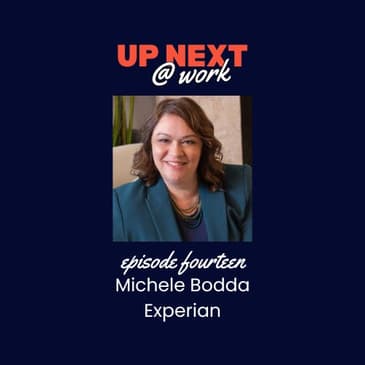
How are workplace culture and financial innovation shaping the future of inclusion and opportunity? On this week's episode of Up Next @ Work, Michele Bodda, President of Employer Services, Verification Solutions and Housing at Experian, joined host Jeanne Achille for an engaging discussion on Experian’s culture, innovation and the evolving role of credit in promoting financial inclusion. With 26 years at Experian, Michele shared insights from her journey, starting in a call center to becoming a senior leader driving transformative initiatives.
Episode highlights include:
- How Experian’s Employee Resource Groups (ERGs) create supportive communities and influence product inclusivity.
- A groundbreaking program with HBCUs, challenging students to solve real-world problems for scholarships.
- Changes in credit processes driven by Experian’s Pride ERG to support transgender individuals navigating name changes.
- How Experian uses data to make financial services more inclusive, including unconventional credit-building opportunities for renters and new borrowers.
Hear Michele’s unique perspective on leadership, innovation, and creating a workplace where everyone can thrive. Find her on LinkedIn and learn more about Experian at http://www.experian.com.
Powered by the WRKdefined Podcast Network.
Powered by the WRKdefined Podcast Network.
[00:00:00] Feeling kind of left out at work on Monday morning? Check out The Barf, Breaking News, Acquisitions, Research and Funding.
[00:00:07] It's a look back at the week that was so you can prepare for the week that is. Subscribe on your favorite podcast app.
[00:00:28] Hello and welcome to the next episode of Up Next at Work. I'm your host, Jean Achille, and I am joined today by Michele Bodda of Experian.
[00:00:41] This is really exciting to have time with you today, Michelle. Would you please introduce yourself to our viewers?
[00:00:48] Hi, Jean, and thank you so much for having me. I'm really excited to be here. Hi, everybody. I am Michelle Bodda.
[00:00:55] I am on the leadership team in North America for Experian with responsibility for some newer businesses for us.
[00:01:04] So I have the distinct pleasure of getting to incubate startups within a larger company.
[00:01:11] And it's a really cool gig that is not lost on me, how special that is.
[00:01:17] I've worked at Experian most of my adult life, so 26 years now in a number of different roles.
[00:01:25] And this one is the most fun. We get to create new things and do new stuff all the time.
[00:01:30] And I get to learn new industries and different ways of working.
[00:01:34] And so thank you for having me. I'm super glad to be here.
[00:01:37] That is so interesting that you've been with one employer for 26 years.
[00:01:41] I would imagine that Experian would have to keep you engaged through new opportunities.
[00:01:50] Tell us a little bit about your own career journey within Experian.
[00:01:55] Yeah, no, very much so.
[00:01:57] I often describe it as what I hope has been a mutually beneficial relationship over these 26 years.
[00:02:06] But I have had a very dynamic career.
[00:02:09] I actually started here in customer service, answering the phones.
[00:02:13] And I've had the opportunity to hold every level of position between customer service rep and now president of three business units at the company.
[00:02:22] And not skipped any level or title in between those two along the way.
[00:02:29] I've gotten to work in different disciplines of the company.
[00:02:33] So everything from the call centers, like I said, to product management, sales leadership, general business leadership, etc.
[00:02:42] Strategy, gotten to work on huge technology projects, a lot of external things, M&A.
[00:02:49] And so it's been a very dynamic situation.
[00:02:53] And it's a great company to work for because we get to support consumers in their life journey, frankly, either through access to financial utility or access to employment.
[00:03:08] And so it feels like meaningful work, too, where you can actually impact people.
[00:03:14] Yeah, for sure.
[00:03:16] And so I'm not confident that everyone knows that Experian is not just one thing or another.
[00:03:24] I mean, you're touching the housing market.
[00:03:26] Tell us a bit, you know, in terms of how broad your purview is.
[00:03:32] Yeah, Experian is, you know, at its core, a data and analytics company.
[00:03:36] So the very, very core of our business and the history of it starts with a credit bureau.
[00:03:43] So enabling access to credit for consumers, whether they be shopping for a house or a car or to get a credit card, etc.
[00:03:53] Over the years, it has grown into, you know, how do we facilitate financial inclusion for all?
[00:04:01] And that's our mission globally.
[00:04:03] And financial inclusion means everything from, you know, in the U.S., how do you pay for health care?
[00:04:10] Like it's a big thing for a lot of people to how do you set yourself up to be eligible to buy a home?
[00:04:18] And now the business, one of the businesses that I'm responsible for is in the employer services space, which, you know, helps facilitate people and their working lives and their jobs and how they actually do fund their lives.
[00:04:33] So it crosses all of that spectrum.
[00:04:36] So given your lines of business, I would think that you need to adhere to a gold standard in terms of your own workforce.
[00:04:50] And so one of the topics that we like to bring up on our podcast, but is it elusive?
[00:04:59] I'm not trying to be veiled.
[00:05:01] It's elusive.
[00:05:01] And that's culture.
[00:05:03] Yes.
[00:05:04] And how do you create a culture, especially when you're talking about a company with so many moving parts?
[00:05:11] Talk to me a little bit about that.
[00:05:13] Yeah.
[00:05:14] Having worked here as long as I have, I've been able to see how the culture has evolved over the last couple of decades.
[00:05:20] And I would say that throughout all of that time, there's been this kind of underlying thread of a real core sense of responsibility for the service that we provide to enable consumers and the responsibility that comes with having to do that, with being trusted with that for people.
[00:05:45] That piece of the culture and trying to do the right thing by that has always been part of it.
[00:05:52] The last 10 years or so, we've had a very deliberate focus on what is it like to work here?
[00:06:00] What is it like to be an employee at Experian, regardless of which region you're in or which division you may work in and what your specific remit is?
[00:06:11] And so there's been a very high emphasis on things like how do people identify with working for Experian, helping make sure that we understand and people understand what's their why for why they're here?
[00:06:25] How do they connect with us?
[00:06:26] So we've done what a lot of companies do.
[00:06:28] We have employee resource groups that advocate for and represent and create a community for different populations of people.
[00:06:37] You know, we've made a lot of effort in terms of the benefits and the activities that we provide.
[00:06:48] We've made a very deliberate effort post-COVID to have a hybrid working environment and a work where it works best for you.
[00:06:55] And so we pretty much have a global policy of work where it works best for you, not forcing people back into the office or anything.
[00:07:05] And that creates new unique challenges for how do you maintain culture in that effort?
[00:07:09] Yeah, it does.
[00:07:11] You know, we're really proud of the fact that just this year we got named to one of the world's best workplaces by Fortune.
[00:07:20] Congratulations.
[00:07:20] You know, it's nice that all of that effort is being recognized.
[00:07:26] Yeah.
[00:07:27] Yeah.
[00:07:28] So in a hybrid workforce and, you know, so I live here in New Jersey and we are essentially, you know, the commuter arm of New York City.
[00:07:42] And during COVID, the parking lots at our mass transit, you know, our trains, our buses, things like that, the parking lots were empty.
[00:07:52] Now the parking lots are full again.
[00:07:54] And but people are really unhappy having to, you know, be mandated to do certain things.
[00:08:04] It's hard to have a hybrid workforce.
[00:08:07] And so but it definitely makes you an employer of choice.
[00:08:11] I mean, I know that that candidates, job candidates are driving that, you know, focus on the hybrid workforce.
[00:08:19] Does this enable you to attract and retain better talent?
[00:08:25] Without doubt.
[00:08:26] Absolutely.
[00:08:27] Yeah.
[00:08:27] Yeah.
[00:08:31] And, you know, it's something that we have to be really deliberate about.
[00:08:35] And I'm not going to pretend and I don't think my CEO would would be upset for me for saying, like, we don't have it fully figured out.
[00:08:43] We're working our way through it.
[00:08:44] Right.
[00:08:44] Like, how do you maintain culture?
[00:08:47] How do you maintain a connection at an individual employee level with the company long term when you're not in an office all the time and you don't build the same relationships and interconnections with people that you used to when you were right there in each other's space all the time?
[00:09:05] You know, there can be a very different type of interaction when when almost everything's virtual.
[00:09:11] So, you know, we do have hubs around the United States and we do host events there where we bring people, you know, people are eligible and welcome to come into the office for a celebration or a meeting or things along those lines.
[00:09:27] And we do a lot of work virtually.
[00:09:29] And, you know, we do a lot of work virtually.
[00:09:59] We're all kind of feeling our way along the wall during COVID.
[00:10:02] You know, we can't possibly know these things.
[00:10:06] Right.
[00:10:07] You just can't.
[00:10:08] And I think people need to stop putting pressure on themselves that they should have it all figured out.
[00:10:14] It's just not possible.
[00:10:16] Talk to me a little bit about bringing your whole self to work.
[00:10:22] Like, that's kind of, I mean, it's catchy.
[00:10:26] Is it realistic?
[00:10:28] I mean, in your business, I imagine it might be, you know, you have a focus on financial wellness.
[00:10:34] And but how do you bring your whole self to work?
[00:10:37] Yeah, I think one of the things, the more I've become involved in all this and I am very involved in our power of you work and everything.
[00:10:46] That's that's kind of what we refer to in this category.
[00:10:51] And all of our ERG work and everything.
[00:10:53] One of the things I've learned in that is that everybody has something, some aspect of themselves that they, you know.
[00:11:04] Either.
[00:11:05] Either.
[00:11:06] Don't.
[00:11:07] Don't bring to work.
[00:11:08] Don't represent or feel like they may have to keep to themselves.
[00:11:12] And sometimes it's obvious.
[00:11:14] And sometimes it's obvious.
[00:11:14] It can be gender expression.
[00:11:16] It can be ethnicity and things like that that other people can see.
[00:11:20] And it can be something like mental health status or a caregiver status or a veteran status or something that isn't visible that you don't necessarily wear on your sleeve.
[00:11:33] Um, I think it's really, really important to make sure that if you're in a business that represents people, having people inside the company who can represent those communities makes your product better.
[00:11:52] Makes your product better because you can have and if you're seeking representation, if you're seeking the voices and the contribution and everything from people to show up and represent their community and what may be hard or what may be holding people back from, in our case, financial inclusion or participating in or having access to different aspects of life.
[00:12:14] There's a very big difference between an employee who has lived it or has family or friends or community who has lived it and representing that and the passion that comes from it and how you show up, um, you know, versus reading about it and trying to understand it but not really being able to connect to it.
[00:12:33] Yeah.
[00:12:34] Yeah.
[00:12:34] I, I, I'm, I'm always struck by that.
[00:12:37] Um, first of all, I'm, I'm, I'm hearing a lot of respect in your, in your, in your responses that you're very respectful of your customers and your employees.
[00:12:45] And I, I, I just love that.
[00:12:47] I think that's so important.
[00:12:48] You know, I was, I was, um, I was telling someone a story the other day because they were frustrated about someone.
[00:12:57] And, and I was like, you know, we have to remember that we don't, haven't all had the opportunities, uh, the same opportunities.
[00:13:05] And, and so some of us have been so fortunate in this life and, you know, have had the opportunities for education and career advancement.
[00:13:15] And then, you know, I'll be very dramatic in this instance.
[00:13:18] You travel to like a country in Africa and realize that, you know, they're making their dinner out of one mango.
[00:13:25] Like, like we have some very stark differences in this world.
[00:13:29] Um, so, so I, here's where I'm swimming back to though.
[00:13:33] You've mentioned ERGs several times.
[00:13:35] Mm-hmm.
[00:13:36] Talk to me about those ERGs.
[00:13:40] Like, what are they specifically focused on?
[00:13:44] Um, I think we have nine or 10 of them now.
[00:13:47] Everything from, um, Asian Americans, Black professionals, LGBTQ veterans, mental health, and caregiving.
[00:13:58] Um, we have an, our newest one is young professionals.
[00:14:02] Um, and that is a direct answer to how do you create culture that people early in their career can have the access that you and I had from being in an office and interacting with people in the hallway.
[00:14:17] And ending up with career opportunities because you happened to be in the right place at the right time.
[00:14:24] To the right person, et cetera.
[00:14:27] And we have to be really deliberate about creating those environments now.
[00:14:32] Um, one of the things I'm most proud of with our work with ERGs, which is relatively new.
[00:14:38] We just really started them, uh, in about 2018.
[00:14:42] Is that those, those employee resource groups are a place of community for our employees.
[00:14:52] But like I was saying before, when you allow people to bring the aspects of themselves to work that represent their communities and, and people within their world, it can change how you show up as a company.
[00:15:09] So it can have an impact on your products and how you, and how you go to market.
[00:15:14] Looking for the inside scoop on payroll, whether you're a payroll pro or just curious about your paycheck.
[00:15:19] We've got two podcasts.
[00:15:21] You cannot miss.
[00:15:23] It's about payroll delivers the latest trends for payroll pros.
[00:15:26] And it's about your paycheck.
[00:15:27] It's here for employees, breaking down pay and rights in simple terms, two great shows, two great hosts and endless insights to keep you informed and empowered.
[00:15:38] Subscribe now and elevate your payroll knowledge brought to you by work defined where payroll meets people.
[00:15:46] If you like swiping, then head over to sub stack and search up work defined WRK defined and subscribe to the weekly newsletter.
[00:16:00] So for example, uh, in my group that supports the housing industry.
[00:16:07] So it supports getting people into, into mortgages to buy homes and or rent homes and where they live.
[00:16:13] Right.
[00:16:14] One of the most fundamental aspects of human life.
[00:16:17] Um, there are communities within the United States, people of color in particular, who have not had the same access to those financial utility tools as other communities.
[00:16:32] We do a lot of work every year with, um, HBCU.
[00:16:37] So historically black colleges and universities across the company, uh, across the country where we sponsor a program where the schools put together teams of students who, uh, put together a proposal for some, um, challenge that we've given them.
[00:16:53] So how do you educate, uh, black youth on what it takes to be eligible for a mortgage?
[00:17:00] That was one a few years ago.
[00:17:01] Things along those lines.
[00:17:02] Schools compete.
[00:17:03] We go around the country.
[00:17:05] We evaluate their, um, presentations, their proposals.
[00:17:09] And then we bring the top three or four to our Southern California office for a week.
[00:17:14] They get to interact with all of our executives, get interviewing, coaching, mentoring, et cetera.
[00:17:20] Um, and then they present to us a group of executives at Experian and, um, the winners get some pretty sizable scholarships and stuff.
[00:17:30] Oh, how wonderful.
[00:17:31] The impact that has is they're, they're talking to in their communities.
[00:17:35] They're bringing it here and representing, and it changes products that we then, as somebody enabling consumer access to financial inclusion, put out in the market.
[00:17:47] Same thing with our pride group.
[00:17:50] Um, you know, the pride, the pride ERG, um, was a really strong, is a really strong advocate for transgender community.
[00:18:00] And one of the biggest problems for folks there from a financial perspective and representation is what do you do with your dead name?
[00:18:09] Like, how do you, what, what, how does your, how do you live with credit and have access to credit cards and car loans and mortgages and getting employment and everything when your dead name is what's on your credit report?
[00:18:23] I never thought of this.
[00:18:25] This is very interesting.
[00:18:26] Never, never thought of it.
[00:18:27] The pride ERG brought that forward.
[00:18:29] Yeah.
[00:18:30] Experian has now re-engineered our credit reporting system so that with the proper documentation and everything, transgender, transgender consumers who have, um, changed their name legally and everything can eliminate, not hide, not, um, mask, not deprioritize, but eliminate their dead name from their credit report.
[00:18:52] Yeah.
[00:18:53] So it's stuff like that.
[00:18:54] And our ERGs.
[00:18:56] This goes to respect.
[00:18:58] This goes back to respect.
[00:19:00] Yeah.
[00:19:01] And I'm so sorry.
[00:19:02] I cut you off.
[00:19:03] You were saying your ERGs.
[00:19:05] Yeah.
[00:19:05] No, it, you know, it creates an environment where those employees feel like they're bringing something good to communities that they identify with and they connect to, and they're having an impact on, you know, on people's lives.
[00:19:20] Yeah.
[00:19:21] Yeah.
[00:19:22] So there's a sense of responsibility and accountability on the part of your employees also, uh, in terms of educating communities and building communities.
[00:19:32] That's lovely.
[00:19:33] Um, and very important work.
[00:19:35] I have one more question that's business related, but then I have a few personal questions.
[00:19:40] Um, you talked about Experian being a data company.
[00:19:45] Mm-hmm.
[00:19:46] So that means you're probably looking at vast data stores and, and maybe even able to predict what 2025 will look like for all of us or maybe even beyond that.
[00:20:00] Uh, tell us how that data is used to, um, educate your product development choices, your perhaps, you know, putting more focus on one region or another.
[00:20:14] How do you use data?
[00:20:17] Yeah.
[00:20:18] I wish I could predict the future.
[00:20:19] I, right before you and I got on this, on this call, I was in a budget meeting and if I could predict what's going to happen next year, that would be really, really helpful.
[00:20:27] That would help with those budgets for sure.
[00:20:30] I don't know that anybody has cracked the code on that one yet, but, um, look, the data that we're responsible for that we are stewards of is, you know, an accurate representation of how consumers have handled their financial lives.
[00:20:45] For the most part, when you're looking at the credit side of the business, for example.
[00:20:50] And, you know, it's our responsibility to make that accessible and digestible to enable them to have access to the utility they want.
[00:21:02] So, for example, if you are new to the country, if you're young, if you haven't built a credit file, et cetera, one of the things we did a few years ago was, and I'm not trying to make this into a commercial.
[00:21:16] So, I want to be really clear about that.
[00:21:18] No, but this is so educational for so many of our listeners.
[00:21:22] Yeah.
[00:21:23] One of the, one of the things we did was launch something we call Experian Boost, which is an ability for a consumer to permission how they pay their utility bills, how they pay their Netflix account, um, and their rent.
[00:21:36] If they're renting from maybe a single landlord or something, um, onto their credit report so that they are getting credit to use another form of that word.
[00:21:47] Okay.
[00:21:47] Or their payment history of things so that they can build a credit history and a file to get access to other types of financial utilities.
[00:21:57] So, um, you know, it shows up in all kinds of different ways.
[00:22:02] Yeah.
[00:22:02] Yeah.
[00:22:03] Our responsibility is, you know, our mission is financial inclusion for all.
[00:22:10] And that means, um, finding ways to help data analytics, technology facilitate that.
[00:22:18] Yeah.
[00:22:19] Yeah.
[00:22:19] And I love that you said you're stewards of the data.
[00:22:22] That's, that's, that's an important position.
[00:22:25] Um, I have to ask you, you probably have no free time.
[00:22:29] Uh, you are so gracious to make time for today's podcast.
[00:22:33] And I know it's rather early in the morning at your end.
[00:22:37] Um, do you ever get down time?
[00:22:39] What do you do in your, in your free time?
[00:22:42] Yeah, I have two kids.
[00:22:44] So I have twins just turned, uh, 14.
[00:22:47] So they're in eighth grade.
[00:22:48] So I'm still in that mode of parenting.
[00:22:51] Well, I'm in that mode of parenting where their friends and their life outside of the house
[00:22:56] is becoming more important, but they're still not independently mobile.
[00:23:00] They can't drive.
[00:23:01] So they still need mom to help in that regard.
[00:23:05] And I get to be a part of it for a couple more years.
[00:23:08] Um, and so that, that occupies a lot.
[00:23:11] They're, they're swim meets, they're football games, you know, they're concerts and, and
[00:23:16] activities and things along those lines.
[00:23:18] Um, I also really for myself love doing anything that I can see come to fruition as it, as it
[00:23:28] happens to something with my hand.
[00:23:29] A lot of the work we do, um, is, is in our minds, right?
[00:23:36] Yes.
[00:23:36] Yeah.
[00:23:37] And it's not physical.
[00:23:38] And so, uh, I, you know, I, I love art and painting and gardening and anything that
[00:23:43] you're creating something and you can see it kind of happen as it comes to be.
[00:23:48] Yeah.
[00:23:49] Um, I, my, I've really taken up, um, plants lately.
[00:23:57] And so my kids call me a crazy plant lady.
[00:23:59] My daughter thinks I'm incapable of going to a store without bringing a new plant home.
[00:24:03] And unfortunately, I think she might be right on that because it does seem to be the case.
[00:24:09] Oh, that is so funny.
[00:24:11] I probably have 65 plants in my house and I am saying that I cannot possibly come home
[00:24:19] from Lowe's or nursery or with some plant that I just had to have.
[00:24:25] And, and sometimes I feel like, what is that little shop of horrors where the plants eat
[00:24:30] the, you know, like every room has plants.
[00:24:32] So, um, but it is marvelous.
[00:24:35] That is a, that it is marvelous to also be part of, of nature and so important.
[00:24:40] And I love what you were saying about your children because, um,
[00:24:44] it is like their activities become your source of entertainment, your leisure time as well.
[00:24:51] Where I'm having to think about what am I going to do when they're not,
[00:24:54] like I don't have a few years left.
[00:24:57] Um, you know, what am I going to do?
[00:24:59] You might start a lavender farm or something.
[00:25:02] You don't know, right?
[00:25:03] Yeah.
[00:25:05] Lots of possibilities.
[00:25:07] Well, Michelle, how do people get in touch with you?
[00:25:11] Oh, any, any way they'd like.
[00:25:13] So I'm definitely on LinkedIn and I try to be,
[00:25:16] I'm not one of the most active people on LinkedIn, but I'm on it every day.
[00:25:19] I make sure I check it and everything.
[00:25:21] So LinkedIn would certainly be a way, um, people are welcome to email me.
[00:25:26] It's not hard to get ahold of me, michelle.boda at experience.com.
[00:25:31] Um, I'm, I'm happy to be a resource in any way I possibly can.
[00:25:35] Oh, thank you so much.
[00:25:37] We appreciate you sharing your time this morning and sharing, um, your, your thought leadership.
[00:25:43] It has really been a pleasure to have you on this episode of up next at work.
[00:25:48] Thank you.
[00:25:49] Thank you so much.
[00:25:50] Thank you.
[00:25:51] And thank you to our listeners.
[00:25:52] Please stay tuned for our upcoming episodes.
[00:25:55] And thank you to Experian and Michelle Boda.
[00:26:23] I get it.
[00:26:24] The podcast just isn't enough.
[00:26:26] That's all right.
[00:26:27] Head over to your favorite social app, search up work defined, W R K defined and connect with us.
Sponsors
