
Powered by the WRKdefined Podcast Network.
[00:00:08] Hello and welcome to the latest episode of the Work podcast.
[00:00:18] My colleague and long-term friend, John Sumcer and I, I'm Gina Kelly, co-host this, hopefully
[00:00:25] on a weekly basis.
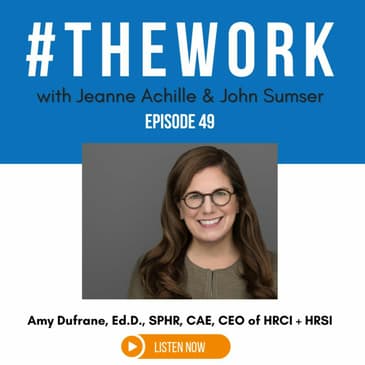
[00:00:27] Today we are delighted to welcome Amy Defrain who is the CEO of HRCI and HRSI, two very
[00:00:37] familiar acronyms in the HR industry.
[00:00:41] Amy, thank you so much for joining us today.
[00:00:44] Let's start off by explaining what those acronyms actually stand for.
[00:00:48] Well, thanks for the invitation, Gina and John.
[00:00:51] It's great to be here.
[00:00:53] HRCI is known as the HR Certification Institute and because we're celebrating our 50th anniversary,
[00:01:03] we've shortened it to HRSI because we're all into acronyms these days.
[00:01:08] HRCI is the longest running certification program on the planet.
[00:01:15] We've certified more than a half a million people around the globe.
[00:01:19] We have certifications for individuals that are starting out in HR all the way up to
[00:01:25] senior level and that are serving the HR profession from a global perspective.
[00:01:32] And HRSI, which might be newer to some folks in HR is the Human Resource Standards Institute.
[00:01:40] It is celebrating its 18 month-ish anniversary and the organization is set up to certify
[00:01:49] organizations against standards that are coming out of ISO.
[00:01:55] ISO is the International Standards Organization and every single ISO group there are tech
[00:02:02] technical committees.
[00:02:04] These technical committees are called TC260 for Human Resources Management.
[00:02:09] That's specifically for HR.
[00:02:11] There are lots of other technical committees, but we are at HRCI, we're the secretariat
[00:02:18] for TC260 and at HRSI we're certifying it against the standards that are coming out
[00:02:25] of TC260.
[00:02:27] So really excited about the work that's happening and we are certifying organizations against
[00:02:33] diversity and inclusion, the standard which is known as ISO 30415 and one that is getting
[00:02:43] a lot of interest from the SEC which is ISO 30414 which is Human Capital Reporting
[00:02:51] which is a standard for publicly traded organizations to recognize on their balance sheet
[00:02:58] their most important resource, their people.
[00:03:01] So I'll pause but that's a little bit about HRCI and HRSI.
[00:03:06] I love seeing this degree of rigor in the industry.
[00:03:11] I just think this is amazing and certainly ISO of course is a gold standard.
[00:03:19] I know John has a lot of questions Amy as we were coming into today's episode and John,
[00:03:25] I think you were mentioning something that we read this morning that crossed desks and
[00:03:31] it goes to AI and ethics broadly in corporate America but also in HR.
[00:03:40] So Amy actually caught the press release.
[00:03:44] Certainly Microsoft is making some sort of public guarantee to cover liability for the
[00:03:49] use of their AI tools.
[00:03:52] I don't know the details but when Amy said this press release across my desk, I started
[00:04:00] laughing because nobody can assume the liability from an employer for the stuff that they do
[00:04:09] with their employees.
[00:04:11] It can be shared and there's emerging law that says, there's emerging court cases that
[00:04:18] say a third party recruiter can be held liable for discrimination inside of a company.
[00:04:28] That's in the last month or so.
[00:04:30] That's a change.
[00:04:31] That's a change.
[00:04:32] It was always the buck stopped at the company.
[00:04:34] So there's an opening for product liability and maybe Microsoft's argument is that there's
[00:04:43] an inevitability that AI will be held to consumer products liability standards that should
[00:04:53] put everybody in the HR tech industry on alert because much of the, I don't have a
[00:05:00] technical term for bullshit.
[00:05:02] Well, that's okay.
[00:05:04] We're allowed to say that word on this podcast.
[00:05:09] Much of the claims about the efficacy of AI and HR technology are just bachelors and
[00:05:20] built on algorithms that we don't understand that produce results that we haven't been
[00:05:25] able to qualify yet.
[00:05:27] And the idea that there is a way for liability to be shared with the providers of that stuff
[00:05:35] is good news because it will increase the ethical quality thing.
[00:05:40] But my question for Amy was given that ethics and practical usage of AI implementation
[00:05:48] of AI is becoming central to HR.
[00:05:54] How do you guys handle that?
[00:05:56] Wow.
[00:05:57] So I think, you know, this is such an interesting topic and one that the global
[00:06:03] community, the global HR community is grappling with.
[00:06:08] And I just wrote an article about this that was published in HR professionals magazine
[00:06:15] and picked up in Iran by one of our community members who said, I want to translate
[00:06:22] this and get this out to the HR community in Iran because we're really trying to figure
[00:06:27] this out as well.
[00:06:29] And I think that HR itself is trying to figure out how do we protect the organization,
[00:06:38] mitigate risk for the organization, explain to our employees that by using AI, there
[00:06:45] are implications A to make sure what we're using is correct.
[00:06:49] The information they're using is correct.
[00:06:51] Because we've all heard the stories about people who are using AI and going and, you
[00:06:59] know, standing in front of a judge and reciting what they got on chat GPT.
[00:07:04] And it's completely incorrect.
[00:07:06] And that reflects poorly on the organization.
[00:07:10] So it's knowing that everything that's being generated has got to be tested
[00:07:18] and looked at.
[00:07:20] And I think there was this huge push from an employee perspective, oh, because AI is
[00:07:28] going to put me out of work.
[00:07:29] I'm not going to have a job anymore.
[00:07:31] So I'm just going to give up now.
[00:07:33] We'll know what your work is going to change and it's going to be different.
[00:07:36] And so HR's job is educating and upskilling those folks and getting
[00:07:42] them ready for what is next with how AI is going to impact their roles.
[00:07:50] I just, I think this is super, super fascinating with the Microsoft release
[00:07:56] about how they believe in standing behind their customers when they use their products.
[00:08:01] They're sensitive to the concerns of authors and that Microsoft would rather
[00:08:06] than our customers assume the responsibility that they will assume it.
[00:08:10] And they built important guardrails into their co-pilots because everybody is
[00:08:15] saying it's all a co-pilot right now to help to respect authors'
[00:08:19] copyrights when they're using AI to produce something, whether it be
[00:08:25] a job description or what have you.
[00:08:28] And no other Google hasn't done this yet.
[00:08:33] I mean, they may in the next few weeks follow suit with Microsoft
[00:08:38] as they all do, but I think they're putting a big stake in the ground around what this means.
[00:08:44] But I think back to sort of HR,
[00:08:47] HR has got this responsibility to ensure to educate employees on what this means to them.
[00:08:54] The safe use of this technology to do jobs that are
[00:09:00] that you could write a job description or do a social media post
[00:09:06] or put together a biography on somebody that you find on the Internet
[00:09:10] that may or may not be true, but it's sort of educating people on how are we using AI.
[00:09:16] And let's be real, I mean, organizations have been using AI for a long time, longer than,
[00:09:22] you know, and I think it's now sort of everybody is saying, oh, AI is the latest and greatest thing.
[00:09:26] But at HRCI, we've been using AI in different ways than what,
[00:09:32] you know, sort of the latest eight to 10 months have sort of
[00:09:38] that the technology and the rapidity in which it's catapulted us into talking about this more.
[00:09:46] I think that that HR has always been at the center of ethics.
[00:09:50] And at HRCI, we realize that, which is why every year when somebody has to
[00:09:55] recertify for every three years, when they have to recertify,
[00:09:59] they need to have one credit hour of ethics, just like a CPA does in the U.S.
[00:10:04] If you're, you know, a CPA, you've got to have ethical credit hours as part of your recertification.
[00:10:10] So these are two professions by which ethics is really at the core
[00:10:16] of what we're doing and in everything that we're seeing.
[00:10:21] So I think it's just this is a fascinating
[00:10:26] topic and everybody is trying to get their arms around this.
[00:10:29] And, you know, Harvard Business Review, the last two issues.
[00:10:34] AI has been on the front cover.
[00:10:36] I just got the Washington Business Journal, and I know they sort of have some of the same articles.
[00:10:41] It was all about this past week was all about AI.
[00:10:45] So we're all just trying to navigate through this and figure it out.
[00:10:51] But it's a fun time.
[00:10:52] It is. It's fascinating, though, because I'm sitting here and, you know,
[00:10:55] being being only 19, of course, I've only read about such things.
[00:10:59] But this reminds me of the advent of the Internet when, you know, in the 1990s,
[00:11:05] all of a sudden everyone felt they they invented the Internet or discovered the Internet, I should say.
[00:11:11] And meanwhile, those of us who were like, you know, Unix programmers way back when,
[00:11:16] you know, or if you were part of an academic network, you knew about the Internet.
[00:11:22] You used the Internet.
[00:11:23] So, so, you know, John, you're our resident AI expert.
[00:11:27] Or like, are we just did we just find a new bright shiny object?
[00:11:33] And and we're running around with it like a little kid.
[00:11:38] Thanks, sir. I think I think there's something new here.
[00:11:40] There's something new here and it's been coming.
[00:11:43] You know, I've been I've been talking about it out in the wilderness for a decade or so.
[00:11:50] And you've been able to see it coming.
[00:11:54] But the human beings are so interesting.
[00:11:59] Human beings are so amazingly interesting.
[00:12:02] And what one of the things that's interesting about them is
[00:12:06] if a machine says it's dark outside and you look outside and it's not,
[00:12:13] you question yourself first, you don't question the machine first.
[00:12:17] Right. There is this there is this tendency,
[00:12:21] very human tendency to believe the speedometer,
[00:12:24] to believe the indicator from the machine over your senses.
[00:12:29] And that's where the ethical problems actually emerge with this stuff.
[00:12:34] And because the stuff has proliferated very, very rapidly,
[00:12:40] we now have.
[00:12:42] People who are fundamentally ill equipped
[00:12:46] to to be the guardians of ethics
[00:12:50] and safe use of the technology in the position of being the guardians of it.
[00:12:57] So so if you wanted to pick a group who is least likely to be good
[00:13:02] at solving this problem, you would zero in on HR.
[00:13:05] I think why?
[00:13:07] Why do you say that, John? I'm curious.
[00:13:09] Because, you know, listen, we're just coming off a period of time
[00:13:12] where HR became the covid czars.
[00:13:15] I mean, right?
[00:13:16] If anything, I think HR is used to dealing with situations
[00:13:21] that that span a wide spectrum.
[00:13:24] I'm curious.
[00:13:25] So I'm so I have I have never.
[00:13:30] But that's not to I know some people and people that will make sure
[00:13:32] good at math, but generally speaking, people in HR are not good at math.
[00:13:39] Period.
[00:13:41] And so underlined and in order to in order to understand
[00:13:45] what you're dealing with with AI, you have to be good at math.
[00:13:49] OK, you have to be good at understanding
[00:13:52] the difference between 80 percent and 100 percent
[00:13:57] and what it takes to fill that gap.
[00:13:59] And so when you get a prediction that's 80 percent accurate,
[00:14:03] you can't inherently trust that prediction if it's 80 percent accurate
[00:14:09] because there's a lot of room for error inside of that thing.
[00:14:13] But you have to be able to think mathematically about it
[00:14:16] to understand the risk associated with a particular answer
[00:14:20] out of a particular system and go look.
[00:14:24] I don't know what's an HRCR.
[00:14:26] I haven't looked at it in a number of years,
[00:14:28] but the level of math training
[00:14:33] and math certification for HR people is low.
[00:14:38] It's low. Are we talking about I mean, listen, math is a broad topic.
[00:14:42] Are we talking about statistics?
[00:14:44] We're talking about statistics.
[00:14:46] We're exactly talking about statistics.
[00:14:50] But statistics turn into math, right?
[00:14:52] It's it's it's they turn into
[00:14:56] this decision versus that decision.
[00:14:59] Right. And so so that's the first piece is math.
[00:15:02] The second piece is that HR functions in a power environment.
[00:15:08] And HR is an expression of the power structure of the organization.
[00:15:14] And ethics is important in HR.
[00:15:20] But ethics is fundamentally a business decision.
[00:15:23] Ethics, if it was a moral decision that would be right and wrong.
[00:15:26] And if it was a legal decision, it would be compliant or non-compliant.
[00:15:29] Ethics is that mid ground of business decision
[00:15:33] where it's not right or wrong and it's not legal or illegal.
[00:15:37] It's in the muck.
[00:15:40] And decisions about being in the muck inside of business
[00:15:44] tend to get resolved as a business decision
[00:15:47] rather than some other kind of a decision.
[00:15:50] Wow.
[00:15:52] I'm going to ask you to pause.
[00:15:54] I'm going to ask Amy to weigh it.
[00:15:56] You really loaded loaded words.
[00:16:00] You're out there.
[00:16:02] They are.
[00:16:03] Oh, I wasn't supposed to be provocative.
[00:16:05] I'm sorry.
[00:16:06] No, no, we love when you're provocative.
[00:16:09] We encourage it.
[00:16:10] We encourage it.
[00:16:12] But but we have to give Amy her her moment,
[00:16:16] her moment to step up and address some of this,
[00:16:18] especially given how close she is to HR as a function.
[00:16:21] Right. Yes. Right.
[00:16:23] So I have to push back on on the financial acumen
[00:16:27] of HR professionals, because I think that
[00:16:31] HR professionals are have have high financial acumen.
[00:16:36] They've got from a when you look at compensation,
[00:16:38] you're looking at benefits.
[00:16:40] You are talking to CFOs about
[00:16:44] hiring individuals.
[00:16:46] I just had a conversation with with the CRO
[00:16:48] for a major health system
[00:16:51] who was having a conversation with her CFO
[00:16:54] and she was a finance person.
[00:16:57] I know a lot of finance people who have made the jump
[00:17:01] made that leap from finance to HR.
[00:17:04] And she was making the argument
[00:17:07] that in one particular hospital system
[00:17:11] or hospital in their system, they're losing
[00:17:15] several hundred nurses every quarter
[00:17:17] and she can't hire them fast enough
[00:17:19] because she's trying to communicate.
[00:17:21] She's got the data and she's having this conversation
[00:17:24] with the finance person and saying the data is showing
[00:17:28] there is a leadership problem and I need dollars
[00:17:31] because I've got to invest in leadership.
[00:17:34] I can't as I'm getting I'm hiring 250 nurses
[00:17:39] and I'm losing 250 nurses every quarter
[00:17:42] and my net is zero.
[00:17:44] I can't hire these people fast enough.
[00:17:47] There is inherently a problem in this hospital
[00:17:49] and I've got to figure it out.
[00:17:52] So I think about that example is one where
[00:17:56] she's she's going toe to toe with the CFO
[00:18:00] and having these conversations and showing the data
[00:18:02] and saying this demonstrates we have a different problem.
[00:18:07] And you can give me all the resources
[00:18:09] from a recruiting perspective,
[00:18:11] but the net is going to be zero at the end
[00:18:15] of what I have from a headcount perspective
[00:18:17] because I've made no ground.
[00:18:19] We're losing money and having those data points
[00:18:24] and challenging HR to continue to go toe to toe
[00:18:30] with the with folks who are saying show me the data
[00:18:34] and you are you're able to articulate
[00:18:37] from a financial perspective
[00:18:41] the cost of a program, you know, investing in leadership
[00:18:45] training and giving more money to HR,
[00:18:48] which by de facto in any organization
[00:18:53] is sort of the last bastion from the budget
[00:18:57] perspective of where the money goes
[00:19:00] because it all goes somewhere else.
[00:19:03] And I think HR has got to be better at this
[00:19:07] and communicating that the value that it brings
[00:19:12] and being able to demonstrate through those examples
[00:19:17] using analytics.
[00:19:19] And I think we've been having those conversations
[00:19:23] and bringing people to the table who are talking about this.
[00:19:28] So I think, you know, in every profession,
[00:19:31] there are people who are not good at finances.
[00:19:35] It's not just HR, as you're saying, which I don't think.
[00:19:40] But people in marketing, people, you know, in all sort of areas.
[00:19:45] But I think there are people who are who are very strong
[00:19:48] who can make those arguments to the C-suite.
[00:19:51] And that's where we've got to be bolstering HR
[00:19:54] to have those courageous conversations
[00:19:57] and having that data
[00:20:00] to be able to have those conversations and showing
[00:20:03] this is the value and the why you want to invest in HR.
[00:20:07] Well, I agree that HR is getting more analytical
[00:20:11] as time goes on.
[00:20:13] But I don't think that that's where it starts.
[00:20:18] I think that's an adaptation that's happening
[00:20:21] and you're liable to see it more in big companies
[00:20:24] than small companies.
[00:20:25] For sure.
[00:20:26] But finances isn't the same as understanding
[00:20:31] the implications of an individual percentage match
[00:20:36] in recruiting or an individual percentage match
[00:20:39] in some sort of career pathing trajectory
[00:20:41] and what it means to have that percentage match.
[00:20:47] Because there's real fuzziness in general
[00:20:51] about analytics about people.
[00:20:52] For sure.
[00:20:54] Right, right.
[00:20:55] And so talking to the CFO, great.
[00:20:57] But using math to run HR
[00:21:00] and making data driven decisions about people inside of HR
[00:21:04] without a really robust understanding
[00:21:07] of the underlying statistics.
[00:21:09] It's frightening to me, right?
[00:21:12] And if you look at what a predictive tool
[00:21:19] an AI predictive tool of some kind gives you as an output
[00:21:24] it gives you a qualified answer with a very good answer.
[00:21:29] A qualified answer with some sort of error rate associated with it.
[00:21:36] And error rates are funny things
[00:21:39] because you can understand them intellectually
[00:21:43] and that's very different than understanding them
[00:21:45] as something that happens to a friend of yours, right?
[00:21:48] And that translation between math and human relations
[00:21:56] I think it's the frontier for HR.
[00:21:59] I just don't have any sense that we have people in HR
[00:22:04] who are native and good at that
[00:22:06] because it's always been the purview of IO people
[00:22:10] rather than the operating person on the ground.
[00:22:14] I think they're just from a data perspective.
[00:22:18] There's, I will not take ownership of this
[00:22:22] but for those of you that know Ceylon's Churras
[00:22:25] she is a former finance person who is in the human capital space
[00:22:32] has been there for decades.
[00:22:34] She's fantastic, has written a book on this
[00:22:36] and she talks about in very simple terms
[00:22:39] the HCRLI, Human Capital Return on Investment.
[00:22:43] Very simple calculation to try to begin those conversations
[00:22:47] about sort of the value of human capital
[00:22:51] and I'm going back to our work in the global community
[00:22:57] around human capital reporting
[00:22:59] which is exactly that giving people the tools
[00:23:02] to what are those things that you can,
[00:23:07] the data points that you should be reporting
[00:23:10] on your human capital.
[00:23:13] Hopefully we'll get more definition
[00:23:16] around this from the SEC soon,
[00:23:18] the Securities and Exchange Commission
[00:23:20] but I mean this has been what three years now
[00:23:23] that we've been waiting for some sort of definition from them.
[00:23:26] They're saying they're going to be using
[00:23:29] the 30414 certification or accreditation or standard
[00:23:34] but we'll see.
[00:23:36] So all of it's all surrounding the data,
[00:23:39] the numbers around the people.
[00:23:44] I know we're short on time.
[00:23:46] I'm hearing that old data quandary
[00:23:49] and that is even with AI this becomes one more data point
[00:23:54] rolling up into whatever the larger decision is
[00:23:58] and that I'm really hearing that you can't hang your hat
[00:24:03] or bet the farm on what comes off, you know, chat GPT
[00:24:07] or...
[00:24:09] So I don't know, John.
[00:24:12] We're still pretty early on in that AI journey aren't we?
[00:24:15] We are and so here's the image
[00:24:21] that I like to inject at this point.
[00:24:26] If you are the recipient of some sort
[00:24:30] of predictive recommendation from a machine
[00:24:34] and you decide not to use that predictive recommendation
[00:24:40] you're going to have to explain that to somebody.
[00:24:45] You're going to have to explain to somebody
[00:24:47] and the machine has the data and you don't.
[00:24:50] And so...
[00:24:52] Or they have more data.
[00:24:54] And so how many times are you going to go
[00:24:58] to your boss and say I disagree with the machine
[00:25:01] before the boss stops listening to you
[00:25:03] because these are human beings in the system
[00:25:06] and so the ethics of that environment
[00:25:10] is how do you make it so that people are resilient
[00:25:14] in their ability to think critically about the output
[00:25:18] that they get from the machine without folding their cards
[00:25:22] and going, man every time I go to the boss
[00:25:25] and say this, the machine's wrong and I'm right
[00:25:28] he or she rolls their eyes
[00:25:32] and sends me back.
[00:25:35] The fifth or sixth time I disagree with the machine
[00:25:39] I'm going to stop.
[00:25:41] And that's where the ethics problem lies.
[00:25:45] Institutional inertia favors the machine.
[00:25:51] You might also have a generational overlay here
[00:25:54] because those of us who didn't have the advantage
[00:25:57] of the machine so to speak coming up through the ranks
[00:26:01] might be more suspicious of the machine
[00:26:04] than perhaps the earlier entrants into the workplace
[00:26:07] who are very, they're digital natives to begin with
[00:26:10] so perhaps they're not going to question
[00:26:13] anything coming from the machine.
[00:26:15] I think we just have the basis of a whole other show
[00:26:18] that we've just uncovered here.
[00:26:20] I do want to thank you Amy.
[00:26:24] I know we're at time and this is a big conversation
[00:26:27] and HRCI and HRSI are used to having big conversations
[00:26:32] especially having now celebrated your 50th anniversary
[00:26:37] which is a huge accomplishment, huge
[00:26:41] and having touched so many HR professionals throughout it.
[00:26:45] Would you tell our listeners how they get touch with you
[00:26:49] where they find out more about individual
[00:26:52] and organizational certifications?
[00:26:54] Just take a moment and bring them up to speed.
[00:26:58] Thanks, Jean.
[00:27:00] So to find a little bit more about HRCI
[00:27:03] you can visit our web page or website at HRCI.org
[00:27:08] to find out more about HRSI.
[00:27:12] It's HRSI.org
[00:27:14] and you can find out more about us
[00:27:20] and about me. You can follow me on Twitter,
[00:27:23] LinkedIn at Amy Dufresne.
[00:27:25] I encourage you to visit our website on HRCI.org
[00:27:29] and you can sign up for our newsletter
[00:27:31] which comes out on a bi-weekly basis
[00:27:33] and we're talking about topics just like this
[00:27:38] in very short fight-sized blogs
[00:27:41] and we're also talking about some of our upcoming webinars
[00:27:45] which are free to those individuals around the world
[00:27:49] that are interested in learning more about HR
[00:27:53] and the business world in which we all work.
[00:27:57] Well, thank you for that
[00:27:58] and thank you so much for joining us today.
[00:28:00] John, did you want to answer that?
[00:28:02] No, no, this is great.
[00:28:04] I want to know more about HRCI and HRSI now.
[00:28:07] We're going to both be at your website.
[00:28:10] Please stop.
[00:28:12] Awesome.
[00:28:13] You've been listening to the work, a podcast about the work
[00:28:17] and our guest today was Dr. Amy Dufresne of HRCI and HRSI.
[00:28:22] Thank you for listening.
[00:28:24] We'll look forward to joining you on a future episode.
Sponsors
