
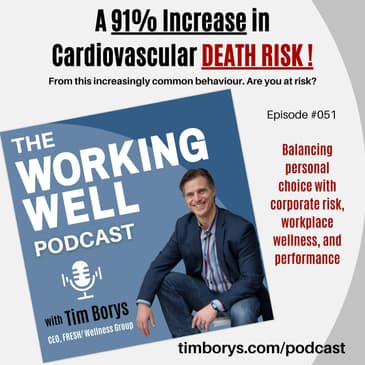
The personal choices of employees are their own to make. However, companies also have a vested interest in ensuring that each person is as healthy, engaged, and high performing as possible. Balancing the nuances of this gray area is one of the most challenging aspects of leadership and corporate culture.
Doing it well requires a customized blend of access to information, clear communication, leadership strategy, and employee engagement. The combination of these factors are important components of your unique corporate culture recipe.
Today’s episode brings up a topic that’s traditionally within the employees personal choice, but the health risk is important for companies to understand and mitigate. Similar to the challenges from smoking, excess drinking and drugs, or other unhealthy behaviours, companies that can engage, inform, and help guide healthier choices in employee populations will see outsized financial, operational, and corporate culture returns.
This episode brings my background in Health Coaching and Performance to the forefront and combines it with the challenges facing companies, leaders, and the quest for improved workplace wellbeing.
I look forward to your thoughts and comments. I encourage you to reach out and engage in the conversation!
Welcome to the Working Well Podcast, the show that explores the rapidly changing landscape of work and wellbeing. Each episode, We dive into the hottest topics in leadership, employee wellbeing, and the future of work! I’m your host Tim Borys.
Powered by the WRKdefined Podcast Network.
[00:00:01] Personal choices of employees are their own to make.
[00:00:04] However, companies also have a vested interest in ensuring that each person is as healthy,
[00:00:10] engaged and high performing as possible.
[00:00:13] Balancing the nuances of this grey area is one of the most challenging aspects of leadership
[00:00:19] and corporate culture.
[00:00:21] Doing it well requires a customized blend of access to information, clear communication,
[00:00:28] leadership strategy and employee engagement.
[00:00:31] The combination of these factors are important components of your unique corporate culture
[00:00:36] recipe.
[00:00:37] Today's episode brings up a topic that is traditionally within the employee's personal choice, but
[00:00:44] the health risk is important for companies to understand and mitigate, similar to the
[00:00:50] challenges from smoking, excess drinking and drugs or other unhealthy behaviors.
[00:00:56] Companies that can engage, inform and help guide healthier choices in employee populations
[00:01:01] are going to see outsized financial, operational and corporate culture returns.
[00:01:08] This episode brings my background in health coaching and performance to the forefront and
[00:01:12] combines it with the challenges facing companies leaders and the quest for improved workplace
[00:01:18] well-being.
[00:01:19] I look forward to your thoughts and comments and encourage you to reach out and engage
[00:01:23] in the conversation.
[00:01:27] Welcome to the Working Well Podcast, the show that explores the rapidly changing landscape
[00:01:31] of work and well-being.
[00:01:33] Each episode we dive into the hottest topics in leadership, employee well-being and the
[00:01:37] future of work.
[00:01:38] I'm your host Tim Borus.
[00:01:42] Today's episode is going to be a little bit different.
[00:01:45] Normally on the Working Well Podcast we're talking about leadership development, workplace
[00:01:51] well-being, things that companies can do to improve well-being in the workplace.
[00:01:56] So today's topic is related to that, but it's something that came out of my background in
[00:02:03] health and fitness.
[00:02:04] For those of you who aren't aware, I was a health and fitness coach, personal trainer,
[00:02:10] well-being consultant for many years and worked with thousands of athletes and corporate
[00:02:17] professionals on improving their health while being in performance.
[00:02:21] And one of the things that came up quite often was nutrition.
[00:02:26] People always wanted the best nutrition plan and over the past 30-something years I've seen
[00:02:32] all kinds of diet trends come and go, one of the more persistent ones is intermittent
[00:02:38] fasting.
[00:02:40] And I've written a couple lengthy blog posts on this and I'll put those in the show
[00:02:46] note so you can access those blog posts.
[00:02:50] And I hadn't really talked to clients about it in a while.
[00:02:53] I know there are still some people out there that do that and I've expressed my opinion
[00:02:58] multiple times on how I don't think intermittent fasting is very effective.
[00:03:04] I think it can have a small place at certain points, but how the majority of people implement
[00:03:10] it is highly ineffective.
[00:03:13] And I was coming at it from a weight loss standpoint.
[00:03:16] I don't think it really works well for weight loss from a long-term perspective because it's
[00:03:22] not approached with the right mindset.
[00:03:25] And those of you who've read some of my other material, my books, The Fitness Curveball,
[00:03:29] I outlined the four pillars of personal performance.
[00:03:33] Mindset, habits, movement and fuel in that order of importance.
[00:03:38] And when we talk about intermittent fasting people are doing that in my perspective
[00:03:44] from a flawed mindset perspective.
[00:03:47] They're restricting themselves purposefully to lose weight, which is might be great from
[00:03:53] a short-term perspective if you need to accomplish a certain goal in a short amount of time.
[00:03:59] But from a long-term sustainability standpoint it's really ineffective and it actually sets up
[00:04:05] a self-perpetuating cycle of what we call the diet yo-yo.
[00:04:11] Now, with that being said I've said my opinion multiple times over the years and like I said
[00:04:16] written a couple of blog posts on it.
[00:04:18] I talk to clients about it all the time.
[00:04:21] A study just came out from the American Heart Association and this was a study of over 20,000
[00:04:30] people over between 8 to 17 years.
[00:04:34] So a long-term study with a large number of people and what they found is that people
[00:04:40] who followed an eight-hour time restricted eating schedule and that's the typical or very
[00:04:46] common 16-8 fasting cycle.
[00:04:50] So you fast for 16 hours and then you eat during an eight hour window throughout the day.
[00:04:56] They found that that type of eating schedule had a 91% higher risk of death from cardiovascular
[00:05:04] disease.
[00:05:05] That's massive, highly significant and anyone who's doing intermittent fasting needs to be
[00:05:13] aware of it.
[00:05:14] People with heart disease or cancer also had an increased risk of cardiovascular death
[00:05:21] when they were following that cycle.
[00:05:23] And so compared in the study the author said compared with a standard schedule of eating
[00:05:30] across 12 to 16 hours per day instead of only the eight-hour window limiting
[00:05:35] food intake to less than eight hours per day was not associated with living longer.
[00:05:42] So when we look at what people are actually doing to lose weight, it's often creating
[00:05:52] significant long-term impacts on their health which means we need to think more effectively
[00:06:03] about how we're approaching nutrition.
[00:06:05] Now where this comes back to the Working Well podcast is that any company is filled with employees
[00:06:14] and employees are part of what we call the general population.
[00:06:18] For years I've worked with corporate executives coaching them on health, well-being,
[00:06:23] performance and again nutrition comes up all the time.
[00:06:28] So your employees for leaders out there, your team members, your employees are
[00:06:32] doing these types of eating regimens and if it's creating a 90% or 91% increase in cardiovascular
[00:06:41] death that's a major risk.
[00:06:46] So incorporating effective nutrition is part of most workplace well-being programs
[00:06:52] yet it tends to get rolled out as part of a part health month or whatever some one-off seminar.
[00:07:02] I believe what we really need is to look a bit deeper at the strategy that we have behind
[00:07:10] not just nutrition but what I call the personal performance paradigm,
[00:07:17] the mindset, the habits, the movement, the fuel, whatever things people are doing in each of those
[00:07:25] areas to produce better health, better energy, better performance in work and life.
[00:07:32] That's something that companies aren't really addressing.
[00:07:36] Again keep in mind most traditional wellness programs have some aspect of those things in there.
[00:07:44] However, there's a difference between offering random programs and creating a strategic plan
[00:07:52] designed to elicit specific behavioral change or health outcomes.
[00:07:59] That's very different.
[00:08:01] It's the same equivalent to saying oh I invest in the stock market and I invested mutual funds
[00:08:07] but I just sort of pick them with a scrabble board and I spin a spinner and whatever one it
[00:08:14] lands on or I just pick the most popular one of the day.
[00:08:19] It's not a strategy, well maybe not a very effective one, but the idea is that as leaders,
[00:08:27] as organizations, how are we positively impacting the health outcomes that our employees are having?
[00:08:39] We know that two out of every three people these days are either overweight or obese
[00:08:44] and that the fastest growing segment of that is the obesity segment with about 50-50
[00:08:52] between overweight and obesity right now.
[00:08:54] Now that's tripled or quadrupled in the last 30 to 40 years depending on which stats and
[00:09:00] which countries you look at, which means that it's not a genetic thing.
[00:09:06] There's difference in lifestyle, there's a difference in, I was talking with a researcher
[00:09:11] earlier today about gene expression and how our environmental factors might be changing
[00:09:17] the expression of our genes to create some of the challenges that we're facing right now,
[00:09:22] whether we're talking about low-level inflammation across the body, obesity,
[00:09:28] autoimmune diseases, all kinds of things are skyrocketing these days because of
[00:09:35] our environment, our behaviors and the ways we're approaching those two factors.
[00:09:43] So as companies we have a massive opportunity to help people but it requires a bigger picture
[00:09:50] strategy. It requires the executive team sitting down to say, hey what are the biggest hot buttons
[00:09:58] for our employee base and how are we specifically addressing them? Not just from an information
[00:10:05] standpoint because every EFAC plan and wellness portal out there has all the nutrition articles,
[00:10:13] has all the here's a workout plan you can download. Those resources are available
[00:10:19] but they're not being utilized in the way that's most effective. Most people only utilize them
[00:10:28] when they're desperate. It's a user self-serve model so employees will only go there to seek
[00:10:36] the counseling if they're feeling depressed or if they get referred to someone. Yes,
[00:10:43] some people do go seek it on their own but generally when they're facing
[00:10:48] undue challenges or stress. Now as an organization we have an opportunity to help build that into
[00:10:56] our culture, build healthy happy positive behavioral change into not just our wellness program
[00:11:07] but into the day-to-day policies, procedures, operations of the business. Now keep in mind
[00:11:15] we're not dictating how people need to live and exercise. We're consistently putting
[00:11:23] not just the information but the tools resources and opportunities to engage
[00:11:29] in those activities. It wouldn't be there in a traditional wellness program and I often talk
[00:11:39] about the difference between wellness and well-being and it's important distinction to talk about
[00:11:46] right now because as I'm saying this a lot of people are out there saying oh yeah well our
[00:11:52] company already does this. We do nutrition lunch and learns and we have this mindfulness app and
[00:11:58] we do all these things and I say that's great. Those are awesome tools in your toolbox.
[00:12:05] How do they fit with the organizational strategy around improving performance and well-being
[00:12:12] and are they actually improving well-being? Now wellness I define as the tactics,
[00:12:23] the actions that you take with the goal of improving well-being and well-being is the state
[00:12:31] of being, the outcome that happens from ideally doing wellness things. And when we look at it
[00:12:39] more closely things like those eFAT portals and the wellness portals and the mental health apps
[00:12:45] they're generally not producing the results that are needed to create bigger picture change in
[00:12:56] individuals and ROI for the company. We know that most of those portals they have success is an 8
[00:13:05] to 10 percent maybe 20 percent in the most extreme cases in terms of engagement in those resources
[00:13:15] across the company. So if only 20 percent of the people max are engaging with it and it's usually
[00:13:22] around 10 percent or even less that means we're still missing the boat in terms of behavioral
[00:13:30] change. And again a great tool in the toolbox that resource to pull at from some time but
[00:13:37] what people forget is that there are other factors that are involved in creating well-being
[00:13:45] that are outside the traditional scope of wellness programs. And that's a really important factor to
[00:13:53] consider and the biggest ones are the impact of leadership, impact of corporate culture.
[00:14:00] And it's a whole other podcast to dive into what corporate culture means but essentially
[00:14:05] it comes out to the daily actions, habits mindset that we approach the day-to-day operations of our
[00:14:15] business that create the employee experience and customer experience to some extent as well.
[00:14:23] But that's what corporate culture is really about and corporate culture has some of the
[00:14:29] biggest impact on well-being out there. You can have all the wellness amenities, check all the boxes
[00:14:37] out there. If your corporate culture sucks it's not going to matter people are still going to be
[00:14:43] stressed out, burnt out, disengaged. So where I'm going to the intermittent fasting here and
[00:14:51] you know again we got back to the wellness side but it's all connected because when we've
[00:14:55] create, when we decide and strategically curate a corporate culture around well-being and performance
[00:15:03] and discussing things on a consistent basis like the foods you're eating, how you're moving,
[00:15:11] setting up a structure in the day where you have healthy options available for food,
[00:15:15] where you have the ability to move your body, to engage in activity perhaps while
[00:15:23] you're even meeting with colleagues and doing work we know that creativity improves,
[00:15:28] we know that focus and resilience and mental health improve when we move our body yet most
[00:15:36] companies are doing the opposite for employees. They're essentially chaining people to a desk
[00:15:43] figuratively hopefully not literally but people are on zoom meetings or teams calls for eight to
[00:15:51] 10 hours a day they have to sit at their computer whether they have the camera off or not they're
[00:15:56] there in the office it's very similar. So what as leaders what what culture in our team never
[00:16:06] mind the bigger organizational culture at this point what culture in our team are we creating
[00:16:11] that allows us to positively impact the people on our team from a mindset, habits, movement and fuel
[00:16:22] standpoint. When we can do that our team will perform at such a higher level we will have
[00:16:30] more satisfaction as a leader the organization benefits again this is simple very straightforward
[00:16:40] the concepts have been there for ages as a personal trainer starting an industry
[00:16:48] C level executives VP level executives were coming to me to learn these skills
[00:16:56] and that's how I got into the fitness industry or sorry that's how I got into the corporate
[00:17:00] wellness industry. I was basically fixing stressed out burnt out broken down beaten up corporate
[00:17:07] executives and helping them get their mindset habits movement and fuel back on track so they
[00:17:14] could see the results they want and perform at their best in life then they would say hey
[00:17:19] why don't you come in and talk to my team about this I this is really cool no one's ever
[00:17:23] presented it this way before and so I started doing seminars and workshops and then these
[00:17:29] same companies would say hey you know what we're thinking about building a gym in our space
[00:17:36] can you run some programs out of there can you tell us what equipment we need and that led me into
[00:17:43] designing and managing fitness centers for large corporate clients and we've had multinational
[00:17:50] companies that we've run facilities for the interesting thing is there was still a gap
[00:17:58] and if we go back to corporate culture and leadership mindset
[00:18:01] that we're running these multi-million dollar facilities for large corporate clients yet we're
[00:18:07] seeing the same call it 10% of people that would use a gym whether the company had one or not
[00:18:15] and then that got us thinking well hey you know what what about the other 90% of employees
[00:18:20] what programs are we running for them so we started doing traditional workplace wellness
[00:18:25] workplace wellness programs we were checking the boxes off hey we're doing nutrition seminars
[00:18:31] hey we're doing wellness challenges we're doing wellness weeks wellness fairs all these things that
[00:18:39] were one-off activities and then we realized there was a gap there we'd have people coming to us
[00:18:47] saying you know what we love the gym we'd love to go but my boss wouldn't look too kindly
[00:18:55] on it if I if I went and went to the gym in the day and I've got kids and with my schedule it's
[00:19:01] hard to make it there before work or after work so I'm just not going I'm not utilizing that resource
[00:19:09] and when we start looking at leadership mindset this distinction between the wellness program
[00:19:15] and then the real work that gets done that's where we see the difference
[00:19:20] and that's what got me into executive coaching and the organizational performance strategy
[00:19:29] consulting with companies and leaders to set up programs that are not just effective but that
[00:19:38] are bought into the company culture that helping leaders shift their mindset to see the opportunities
[00:19:44] that are available from a people performance standpoint and an organizational performance
[00:19:49] standpoint because those two things go hand in hand so to come back full circle to the intermittent
[00:19:56] fasting and the 91 percent higher risk of death from cardiovascular disease we want to look at
[00:20:05] how does this all fit together in your organization just even from your leadership mindset
[00:20:12] perspective how is this resonating have you checked all the boxes but are maybe not
[00:20:20] seeing the results in your organization if so please reach out call me DM me I'd love to connect
[00:20:28] I'd love to hear what's working for your company what's not what your vision is for the future
[00:20:34] and I'd love to help you put that in place tim boris.com just go to the contact page reach
[00:20:40] out there on linkedin you can connect with me on linkedin Tim boris thank you so much we'll
[00:20:47] see you on the next episode that wraps up another episode of the working well podcast
[00:20:57] if you enjoyed the show please rate review and subscribe wherever you get your podcasts
[00:21:02] now which guests would you like to see featured on the show let me know send me a message through
[00:21:07] linkedin or on the contact page at tim boris.com see you soon
Sponsors
