
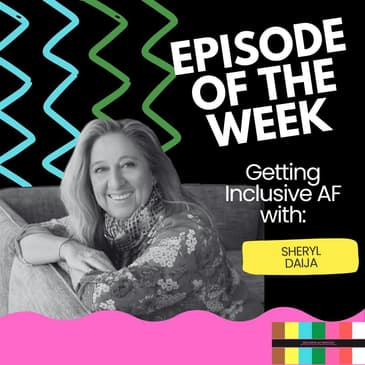
In this insightful episode of The Inclusive AF Podcast, hosts Jackye Clayton and Katee Van Horn sit down with Sheryl Daija, the brilliant founder and CEO of BRIDGE. Discover how Sheryl and her team are revolutionizing Diversity, Equity, and Inclusion (DE&I) practices across the corporate world.
We dive deep into how BRIDGE and the IMAX (Inclusion Maturity Assessment and Capability Building) framework are helping Fortune 500 companies, agencies, media platforms, and brands develop best practices for operationalizing inclusion. Sheryl shares her unique perspective on why organizational inclusion needs to be a priority, not just for the Chief Diversity Officer but for everyone in the organization.
Highlights include:
- The critical role of "BRIDGE" in standardizing DE&I definitions.
- Why every company should undertake an IMAX assessment to measure their inclusion maturity.
- The business impact of effective DE&I practices with real-world examples.
- How companies can strategically address missteps and setbacks in their inclusion journey.
- Insightful discussions on the intersection between marketing and DE&I initiatives.
Plus, hear personal anecdotes and expert advice on staying the course with DE&I to achieve both moral and business growth. Don't miss out on these key takeaways and forward-thinking strategies that can transform your organization!
**Connect with Sheryl Daija:**
Email: sheryl@wearebridge.com
Website: [wearebridge.com](http://wearebridge.com)
**Hashtags:**
#InclusiveAF #DEI #DiversityAndInclusion #BusinessGrowth #Podcast #SherylDaija #BRIDGE #IMAXFramework #WorkplaceInclusion #MarketplaceInclusion #InclusiveBusiness #CorporateDEI #DiversityMatters #InclusionStrategies #MarketingAndDEI
**Timestamps:**
[00:00] Introduction
[05:15] Sheryl Daija on standardizing DEI definitions
[12:30] What is the IMAX assessment?
[20:45] The importance of organizational inclusion
[30:10] Real-world examples and success stories
[40:25] Strategic advice for companies
[47:00] Key takeaways from Sheryl Daija
[49:57] Closing remarks
Don't forget to like, comment, and subscribe to our channel for more episodes!
---
Feel free to like, comment, and share this episode if you found it insightful! Subscribe to our channel and click the bell icon so you never miss an update. 🌟
Powered by the WRKdefined Podcast Network.
[00:00:00] You're listening to Inclusive AF with Jackie Clayton and Katie Benhoard.
[00:00:10] Alright, Jackie, hello. Hello. How are you doing? Thanks for saying my name, Katie.
[00:00:16] See, we're just getting it all spicy for changing it all up.
[00:00:19] Yeah, mix it all up over here and thank you for saying my name.
[00:00:24] So this is the Inclusive AF podcast and it is a beautiful body Wednesday in Arizona.
[00:00:29] How's touch? Just click your there. I'm glad you're home. Well, come home.
[00:00:34] Katie was stuck in the airport this weekend and I was really nervous.
[00:00:40] We are bestie so we share a location and I just kept saying, Oh my gosh, she is still at the freaking Billy airport.
[00:00:48] I was like, are you ever leaving? No, no. I wasn't allowed to go in and so there were there were a couple other folks that were sitting in that lounge for a very long time as well.
[00:00:59] So I got to see some very entertaining things. So if nothing else is a very entertaining weekend, a lot of people watching going on.
[00:01:07] So Jackie, I'm also glad to be home.
[00:01:11] So for those of you who do not follow Jackie on the socials, I just want you to know that my friend Jackie is kind of a badass. She's a true runner now and
[00:01:24] I'm glad to see you today. You know, trying to get some money together for ALS research. So we will put a link in the show notes.
[00:01:34] So if you are interested in donating to Jackie, we'll, we'll let you do that and would ask for any donations there.
[00:01:42] So yeah, you're a runner.
[00:01:43] I know I'm like dropping a group. I'm joining running groups. I'm like drinking water with lemonade and being a huge staff.
[00:01:49] That's happening. It's real. I love it. I love it. All right. Well, let's just jump right in. So we have a phenomenal guest today and want to turn it over to her. So she can introduce herself and then we will have some conversations with all about Cheryl. So Cheryl would love for you to introduce yourself to our guests.
[00:02:09] Oh, you're nice. Well, I appreciate Katie and Jackie. Thank you for having me. My name is Cheryl deja. I am the founder and CEO of Bridge.
[00:02:18] Bridge is the first independent DNI trade group for the global marketing industry. And I guess our mission is to help companies operationalize inclusion as a business practice for growth. So that's why I am awesome. Very cool. So when you think about kind of the typical client that you're working with, what are they looking for? What's in what do you do for them?
[00:02:44] Yeah. So we're we are, you know, as an industry trade group, we have the kind of unique opportunity to actually bring the entire industry together. So we are a membership driven organization. So we're not in a necessarily an agency with clients but rather an industry group that, you know, kind of coalesces and brings together members.
[00:03:12] So our members are and if you, you know, kind of if you look at the bridge board.
[00:03:19] Their company, our our our companies and individuals are comprised of Fortune 500 companies agencies media platforms. And then obviously, you know, we have a number of different kind of, you know, a number of different brands.
[00:03:39] And then specifically in terms of the individuals, we have a combination of chief diversity officers or chief DNI officers, CMOs, chief marketing officers and then CEOs.
[00:03:52] So we fundamentally believe that the change needs to happen at the intersection of DNI and business. We're very focused on inclusion, you know, for business growth obviously there's a moral imperative to it all but our, you know, kind of focus is on the, on the business imperative.
[00:04:09] And so we help companies with basically developing best practices for being able to operationalize inclusion.
[00:04:19] We have a tool that allows companies actually measure their inclusion maturity across their organization. So we're focused both on the workplace and on the marketplace because, you know, obviously DNI has had a big focus is on talent and
[00:04:37] what your organization kind of comprises and looks like. We fundamentally believe that DNI and inclusion in the marketplace is as essential. So how are you, you know, developing your products, how are you showing up in the marketplace, etc.
[00:04:53] Well, I'm going to ask you a question. Our listeners know that I'm always talking about airs a difference when you're looking at it from a business imperative or you're looking at it inside of an organization versus if we're doing something outside because
[00:05:07] everybody's community and pieces are are different. And I feel that there has been evidence especially lately that there's so much confusion as to what inclusion means.
[00:05:22] And I did do some research and I was looking back at your Harvard business review and talking about product and mentality kind of touched me.
[00:05:30] And I was wondering if you could share a little bit more about like the real impact, this isn't even though, you know, there's a moral side.
[00:05:38] There's the other side, but it really equates to actual numbers and I'd prefer you to share a little bit about that and again, I thought I will put it in the show notes the link to the Harvard business.
[00:05:47] Okay, yeah. So I want to repeat then what's in the Harvard business review, but I will kind of share a share a few things with you.
[00:05:57] So firstly inclusion is everyone so I will let you put that out there and certainly, you know, the misrepresentation of what the United stands for.
[00:06:07] It needs to be rectified and hopefully in this new historically cultural, the new historical cultural moment that we are experiencing over the last 48 hours.
[00:06:19] Our opportunity to take back the narrative is even stronger than it was, you know, just two days ago so more from more on us from that by the way.
[00:06:29] But from the from the business imperative side, we are actually now so the Harvard business review obviously shows companies like Sephora and other companies who have been very intentional about their inclusion practices in terms of the growth that they've experienced and you know.
[00:06:51] And the success that they've had in the marketplace as a result of that.
[00:06:56] And then you can look at companies, you know, I often say to to brands when they so there's a few things that come away one is, you know, we we were so nervous that we're going to end up on the front page because we've done something wrong and what I often say to to brands is.
[00:07:13] So I'm ex, which is our product literally shows that there are over 80 business practices in support of building an inclusive brand.
[00:07:24] I think they might be eight of those practices or 12 of those practices that are about advocacy so as a brand, so I don't even have to go as far as advocacy we've got like 72 practices that they can.
[00:07:37] And so there's a lot of different things that are in the business impact right.
[00:07:42] So there's a, so my point is there's no excuse not to do it.
[00:07:47] And then the other piece of it is that we've just announced some research around the business impact of inclusion on purchase intent and on engagement.
[00:07:57] And what was really interesting about that research is that so there's a few things one is there is a difference between diversity and inclusion.
[00:08:08] Diversity without inclusion is not as impactful as inclusion with diversity so that's one thing.
[00:08:15] Diversity and inclusion is the most impactful and you can actually see three x increase in your purchase intent if you do diversity and inclusion and people think like, you know at the end of the day it's like is this a brand for me right like does the sprint talk to me.
[00:08:33] So we are seeing some incredible research that now justifies the what we've all known, which is that inclusion has huge impact on on purchase intent.
[00:08:47] And then the other thing that I'll throw out, which is not in the HVR article but I think is relevant is that you know.
[00:08:55] Fenty exists as a billion dollar company because cosmetic companies didn't make cosmetics for black women, you know, period end of story.
[00:09:06] So it's a it's a cautionary tale just in Walker, you know, Lord's Bevel because he couldn't find a single blade quality raise up when he was walking down the aisles because, you know, companies had the trend had gone to five and six plate raises and then he ended up selling his business for 50 million or so.
[00:09:25] And I'm just going to mount to PNG so our you know message really to to brands is that it's a cautionary tale if you're not considering the business impact of of inclusion.
[00:09:37] But that's so much because you know it does equate but then it also helps tell the narrative of what's going on and the impact like there is and that's what makes it.
[00:09:50] It's important but also to let people know the broader picture of what's really happening.
[00:09:56] When I moved to Texas from Oregon and when people ask why did I move to Waco.
[00:10:04] I when I'm being silly I'm like because they don't have hush puppies in like a swigo and I remember you know if you've moved or you've lived in different places when you're trying to identify.
[00:10:17] You know you missed your home you want to make food from your home and I just wanted cat fish and hush puppies. I live in Texas like you can get.
[00:10:24] Pat fish at any lake at any golf course in Texas like I don't know why this is a issue made it.
[00:10:30] And it made me feel instantly like I didn't belong here and I moved 1200 miles away.
[00:10:39] Back to Texas and there is a cat fish king right up the street. So you know those kind of things had major impact on the overall economy.
[00:10:49] But how you feel about the brand and once you have those experiences and you can breathe those up where people don't have that as a distraction they can also do their best work and share within the organization as well.
[00:11:04] Yeah, I mean there's there's five trillion dollars in buying power between Hispanic Americans black Americans into indigenous Americans and Asian Americans.
[00:11:13] So it's really up to you as a company if you want to tap into that buying power you don't I mean it's pretty simple.
[00:11:20] I was actually on a on a panel that was fortunate enough to be able to go to can the can lie and festival of creativity in June and I happened to be on a panel with somebody from PNG and here and I were talking.
[00:11:34] And he disclosed so I'm not disclosing anything because he said it publicly but he disclosed that PNG has analyzed that if they.
[00:11:44] If they implement more inclusive marketing strategies that it's a it's a 500 million dollar revenue increase in one in year one in year it's just a in the first year so that's a billion dollars in the second year right.
[00:12:00] And and it's and it's you know there are simple things that companies can do to tap into those historically unrecognized communities.
[00:12:10] But you have to do it authentically right like you can you and that's the other piece of it is I think we've we've gone down a path of you know.
[00:12:20] Heritage once which allow companies and and they've certainly have a benefit but we have to be careful that it's not performative and that you're if but you know you're authentically understanding your marketplace authentically developing products for that marketplace and then showing up in an authentic way.
[00:12:38] So it's not it's not difficult but it needs to be done well.
[00:13:08] To implement any DEI there's some other work that has to be done here first.
[00:13:13] But you see situations like that do you think they too benefit from inclusion or what do you say to people organizations like those.
[00:13:23] Yep.
[00:13:24] Oh, well.
[00:13:26] Yeah let's all take a heavy side.
[00:13:29] You know.
[00:13:30] So I will tell you.
[00:13:34] You know, I was talking to somebody this morning and she and I have both now started to get fun calls from companies that want a backtrack on their backtracking so let's put that out there right.
[00:13:48] And and I think you know again it's like listen we cannot cave to political pressure when we know that.
[00:13:58] That you know we have an opportunity to do the right thing for our businesses right I mean that's just the and and like that's really the most important thing and so it's very for me very short side of what tractor supply did and what John dear has done.
[00:14:14] Because the the the makeup in this country the racial diversity in this country is inevitable it does not matter if a presidential presidential nominee or governor.
[00:14:32] Or the heritage foundation you know with project 20 25 once to change what what our country looks like at the end of the day there is an inevitable.
[00:14:43] And so the ability to what the country is going to be right and so like it's like let's just in front of you if your business and I feel like seasoned executives understand that like if you're a business you have to embrace with the country that you're in.
[00:14:58] And what the reality is I don't care if you believe in the moral imperative.
[00:15:03] Obviously I would like for that to be the case, but at the end of the day there is a business imperative to inclusion and so it's a very short side of to you know make these far reaching statements because listen at the end of the day and I'm going to predict this here now.
[00:15:19] Tracks are supply and John dear are going to have to backtrack because fundamentally there they have consumers that reflect a different.
[00:15:32] Make up then the consumers that they're reacting to right.
[00:15:38] And as all you know kind of back to you know back to your point Jackie the misrepresentation around the United right I mean.
[00:15:46] There is if you really understand what do you know I means you would know that it includes absolutely everyone and it's actually very funny because I was having a conversation with a few people yesterday we're actually working on an inclusive media and marketing.
[00:16:05] Practice that we think you know should quite frankly replace what is out there from a multicultural perspective and you know general market and.
[00:16:16] And we made a joke that you know the new majority right there's going to be a new majority and and it's going to be our job to make sure that the current existing minority like the current existing majority.
[00:16:31] Who will be it will end up being the minority are then going to have to be included and make sure that we're you know kind of targeting that so things change right like listen in the last 48 hours we have seen.
[00:16:42] If a huge shift in this country I mean it's just if the unbelievable the shift that happened in 48 hours.
[00:16:49] It's a real I think lesson for all of us and for companies especially that you have to stay the course win us the right thing to do you just you have you have to stay the course and you have to really believe in what you're doing.
[00:17:04] And understand why you're doing it and know what your goals and objectives are and go after those goals and objectives and not let the chatter right like impact your business because.
[00:17:15] I don't know if I've said this before now I'll keep saying it if I if you're CEO and you don't believe in building an inclusive company or an inclusive brand you shouldn't be a CEO.
[00:17:26] Right.
[00:17:27] Tell it.
[00:17:28] I'm going to share I mean and you know like you're talking about seeing this major shift seeing this go go over and back tracking on their back tracking the first thing I.
[00:17:42] What I'm going to say is that you're talking about what you're talking about is like how are they not having a walk out of employee because you just rejected.
[00:17:48] How many people that work there what happened to the psychological safety people that are at work.
[00:17:53] That saw that major stance and I was just for them because the economy's not like where you can walk across the street and get another job and you have families and how do you explain that to your parents or your cousins or your aunties like.
[00:18:07] Why are you staying at that we're going to say you know there there is so much impact and it was shorts cited and I think they did listen to those things politically but I can understand also if politics is telling me I can't.
[00:18:23] Have a D. I person in my organization because I'm a public funded you know organization they very very it makes it difficult to know and what direction.
[00:18:33] To fight in those situations yeah listen it's a cup is complicated you know there's no there's not I mean there's clearly complicated because if it wasn't it would just be.
[00:18:45] It shouldn't be complicated right I mean it shouldn't be complicated equity for all should just be a given that's the country that you know we strive for and it should not be complicated.
[00:18:56] But as you say people have jobs and and then leaving is not you know really hurting anyone but themselves and so they're trying to figure out how do you stick it out in a company that doesn't support you right.
[00:19:09] I believe that at some point you know this will change I mean I don't know I'm going to I'm not fighting I'm all because it like it's just it's just crazy like I don't even know sometimes what we're arguing about.
[00:19:26] I mean I just don't even know what we're arguing about we have.
[00:19:30] One of our members is milkpeep and they're actually like the USDA like the dairy like got milk right and I was talking to the CEO there and she told me that there was a peep that it was fascinating the peep that I don't know anything about golf I don't do anything with golf.
[00:19:50] But she told me that.
[00:19:54] Men if you play in the in the pee and the what's it the PG golf thing whatever it is right I think for the second the PGA right the PGA golf thing I've got PGA on that the PGA golf thing.
[00:20:06] That man don't have to pay but if you're a woman and you play in the woman's version I'll do you have to pay.
[00:20:12] Yeah, that's just so he missed like why right so you know there's just so many so many things that.
[00:20:21] That don't make sense right and we just need to start having a make sense so.
[00:20:29] The other you know the I think the other thing is.
[00:20:32] I'm just listen I understand that there is a reality and there are some people out there that just don't want to see progress.
[00:20:38] You know we get that right and we also get that there are very well funded and can bring lawsuits against him ever they want because of that funding.
[00:20:49] But there are absolutely ways to do the work without getting into those kinds of you know issues around lawsuits etc and by the way you know I mean it's kind of actually is sorry I'm a little bit of a rambling up but it's kind of actually a firm and action thing right.
[00:21:07] The other turning of affirmative action was very squarely about universities but it had a ripple effects on companies right because they started to get concerned that they were going to be low suits etc.
[00:21:20] Kenji or she knows a professor at NYU talks a lot about and I'm sure you've you've heard about him talks a lot about the work that you can do despite the overturning of the firm in the action.
[00:21:32] There is a lot that companies can still do to make to become inclusive companies and from our perspective that's why we created I'm acts right because I'm acts focuses on the business it shows you the business practices that you need to implement and it gives you a framework on how you do that.
[00:21:53] And you don't even have to have a DNA conversation in some respects right not that we don't think you should but you almost don't even have to because it's really based on business practices and the opportunity that those offer you so.
[00:22:08] I have so many questions right now so I am going to talk about the last 40 hours and ask you a couple of insider marketing questions so you know people are speculating that.
[00:22:21] Joe Biden did a you know a very smart marketing move by announcing that he was stepping down or you know stepping out of the race when he did.
[00:22:31] What are your thoughts on that like what do you personally think you think that was a strategic move or do you think it was that happened to be the timing when the decision was made.
[00:22:40] I mean you know like we not not know many dollars right what I would well what I will say is that I hope that.
[00:22:49] That it was very strategic and if it was it was incredibly brilliant certainly following you know the convention that came before and you know with get you know I mean there are a million reasons why it was really good it was a slow Sunday there was no news going on.
[00:23:06] You know the vice president had the opportunity to just literally just become the news and I feel like I guess I feel like it was strategic because.
[00:23:21] For the first time in a long time I felt like the democratic party all knew what they needed to do to get behind a single person to you know kind of when the election and so for me.
[00:23:36] You know I don't think we should underestimate person and Biden you know albeit he might be older now and you know kind of.
[00:23:44] Coming to the end of his term, I don't think we should underestimate him and I don't think we should underestimate the people that he surrounds himself with.
[00:23:51] Because you know I wouldn't imagine and I don't think we should underestimate our you know vice president I mean right so.
[00:23:58] Yeah I think that it was an incredibly brilliant brilliant move so and you know I will say that bridge is not obviously we're not a political organization.
[00:24:10] But when we are fundamentally being attacked by one candidate well then we have to you know fight against that attack because it's fundamental to our philosophy what we believe in our and our prisoners so.
[00:24:25] So clearly there's a there's an opportunity for us to you know to support what's right as opposed to necessarily even kind of political parties.
[00:24:34] Got it so I want to back up to you know the around Christmas time and you know before that when companies like target and a few others got rid of difference like they got rid of some of the pride.
[00:24:51] Clothing and things like this and you know and they obviously had been a company that was pretty.
[00:24:58] Stanchely left and progressive and all of these things so you know and even you know the the examples we just gave about chapters play it such a.
[00:25:09] Do you think that was a political thing where it was hey we think that Trump might win so we're going to now let the wind kind of carry us or do you think that was truly just they got that much backlash that they felt that that was the right move to make.
[00:25:25] Yeah I mean again you know so I'm so complicated but not in the second one on in the you know in the meeting rooms having these conversations understanding what the impacts are.
[00:25:35] It was target has historically done an incredibly great job not only I think at what I would come maybe I'm going to some of the pride stuff stuff to be a little bit more performative but they have.
[00:25:49] Created clothing right for kids that are that have sensory issues so that they feel comfortable in those clothing in you know those clothes they very intentional about what the.
[00:26:02] Distor experience is because I've spent quite a bit of time with to hug and talk into them and they're intentional about how they come up with their advertising i don't agree with their decision.
[00:26:16] because I don't think we should, you know,
[00:26:18] I think at a certain point,
[00:26:19] you have companies have to know who they are.
[00:26:21] And if they fundamentally believe in supporting
[00:26:24] the LGBTQIA community,
[00:26:27] they need to support it no matter who says don't, right?
[00:26:31] So I personally don't necessarily agree with their decision,
[00:26:35] but I would know who targeted it.
[00:26:39] For me, targets a little bit different
[00:26:41] than the tracks are supply, right?
[00:26:43] They're knowing how committed they had been.
[00:26:46] They must, you won't can hope that there was a real business
[00:26:49] reason for what they did.
[00:26:53] But again, you know, I would have preferred
[00:26:54] that they didn't do it regardless.
[00:26:57] The, I think one of the pieces that is very complicated
[00:27:01] is when people's, when people's safety is at risk.
[00:27:05] And from what I read and from what I learned about that situation,
[00:27:09] it might, it might have been an issue of their employee safety,
[00:27:15] that kind of rose to the top and was the reason
[00:27:17] for them making that decision ultimately.
[00:27:21] In which case you can, you can, again,
[00:27:24] you might not like it, but you can kind of understand it.
[00:27:28] So we live in a very complicated time
[00:27:30] and our employee safety must come first for sure, right?
[00:27:37] So it's unfortunate that people would kind of go crazy
[00:27:41] about, you know, a t-shirt that shows up.
[00:27:45] It's like, you know, you know,
[00:27:48] the Lehman in, you know, the Lehman being gay,
[00:27:52] don't just on the gay, I mean, you just choose differently, right?
[00:27:54] But you don't have to tell somebody else not to me, right?
[00:27:59] So, but it's my, it's so important,
[00:28:01] like I don't work for rich,
[00:28:02] but I think it's so important to have an organization like Bridge
[00:28:05] of a very detailed, structured format.
[00:28:09] Like this is where we're going because so often times
[00:28:12] if you're doing piecemeal work and it's not unclear,
[00:28:17] it's hard to have a rally behind it.
[00:28:19] Like this is who we are.
[00:28:20] This is what we're doing.
[00:28:21] This is where we are in this stage.
[00:28:23] This is without coming impact.
[00:28:27] And I think that's a primary difference
[00:28:29] between just a, you know, social narrative
[00:28:32] of business narrative like understanding, like,
[00:28:34] though this is a business plan we're launching it
[00:28:36] with a strategic expectations at the end of it.
[00:28:40] And then when you're doing this, it's hard.
[00:28:42] The metric is hard.
[00:28:44] It's like, oh, sorry, there was a tweet
[00:28:45] that went on on Thursday, so our numbers are down.
[00:28:48] You know, it's not like it is complicated.
[00:28:51] I mean, you know, listen, the, the,
[00:28:54] the IMF framework puts everyone on the same playing field
[00:28:58] in within your organization
[00:28:59] and it shows everybody where you are, right?
[00:29:04] And it's really, it's not to,
[00:29:06] you know, some come to the, like, well,
[00:29:07] are you going to show or are you going to share it?
[00:29:10] It's obviously not the proprietary
[00:29:11] to your individual company.
[00:29:13] And it's really not about naming and shaming.
[00:29:15] It's about how can we help you develop a strategy
[00:29:19] that is inclusive that ultimately brings you business growth.
[00:29:23] And understanding where you are
[00:29:25] is always the first step in good business, right?
[00:29:27] And having data to back that up.
[00:29:30] The other thing that I would, you know,
[00:29:32] just kind of just, I don't know,
[00:29:34] I keep coming in my head is that,
[00:29:38] you know, D and I practitioners are really skilled practitioners, right?
[00:29:43] They, it, it, it, it,
[00:29:45] you're not a D and I person if you're like or your Asian
[00:29:48] or your Hispanic or your, you know,
[00:29:51] you're part of the LGBT community,
[00:29:54] you are a D and I leader when you are skilled
[00:29:57] to be a D and I leader regardless of what your,
[00:30:00] you know, your gender or racial identity
[00:30:02] or sexual orientation is.
[00:30:04] Certainly your lived experience might contribute to it,
[00:30:07] but these are skilled people that really understand
[00:30:10] I have been incredibly lucky
[00:30:14] to watch my outreach to most of the officers
[00:30:16] around the board because I have learned
[00:30:18] that there is such a difference between the lens
[00:30:21] of a D and I leader than the lens of somebody
[00:30:24] who just happens to be part of a different community,
[00:30:27] right?
[00:30:28] And so we should not underestimate the,
[00:30:32] I believe that there are gems in your,
[00:30:34] it gems within companies and I have seen the power
[00:30:37] when marketing and D and I come together
[00:30:39] and that unlocking that kind of collaboration happens.
[00:30:43] I've seen, they've seen the power
[00:30:44] in what you can kind of accomplish together.
[00:30:47] So I don't know why I wanted to bring that up,
[00:30:49] but it was just kind of in the back of my head,
[00:30:51] I realized it wasn't a question,
[00:30:52] but I feel like it kind of blames into everything
[00:30:55] we've been talking about.
[00:30:56] Yeah, I actually was, that's one of my questions is also,
[00:31:00] what are some good examples that you have
[00:31:02] of when companies get it right?
[00:31:04] So when you do blend that Chief Diversity Officer,
[00:31:07] the marketing team,
[00:31:09] and you don't need a names specific brand or a nice that,
[00:31:13] but what does that look like
[00:31:14] and how does that come about?
[00:31:20] The inclusion is intentional.
[00:31:23] And so if you bring intentionality,
[00:31:26] if you're a, you know,
[00:31:27] if you're part of the marketing team
[00:31:29] and you're not talking to your Chief Diversity Officer,
[00:31:33] you I don't believe can be a successful marketer
[00:31:37] in today's culture and in today's opportunity.
[00:31:44] So I would really challenge marketers
[00:31:47] to seek out your Chief Diversity Officers
[00:31:49] and I would also challenge the Chief Diversity Officers
[00:31:53] to understand their business more
[00:31:55] and not to solely focus on,
[00:31:58] listen, talented fundamentally the foundation
[00:32:00] upon which you can build inclusive companies and brands.
[00:32:05] But they have a huge opportunity
[00:32:07] to understand the business impact that they can bring.
[00:32:10] So I challenge people,
[00:32:14] and I think that that's why our board is so incredible
[00:32:17] because literally you can just sit there
[00:32:20] and you can watch the learning that happens
[00:32:22] between the two different communities
[00:32:24] and somehow it just works in the blends
[00:32:26] and we have our events that we bring everyone together
[00:32:31] and we focus on both what the Chief Diversity Officers role
[00:32:35] is and what the CMR's role is
[00:32:37] in building these inclusive brands and companies.
[00:32:41] So for me, it's an imperative
[00:32:43] that there is that kind of collaboration
[00:32:44] and unlock happening.
[00:32:47] And I'm actually willing to even like to talk about certain brands.
[00:32:51] So I bring up Sephora
[00:32:53] because it's just is such a great example,
[00:32:56] you know, the global Chief Marketing Officer
[00:32:58] and the Chief Diversity Officer.
[00:33:02] I don't know, I have a feeling they talk every day
[00:33:05] because that's the relationship they have, right?
[00:33:07] And when we're working with them
[00:33:10] and we think that they actually piloted
[00:33:12] the IMX program, they were one of our pilot brands.
[00:33:17] They were in such luck step
[00:33:18] but they could finish each other sentences.
[00:33:20] Like there was nothing where there was a disconnect,
[00:33:23] you know, there was no disconnect.
[00:33:25] They fundamentally understood
[00:33:26] how important that connection was.
[00:33:28] And as a result of that, they have changed
[00:33:30] their in-store experiences,
[00:33:32] they understand who their consumers are.
[00:33:35] They're doing so many things
[00:33:37] because of that as a result of that collaboration.
[00:33:41] And there are others with unobored
[00:33:43] that kind of have the same unlock.
[00:33:47] So for me, it's incredibly powerful
[00:33:49] and unused, I think opportunity in companies.
[00:33:57] Sorry, did that answer your question by the way?
[00:33:59] Yes, absolutely good.
[00:34:00] That's great.
[00:34:01] And you know, I think that the follow-up
[00:34:02] is going back to chapter supply or other folks.
[00:34:07] I mean, I think we've had,
[00:34:08] unfortunately, wait too many examples
[00:34:09] in recent years of brands that have not included
[00:34:13] that Chief Diversity Officer
[00:34:14] or have made a misstep.
[00:34:17] What is your advice to folks
[00:34:18] that, you know, once you have that unfortunate misstep
[00:34:22] or do something that isn't really supporting the brand
[00:34:26] or supporting the folks
[00:34:27] that are your customers and are your target audience,
[00:34:31] if you will, what do you do?
[00:34:35] You backtrack on the backtracking.
[00:34:39] I don't know, Colis will help you.
[00:34:42] Everybody should, everybody should,
[00:34:44] should we consider those decisions?
[00:34:46] Absolutely, and fundamentally,
[00:34:48] you should understand what the impact
[00:34:51] of those decisions are on your business.
[00:34:54] We have considered reaching out
[00:34:56] to both tracks of supply and junk dinner
[00:34:58] and will likely do that to offer our help,
[00:35:01] because that's why we're here, right?
[00:35:02] Companies are going to make mistakes.
[00:35:04] They're going to make missteps.
[00:35:06] The good companies or those that recognize the mistakes
[00:35:08] that they've made
[00:35:09] and then, you know, figure out how you're going to fix it.
[00:35:14] You know, and if you don't fix it,
[00:35:17] then the, you know, what happens in the future
[00:35:21] is kind of your responsibility, right?
[00:35:23] Again, we're back to the cautionary trail.
[00:35:25] So I would say rethink it, reconsider,
[00:35:31] and find a way to do it differently.
[00:35:32] I mean, if it wasn't working,
[00:35:33] then find a way to do it differently and, as I say,
[00:35:36] you know, bridges here,
[00:35:37] we're here to help.
[00:35:38] Like we're not here to attack, right?
[00:35:43] Like we do a lot of work behind the scenes.
[00:35:47] We have a lot of companies calling the, you know,
[00:35:50] that we never ever talk about.
[00:35:53] You know, just recently, a couple of weeks ago,
[00:35:58] you know, a brand took a dinner misstep
[00:36:00] and they called us and we helped.
[00:36:02] So, you know, we would never kind of disclose
[00:36:04] we don't talk about it, we just do, we just do the work.
[00:36:08] We celebrate the successors for sure, though.
[00:36:12] Let's say that too, because I was shocked the other day,
[00:36:17] I think it wasn't a, it was Wells Fargo.
[00:36:20] And you remember the deal with Wells Fargo a couple of years ago
[00:36:23] and they had a big major thing
[00:36:25] and it was somebody, they wrote this article
[00:36:27] and they were talking about this award
[00:36:29] for like a diversity inclusion
[00:36:30] and all of these things and I said,
[00:36:32] well, look, Joe Wells Fargo,
[00:36:33] I haven't heard about y'all since you made that mistake
[00:36:36] and everybody was starting to, you know, cancel y'all.
[00:36:41] But I do think it's important.
[00:36:43] We, like you said, of getting somebody who knows this work
[00:36:46] and understands it, there's professionals
[00:36:48] because you have to be resilient.
[00:36:51] You're not gonna scare DEI professional
[00:36:52] because we're all like, I mean, people try to do that
[00:36:56] every day, it doesn't work.
[00:36:57] And the other part is understanding these scenarios
[00:37:00] that you can get back and say,
[00:37:02] when you're okay, when you're ready, look,
[00:37:05] like these are the things, this is what we stand behind,
[00:37:07] but you can, we expect people to make mistakes.
[00:37:12] Just like in any department, there's no different,
[00:37:15] but it's important again to have a plan
[00:37:17] and the business imperative
[00:37:19] to be able to push those things forward.
[00:37:21] I wanted to ask, what do you think is,
[00:37:25] what's a common misconception from organizations
[00:37:29] when they're asking you what they need to do
[00:37:31] in order to implement one of your programs?
[00:37:36] Yeah, well, I think the common misconception about DEI
[00:37:39] is that it's about race.
[00:37:41] So we'll just put that out there and it's not, right?
[00:37:43] I mean, we have, which we are learning a lot about
[00:37:47] is kind of differences in ability
[00:37:49] and accessibility and all of that kind of stuff.
[00:37:52] So we actually start there
[00:37:55] and bridges gonna come out very soon with some definition.
[00:38:00] So just sidetracked for one second, bridge is an acronym
[00:38:04] for the longing representation inclusion, diversity,
[00:38:07] the geese for growth and then the ease
[00:38:09] for equity, which is our ultimate goal.
[00:38:13] And so we have now created definitions
[00:38:15] for each one of those pillars, right?
[00:38:17] For both one of those ideas.
[00:38:22] Because everybody thinks of inclusion,
[00:38:25] but they just think of it differently
[00:38:27] at the very beginning of when bridge was formed,
[00:38:29] I asked for a board to send us their definitions
[00:38:32] and nobody had the same definition.
[00:38:35] So part of our, I think part of our job and our role
[00:38:38] is to try to standardize some of the stuff
[00:38:41] so that we're all working towards the same outcome
[00:38:45] with the same approach or similar approach, right?
[00:38:51] And then we can start to hold companies accountable
[00:38:53] and measure the success, right?
[00:38:55] Because then you've got kind of your benchmarks or the same,
[00:39:02] right?
[00:39:02] But all working kind of with a standard,
[00:39:04] which is again, you know, part of what I'm excited about
[00:39:07] and without a goal of turning inclusion
[00:39:10] quite frankly into a brand metric.
[00:39:13] So one is we dispel the notion that D&I is about race.
[00:39:19] And then the second one is we talk about the fact
[00:39:24] that inclusion is not just about workplace practices,
[00:39:28] but it's about marketplace practices too,
[00:39:32] or in addition and maybe even, you know,
[00:39:35] and as importantly for sure.
[00:39:37] And that you need to understand
[00:39:38] what your marketplace practices are
[00:39:40] in order to build an really inclusive brand
[00:39:43] and an inclusive company.
[00:39:44] That's where we, you know, that's where,
[00:39:46] if you start with that,
[00:39:47] then you're starting to think about your organization
[00:39:49] as a whole and not just kind of silo, right?
[00:39:54] I mean, we know, right?
[00:39:55] D&I has been kind of like,
[00:39:56] we're in a corner over here and talk to fix things,
[00:40:00] and that's not how it works.
[00:40:01] The inclusion is everyone's job.
[00:40:03] Every single person in an organization's responsibility
[00:40:07] is not the chief diversity of his responsibility.
[00:40:10] They can obviously bring their skill
[00:40:12] and their lens to what it can look like
[00:40:15] and how to approach it and the right policies
[00:40:18] and processes maybe, but it's everyone's job.
[00:40:23] And you know, and I think that's one of the things
[00:40:25] that we are really trying to spell.
[00:40:27] It's not a single person's job.
[00:40:30] Great, I think that's from my culture perspective.
[00:40:34] It's that whole idea of whoever the least inclusive
[00:40:39] or the person that's not actually following the culture.
[00:40:42] That's actually what your culture is.
[00:40:44] So you need everybody on board,
[00:40:45] everyone kind of going in the same direction.
[00:40:48] So Cheryl, but love for you to share a little bit
[00:40:50] about the IMX program and kind of what you do
[00:40:54] with companies that you take through that program.
[00:40:57] OK, so there is a little bit of background
[00:41:01] on how we got to IMX because maybe helpful
[00:41:03] just to kind of grounded.
[00:41:06] We partnered with the NACA Demic Team
[00:41:08] from Emory University University of Georgia
[00:41:12] and Indiana University.
[00:41:15] And I've been very fortunate to work with Dr. Omar
[00:41:20] Rodriga via from Emory University
[00:41:23] along my career.
[00:41:25] And I called him and I was like, I said, Omar,
[00:41:27] what are we, you know, Nada,
[00:41:29] we're a batch launch bridge before we launch it.
[00:41:32] I want to know what is the research that we need
[00:41:34] in order to help brands build inclusive,
[00:41:37] you know, building inclusive brands and companies.
[00:41:40] And so what we really wanted to focus on was
[00:41:44] understanding what are the business practices
[00:41:46] that contribute to equity in equity's and the marketplace.
[00:41:50] We focused our research on the marketplace
[00:41:52] because we knew that there would be dependencies
[00:41:55] on the workplace.
[00:41:56] And there was obviously a lot of research out there
[00:41:58] already, you know, from the workplace,
[00:42:01] inclusive workplace perspective.
[00:42:04] And so what we did was we interviewed
[00:42:06] over 50 CMO, CDOs and CEOs to understand,
[00:42:10] you know, from their perspective,
[00:42:12] we correlated and aggregated other research
[00:42:16] that was out there.
[00:42:17] So we had a quality and quantitative research.
[00:42:20] And what the research revealed
[00:42:22] were these 80 class business practices
[00:42:25] across the five pillars of an organization.
[00:42:30] And the five pillars are organizational practices,
[00:42:34] marketing management, commercial practices,
[00:42:36] which is all your product development,
[00:42:41] communications and then advocacy.
[00:42:42] And if you think about it in a little bit of a different way,
[00:42:45] it's like, how do you lay the foundation?
[00:42:47] How do you see your marketplace?
[00:42:50] How do you serve your marketplace?
[00:42:51] What are the products?
[00:42:52] Then how do you show up in the marketplace?
[00:42:54] And then obviously advocacy is, you know, kind of next.
[00:43:00] What we didn't want was we didn't want research
[00:43:03] that just showed that.
[00:43:04] We wanted to make it actionable
[00:43:06] because we're all about like,
[00:43:07] how do you actually try to change?
[00:43:09] And so we turned that research into
[00:43:12] an assessment of inclusion maturity.
[00:43:15] And so I'm actually stands for inclusion maturity,
[00:43:18] assessment and capability building, right?
[00:43:21] Because it's important to understand where you are,
[00:43:24] but then it's important to understand
[00:43:25] what are the capabilities that you need in order
[00:43:27] to increase your inclusion maturity.
[00:43:31] And so that's really fundamentally what I'm excited.
[00:43:33] It's all it's steeped in that research.
[00:43:36] It is now an assessment that companies can take.
[00:43:40] It's not a complicated cultural assessment
[00:43:45] that exists out there.
[00:43:47] There are a lot of companies do
[00:43:48] where every single person in the company needs to take
[00:43:51] the assessments and it takes two years or a year
[00:43:54] and I have to get the things and it costs a lot of money.
[00:43:58] For us, it's 25 to 30 people in a company
[00:44:01] but take the assessment.
[00:44:03] They represent the different pillars.
[00:44:05] They represent different seniorities.
[00:44:08] Obviously we want a kind of racial diversity,
[00:44:12] gender diversity, et cetera.
[00:44:14] And then we have an automated tool
[00:44:16] that once the assessment gets input into that tool
[00:44:20] that automatically shows you your report
[00:44:22] on where you are from an inclusion maturity perspective.
[00:44:26] So you get an overall brand inclusion maturity score
[00:44:29] and then you get a score for every single one
[00:44:32] of the 80 business practices that are included.
[00:44:37] Once you have the assessment done,
[00:44:39] then it's really important to ask
[00:44:41] for us to help prioritize where you focus
[00:44:45] because you're not gonna focus on 80 business practices
[00:44:48] at runs that are unrealistic.
[00:44:50] So we understand that companies' business
[00:44:52] we see where the opportunities are
[00:44:55] and where we think that you can bridge the gaps
[00:44:58] potentially with high impact low efforts.
[00:45:01] We look at all of that.
[00:45:04] And then the last component,
[00:45:06] which is the beauty of the having bridge
[00:45:08] as a trade group, is that we are now starting to build
[00:45:12] best practices around where we know the bigger gaps
[00:45:16] are showing up already.
[00:45:18] And so as I mentioned,
[00:45:20] we have this inclusive media and marketing,
[00:45:23] coalition of companies where we're looking at,
[00:45:26] how do we fix what's happening with general marketing,
[00:45:29] multicultural marketing?
[00:45:30] We have our chief diversity officers already
[00:45:33] working on best practices
[00:45:35] with talent management and retention and acquisition gaps.
[00:45:41] And so we're only two years old,
[00:45:43] so we have a lot of work to do,
[00:45:45] but that's how it all comes together
[00:45:48] where companies then start to build your capabilities.
[00:45:52] The other thing that I would just add is that
[00:45:57] we also understand, you can also take IMAG,
[00:45:59] so there's two things.
[00:46:00] You can take IMAG's both at the company level
[00:46:03] and at the brand level.
[00:46:05] So if you're a company that hasn't
[00:46:06] afforded fully of brands,
[00:46:08] and it would be overwhelming to do IMAG's
[00:46:10] at the company level,
[00:46:12] like for example, Campbells,
[00:46:15] they want to compare two of their brands.
[00:46:19] And so we can do IMAG's at the brand level as well.
[00:46:21] And what was interesting from Campbell's perspective
[00:46:24] was that one of their brands was more inclusive
[00:46:26] than the other, but so they have a core competency
[00:46:30] in their company,
[00:46:31] but they weren't applying it across the brands.
[00:46:33] So now, you know, kind of looking at how you do that.
[00:46:36] So that's the first thing.
[00:46:37] And then the second thing is we understand
[00:46:40] that every company is a little bit different.
[00:46:41] If you're a retailer,
[00:46:42] you're going to be different
[00:46:43] and if you're a CPG, right?
[00:46:46] And so we do kind of modify the assessment
[00:46:50] to make sure that it applies to your business.
[00:46:53] Very cool.
[00:46:55] So my question to you, well first,
[00:46:58] how do folks find you?
[00:46:59] How do they get a hold of you?
[00:47:00] You're so nice, thank you.
[00:47:02] So I am Cheryl, SHERYL at wearebraged.com.
[00:47:09] We couldn't bridge.com was too expensive
[00:47:11] as a year as we can all be imagine.
[00:47:14] Yes, yeah.
[00:47:15] So we were a startup, we like there was no way.
[00:47:19] So we did weupbraged.com.
[00:47:21] So that's the URL as well.
[00:47:22] So if you got to our website as we are bridge.com
[00:47:25] and feel free to email me, Cheryl,
[00:47:27] like weupbraged.com, so awesome, very cool.
[00:47:30] And what are one or two things
[00:47:32] that you want to make sure folks heard during this episode?
[00:47:37] Well, so stay the course.
[00:47:41] When you don't, there's no need to panic.
[00:47:46] Inclusion is good for business.
[00:47:48] It's good for business growth.
[00:47:49] Stay the course.
[00:47:50] Bigger out of where your opportunities are
[00:47:52] and then our ties against those opportunities
[00:47:57] and make a commitment to building an inclusive brand.
[00:48:00] One of the things that we didn't talk about
[00:48:02] was the Gen Z population
[00:48:04] that is absolutely gonna demand more inclusion
[00:48:07] from everything that companies do.
[00:48:10] So for me, it's really stay the course.
[00:48:13] And then I think the second thing
[00:48:14] is really understand where you are.
[00:48:17] If it's not through IMAX,
[00:48:19] to figure out some other way to understand,
[00:48:22] but really understanding what your business practices are
[00:48:25] that are gonna contribute to that potential growth
[00:48:28] through inclusion is essential.
[00:48:32] And it's really important to know where you are,
[00:48:36] to know where you're going,
[00:48:36] you know to know where you can go, right?
[00:48:39] So figure out the data and make sure
[00:48:41] that you understand it.
[00:48:43] Awesome, thank you, Jackie, what's your got?
[00:48:46] Don't be afraid to backtrack on your backtrack.
[00:48:48] Oh my gosh, yes, that was what I was gonna say,
[00:48:51] that was awesome.
[00:48:52] So now Katie, you always make me go first.
[00:48:54] If you would just go first.
[00:48:55] Yes, I know.
[00:48:56] Thank you, thank you.
[00:48:58] Yeah, thanks.
[00:48:59] I love it.
[00:49:00] Well, and I think for me the pieces that,
[00:49:03] when you make a misstep, well, I call you.
[00:49:07] But then also making sure that you are thinking about
[00:49:11] what is that moral imperative
[00:49:14] and how does that align to the business imperative?
[00:49:16] And how do you think about kind of all of that together?
[00:49:18] I think that's something that there is that disconnect.
[00:49:21] And you know, you're talking about the CMO and the CDO
[00:49:25] talking every day and connecting every day.
[00:49:28] You know, I think that's something that is just,
[00:49:30] most folks wouldn't think that that would be a critical thing
[00:49:33] to do and it absolutely is.
[00:49:35] So I love that as well.
[00:49:37] So this has been great.
[00:49:39] I appreciate you taking the time to chat with us.
[00:49:42] And again, folks, we'll point some notes in the episode.
[00:49:46] In the episode notes, we will share the link
[00:49:48] to her website, all this good stuff.
[00:49:50] So you can get a hold of Cheryl.
[00:49:52] And we want to thank you for joining us today.
[00:49:55] This is Kate Van Horn.
[00:49:57] And this is Jackie Clinton.
[00:50:02] Do you love news about LinkedIn?
[00:50:05] Indeed, Google and just about every other recruitment
[00:50:07] tech company out there?
[00:50:09] Hell yeah, I'm Chad.
[00:50:11] I'm cheese.
[00:50:11] We're the Chad and cheese podcast.
[00:50:14] All the latest recruiting news and insights are on our show.
[00:50:17] Dripping in snark and attitude.
Sponsors
