
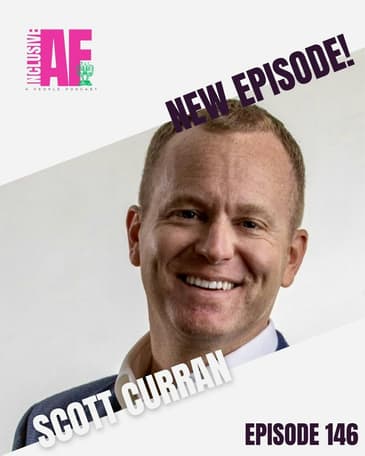
🌟 Dive into Episode 146 of The Inclusive AF Podcast 🌟
Join us as we sit down with Scott Curran, a corporate attorney and CEO of Beyond Advisors, who is reshaping the landscape of social impact, law, and DEI. Explore how Scott's unique career journey across corporate law, nonprofit leadership, and consulting equips organizations to make a more significant impact.
In this insightful conversation, we unpack:
✔️ The importance of focusing on your core and how it can guide you through challenging times.
✔️ The evolving legal and political landscape around DEI and how organizations can reframe without retreating.
✔️ Inspiring stories of cross-sector collaborations and the potential for positive change.
✔️ Scott's upcoming book, "Do More, Good, Better," offering a framework for individuals and organizations to enhance their social impact.
🔗 Don't miss out on Scott's thought-provoking perspectives and actionable advice for staying grounded in your mission, even amid uncertainty.
👉 Subscribe, share, and take a step towards doing more good, better!
#InclusiveAF #Podcast #DiversityEquityInclusion #DEI #SocialImpact #BeyondAdvisors #Leadership #ScottCurran #Philanthropy #Nonprofit #CorporateLaw #Government #ReframeDontRetreat
Tune in and be part of a movement that’s making a difference. Your path to more inclusive and impactful work starts here! 🌍
[🔔 Subscribe Now] to stay updated on all our episodes!
If you like what you hear, we would like to encourage you to subscribe to our channel!
We would also appreciate it if you would rate this channel by going here: RateThisPodcast.com/inclusiveaf
We create this podcast as a labor of love. But if you would like to support this channel you can buy us a cup of coffee here: https://www.buymeacoffee.com/InclusiveAF
Powered by the WRKdefined Podcast Network.
[00:00:00] You're listening to Inclusive AF with Jackie Clayton and Katie Van Horn. Hey y'all, welcome back to another episode of The Inclusive AF Podcast. I'm Jackie. And I'm Katie. And we are so excited. We have a special guest joining us today. Incredible guest doing just some seriously impactful work across the intersection of law,
[00:00:29] social impact, and of course DEI. And so, you know, we're very excited. That's right. We are talking to Scott Curran. He's a corporate attorney, social impact lawyer, and the CEO of Beyond Advisors, a consulting firm that helps organizations scale their social impact work. He's worked with some of the biggest names in philanthropy, social enterprise, and the private sector, including Clinton Global Initiative, Starbucks Foundation, and the UN Foundation Clean Cooking Alliance. So no big deal.
[00:00:59] Right. Chill. Super chill. And on top of that, also a professor. You have a law school course called Lawyers as Social Innovators. And that is, from our understanding, the coolest course. So that's always no pressure for you, Scott. No pressure at all. But yes. We're glad that Scott is leveling up with us today. Yes. Yes. I am too. And I just want to say something about that designation of one of the coolest classes for law students. No joke.
[00:01:29] I have no idea to this day how that designation happened. And it actually occurred before the syllabus was ever written. True story. True story. Yeah. So you want to talk about a no pressure situation? I was like, oh, no. We were just talking about that. Someone used to say I was the best networker in Miami. And I was like, it's because I'm terrified. Now I have to go. People are expecting me to be there. I better figure this out.
[00:01:57] Nothing like rising to the level of other people's expectations. Right. That's right. Well, we know that you've weighed in on CNN, Hollywood Reporter, other media outlets about the increasing legal attacks on DEI, which we all feel very, you know, one way about, particularly now with the Trump administration and everything shifting in the landscape. And today we're going to go into all of that. I just told her not to do that, but she wasn't listening, Scott. So see, she's- I love it.
[00:02:26] Listen, don't let me do what I want to do. It seems like all the rules are out the window. So I think everything's fair game right now. I do what I want. I don't listen to instructions. She's not the way they're smart. Yeah. In case you haven't picked up yet. But Scott, thank you for joining us. Thanks for having me. Yeah. How are you doing today? And is there anything else you'd like to add to your illustrious introduction? No, thank you. That's very kind. Other than, you know, what's on my mind is what's on everyone's mind, which way is up. And where do we go from here?
[00:02:57] Absolutely. Absolutely. I just feel like right now is such a volatile time. There's so many things that are there. You know, I just kind of want to start from the beginning. That's a good place to start, right? Like you've had such a unique career looking at corporate law and then the nonprofit leadership and now consulting global organizations. So what's inspired you to take this path?
[00:03:22] I think the same commitment to service that probably runs through, you know, both of you and most of your listeners and most of the people who care about any and all social impact work, including but not limited to ESG, DEI. Pick your favorite acronym. You know, to me, it goes back to CSR in the 50s, which has evolved substantially. And in my view is an indicator of probably a lagging approach to wider social impact work.
[00:03:46] So I was raised in the same way, a commitment to service and all we do in the households in which I grew up and evolved over time. And so, you know, I didn't know exactly what I would wind up doing in my life. I wanted to be an astronaut for most of my life. Still do. I don't think you give up that dream. I went to space camp four times. And then I was only dissuaded from that path when I finally went on college visits and realized what was involved in an engineering degree.
[00:04:16] And I was like, wait a minute, that's a lot of math and science. And the admissions person was like, you do know what's involved in being an engineer, right? And I said, well, I think I have a better idea now. And so I went through undergrad, liberal arts major, and went to law school knowing I didn't want to be a lawyer in the traditional sense.
[00:04:40] So even when I wound up practicing corporate law at 24, I knew that wasn't what I was going to do for the rest of my life. But I knew it was preparing me for whatever would come next. And so I soaked it up like a sponge and couldn't have done anything that came after it but for that experience. So, you know, one thing I've learned is that it's all cumulative and that everything we're going through in any given moment, including this one, is preparing us to be stronger in the next. So it's a huge part of it.
[00:05:06] Even if we can't see exactly which direction it's taking us, you know, you can only connect the dots looking backwards. And so but there was this through line of service. And so I took a little bit of a detour in my fifth year of corporate practice. I left the practice of law and went to Arkansas and was in the inaugural class of the University of Arkansas Clinton School of Public Service to get the nation's first ever master in public service degree. It felt consistent with that through line, but I had no idea what it would mean.
[00:05:34] And none of us did because there were no graduates of that program and there was no degree by that name offered before. And so that's what launched me into the sort of global philanthropy for for 10 years. And then, you know, that was a ride all its own because the Clinton Foundation in 2005, when I first met it, was vastly different than the Clinton Foundation in 2016 when I left it and when the entire world was focused on it. So I learned a lot during those 10 years.
[00:06:01] And then even though I had a stronger version to ever being a consultant, wound up becoming a consultant and have really enjoyed it far more than I ever thought possible. And really, the end game is to give away as many of these tools and resources as possible to the people and the individual or the organizations that are doing the work to make the world a better place. So it's that same through line. It doesn't really matter what the title is, what the work looks like.
[00:06:25] Like there is this through line of service and people who are committed to impact by whatever name and on whatever side of the acronym they're on, whatever the acronym may be. But that's that's a long answer to a short question, a through line of service starting from when I was born to where I am today. Awesome. And so, you know, obviously, Beyond Advisors is your consulting company. So tell us a little bit about the concept of that that hardest parts of doing good.
[00:06:55] Well, what does that mean? And what what does that actually translate to? So. I'm trying to give you the short version. When I left the Clinton Foundation, which in 2015, 2016 was at the time the most scrutinized nonprofit in human history and the not the first, but one of the most high profile to be turned into a political football.
[00:07:21] I think that title will fall in the years ahead, that it will be the most scrutinized or politicized nonprofit. But I knew that we had done some incredible work with fourteen hundred people in 40 countries, 35 U.S. states working on over a dozen different initiatives that ran the gamut from public health to traditional development to world changing conferences.
[00:07:42] The Clinton Global Initiative was at the end of the day, a conference to a different dynamic presidential library in Little Rock through to women and girls, early childhood education, et cetera, et cetera. And I knew that the toolkit we had assembled was was super valuable. And I knew that it wasn't mine to keep. And so I just wanted to find a way to give it away, to use it and deploy it in the best way possible, because I had seen what was hard about this.
[00:08:08] And there's a lot that's really hard about social impact and particularly nonprofit work. But I'd also seen the patterns, the frameworks and the patterns that were shared between and among all of them. And they as I sort of like came out of I was described leaving the Clinton Foundation after 10 years as being like leaving the engine room in the basement and like coming out to the light of day, squinting and looking around, trying to get your bearings. I was like, I think this would be valuable and helpful. And so I just wanted to find the best outlet to give it away.
[00:08:35] I thought for sure I would go to another nonprofit or worst case scenario, go to a big law firm and use that as a purge. And then I found neither of those would would allow me to best give it away. And so I ultimately had to create my own thing, which became the consulting firm. And so the driver was to take this framework in this toolkit for doing these hard things well and in a way that would stand up to unprecedented scrutiny.
[00:09:01] Try to get those to as many organizations and individuals making an impact as quickly as I could. And so that is what prompted us to start it. What it looks like can take a few different forms. For my purposes, I would say the hardest parts of doing good well generally fall into four categories of work. Governance, compliance, legal and operations. Those are four big buckets. Most of us know that they're all really important, but not all of us can give any or all of them a definition.
[00:09:28] I really know governance is important, but many people put on the spot would be hard pressed to provide a confident definition. Same with compliance. Legal is a huge bucket. Most people don't have a legal budget and don't know which lawyers to call, much less what questions to ask or how to put their guidance to work, et cetera, et cetera.
[00:09:47] And then operations, which is including but not limited to HR, which is a massive piece of the work we do, also has tried and true realities around it that scale. And so my goal was to take those things and make them easier to understand and even easier to put to work in any organization, whether it's brand new growth stage or scaling and having been around for a while.
[00:10:13] And so that was my motivation. And my focus is across the four primary elements of any organization. It's board, operations, programs and partnerships. And 1.8 million nonprofits in the United States. They are all special, but none of them are unique. They all start the same way. They end the same way. They file the same thing every year. And we know how to make them work well. And so that was it. Governance, compliance, legal and operations across boards, operations, programs and partnerships.
[00:10:38] And how can I give away the same framework for understanding that and the tools underneath it as quickly as possible? And so that's what gave rise to Beyond. So does that mostly focus then on just like, is it just for nonprofits or do you also work with for profit organizations? Yeah, we absolutely work with more than just nonprofits. We work with for profits. We work with social enterprises. Anybody who's incorporating social impact into their work, we can probably help. There are some limitations.
[00:11:07] We are a boutique. We're small. We can't do everything that a McKinsey social sector practice could be. I always say, you know, if McKinsey social sector practice or Bain and Bridgespan are the Navy, we're the Navy SEALs. We come in for special operations. We're a smaller group. There's only so much we can do, but we're pretty damn good at what we do. Awesome. Very cool. I love that. And then on top of that, you teach a law school course called Lawyers as Social Innovators. I'm glad hearing your story. It's like now you give them a place.
[00:11:37] But curious as to what led you to develop that course and why do you think it's so important right now? I haven't taught the course since the pandemic, but I literally just sent an email this morning about getting it on the fall semester. And I'm probably going to change the title of it to social impact law because I think that's what we're coalescing around. And I think it's a bigger bat signal to attract people to. And that's really what it evolved into. The motivation behind it was the same about giving it all away.
[00:12:05] The only way for me to scale what I do is to either build a super agency, which is really hard, or give the same framework and toolkit away to as many people as I can. And so the law school class was one way to do that with one of the groups I think can be most effective at doing it and which I believe inherently is motivated to try to help. And that's lawyers.
[00:12:29] Because my view of really great social impact work and really amazing organizations, whether they're in the nonprofit sector, the private sector, or social enterprises in between, is that nobody's doing the great work without their lawyers. Nobody. I love that too. Yeah, go ahead. As an expert person, I'm not going to agree to that, Scott. I do great work without my attorneys. No, don't tell them I said that, though. She doesn't. She doesn't. But the other part of it is just having it applied, right?
[00:12:56] I feel like it's one of those places where people don't realize, like, no, you don't. There's other ways to apply this law degree and, you know, where you can still make that kind of impact. I think it's great that it exists. Maybe, you know, I just think it's cool. Yeah, and the slightly longer answer is that when I was at the Clinton Foundation, we had law firms tripping over themselves to give us free advice.
[00:13:19] And even when I accounted for the name on the door and the attraction to the big name in philanthropy, I found that my peers at other organizations that weren't as well known were finding the same thing. Lawyers were running to give free service to clients doing good work in the social impact space. In that case, it was philanthropy, but it's everywhere. Lawyers want to do this work. Lawyers are obligated to do pro bono, but much of this is not pro bono.
[00:13:47] And so I kept asking the chairs of these really big global law firms, why are your teams so excited to just pour this incredibly valuable and helpful work on us? And they said they love doing it. They so badly want to be a part of it. I thought, well, how can we scale that? Let's bridge this gap between the demand. There is incredible demand for lawyers and legal work.
[00:14:12] And there is an awful lot of supply, but the market is very inefficient because they're really expensive. They're very hard to use or find, et cetera, et cetera. So I thought this course could be a way of equipping every attorney with the ability to understand what these kinds of clients need and how to best meet those needs. And so that was really the motivation behind it.
[00:14:32] And I collaborate with other lawyers who teach similar courses, and we're all sort of cut from that same cloth of we know lawyers really want to do this work, but it's also hard for them to know how best to do it. And so it's all part of that bigger puzzle of giving away this framework and roadmap to understanding it so that, my view, no organization should ever fail to survive or thrive because they lack access to good guidance and tools.
[00:14:57] Yes. And, you know, and I think that kind of takes me to the next topic that I want to get into, because I think, you know, in the current climate that we're in, there's this moment going on around DEI where there's legal, political challenges, all kinds of, you know, policy reversals and lawsuits and, you know, bans and all kinds of other things around DEI. Sure is. How has that shift impacted your work? Like what, what are you all thinking about now?
[00:15:28] It has impacted it greatly. We're thinking about responding instead of reacting, which is a bit of, I think, important guidance. We have to remember that the chaos we're seeing is by design. That's the goal. Flooding the zone is not a new concept. It was part of the first administration. It is absolutely part of this administration. It is the goal.
[00:15:50] And I think if we all take a beat and a breath to realize they want you to feel this way, confused, overwhelmed, they want you to feel it's too chaotic to manage or handle. And if you can take that beat and if you can take that beat and realize that's what they want and then work against that, that's how we win. One step at a time in the clear right direction. Don't get pulled off your course. Yes, we have to make adjustments.
[00:16:19] Yes, we can reframe. No, we shouldn't retreat. We should keep going because the chaos, the confusion and the overwhelm is what they want you to feel. So that's what I'm trying, you know, despite all of the work we can do across governance, compliance, legal and operations. The most important thing we're delivering right now in response to overwhelming inquiry that we are unable to meet.
[00:16:44] We are taking no new clients. We are not doing anything net new. We are not in a business development mode. We are simply trying to serve the current clients, but also put out, you know, sort of evergreen, timely messaging. It would be keep calm, stay focused. Don't allow the intentional confusion and overwhelm to get the best of you. It is it is the design. It is the intent. It should not, therefore, be what you focus on.
[00:17:14] I'm going to play that clip every day with my coffee. Like, Jackie, before you turn on the computer, remember, because it's everywhere. It is the single most important thing any of us can do right now. And, you know, we all know this and I do a ton of HR work and love the HR work and feel the same way in times of trouble. The number one thing we guide clients to do, no matter what the turbulent time may be, in times of trouble, double down on core functions.
[00:17:45] Protecting your core is not a new concept. It's not specific to HR. It's not specific to DEI. It's not specific to the law. It's specific to life. Protect your core. And so in these times, double down on what you do uniquely well. Focus on the safest, strongest parts of what you do. Keep your focus there and only branch out or expand from there. I think that's one of the things that have been so frustrating.
[00:18:12] Someone asked me recently and they said, well, now that we're seeing this in the climate right now, how does that change your work? And I go, oh, I guess it's just not important anymore. So no one will look. But my work doesn't change. It's the same thing. Like we're still trying to get these environments. And I think there's organizations that are like, we're just hiring fairly.
[00:18:36] You know, how are you seeing organizations like nonprofits or corporations that are saying, hey, we want to keep doing this work. We're seeing the benefit of it, but they want to stay compliant. They're just using the word is a fear. So how are you talking with some of your existing clients or nonprofits that you're working with and what, how to manage it? The three word answer that we're giving is reframe, don't retreat. Reframe, don't retreat.
[00:19:05] If you have to give up the acronym to keep doing the work, fine. Right. But the work is never going to stop. The diversity, take away the acronym DEI, say the words out loud, put them all in lowercase. Diversity, equity, inclusion have been part of America from the very beginning. They are part of America today. They are going to be part of America as long as America is here. Period. Hard stop. Fight me on it. It's true.
[00:19:31] No presidential administration or minions or political attacks will ever change that. We have to live in that reality and that truth. It doesn't pick your favorite period of history or favorite leader. It is true that our diversity makes us great. Our pursuit of a more perfect union where people are treated more equitably and inclusively.
[00:19:55] And the profits that results from that for corporations and the better decisions that are made by any in and by any organization that is more diverse, that is more equitable, that is more inclusive are always better. They always are. That work is going to continue. Private markets are going to drive it. The demand is going to drive it. Yes, there may be a contraction. Yes, we may feel we're selling our soul if we stop using one acronym, one phrase, one title or another.
[00:20:25] But just reframe it. Don't retreat. Reframe, don't retreat. That is the most important guidance we're giving clients right now. And it opens up the world of what's possible. How can we reframe it in a way that we can keep doing it without becoming a target?
[00:20:43] And that is what most of the organizations with which I'm working and the people with whom I'm collaborating right now are focused on, which is how do we reframe to minimize and mitigate the risks of being a target while continuing to do the work that is important to us and our team and the stakeholders we serve. And that's the recipe for success for this moment.
[00:21:06] I think that is great because that actually I'm going to go into chief people officer mode for a moment and ask a question. So, you know, we've seen this rise in the anti woke or everyone's too woke, you know, rhetoric and how that has really been influencing corporations, you know, name brands that we know very well and have loved and, you know, and nonprofits as well.
[00:21:33] So what are you telling leaders on how they respond to this pressure? Like, how do they respond to their team members? So they can stay aligned to the values of the organization. Like what, what should they be saying? There's different answers for whether we're talking about an internal facing answer or an external facing answer. And that's really where the volume has been turned up right now, which is how do I respond?
[00:22:00] How do I present publicly to this changing landscape and this dynamic? And obviously, if if and when the legal requirements change, everybody should stay compliant with the law. There's no question about that. And there are really great organizations that are going to work to protect the legal boundaries. And those things shift. That's part of the great American experiment. And we're in this new phase of the great American experiment right now. And I hope the rule of law remains strong and is upheld.
[00:22:30] And I hope the separation of powers are upheld and withstand. And assuming that they do, we're going to see some shifting boundaries. And I think, again, if we just find ourselves in the space of realizing the boundaries are going to shift and we're going to comply with them when they do. We may or may not like them. And we may win some, lose some. Two steps forward, one step back. One step forward, two steps back. I don't know what the dance is going to look like, but I know we're going to keep dancing.
[00:22:56] And so what I say internally for clients is keep communicating your mission, vision, values and stay true to that. And whoever your stakeholders are, if it's in the for-profit context, this is your market. This is your these are your customers and your clients. These are your shareholders. These are your supply chain stakeholders, et cetera. And there's a lot of people impacted within and throughout those ranks. And so your answers can vary greatly depending on the type of organization you are.
[00:23:22] If you are speaking externally to the world, you're going to have to be a bit more measured right now, especially if you're on the forward leaning side. If you're a government contractor, you have to comply immediately with changes to government requirements. And so you have to be nimble and quick. But staying true to your mission, your vision, your values, that core of who you are, what you do, who you serve and how you serve them is so fundamentally critical right now.
[00:23:47] And some people can be so distracted by what changes they have to make that they overlook the changes they don't have to make. The things they can keep doing within their control and within their organizations to keep serving their internal stakeholders and their external stakeholders in the markets. So right now we're really just strongly encouraging people to take the beat, take the breath, take a key strong inventory. You are the same organization you were yesterday. There's some external factors that are impacting you.
[00:24:16] There may be some changes we have to make. We can accept the fact that we won't feel great about all of them. We won't love them. But they may be necessary for us to live to fight another day. I'm glad that you brought up to like the American experiment. I was just I got like really emotional. They were talking about George Washington. It was George Washington. And they when he became president, he wrote this letter talking about, you know, how this is going to happen and why it's going to be so great. And the leader is going to do this.
[00:24:44] And it's and and it makes me think of you saying earlier, like going back to your core, like if you were double down, protected on your core. We've gotten that kind of off off track a little bit, it feels like. And I know that it is, you know, it just made me think about that a little bit of being able to do that. And I know organizations are having to like rethink how they approach it, not just as compliance, but deeper cultural reasons and ethical commitment. But what advice do you have?
[00:25:13] And it might be the same. I think you kind of touched on it about not just that's legally defensible, but like meaningful. Is there a way or a direction that you think that they should take that can have the greatest meaningful impact right now?
[00:25:31] Communicating to your core constituents, your key stakeholders, what it is you value and care about and really reinforcing that commitment to them and that you're going to get through this together and with them and invite them into the conversation is the single most important thing any organization can do. We're seeing right now in the news.
[00:26:21] Looking at the headlines and the trend lines that result, you see a contraction. You see big businesses, big brands changing things like their DEI initiatives or their ESG work more broadly or what I would call the broadest levels of social impact work. It's not going to stop. It's just going to change.
[00:26:45] So inviting everybody into the conversation of how we can keep doing the things that really matter to our organization, the individuals within it, the markets we serve. And that's true for for profits and nonprofits. And it's true for the government as well, which is where this great American reckoning is going to happen amidst all of this, which is are we being true to our core principles? Like I just try to figure out, like, what if you just apply a basic HR lens to what's happening in the administration? Like, wouldn't they be fired from like so many organizations instantly?
[00:27:13] We should probably lean in on that conversation because I think it's really important. I think accountability matters, especially when you're an elected official who's accountable to the American people. But I think for organizations, they have to invite their teams and their markets into the conversation about how we keep doing the things we care about, starting from the place that there are things we all care about. Right. Starbucks cares about selling coffee, tea and cocoa beverages. And they care about the first mile and last mile.
[00:27:42] They care about their their growing communities around the world that grow coffee, tea and cocoa. And they care about the last mile, the stores where their team members serve their customers with those products. And so if we start from the place that we know there's things we all care about and that there's there's markets we're serving. That's where we find the comfortable space rooted in our history, hopefully have deep roots on that. And we keep doing that work, even if we have to change some of the other things about it.
[00:28:10] But we're staying so grounded in that core principled work, which, again, I think has always been part of what makes America great is still part of what makes America great and is going to keep being part of what makes America great. Let's take it back. Let's talk about it. Let's say it out loud and speak its truth into every market. Because, look, at the end of the day, this reckoning is not just going to be political. Markets move.
[00:28:30] Like, to my understanding, the right and the political right loves the Citizens United ruling, which basically said corporations are citizens for purposes of free speech. Super duper. How do you reconcile that with an anti-woke and or anti-DEI ideology? I'm listening. All ears.
[00:28:54] Because either you believe corporations have free speech rights that the government should not interfere with and tread upon. Or you're not an honest broker. And it's OK. You can say it out loud. But we should ask the question. We should demand the accountability. We should ask them to perform against their own standards. Like, we can have these. This is the conversation we can and should be having. This is the accountability we should seek. This is what the press has every ability to be asking elected officials about. And we can and we should do it.
[00:29:22] There is power and strength in these bedrock principles that still exist. So, again, going back to the core of what actually makes us great, it includes the fact that we care about inclusive workspaces and marketplaces. And that we believe free speech really matters. And that the private sector should enjoy its free speech rights. So, which one is it? And I think we're at that reckoning. I think it's going to happen soon.
[00:29:46] If we can continue to strengthen and uphold the democratic institutions that support it, separation of powers, balanced government, the authority of the judiciary. These are all real questions evolving in the news cycle in real time, too. But if those things hold, we, the people, can continue to pursue the more perfect union, even against a really imperfect set of circumstances. Awesome. I love that. So, you know, obviously we're we don't want to be all doom and gloom. And you're what you're sharing is awesome.
[00:30:15] And I think so enlightening for folks, especially, you know, in our roles where we're on the front lines trying to stay the course and do the right things with our, you know, with our team members, etc. But what what shifts are happening right now that are giving you hope? Well, there's a one there's a wonderful Mr. Rogers quote that I think he elevated after September 11th, which was shortly after Mr. Rogers retired.
[00:30:45] And. He was asked how to. Talk with kids during times of tragedy, and he recalled something his mother had told him that even when things are really difficult, you should look for the helpers. Because there are always helpers in a fire after an accident in any sort of tragedy, there's somebody showing up to help.
[00:31:07] And so I again, core functions like a kid who grew up on Mr. Rogers, going back to the core of what I've learned is to look for the helpers. And I am really encouraged by seeing all the helpers. I see leaders in government. I see leaders in the private sector. I see leaders in big philanthropy. I see leaders in small nonprofits.
[00:31:29] I see leaders in C suites, in HR offices, in program teams who are all trying to be part of the solution to help across the entire spectrum of issues that were there before the current president was inaugurated and will be there after that president is no longer serving as president. And I am very encouraged by it. There are some organizations doing incredible work. There's, you know, old school institutions that have been around for a long time that are stepping up.
[00:32:00] There are brand new ones that are stepping forward. And look, I think there's some that have caused us all some concern. I think we all watched the big tech companies and the tech bros show up and appear to kiss the ring at the inauguration and cause us all some concern. I think even within those organizations, we're seeing some disruption and recalibration. And I expect, you know, look, the pendulum swings. It just does. And it never stays in one place. So we're seeing the pendulum swing wildly in a new direction. It will come back.
[00:32:29] It always does. The question is, you know, where how far will it go and when will it start turning back the other way? But I'm really encouraged that, you know, even though it's been a heck of a four or five week period at this point, it's going to swing back the other way. I don't know when or how quickly. And I don't know who will cause it to move in which direction the fastest. But I am very hopeful to see the number of organizations and individuals of prominence who are responding to the moment.
[00:32:59] That's what gives me hope. And if we look around, they're there. They are there. I can appreciate that. We were just talking about that. We know the pendulum is going to come back. We don't know how far, but there are lots of helpers. And I know you've been, you know, law, philanthropy and in business and been able to kind of work cross sectorally. I would love to know an example of a what a good partnership looks like. Any key lessons that you've learned working cross collaboratively in that way?
[00:33:30] So many, so many. Yeah, it takes all of us, right? The world is hot, flat and crowded. It's very small. Look, when I the first day of my law school class, I literally write on the whiteboard. On the left side, I write the I write nonprofits. On the far right side, I write private sector businesses. And in the middle, I write social enterprises. And over all of it, I write social impact. And so the greatest social impact work is happening with cross sector partnerships. Big philanthropy is wonderful and it does what it does.
[00:33:59] It has its critics and criticisms and rightfully so. And it should be responsive to those things. There are things within the current administration that are fair. We can find incredible agreement about some of the things. Look, nobody wants fraud, waste or abuse. I can't find anybody who raises their hand and says, I love fraud, waste and abuse in government.
[00:34:15] But there's also very few people in this country who really want to give America's leadership over to other countries with lesser intentions. And so when we see things like USAID being shut down, etc., those things scare us and cause us concern because they confront our identity as the world's leader and not just its boss. Because it's better to be the world's leader and not just its boss.
[00:34:44] And we're seeing those leadership pieces being whittled away. And that's a big concern. But the government is never the answer alone. The private sector is never the answer alone. Nonprofits, even at the highest levels and versions of scale, can't solve all the problems. They're dwarfed by the private sector and by government. So the best solutions are found between and among their work together.
[00:35:11] And, you know, there's all kinds of examples of cross-sector collaborations. We've all seen it, right? Buy one, give one models. Pick your favorite, right? Tom's Shoes, Warby Parker, so many of them now. You know, a portion of proceeds goes to benefit a cause I care about, right? Rounding up at charity at checkout. We see it everywhere. That's all cross-sector collaboration. It's in front of us everywhere we go all the time. I mean, it seems like you can't do a digital checkout without being asked whether or not you want to be a social impact leader in that micro moment.
[00:35:40] And, you know, round up for a cause that you may or may not have ever heard of. And so there's all kinds of wonderful examples in daily life. And I love that. You know, it's proliferated our lives. And look, I think people, when they show up, you know, until the robots fully take over, it still takes humans to run these organizations and these institutions. And therefore, our human resources are our very best and most valuable resources. And every single one of us cares about leaving the world better than we found it.
[00:36:08] And if we're given a choice to make a positive difference, we will. And we do. We're wired for it biologically throughout all of our history on this planet. We are wired. We have chemicals in our body that literally reinforce and reward us for doing good. And so it does not matter what sector you work in. It does not matter what sector you serve. It does not matter what sector you show up in as a consumer. You care about doing good. Everybody cares about doing good.
[00:36:35] And so if we look around, we see those cross-sector collaborations everywhere. They don't have to be the big, massive partnerships. They don't have to be, you know, South by Southwest, Davos, GEA, the Clinton Global Initiative. You don't have to go to a conference to do good. You don't have to write a check to do good. And so that cross-sector collaboration is not as big and unique as it sounds. We see it everywhere, every day. And so my favorite examples are the ones that we interact with every single day. If you have a public library and you're a taxpayer in your community, or if you volunteer anywhere,
[00:37:06] if you are a member of a faith group and you do something within your community, those are the great, you know, public-private partnerships occur all over every day. And so those are my favorite examples. The ones we see around our corner, down the street, at the supermarket checkout, those are my favorite. Awesome.
[00:37:28] So, you know, all of this being said, I would love you to share, if you can, a little sneak peek about your new book that is coming out, I think, soon. The do more, good, better. Can you share a little bit about that? I'd love to. I feel like we've been talking all about it. It's fundamentally, my goal was to give it all away. I actually started writing it as a guide to give it away to nonprofits to say, here, here's the roadmap to success.
[00:37:55] And specifically in the nonprofit space, there's 1.8 million, give or take a couple hundred thousand nonprofits in the U.S. Within 10 years, a third of them fail. Within their first 10 years, a third of them fail, but they don't have to. Many of them do for reasons outside of my view of the world, and many of them shouldn't have existed in the first place or shouldn't have been a nonprofit. But my original goal was to give away that framework and toolkit so that nonprofits could not just survive but thrive, because so many of them won't ever have access to the kinds of resources we saw.
[00:38:25] A lot of people thought that was a great idea, but sounded like a really boring book. And so I'm not writing that book anymore. I'm writing a bigger book that applies to any individual in any organization, but follows the exact same framework. So in my view, there's three types of personas in the world. There's people who are new to doing good and want to get sort of their sea legs under them in that journey and might be new to the idea or where and how they'll find it in life or in work.
[00:38:55] There's those who are already doing good and want to do more of it. And then there's those that are doing really great good but want to do it even better or at scale or in new and dynamic different ways, which is the space that I've been very fortunate to spend a lot of my career in because I've been working with really high performers. What I realized is they all follow the exact same pattern, every single one of them. And so that's what I'm revealing in the book. Say here. I'm not special.
[00:39:20] I just got lucky to sit in a seat and work and have this incredible career that pivoted from the law back to school and public service into philanthropy, back into law while in philanthropy, working with these global leaders across sectors and all of their cross sector work. And every single last one of them followed the exact same pattern. And so it's that pattern with very specific examples, including some incredible, amazing, fun clients who are interesting to read about.
[00:39:49] And I'm sharing saying this is the exact same framework every last one of them use, whether it's former presidents, and I've been fortunate to work with multiple of them, whether it's A-list actors who I grew up watching and have been enamored by and have now been thrilled to work with, or honestly, whether it's the nonprofit on my street corner, which I literally discovered when I got off the train one day, walked into their door, the bell over the door dinged when I walked in, and I still work with them today.
[00:40:16] It does not matter who you are, where you live, or what you do. The opportunity to do good, to do more good, and to do more good better is part of your daily life every single day. And there are so many more of us who can do more of that kind of good that makes such a huge impact compared to the organizations and institutions we usually think this is reserved for. And so that's the overall approach to the book.
[00:40:40] At first, I was incredibly insecure and had insane imposter syndrome about whether I had any standing to write that book at all, because I'm literally a nobody who nobody's ever heard of. I now have just slightly less imposter syndrome, still a huge chunk of it. But what I realized is that while I'm not special, the experiences I've had in my life and in my career to observe these incredibly high performers who follow a shockingly simple approach was, in fact, unique.
[00:41:10] And that's the best part of the book that I'm excited to share. Awesome. I should wait for people to get it. I feel so good today. I wasn't sure. You know, we talk about this all the time. It's been a rough couple of weeks, like you said. You know, last week was a long month, but it's been such a powerful conversation and helpful. So I want to just thank you for sharing your insights. And like I said, especially for that bit that I'm going to start listening to every day. And for all of the work that you do, helping organizations navigate through this space,
[00:41:39] because there's so many challenges, it feels like. But knowing that you're there and knowing that there are other people doing this work together, just pushing forward, I just really want to tell you that I appreciate the work that you do. Thank you. And I appreciate the work you guys do. And it's important. It's more important now than ever. And we have to not just look for the helpers helping others. We have to look for the helpers who we can help and who can help us, because our amplified effort is going to be the answer. It's going to be the antidote right now. None of us are bigger than government. None of us have the power of the presidency.
[00:42:09] But all of us together are bigger than it. And we ultimately are the ones to whom it answers. And so we have a voice and a role. And every single day, we should be wrapped in that enthusiastic approach to wait a minute. This is actually more my country than it is anyone else's. And if we all say that and work towards our vision of that more perfect union, that's the answer of this moment, right? That's not my focus. I actually don't do politics at all. I've worked with former politicians, but I've never worked for sitting politicians.
[00:42:38] And I don't work in that space. But I'm affected by it. We're all affected by what happens. Everything has social impact. It doesn't mean it's positive social impact. There is definitely negative social impact. In fact, there might be as much or more negative as there is positive. But if we calibrate and work around it every day, we will find it. We will find the opportunity to take that next right step in that direction. Whether it's DEI, ESG, social impact, philanthropy, government, public service, you name it.
[00:43:07] Every single one of us has an opportunity and a role to play every day. And we can't forget that. Forgetting that because we're confused and overwhelmed by chaos is someone else's strategy. Do not let it be yours. That's right. Awesome. So, Scott, we are going to do a little round the horn here. So, what is one thing or what are a couple of things that you want to make sure people heard during this episode?
[00:43:37] You are the answer to the challenges you struggle with most. Your next right step in taking action, even if that action is an extra beat and an extra breath, and realizing that you're not going to let confusion or overwhelm get the best of you, the moment, your work, your approach, your interactions with others, realizing that that is playing into someone else's strategy,
[00:44:05] and that takes you off the highest and best version of your work and yourself and your ability to show up each day and do the thing that you do uniquely well, in my view, is the single best way of preserving those core functions that are the best of each of us. It's so important right now. We have to take care of ourselves. We can't take care of anyone else unless we take care of ourselves. And protecting the thing that lights you up and pours rocket fuel and the things you do uniquely well is what's going to help us get to the next day.
[00:44:34] One of my favorite quotes, which is not mine, is, you know, you've survived 100% of the hardest days of your life to date. You will get through this one, too. But make it more than just getting through it. Get through it in the best way possible. So protect that core. You're the answer. And you can get through this day, too, with a focus on what is uniquely yours to give. Awesome. Jackie, what you got? I think I want people to know, first, that they're not alone. There's a lot of people that want to do good work. And it can feel like that.
[00:45:03] But you do look for the helpers to remember to do that. And that you're not wrong. Like that feeling, it's still the work. It's still the work that we have to do. And we're not wrong in trying to make it a better world of work. And just a better world for all of us in trying to be fair and balanced. So just keep going. One foot in front of the other. That was like 25 things. Yes, yes. You both did good. And Jackie always complains to me that I take everyone else's. And I'm like, because you guys say all of the things.
[00:45:34] But I think for me, protecting the core, like the frame that you put that in of not just the core of the business, it's also the core of yourself. And I've never thought about it that way. And I think Brene Brown has a, and I'm going to horribly butcher this, but something about like the hard shell but soft underbelly kind of thing. A similar thing where you have to protect your core. And how are you doing that in your organization? How are you doing that for yourself?
[00:46:04] It's such a critical thing. So Scott, I'll echo what Jackie said. Thank you so much. This has been awesome. But where can folks find you? I'm most active on LinkedIn. So find me on LinkedIn at Scott M. Curran. There's a couple other Scott Currans out there. My middle initial is M for Matthew. But Scott M. Curran, you can also find my personal website at scottmcurran.com or find our business website at beyondadvisors.com. Awesome. Y'all, well, this has been so great.
[00:46:34] I know it's the conversations that we need to have. And for our listeners, if you love that episode, please make sure and subscribe, leave us a review and share this with someone who needs to hear it. Absolutely. So keep it inclusive. Keep it real. I think we just had a very real conversation. And we'll see you next time on the Inclusive AF podcast. Bye. Bye. Bye.
Sponsors
