
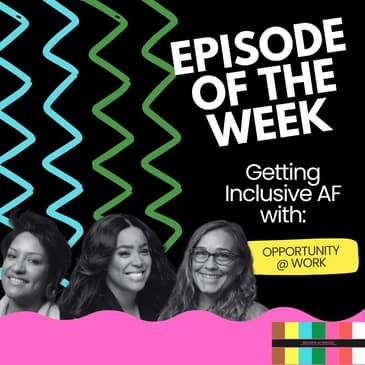
Welcome to the Inclusive AF Podcast! In this episode, we dive into the power of skills-based hiring and the value of non-traditional pathways. Our guests, Natalia Lara, Crystal Zilliox, and Danielle Guadeloupe-Rojas, share their inspiring journeys and advocate for dismantling traditional hiring barriers. From overcoming imposter syndrome to emphasizing transferable skills, they remind us to embrace diversity of thought and experience. Join us as we champion confidence, lifelong learning, and the importance of valuing practical skills in creating truly inclusive opportunities. Let's tear down barriers and embrace the future of talent recruitment!
Powered by the WRKdefined Podcast Network.
[00:00:00] You're listening to Inclusive AF with Jackie Clayton and Katie Van Horn. Alrighty, Jackie is back. Woo, woo, woo, woo! I know. Welcome back my friends. Thank you so much. I've been doing absolutely nothing. If you can tell, look at my face. I look relaxed. Yes.
[00:00:25] That's exactly what I've been doing. Can you tell on my face that I have been doing too many things? I was going to say, but I didn't want to say. Yeah. We'll just sit there. This is the Inclusive AF podcast. This is Katie Van Horn.
[00:00:40] And this is Jackie Clayton. And today we have multiple guests. I know people are going to be very very confused, but I'm really excited about it. Yeah. We have a whole room full, a virtual room full of peeps, which is awesome.
[00:00:54] And so I think we just need to get this party started. So Danielle, I'm going to turn it over to you to have you introduce yourself and then we'll do a little around the room and Natalia and Crystal jump in. Thank you so much.
[00:01:09] And thank you for having us here today. So I'll kick it off. My name is Danielle Guadalupe Rojas. And I am a director at a organization called Opportunity at Work. We'll get into a little bit more about what we do,
[00:01:21] what we stand for, and introduce you to the term stars. I come with a large background in DEI and as well as workforce development, 15 plus years in the game, but who's counting and really truly enjoy the work that we do at Opportunity at Work.
[00:01:39] And I am a star. I'm going to go ahead and pass it over to some of my colleagues that I've brought here with me today to tell you a little bit about themselves, what they do at the organization and a little bit of the work that we're doing.
[00:01:50] Yes. So Katie, Jackie, it's so nice to meet you. It's so fun to be part of a podcast that talks about inclusivity. As Danielle mentioned, we work for the organization Opportunity at Work and I am also a star. That's an individual who is skilled through alternative routes.
[00:02:11] We'll talk a lot about our star experience and journey, but I'll share a little bit about my background. I grew up in the Northeast. I'm a first generation immigrant that grew up in a household with a single parent. I attended public school and although I had really great
[00:02:30] grades, I was not able to make it to college after a brief stint in the Army National Guard. I went into the workforce and for about 12 years, I worked my way up and what was a professional in talent acquisition and had a few other stints as HR generalists.
[00:02:48] So I'm very familiar with your world. And today I work as the director of product design for Star's inclusivity. So we work with partners as well as our internal teams, one of whom which is here today. And we design tools and products that will help
[00:03:08] talent acquisition specialists, employers, job seekers who are stars to navigate and increase their upward mobility. Great. Hello, everybody. Great to meet you guys. I'm Crystal Zilliocks. As Danielle and Natalia, I am also a star. My career started over 30 years ago serving as a member in
[00:03:33] the United States Marine Corps as a technical liaison. So as IT, my career has had so many twists and turns, one of which included maybe two years of college, but for lots of reasons decided not to finish that, but I've been an IT.
[00:03:49] I've built help desks, customer service, customer success. I've been in high end technical sales marketing. I've done many years, I guess the last decade, I've really been focused on the sourcing and recruiting market, the last six a wish formally as a product manager.
[00:04:07] And so currently I am a senior member of the product team at Opportunity at Work. And I really focus on building tools for star inclusivity, right? So building tools for employers to understand our mission and building tools for stars to understand where they fit within our mission.
[00:04:23] And really honestly just trying to give back, I'm a star that has a really weird career transition that would make that looks really bad on paper. But if you get to know me, you'll understand my powerhouse as a product manager.
[00:04:35] And if I could do anything, I would just love to put what I've been able to do with my career in the hands of other stars and that knowledge of how valuable somebody like me could be in an organization who traditionally only looks for people with college degrees.
[00:04:48] So I'm just excited to be here, share my experiences and really kind of uncover what we might be able to collaborate here together about. I love this. By the way, I'm a star and in case you aren't familiar it stands for skill through alternative routes.
[00:05:02] So it's people who don't have to do it, which I love that. It's like oh, we were talking about rising stars and I don't know what it was. It's like super, whatever. Nova stars, it's like whatever. There's all of these different layers, but I love
[00:05:17] the public service campaign of the tear the paper ceiling. I see it all the time and I'm going to get in a car accident. I have an eye drive between here and Dallas and I see it. I get so excited. I'm like, I'm excited.
[00:05:31] And I get very excited because I think it's so many people know like when they see it, they want to know more about it and they understand what it is. And I just think it's so important. An important campaign for people to know and that
[00:05:47] you put a name on it because I don't know if people knew like why this should be something that they need to pay attention to. Jackie, if I can jump in, I really resonate with what you're saying. I, you know, growing up and moving throughout my career.
[00:06:04] As a star, I didn't know that there were all of these things that I had actually built that were valuable. So like one thing that we often talk about when we talk with stars who are like us who are like moving
[00:06:16] throughout their career without a degree is that there's tons of imposter syndrome. And we also don't have a way to like fully qualify or validate or even articulate like what our skills are, how we develop them. And so we're going to be able to really
[00:06:32] understand how we develop them. And so when the campaign was launched, I mean, I literally cried every time I see it, I cry because it just, it means so much to focus on what we do have and on the value of this diverse, you know,
[00:06:48] all of the diverse pathways that we all walked to get to where we are and to contribute, you know, positively. It's just, it's so refreshing to finally have a name that we can use with pride. And I think that's certainly that, but I think the
[00:07:04] the word star itself has such a positive connotation to it. So for me, prior to joining Opportunity at Work, I didn't know what a star was, right? I was embarrassed to show that I didn't have my degree. I was scared. The imposter syndrome was real.
[00:07:19] I did not want to tell anyone that I did not go to school. I am based out of the DC metropolitan area and the very first conversation that people like to do is ask you what do you do for a living, which is fine.
[00:07:29] I'm not going to say that I graduated from the school of life. Or if my mother was on the phone because she's a business owner and that's kind of where I got my star start from, I'd say I graduated from the
[00:07:39] school of Denise Rojas because that's a very important school. I graduated from the school of business with my mama. So I said all that to say that it really did help with my business acumen. And you'll notice throughout this conversation and
[00:07:52] just the trajectory of stars that we all don't just do one thing. We all kind of do a multitude of things when we're talking about the different industries and the different industries that we all have. And I think that's one of the things that I've
[00:08:04] seen in my life. I've seen so many skills and so many pathways. Me personally, I have been in so many different industries. I think it's easier to ask me what industry I haven't been in and what industry I haven't had experience in versus what have I done?
[00:08:18] That is awesome. And so how did this get started? Opportunity at work or just the notion of stars? The notion of stars and opportunity at work. Yeah. I think it's a great idea to consider myself a star. I do have my degree, but it took me 10 plus years
[00:08:32] to get it. Does that count? Absolutely. Yeah. You can consider me a star trajectory for sure. I'd love to tag team on this with Natalia to talk about a little bit of the work that we do. But one of our founders and CEO Byron worked
[00:08:50] exclusively with the Obama Administration several years ago and really lent aid and the research understanding what is really affecting the workforce development, talent acquisition and where's the talent? I don't know about you all, but I've had experience in staffing. And I would say for the most point, our
[00:09:10] recruiters would always say where are the stars? Where are the people that we can find and be able to help with their talent? But it was a little bit of an issue because we've all been wired, right? Just because we're working with the
[00:09:23] administration to get the data to lend to the administration to say, okay, no, there's a serious problem here when it comes to our hiring practices and we really do need to open an alternative solution to people who don't have degrees.
[00:09:36] And I want to say this for the record, we're not blaming or shaming anyone that has a degree. We're not blaming or shaming anyone that has a degree. We're not blaming or shaming anyone that has a degree. So I think that's a good thing to say.
[00:09:50] We're not blaming or shaming anyone that has a degree. We celebrate you. So we're not saying don't go to school and get your four-year degree. If that is your pathway, if that's your trajectory, we celebrate you. But we're also saying please consider that
[00:10:02] there's also alternative paths and pathways to people like myself, Crystal and Natalia and Jackie who have the skills and you shouldn't really knock them down for being qualified for a position because they probably got the skills, whether it's on the job training, apprenticeships or just simple using your
[00:10:21] skills that you've developed from other jobs to be able to do the job that is saying it requires a degree. So I'm going to turn it over to Natalia so she can talk a little bit more about kind of where stars came from, but that's
[00:10:33] kind of how we started the concept of opportunity at work. Thanks, Danielle. I don't know that I'm the one who can tell the origin story the best, but I have been with the organization for six years so I do know a little
[00:10:45] bit of the history of the history of the organization. And before I talk about that, Katie, I do want to share, you know, it's in the name, right? Like skill through alternative routes. So I would say you are definitely a star. For many, many years you were navigating
[00:11:00] your education and your responsibilities to school as well as, you know, the rest of your life. And that is the experience that many stars have today. And so what we're trying to address with this tier of the paper ceiling campaign and the mission to,
[00:11:17] you know, raise awareness about stars as a talent category is that, you know, the way that we've been hiring traditionally within our labor market has been by, you know, proxy of using the college degree as the qualifier. There's just inherent bias that goes
[00:11:37] along with like who has access to college education and what it takes to get through college education. But the reality is that we all struggle through many different challenges, whether it's education or it's, you know, working and taking classes or taking care of our families,
[00:11:55] whatever the case is. We still have the grit that you develop in school. We still have the dedication and the commitment because we have to it's a survival mechanism. Like there's so many ways that we have a lot of things in common with college graduates.
[00:12:13] So really it's not about the fact that you have a degree or not have the degree, it's about what you view as valuable when you're making hiring decisions. And because of the degree requirement that many employers have in place, it's limiting the possibility.
[00:12:28] So bringing on amazing talent that you're missing out on simply because your tools are wired to exclude them or because of that internal bias that we have to like face and be honest about and say, like, what can we do that's different? Like hello, we have 70 million people
[00:12:45] who are ready to work. Put them to work, you know, that's really what the mission is. So the origin of the star acronym was really the beautiful mind child of our former senior director of communications and the work that we did with Ogilvy and the
[00:13:05] ad council to deliver the ad campaign. So all credits go to those groups which have recently been awarded amazing things for doing the work that they do. So yeah, I would say that anyone can be a star and everyone probably is a star at
[00:13:21] some point, but it's really more about like what can you do within four stars? Awesome. And so the whole concept, you know, I think the only thing that we can think of that's kind of what I have experienced working in recruiting and in tech is some
[00:13:39] of the boot camps that were launched, you know, years ago to, you know, for folks who did not have a degree to say like here's how you write code. Here's how you start to learn. So are there learning programs that folks go through to learn this skill
[00:13:55] sets or is it stuff that they have learned through on the job training? How do folks get educated or get the skills they need for the roles? I mean, I'd like to take a stab at that. I think my path is fairly untraditional. I got
[00:14:09] you know, I started my career in the Marine Corps doing a very highly technical role and you know, there was a my next job after that. I very quickly moved into IT management and then decided to go to school for a couple years. But when I
[00:14:25] moved to a different city, they no longer had my college there. So I decided I would not to go and I haven't actually been through formal certifications classes. I have not you know, enrolled. I actually learned very well by reading articles by listening by, you know, podcasts
[00:14:41] like I soak up information differently than maybe your average person who prefers sitting in a classroom. So I would say that, you know, 90% of what I know today is literally just being in the workforce learning from my co-workers
[00:14:57] and then taking those skills. And I guess I've been really fortunate in that my brain is wired to say, okay, you know what? I have all these skills. Where else could that take me? So, you know, from going and I don't think that my path is very traditional.
[00:15:09] I literally went from an IT manager to a high end production sales person who sold high end production equipment into data centers right because I had the IT background but I had this, you know, as a manager I learned communication. I learned how to work
[00:15:25] with people. I learned how to negotiate. And so those are all skills that as an IT manager you would not necessarily think would, you know, transfer well into a high end production sales role but I made that transition very easily. And then
[00:15:39] when I worked at some of a couple of large companies I did have internal training opportunities where I'd pick up more skills. And so and then about the time I decided, you know what I'm really selling my soul in sales I'm over this. Where do I go
[00:15:51] next? And so then it was like okay I have lots of management. I have lots of IT. I have lots of people skills. I have sales and marketing background. And I thought well man maybe being like a technical recruiter would be fun. And I literally did
[00:16:05] that. But what I did is add a star because I don't have a degree. I literally had to make these career transitions and often had to start over from scratch. That was I was in a position and I was willing to do that because I knew
[00:16:17] over career like how important skill growth would be, right? And so here I am. I'm a senior member building products in the technical space for a sourcing IT kind of market. And if you think about my career path and you saw it on paper, all
[00:16:33] those skills that I built along the way make me absolutely perfect for product. I didn't even know that I would be good for product. It took a CEO of a matching algorithm company to look at my resume and say wow I think I applied for a manager
[00:16:47] of like a customer success role position but she said wow you know you because I previously worked at Indeed and I built the candidate experience from ground up and she's like you know what, Crystal, I really think that you would be a great product manager.
[00:16:59] I'm like well I'm not sure what that is but let's give it a go. And I actually very quickly moved my way up into head of product and then next thing you know over the course of three years I was building
[00:17:09] products from the ground up. And I didn't even necessarily know that I could do that until somebody saw it in me and they didn't adhere to the traditional I'm not going to care you because you don't have the title and you
[00:17:19] don't have a degree. She took a chance on me and I'm in a great place because of it. So I really think that you know skills can be learned anywhere and it doesn't have to be in a formal training program. It doesn't have
[00:17:29] to be in a formal school. I think you know your real you know solid people in the workforce are the people that are just lifelong learners. They're just the ones that are excited about learning new things. I have a tendency
[00:17:41] to get bored if things are status quo for too long so that might contribute to my moving around a bit but I'll never regret the trajectory that I took or the choices I made and I just have to be grateful about
[00:17:53] the opportunities that I was provided along the way because I've had some great managers that didn't necessarily adhere to the traditional you don't have the title you don't have the degree. So again for me now it's about building products and making and creating a fair playing field
[00:18:07] for those with or without degrees that's on that. I think it was we were we were at HR Tech last year when we were talking about Delta and they were doing skill space hiring and so they don't require a degree anymore for their pilots
[00:18:23] and what was interesting it was how many people went from high school to going into the military right they didn't get a high school degree. They've been a pilot for so many years but yet they couldn't work at Delta even though
[00:18:37] they had the hours and they had the experience because they required a degree up until last year or the year before. And so it seems like such a dumb moment like why don't you hire people for the skills that they have it's like oh wait
[00:18:53] you know like I still have value but it also speaks to the issues that we're seeing with with why DID is so important because these barriers were was not a mistake and knowing that there's a certain level of privilege in getting these opportunities whether it be race or
[00:19:15] money or mental health or being differently abled. This was set on purpose and so that's why I love the tear the paper sealant but then you look at right now nobody went to school for this particular algorithm like you would
[00:19:37] have had to catch up in the last three years so anybody beyond that didn't know what AI was when they were going or did not that wasn't something that they referenced and so I like to always say that the greatest gift that I have
[00:19:49] was that nobody told me how to do this I had to figure it out and I still figure it out so I do what makes sense and not what was written in a book from having those experiences but I think to your point earlier
[00:20:03] a lot of people do get chained and embarrassed and so it's a little early and I know you're going to share more like this but when somebody is listening right now and they're like I would agree and they're getting very excited right now where do they go
[00:20:19] what kind of things can you point them to when I go to for them to share opportunities and network do you have opportunities like that for people who are stars? Absolutely I work with a lot of big companies and I don't know if I'm allowed to list them
[00:20:37] but a lot of companies that a lot of people know on a day to day including Walmart we can list Walmart and what I think is really great is that one of the pieces of advice that I would give to how to attract being a star, employer's attention
[00:20:53] because it's not just opportunity at work it's not just us who is focusing on this there's other organizations that have signed on to being part of the tear the paper ceiling coalition and it's gotten so big that now organizations want to say we are signing up to pledge
[00:21:09] that we will as a company start to learn and navigate how to hire stars in this space so my advice to a star that is watching this is a few things one sometimes you really just have to apply to the job that says degree required
[00:21:23] just to be honest like sometimes you have to throw the baby out with the bathwater and say let's just hope that they don't catch that I don't have a degree or let's just hope that they see
[00:21:31] that I have the skill set to do this job without the degree the other thing too I would suggest is make sure you list these skill sets right you always want to tailor your resume to the job that you're applying to when you have the time but
[00:21:43] put these skills that you you have on your resume because it really might be able to replace the degree and show that you have the amount of experience based on the skill set that you listed on your resume prime example I'm in business development
[00:21:57] and corporate development people would never think that I have an IT background and I know that I can do things in Salesforce and AWS and have all these certifications they'll just think that I'm just into relationship management but lo and behold
[00:22:09] if you have a little bit of a problem I'd be able to help you with when it comes to cybersecurity and IT and network security things like that but you would never think that I didn't go to college to get that I went
[00:22:19] to a job I learned the trade a little bit into IT and cybersecurity and I collected the skill like I collect bags that's kind of how I look at it right I love to go to every single job that I've had in the past and write down
[00:22:31] the skills that I've been able to collect because it really surprises employers when I tell them I can do that as well they'll say Danielle that's not on your resume and I'm like I have too many skills I can't list them
[00:22:41] all in my resume so those are some of the two important things that I would suggest and also go into your internal HR departments people in culture departments and see if there's anything that you can do to upskill in your current job
[00:22:55] so you can add it to your LinkedIn to your resume because those kind of things will definitely help awesome to add to that because I so I work in as the director of product design I formally sat on our own innovation
[00:23:11] team and we did a lot of design research for prototypes that we were designing and one thing that I recall from the design research that we've done with stars is that like not everyone is at that kind of moment where they can
[00:23:27] say proudly I'm a star like it is a personal experience that you have to go through to get to a place where you believe that you have valuable things to contribute because the conditioning we've gotten from like our society is that like we have something that's
[00:23:43] missing and I'd like to tell this story because one I love this dear friend his name is Yvonne we were colleagues when I worked for a recruitment department and I remember I had worked for another social at a price nonprofit based in Boston
[00:24:03] sitting in the people and culture team as a recruitment manager hiring for the C-suite and I kept thinking when we would go into our team meetings I'm sitting next to graduates from Harvard from Princeton from Brown and I'm like I do not
[00:24:17] belong here like what am I doing here I feel like I'm a fish out of water and he was the person who reminded me that I'm sitting there with in a room full of like not only college graduates but graduates from elite schools that you know have this
[00:24:35] perception of just being the top tier you know like greatest minds that they create and so he had to remind me that like for some reason I'm still sitting there and it was because of the work that I was producing and it was because
[00:24:51] of the work experience that I had so whenever I think about like where stars are today and how do we get to a place where you know there's more opportunities provided the onus is certainly on the employers but I also believe that the onus is on our individual
[00:25:07] responsibility to build up that confidence to learn how to tell our story like when crystals tells me her story I get chills because I'm inspired and moved by the grid and the you know like the epiphanies that we all experience when we're like realizing
[00:25:25] wow like we actually have something to prove and something you know to contribute so I would say mentorships if you can find them definitely visit our tier of the paper sailing website where you can connect with other stars we really want for more people to hear this
[00:25:43] term to hear these stories and to tell their stories and within that community of stars that's beginning to emerge to really find that light and positivity and confidence and boost that we all want as both stars and non-stars right like but to know that we now have
[00:26:03] this platform and this movement it really means a lot and I think you know part of the work that we all will do is to become a part of it the other thing I wanted to add too is that there's over 70 million stars around the nation 70 million stars
[00:26:21] around the United States there's actually more stars than jobs like that is a fact that is a data point that we do here at Opportunity Work where we express the value of stars so I'm basically saying be proud to be a star right show it off talk
[00:26:37] about it let people know I tell people all the time I'm a star and they're shocked I said just because I'm a star doesn't mean I'm not educated I have a lot of skills I know a lot about things
[00:26:47] I could probably teach you a thing or two right so I tell people be confident let's reverse the narrative around you know you not having a degree being a bad thing but let's talk about the things that are really great being a star
[00:26:59] I've had the ability to jump into different industries Crystal you have a beautiful story and Natalia you have a beautiful story as well I think when we share these stories it really kind of changes people's biases a little bit in their head and understand that
[00:27:13] you know what being a star is a good thing and it can add value to our company I would like to double click Jackie I'm glad that you said that I don't know can you hear me yeah yeah I was going to actually double click Danielle you mentioned
[00:27:31] like a resume right building a resume I firmly believe in a skills based resume right let's stop breaking our experience down by the job titles and the experience we have let's have that whole half of that first page just double down on the skills that I've
[00:27:45] earned that are specifically transferable to the job that I'm wanting and Natalia you mentioned building your narrative that's what it's about right it's about gaining that confidence understanding transferable skills so if you're a star and you don't really know where to go start looking for career pathing
[00:28:03] tools that really allow you to kind of look at your transferable skills where you can you know see the skills that you have and how those might transfer into different career paths and then you can start looking at what your interest is and once you understand skill
[00:28:15] gaps then you can always attain look for mentorships in areas where maybe you're missing some skills look for certification or some minor training classes like there are so many opportunities I think most of us knowing yourself where you've been where you want to go
[00:28:29] building your narrative around those skills that you've gained and how those transferable skills would align into the career path that you want and so I just think that double downing on all of those is really the path that stars should take to find some success
[00:28:43] in their career pathing awesome so how do you connect with you know I'm actually chuckling as I'm listening to you because I firmly agree in every single thing that you're mentioning I love the idea you know the thread from each of you is taking those
[00:29:03] opportunities taking on stuff even if you don't have the degree in it or don't have the oh I have this specific skill and you know we know from the research obviously that women and people of color are less likely to apply and like you said Danielle
[00:29:17] even if you don't have a degree apply for the job anyhow I just had a conversation literally this morning with one of my leaders in Barcelona and said we really need a degree for this job if they've been working doing this for seven or eight years
[00:29:29] did they need a degree and she's like well yeah I guess not and I'm like okay let's just have an actual conversation about I'd rather have someone that knows how to do it versus they have to have a pretty degree as you know as you all have mentioned
[00:29:43] and so I think it's something that you know the lifelong learning and just the being able to take on new things that is something that I think is you know if folks are listening here nothing else listening to that and hearing just that each one of you
[00:29:57] really took on things that maybe weren't 100% comfortable with or didn't know you know through and through but it was let's just try it and see how it goes which I think is something that a lot of times people are afraid to do you don't want
[00:30:09] to fail and so it's the I'm just not even gonna try because I don't want to fail so if someone wants to you know if an organization wants to work with you all how do they get involved with working with you all
[00:30:21] how do they actually partner with you so in a nutshell you call me I'm the director of strategic corporate partnerships here at opportunity network and my job is really to be that connector right to connect with organizations like the walmarts and the linkedins to really be able to
[00:30:39] understand what's currently going on with your organization and see how we could be a good fit this is not a one size fits all by no means for anybody just like a star is not a one size fits all crystal has
[00:30:51] a beautiful story and itaille has a beautiful story but they're two different stories my story is completely different from crystals I was stuck in an office at the age of 14 learning how to run a business and that's how I got my skills right and I don't mean
[00:31:03] stuck it was one of the best experiences in my life but you get what I'm saying but I say that to say that our job my job specifically is to have these conversations and see that if you're already doing this work a lot
[00:31:15] of organizations are already starting to remove or say or equivalents I don't know if we've seen that before but for equivalent bachelor's degree required or equivalent experience I love that but how can we kind of talk about that language even more make it more attractive
[00:31:31] for someone like myself to want to apply and that's kind of the work that I do with these organizations and really do some solution selection again it's not one size fits all so what resonates with one company company a might want to
[00:31:45] focus more on hiring Hispanic stars versus company B might want to look at more clean energy jobs and then it is our jobs to really be that advisory that sounding board that let's think about how we can really help you create a sustainable ecosystem right because
[00:32:03] not only do you have to walk the walk but you have to talk the talk and kind of make sure everything is happening I've had a corporate partner say I need to make sure I reach out to our HR and TA teams
[00:32:15] to make sure that yes we want to be part of this but do we have the capacity to do this right so I say all that to say that we are here to really be able to help everyone at whatever journey they are when it comes to
[00:32:27] hiring stars the first thing I would strongly suggest to do is sign up for the tear the paper ceiling coalition and add your company to pledge will leave the information below so that everyone can click on the website and the opportunity at work website and I strongly suggest
[00:32:45] this going through our reports too we have some fascinating reports that really give you some really great intellect around the insight steps stars are you know affecting into these larger work communities and how we're adding value and how we're stars of many different colors and ages and sizes
[00:33:03] and demographics and we have so many different skills to add so I would definitely go to the opportunity at work website to definitely look at our reports and for anyone who's in talent acquisition in HR call us even if you're scared
[00:33:19] and you're saying I don't know where to start call us reach out to us will see where you are where you are in your journey and figure out where you want your future state to be and develop that multi-prong approach connect you with our data
[00:33:33] and insights team or advisory services team or delivery team to really be able to talk about this work and how we'd be able to best suit your needs awesome I love it and I think that this is something that employers like you said are starting
[00:33:49] to get on this train of the or equivalent but I think there's still a lot of work to do and you know I think even within the we did something at the last company I was at where we changed our EEO statement and basically said you know even
[00:34:05] if you don't check every single box but it sounds like something that you're passionate about apply and you know we got a lot of people that we would never have seen and would never you know would never have come across our desk would never have applied and
[00:34:19] you know that was also a way for us to just build this group that was very diverse very different backgrounds very different experiences but you know with the three of you as the example so many amazing skill sets that they have on paper
[00:34:35] it might be oh well you don't have the degree or whatever but what you do have like you said having that skills based resume having that I can't even list all the skills that I have on my resume like I love that because it's so true
[00:34:47] if you just jump in and start taking on things and start learning new things it is very hard to write a skills based resume at some point absolutely absolutely and I think employers need to be open-minded right the old way hiring is gone people it's gone
[00:35:03] let it be gone you know if Byron was on the call he would say we are rewiring the labor market to make sure that you know people are starting to look at us stars in a different way it's not a bad thing to bring on a star
[00:35:19] and probably people think that you have to train us so much it's like no we're just like everybody else so I really encourage people who are listening whether it's employers or fellow stars just take the chance you know I went from an operations background at my mother's
[00:35:35] office and joined a really big organization in the DC metropolitan area that was well known and they took a chance on me they literally just said you have the skills we want to mold you we're going to walk you through all the certification I was started off in
[00:35:51] financial services which is a great start for stars by the way because you don't need a degree to do the work in financial services that you just have certifications and once you get these certifications and you build on the certifications I was licensed in DC, Maryland, Virginia
[00:36:05] in property and casualty and health life and health and insurance and financial services I still have those skill sets that I learned I can tell you about insurance and read your policy still to this day it's just muscle memory
[00:36:19] so I say like to say you have to take a chance on a star a lot of people are doing it these days and I think that's what the states are jumping into we do a lot of work with the public sector
[00:36:31] so big plug to our team our policy team at Opportunity to Work doing a fantastic job we have officially 21 states that have signed up and said hey guess what we're removing the degree requirement for our state positions which is so amazing and shout out to you know Maryland
[00:36:47] because that's where I sit but we were the first date to sign up and say yes we're going to remove the degree requirement so it's really affecting more than just corporate to be honest with you it's affecting everybody and creating a larger and diverse talent
[00:37:01] pool will be helpful for everyone 100% well and I would also like I think you know we're hearing all these things about AI and all of the different you know we know so many changes are coming from a what do we need from the
[00:37:13] workforce and you know I think that's just another good point of like here are folks that are even if they don't have that exact skill they're going to come in and go let me learn let me figure it out let me let me jump in and just go
[00:37:27] which is something that's amazing and if you can have those highly motivated people what else do you want as a leader you want someone that's going to go yep I will I'll do all the things just let you know let me go and I'll run yeah
[00:37:41] I think it's worth like we understand this is a very nuanced conversation like we've been celebrating stars you know for the past 15 minutes or so but there's really a lot of work that is good work that's happening on just behalf of everyone and it really boils
[00:37:57] down to skills based hiring you know so I think that sometimes recruiters even hiring managers like are like fallen either side of the fence where it's like I really believe in this but I don't know how to you know convince my leaders
[00:38:13] or on the flip side it's like I get it and I have to do this but I really don't know where to start I would just encourage people to look into like the advances that are happening both through like philanthropic organizations but also through
[00:38:27] like local community based organizations we're doing the work on the front lines and helping people not only get over those hurdles to land the job of their dreams but also to develop and train and to provide pipelines of talent into industries that are growing
[00:38:45] or that you know are seeing that decline in skills based talent so I would just encourage people to think more broadly about just the term stars like yes we're proud to be stars but it really is about you know skills based hiring changing the status quo
[00:39:01] and working smarter not harder to like get the people into your companies and to you know provide that economic boost to our communities I love that Natalia I think you know one thing that I witnessed directly as a technical recruiter I worked for probably the worst agency
[00:39:19] boss ever I didn't have a degree I was kind of my first technical recruiter role and he forced me for these software engineers I was not allowed to present anybody without a degree and I just felt so you know just it's it's so felt so dirty so wrong
[00:39:35] and then I would go into these companies and what I found is a bunch of organizations that had identical people one after another they all came from the same schools they all have the same train of thought they all approach problems similarly I
[00:39:49] think when you start really double downing on a skills based hiring approach versus looking at previous job titles and education as your anchor what you really get is this amazing diversity of thought right and I think that's what it comes down to when you start recruiting people
[00:40:05] that are from it widely like diverse backgrounds people that didn't have a lot of talent and they are really well-rounded and they are very diverse they are free thinkers they are trendsetters they are visionary sometimes and sometimes they're just absolutely impeccable what they do and they
[00:40:23] approach problems very differently than maybe the other people in your organization so what I would say you know part of the key things where employers really need to listen up the skills based hiring is more about creating diversity of thought and always tend sides to a problem
[00:40:39] and having the different approaches is really how we solve things fast quickly and efficiently and so you know really doubling down on that not even necessarily hiring stars but skills based hiring and focusing on that over degree and title would make a huge difference in just
[00:40:55] the representation that you have at your tables. And if this work works it really does the three of us here are directors and senior managers positions heads of departments and you know we got here being stars so again to any stars watching this this can happen
[00:41:13] this is real this is not one in a million if anything there's more of us out there and just keep being tenacious and reaching out to resources such as us your LinkedIn networks and you'll get to where you need to be don't feel like you know not
[00:41:29] having degree is going to stop you along your journey because that's not the case look at the three of us awesome my dogs are losing their minds right now so I apologize I had to mute there for a second. So the kind of the last
[00:41:45] question we always like to ask folks is if folks are listening to this episode what is one thing that you want to make sure they heard what is one thing and let me be clear Jackie never just has one so I'm just going to leave y'all heads up
[00:41:59] now. I am always very efficient only one but it feels everybody's at the end it says yes same that's how it works. All the things you said yeah dinner but would love to hear from each of you what is one thing you want
[00:42:15] to make sure our listeners whether they are you know working in an HR role in a town acquisition role if they are a star if they are someone that's hiring what do you want them to know so Natalia let's start with you. Try to
[00:42:31] keep it brief I would just say you know the new frontier of HR talent tech is skills based hiring so if you are an employer or if you're consuming tools to do your job or your builder making tools to help employers find talent you know really consider
[00:42:51] how you're advancing skills based hiring through your solutions and through your choices. Awesome Crystal. Sure I would say in general across the entire ecosystem remove your fear skills based hiring is a tried true proven way you see stars here you see people all the time that
[00:43:13] are very successful without formal education backgrounds so if you're a star don't be fearful of applying for things that you don't check off every box I love that you know if you have a passion apply for it anyway and then followed up with a kick
[00:43:27] ass cover letter telling you why you're the only person that they should be interviewing right if you're hiring manager stop being scared that a degree that somehow degree is going to prove this person has a skill set by the way when I was
[00:43:39] recruiting some of these people didn't hadn't gotten the degree in 20 years how is that more valuable than someone who's been living those skills for last five again remove your fear try something different focus on how you bring diversity of thought into
[00:43:53] that's what I would say remove your fear awesome Danielle I don't know how to follow up I know right why did you make me laugh I think okay well I guess I want to say it's okay to change the algorithm is totally okay to change the algorithm
[00:44:13] don't feel like you have to use the things that the standard right what was the standard don't feel like you have to do that and it's okay to be that underdog I always root for the underdog the Celtics one recently hello underdogs underdogs always win okay
[00:44:31] so I always say that you know make sure that you are doing what you need to do to try to change the algorithm because sometimes you know when you're listening to your music and you put a little different you know song or different genre into that
[00:44:45] musical playlist it changes the algorithm so it's not something that only stars can do it does take the help of DEI departments talent acquisition departments H.I. departments you all on this call it's going to take all of us to be able to make this sustainable change
[00:45:01] and we're just getting started so don't be afraid to change the algorithm don't be afraid to tell your story I think that's another thing that's really important is do not be shy to tell your story if I could scream my story out loud
[00:45:13] every single day I would and I'm so proud to be a star so I suggest you know build that confidence up so that you can feel proud to tell your story your star story as well and make sure you sign up with the talent paper ceiling
[00:45:27] campaign that we want to see one thing Danielle sparks for me and I was going to say like in terms of rooting for the underdog Kendrick Lamar come on oh we don't even have time yes but look what rooting for the underdog does right and
[00:45:45] you know not that underdog is a negative connotation I love being the underdog I love showing people I love getting a challenge being a star to me is a challenge it's to show people that I can do this I love being able to put
[00:45:57] on my resume the stats that I have done I feel like the stats I'm in sales so if I brought a company 2.5 million dollars don't you want me to make you 2.5 million dollars too isn't that what it should be isn't that all that
[00:46:09] it matters to be whether I have a college degree or not college didn't teach me how to make the 2.5 million dollars it's my skills it's my on-the-job experience it's me going out and shaking hands and building those relationships that's what taught me how to make the 2.5
[00:46:23] million dollars and your mama and my mom yes yes absolutely I feel like my mom and your mom might get along very well because she was also like that no you're gonna come work now let's get this done yeah but mom was
[00:46:37] like oh spring break you thought you were going outside to play no you're gonna be in the office answering phone calls and you're gonna be in quick books doing my accounting thank you Jackie what you got just want people to know imposter syndrome is real it's it's
[00:46:53] it is very difficult and tricky of understanding you know that feeling that you have like it's not a made up point when you are nervous or you feel a certain way about those things but like you were saying you know you
[00:47:09] want to try to build that confidence but just know that there's other people out there trying to network with other people get involved and get those relationships with your partnering there and slowly work on those pieces and if you forget and feel that
[00:47:25] imposter syndrome you know call one of us or hit us up on on LinkedIn it to discuss it I think it is okay my favorite is when I talk to people I had talked to somebody about potentially going back to school and they
[00:47:39] were like why did you leave school and I was like I'm in my 40s I was like because I wanted to party and I still do I still want to party that has not changed school is not work for me and then realizing also for other people
[00:47:53] who are newer or diverse I didn't get diagnosed until I was older I didn't know that I could not sit still the reason I couldn't do it there's no way that I could sit still every single day three times a week for hours
[00:48:05] was never going to work for me and so if you're in that position know that you're not alone and look into those things not only build your confidence but to find out your skills and to see if there's any other diagnosis their solutions
[00:48:19] if there is something a reason why school maybe wasn't the avenue there could be an underlying cause for that and if you haven't thought of that before start looking at it now because once you have those solutions there's tips and skills and things that can help
[00:48:33] you get you know move forward so I just wanted to throw that part out there what about you Katie you know for me I think it's a combination of everything you said and did you change every week every week no whatever I was going to say
[00:48:49] it's a combination of I agree like the underdog like I don't want to have a negative connotation because I think it is it's more the go-getters it's the folks that are nothing maybe hasn't come easy maybe it hasn't been a smooth path but you keep going and you
[00:49:05] keep learning new things and learning new skill sets to add to your toolkit but I also think there's a whole theme of you pick up folks that are doing this work you know I think Crystal you said it would you rather have someone
[00:49:19] that has a piece of paper from 15-20 years ago or someone that's doing the work right now today and knowing as quickly as technology is changing as quickly as everything changes of course you'd want someone that's doing the work that knows the skill set that knows the most
[00:49:35] the most nuanced or new technology you want those folks and so I think it's just again changing that as you said the algorithm the mindset of what do we need to do how do we need to do it to get it done so and to quote Kendrick Lamar
[00:49:51] they're not like us they're not like us right I want to say one more thing Katie what you bring up and also Jackie made me think of like on the flip side it's also about unpacking your bias so like I'm thinking about your audience members
[00:50:09] who might be coming to listen to this podcast to learn how to be more inclusive and how to look beyond the degree to make a valid assessment about a person and so I would say start to unpack your bias around what you perceive are the things
[00:50:23] that make someone from a college graduate program better in your eyes and like what you've been told and what you've been taught and start to you know reimagine like where else could those skills be coming from like if you're you know you know like love research maybe
[00:50:41] you know there's so many ways that you can make those skills transferable so I would say unpack your bias so that you can start to reimagine what that could mean to you and the skills you're looking for and make your decisions based on that awesome love it
[00:50:57] I feel like we need like six more calls to like dig in more so if we can get those on the books that'll be great but thank you ladies for joining us truly appreciate this I think this has been really really helpful and
[00:51:11] again has been kind of eye-opening for folks that are listening or will be eye-opening for people that are listening of you know how to think about things differently which is what you know what this podcast is really all about so this is Katie Van Horn
[00:51:23] and this is Jackie Clinton Bye Bye We out
Sponsors
