
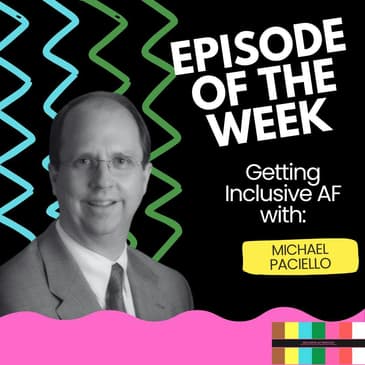
Join Us for an Inclusive AF Journey with Michael Paciello!
In this episode of "The Inclusive AF Podcast," hosts Jackye Clayton and Katee Van Horn welcome Michael Paciello, Chief Accessibility Officer at AudioEye, for an insightful discussion on accessibility and inclusivity. From his serendipitous start in accessibility with the National Braille Press to leading technological advances in digital inclusiveness, Michael shares his incredible journey and the evolving landscape of accessibility.
What to Expect:
- Light-hearted banter about fancy new podcast equipment and friendships.
- Michael's fascinating career from technical writing to pioneering tech accessibility.
- Historical context of accessibility innovation and its impact today.
- The essential role of empathy and inclusivity in tech design.
- How AI and automation are shaping the future of accessibility.
- Practical steps and resources for integrating accessibility into business workflows.
Get ready for a heartwarming and educational conversation jam-packed with humor, personal anecdotes, and actionable insights for creating a more inclusive world!
Don't miss out—hit that play button and get Inclusive AF with us!
Contact & Resources:
- Michael Paciello: michael.paciello@audioeye.com
- Connect with Michael on LinkedIn, Blue Sky, and X.
🔗 Like, Comment, and Subscribe for more episodes packed with tips on inclusivity and accessibility!
#InclusiveAF #Accessibility #AIinTech #Empathy #TechInnovation #MichaelPaciello #DisabilityInclusion #InclusiveDesign #Podcast #DEI #DigitalAccessibility #FutureOfWork #AudioEye #InclusionMatters
Powered by the WRKdefined Podcast Network.
[00:00:00] You're listening to Inclusive AF with Jackie Clayton and Katie Van Horn.
[00:00:09] Hello, hello, Jackie. How are you today?
[00:00:12] Doing great, Katie. How are you doing?
[00:00:14] I am good. I'm speaking as if you and I haven't talked today already and recorded, but first coffee.
[00:00:20] But, you know, what can, what is going on? Is that like a poofy microphone now?
[00:00:26] Now we've got like a whole, it's as I, my hair might have changed because I took.
[00:00:31] I was outside recording earlier and you know, I'm fancy now.
[00:00:34] You are fancy. Jeez, oh, Henry, I didn't know. My goodness gracious. Okay.
[00:00:40] This is the Inclusive AF Podcast. This is Katie Van Horn.
[00:00:43] And I'm Jackie Clayton. And soon Katie's going to have to like strictly go through our admin,
[00:00:49] even though we share, to talk to me because I'm so fancy.
[00:00:53] You are fancy. You have a trophy shelf wall, whatever you want to call it,
[00:00:57] the executive producer has created. You have a fancy microphone. I don't even know you anymore.
[00:01:02] I mean, I just feel as though, you know, we only talk 16 times a day and I barely, barely know you.
[00:01:10] Here we are. We bought matching pajamas and yet.
[00:01:14] Yes. And yet we don't know each other. Yes.
[00:01:17] Those are on the way, by the way.
[00:01:18] So we are, so we have a guest today and I, Mike, I'll give you a heads up that Jackie and I,
[00:01:26] and two of our very dear friends, John and Robin, we are all receiving matching pajamas
[00:01:32] that we will be wearing together at some point in the future.
[00:01:35] I'm not sure when, when we have a slumber party somewhere.
[00:01:40] But, yes. So Mike, thank you so much for joining us. I would love for you to introduce yourself,
[00:01:46] share a little bit about who you are, all that good stuff.
[00:01:49] Yeah. Hey, thanks very much for having me. It's, it's great and a great introduction. I'm,
[00:01:53] I haven't done slumber parties since my daughter was like 13 or 14 years old.
[00:01:57] And that was like 30 years ago. So there you go. You get it.
[00:02:00] There you go. Okay.
[00:02:02] But no, it's really good to be here. I, particularly because this is about inclusion,
[00:02:07] right? So that's a big, a big part of my life. I've been in the accessibility business
[00:02:12] around people with disabilities now since the mid eighties. Actually, this is literally my 40th
[00:02:17] year, 2024, started in 84. Now I work with AudioEye as their chief accessibility officer in my life
[00:02:25] is still pretty much the same thing. It's all about technology, people with disabilities,
[00:02:30] and making people's lives more productive where, where technology is concerned.
[00:02:35] Awesome. Very cool. And I, I think just to start us off. So we were actually just talking about the
[00:02:42] eighties earlier today, because I don't know if you're a movie buff, but Red Dawn came out in 1984.
[00:02:49] We were, we're talking about, you know, end of times that might be happening here soon. And so
[00:02:54] Red Dawn seemed appropriate to be discussing.
[00:02:56] You know, just to keep it light with Red Dawn.
[00:02:59] Light conversation.
[00:03:00] So we're not going to be talking about Armageddon or anything?
[00:03:03] No, no, we don't. We can skip that. We already did it earlier today, so we can move on.
[00:03:07] All right. All right. That's cool. That's fine.
[00:03:09] Would love to, to hear. So what got you started on this journey and, you know, kind of where did you,
[00:03:15] how did you start working in this space?
[00:03:18] Yeah, thank you. It's a, it's, it's a great question. It's kind of an interesting thing. I kind
[00:03:24] of fell into just to be, you know, be very honest and very transparent about, you know, this career that,
[00:03:30] that has kind of, I've, I've evolved into, but I was a technical writer for a company,
[00:03:38] Digital Equipment Corporation, which has long since been acquired two or three times over again. Right.
[00:03:43] And I think it, some of its remnants lie in the annals of HP somewhere in, in, in their, in,
[00:03:50] in their hall of fame. But with Digital Equipment Corporation back in the seventies and eighties,
[00:03:56] they were the second biggest corporation next to IBM. And it was great working with them,
[00:04:01] a great company and very proactive. As it turned out as a technical writer, I was asked if I would
[00:04:08] take over a little project, kind of a pro bono thing that my manager at that particular time,
[00:04:15] Bobby Raska, I had. And he's, the project was simply every now and then, maybe once or twice a
[00:04:23] year, we get a request from the National Braille Press out of Boston, Massachusetts. And that request
[00:04:29] is, can you give our documentation? So back then it was all basically operating system,
[00:04:35] some, some layered product applications, but mostly was operating system type software,
[00:04:40] big reference guides. You know, we're talking five, six, 700 page documents in, and NBP,
[00:04:48] National Braille Press would request that one or two a year. And then they would take that document in,
[00:04:53] in theory, transpose it and put it into Braille. So he gives me this project, Bob gave me this project.
[00:05:01] And the very next day, I got a call from the director of the NBP at that particular time,
[00:05:09] and said, hey, we need X, Y, and Z publications. So I said, sure, I'm the guy, I'll, I want to come
[00:05:17] down, I'll just drive down. But I lived in and worked in southern New Hampshire at that particular time.
[00:05:23] And Boston was about a 50 minute drive, you know, no trip when there's no traffic. So I drove down there,
[00:05:28] went to National Braille Press. And their director, Bill Rader said, hey, Mike, while you're here,
[00:05:36] would you like a little tour? And I said, why not? You know, I don't know anything about Braille at that
[00:05:42] time. And so he took me through basically a workflow, you know, what I would call workflow,
[00:05:47] a process of they get the books, they take the books apart. They've got individuals, many of whom
[00:05:54] were blind or low vision themselves, using Braille typewriters. So we're talking hand-pecking
[00:06:00] Braille typewriters, taking these pages, and then building, you know, a master document,
[00:06:06] so to speak, in Braille, then they would put that through their publishing, their print trees,
[00:06:12] the Braille print trees. If you have any clue about, you know, what a, an average print page of a
[00:06:19] document. The equivalent Braille is three pages. So that's, that's what we're talking about,
[00:06:26] because it's a contracted language. So you take a six or 700 page book, and it's turning into volumes
[00:06:32] of books now in Braille. And I thought, hand, doing this manually, even at the 80s, in the age of what I
[00:06:42] thought at that time was the age of computer, computers, this is crazy. There's got to be a
[00:06:48] faster, better way. As a technical writer, at that particular time, Goldfarb, Charles Goldfarb,
[00:06:55] had already invented what was called markup languages. I think his first version was called
[00:07:02] GenCode. And I was working with that. And it basically, it was the way to take an electronic
[00:07:07] document, which was all text then, just pure text, and then putting code in that text, that electronic
[00:07:13] text file to create structure out of that document. And now you send it to a printer.
[00:07:19] So a document, it's all text, but it's got implied structure like paragraphs and headings,
[00:07:24] et cetera, and so forth, punctuation, now has what an editor, a publishing editor would go and mark up
[00:07:31] a page and say, here's how it has to go. And then they build the galleys out of that.
[00:07:35] We were doing that all electronically. And I was involved in some of the early versions of that,
[00:07:39] you know, what was called the standard generalized markup language for electronic documents. And I
[00:07:44] thought, my goodness, if I can mark up this document, and it can go out to various print
[00:07:50] formats at that time, back in the 80s, why not do this for Braille? So that's how I got started,
[00:07:58] was that. And I started doing, I started doing some research, looked up some people in the industry.
[00:08:03] Now, remember, there's no web then. The internet was, the internet back then was basically email
[00:08:08] and a couple of download services and things like that, that you could go back and forth with. But I
[00:08:13] did manage to figure out, you know, who were some key people. It turns out the big and, you know,
[00:08:18] one of the biggest producers of Braille translation software was right there in Duxbury, Massachusetts.
[00:08:23] So I met them. We formed, a collection of us formed an international working group,
[00:08:30] all pro bono, all on our own. And we built for that working group, an international standard for
[00:08:38] producing electronic Braille, large text and voice ready files.
[00:08:43] Wow. That, I mean, it's just so interesting thinking about what if you didn't go to the
[00:08:50] office or what if you didn't operate tour or what if you, like, that sounds like this world would have
[00:08:55] been completely different.
[00:08:57] Well, yeah, I think so because, you know, the modern day evolution of that simple, small little,
[00:09:06] we call it a fragment of code at that particular time has evolved into what today is functionally
[00:09:14] the web content accessibility guidelines that have become the de facto standard for building accessible
[00:09:20] web environments today. It's still built on markup language. HTML, right? Hypertext markup
[00:09:26] language is a child of SGML. So all there's all of that has all taken place over these, over these many
[00:09:33] years. Yeah, it's, it's, it's quite pervasive and, and, you know, thinking back over 40 years, it's,
[00:09:38] it's sad that I'm that old, but at the same time to be part of that kind of history is, is, is, is a lot of fun.
[00:09:44] And I am humbled by it just, just, just, just by that.
[00:09:48] Very cool. And so how do you corral? So, you know, knowing that this is, Hey, this is a, the way that we
[00:09:56] should be working through the braille language. And then obviously it sounds like it expanded out, but
[00:10:01] how do you get everybody on board?
[00:10:05] It was not easy. It wasn't easy. However, one of the great aspects of being in the world of, of,
[00:10:12] of people with disabilities, the community of people with disabilities is they are gun ho for
[00:10:17] everything and anything very passionate about making their personal lives better, but also the
[00:10:23] lives of their, of their, of their friends and colleagues. Right. And while we were just focused
[00:10:27] originally on people who are blind, ultimately we were at that particular time, we were talking about
[00:10:34] people who were print disabled. So that became a very popular term. What does it mean to be print
[00:10:40] disabled? Well, it's not just the blind, it's individuals who are, have a, what we would call
[00:10:44] visual impairments or, or low vision, maybe legal blindness or have other forms of it. It actually
[00:10:50] included any person who might not have the ability to turn pages. So individuals that, you know,
[00:10:58] were missing limbs and things along that line and some cognition disability. So I'm, I'm looking at this
[00:11:05] and realizing how many people and how many types of individuals with disabilities, where am I going to
[00:11:10] find these folks? What I did was I started to look up conferences and events that I knew these people
[00:11:20] would be at. And, or I, you know, I assumed that these people would be at, and that's really how I got
[00:11:26] started was a little bit of email, a little bit of gopher back then on the internet. Right. And, and using
[00:11:33] that, I came in contact with a, with a colleague of mine who is still a very, very good friend
[00:11:39] himself, just a champion of people with disabilities, especially the blind, George Kersher. And George and I
[00:11:47] started talking and said, let's build this little group. He knew some people who knew some people and now we're
[00:11:54] playing, you know, the, the Kevin, what's the name, uh, game there, the, uh, the actor, seven,
[00:12:00] seven links from Kevin Bacon. Yeah. Yeah. Right. Kevin Bacon. I was going to say space enough. Kevin Bacon.
[00:12:06] Right. Exactly. And it's, you know, you know, one person, they know three people, they know seven people
[00:12:11] and it grew. And the beauty of this is that we went international very quickly because we started
[00:12:19] getting involved with the SGML community, which was already an established, you know, new, but, but,
[00:12:27] but established somewhat mature publishing, electronic publishing, uh, environment. So people like
[00:12:34] Goldfarb and, uh, and Yuri Rubinsky, who has long since passed away, you know, were there. These were the
[00:12:40] titans of that field. And they introduced us to guess who? Tim Berners-Lee, who, you know, invented the
[00:12:48] world wide web. So now we're working with Tim, working on the, on all these things. So you just
[00:12:53] see how they expanded the international internationalization aspect of this, um,
[00:12:58] happened very quickly, even back in the eighties and nineties. Well, I hate to tell you, but Al Gore
[00:13:03] actually invented the internet, but that's, you know, I've, I've met the, I've, I've met vice president
[00:13:10] Gore. Um, and you probably know from reading my bio, I've got this kind of word from president Clinton.
[00:13:16] Yeah. I know all about that. And I can tell you, he didn't. Okay. But I did have a question because
[00:13:21] you're an international leader in the space and you said that it happened quickly. And I'm wondering
[00:13:26] how accessibility priorities differ across this, differ across regions or even from other countries.
[00:13:34] What can we learn by looking at accessibility as we look internationally? Yeah, that's a, that's a
[00:13:39] really, uh, a great, great question, Jackie. Um, there are differences, but the differences tend to
[00:13:46] be more subtle, uh, than they are in principle. So in principle, a blind person can't read, they can't
[00:13:51] see. So many of the nuances associated with, you know, how do I read an electronic document? How do I
[00:13:57] read, um, you know, a webpage? How do I render? They're still using the same types of assistive
[00:14:03] technologies and things along those lines, screen readers for the blind, uh, screen magnifiers for,
[00:14:08] for individuals who are a low vision, uh, people with a lot of different types of AT use their
[00:14:14] keyboards. So they're very keyboard centric at the bottom level, principle level foundation.
[00:14:19] They're pretty much the same where they are different is kind of very similar to how language
[00:14:27] is different for us. So you've got grammar that is structured different. So there, there,
[00:14:32] there are differences there technology wise. You know, I, I, I have traveled all over the world
[00:14:39] have been in Japan, Australia, Africa, Europe, South America, by and large, um, you know, here in North
[00:14:49] America, by and large, things are not too, too different. It's just some cultural differences,
[00:14:55] some language differences and nuances at that level. Even the laws that mandate are pretty
[00:15:02] much all based on the fundamental root of what's coming out of the, uh, of MIT, the W3C,
[00:15:07] they're all based on that. So, so not a whole lot of difference at that level.
[00:15:12] I feel like you talk about this from like that grassroots perspective of, you know, you know,
[00:15:17] a friend who knows a couple of friends who knows a couple of friends, like that's such a great way to,
[00:15:21] you know, get some of these things started. And, you know, I, I'm thinking now to, you know,
[00:15:26] where we are today in history with some of the pushback on, you know, some of the DEI topics and
[00:15:33] just some of the inclusion topics and where, you know, thinking about the space that you're in,
[00:15:40] what are you seeing as the current challenges or the current, um, struggles with this space
[00:15:48] from an accessibility perspective? Yeah. Uh, that is, that's certainly one we're thinking a lot
[00:15:54] about now, because as you said, um, it looks like DEI and, or, or, you know, the U S federal
[00:16:02] government had DEI and A, which the A was for accessibility. So that was really crucial for us
[00:16:08] is, uh, going to, you know, probably die a very painful, uh, death. I'm sure there'll be some
[00:16:13] survivors around it. Like there are any kind of civil rights kind of notion. Um, so we do have
[00:16:19] to take a different tack. Now the challenge ironically has up until now been pretty much
[00:16:26] twofold. One is the, um, the business priority, prioritization of it, right? So at, at the, at the
[00:16:34] 30,000 foot level from a business to a level, how important is inclusion? How important is
[00:16:42] accessibility, especially since society now is a digital society, right? So it's more pervasive.
[00:16:49] It's more software, more online. We're not talking about the old days of, of ADA, um, you know,
[00:16:57] where you're talking about the, you know, the built environment. So accessible bathrooms and
[00:17:03] accessible walkways and et cetera, and so forth like that. Right. We're talking about everything that's
[00:17:08] digital in, in all the investments are going at that level. Companies just don't have disabilities
[00:17:16] and accessibility in their scope, in their lens as, as a priority. One of the main reasons why is
[00:17:23] because they don't see them. And why do they not see them? Because frankly, that's where,
[00:17:29] you know, the ADA laws have kind of backfired on us because they, right now, they really don't mandate,
[00:17:36] um, accessibility at that, at that level. Um, but even if they do, it's compliance driven
[00:17:44] and anything that is compliance driven is perceived by business as a cost of doing business. So that's
[00:17:51] why it's not a big priority. And ADA prevents them from knowing, you know, going out and doing their SEO
[00:17:57] and trying to figure out who's really buying my goods, right? They can't, they can't see that.
[00:18:03] They're not allowed to go out and say, is this a screen reader user? Is this a person who's,
[00:18:07] who's deaf that's watching, you know, watching the videos that we're producing to making sure that
[00:18:12] they're, they're captioned properly. They can't see that the law doesn't allow them to do it. So
[00:18:16] in that, in that sense, you've got that. So that's a business priority.
[00:18:21] The other issue is, is compliance also tends to drive litigation. And so in this country, at least,
[00:18:29] um, you know, uh, litigation is, you know, second only to having breakfast in the morning, right? It's,
[00:18:37] uh, the, the, it's, it's part of the American dream, I think literally. And so litigation has given
[00:18:43] the disability and technology and accessibility. I believe it's given it a bad name because you've
[00:18:50] got the ambulance chasers that are out there filing lawsuits against organizations rather than being
[00:18:56] collaborative in nature and working with, they file lawsuits. And whenever you file lawsuits,
[00:19:01] everything becomes contentious. And then everybody's fighting for the minimum. And that's another big
[00:19:08] problem. So those are the two challenges. Now we're entering into this new era of no more, um, DE and I,
[00:19:16] what are we going to do? My colleagues and I, people that I talk with close friends in this industry
[00:19:23] believe we're probably going to have to change the message. And that message has got to be more
[00:19:28] technology driven. So because of artificial intelligence, intelligence, because of, because
[00:19:34] of automation being a big parts of, of the, of the technology ecosphere that we, that we work and live
[00:19:40] in today, we've got to start driving a message that across the enterprises, across the small businesses
[00:19:48] in government and all the other services that basically says, here's the technology. It does
[00:19:53] everything that you need. And then some, and sell that across the board. I really think that's probably
[00:19:58] how we're going to end up having to do this. Um, another big reason for that is because we can't scale.
[00:20:03] We cannot keep up, you know, there are some 250,000 or more websites that are being generated each and
[00:20:10] every day. And I would love to be able to say that there are, there are certainly tens of thousands of
[00:20:15] people like myself that are in the accessibility business, people far smarter, far better than,
[00:20:21] than I ever will be. Um, we just can't keep up with it on a professional expert basis. So we've got
[00:20:29] to find ways to scale. That means we've got to join the club. We've got to get in with AI. We've got to
[00:20:34] use that. We've got to get in with automation. We've got to scale that way. And then we still have
[00:20:38] to apply, you know, what we've always done. You can't do this kind of business without integrating
[00:20:45] people with disabilities as part of the solution. They've got to be there because they know how things
[00:20:50] work for them. And you really can't do this unless you're really focused on, on, um, usability and
[00:20:57] user experience and integrating that part into the past. So a lot of things that have to take place,
[00:21:03] but I really do think that going into this, um, into this new year, we're going to have to change
[00:21:10] that message. And that message has got to be all about how technology will solve these problems.
[00:21:15] I, I can appreciate that. And also in thinking of, of, of creating a platform, it's going to be
[00:21:25] building. It's going to be tough as we move as the speed of technology, as things change. I mean,
[00:21:30] how many times in the last year, have you gone into a room where someone said,
[00:21:35] raise your hand if you can't hear me? Right? Like we're so it's such a six where it's like, okay,
[00:21:40] I can't raise my hand if I don't hear you because I won't hear you. And they just keep going. Let me
[00:21:47] know. Let me know. I'm not loud enough. Okay. Um, I can you hear me now? That kind of thing. Right?
[00:21:55] Right. Like putting my hands up to my mouth. Right here. Maybe. Um, and putting those things together,
[00:22:04] but there is a challenge with technology of how do we integrate and scale this into our existing
[00:22:09] workflow and for years. And I don't know why it's just like we've been hearing since I began over 20
[00:22:16] years ago and recruiting that we don't have enough talent. And we've been hearing that we only want one
[00:22:21] platform for as long as software has come out. Like how, what is, do you have any ideas on how to get
[00:22:29] organizations to integrate these tools into their existing workflow or how does that process start?
[00:22:37] Well, you know, it's, that's where the messaging always becomes the same, same old, same old messaging.
[00:22:43] Right. And, and that is companies need to invest in a workflow and a platform so that they're
[00:22:50] integrating accessibility at the very core, at the very beginning. Right. That is a workflow issue.
[00:22:56] That is, that is a corporation that especially, well, everybody's rolling out digital platforms and
[00:23:02] digital whatever's right. Um, assets as, as they go across, if their development environment doesn't
[00:23:09] include accessibility at each and every key phase. So I talked about earlier, you know, we've got to
[00:23:16] make sure we embed, uh, and invest in people with disabilities to be part of that. Well, part of that is
[00:23:21] testing is what I'm building usable and accessible to these technology that employees or clients,
[00:23:30] you know, with disabilities are using. Well, that is the, that is a message that we have been preaching
[00:23:36] and teaching for a long, long time in businesses still aren't doing it. It's not a, it's not a, you know,
[00:23:45] a blanket statement, meaning that all businesses don't do this, but very, very few, you know, the
[00:23:51] Amazons of the world, the Microsofts of the world, the Googles of the world, they have offices and
[00:23:57] practices built around it. Right. They have their own style guides that say, here's how we build,
[00:24:02] right. When they build their software libraries, that this is how these things should be coded.
[00:24:07] And yet today their software still is not fully usable and accessible to people with disabilities.
[00:24:14] And their investment in measuring, it's like measuring, you know, the federal government's
[00:24:20] investment in the military versus the federal government's investment in people with disabilities,
[00:24:26] right. At that world, we all know it's just not, it's not apples to apples. It's not even close.
[00:24:32] You know, so I would like to believe that it will only take one great strong leader
[00:24:44] to push, to push the agenda, right. To push everybody over the edge. It would be ideal if,
[00:24:52] if Google or Amazon or Microsoft, what have you, you know, you know, if, if one of their CEOs really took
[00:25:00] the lead, set the pace and required everybody else to follow them just because competition dictated
[00:25:07] that they did. And there have been some good messages in that area, but it hasn't been enough.
[00:25:12] Just hasn't been enough. But it's changed. The world has changed. The first thing that I thought of
[00:25:17] thinking of what we might see in the next four years was remembering that they took sign language
[00:25:23] interpreters away the last time that Trump was in office. And, but the difference, there's a lot
[00:25:30] of differences, but one of the differences now is that there's AI generated like translation that we
[00:25:36] never, we, nobody would have even dreamed or imagined that there would be.
[00:25:40] You know what, actually, I saw this 20 years ago, 25 years ago, was built by a company. They were using it
[00:25:47] for a completely different application. It's still a very, very well-known company, co-owned by Dell,
[00:25:56] FYI. And they were doing something for the NSA.
[00:26:03] Right? They were spying. It was for spying, right? But what they were doing is they were listening to
[00:26:09] voices and then creating a text transcript right off of it. And there it was going on using, you know,
[00:26:16] using more machine learning than, than AI, but certainly in, you know, principles of AI built
[00:26:23] into it. 25 years ago, I saw this. I got up in the audience and said, this is brilliant. I've never
[00:26:28] seen anything like it. How do you feel about taking what we've learned here and applying this to the
[00:26:33] media world and building automated captioning then? And they said, the person who was the chief
[00:26:39] science officer at that company recognized me from some other thing that I had spoken at and said,
[00:26:45] are you Mike Paciel? You work digitally? Yeah, I did. I should have thought it would be you because
[00:26:50] you're always talking about people with disabilities. Now we're not thinking about that at all, but
[00:26:53] this is a good idea. Maybe we can talk about licensing this technology. So it's been around for a while.
[00:27:00] We've had the, we've had the goods, so to speak. We're just not pushing it, you know? And so now it's
[00:27:07] good. I don't want to come off and saying we're not doing anything. We are, we have made huge strides,
[00:27:13] huge strides since I've, you know, I started in the eighties and where we are today and where
[00:27:19] accessibility, at least people, when you say by the way, or you say, you know, accessibility, use the
[00:27:26] word, generally speaking, most, most people in the field know it. They, they, they relate to it, but it's not
[00:27:34] anywhere where it should be. So for the folks that are listening, you know, I think we have a lot of
[00:27:40] listeners who are in HR and, you know, either in HR leadership roles or in HR roles. What are your
[00:27:48] thoughts on how we can help as HR professionals to move this forward and kind of, you know, not
[00:27:56] implement it in our organizations? You know, a lot of times we are influencing without authority, but
[00:28:00] to make and create awareness within our organizations about some of these things.
[00:28:07] Yeah. So let me just put a plug in for a couple of organizations that are out there today that are
[00:28:12] in the HR field. I'm sure you're probably disability in, right? And, and what's the, what's the other one
[00:28:19] there? Oh boy, I can't, I lost, I lost the name of it. But, but these are organizations who basically
[00:28:27] are in the HR field and they promote disabilities, right? At that level.
[00:28:38] No, no. I think Mike is.
[00:28:43] I'm drawing a blank on it, but I'll think about it as, as we go here.
[00:28:46] Um, so what I think is going on there is they are a being more inclusive about, about their hiring
[00:28:55] practices. So this is one thing that has to be done. You won't understand unless you start to be
[00:29:02] more empathic in your hiring. So bring people with disabilities in, you know, there's still that mindset.
[00:29:08] I think maybe, uh, Jackie had kind of alluded to it earlier. There are people who still don't have a
[00:29:15] clue about any of this stuff. There's just not enough awareness built around it. This show is a
[00:29:21] great example of something that is promoting it, but there's, there's just not enough. So hire people
[00:29:27] with disabilities into your organization. Number one. Um, number two, I always believe that a company
[00:29:37] needs to have some sort of accessibility strategy or what's popular right now is using the maturity
[00:29:46] model, uh, notion of things, right? The accessibility maturity model, there are a few organizations that
[00:29:53] are out there promoting them. The W3C does the international association for accessible, uh,
[00:29:58] professionals, IAAP. They have them. There, there are a few of them that are out there. Um, the point is,
[00:30:03] it's, it's fundamentally a, you know, a, a, a set of guidelines for how to build an inclusive and
[00:30:12] accessible, accessibility minded organization from the top down. Right. Mike is muted on us.
[00:30:27] Mike, where we are, I have lost the audio on you. Did you hear it? Can you hear me now?
[00:30:33] Now we can. Yes, yes, yes. I'm sure whatever you said was brilliant. Uh, so,
[00:30:40] so what I was saying is, uh, build an AAMM, an accessible maturity model as, as a strategic
[00:30:46] guide for the corporation, right? And, and that has, that's a lot of thought that has to be put into it,
[00:30:52] but it's something that's circulated on the C level at the C suite level, the C CEO buys into it,
[00:30:58] and then it becomes part of HR's rollout. Okay. One other thing I think is really important that we
[00:31:05] have do, we are doing here at AudioEye, I've seen done in a lot of other corporations. I think the first
[00:31:10] one, believe it or not, that I really thought was a model was being done by, uh, Victor Saren and
[00:31:15] Alan Brightman, um, at, uh, and Larry Goldberg at Yahoo several years ago. And that basically was,
[00:31:23] they created a, you know, an educational awareness, um, course that every new employee had to take.
[00:31:31] Uh, so when you come in, you've got a new hire employee, you were introduced to accessibility
[00:31:36] and disabilities. So there's three, you know, potential, um, strategies that, that organizations
[00:31:42] might do that should be led by HR, frankly speaking. That's an HR, uh, uh, strategy that I believe,
[00:31:49] I should be highly promoted and invested in. Absolutely. And, you know, thinking more,
[00:31:54] you know, kind of looking at the business side of things as well from a, you know, UX, uh, UI
[00:32:00] perspective, where can folks find information on how to build accessible websites or to leverage AI
[00:32:10] to create a more accessible website or different tools that they're building?
[00:32:16] Yeah. Well, the first place to go is, is go to the, the World Wide Web Consortium website,
[00:32:21] right? W3C.org and look up, uh, W3C.org slash way, which is the web accessibility initiative.
[00:32:29] So it was an office that I had the privilege of helping start, um, with, with, uh, you know,
[00:32:35] with folks at MIT long before we were talking about web accessibility, that office, uh, is where
[00:32:43] all of the guidelines for building an accessible website and accessible web applications, which
[00:32:48] is important. And to a certain degree, accessible documents, right? Because PDFs are still out there,
[00:32:55] right? Other document forms that, that, that are really crucial to user experience. That's where I
[00:33:01] go first, go there. That's where all the government laws are written and that's what they default to.
[00:33:07] The ISO standards point to those, to those guidelines. So that's definitely a place. They
[00:33:11] have a lot of, a lot of material there, you know, to, in courses that, that you could take to, to learn
[00:33:16] it. In terms of just books and things like that, all you got to do is just type in web accessibility
[00:33:23] and you'll see all kinds of books. I mean, I wrote my book, you know, I have the, the, um,
[00:33:28] you know, distinct, uh, pleasure of, of, of having been the first book out on the topic,
[00:33:33] but it's by, by, by leaps and bounds. There are much, much better books out there than, than my,
[00:33:40] a close friend of mine, uh, two close friends of mine, uh, uh, David Sloan and, and Sarah Horton
[00:33:46] just released a brand new book on, on, uh, on accessibility and in designing and developing,
[00:33:52] uh, the web for people with disabilities. It's also a great book. So, um, there are a lot there.
[00:33:58] There there's a lot there. And, you know, when you, when you think about,
[00:34:03] you know, not just the website, but also just, you know, products, things like that,
[00:34:09] who do you bring into the conversation? Obviously you have been doing this for quite some time and
[00:34:15] have expertise, but who are your people? Who are the folks that you reach out to when you're trying
[00:34:19] to figure out how to solve something or, or, or, you know, how to create something that is more
[00:34:25] accessible yourself? Well, if I tell you that secret,
[00:34:31] no, no, no, you know, um, I've, I've said this many times, uh, in some of my other discussions or,
[00:34:39] or talks that I've given one of the great privileges, personal privileges I've ever had was I created a
[00:34:47] company affectionately known as TPG, uh, the Pacella Group. And that company became the foundation
[00:34:57] for me to do something that I'd always wanted to do back in the, in the nineties and early two thousands.
[00:35:03] And that was to pull together, um, a company built on the greatest, most experienced individuals
[00:35:10] in the world around accessibility. Ultimately, that is exactly what TPG became. And our brand became
[00:35:17] so well known because we had the greatest people, technologically wise, people themselves with
[00:35:24] disabilities, many of them with, with disabilities that would became world renowned. The brand itself
[00:35:28] still stands today. We were acquired by, by Vispiro back in 2017. They've kind of renamed the company to
[00:35:35] TPG I, but beyond that, the, those are the folks that I go to my old colleagues and friends. So the
[00:35:42] Steve Faulkner's, the Jez Lemons, the Carl Groves, the 80 Roselli's of the world. These are all friends
[00:35:49] and colleagues of mine. They're brilliant. They're leaps and bounds, uh, much smarter than I am. They
[00:35:55] know this Leone Watson. Leone is on the board of the W3C and she's one of the chairs of the group there.
[00:36:01] Those are the folks that I go to. Joe Devin, when it comes to AI, I call Joe Devin up. Uh, you know,
[00:36:07] he's to me, you know, you know, probably one of the greatest minds around, around this right now.
[00:36:13] So I go back to my old colleagues, my friends, you know, what do you go play with? You go to back to
[00:36:17] the playground, right? And that's, that, that's what we go to. Perfect. And would love to hear your
[00:36:23] thoughts on what are you excited about in regards to AI in this space? Yeah. What I'm excited about
[00:36:31] is the reason why I came to AudioEye, to be honest with you. And I did that at great risk to my own
[00:36:35] career. Uh, you know, people, AudioEye had a bad reputation because of its, its, uh, style of sales
[00:36:41] and, and marketing. Very aggressive, not always, you know, necessarily being completely honest about
[00:36:49] everything, the way things work and scale. But, but we're, we are, we are bottom line now where I
[00:36:55] believe we were with TPG. At what point we don't have all the expertise, that's for sure.
[00:37:00] But where AI is concerned, we have an outstanding engineering group. These are folks have come out of,
[00:37:06] you know, the Facebooks, uh, other world, Meta, uh, and Google. And these are high class engineers
[00:37:14] that really know their AI. So we're integrating AI into our automated remediation platform.
[00:37:22] I can't talk about more. I can't talk about as much more, more about it than that. Other than that
[00:37:28] is what we're doing right now. You can't share any specific IP with us right now. We would like to,
[00:37:35] no, no, no, yeah. Somehow I think I would, yeah, somehow I think this would be my last show.
[00:37:39] Right, right, right. Right. But what I can tell you is what we all know. Look, AI,
[00:37:45] you know, is it really intelligence? It's building these large language models. I still feel like
[00:37:51] it's more like machine learning, but we're making smart, it's making smarter decisions about things
[00:37:58] because it's learning about environments. It's learning about users and you know, you repeat,
[00:38:02] repeat, repeat, repeat, repeat. You correct, correct, correct, correct, correct. And you,
[00:38:06] and then eventually you get to something that, that works and works very well.
[00:38:11] What we're doing today, we know that we can remediate by automation and AI somewhere around
[00:38:17] the 35% in levels of pure what we could capture and fix. Well, 35%, unless you're playing baseball,
[00:38:25] not really all that great from my perspective, right? If I got a 350 average and I'm playing
[00:38:30] baseball, I'm looking pretty good. Probably maybe MVP material, right? So we'd like to look at it from
[00:38:35] that standpoint. The reality is we've got to get to somewhere in the 80, 90%.
[00:38:40] The irony is, is that the validation tools, the automated validation tools that have been
[00:38:45] around for some 25 years now, they're running at that same rate, right around the 35 to 40%.
[00:38:52] So we got to get better at it. And I think AI is the way to do it. And everything that I've seen that
[00:38:57] the devs and the engineers are showing me here really give me, you know, a lot of faith that that's
[00:39:03] exactly what's going to happen. It has to, because if it doesn't, I don't see any way that we keep up with the
[00:39:09] scale of, you know, the digital environments that are being developed in the platforms that are out
[00:39:13] there today. Nevermind the enterprise level aspects of it. We just won't be able to do it, you know,
[00:39:19] manually. And since we can't, going back to our earlier discussion, we can't convince enough
[00:39:24] organizations to invest in building these things, using them accessible out of the ground up,
[00:39:30] we got to do something. And this is, this is my bet. That's my bet. This is the company's bet.
[00:39:38] I think you're, but I agree with you. I think that's a, that is a smart bet and putting those
[00:39:43] things together and hopefully we'll be able to, I think the more accessibility people have,
[00:39:51] the more we can hear the feedback, the more people that can get, we can get this into the right hands,
[00:39:56] the more access and it'll be really enlightening. I know like we're sharing things that we've seen or
[00:40:03] heard or, and you're, you're, you're an expert, but I would love to know what you think is,
[00:40:10] what is something that an organization could do today that like, like start here, that is somebody
[00:40:18] that's interested in trying to get started as something that they feel like they can implement.
[00:40:23] Any thoughts? In terms of making their digital environments accessible? Yes. Starting,
[00:40:28] I was thinking of their website or whatever they're using, their, for cloud. Yeah, yeah, yeah, yeah.
[00:40:34] Yeah. Well, given that this is mostly an HR environment and, and, and audience, let's start
[00:40:41] where it should start. Hire people who know what they're doing, right? Now you're pushing it, Mike.
[00:40:48] Right? In every, I'm dead serious. If I had a nickel, I'd rather, I guess probably have to talk about five
[00:40:55] or 10 bucks now though, with inflation the way that it is. But if I had a nickel for every company that we
[00:41:01] rated to that came to us and said, we don't know anything about this. We've been developing software
[00:41:07] for, you know, forever. And, you know, AI developed platforms and, and VR and augmented reality of
[00:41:15] platforms and media platforms. We don't have a clue about accessibility. What do you mean people? I never
[00:41:21] knew that blind people can even use a computer. You can, there's still an awful lot of that. So how do you solve
[00:41:27] that? Get people who know it and understand it. Get someone, not a lawyer, get someone on the team
[00:41:33] who has some engineering savvy, hire them, bring them in and start to build awareness internal,
[00:41:40] right? The best way to improve is first inside and then spread it to the outside. Get things right inside.
[00:41:47] That would be the first thing that I would do. After that, then you start to do some of the other
[00:41:51] things that we already talked about. Go find out what those web content accessibility guidelines
[00:41:56] that are being promoted, that are the standards for accessibility, web and software today. Find those
[00:42:02] things, learn them, teach them, make sure all your devs understand them, right? So now you've got to build
[00:42:09] on a learning environment, an educational environment. This is something that AudioEye has done. We've built
[00:42:14] our own kind of a help system. We call it AudioEye Queue that we give to our, we give it to our clients.
[00:42:22] And it teaches engineers and dads and usability folks how to build and design and develop accessible
[00:42:30] digital properties that they do. So, so build on the awareness aspect of it. After that, then you
[00:42:38] integrate people with disabilities and your, your workflows. You just be, you just, you don't really
[00:42:44] have to change what you're doing. You just need to be more additive, right? Or, hey, what's the name
[00:42:51] of your program? You need to be more inclusive. Yeah, right. Right? I mean, there's no rocket science
[00:42:57] to this. People feel like this is rocket science that I just said possible to attain what you wanted.
[00:43:04] That's baloney. It's just an excuse. It can't be done. You've got to make a priority. You have to,
[00:43:09] you have to be committed to it. And frankly, you have to have the passion to make it happen.
[00:43:16] Absolutely. So, Mike, I would love to ask, you know, the question we ask pretty much with every
[00:43:21] episode. What is one thing you want to make sure that the folks that are listening heard during this
[00:43:26] episode or one action you would like them to remember from this episode? And it doesn't have
[00:43:32] to be just one because we always say one and then it's like 17 that all of us give. So, yeah.
[00:43:38] Yeah. Yeah. Yeah. And yeah, so I thank you. I think it's, I think it's important to drive home.
[00:43:45] One big message is in anything that we do, whether it's technology or anything as a business
[00:43:52] or as an organization, hire people with disabilities, bring them into your organization.
[00:43:58] They're going to be able to help you. They will want to help you help an organization to get better at
[00:44:04] or to make whatever you're doing, whatever you're building usable and accessible. I really believe
[00:44:09] strongly in that. I would never have been able to learn what I've learned had it not been from my
[00:44:15] colleagues. George Kirscher is one of my best friends in the world. He's blind, right? So you think
[00:44:20] about those kind of people that are out there in the world. They're champions. They're the true
[00:44:24] champions. Bring them in and hire them. Secondarily, I think it's important to understand that
[00:44:31] technology probably is going to be the next big wave in terms of really hitting that pervasive
[00:44:39] accessibility goal that we all have. So I do think companies should invest in AI. Everybody is. Are
[00:44:46] they investing in it in such a way that it will improve the accessibility of their digital environments
[00:44:52] and their platforms? I suspect not. I suspect not. So that's where I would like you to focus. If you need
[00:44:59] help companies like mine and other companies that are out there, you know, the Joe Devons of the world,
[00:45:04] we can help you do that. There is one warning. And I'm saying that particularly because this is an HR
[00:45:13] driven platform. One of the concerns that we have about artificial intelligence today is bias,
[00:45:21] right? And I'm sure you've dealt with it yourself. It's what I call edging out, right? So where we,
[00:45:28] the AI focuses on the statistical center of what looks will be the best way to represent or present
[00:45:35] something or how something needs to be rolled out, who you hire. These look like they all go for the
[00:45:43] statistical center at that point where those people with disabilities are on the outer edges. So be careful,
[00:45:51] right? Be strategic about making sure that that doesn't happen. You don't edge out or bias out individuals
[00:45:57] with disabilities, especially at the HR environment.
[00:46:02] Awesome. Thank you. Jackie, what you got?
[00:46:05] Well, it's just, it's the same kind of going along with what Mike was saying. It's be inclusive AF and
[00:46:13] then mind your business. And the reason I say that is because so many people like understand that we want
[00:46:19] to be inclusive and hire people with disabilities. You don't have to guess and ask people that, like,
[00:46:25] don't try to picture everything in your head. You don't have to put all the pieces in your head.
[00:46:30] The, the people that you hire will show you. And that's the part that's frustrating when you hear
[00:46:35] someone say, oh, I couldn't imagine putting my shoes on if I didn't have arms. And it's like,
[00:46:42] and yet there's a person here with no arms, but shoes. Like they have been able to adjust and figure
[00:46:48] this out. Quit trying to put your own experience onto somebody else. Make sure that you have the
[00:46:53] space and then mind your business, like, and just offer support. People will give you the answers
[00:46:58] to the test. You don't have to guess. And I think that's what I think that's called empathic design,
[00:47:05] right? Empathic design. Empathic design. Again, it's something that we've preached and talked about
[00:47:10] for, for, for many, many years, but it's look, it's okay to put myself in your shoes,
[00:47:16] but it's your shoes that I need to see. How do you wear them? How do you use them? Right. That,
[00:47:21] that kind of a thing. I appreciate that. Cause that's the part that always makes me really
[00:47:26] frustrated when I would put people in the places and they were like, did you know,
[00:47:30] this was years ago at the beginning of that. And they were like, did you know that they had one arm?
[00:47:34] You sent somebody over here with one arm. And I said, jokingly, I was like, well, the job description
[00:47:40] did not say that it required two arms. And he was like, oh, haha, hired the guy. He was like the
[00:47:46] best developer ever. And so that was always something that really frustrated me that automatically
[00:47:51] tried to discredit without having the conversation based on their own, you know, lack of empathy.
[00:47:58] It's, it's a, it's a societal prejudice that just doesn't seem to want to go away. And it's not
[00:48:11] necessarily meant to be a prejudice built on, you know, uh, uh, hate or, or, or, or anything like
[00:48:19] that. It's just being misinformed and unaware and uneducated, you know, frankly, ignorant. Right. And it's
[00:48:29] that that's one of the uphill battles that we've all had, you know, for so many years, we just have
[00:48:34] to keep, we just have to keep shouting to the top of the mountains and, um, in, in, in hopefully
[00:48:40] we'll get it. Like I said, where we were when I first started in the mid eighties, uh, where technology
[00:48:47] and people with disabilities and accessibility and usability were then compared to where they are
[00:48:53] today. It is night and day. We've made some huge, huge, uh, advancements and I'm very,
[00:48:59] very happy to be, you know, a part of, of that history with, with, with some of these advancements,
[00:49:03] but there's, there's a lot more to go, a lot more to do.
[00:49:09] And I think that the piece that you said this a little bit earlier, and I want to reiterate it
[00:49:14] because I think that it's really critical. Don't make an assumption because someone has a disability
[00:49:20] that they aren't going to be reading a book or that they aren't going to need access to whatever,
[00:49:25] or they aren't going to want to look at a website and be able to access it in whatever way they want
[00:49:30] to access it. And I think that's the piece is also like stop making assumptions. And then the second
[00:49:37] piece is if, you know, if you want to be a viable business in the future, this isn't a nice to have,
[00:49:43] this is something that we have to be inclusive of everyone with whatever capabilities they have.
[00:49:49] And being able to really think about that and be thoughtful about that is, is really important.
[00:49:54] So Mike, where can folks find you?
[00:49:59] Uh, well, so online, they could find me by email at michael.paciello at audioi.com.
[00:50:06] Okay. Um, I also own another little company that is working on, uh, using integrating AI in,
[00:50:13] in the publishing field and, and, uh, called web able or web able.tv. So you can said,
[00:50:19] send me email there, look me up on the web there. Basically, if you just type my name into the web,
[00:50:24] you're going to find me. It's, it's not something necessarily I'm proud of, but the fact of the
[00:50:29] matter is, is that kids come up to me, my kids come up to me and say, Hey dad, I saw this about you,
[00:50:34] or, you know, things like long lines. Right. So, uh, but I'm at audioi, the chief accessibility
[00:50:39] officer there, that would be the number one place to go to after that. Uh, I'm on LinkedIn,
[00:50:45] you know, uh, I just joined blue sky and, and, uh, you know, I've got, uh, X, I'm still,
[00:50:52] still have presence there and Facebook. I'm there. Um, well, I would love to just say to you,
[00:50:58] thank you for the work that you have done for this many years, you know, and the, the allyship
[00:51:04] and partnership that you have taken on, uh, you know, and almost, you know, from the story that you
[00:51:10] shared almost stumbled into, um, and how you have really brought this message and this work
[00:51:17] so far and advanced it so far. Um, you know, thank you for that. And thank you for your continued
[00:51:21] work on that. I think it's really critical. Um, Mike, thank you for joining us. This is Katie
[00:51:27] Van Horn. This is Jackie Clayton. Bye. Do you love news about LinkedIn, indeed Google, and just
[00:51:39] about every other recruitment tech company out there? Hell yeah. I'm Chad. I'm cheese. We're the
[00:51:45] Chad and cheese podcast. All the latest recruiting news and insights are on our show dripping in snark
[00:51:52] and attitude. Subscribe today, wherever you listen to your podcasts. We out.
Sponsors
