
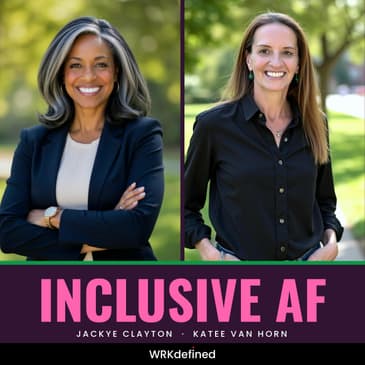
In this episode of The Inclusive AF Podcast, host Jackye Clayton is joined by special guest Donald Knight, Chief People Officer at Greenhouse, as they engage in a dynamic, thought-provoking conversation about diversity, equity, and inclusion (DEI) in the workplace.
Donald Knight shares his journey from his initial aspiration to pursue a legal career to his current role as Chief People Officer at Greenhouse, and the pivotal role his CHRL, Katee Kennedy, played in shaping his career path. His extensive experience working at multiple companies, including his current position, adds depth and insight to the conversation. Donald also reflects on his role as a father and emphasizes the importance of raising his children with a deep appreciation for different cultures and perspectives.
The episode concludes with Donald Knight's emphasis on the importance of influencing narratives around the future of work and his refusal to relinquish this responsibility to those who may not have the same standards or experiences. Jackye Clayton adds her insights, underlining the crucial distinction between genuine practitioners and individuals who only provide knowledge without true engagement in the work.
Links:
1. Greenhouse - https://www.greenhouse.io/
2. Black Women on Boards - https://www.blackwomenonboards.org/
3. Textio 2023 DEIB Report - https://textio.com/deib-report-2023
4. Donald Knight's LinkedIn Profile - https://www.linkedin.com/in/proximityknight
5. Inclusive AF Podcast Website - https://www.inclusiveafpodcast.com/
Powered by the WRKdefined Podcast Network.
[00:00:00] You're listening to Inclusive AF with Jackie Clayton and Katie Van Horn. Hi, and welcome to the Inclusive AF Podcast. This is Jackie Clayton, and this is usually the time when you hear, and this is Katie Van Horn, but Katie Van Horn is probably off somewhere drinking margaritas, contemplating
[00:00:24] their choices in life. But instead with me, I have the wonderful, brilliant, a personal friend and someone I look up to, Donald Knight from... I'm doing good, Jackie. Thank you for having me. I brought my glasses, so I just want you to know. You love them.
[00:00:45] I'm going to be on the man today with you. There's a Clayton brand if you don't know. That's what... The glasses is always the signature accent piece. How have you been? How's life? You know what? It's been pretty good.
[00:00:57] I just got that watch we did record and put this on YouTube. These are brand new glasses, and I slept in them. I slept in my glasses and woke up and they were broken, but I still love them. These are the latest pair, but things are going good.
[00:01:14] I just had the DEIB report come out, my 2023 DEIB report, and I am so glad that that came out and that's done. It's something that I don't... It's like my own Super Bowl, but I'm competing with myself. We won.
[00:01:35] We still have work to do, but I'm doing pretty good. How are you doing? I'm doing great. First of all, for the listeners, if you don't go read the DEIB report, you're lost. Please go do so. Thank you.
[00:01:51] Our head of idea, inclusion, diversity, equity and allyship, Jamie Adasi. She uses that report because it's one of the very few in my opinion that shines light on the things that we should be measuring and monitoring inside of our businesses. So kudos to you.
[00:02:10] I don't think you're just competing here with Super Bowl. There's some bad content out there and bad reporting out there. It's ridiculous, really. Yeah. I think we've gotten to a point where people are so quick to put things out and haste.
[00:02:31] Almost through this lens of quantity that we've created an ecosystem where quality now is the new outlier. Right. I love that. Especially now, it's almost like with chat GBT. I always laugh because if you see a rocket in anybody's post, then it's chat
[00:02:55] GBT because when is the last time you put a rocket in a post? I'm like, you never put a rocket in a post before. You never used that star before. I don't look at your content for five years, but it comes out so fast
[00:03:09] that people have been not only doing that. It's like a new version of plagiarizing people's content so that the same bad advice comes in five different forms. Yeah. It'll be the topic of a podcast, a blog post. It'll be somebody uses it for a webinar.
[00:03:32] And it was bad when it first came out. Oh, I mean, absolutely. I mean, I saw this literally yesterday. I had a friend send me a video. He was at a conference and he said, he said, Don, you're not going to believe this. I'm like, what?
[00:03:50] And he sends me the video. This guy is playing my content. He's given a speech at Amplify. He's playing my content, which I don't mind. Like if you there's plenty of people like Jackie Clayton, Meeta Mallick, like there's people, Brené Brown, that are putting meaningful
[00:04:08] content in the ecosystem, but all means like share good content, especially because it's impactful. It can help people learn. It's insightful. But like give credit where credit is due. This dude didn't have my name. He didn't have my company. Are you serious? I'm so serious.
[00:04:25] So I quickly had our team find out who it was. Come to find out. He's a fraternity brother of mine. What? Oh, I'm so serious. So I won't put his name on here because we have agreed that if he's going to use my content
[00:04:43] moving forward, he has to start giving credit where credit is due. But it's like, dude, that cost you nothing. But again, it's like people want that reaction, right? Like the quality content, the quality research, the quality reporting, it's the outlier now.
[00:05:00] And so because it stands out so much, everybody wants to use it. And so if I see you on my LinkedIn profile and you're taking Jackie Clayton content or media malloc content and you're not citing them, I will slide in your DMs. That's right. That's right.
[00:05:16] I'm sliding in. Yeah, because it's like you've got to start giving people credit. But other than that, I'm doing really well. Well, for everyone who doesn't know you, tell people a little bit about your background.
[00:05:30] Yeah, Donald Knight, Chief People Officer, Greenhouse Software, a little bit about my background. My parents are both military. And I got to live all over the world. I tell people that because like Jackie in many ways, I view the world through a lens that's not American-centric.
[00:05:50] Like I love America. My parents fought for the company. For the country, they wore the country's uniform. But like, and I recognize opportunities we have in this nation that many nations do not. 195 nations on the planet for those that are listening is 195.
[00:06:05] But I typically view the world through like a global lens in the sense that I don't say, oh, I went and studied abroad. Like no, I studied globally. The world doesn't center on the U.S. Right. Right. I love that. Yeah. So that shaped me.
[00:06:22] And as I got older, like I really wanted to be in roles that I thought could unlock impact. And so my parents ended up divorcing really, really early in my teenage years. And because I was able to successfully help them agree on what each other got, I thought
[00:06:42] I wanted to be an attorney. Yeah, I know. I'm glad I'm not an attorney. I like attorneys though. I do like attorney. Speaking of which, our chief legal officer, Jung, she just saw you somewhere or was it like a talent makers conversation or something? Oh, yes.
[00:07:00] Yes, we did have some. Yes, yes. Yeah. So shout out to the job. I do like attorneys. But my, I had my first C.H.R.L. K. Kennedy, she basically convinced me not to go into the legal profession and she
[00:07:14] talked about like the shift that was happening in our profession and how there were going to need leaders who viewed the world differently, who were more commercially driven but can connect with people with specific traits that weren't being taught at the time.
[00:07:30] Things like vulnerability, things like empathy, things like transparency. And but not for her. I wouldn't be in the profession and you know, I've matriculated through multiple companies since then and worked for phenomenal leaders and some not so phenomenal leaders.
[00:07:48] And all those roads and all those paths led me here to Greenhouse. And so I'm happy to be here. I'm also Dalen's dad, I have a son who's 12, he'll be 13 later this month. And I'm pretty excited to be his dad. He's taking up wrestling now, Jackie. Whoa. Yeah.
[00:08:06] How's that as a parent? I think my wife is like, oh, like very near heart attack mode every time he's on the mat. She's like, that's my baby. I'm like, that's somebody else's baby that he's tossing around to. A lot of babies on the mat.
[00:08:25] I call my son's baby TJ and I'm the same way when he was in swim lessons, I could not watch. I was just like, oh, I can't do it. Yeah. And then I got a little girl on the way. So I'm excited to be a girl dad.
[00:08:41] It's gonna be fun. Congratulations. You know, you could be as fun as the rest of us. That's what I was saying. Welcome. Welcome. But I think I, it's funny that you said that somebody like took your, I can't believe
[00:08:59] that people are still doing that and thinking that you're not going to get called out, that you're not, I had someone take my content, rewrite the content, but kept the core content. And then I was like, they tried to enhance the title of the content and then kept
[00:09:16] everything in the middle and then tried to rewrite the outro. And I asked them to change it or get, give credit. They said no. He said no or not. We admit that we, that it was your document. We'll just rewrite it again.
[00:09:32] I was like, but it's not your content. And they were like, no, I didn't want to give you credit. So then I was just like so angry. I'm going to abuse you if you were a lawyer at that point.
[00:09:42] I could have used you as a lawyer, but I do think what you said makes sense in the world of work has changed. Our roles have changed. But I think that employees have different expectations than they did five years ago.
[00:10:03] No longer is the, I just want to go to work and put my head down, do my job and go home. I think that what I want to change is, is what I want to do. I want to change the context of what we're seeing.
[00:10:14] So the content and the content that we've seen in the work place is really important. You don't see as many people like that anymore. They're looking to more. Like, what have you noticed has been a change? What would you say significantly through this experience?
[00:10:30] in the workplace all along, which is people would rather impersonate than congratulate. Like I remember, I remember seeing hearing my mom come home and once she left the military and was working as a silver servant and she remembered seeing her bosses praised for work
[00:10:51] publicly inside of the agency that she worked at only for her to be like hey I gave that to two weeks ago and you never responded. And if you thought it was so good, why didn't you
[00:11:04] just put me in the footnote? She was clearly that leader's team but why not provide somebody a lens of congratulation or affirmation? And I think what has happened is and that's happened
[00:11:16] for I'm sure there's plenty of women, there's plenty of people in business that that has happened to I think it has seeped into content creation and social platforms where we would much rather impersonate someone else's creativity than congratulate them for the creation itself.
[00:11:33] And to me like that's not okay, like when people tell me imitation is the greatest form of flattery, don't flatter me. I don't want to be flatter. Like give me my credit instead and if we can partner
[00:11:46] but like give me my credit. So I hope people listening here like go affirm the people that you have found meaningful impact from the work and the creations that they put out into the world.
[00:11:58] I love that because it's an insult, it's an insult because number one you think I'm stupid like let's just start with that. And it's just lazy like it's pure laziness. We don't
[00:12:09] gotta be that lazy. I think to your point about other trends in the workplace. Yeah, I think the future of work has shifted. But I think often Jackie we talk about this almost like a generation
[00:12:22] versus generation perspective. You see this would like return to work. It's like, there's people that are like, Oh my, oh my goodness, my leader doesn't like people. Why? Because they're making us come back to work. And then on the opposite end, you have these leaders that are like,
[00:12:38] OMG, like these people are all lazy. Why? Because they don't want to come to work. Right. And I'm like, you realize like the truth is somewhere in the middle. There is value and collaboration in person. And we have to figure out what that balance looks
[00:12:55] like for each individual company differently because our cultures are all differently and comprised of different people with diversity of thought. And I think equally at the same time, there is a flexibility that companies should be offering to talent now. Like for the leaders that
[00:13:10] say these things shouldn't evolve, everything else did. That's right. We don't ride on camels and horses every day. And both things can be true. Yes. Right. Both things can be true. I think that there's a narrative that we see where everybody's like, pick a side, pick a side,
[00:13:28] pick a side. It's not always us versus them, me and you or I have to pick a side. I can, like I live in Texas. I can look at Governor Abbott and say, you know what? He's done some really
[00:13:42] gross things. But thank you for the tax credit for my house. Like I could be appreciative of the tax credit for my house. It's still think that you're going the wrong direction with
[00:13:52] education. Both of those things can be true. Why do you think that's hard for us to do as humans today? Like why is it so, because I think you touch on something, your ability to
[00:14:05] give praise and compartmentalize the things that are going well and give criticism on the things that are not going as well. In many ways today, you're an outlier. Like there's a certain level of maturity that takes. Why isn't that, why is that the exception, not the rule?
[00:14:24] That I think because if you look at historically what always seems to stand out and granted, I always say, you know, I have an American public school education. So work with me. I always say,
[00:14:38] we're always looking for a hero in everything that we do, especially within the United States. We want to be a winner. And the only person who wins is first place. But you never, you always are pushed that way, especially those of us that were athletes,
[00:14:52] were always pushed in that it was never be your best. It was be the best. And so that means in order for me, we've taught that in order to be successful, you have to be number one at school.
[00:15:06] They didn't say you took a test and then they were graded. And then you had the person who got the highest score. Those are the person who gets the best grade to get to sit in the front
[00:15:17] graduation. That's how we look at how you earn is by being the best. And so it's it and so there has to be a clear loser. People feel like there has to be a clear loser in order for some groups
[00:15:33] to feel like they're being a true winner. Yeah, somebody's gonna have to lose. It doesn't make it doesn't make sense. But it's also because you haven't been with that global point of view, like you're talking about. Yeah. Like it is understanding that that what we're
[00:15:55] starting to learn, especially like around music, I love music, I used to be a violinist and it but you listen, you learn music from this Eurocentric lens, it's like four four time, it's understanding the types of notes of what you think is beautiful. And then go listen to
[00:16:10] traditional Indian music. It's not taught in school as a form of music, like the key signature, the types of notes don't even exist. It's a completely different language that once you hear it,
[00:16:22] you can't unhear it these and it's like this beautiful bouquet. But it takes taking the effort to seek those things out because that's not what's presented to people. And so
[00:16:33] in order for people to have this experience, they have to seek it out. Yeah. And so that I think that it's easy. It's lazy. That's what it is because that's what you said. That's lazy of not looking
[00:16:48] at other points of view. You know? Yeah. I mean, I think you touch on so many things. You're right that to seek out in many ways today's society has made it easier for us to opt into
[00:17:04] perspectives that align and remind us of our own. Yep. And so if the real work is finding differing perspectives and the insight or beauty in that that is offered from those perspectives, yet it takes a level of effort. You're spot on people who don't put in that effort
[00:17:26] won't find those perspectives. I think the problem is it starts to creep into the workplace. Yes. It's like one of the coolest things I like about being a distributed company is that I don't sit in a floor that is completely designated to people teams or HR teams.
[00:17:47] I think that's the coolest part about being distributed because now I'm forced to seek out everybody that I'm connecting with. And so in many ways, I'm spending my weeks speaking to as many engineers or marketers or salespeople that I would do people teams and it has influenced
[00:18:08] the way that I lead influences the way that I show up not just from my team but for the company. Do you love news about LinkedIn, indeed Google and just about every other recruitment tech company
[00:18:21] out there? Hell yeah. I'm Chad. I'm cheese. We're the Chad and cheese podcast. All the latest recruiting news and insights are on our show. Dripping in snark and attitude. Subscribe today wherever you listen to your podcasts. We out. I'll give you an example of that. There's
[00:18:40] a but we have ERG's we call them arbors. One of them is called trellis. That is so cute. I get it. Green house. I'm sorry. I'm left. But yes, like the population that we're hoping to like encourage to find support in that community
[00:19:06] are people who identify as a multitude of things people with disabilities, people with diversibilities, neuro divergent individuals. And what I have found is like I'm more cognizant of the way that I show up in spaces with them in mind. So like little things like
[00:19:27] are in my recording meetings. Am I doing transcripts? Am I sharing that trend? Am I giving people access to that recording? Because what I found is like in many ways people are learning and collaborating differently. For some people reading the text afterwards from the recording,
[00:19:44] the transcript allows them to be up to date on the things that were discussed as opposed to others may need to be live. But I didn't have that perspective before I came to greenhouse. I can
[00:19:55] honestly say that I didn't have that. I didn't think about those types of environments. And so I hope that there's listeners out there listening like find ways to seek out the different perspectives that Jackie's talking about, because in many ways you'll be better for annoying.
[00:20:12] I appreciate that. I would love to know when you got to greenhouse, what was something that you were like that was part of the culture that you knew, we're going to build on that? Or to the opposite of that, was there anything you're like, okay,
[00:20:32] we're stopping that today? Because you came at a certain time. The thing that is interesting about greenhouse, and I'll tell you my background because I used to write. So my thing is what I
[00:20:45] use, and you're the guest, I'm not the guest. But when I used to write about it, I remember at the beginning, another like ATS that was coming out and people, it was all the buzz.
[00:20:56] And then it was greenhouse. It was all the buzz about these two companies that were going to compete with each other. And then we were like, well, what tell me about what's going on with
[00:21:04] these companies? And so there was already a following and kind of like we discussed earlier, that there are those of us that are in this space who work for companies that their product
[00:21:16] is directly tied to our roles. So then people are looking at you to set the standard. So when you got there, what was something that you thought was really great that you love about a greenhouse or
[00:21:30] something that you thought maybe we should change? I'll take both. The first thing I thought that I wanted to build upon was the social impact. It is undeniable that if you have structured interviewing, and you can limit the amount of bias inside of an interview process
[00:21:48] with things like a scorecard, with things like inclusive languages, like with things like pronouns, with things like name pronunciation, the candidate shows up better. The company shows up better. You have better conversations. And then you're creating access for talent that
[00:22:07] otherwise might not have had it. Like that's what most people don't realize when it comes to hiring. The reason why hiring is so fundamental, it's the access. There are so many people that
[00:22:18] have been locked out of certain industries in their peak because they weren't hired to be a part of the companies that were experiencing the highs of new industries. And to me, like if the social
[00:22:33] impact perspective, there's a company, if you're not plugged in with them, we should get you plugged in. This is live, by the way, so I love doing this. But there's a young lady by the name
[00:22:43] of Merlene Santial. She co-founded with this young lady named Robin, a nonprofit called Black Women on Boards. And I got the opportunity to meet Merlene in New York. Why do I bring this up? When I went and looked at the members of her organization and where they worked,
[00:23:02] and how many of them were powered by Greenhouse, and how many of them might not have had those opportunities to go on to be directors, VPs, SVPs, C-suite leaders prior to having that history is what has positioned them to be
[00:23:19] people that are creating value and steering companies both private and public. My life, by the way, I'm like, that's social impact. That's social impact. Wow. That's pretty cool. Yeah. And so for me, when I look at those things,
[00:23:37] it's the social impact to me was something I knew I wanted to build upon. And I've nerded out with one of our co-founders, John Stross on this, to no end, which is like,
[00:23:48] how do we tell the story? This isn't just you choosing hiring software. That ain't what this is. This isn't just an ATS. We are finding ways to create access to communities, to talent that companies would have likely otherwise overlooked. And when you go on
[00:24:07] either value, it's amazing. There's a young lady at our company. Her name is Madeline Conway. She's one of my favorite people in the world. She's on our enterprise sales team. Madeline had the best quarter of any Greenhouse AE in the history of Greenhouse this year,
[00:24:24] in this market. Ever, ever. Young lady, by the way, lady, woman, for all of those that are wondering like, should you have women in tech? You should totally have women in tech. Don't believe me,
[00:24:38] Ash, Jackie Clay, Nass, Madeline Conway. They'll get women in tech. When her stats came out, I of course applauded her and sent her a voice note, but you know who else I went and applauded? The person who hired her. Who sourced you? Who was your talent acquisition manager?
[00:24:57] Who made sure that your interviews were, because that person is a part of that story. I'm so glad that you said that. I just said that. It's like it's one of the most thankless jobs nobody ever says, oh, such a great job. Look what we just developed.
[00:25:12] That's the whole team that you recruited. Oh, I love that. Yeah. So that's what I knew I went to build off on. What did I know I wanted to stop? There's a host of things like we've changed out
[00:25:30] our tech stack. We've built out people awards. We've built out what performance conversations should look like. We built a talent philosophy. Just many things. I think the two things I wanted to stop. The first one was access to me. Yeah, the C-suite is not an ivory tower.
[00:25:52] And for all you leaders that are like, oh, I have an open door policy. Yeah, but if nobody walks in that door, you don't have an open door. Right. Like I wanted to create access to people
[00:26:04] up and across the organization. I can care less what your title is. I don't care who you report to. I want to be the most accessible chief people officer on the planet. And if someone feels
[00:26:12] like they want to get in contact with me, I want them to know they can. Like that's important to me. I'm not an ivory tower person or leader. The second one though was what you do very well,
[00:26:23] Jackie. And we've talked about this a little bit. But you, Kara Alamano, like there's certain leaders in our space, the bars higher for us because of the companies we work at and the purpose that we're on and how we're powering a different conversation inside of the
[00:26:43] workplace. And when I met with our CMO, Karen and our CRO, Sean, I said, listen, I don't see your people leaders anywhere. Like at all. Yeah, that's not an indictment. It's just
[00:27:02] like I do. I feel like if you're going to be in this space and you're really on a mission and you're signed up for the values and how we're helping companies unlock potential, I'm not letting you craft the narrative. We're going to craft the narrative. I'm
[00:27:16] customer zero. Like I used the product before. So I knew that was something I wanted to start, which is like how do we get in shared spaces, crafting our own narrative? I like the influencers
[00:27:32] in our space. I think there's many of them that are doing phenomenal work. But although I don't consider people like me, you or Kara are influencers, I do believe we have a responsibility
[00:27:43] to influence. That's right. That's right. I mean, I don't know. I think and I'm glad that you said that because it's not. I think there are people that are influencers or people that are trying to
[00:27:56] influence. I'm not trying to influence. I'm just trying to share what I know. I don't even go as far as say educate. I'm just going to share what I know and maybe a different perspective
[00:28:08] because it is very key for those of us who work in these spaces that are held to a different standard that we don't let marketing dictate that back. And so often it's like, well, how we do the same
[00:28:24] thing internally here at Textio. We have a Textio for Textio where we use the product and how do we use it? And what does it look like? And you know, what is always surprising, I think,
[00:28:35] to founders is when you're like, oh yeah, I don't use that part of the product. It's like, what? No, I don't like that one. Why? You know, then the next thing you know, you got product in your
[00:28:45] office, you got all these people in your office. But I love that you said access to me because that is the outcome of using our products, right? So now that we've put these people,
[00:28:57] now you have to see the change that that has made. I think one of the things that is interesting about you is that people at Greenhouse know you, they're excited to see you. They are seeing,
[00:29:16] you know, when they see you, they smile, they want to talk to you. They want to, you know, it doesn't look like I don't think there's an ivory tower. I think people get excited to
[00:29:25] hear what you have to say, which does not happen in a lot of organizations. They're like, oh, it's our chief, yay, our chief people officer. Most people run the other way. Yeah, I think, yeah, I
[00:29:38] mean, I agree with you. But that's when I say influence, that's what I mean. I mean, look, I think there's, and there's a number of people in this space that is doing meaningful
[00:29:48] work. I don't want to like knock any CRO or CPO or VPs or SVPs that are out there. But I do believe that in our organizations, respectively, that the bar of excellence, the standard of excellence
[00:30:02] is a lot higher because we're in the space. And I refuse to relinquish the responsibility of influencing narratives and shared spaces around the work that we're doing. Like if the people that are talking about the future of work doesn't include people like you, Kara, Pat Waiters,
[00:30:22] Ashley Goldsmith, if we're just going to relinquish that responsibility to people who are not even in this seat, who may not have the same standard that we have to meet on a day-to-day basis.
[00:30:37] Nah, shame on us. Yes. Like I think that responsibility is on us. And so I embrace doing that and my hope is not to be an influencer like I want to be an influencer.
[00:30:47] I do hope we can help shift the narrative. Yes. I hope the next time a CEO says, you know, remote work doesn't work or distributed work doesn't work, that, you know, their VP,
[00:31:00] their CHRO can be like, oh, by the way, like, I saw this report from Jackie Clayton or I saw this blog from Donald Knight or I saw this blog post or LinkedIn post from Kara. I hope
[00:31:13] they're able to go into the boardroom and say, hey, listen, I understand you have this thought process. Here's how another company is thriving. Here's how another company is creating flexibility. This is what I stumbled across. I hope that's able to influence that conversation.
[00:31:29] And so for me, it's us not relinquishing that responsibility. My mom used to tell me this. She was like, if you're going to be here, the miles will be great. I like your mom. But the other part of it is that
[00:31:50] the difference is there are a lot of people that are considered influencers who don't do this work. There are people that I call knowledge bombers where they just run in, they drop this knowledge
[00:32:01] bomb and they run out. They're never there to see what the impact was of what they just put in that space. And you can generally tell the difference because one is more excited because they're doing the work and they're learning and growing. And there's another group that's like
[00:32:19] really angry. They're like, you see these posts? They're just mad all the time. And part of the reason that it's frustrating is why people are angry is because you can't see the outcome
[00:32:29] of your work. You haven't been able to do the work. And so you're trying to influence with words alone and not impact much like we see a lot of politicians do or people that are talking about things that they haven't been able to experience. And once you
[00:32:50] do the work, you're able to see it takes many of us to put this together. And you're able to look at it from a different perspective on how we can work. It's only going to work if we can all
[00:33:01] work together and we can come to some type of mutual goal that we all have this impact that we're trying to achieve. And I think that's interesting about you too because you said
[00:33:14] you have lived globally and you've been all over like what are some of the lessons that you've learned and what are some of your favorite places that you've been to? Yeah, absolutely. First of all, I just want to ditto underscore retweet what you just said.
[00:33:30] I call that the ing effect, ing, the ing effect. You got some people that are out there and they're faking. That's right. They've never done this work before. Stop it please. Stop it.
[00:33:42] You're making it harder for the rest of us. Stop it. Yeah. Then there's some people that are consulting to your point. They come up with all these like nifty ideas and research drop the
[00:33:52] bomb believe. Yep. There's a space for you but just at least acknowledge that you're not an active practitioner. Tell me, tell the people you've never implemented this process you just gave them
[00:34:07] so you don't know if it's really going to work. Exactly. Please just codify that a little bit. You keep consulting. Just codify. Yes. And then there's people like you and I where we're living Yeah. The practitioners. There's a difference there and I share this with people. It's like
[00:34:27] if you've been in this work over the last two to five years, it's never been like this before. Right. So there's a different level of practitioners today than we might have saw before. As I think about all the places I've traveled and the influence it's had on me,
[00:34:46] you know, I think the place that has influenced me the most is probably Ireland. Wow. Ireland. Yeah because so I went to Ireland the first time I was in grad school and they had a
[00:35:02] global study opportunity and I studied there for a semester and it was the first place. Like I know people in America would be like oh my goodness America has all these shortcomings. We're not inclusive. We're not diverse. You gotta get out and travel more.
[00:35:18] Please travel more. I went to Ireland. They have what I call Jackie monoculture. It's not a bad thing. It's just a factual thing. Monoculture they have over 90% of the country identifies as Caucasian or white. Over 92% of the country is Catholic.
[00:35:40] Right. And people wonder like oh so everybody's the same. No that's what people say if you've never visited there. There's still bar fights in the pubs. Oh yeah. Yeah to be clear. Let your
[00:35:53] football team be different from mine. Like people go to the mat okay. So but I say that to say this like when I first got there and I did all this homework like just to prep I'm
[00:36:04] like oh my goodness monoculture. I'm probably gonna stand out like it's probably gonna be very difficult but I still chose to go and my mom she was wondering she was like why are you still going
[00:36:14] if you already know these things. And I'm like mom you know there's so much for me to learn there. Right. And so I was at University College Cork so County Cork it's further south from Dublin and we talked about the whole the the class was on global economics
[00:36:32] and it taught taught me so much about Irish history. So I'll give you a few things like the first thing is only five million people live in Ireland today. Five million. Over 60 million people in the world identify as Irish. Wow. They have successfully exported their culture
[00:36:55] all over the world to the point that some people that live in Ireland they wonder if they could get 10% of those people to move back to Ireland. What would that do to the economy? What would it do for
[00:37:08] entrepreneurship? What would it do for new industries? What would it do for AI things of that nature? What would it do for home prices like there's a group of community there
[00:37:18] that really wants to see people repatriate back to Ireland? I would not have learned that had I not been there. The other thing I learned was the rise of the Celtic Tiger. So basically when they talk
[00:37:29] about their economy the rise of the Celtic Tiger really focuses on when the economy in Ireland took off. For many people who may be listening you might have never been to Ireland. I'll give
[00:37:40] you the cliff notes or the chat GPT version. But the rise of the Celtic Tiger when they separated from Great Britain, from the Queen, of course you have Northern Ireland which is still
[00:37:56] associated and you have the Republic of Ireland. There's a great Liam Neeson movie out there that kind of talks about this story a little bit but what they saw is they went into extreme poverty.
[00:38:07] The crown was no longer taking care of the country is extreme poverty and in many cases a lot of the educated Irish people then left. Right? What ends up happening the rise though comes from
[00:38:23] leaders in the country figuring out we have to figure out how we become a destination spot again. How do we become a gateway to Europe? How do we become a place where they can see the talent
[00:38:33] that we have here beyond our current means? It was aspirational. Like there were basically Irish Dr. Kings over there trying to figure out how do you change this landscape and the rise comes from
[00:38:46] putting in legislation that allowed corporate companies to have a cap on their tax rate corporate tax rate at 12.5%. Tech companies all over the place went over there pharmaceutical companies all over the place went over there and today many of those tech companies are pharmaceutical
[00:39:01] companies and so many other industries are still present in Ireland today. Now I would not have learned any of that had I not been there and what I saw was parallels between American history and Irish history. I saw struggles of the suffrage movement, civil rights movement
[00:39:20] and the Irish movement on how did they stimulate their economy post separation from the crown and when I got back to the US my whole perspective changed. It changed about when people say oh we're not inclusive country. I'm like listen yeah the US has its shortcomings
[00:39:44] but like this progress that we've made has been it rivals no other country. Some people would then tell me but Donald we still have racists. I'm like yeah but we have race sense. That's right yes that's right. You know so it just it just changed my mentality
[00:40:06] and what I found what was very unique it reminded me when I was a little kid and my parents lived in Germany or we lived in Italy um there's universal languages out there food is a universal
[00:40:19] language music is a universal language um dance is a universal language sports specifically a soccer you have a soccer ball you can go anywhere on the plane that's right universal language and I used to make friends with these universal languages when I was little
[00:40:37] but being in Ireland and making friends at a much higher age you know 2021 I'm like OMG like there this world has way more in common than I thought before and yet there's still beauty in
[00:40:50] our diversity and what I found was I needed to find ways to create my own universal language that helped me connect with people as I navigated business and so similar to you being known for
[00:41:03] glasses and your amazing bubbly personality I'm very much known for ice cream like ice cream is like my thing you might be surprised to know that not all serial killers are straight cisgender
[00:41:17] white men and the victims of true crime are not a monolith either she's Wendy and I'm Beth and together we host Fruit Loops Serial Killers of Color a true crime podcast together we take deep dives
[00:41:29] into the true crime stories about marginalized and minor ties perps and victims that often go untold we also provide the context and nuance that these stories deserve at Fruit Loops we're serving up true crime with a side of history society culture and some fun listen to Fruit Loops
[00:41:45] Serial Killers of Color on Spotify Google Play Apple podcast or wherever you get your podcasts I the first time we had ice cream at greenhouse open is because Karen was like yes he's here now
[00:41:59] he loves ice cream we're gonna have ice cream people in my companies that I work with know if you want to get time on Donald's calendar all you got to do is mention ice cream we will
[00:42:09] find it but people don't realize that I found I always ate ice cream I always loved ice cream but the reason I leaned in on ice cream it was after Ireland when I was there I found that having
[00:42:23] ice cream with people was an easy way for me to connect with people and I learned so much about county court versus county Galway versus Ken cell versus Cove and it just made me just a very different human the way that I view people and so
[00:42:38] I would encourage people like when you're thinking about the perspectives Jackie talked about about us seeking out different perspectives I am a walking testament that having a different level of perspectives that that you seek out can have a positive effect not just on how
[00:42:55] you navigate this planet but also how you navigate your career I love that I love this whole story gosh this is really cool stuff I mean I now we have to get our friend from lattice
[00:43:09] over here because I bet you there's a there's a there's this corresponding piece there has to be because my joke it was always been people don't get into human resources because they love people
[00:43:20] however when you you it's it it is using empathy as a form of loving people yeah you still have to be able to be empathetic which is really so when I say that it's not because people don't like
[00:43:38] people it's like people think it is what I mean is it's about being able to see multiple perspectives and going back to what we're saying that both things can be true because people outside of HR
[00:43:53] oftentimes say you just want to protect the company and I think you're right because I work here like you just want to protect the people that's right because they work here that's actually our job
[00:44:05] is to make sure that the the company is whole and the people who work here are whole to be able to develop this company and those things come together what do you think so greenhouse now
[00:44:20] what's funny is people will say I love textio and I'll be like oh gosh you know as your interview and people are like I don't you're I don't know I don't know man but then I go to greenhouse and
[00:44:32] I'm like oh my god I love greenhouse I love Karen your CMO and then you say things like oh it's called arbor I'm like yay I get it like when they see everything all of the materials has such a brand
[00:44:51] that that people do love greenhouse and they love the brand what do you think as the C CRO like what is a something that is a misconception that people just assume because
[00:45:09] your greenhouse and you have you know leaves and you have this cute little you know booth that stuff everything relates the brand stands out from itself but what do you think that the misconception
[00:45:22] is as people are interviewing for roles yeah I will say Karen is an amazing brand leader and marketer and when I think about arbor's I have to give credit there's a young lady on my idea team named
[00:45:40] Nia Darville she's actually the brain the brain child behind calling our ERGs arbor's yeah the idea was like if you look at arbor's for plants it's a safe place for people to grow
[00:45:53] and our mission is to unlock human potential but I joke with like John and Daniel it's like it's amazing you want to tell unlock human potential but in doing so you've created
[00:46:04] an environment where people do feel safe that they can yes so shout out to Nia for that for that branding I think one of the biggest misconceptions is that well there's a couple one is that everything is like leaf or green house related
[00:46:25] yeah it's not like do we call our employees greenies yes where was that was that an original thought that came from John and Daniel absolutely not yeah I think there's some amazing
[00:46:38] we have tons of people who have like side gigs and passion projects and in many ways a lot of our culture has been the addition that they have given to us but it hasn't been like a mandate there's no
[00:46:51] mandate that you have to go with like leaf and flower names or trees like that's not a mandate here that's a misconception I think there's a second misconception that we have everything
[00:47:00] figured out and yeah the bar is higher for us right when you got we have over 7 000 companies that depend on you to get this right because this is how they're bridging amazing talent to their
[00:47:15] company yeah the bar is higher the stakes are higher but we fail sometimes and I think that's okay that's the charm yeah I think I think it's okay for us and I think we're getting more comfortable
[00:47:32] with sharing how we've learned from those failures which I think to me personally Jackie I think that's more powerful I think in this the shift that I see happening in the workplace right now
[00:47:46] probably the biggest shift that I see is that leaders don't know how to lead now uh right they the the playbooks the traits the default habits actions and behaviors that might have helped you get to 2000 or even 2020 that ain't gonna get you to 2030 not there's there's
[00:48:10] there's people who will not follow your leadership because of your lack of ability to evolve and see value and things like empathy transparency acceptance of and sharing publicly where you might have failed and why that's okay creating a place where it's a safe environment for people to be
[00:48:31] themselves like if you think that's just flowery language I feel really bad for you because you won't be able to lead the leaders of tomorrow you won't be able to lead the experts of
[00:48:42] tomorrow I think that's the new table stakes that's the new standard and honestly I think that's why people like you have been able to thrive you were ahead of the curve thanks it was really bumpy it was really bumpy
[00:49:00] but I think you know to your point I every two weeks I call it it's like my three johns because I speak to um I do but first coffee with John Baldino and then um I talked to John Stross
[00:49:16] and then I talked to my other John and it and I think what's really interesting and talking in John so I always laugh because at Texty and we only have 100 people and we talk about stuff I'm
[00:49:26] like I'm saying there's a big difference between 100 what you know there's like the 100 to 300 then there's a 300 to 500 there's a 500 to 700 those of us in HR know there's a there's an that's a ramp that's a huge ramp yeah and what I love about John Stross is that
[00:49:45] he'll say you know I was thinking about something like he's always thinking and open to ideas and really goes back to wanting to wanting to do this right but being able to be
[00:50:05] to know when you're not getting it right or you're like I don't something feel right like this doesn't feel right this is we need to make a change here and being self aware is what's different now I think between leaders now than the leaders that
[00:50:23] brought me up like I tell the story it was like the best moment hindsight probably a little traumatic like now that I'm adult at the time I had a boss that she was a black woman she was the
[00:50:40] director of IT I interviewed for to be a business analyst with her yeah there were 40 people who applied internally for this role I did not have a business analyst background and I was so excited
[00:50:53] when I got the job and it was my first day and this is a black woman who's four foot 11 and just this tiny thing that always had to have a big personality because everybody would be like
[00:51:08] oh look you're so cute like you know so they had this big personality and when I went in all proud of myself because I got this job like fold them look at me I'm so awesome and I sat down it was
[00:51:21] my first day and she said we both know you're not qualified for this job I was like damn it I just got the job like it's my first day and she goes I hired you because you told me if I gave you
[00:51:34] anything task that you would figure it out and I said yeah and she said and I was like 23 maybe she said I need you to build a multimedia presentation to teach people how we're going to
[00:51:50] implement remedy like in the whatever and it I need it in two weeks and it's going to go to our stakeholder meeting to present to our stakeholder meeting now this is like before 2000 this is
[00:52:05] I didn't know what multimedia meant I didn't know what remedy was I didn't know and I was like how am I supposed to do it and she said you said you'd figure it out and I said yeah but what should I
[00:52:18] use to do it she goes up figure it out and she goes figure it out she yelled at me she threw me out of her office to slam the door that was my first day I figured it out I got the right
[00:52:30] people like I went around and got the book and what everything that's about development you can't do that today you can't yell at people yeah it's just probably not as effective
[00:52:43] so it's like what is the aversion now like how in HR how can you boost people to the next level what should what what should leaders do to expect to get the best out of people today
[00:52:57] I still believe in stretch assignments I think you have to be very intentional with them though I think my superpower is not I've benefited from stretch assignments and leaders that have afforded me that opportunity one of them is very close to four foot 11 and when she hears that
[00:53:19] she's gonna be like yeah she's a big personality too but honestly I think you know I think I think the superpower I've seen to help people get there Jackie co-creation co-creation I'm working on my leave plan now right I'm gonna name two interim CPOs
[00:53:39] while I'm gone I'm splitting my responsibilities a lot of my peers are nervous about it they're like what you're doing what like yeah interim assignment I'm splitting my duties I want to
[00:53:54] accelerate their growth did I have a point of view on it yeah but did I partner with my BP on it yeah I partnered with her honestly she's she's more than my BP in many ways she's like a shrink
[00:54:07] her name is Mel I worked with Mel on it probably multiple I don't know five versions before I even took it to Daniel initially and I gave him two options I was like listen I can split the time
[00:54:20] or I can split the duties and here's the pros and cons for both written out he was like yeah I think I like the latter great and so I gotta circle back with him and share with him how I've come
[00:54:31] up with those split responsibilities but I let both of those people weigh in here's the thing both of those individuals either added or subtracted something I was willing to give them while I was out after they saw what I had drafted that the power of creation is powerful
[00:54:47] because they feel a part of it yes yes they feel a part of it people wonder how Dion Sanders has been phenomenal at coaching Colorado and they didn't even win that many games like they actually
[00:54:59] have a losing record yes but here's the thing it was their first time being together and they feel like they co-created the team together next year they're going to be a force to be
[00:55:10] reckoned with because they feel like they put in part of the creation process and I think so often as leaders one of the failures I think we teach leaders unfortunately is that they have
[00:55:21] to create everything and you don't right you don't you mentioned Stross me and Stross nerd out all the time we go we walk when I'm in New York we do these he might get mad that I'm telling the
[00:55:32] story but whatever I'll hug you later John but I call it strolling with Stross because he and I do so much ideation and nerding out together but we do it while we walk we'll literally just walk
[00:55:47] around New York wow old weather does it matter and then we'll get back to our computers respectively do this crazy data dump like just bump on a google dot async and figure it out but I think
[00:56:00] when his superpowers Daniel has the superpower as well is they are wise enough to know they don't know everything yet curious enough to surround themselves with people to help them figure it out
[00:56:13] that's right and they let us co-create they let me co-create and they didn't brand it that way but you know I worked at Edelman so like everything's right right yes the power of co-creation and I
[00:56:29] think moving forward the challenges we're seeing now Jackie to your point these are different challenges and there's challenges we haven't seen that are on the horizon and so I think you know if I
[00:56:42] could leave the team with anything if I can leave your listeners with anything it would be be courageous enough to co-create with the teams that you have find the talent in the market if
[00:56:51] you're looking to hire somebody hire somebody very similar to the way that the leader that hired you Jackie which is yeah they might not check every box but can you create with them right
[00:57:01] if you can create somebody oh man so powerful I told a group yesterday I think the biggest emerging skill set for people in our business is storytelling yes if you can't tell the story
[00:57:15] right no one cares if you give me 50 pages of data nope what story are you telling me um so yeah like co-creation storytelling clearly you got it done with multimedia so
[00:57:31] I'm gonna get the body on my team after this and be like hey I need a multimedia project with remedy that's right I don't know I don't know you do it that's what I'm asking oh I appreciate you
[00:57:43] everybody Donald Knight thank you for being on the inclusive AF podcast I am Jackie Clayton Katie you know pray for her and we'll see her the next time and thank you for being here absolutely Jackie thank you for having me thank you bye bye
[00:58:03] welcome change agents to your go-to place for stories that ignite your spirit fuel your purpose and connect us all we believe in the incredible power of the human spirit its boundless resilience and the inspiration it brings to our lives on the driving change podcast
[00:58:19] we'll journey together through the extraordinary yet very relatable experiences of some of the most amazing people on earth our mission that through these stories we might just spark change within you and awaken a newfound motivation to harness your unique gifts to make a real difference in the
[00:58:37] world so get ready to be inspired and join us on this incredible adventure you can find the driving change podcast on apple podcasts spotify i heart radio or wherever you love listening to your favorite podcast
Sponsors
