
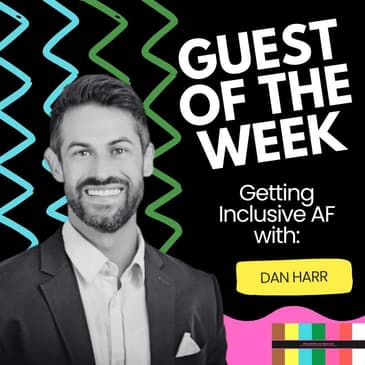
Welcome to The Inclusive AF Podcast, where we discuss all things diversity, equity, and inclusion in the workplace. In this episode titled "Getting Inclusive AF with Dan Harr," hosts Katie Van Horn and Jackye Clayton are joined by special guest Dan Harr, a diverse equity inclusion professional and ERG strategist. Together, they delve into the challenges and opportunities surrounding Employee Resource Groups (ERGs) and the impact of diversity, equity, and inclusion (DEI) efforts in businesses. Dan shares his expertise and insights on aligning ERGs with business strategies, fostering allyship, and creating impactful events while ensuring inclusivity. Join us as we explore the critical role of ERGs in promoting a sense of community and support for marginalized employees, and how they contribute to the overall success and growth of organizations.
If you like what you hear, we would like to encourage you to subscribe to our channel!
We would also appreciate it if you would rate this channel by going here: RateThisPodcast.com/inclusiveaf
We create this podcast as a labor of love. But if you would like to support this channel you can buy us a cup of coffee here: https://www.buymeacoffee.com/InclusiveAF
Powered by the WRKdefined Podcast Network.
[00:00:00] You're listening to Inclusive AF with Jackie Clayton and Katie Van Horn.
[00:00:07] Hello, hello. This is Katie Van Horn. And this is Jackie Clayton.
[00:00:15] Jackie, Jackie on the street? Is that we're going to call you?
[00:00:18] Can you hear it? Why? I mean, how are you supposed to be cool when you're walking down
[00:00:23] the street in Austin and you're literally has jazz at every restaurant?
[00:00:28] That's awesome. That's actually a good thing though. That's like that's a good city to be in is Austin and what are you doing in Austin, Miss Jackie?
[00:00:37] I know it's an anniversary of sorts. I'm at work human.
[00:00:41] Nice. Very good. Yes.
[00:00:44] I am a slacker and did not attend this year. And so Jackie is representing representing the family of inclusive AF.
[00:00:53] So this is the inclusive AF podcast. Thanks for listening. We are joined by a wonderful guest today and I'm going to turn it over to you to introduce yourself and share a little bit about who you are.
[00:01:04] All right, well, happy to be here. My name is Dan Harman pronouns are he and they I am a diverse equity inclusion professional but an ERG strategist.
[00:01:14] I always say that due to the fact that my passion for diverse equity inclusion really thrived with me getting more involved with employee resource groups.
[00:01:22] So from going into marketing going into town acquisition then leading ERG and then have been tapped on the shores and I think your passion has some purpose so let's put that into action.
[00:01:32] And that's where it led me to diverse equity inclusion and I think my passion with ERG comes a little too strong at times to the fact that I have a teacher that even says ERG is on today.
[00:01:43] Because yeah, that's who I am but outside that I am a proud gunkle of a 10 year old gunkle means gay uncle.
[00:01:51] I live in Omaha, Nebraska.
[00:01:53] Also, Lincoln, Nebraska as I live here with my partner Joe and yeah just ready to take on what's life adventure.
[00:02:02] Awesome. Very cool. Very cool. And I do love this shirt so Jackie I don't know if you can see it but we have a very shiny shiny ERG sign on his shirt. It looks very cool.
[00:02:14] I was very excited.
[00:02:16] I was like, no dude I want the shirt.
[00:02:19] That's awesome. That's awesome.
[00:02:22] So, dad tell me first off where did the passion for ERGs come from like how when did that start and why was why has that been a thing for you?
[00:02:32] Well, I'll start when I first got into actually my first corporate entity. So I got in there and being a gay individual and I don't want to you know back in the Stone Age for me it feels like many years ago coming in I wasn't sure how I could share myself authentically and be safe.
[00:02:51] So when I got into my first corporate job, I found out that okay we have employee resource groups and there was an LGBT one. And I got more involved and started to take pain at interest and that kind of interest also sparked from the second week of being there.
[00:03:06] I was actually someone pushed me across the hallway and they said move it insert the F word.
[00:03:13] And I was like, okay we're not supposed to do that in corporate America. Are we supposed to what's going on here?
[00:03:19] But from there I got more involved with LGBT ERG and from that point they're like hey we have a VP position and I'm like what's that?
[00:03:28] And I call we have positions on our board and you help you know serve the DNI strategy and implement different initiatives and events and I go so like happy hours and like well yeah kind of.
[00:03:38] And when I got in there I started seeing the momentum of really able to align it with our new DNI strategy that's coming into play.
[00:03:47] So at that time, Angela Cooper soon to be aka my boss came into play as the director of diversity inclusion started seeing what I was doing with LGBT ERG and how I had opportunities within town acquisition and my connections
[00:04:03] and other company heads of saying hey how can we really evolve our ERGs to do more because at the end of the day you're looking at these ERGs and they're already working nine to five and the ERGs work is their passion work.
[00:04:15] So how can we put that passion into purpose and cultivate impact to really uplift the people so they can feel like they can be their authentic self.
[00:04:23] And then from there, you know Angela tapped me on the shoulder and said hey I got a job and I'm like okay.
[00:04:29] So from there I was able to put my project manager hat on and my program manager hat on and actually embed a ERG strategy to look and feel more like a business sector and say hey business units we're going to be having quarterly.
[00:04:45] ERG strategy sessions. What do you want to see from us how can we add value back to you, but also we want to see value that you add back into us and really how that unfold into something that was definitely uplifting to see intersectionality between ERGs as well as making sure the ERGs are going beyond just happy hours like yeah happy hours are great trust me I like a drink trust me I could use one word about now.
[00:05:09] But I think the meaning of you know building up that ally ship uplifting the heritage months into actually action versus putting a post on social media social media is great.
[00:05:19] But what else can your company do to really uplift that day of observation so okay it's not it's the Wally day cool the image doesn't really depict where doesn't let your employees really live that out.
[00:05:33] Or what is pride yay rainbows I'm gay I love rainbows don't get me wrong I got sequence blazers galore. However, glitter can you know we can calm down the glitter and the Skittles taste the rainbow whatever but how can I actually talk to entity about my journey of being a proud gay man out in public as well as how can I uplift my trans community and say these individuals really deserve a voice at the table how can we do that.
[00:06:00] And the ERGs is definitely a stop a stepping place that we can make those introductions as well as bringing them to that table and say, well, let's see.
[00:06:09] Let's talk.
[00:06:12] I love that so much because I have been known as being anti ERG but the real thing is I'm I don't want to be in a book club like you're saying it's like I didn't join I came to work not to make for my friend group like I'm trying to keep those things separate and so I want it to make sense.
[00:06:30] And it sounds like you've been able to do that.
[00:06:33] And so I'd love to hear you talk more about the strategy part, because I don't think people look at it as a strategy they look at it as a more of an expense and something that you can utilize in the business.
[00:06:44] So, can you talk a little bit more about the framework and the strategy that you, you know, that journey because a lot of people are like what do you mean strategy why do we need a strategy so I'd love to hear more about that.
[00:06:55] Yeah, so back then when I was with that company at that time we kind of build our format of their DNA strategy back then to three pillars. So workforce workplace and marketplace.
[00:07:08] And I took that and trying to align it with our ERG's and challenge them every time we met quarterly is okay.
[00:07:14] We're then all come together. We're going to be given this opportunity to say okay how can we build structure within the upcoming three months so quarterly pays similar to a business unit does every time.
[00:07:26] How can we address it on the coast of workplace workforce and marketplace that being workforce how can we up that lift the allyship internally workplace how can we retain that top talent or attract that top talent and marketplace is how do we show on the community
[00:07:43] so how can we give back to our community partners. How can we do more volunteering how can we make more of a presence of our voices being heard and really aligning that as well as during that quarterly conversations.
[00:07:55] It was a time for us to actually challenge one another within the ERG's I was a big thing of, for instance if your company is huge and if you have nine ERG's times that by 12.
[00:08:09] That's 108. If I got that wrong, I don't have my cat there with me but I believe it's 108. 108 events. Do we have does your employees have time capacity to actually go to all 108 events.
[00:08:23] No, they don't. Let's be honest because if they're either in call centers, they're working on projects or depending on what kind of focus area, they don't have time to get away.
[00:08:34] So during this quarterly means I really challenged each ERG's and you have three events that you can post you can host this this quarter.
[00:08:44] Like why three Mac threes your max actually I done ideally I would like you just to have one or two.
[00:08:50] And I will that kind of defeats the purpose like what if we have a month's observation really want to go all month out. Great start planning that out six months in advance and really narrowing it down.
[00:09:02] Like for example, our back then our Asia Pacific heritage ERG was talking about to Wally always one day.
[00:09:10] They took six months to map out a whole entire event during the lunchtime so everyone come down and eat but experience hand painting, map drawing tastes different ethnic foods as well as seeing Wally dancers.
[00:09:27] And from that six months of playing that one event that event is still talked about to this day versus just talking about Oh, we're gonna do trivia for pride.
[00:09:39] Cool. I already know, you know the riots happened. I already know about Stonewall. I get it. Trust me it's like gay one on one for me but at the same time as I know some people don't have that experience so we need to have that but trying to challenge them how can we do more by by also thinking less and they're
[00:09:56] like what do you mean Mike okay I love a good acronym you know the ERG is for instance, but highlight so high impact low input. So during those strategy sessions I was like what can we deliver that as high impactful, but low and input being mindful of your time and your resources is when you really also thinking
[00:10:16] that ERGs have a limited budget. We don't we're not like it or HR that gets half a million dollars to do whatever they want not saying that not doing everything work, you know, just stupid things. I'm saying when I shouldn't say stupid things that
[00:10:31] don't actually deliver ROI's so if your ERG only has $5,000 for a whole entire 12 month cadence. How can we really pivot that mindset to really think strategically as a business union.
[00:10:43] So during those strategy sessions it kept on me just trying to challenge them and kind of be that devil's advocate, but trying to gear them in a conversation that's going to be more uplifting to make sure that delivering things that are memorable and appreciate.
[00:10:58] And like you said book clubs are great. Not a lot of people read.
[00:11:03] I don't read.
[00:11:06] I watch movies. So like, how can we maybe flip that how can we make my current employer, we didn't do a book club for our ear or LGBT ERG. We actually did podcast. So we would either talk about a book we talk about podcasts we talk a movie and discuss it versus just kind of saying
[00:11:26] chapter one, we talk about this and you're like, what cool fantastic. I'm sorry, folks. What's going on here, but you know book clubs can be memorable it just depends on how you structure and how you align it, but to see if you're actually members are getting some out of it too.
[00:11:43] I love that. I think you know one of the things that I have always been thinking about when it comes to ERG is exactly what you're saying that.
[00:11:54] And we know this from the different communities and I'm sure you've had this experience yourself where it's, you know two days before Women's History Month or before, you know, Black History Month and it's okay who can we get for free to come and talk and come into
[00:12:08] like, no. So I love this whole idea of, you know, planning and being very intentional in the planning it sounds like. So tell me, you know, aside from budget which I think is always a question and you know always something that folks are looking for.
[00:12:23] What does that planning look like and you know and this the folks that are listening or folks that are in this role or you know maybe are in an HR role that that need help with how do I make this real.
[00:12:36] And how do I actually start to think about this differently than I maybe have in the past.
[00:12:41] I'm happy to ask that because actually that was my pride and joy. So I, you know, canva so the online source of current like infographics and everything I'm a visual learner.
[00:12:52] So I took it upon myself to actually connect with a lot of internal partners so you got to think about when you're playing or even a wedding or a birthday there is different internal partners you have to coordinate with you got marketing, you got your security, you got your IT,
[00:13:07] you got the facilities, you have everything but no one knows how to play. So I took it on myself and kind of actually looking at if I was playing like a wedding or if I was playing a big event so I was researching event planning companies and even connects with people with the knot that's a wedding
[00:13:26] people and kind of getting ideas. How do you plan out weddings? How do you do this because I was trying to figure out a cadence so from there and connect with all my internal partners and all of our internal resources online.
[00:13:37] I created a beautiful it's purple. I love purple. I'll tell you why I love purple in a little bit, but it's an infograph that I depict and how to break in downtime. So like three to six, three to six months.
[00:13:50] This is where you're going to be IDAD. You're going to brainstorm. We're going to figure out what you want to do as you look towards those upcoming months one or three months you're going to submit in your event of that plan to the D and I team or whoever is lean your ergie so they can approve but also that'll be a
[00:14:06] cadence for you to okay let's align our committee with our responsibilities who's doing what where are we having it send out the invites make send out they save the dates and everything and then it kind of broke down even more from two weeks out one week out the day before the
[00:14:22] day of and also some people don't forget I don't include this but I think is the day after and the day after really to you know regroup as a group and say okay what went right what went wrong how can we improve and what can we do better next time or is this event that we want to recreate.
[00:14:40] But I create a huge infograph and within the graph had hyperlinks to all the internal partners emails as well as a list of our nonprofit organizations that we partner with if we want to reach out and we can bring in a speaker.
[00:14:53] And also I tell my your cheese.
[00:14:55] I keep on telling you to use the matter what if you bring in a speaker hey them what they're worth.
[00:15:01] And if you have a great connection with them fantastic but let's see how we can give back to them in some kind of way as well.
[00:15:08] So, I think kind of planned that that infograph or my infograph baby that I love so much I even use it to this day even in my personal life of how we can really map out and make a plan event that is actually packed.
[00:15:22] Love that I really like the fact because I love making it into a leadership opportunity right there learning other skills that they can put through do you do anything in helping people who participate.
[00:15:36] Share that message of how they participated with their departments because it sounds like a good growth opportunity and can be impactful and helping managers as well get people engaged but also learning additional skills that they can use has that part of the process.
[00:15:51] I implemented that when I was with my past employer and I continue.
[00:15:57] I connect and consult with a lot of your cheese here locally and some national at times to and there's different ways of I tell people so people talk about your GP while I was like okay well if you are overseeing your years how can you do an annual performance review for your years leaders and send it to their managers.
[00:16:14] You know your managers have a team of you know 5 to 20 or even more they're not really going to know the extra value that you add to the company so by sending those performance reviews they were able to see the value added back to the company.
[00:16:28] To I tell people a great way to engage employees to join an energy or to join on a leadership board of energy.
[00:16:36] I was like is networking you know if you're in a big entity you're not going to meet Bob and I T all the time if you're going to be in marketing so I always tell people you come to the events you're going to cross reference cross network with different people in your company and you'll be able to meet and learn about different positions or different opportunities that are available as well as when you're in that leadership realm.
[00:16:59] You're a face that you're G you're putting your face out to the company so those leaders is saying hey I see Dan doing amazing things with our LGBT kind of want to pick apart his brain for project or working on right going away he's doing a lot of things that showcase what we need in this role.
[00:17:16] Maybe I'm not going to reach out to and retain that top talent and send him that job description and the great thing is I've seen over the past years.
[00:17:25] E.R.G leaders are at a percentage of 50% to about 72% wanting to retain stay with that company because the E.R.G makes a place like their second home their second family as well as they were able to get different opportunities within the organization based off of their exposure from the E.R.G.
[00:17:47] So I always try to tell people your cheese or sales pitch helps you not only develop in different skill sets because you're just have different positions, you know, president vice president program coordinators event chairs and so on and so forth, but also exposure to those leaders who might not know who you are.
[00:18:03] Yeah, absolutely. No, I think that is great and I think the networking piece is kind of the next I'm glad you mentioned that because I want to ask what has shifted when you think about this and you know talking about planning these events you know over a long period of time and how you know what the goals are for those events in this world that we're in of remote work and you know folks not being in a centralized location anymore and you know I I.
[00:18:33] myself have multiple locations around the globe that I support.
[00:18:37] How do you think about that and think about kind of that remote or that when you don't have people all in one place or people coming into a specific office.
[00:18:47] Well, I challenge the companies to think about it when they're looking at advances what is their audience look like so if you are a global company maybe see if you can schedule two events that are at the times that over kind of over shift different times like the current company I'm working for right now we are.
[00:19:03] Global company and sometimes we have to schedule for events at 8am.
[00:19:08] It's not great in the Midwest because you're just waking up you haven't had your coffee, but we want to make sure our Asia office can participate and yes it's very late for them but we're trying to find out what works with what.
[00:19:20] And if it's based off our you know the speaker is coming in hey can't make 8am or they can't make those certain times we try to best record those events so they can rewatch.
[00:19:30] As well as trying to see if how we can.
[00:19:33] Reduplicate the event in a way that is mean their needs so I think it just depends on from that year G scope of what is there overall and goal when creating that event.
[00:19:44] And how can we deliver it on based on the members and also depends on that event if it's just that year G specific or is that year G really want to cap date the audience of the whole entire enterprise if so that's going to be you know born.
[00:19:59] The whole entire ocean so how can we know scale back but still make impact.
[00:20:04] So I think there's different ways of how you can approach it just depends on what your overall goal is and how you can stream work with what you have some companies you know they might just have zoom the others might have teams so they have those affiliates like on Microsoft they have teams as well as they have SharePoint and they have.
[00:20:23] Yammer there you go.
[00:20:25] Yammer it's like social media and everything but how can we make those events or those resources or development opportunities accessible to them if they're not going to be there in real time.
[00:20:38] Yeah absolutely.
[00:20:39] Absolutely and so when you think about you know the the role that you have and it sounds like you're in a company and have been very fortunate to have leaders that are supportive of this work.
[00:20:54] What about folks who you know in this world we're in right now you know that where D. I. programs are being dismantled and you know laws are being passed about funding for any type of D. I. universities all of these different.
[00:21:09] I don't even know how to say but you know just very unfortunate and like just wackadoo way that things are being handled in regards to D. I. what about those folks that don't have the support of their leadership team or don't have the support of their leader to actually drive some of this work.
[00:21:31] Great question difficult question because
[00:21:34] Well then the interesting thing is I I'm on the way out of my current company as well because I you know especially with these times business business comes first and foremost and some of their decisions is best for the business and I respect that a lot of
[00:21:53] I think it comes down to just really you know being okay with it so it's relatively fresh for me and a relatively fresh for a lot of individuals but I think it also comes down to just really you know being okay with it.
[00:22:08] So it's relatively fresh for me and a relatively fresh for a lot of individuals but I think it also comes to a point of giving us still hope as D. and I is not going is not going anywhere.
[00:22:18] It might change or might be republished to culture work or belonging work but if you look around us we have diverse town everywhere we will and if come from the United States we have a lot of people that are not going to be able to go to work.
[00:22:28] They're going to miss out and not be able to you know have business reasons to keep other people around because they're not really seeing that value there.
[00:22:37] I'm in a bi-racial relationship so my partner is black so I know when he goes to his company he doesn't see leadership that represents him.
[00:22:44] He's not going to be able to go to work.
[00:22:46] He's not going to be able to he can't see where he's going to be at and within a year or feels like he can move forward.
[00:22:54] He talks to me about it I was like hey I get it.
[00:22:58] I'm a white man and I'm a white man and I'm not going to be able to go to work.
[00:23:04] I'm going to be able to go to work.
[00:23:06] He's not going to be able to he can't see where he's going to be at and within a year or feels like he can move forward.
[00:23:12] He talks to me about it I was like hey I get it.
[00:23:15] I'm a white male in a diverse equity inclusion role where majority is usually women who are white or people of color or women of color or men of color
[00:23:27] and being white and the one thing I got going for me is gay as some people say and it's hard for even me to have a seat at the table.
[00:23:34] I think it's just telling those companies let's be real we're not going anywhere diverse equity inclusion is still strong and needs to be uplifted in different avenues.
[00:23:44] So I would want to challenge those companies to relook and repivot their approach and see how they can best align their resources to make sure people like in my position
[00:23:55] especially their employee resource groups to continue to thrive because if you don't some of those employees are going to start seeing that they may not feel like they have a place
[00:24:04] to go and they want to leave as soon as possible.
[00:24:07] Yeah I love the points you're making because you know I think that is something that a lot of business leaders don't think about is you know you mentioned earlier that you know
[00:24:15] within the ERG people find that safe team or that group of folks that they you know that they really develop strong bonds with which helps with retention.
[00:24:23] You know have things that actually do support business goals and do support some of the bigger picture items that a business is trying to drive and the fact that you know you're tying those pieces together of
[00:24:37] hey this isn't something that's going away this isn't a hot topic of today that tomorrow won't be a thing.
[00:24:43] This is something that's real and that will be impactful to your bottom line ongoing and when you do dismantle some of these programs the rest of the employees see that
[00:24:54] and it is a very definite signal of are you safe here is there a place for you here for anyone in a marginalized group.
[00:25:02] And you know I think that's one of the things that you know I appreciate that the folks doing this work it you know it's I think always been hard to do this work.
[00:25:14] There's an additional layer here that you're also fighting a political battle that yes there's already been politics involved in so many of these stories and you know for marginalized groups
[00:25:24] but the idea that now you're even fighting the business case that we've been able to make and and been able to speak about and you know it just is very frustrating and so it is one of those things that
[00:25:38] it's always good to keep that hope and to keep the what can we do and like you said what can we what can we fix and what are the things we just have to go this is just the way it is and
[00:25:50] I'm going to find a place that is right for me so I appreciate your sentiments there because I think they're so important for for folks to hear especially right now when there are so many
[00:26:01] DEI professionals that are amazing and doing great work that are getting that different message from their companies and from their leadership and executives of oh it's not really that important actually we need to worry about the bottom line
[00:26:16] and you're like do you not see that this is all tied together just you know just just a thought folks but so tell me a little bit about your approach when you're going into a company that doesn't have any erg's and and do you have a specific
[00:26:34] you know I'll say you know that normally when I'm working with the company we talk a lot about women first and and and the reason why is because that's usually a little bit more approachable for folks but one of the things that you're thinking of when you're going into a company that maybe doesn't have resource groups currently
[00:26:54] yeah I when I'm going into a company that doesn't have any resource groups and or if they're asking hey we want to start one okay great fantastic I love the excitement love the passion but let me back up real quick I usually ask how many employees you have do you have a
[00:27:10] do you have a dni strategy do you have or do you have your values tied within your dni like my current company they have inclusion as one of their values and I love seeing that because that speaks volumes and it really ties in with their erg's bringing that message
[00:27:24] going into a company asking them okay dni strategy how big is your company and they're like why are you asking this like we need to align if you need to line that erg to something as well as you need to have enough people to really you know make something happen if you only have 10 employees or 100 employees
[00:27:41] you're looking at you can't really have nine erg's because that's in state sustainable so how can we really leverage it so I kind of backtrack and say let's create a strategy if you don't have a dni strategy
[00:27:53] now if you do have a dni strategy great you're already 10 feet ahead of the everyone else let's utilize that and really magnify that and then I go into asking them okay can we get your people's analytics your people analytics and like why again we have enough people as well as you need to have the right people it's just like
[00:28:11] to sustain those groups like I said everyone lives rainbows they might want to lgbt erg but if you have no way of tracking that of who identifies as what because that's still a great area when people are reporting out when their analytics it kind of comes into that territory
[00:28:31] okay are you going to out people who are not ready to out just because you want to have a rainbow pride erg no we're not going to be doing that so how can we get your analytics how can we see how many people you have your demographics of each and then let's send out a survey I know we all love surveys we all have fatigue but the erg's is something that you really want to instill in your employees want it
[00:28:54] that survey is going to be really monumental in how you can establish your first year g your second year g and so on and so forth and how you can really build that up
[00:29:03] and if your company has very to be small I challenge them okay maybe let's not start with an erg what about if we do a dni council or a committee and really start you know uplifting allyship intersectionality and get people's awareness of diverse equity inclusion so when they're
[00:29:23] ready to start erg's that committee has already set a solid foundation of people bottom in ready to do more and take action
[00:29:33] absolutely you know and I think that's another piece where when you have a global team or have a team that is dispersed across different locations having a women's erg in each location can be very difficult or having you know
[00:29:48] whatever erg in each location it you know doesn't really work so the idea of an inclusion council committee group whatever you want to call it I think is a great idea as well
[00:29:58] so when we think about I'm sorry my slack is talking to me I apologize for that it's a lot lots going on for some reason right at this minute
[00:30:08] when you think about kind of what's next and what you see in the future what are some things that are on your mind what are some things that are on your mind from a kind of a local to your state maybe national and then also from a global perspective
[00:30:27] as right now we currently stand so I live in a red state that says a lot but from looking holistically outside I think the companies were invest who have stayed invested within diverse
[00:30:42] inclusion are going to continue and also maybe increase their investments the other companies who might be able to stand off ish they're going to hit some rocky areas they're not it's going to be hard to bounce back right away
[00:30:55] and I would say there was a quote or someone who's a famous actress I forgot their name I can see the jib for the video but they're like if you're going through a rough time don't they say feed into it push through it an experience
[00:31:13] because you're going to be learning a lot so I want to challenge those companies who might be thinking about or dismantling or reconfiguring is like just push through but still have that passion and purpose and go keep moving forward which I tell people and that's why I said earlier my favorite color is purple
[00:31:32] purple is an acronym to me and I always tell this to companies the purr is the purpose and the poll is the people so through diverse equity inclusion how can we put the purpose back into the people well that's through diverse equity inclusion so we're putting that purpose into passion in action
[00:31:47] when when you're working with companies and you know when you're thinking about I mean I think we are all holding our breath a little bit with you know the the political arena of what's going on right now and how do you give people hope so you know you're exactly what you're saying with your your purple analogy I love that
[00:32:08] how are you giving people hope in this time where it is like how are we going to keep doing this or what are we going to do or will we be able to keep doing this depending on what what happens here and then the next coming months
[00:32:26] so from a bigger perspective if you have a lot of buy-in I kind of challenge companies or ERG say how can we maybe take what's happening outside of our work and bring it into a better understanding so what is the current climate within Dean I and the government or anything I have a better understanding what that looks like holistically
[00:32:47] so I challenge that conversation or if that company or if that ERG is like okay we're just trying water over here we're just trying to you know make ends meet so to speak and still be impactful like okay if you're fearful how can we gauge hopefully pull this in and maybe work with some business units so people will have that additional buy-in okay no these are good for us so partner up with talent acquisition for recruiting efforts
[00:33:14] partner up with marketing how you can expand into making your products have bilingual capabilities like really can look at your impact as an ERG in a way that is back to the business during this time so that company knows that hey these individuals they're actually adding back into the business so we can keep them around
[00:33:34] versus trying to rock the boat with a rocky kind of scary conversation as some companies might be a little they might say okay let's pump the brakes if we're having a political conversation here we don't need to bring that here and I understand that but some people you know might want to have that conversation that is
[00:33:51] I opened so actually understand okay what is currently going on like I actually had a conversation with someone the other day that what do you mean he's running again and like yeah do you not watch the news what's going on and they're like um no I don't I don't know what's going on anymore and I was like well let's just say hopefully you're voting and hopefully take this time to educate yourself
[00:34:12] or even some people said I never vote and I'm not going to vote in my how can we have a conversation about that let's dive into that but I know that going into the political climate and mixing it with work that's kind of a rocky issue
[00:34:26] entire with a lot of companies I would just kind of scope out or try some water and lightly during this time and but still keep pushing forward as you can. Yeah absolutely and I think that's the piece that you know folks are trying to hold on to you know how do we make this okay how do we make this better
[00:34:45] and sometimes the best answer is you know just hold tight or just keep treading water and until we you know figure out what is going to be the land all of these things so I love that I think it's really critical for folks to hear what other people are doing
[00:35:03] and you know how to think about some of the stuff. You talked about kind of data and data analytics earlier and you know I want to I want to talk about you know the example you gave of you know who is in the LGBT community or identifies as LGBTQ and I want to ask the question
[00:35:23] I know the answer but I want to ask the question for the listeners of how do you ensure safety for and I'll you know pick on the LGBTQ community or questions I pick on select that group, but how do you make sure that you aren't outing someone in the trans community or in the LGBTQ community that maybe isn't out of the closet in these situations.
[00:35:47] No, definitely rocky because I've even told I being gay and everything I'm a different gay person than my partner. So I'm gonna be okay if someone comes up to me is like hey, I know you're gay let's talk and be okay but some people make.
[00:36:02] I'm not that gay and I don't want to talk about it back what do you mean not that gay we're talking about we're all different we all have different is that kind of like I'm not I'm not really pregnant is that it's like what he went no we're good we're fine.
[00:36:15] But with analytics part like it depends on what you're pulling into it and also your communication of, hey why are you pulling that data. So you can tell your company you can tell your associates can we're pulling this data and this is how it may be used and not saying more than be reaching out these people directly but to get like a narrow scope of how many people identify within that realm that's one way.
[00:36:37] To if you're trying to reach out to people and say hey like if your LGBT group wants more gay people in it or lesbians or trans or bisexuals or you know, I say the alphabet mafia because you know we keep on growing and we can't letters or even numbers.
[00:36:51] But just I tell people like, you know what let's not try to gravitate let's try to maybe shift that mindset of the LGBT ERG and say okay how are we projecting ally ship.
[00:37:05] And how can we say okay this ERG is creating a safe haven and try to create a safe place for those individuals to come to us versus trying to hey we got to find a gay people.
[00:37:15] I watched a movie a couple weeks ago and they're like it was I think your gay best friend it was one of those silly comedy movies that you see on TV and I was like I just need to watch and they're like I need to gay best friend.
[00:37:28] I'm like okay well your LGBT doesn't need to have it would be nice to have you have people identify but it's also nice to have an ERG that uplifts ally ship so those people can come to that ERG and say this is a safe haven for me.
[00:37:42] Yeah, absolutely and I think you know exactly what you're saying is so true is that you know we have to protect folks and we can't share that data and using it in the aggregate is always the you know the best way to go because invite everyone at the table and those who choose to come and join could be allies could be part of the community and you know having everyone there is great.
[00:38:05] On the other side of that how do you determine what events or what activities or whatever they might you know the ERGs might be planning when it's for that group specifically and when it's okay to invite allies into the conversation.
[00:38:26] How do you think about that.
[00:38:28] I think comes down to when you're playing like the overall goal, but I kind of looking at from a different perspective of saying okay let's look at the month calendar month what observations or heritage months are coming up that you went up lift.
[00:38:41] Or do you want to change the narrative and like I've had emerging leaders or young professional ERGs they don't really have a design month so they're like where do we fit this doesn't include us.
[00:38:53] So they went from a development standpoint okay how can we gravitate and really uplift people's development or uplift different key areas within the business sector that people don't know about.
[00:39:04] So it's an opportunity to just and during those quarterly sessions or when I invite other ERGs to the table and kind of collectively brainstorm their upcoming ideas.
[00:39:15] That's where I that's a great time for those ERGs and say hey we're doing we're thinking about doing a event in next month and that kind of aligns with what your goal is how can we connect and making not making them but just kind of making that opportunity come apparent to them saying.
[00:39:30] Oh this is an idea let's go like for instance women hit women's history month is in March. Trans day of visibility it's March 31st so how maybe that your LGBT and the women's group can collaborate on that day uplifting that special day similar to.
[00:39:48] Like.
[00:39:50] Spanica Spanica heritage month is September through October so it's a different time period but there's a lot of cadence of what's happening during then how we can uplift that and diversity month whether you look at it from October and April time period.
[00:40:05] So different months you can uplift that too. So I think comes down to the goal but also just having that collaboration and that communication with those ERGs can help break down those barriers of like how can we collaborate or what can we uplift or hey I love your message that you want to deliver at that event.
[00:40:21] Worthy now you know pause on what we're thinking is a good idea right now but how can we uplift yours so maybe reaching out to our membership and say hey check out what the women's group is doing next month how and being great allies for them.
[00:40:35] So I think it just depends on just making sure everyone is well aware and also eliminate that overlap because like I said you don't have too many events going on as well as you don't have you don't want to have too many events happen on the same day.
[00:40:48] Trust me. Yeah.
[00:40:50] My feet kill from running one side of the building to the other side of the building trying to coordinate for both of them.
[00:40:55] Of course of course. So the other piece I think you know just to frame up as you know when you think about those different days those different activities those different pieces is the you talked about this earlier and I want you to talk a little bit more about it.
[00:41:13] Is the event the objective or what are the objectives that folks are setting throughout the year or for that day.
[00:41:22] Great question I think it's kind of two four so when we're doing that strategy session I tell people we talk about and when I challenge other companies like what you want your company you are in place to take away from that event.
[00:41:36] So yes I've been in HR in the past so I'm one of those HR people that can what's our takeaway here. What are we doing what's going on or do we just go eat food and leave.
[00:41:46] You don't really get anything out of that.
[00:41:48] So I challenge the ERG is to be okay. What do you want people walking away with as well as what do you really want to encompass within this panel event.
[00:41:55] Do you want to uplift that women have important places at senior leadership level. Great how are we going to showcase that or just bringing them to showcase for women who all make half a million dollars each and who are running the business and just speaking like they
[00:42:12] and just talking. No so how can we shift that mindset and shift the panel questions to get more key takeaways so they can be inspired.
[00:42:21] So kind of really just kind of leveling up for them of what are we wanting to get out of as well as telling people how can we equip employees afterwards to give us their feedback.
[00:42:32] A lot of people don't really realize that's why after those events I say what we're doing afterwards because if you don't learn what you just did you're going to keep on redoing it and thinking it was good.
[00:42:41] It was great when everyone is like.
[00:42:44] Great.
[00:42:46] Fantastic.
[00:42:48] Yeah, I think that's such a critical piece is getting that feedback from the folks in the ERG getting feedback from folks who attend his allies all of that.
[00:42:56] So yeah I the day after I love these said earlier and you know reiterating that now because it is such.
[00:43:02] I think all of us have attended those events where you're like that was neat. Okay bye and you know you move on with your life and there isn't really but then we've also been to those that have been very impactful and very much a wow
[00:43:15] here are the 20 takeaways I took from that conversation that panel that whatever or even a book just to be clear I am a reader.
[00:43:23] So I you know from a key takeaways of this conversation you know I loved everything that you've shared but what is one thing you want to make sure our listeners heard from you or a key takeaway that they can you know go implement tomorrow.
[00:43:44] I leave you with the hardest question.
[00:43:47] Dang. Okay.
[00:43:49] I want to challenge those individuals who look at and play resource group with maybe a questioning or curious mindset and challenges in the go to an event or challenge them to maybe even start in the ERG or see how they can equip that into it and really really doing the research because when you look at the powerful ways of energy can add back not only to your company but your
[00:44:13] you as a person.
[00:44:15] You will see where it leads you like for me I invested my time into an LGBT energy and it found my passion within diverse equity inclusion.
[00:44:25] I've seen people come in from a standpoint of I'm just I'm just doing the call center.
[00:44:30] I'm just a call center person doing this and this but going join it here.
[00:44:34] Gee they thrived in that and now they are actually an actuary trust me if you're not knowing when actually is that's a lot of math a lot of data but you get paid a lot of money but not embracing those ERG is in the power of what they can be.
[00:44:48] You might just be still stuck in the dark where the stone ages back.
[00:44:52] Yeah I don't feel like going to a happy hour.
[00:44:54] Ergies are more than a happy hour period.
[00:44:56] Awesome.
[00:44:58] Love it.
[00:44:59] I think that's the piece the networking and the you know ability to actually get to know folks that you said this earlier and I think this is my take away or give away whatever you want to say.
[00:45:12] The people that you're able you know we talk about exposure we talk about mentorship we talk about sponsorship the people that you meet within these groups a you know they're like minded in that they are passionate about these topics.
[00:45:26] You can find kind of your your place within an organization and your your reason for coming in every day or showing up every day.
[00:45:37] I'm being able sorry and being able to translate that into a profession versus a job or a career versus a job is so fantastic so I love it so Dan how can folks get a hold of you if they would like to connect if they would like to talk with you.
[00:45:55] Yeah well I am I use LinkedIn way more than anyone so my friends think of weird but you can find me on LinkedIn it is Dan Har HR so Har not hair so not a bunny rabbit and Dan Dan and I'm always happy to connect and talk more about Ergies and see how we can help each other out.
[00:46:16] Awesome very cool well thank you so much for joining us you know Jackie had to drop it sounds like she's got some issues.
[00:46:24] She's at a conference right now with with Wi-Fi so we will rejoin her at another episode but thank you for joining us this is the inclusive AF podcast and this is Katie Van Horn.
[00:46:45] We are gathered here today to give you permission to plan the wedding that you want.
[00:46:50] I'm Jessica Bishop and I'm sorry we know men and we're the hosts of the bouquet toss podcast today's couples have to juggle so many things from family expectations to outdated traditions and what's currently trending.
[00:47:02] So to make it easier we're going deep to figure out why we do weddings the way that we do so you can decide what to keep and what to toss from your wedding day plans.
[00:47:10] You are cordially invited to subscribe to the bouquet toss wherever you get your podcasts or at evergreenpodcast.com.
[00:47:16] By the power vested in us we pronounce you free to plan your day your way.
Sponsors
