
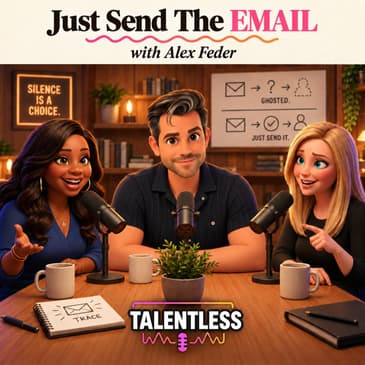
Just Send The Email: What Hiring Transparency Actually Takes
Alex Feder, Founder of Ghosted.work
LinkedIn · Ghosted (ghosted.work/trace, free, public beta)
Alex Feder spent the last year job searching and getting ghosted, so he built software to fix it. Desiree and Ashley talk candidate experience from the other side of the table: what real transparency actually sounds like, why "the system is broken" is the wrong excuse, and why sometimes the fix is just sending the email.
In this episode:
Why Alex built Ghosted.work after his own brutal year of job searching, and why he built Trace as a second, narrower product instead of scaling the first
What "transparency in hiring" actually means in practice, from both the candidate side and the recruiter side
Ashley's own ghosting story: rejected before the interview, then invited back to interview for the role she'd already been rejected from
The fake-job problem, response rates under 1%, and a real (anonymized) story about a company posting fake listings just to farm LinkedIn followers
AI on both sides of the hiring table, and Alex's line: "these are two cars racing to a red light"
Why Alex is skeptical of the existing "call out the ghosters" sites and how Trace's approach differs
Homework assignments and live presentations as a harder-to-fake alternative to standard interview questions
Ashley's "Rate My Recruiter" pitch and the case for hiring the long-term unemployed as a wealth-gap lever
Resources/Links:
Ghosted.work: https://ghosted.work/
Trace: https://ghosted.work/trace
Alex Feder on LinkedIn: linkedin.com/in/alexfeder
Desiree's book, Leadership is a Practice, Not a Personality, out October 2026
Talentless at RecFest and HR Tech this fall
Powered by the WRKdefined Podcast Network.
[00:00:06] Recording in progress. Ashley, I want a weird question for today since you just came back from Alaska. Okay. Yeah, give me one. Let's see. Would you catch a fish with your bare hand if you could? Yeah, I've done it. Would you really? With the slime? And it would just nibble at you? Yeah, I've swam with sharks, girl. I don't lie. Have you really? Okay, Alex, would you catch a fish with your bare hand if you could?
[00:00:33] Absolutely. I picture the salmon, you know, swimming up stream. Yeah, the whole thing! Yeah, that's where I go. I'm waiting right there, snatching right out of the air. Just clapping them together. Let's do something. All right, I needed that one because Ashley was away for a week and I missed her. So I didn't get to hit her with any weird, weird questions, which is my normal go-to daily. So that was the weird one. It was good. Today's guest, folks. And first of all, thank you to all our listeners and anybody
[00:01:03] new. Welcome aboard this crazy ship. Uh, today's guest spent 2026 living the thing he now builds software to fix. The hiring gauntlet. He lost a job, went through modern hiring gauntlet himself, did some crazy things, and now he's built a company around it. And I think it's pretty cool. And so Alex Feeder is the founder of Ghosted.Work, a candidate advocacy platform built to bring
[00:01:30] transparency and accountability to hiring. Before that, he spent over 20 years in project management and customer success, including leading a 12 person team and an $80 million portfolio at Razorfish and running customer success for 30 plus enterprise accounts and business on where he drove a hundred percent renewal rate. He also founded Live Edge Group in 2022. Alex, welcome to Talentless. Thank you so much for having me. Did I miss anything?
[00:02:00] No. In fact, probably you gave people too much. It feels a little embarrassing to beat my resume. It's really weird with your social. I appreciate it. It certainly qualifies me. Thank you. Yeah. So here are some numbers. Let's throw them out. Somewhere between 53 and 61 percent of candidates, depending on who you believe, get ghosted after an interview and that number is
[00:02:25] climbing. And that is scary, scary crap. I don't know what to tell you. This system, I'm just tired of using the word system is broken, but that definitely will show you the system is broken. And so today, folks, we are talking about transparency and hiring what it actually requires to do this work operationally. And I was talking to Ashley last night, folks, just about this, about seeing it from a candidate lens and talking about this as more of a candidate
[00:02:52] instead of a recruiter. Because I think we get so mired in doing really great recruiting. We forget about sometimes there's candidates on the other side of this crazy thing. And so I thought Alex was a great person to bring on and really dig into it with us. So Alex, why don't you give us a little bit of background? Tell us the story. Get us to today. Yeah, absolutely. Well, I'll focus more on the last year because I think, you know, we've all had
[00:03:18] bouts of looking for work, you know, but the hiring environment is different, you know, than it has been in years past. So this past year is especially relevant as I experienced or lived some of those statistics that you're throwing out. You know, I too became pretty frustrated with, you know, the candidate experience and, you know, lack of communication, lack of transparency. I think that frustration felt like I didn't have a good outlet for it first. And that's because
[00:03:47] it's, you have to risk a lot to call out and name names on a professional network like LinkedIn, right? And while we're all looking for jobs, that's a pretty risky and, you know, proposition to put your name assigned to complaining about a hiring process. So, you know, I wondered if there were many people like myself experiencing that frustration. Of course there are. So it all kind of started with
[00:04:12] creating this LinkedIn account and allowing people to simply submit evidence of like I required proof. I didn't want, you know, to just be a ball horn or microphone for people just to complain. I wanted these to be real life things. And I walked this line between millennial and Gen X and channeling my, a bit of my Gen X side. I kind of feel like you need to draw attention and create some challenges on
[00:04:37] the company side for, you know, the hiring process itself to improve. I like to say that we didn't design the system, but the technologies on both sides that are dealing with these issues like volume and whatnot have amplified what's wrong with the system, right? So I think these cracks are always there on some level, but technology is very much amplified them. So, you know, I'll just round out by saying the,
[00:05:02] with that frustration, I wanted to learn some of the new tools out there, AI included, but some of these like prompt based, you know, they call it vibe coding, but giving people like myself and others, the chance, you know, firsthand to build things in ways that we couldn't before without like an engineering degree. And so I wanted to learn some of those new tools and started playing around with what
[00:05:24] a product might look like. And so after a while I, I had a, a Frankenstein three headed beast of a thing that I'd built and decided, well, what's the most useful thing? And my, I kind of focused myself on what I'm calling trace and forgive the branding here. Don't take me too seriously, but trace is basically a board that piggybacks off your email communications to organize your job search. So by
[00:05:51] simply forwarding emails, it creates cards, understands the status of those opportunities. You can make notes, set reminders, and then kind of track your hiring journey. And it's made specifically for candidates, for folks living this modern hiring experience of applying to a large volume of jobs in ways that we just wouldn't think of before, like applying to hundreds of jobs, you know, would have been crazy five years ago. Right. Right.
[00:06:19] But there's a lot of people like myself that, especially as for me, it's been a year not having a traditional job, you know, and I still apply to jobs, but you know, it's unbelievable. And I definitely have lived that statistic. So that's the long and short, mostly long of it is how it kind of came to be. Yeah. I'm a Gen Xer as well. And you know, for me, I was on the job search for a while and I'm going to tell you, I was just astounded by the fact that I
[00:06:47] didn't have a job with like really quickly or that people were so rude and didn't get back to me as a person in recruiting. I was like dismayed by the whole system. And it's funny as a recruiter, you like, I talk about this stuff all the time. So, you know, I'm like, everybody's going to treat me like, you know, it's going to be great. It's going to have great canon experience. And then I was in it and it was just awful. I mean, absolutely awful and soul wrenching and like crying moments were
[00:07:16] happening and like all of these things. I mean, I pulled myself out of that craziness at this point, but it is soul crushing. And I actually think the product that you're building, we talk about tech on this show a lot about how some of it's not useful, right? The floor building. But this I think is actually useful, right? Because the job application process right now is unheard of for most people.
[00:07:44] They're used to applying to maybe 10 jobs and they can track those very easily. It's like, okay, you know, Mary got back to me and Jane, you know, but at the volume you're having to apply, there's no way for a normal human to keep up with the status of everything, unless you're building your own thing through quad or whatever you're doing. Very capable of doing that. But it would be great
[00:08:11] to see that happen for people and people not feel so, I don't know, devastated by this market in, in a way that at least they know they can track what's happening in their life. I feel like your inbox just gets so crowded or not crowded, right? Right. Like there's nothing happening in it. And you can then maybe take that information and then maybe change something that you're doing,
[00:08:38] right? Or totally evaluate what next to do versus like this, just constant applying and filling out work day. Sorry, work day. Not sorry, work day. Work day applications that take you 20 years and two new logins and you know, the whole thing. I mean, I applaud you for thinking about that in, in a really real way. It makes a lot of sense. I appreciate that. Yeah. If I could also say like,
[00:09:07] there's so much of what you're doing that's a necessity. Because I can tell you, in 2015, I was working for a place that was still accepting paper applications at their sites. Wow. So we've gone from paper application to resumes on job boards to thousands of applications sent with one click applies. And so, so much of the recruiting process has ebb and flowed based off of what candidates
[00:09:36] are able to do or not to do. I mean, even just changing from on site to remote changed how anyone approaches all of this. And so what I think you've actually accomplished, and I think it's something that is really hard to do is once we've moved from this, I went and shook Bob's hand at such and such site and applied to this to now I've applied to a thousand jobs. We've relinquished a lot of
[00:10:03] control. We've relinquished a lot of our ability to feel like we make any impact in what happens whenever we submit our application resume. And I'm not super familiar with your product, and I'll be totally candid, but just based off of what you've described alone, just the idea that it is tracking what you've applied and it's your own centralized bank of how you can actually be
[00:10:29] successful and it brings you back that element of control. Even if it is, you know, and I don't know if it is, but even if it is pseudo, even if it's just tracking what emails you've gotten, at least you can see I've done this effort. I put forth this much. And you have that ability now to follow up because now I remember whenever I applied to such and such and I know the date and it's not
[00:10:53] just somewhere in my inbox. And so, so many different things when actually what it sounds like to me is the biggest comfort is kind of that, and I'll call it what it is, that kind of illusion of control that we've lost over the past 12 years of someone saw my face, shook my hand. Now there's this indebted duty to at least be dignified enough to tell me yes or no to where we've become so separated
[00:11:19] and it's too hard to keep up with. You're having to do it in mass. So it truly sounds like, and I know this might sound weird, but sometimes I think whenever we're at our pits is whenever we make our best stuff. Yeah. Because it's, it's something to, it's something I've always thought of. And I got told by my philosophy professor in junior college, and I've stuck with it for the rest of my life, is solutions are only
[00:11:45] created when problems are present. Absolutely. And so you can't be a solution-oriented creator unless you're dealing with a phooey ton of problems. And so I know it sounds weird, but I, I think what you're doing is actually kind of great. I think you've turned a phooey problem into a super solution. At least it sounds, right? So like, let's keep diving in. I'm going to stop the epic. Yeah. I appreciate it. I think
[00:12:12] it's just a baby step, frankly, in terms like it's starting out in what I believe to be the most useful solution for this very shrinking down the problem, right? To just a candidate dealing with a volume of applications and wanting to show up well, I think is like a good starting point. Right. And that has a very clear focus. I think that you guys will agree, you know, one of the things that I
[00:12:39] realized, and you know, I've had a beta group testing. We meet every Wednesday, actually met with them right before our meeting right now to get feedback, right. And, and to be listening and, you know, adapt. And I think that the, the thing to keep in mind is, or that I've had to remind myself of is that everybody's kind of chasing the job board referral link job placement, advertising,
[00:13:05] advertising and, or recruiter kind of like tooling. Right. And it, and it, of course they are. I mean, it's, that's where the money is. Right. But that's where I saw, you know, everybody's chasing that. I'm just one person, you know, and there are companies with far bigger resources and control that, that own that. And so sure, you have a lot of AI tools that are applying for you and really just making this problem worse, frankly, but you know, everybody's kind of like focused on building that
[00:13:35] and I'm kind of working backwards is how I see it. So the way that I see it. And as you mentioned, when we're talking about transparency, you know, I think that's, it's, it's good that that's sort of the theme of our conversation, because you can imagine if you have a hundred thousand people tracking their job opportunities and, and all this stuff in a system with that's updating its status and all that,
[00:13:58] you start to have a very, maybe the only objective data set representing hiring, you know, in a market. And so I can then say that certain companies ghost more off more often. I can say that a typical hiring journey takes this long. I can say, right. And this just becomes objective data. And so my thought
[00:14:24] going back to the word transparency is like it, that's how I'm viewing trace sort of laddering up to that part of the mission of transparency, because through that job organization, my hope is that we can increase that transparency, you know, through job search organization, we then can make things known to the, to the community about what to expect from certain companies in a very objective way, rather than a anecdotal, I had a bad
[00:14:52] experience and I just need to vent. So yeah, that's kind of my thought there. Yeah. I think we let's, cause I, as you were talking, I was like transparency in hiring, it's meant so many things to so many people over time. And what does that really mean in practice? Right. And then it depends on who you're asking, right. As the candidate, you're like, I need to know these things. The recruiter and they're like, I'm willing to tell these things.
[00:15:21] So, you know, like where does that, where can we get that line to get a little closer? But Alex, because this is a topic about define it from a candidate and then I'll go to Ash, do how to jump in on the recruiter side. But talk to me about what transparency in hiring in your mind means to a candidate. Yeah. Great question. Cause it is a big, broad word. Yeah. I think that it's synonymous
[00:15:46] with communication, frankly. So, you know, it's not so much, I need to know when you're making a decision. It's that there's occasional updates, right? I don't need to know everything that's, you know, going on in the sausage making machine. And a lot of those things I know that you cannot share, but the answer is not silence. Right. So, right. So it's, it is much more just about
[00:16:10] an update with no new information. It means the world to a candidate, even if you have nothing new to share, because it says to me that I'm still important in the process. It also pays me the respect of, Hey, I've got other job opportunities going on, you know? So it pays me the respect of, Hey, we appreciate your time. We value that. And although I don't have an update, I'm, you know,
[00:16:35] hoping to meet with the hiring manager, you know, whatever a recruiter might feel comfortable saying, but really all that is, you know, secondary to just the open lines of communication. So sure. I have opinions that we should be disclosing salary or things of that nature. And you could frame that as transparency. But I think that to me, it's more about communication. And if we can't get it directly
[00:17:00] from the horse's mouth, that's where a tool like this, like that becomes a form of, Hey, this is what this process is going to look like with this company, you know? And that's kind of how I work my way toward that with starting out in this more fundamental way. But yeah, I think to me, that's what it represents, right? It's just a more respectful exchange and communication as much as possible. Yeah, absolutely. Well, Ashley, you know, I said, I would pick on you a little bit. I'll be the recruiter side.
[00:17:31] So transparency, I feel like there are two sides of it. So there's transparent, there's the layers of transparency. There's the role, the comp, the team, the process, like actually being and having candor whenever a candidate says, well, I'm leaving this role because of XYZ. And you know, this company also has XYZ. Do you take the time to give them care and candor and transparency? Those are like different types of levels. Like again, comes with comp, role, team, process, all that.
[00:17:58] However, to the point of what Alex said is, what does transparency actually mean? Like, what does that look like whenever we're looking at behaviors? And to me, that is effort. It is exactly what he said. It is comms, even whenever the communication is nothing other than just checking in to let you know it's still going. We just don't have much. And I can't tell you how many times as a recruiter I have had to do that because it is something that if I was the candidate, I would
[00:18:28] want to know too. Transparency is something as small as we find out on Friday morning, we're not proceeding with the candidates. And I tell you before the weekend that this is what's going to happen. It's care. It's not always just candor. It's effort. It's what are the other words that I wrote here? It's communications. It's all of those things. So you have all these different levels in which you can adhere and provide transparency. But what transparency actually is, is as I completely
[00:18:58] agree, whenever you break it down, it is this form of communication and it is this form of just intrinsic effort, you know, going that little itty bitty baby inch just for the sake of that's another human on the other end. And I hate even saying the baby inch because honestly, it's the bare minimum. It's what we should already be doing. It's a reverse inch. If you're not doing it, you're silly. It's sad that it's sad that the bar is that low. So low. What are we doing?
[00:19:25] What are we paid for? But it means the world to me, you know, and if that's where we have to start, I'm OK with it. And I also I think as much as, you know, the communication tends to be one way. Right. But what I like about the word is it does imply a two way street. Right. So there are equal, you know, obligations and responsibilities that candidates need to bring to the table as well.
[00:19:52] Right. But and so I think it's worth like underscoring the like two way nature of that. Right. Absolutely. I mean, you can't have I mean, it only works if it works both ways because of course it's ghosts to like, you know, they do. You know, and I wish I could in this market, but it still happens. But it definitely happens. And also if a candidate is listening just because I just went through this, there are some candidates that will will bend not necessarily bend the truth, but just be a little
[00:20:21] flexible because they need the role. I am here to tell you and I know it's hard because you're like, this is the 50th job. I'll take anything. I'll do anything. But ultimately, if it's not something that will sustain you or it's not something that bend will make you break, hold hold to your threshold, hold to your standards because it will make you miserable. It will be in a trading role. And so I just went through this with a candidate where they bent a little because they were needing a role. And ultimately it didn't work out. But whenever we spoke, they were like, you know what?
[00:20:50] I'm kind of glad it didn't work out because X, Y, Z. And I was like, man, I wish you just would have told me I could have saved you this time. I could have told you know what I'm saying? So there is there is an element to that is the recruiter can only be as good of a matchmaker as troops as they're able to accept, receive and give. Yeah. And so same thing with the managers. Recruiters are only as good as the feedback that they receive. So it takes a lot of transparency on every single level of all parties involved to have that type of candor.
[00:21:16] You know, what's shocking to me is that we live in a world where technology is everything, right? So to me, transparency and hiring should be one of the easiest things for a recruiter to do. Build an agent, create a system, do all the things, put a template in your ATF. I don't care what it is. Build an agent to remind you to check in on your candidate. I don't care. Like, I don't understand
[00:21:41] still why I know I'm well, I'm big on candidate experience. So I spent a lot of time thinking about this, but I just don't get where the disconnect comes with building these things. Now, I can argue that right now the market is so flooded and there's so little bandwidth on these teams that they just aren't thinking about this stuff and digging deep into it because they probably
[00:22:06] lost a lot of these people that did some of that back at work. But it's still no excuse to me. It's still. And I will say even a sorry to interrupt, but even at the beginning of this chat, whenever you were dropping the data about how many people aren't getting rejection emails, one of the people on the call said, well, the system's broken. And in my head, all I thought to myself is, nah, that system has auto reject. And that system has where you can one click and do what you need to do to drop those messages. The human is broken. The human doesn't want
[00:22:36] to get uncomfortable. The human doesn't want to have to say no. And some of it, I think, goes back to sometimes recruiters don't really know who's a fit and who's not. And so sometimes they're just like, I'm not going to reject anyone until the manager tells me. Sometimes the hiring manager doesn't know who they want. Right. Right. Big, big, good call. Good call. And that's where I know. We are stuck in a hard place, recruiters, right? Like we're stuck waiting for the answer sometimes,
[00:23:01] but I agree that there should be this level of, okay, if we're waiting on that hiring manager, it's a short, quick email to all the candidates still in the process. Like it takes very little time to do that, to soothe somebody's mind on the other end. Listen, if you'd seen me crying on my bed, you would have sent me the email. Okay. Like I, you know what I mean? You would have sent me the email if you actually had to confront the person on the other end. Just send the email. Just send me the email.
[00:23:30] It goes a long way. And I, I also, you know, I try to draw this line from candidate experience to customer experience because, you know, when I would say that I'm far less likely to use products from companies that have not treated me well in the hiring process. Sometimes you don't have much of a choice in what products, you know, you're purchasing when you're working at an employer,
[00:23:59] but you know, sometimes you do and you upset enough people out there. I would argue at some point that starts to impact your bottom line. Like this is not just a temporary thing, you know, it does carry over into, you know, especially an employer brand are directly connected. I don't care. I'm going to tell you right now. It won't tell you different. Yeah.
[00:24:22] Like the Glassdoor reviews will prove it. Okay. It's directly connected. And I have stopped not in this morning, but I have stopped myself from applying somewhere because I've gone to Glassdoor. It will burn you in the end. And that affects your bottom line. I don't care what anybody else says. And if James Ellis was here, shout out to James Ellis, he would tell you exactly that. Yeah. He would tell you exactly that. Like there is no way it's not connected.
[00:24:50] I think a lot of recruiters who work at B2C companies never even think about it. They never even think, because I'm going to tell you right now and I'm not going to say anything more than this. Well, actually, I'm not even going to say their name. Why? Because why? This episode of the Talentless Podcast is brought to you by Do Better Consulting. Hiring is broken. Job searches are broken. And honestly, most career advice out there
[00:25:16] is just recycled nonsense. Do Better Consulting exists for people who are done guessing. They work with mid to senior leaders, founders, and talent teens to get clear on their signal, how they show up in the market, how they hire, and how decisions actually get made. No fluff, no templates just to say you have them. Just strategy, structure, and honest feedback that
[00:25:39] actually works. If you're tired of spinning, it might be time to do better. Head to dobetterconsulting.net. Company. There's a company, all right? Their hiring process, seen it from the back end, experienced it from the front end. And for the rest of my life, whenever I see their brand, I tell people, you should actually switch to so-and-so. Let me tell you about the internal of this company because it's a dark place. And so I say this just to say, there are so many times,
[00:26:09] especially if you are B2C, B2B gets to have a little bit more audacity because whatever, but B2C, recruiters don't even think twice. And it does impact their bottom line. It's going to impact the layoffs that impact your cost center, aka talent acquisition. It's going to impact all the different things whenever they're not able to bring home the bacon that they were because now, you know, our hiring practices have resulted in a product that even our output isn't great. Like
[00:26:35] even who we selected isn't great because we didn't have a good process. And not only that, but good, good, good candidates who experience bad process remove themselves. They do because they can. Yeah. And so, and that was probably the difference with me. This was the very first time, this was probably about a year ago now that I ever had to job search in my career. And I know that sounds really hoity-toity and I don't mean it that way at all. I've been very, very fortunate, but it was the very first time. And a lot of the reason that I had to be on the job search is because
[00:27:05] I was too ashamed to tell people that I was job searching, to be quite frank. I didn't want to call on a referral. I didn't want to call on a friend. I didn't want to do any of that. I just wanted to try to do it myself. And I'm going to tell you right now, I interviewed with two companies, went ahead and committed with one and both processes were horrible. And it ended exactly how I thought it would because it was the exact process. I mean, before they even called me to interview me, they sent me a rejection letter. Then right after we're like, Hey, actually just
[00:27:33] joking. That wasn't meant to be. Can we schedule a time? Interviewed me for one role. And then we're like, actually, we want to switch roles. So it's something to where I say I empathize so much with people who are having to do this on a grand scale. Cause a year ago, I still, I think it's getting a little better, but it's still so rough, man. It's so rough. You know, look, the, I'll go back to the beginning of the meeting Desiree with, you know, you're mentioning about the statistics, right?
[00:28:01] Yeah. And, you know, here's when we look at platforms like a LinkedIn, right? And let's say that's my, that, let's say that's where I'm applying. Okay. Is looking at those listings and, you know, I've gotten to know how that integration works like pretty intimately just by talking to folks like yourself over the last year. But when you start looking at, okay, let's take away the ones that are actually scams. Let's take away the ones that are just pipeline building. Let's take
[00:28:29] away the ones where they just need to go through the process and have three candidates, but they already know they're going to hire X, you know, as you start adding up all these percentages, you know, as much as I hear from people, it's not a volume game. It's hard to really accept that when, you know, maybe
[00:28:51] a response rate is like point. Yeah. And, you know, 80, 60 to 80% of the jobs you have no chance of getting anywhere, either because they don't exist or because they already have their person or it's a scam, or it's, you know, on and on. So I think, you know, that is something that I think deserves to be like called out. Right. And it's a very real, real part of the frustration. And, you know, you start
[00:29:18] blaming yourself too. It's, you know, it's hard on yourself personally. So, you know, I want to see more things done that, you know, lower that percentage that makes sure, Hey, if you're going to put a job out there, you ought to be obligated to follow through and hire for that job. You know, I don't know why we can, we can't, we can't advertise fake products on TV. I don't understand why we can advertise fake
[00:29:43] jobs, especially when I'm providing such sensitive information just for the opportunity to be considered for that fake job. So, you know, I, I've seen some state legislation that started to kind of attempt to address this. Yeah. Right. Yeah. Yeah. As they should. Which by the way, it's funny that it's coming from Texas. We both live in Texas, but a lot of it. Yeah. Did you see that? Kent Baxter.
[00:30:10] Yeah. I was like, really? I know. So rando. Well, you know, when I saw, I was glad to see it, but yeah, you know, there's actual legislation to this stuff now that's actually being put in front of courts and I don't disagree with it. Right. I think two years ago, you could have told people like be really, you know, take the quality and only apply to the quality jobs and only do it just it in
[00:30:37] the world we live in today that will actually, to me, get you nowhere because there are too many variables. Add in a layer and add in AI now that is doing a lot of the shortlisting. I think the old school idea that you apply to these 10 jobs and you'll get a response from four of them. The math doesn't math anymore. And if we keep saying, and as a recruiter sitting in the seat, it's easy to say,
[00:31:06] like only apply to quality jobs and only that. Yeah. This is any skill. Yeah. It's great for us to say that until we can't, people can't pay their bills. Right. And so I think we need to be empathetic to the people sitting on the other side of the fence and say, like, it's great that we have these theories about how we all work and should work. It's not reality. And so we are going to see people that are applying that are less than qualified because there's just desperation is an actual
[00:31:36] thing. Yeah. It's an actual thing. And these fake jobs are not helping anybody. So I will say. Yeah, there are the fake candidates, right? Right. Well, and then all the bots, right? That hurts other candidates too, as much as it wastes the time of recruiters, you know, it's horrible. Yeah. Yeah. Yeah. I really, it's, and you know, there is a bit of a journey, especially as, you know, being unemployed. It's one thing if you're unemployed for a few weeks, you know, but
[00:32:05] I have two little ones, you know, I'm post-divorce and, you know, being unemployed for a year has been tough. And when you see somebody who maybe hasn't had a full-time job in a minute, show up and perform on par with the person that doesn't need the job, you know, that you interview next, it's the kind of person that you want to hire because they are shown up in probably one of the lowest periods of their lives. And if they're able to knock out an interview, just think of with a
[00:32:33] little stability, what they can do, you know? So I do want to remind folks, you know, as much as we can empathize with the other, right, on both sides of this, it's important, right? So I want to call that out because it does take a lot out of you, you know, and it's hard to, you know, sometimes it's hard to get up and do it all over again and see the rejections and, you know. Yeah, it's the worst. I can't leave this conversation without us talking about AI a little bit because AI
[00:33:00] and transparency have to be talked about, right? Transparency in the hiring process and, you know, AI being interjected at all stages right now. I've seen it everywhere. It was just crazy, both from candidate side and the recruiter side, you know, how transparent do we need to be that AI isn't involved in this process? And where is that line where we say like, okay, you have to go,
[00:33:27] if you take this screener, right, you must take it with AI. Like, where do we get lost on the transparency kind of line here when AI is involved? And this goes to candidates too with these apply all places. Like, please stop. I just want people to stop doing that. It doesn't work. First of all, it doesn't work. Second of all, it costs you money. Right. Third of all, you're going to
[00:33:53] piss off a bunch of, sorry, pardon my French, but you're going to upset a lot of recruiters at companies and you might not even know it because it's doing it for you. Yeah. I mean, they're just not good. They're just not good. But as I'm going to ask you, like, I have my own opinions. Obviously, I also consult for an AI company, so I can't really have too many opinions here, but I'll go to you first. I feel like recruitment right now in the age of AI is just bots talking to bots talking to bots.
[00:34:23] Like, I think we've made a full circle at this point. Like, recruiters are using it to create resume, which, like, literally, who cares? You do you. They're doing it to apply. Yeah, it's messy. Yeah, it sucks. I see how you got there. All right. And then it's like, we're using it to comp for the mass amount of apply so we can. So literally, we've just created a layer that's just drinking all of our water. Like, that's all we've done. And I think that if we literally just cut it out, one, we would
[00:34:50] still have water supply. Two, moving on from that, I think that we would have much better experiences for all people involved. I honestly, something that I say a lot on the show, and I truly believe it, I hope that the job applying generations that are in the mix right now, I really want us to start holding the line. Like, I want us to be like, no, get AI out of the process. I'll take my AI out, you take your AI out, and we'll all leave. And we'll all just start comparing each other as humans,
[00:35:17] like we used to, and use, you know, normal things, our brains. Because I think that that is better. It genuinely feels like we're all just using technology to overlap the other person's technology. And I don't know that it has actually, at least top of funnel, has added any value other than now I need to find some form of automation or artificial intelligence to assist me because now the quantity
[00:35:42] has changed. We no longer are seeking quality. And whenever we're talking about humans and hiring, it's not money. It's every dollar doesn't spend every candidate doesn't work. So it's just wasting time. So for me, it's something to where I feel that the other thing and just something to note on whenever we're talking about fake jobs, a lot of people are like, I don't know if they exist. I will say there was a company that I knew of that on LinkedIn, whenever you post a job,
[00:36:07] it automatically makes you follow the page. And so they would actually just post jobs on LinkedIn because they wanted more followers. Not a single one of them was a real job. And that to me was one of the most dirtiest things I ever heard. Even as I said it, I got the chili willies. I was like, how gross? Because they like literally have like 10,000 followers right now. And I'm like, y'all have like two employees. But it's something to where you do have to be cautious because your AI
[00:36:34] bot is putting out all of your information over there. They are sending sensitive data and data is a currency these days, y'all. Like your private information is as valuable as oil and gas right now in 2026. So it is something where you want to be conscious. So for me and my answer and my boomer lifestyle, I would love to say we all get rid of AI and just tell it phooey and hold the line in one area of life, which is opportunity job occupation. If that'll happen or not, who knows?
[00:37:03] But that's that's what I would say. You know, I was talking to a CEO the other day of a startup who's thinking of us starting another HR tech recruiting process product. And I was like, please stop. But his philosophy is that we will become where no one's talking to anyone. The recruiter agent is talking to the candidate agent. Correct. And they're talking to each other and then they make a hire down that path.
[00:37:33] Who has the best agents? Yes. And that's his whole premise for this product, right? Is that this is where we're evolving. I think Anthropic just came out with an article today about how they believe it's going to kill all human interaction in like the next 30 years or something like that. Right. So yeah. So this idea that we're never going to be talking to each other to get a job working and doing human
[00:38:00] things is bizarre to me. I, I, when he told me the whole premise, I'm not sharing anything private or anything, but I was like, this is insane, but I don't disagree with him, which is sad. I think we're there. We're almost there. We're like, we're like two days away. Wait, candidates don't have agents yet. I think we're getting mad. It's finally figured out that they can create, like, I'm going to create a Desiree and go to
[00:38:25] all these interviews, not bots, like the actual me going to these interviews for me. It would be, it's going to be wild. Alex. Well, hold on. I just want to add one last thing. Sorry. It also leads me to the question. If they're good enough to be validated in an interview, does that mean that they're going to be good enough to perform the job? And at what point do we stop? At what point do we not let our bot go to work? Because that's something that I have with the interview process as well as the
[00:38:52] conundrum of when they involve AI. Well, they do this, they do that. Well, if they can do math with a calculator, does it matter? Like, if they can do it, if their bot can make it happen, and then that brings about a different question to the company. Do we need humans at all? And that's the question that y'all need to stop letting them propose. Get your A out of the process. I've decided I'm going to go be a farmer because... You're going to have to. Are you thinking of pluck your corn?
[00:39:21] I'm going to opt in the fields because they're coming for me. It's all trades. Trades is all we have for the future. All our kids are going to flip from college because LAI is knowledge-based people. And why would they? You're going to have to. Alex. So that's exactly how I was going to start my answer is what you just said, because I'm like, the whole purpose of this dance of interviewing is to determine if you can do
[00:39:46] the job. So if you just have bots talking to bots without human interaction, what are you even hiring the human for? Right? So like, that would be my same challenge to... Look, I've seen trends with technology right over the years. I may not be a dinosaur, but like, we've seen the internet. We've seen mobile. We've seen, you know, these different trends come and go. So obviously AI is not going anywhere, but I don't think I've been wrong and I've been
[00:40:15] right about trying to predict. I have learned to be humble about really predicting anything. So I have no idea. Very well could go that direction. But in my opinion, you know, these are two cars racing to a red light. That's how I view the current environment. That was a great sentence. Yeah, that's something that I've just kind of clinged to because it very succinctly described.
[00:40:40] It's like, well, if we're just having this volume of fake AI written resumes and this volume of fake jobs and, you know, like now it's just going to be them talking to each other. And what's it's by the way, they'll stop. The thing that you have to keep in mind, too, about AI, right, is if they're just talking to each other, they'll kind of stop getting better. When we're not feeding it our own like new thinking, it does kind of stall out.
[00:41:08] That's a broad statement because there's other things that it can do really well, like medical research and trying to take big things of data that would just make our heads explode. We know we can't handle. That's different than like, can I hire better for a job? Can I write a better resume? Like those are a red light and then they're not they're going to stop getting better. And then what? We're going to be left with the same question, right, is now what? Now what do we do? You know, now we're going to have to go all the way back to paper and pad.
[00:41:38] Let's go. Honestly, here's my thing, because we've moved from who, you know, hiring to now we're kind of, you know, I'm ready for performance outcomes hiring. I'm ready for I want to assess you for the actual job that we're actually hiring you for for the actual skills. I don't care what you did before. I don't care any of that. I want to see how you do this exact thing. And then because what we're going to find is there are going to be people with 10 days experience that might do it better than people with 10 years. It all comes down to your assessment tool.
[00:42:07] And to me, the that is where I feel recruiters could shine. How can we really tune up how we assess? Because then an AI shouldn't be able to penetrate that. And like, you know what I'm saying? Like it should take those different things. Anyway, that's going to be a whole different soapbox on how we assess. But I wait for the day whenever we have performance outcome hiring, whenever it's all based on who can actually produce the results, not who had the most whatever.
[00:42:33] And it sucks to say we're going to get rid of who had the most tenure as a massive data point because that gets rid of someone like me who has, you know, or any of us that have all these years of experience. But what it is to say is those years of experience should contribute to some type of impact and outcome. And if you can't show for that, then. Yeah. And for me, on the candidate side, a lot of people hate when the interview process involves
[00:43:00] this. But for me, I love when I'm given the homework assignment and a presentation. And I'm like, that's a hard thing to fake. OK. Right. And I, you know, part of my communication style, as may come across in this podcast, is that I can go off on tangents. I can be a little verbose. And that can be off putting to some folks during an interview. And, you know, we have these tricky kind of gotcha questions. Some of them are the same.
[00:43:29] Others are a little bit more nuanced. And it's this kind of game and theater to it. But it's a presentation, which I have to give a lot in my line of work. So it's a real sort of working example of what I might be like in the job. You know, that is a difficult thing to fake. You can use all the AI you want, you know, creating the presentation or whatever. But you got to know it. Right. Right. And it helps in my communication style.
[00:43:56] It helps keep me on task because I've got my bullets and I've got my structure. So I'm biased toward that format. But I do think there should be more of it. And I don't it. It seems kind of perplexing to me that we put so much emphasis on this Q&A dance of these questions. Right. And not a whole lot on like, well, let's see what this person would really be like. Yeah. Crazy that we have like this first date mentality versus why don't you travel with them and see how it goes?
[00:44:26] Like it's a whole different kind of. Yeah. It's that extra step of like, OK, I went on a date, but let me see. Like, let me get let's get boots in the seat and see how it goes. Right. And to me, I've always those I always call interactive sessions. So anything that is not an actual Q&A type of interview style, we have named interactive session in the process. And so for me, the roles that have had interactive sessions, as far as the assessment goes, have always had higher retention.
[00:44:54] They've always had better production and outcome as far as impact goes, a person in seat. They have always also had better quality of like satisfaction as far as an employee goes, because they're more in tune with the job, too. Why? Because they know what's expected. They now know, too. Like whenever it's one thing, whenever you're going back to the traveling example, if you're on a first date and you travel, it's like, OK, now I get to see them, but they get to see you, too.
[00:45:22] They get to see what they're stepping into, how that works, what the expectation is and the environment, like so many different things to where whenever as a person who creates assessments and does validity checks and reliability checks, it is something that every single time we have it, it is just such an asset that I don't understand why people don't do it. I mean, I do. There's a lot of legality issues whenever you are creating your own type of true assessment. You're going to.
[00:45:50] Yeah, I was about to say you need to have your IO psych people in there validating, making it reliable. This goes back to the whole. I know that. I know it. OK, I know it. But all I am trying to say is even just starting down that path of even just integrating questions that bring that realistic, real time assessment into it. You don't have to go all the way to the wall, but it is something to where that integration of those aspects, it really is beneficial for all parties, in my opinion.
[00:46:20] I have yet to see it fail again unless it was invalidated and not reliable. Then that's a whole different conversation. That's a whole different podcast. But whenever they were and they were done right, it's done very well and it's impactful. Yeah, absolutely. I want to go back to Trace one more time before I let you ask, do you have a talent outside the box? Of course I do, girlfriend. Hi, Dad. No, I know there are a lot of, you know, when Ghosts.org came out, I forget there's another
[00:46:48] site and I can't think of the name of it right now. Anyway, I've seen other sites like this. I've seen a lot of them out there. Yeah. Playing off the word ghost. Well, because people are frustrated, right? Yeah. Just call it Casper. Yeah. Casper. They're really, really frustrated. And so tell me about the difference between those type of sites, Ghosted.org and Trace, like make the connection for me a little bit. Yeah, totally.
[00:47:13] A lot of the sites that I've seen that I think you're referencing, you know, they were basically like fill out this form, tell us what happened. And, you know, there's some kind of page of like the top ghosters, you know, and blah, blah, blah. But I really question the data because it's not like these things are wildly popular. So I think it's like pretty bold to be saying, here's like the top ghosting company, you know, when you have like five people contributing.
[00:47:43] Like five people filled out the form and one of them was your mom. Yeah, I get it. Exactly. Exactly. So that's kind of my two cents there. So, you know, this form, you can imagine it's like where you're basically just submitting something, telling a system or a site that you were ghosted. Okay, fine. What Trace, you know, is more, there's a product called Trello. Yeah. You may have heard of. Yeah. Okay. Yeah.
[00:48:11] So it's a really good way to kind of wrap your head around Trace. Trace is basically Trello that acts a little bit more like a CRM and recognizes that we are all going to be applying for jobs on different sites. So no one platform, this is a prediction, I guess, no one platform will ever own all the jobs, you know? So what that means is that your email becomes really the one source of truth.
[00:48:39] That's the only place we're going to get communications reliably in one single area, right? And so by recognizing that and then just being able to forward it to your little Trace alias and then when you go to Trace, everything's organized for you like a Trello board. Yeah. Nice. That is, that's a way to kind of wrap your head around what it is. Yeah, that's great. I love Trello and I love any project management, anything that I see. I like that it's in pods.
[00:49:09] Organization squares. It makes me so excited and I can color stuff. I get into it. Trello's designers knew. They knew their audience for real. I love a little pod approach. I'm telling you. Hey Trello, by the way, if you want to sponsor this show. Yeah, Trello. And you can sponsor Trace. You can sponsor us all, honey. Yeah. All right. Come on, Atlassian. Yeah. What are you doing? Get on it. Get over here. Yeah, I'll march down to your office today. How about that? Knock on some doors. Make me mess with confluence.
[00:49:40] I'll take a trip to Australia too. Yeah. Yeah. So we're all on our way. See y'all in a bit. This is your turn. It's the point, everybody. If you don't know, this is Telling Outside the Box. Talk about the cognitive, psychological, or whatever Ashley has in her brain. Thumbs out about the topic we've been talking about. It's yours to take away, Ash. That literally is what the segment is. It is. I don't know why it's called Talent Outside the Box. I don't know either. Outside the Box. She's so inside the box. She's in her brain. Okay, two points.
[00:50:10] One, I used to be a professor and we had a website called Rate My Professor and I loved it. And I'm saying right now we need to rate my recruiter. And I don't know who hears that and is going to start it, but this episode is copywritten, so I will be taking my 10%. Second point, and the most important one, is one thing that you hear Desiree and myself always talking about is how talent acquisition really has the opportunity to change the wealth gap in America without a single piece of legislation. And there are quite a few ways to do this.
[00:50:38] One of the most surface levels is obviously making sure that salaries are equitable, right? Like that's bare minimum. Is it equitable internally to the market? All those other things. Step number two is obviously through diversity, equity, and inclusion of the fact of can we put people who are maybe in more underserved communities in these opportunities and that changes the generational wealth there. Number three, and something that we're talking about today is unemployment rates. Whenever you are interviewing people who are unemployed and have been for a while, to
[00:51:06] be able to hire them into a role actually can change the impact greater than someone that might already be in a role. Now, that's not to say that that should influence how they're qualified or who isn't or who isn't, but it is to say that if you are somebody who is looking to make an impact in the wealth gap in America, starting with those people who have those green little open to work signs, I know people like to say they're not cute, but guess what? You being able to hire them makes an impact twofold versus someone who already has a role.
[00:51:35] Not to say that that won't be open and someone else can't apply to that, but it is to say that if you have the opportunity to hire people that are on unemployment or have been unemployed for a while, the impact and the amount of fold, I guess you could say, the twofold, threefold, I don't know, talking about poker here. But the point is, is the impact that you could make is much greater. And so if you are someone who is like, I want to make a change here. I want to make sure that the people that I put in seat are from different communities,
[00:52:04] that they're all paid equitably and that maybe we can impact unemployment rates as well, that is one way to do it. So just a strategy there. Alex, this is your part of the podcast where you get to plug all the things that you're doing, get people to follow you, do all the things. Hit it. Great. Awesome. Everybody's favorite part, I'm sure. It depends who you are. Some people wait for it.
[00:52:29] No, I'm, you know, going back to that humble quality, you know, I wanted to talk to you guys. Right. And so that's why I'm here today. But, you know, of course, I'd appreciate if people check out my site. It's ghosted.work. We're mostly active on LinkedIn. Weirdly enough, maybe my age is showing, but we don't have any content. Most of our content is on LinkedIn.
[00:52:53] We try to do balance some, you know, naming names kind of behavior with some in-depth research and analysis. So you'll find a combination of that on LinkedIn. And then this product we've been talking about, Trace, you'll see very clear CTAs for that at ghosted.work. But if you go to ghosted.work slash Trace, you can sign up. Everything's free. You know, so there's, this isn't like a job board or an ATS. We don't spam you. This is your own tool to use.
[00:53:21] So, you know, it is deliberately not that because we're all kind of burned out from it. This is just something built for job seekers to help organize in their life. And yeah, that's it. I love that so much. Thank you so much for joining us. This was actually really riveting and great conversation. And we don't do a lot of candidate stuff. So this was, this was good for us. It was good for the soul. So that was great to have you. You're a great guest.
[00:53:49] Everybody, please check us out wherever you get your podcasts. Follow us on YouTube. All the things you know where to find us. I have a book coming out in October. I know you're sick of me saying it. Leadership is a practice, not a personality. Go buy it when it hits Amazon. Thank you so much, all of our listeners. And we will see you next time. Bye. Bye. Bye.
Sponsors
