
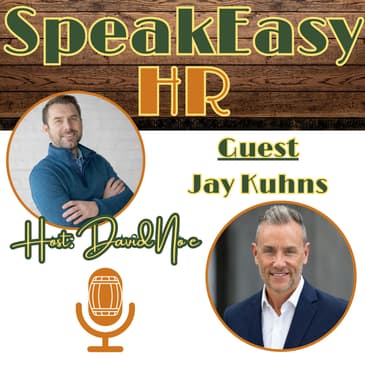
[00:01:05] going on out, everybody. David Noe with SpeakEasy HR, presented by Payroll Partners. We are back live for another amazing episode with an awesome guest, getting some feedback and some insights into a really important topic that is going to become a theme for this month. And it's about leadership. I am thrilled to have on SpeakEasy HR for Episode 84, Jay Coons. Welcome, Jay. How are
[00:01:34] you today, my friend? Jay Coons I am doing great, David. Thanks so much for having me. I'm excited to be here and excited to chat about one of my most favorite topics. So eager to dive in with you. David Noe Yeah, we've had several discussions over the last few months, and it's been great to get to know you a little bit, hear about your book, Unstoppable Power, your family. And so it's just been really definitely rewarding and excited to
[00:02:02] have you on here now. So we are live on LinkedIn and YouTube. If you are tuning in live, thanks for making part of your Monday with us. If you have any questions along the way, throw them in the chat. We'd love to hear from you as we get into this topic. So Jay, I'm not going to share your bio. I feel like a lot of times people do that, and I like to hear from the guests. So tell everybody about
[00:02:29] yourself. Where did you grow up? What did you want to do when you were growing up? And now you've written a book, you're an author. So dive into that a little bit. Yeah, I'd be happy to. Thanks, David. So I grew up in upstate New York, where I feel like it snows 11 out of 12 months out of the year, but a wonderful place to grow up. And early on in my career, I was very focused on
[00:02:55] becoming an executive director of a human services agency. So to me, that was the ultimate. And so I started working in that space at a great agency. I was going to grad school and I suddenly realized that healthcare as an industry was more of my calling, not just the human service space, but specifically
[00:03:20] hospitals and health systems. And I also realized that for me, a small human service agency was probably not big enough. I don't know if it's my giant head or my giant ego or my giant desire, whatever it might've been, but I felt like there was more that I could contribute. And so I got into hospitals and health systems in upstate New York, and then 25 years ago, relocated to the Gulf Coast of
[00:03:46] Florida and the Tampa Bay area, continuing to work in hospitals and health systems. And about 10 or 11 years ago, I had an opportunity to move into the consulting space, which was a radical departure from what my original plan was. But as we'll talk about a little bit later, you have to go for it. And so I did still very much embedded in the healthcare practice world. So led the national healthcare
[00:04:14] practice for an RPO and HR strategy shop for five years. And then for the last six worked for a wonderful company that I was a former client of, and we did about 70% of our business with hospital. So that's just been my whole thing. And now I'm on the brink of returning to the large hospital space
[00:04:37] next month, and excited about that as well. So it's been a hospital life, I'm very comfortable in hospitals. And I just love it. I think they're the jewel of any community. And it just personally and professionally very satisfying for me. Yeah. Yeah, I have had a stint of my HR career in the
[00:05:01] the healthcare hospital physician setting. So I have seen that, but for you to do it this long and to be kind of moving into a, you know, an ongoing setting with healthcare, I think it's really critical, really important. And so, you know, you've spent the 25 plus years leading HR in those complex healthcare environments. You know, what's maybe one lesson about people and leadership
[00:05:28] that, that experience has really helped teach you to understand more about the, the organizations and the environments you're in? Yeah. So there's a lot of lessons learned, because when you start with somewhat of a blank slate, you do a lot of learning over the years, as I have. But one of the most important factors for me has been, if I'm the smartest person in the
[00:05:49] room, were doomed. And so I made a very conscious decision early-ish in my career that I don't need to flex some sort of authority because my title is fancy. I need to make sure the best ideas are implemented. Yeah. But I do not have to come up with the best ideas. So if I am accessible to the team
[00:06:16] that I have the privilege of leading, if I trust them and I trust their judgment, that's going to make a big difference. That's just kind of in within my HR team I'm talking about now. But that, that you get people to buy into your vision because they're contributing to how you get there. Yeah. But I was never, still am not smart enough to be able to build every floor of the building, but I know we need to have a hundred story building and I know we need to
[00:06:45] have these pieces in it. So let's get the brightest minds together and let's go build it. Yeah. So what's one of the biggest pieces of advice you've received along the way in your career? Yeah. Take the risk, a hundred percent. Not being reckless. That being reckless is a totally different and unprofessional actually approach, but take the risk. I don't know anybody who has said,
[00:07:11] oh my gosh, David, I'm so glad I waited this long to finally do that. Like said no one ever, ever. So we wait out of fear. We wait out of how it's going to look with our colleagues. I will tell you early on when social media burst onto the scene, I was a very early adopter. I'm very heavy user of social media tools today still. And I was teased incessantly about it by my executive colleagues.
[00:07:39] Nice. Until things worked. And then it got really quiet because those tools, which I consider business tools, not social tools, were really making an impact and driving execution of strategy and all these things that are the business terms we use. We don't apply them to social as an example, but my gosh, take the risk, use the tools and then you reap the reward. So absolutely take the risk. A hundred percent. Love that. Got to get the mini air horn out for that one.
[00:08:09] Heck yeah. Heck yeah. Yeah. So for those of you new to Speakeasy HR, maybe this is your first episode tuning in with Jay. I am the producer, editor, everything host, and it's been a lot of fun to have this podcast for the last couple of years. A lot of amazing past guests, a lot of conversations around work, HR and leadership and all kinds of topics. One blog I put out today is about is HR losing its
[00:08:34] people? So the current state of the HR profession. Definitely check that out. Would love to hear your insights. So go to speakeasyhr.com to find that. All right. So I gave you a quick, before we came on, Jay, I told you about the envelope icebreaker game. So as we transition, all you got to do is think of a number one through 15 and we'll get to that. So think of a number.
[00:08:59] And all right, what do you got? One through 15, Jay? Jay Jay We're going with 10. Jay Jay Jay Jay Number 10. All right. I forget what's in these half the time. So it's always fun to see. Jay Jay Jay Well, that's fun for everybody then. Jay Jay Jay Right? Okay. So this is a great one. So you're in charge of renaming HR.
[00:09:25] What's the funniest yet oddly accurate title you'd give it? Jay Jay Jay People actually matter. Jay Jay It would be Pam. Jay Jay People. Jay Jay People actually matter. Jay Jay Yeah. If we're going to be goofy, that's what we're going with. Jay Jay Jay There you go. People actually matter. The new phrase for human resources. So, well, we are live on LinkedIn and YouTube. If you are tuning
[00:09:51] in, have a question along the way, feel free to chime in. I have several for Jay to get the conversation. Jay Jay Jay But just before we get into that, just a few messages from our sponsor. So hang tight and I'll see you in about a minute.
[00:10:32] Jay Jay Jay Finding a new employee takes time and money. Jay Jay Jay bank. And this feature lets you e-blast your network, hosting jobs on multiple boards at once, all managed in one location. Payroll Partners, elevating your payroll and HR experience.
[00:11:03] So if this resonates with you, and I say clunky HR payroll software on hold for hours at a time, trying to get ahold of a human, no good system, no good support, too many spreadsheets to do things that are easily tracked in systems, you probably want to talk to me and figure out if we can maybe help you along the way. Would love to connect. So look me up on LinkedIn and we can talk about
[00:11:30] your situation, see if we can help. So, all right, Jay. So we are going to warm up just a little bit. We're going to do some rapid fire questions. These are the quick five to 10 second responses. So number one, what is one leadership trait you believe is underrated but essential? Kindness. I think it should be a mandatory competency that's validated if you're going
[00:11:55] to be an effective leader, hands down. Absolutely. What's one book, mentor or experience that has shaped the way you lead? Uh, so two mentors, one had a very, um, I'm going to say difficult leadership style. And I committed early on in my career to do the opposite of what that person would do in situations. Uh, and the
[00:12:21] other one, uh, was very inclusive of the team. Even if the team was truly not going to be empowered to actually influence the final decision, she was, uh, one who would go out of her way to at least bring you in. So you could understand, okay, now I, I see why we have to go on path B instead of path
[00:12:47] A and I'm ready to go along. What's one, I'm sorry. What's the best leadership advice you've ever received? Um, I don't know that it was the best advice, but I'm going to turn it around a little bit and say it was one of the, um, nicest things that I ever heard about my style, which I did not
[00:13:13] see coming. And it was quite humbling. And that was that I was, uh, one of the most accessible executives in the organization. And to me that validated the rounding, the, um, time spent connecting with people, the, the practicing what you're preaching all day long. It was really quite something. It was, yeah, it's wonderful. It's awesome. What's one common leadership mistake you
[00:13:42] see organizations making today? Oh, promoting people who aren't ready. Oh, yeah. Uh, yeah. Oh, not good. All right. Last one. Finish this sentence. Great leaders always include their people. There you go. If it's, if it's me and half a dozen others in a mahogany boardroom
[00:14:06] making all the decisions, we are so far out of touch. It's scary. Scary. That's great. Well, we are, we are warmed up. I feel like we can dive straight into this topic that you have brought to the podcast for today, episode 84. It's the three essentials of great leadership. And you wrote the unstoppable power and we're going to get, and, and, you know, obviously take
[00:14:33] some of what you wrote in here and I think cover it in these. So your topic is about those three essentials of great leadership. So, um, how do you define great leadership and what separates a great leader from someone who simply has a leadership title? Yeah. So, so the, the, the three tenants for me integrate your two, your two questions right here. So I think this will perhaps flow and, and,
[00:15:01] and, uh, tell the story a little bit for me there, there, there are three core elements. There's a fourth, it's kind of a bonus, but there's three core elements that without these I have found over the years, it is difficult for people to follow that leader. Okay. Um, it doesn't mean they agree with everything. We don't agree with every single thing that ever comes out of our boss's mouth and our team members aren't going to agree with every single word that comes out of ours. Right. So we need
[00:15:30] to kind of get over that. Uh, but the three elements for me are, uh, number one, a leader must be a high energy person. Now that doesn't mean they can't be an introvert. It doesn't mean they can't be more reserved, but they do have to show energy. Um, again, bully pulpit. So I get to say, right. My, my two cents here into the leadership discussion. I have known plenty of folks who are super bright and
[00:15:58] their, their affect is so flat. There's no passion. You wonder, do they really believe in this stuff? Or are they just coming to work and saying what the corporate line is, but you can tell when someone's passionate about it and they're fired up and they get excited and you hear it in their voice, people pay attention. People notice. And, uh, the phrase about faking it until you're ready or faking it until you make it. Well, fake it then. The people need to feel like you care.
[00:16:28] And when there's energy that's often linked with caring about the topic. So be fired up and get everybody else fired up. Uh, it's not just, Oh, I have a new job. So I have more boxes on the org chart. No, no, no, no, no, no, no, no. Oftentimes you have a smaller number of boxes because the higher up you go, your direct reports often shrink. And so you now have this core team of experts around you. You need
[00:16:54] to inspire. So absolutely. Number one for me is energy. Number two, uh, links back to your best advice question. And that's around, um, uh, risk. Yeah. Absolutely have to take the risks again. I'll be a little bit repetitive, not be reckless. I cannot emphasize that enough. Uh, and my hospital and health system world risk is often denoted in a negative way. There's risk management, there's
[00:17:24] risk for the lawsuit, there's risk, whatever. Yep. That's not the kind of risk I'm talking about. I'm talking about the ideas, the strategies, the innovation. There's so many tools available. There's so many ways organizations can present themselves from a people perspective. And I don't see many doing it. They say, Oh, we have a video on our careers page. Okay. Well, what are you doing next week? A video flamed out on your Google algorithm by three days later.
[00:17:50] That that's like, what is that? That's not a strategy. That's the check the box and we'll do a video next year. So the risk has to be, how do you operationalize that? For me, I referenced social media earlier. I would jump behind the line in the food on the cafeteria. So I'd say to the team, you know, these are people who are making very low hourly rates. They're, you know, scooping roast beef and mashed potatoes and carrots on a tray for a guest or a
[00:18:17] patient or family or an employee. And I'd say, who wants to take a selfie with me? And six employees would run over and we'd take a selfie and I'd post it on my Instagram. And I'd say, you need to be here. We have the best team. So that takes what? A minute to take a picture and type it in Instagram, a couple of hashtags that are the approved ones for the organization. Why wouldn't you do that? Is that risky? I would submit no, but for many stale, buttoned up, super wound type people who
[00:18:46] aren't accessible, safe is the way they're going to play it. Nobody wants to work for them, David. Nobody's inspired by them. So you take the risk, you do some fun things. Lastly, is you value every single relationship. So if I'm talking to you and you're the evening EVS worker who's come to clean my office and I'm working late, you are the only person in the whole wide world when I'm talking to you.
[00:19:12] If an executive comes in, I'm still talking to you. I'm not looking over your shoulder to find somebody more important. You are the whole world. And there's a cumulative effect of that, particularly when you're in senior leadership roles or any leadership roles, but particularly senior leadership roles. And the word gets out that you actually care about the people you're talking to versus, oh, he's always looking over down the hallway. She's always looking for the most.
[00:19:40] What is that all about? Yeah. You get points for noticing somebody higher up the food chain than you? No, you just alienate the people that you're relying on to do the work. So for me, these three elements that I didn't realize were my three core elements, candidly, until I started seriously thinking about the book and having to memorialize it in some way. Yeah. You know, you're asking
[00:20:07] yourself these challenging questions. Well, I'm so passionate about leadership. What's worked and what have I seen fail? As you know, when you're in the HR world, we see all the craziness, right? Yeah. So 98% of the workforce can do a great job every day. And 2% can be crazy. We get to see 100% of the 2%. Yeah. So we've seen everything good, bad, and indifferent that works and doesn't work.
[00:20:36] Yeah. So that really forced me to grab these things that I'd been doing, but I hadn't really put them into words. And those three elements, energy risk and relationships are what drove the ideas around the book and many, many, many, many examples, real life examples throughout. Yeah. I will add to that as you were talking, it costs nothing to say thank you, right? And when you
[00:21:03] are present with someone, like you had said, and you are in the moment and you show someone that they see, they, they, they can feel seen, heard, respected, you know, you want to talk about a great leader that those skills for some, especially with a thousand distractions going on, very, very difficult for some people to do, but a lot of people don't leave a company. They leave the manager and it's.
[00:21:32] So frequently. And to your point, David, the, one of the biggest curses out there is when you're fortunate enough to move up the food chain a little bit and the title starts to get a little heftier, people get weird. Yeah. They, they think they know it all, which they don't.
[00:21:54] Uh, they think they have to make all the decisions, which they shouldn't. Um, I I'm a big fan of rounding around the organization and I've always had my badge turned around. Yeah. So nobody, I just say I'm Jay from HR and then it's fine. Yeah. But as soon as you're the VP of HR, it's like, oh my God, everyone's nervous. It's like, Hey, you know, relax. Right. I drink my coffee on the way to work,
[00:22:20] just like you all do. Like I'm just a regular guy, I have different job than you, but you know, we all have to do our part and then it works. Right. So, yeah. So one of the biggest challenges that I think organizations face today is trust. And so how do leaders build trust with their teams, especially during times of uncertainty, change, work from home environments, that kind of stuff.
[00:22:48] Uh, so the wonderful question and with all the uncertainty in the world, I mean, let's just put the morass of politics to the side, just corporate life, work life, business life, the economy. It's, it's really crazy. Uh, I have found that the more vulnerable I am and the more times that I ask for help where I literally say the word need, I need your help to the team. Uh, that changes the dynamic
[00:23:15] of how people want to help you. If I am promulgating edicts all day, not a lot of trust there, but think about when someone says to you, Oh man, I could really use your help. We, our brains change. Oh my gosh, I've got to help you. And particularly in one of the helping fields, like a big, busy hospital. And someone says, I need your help. Like we're all hardwired. Well, of course I'm gonna help you. Like you're tearing your jacket off. You know, you're like,
[00:23:45] where, where do we need to go? What's I'll go. Right. What do you need? And that same thing can happen all the way up through the leadership ranks is when you, when you expose yourself from a vulnerability perspective to, to needing help and someone helps you, they see that you're human. They see that you're accessible. We touched on that before. And they're contributing to the success. They're like an insider now because you brought them in saying, here's this thing that I'm supposed
[00:24:13] to be able to do. And I can't do it on my own. I need you to help me. Oh, like, why wouldn't you do that? And quite honestly, why wouldn't you do that? Even if you think, you know, the answer, why wouldn't you just include people? You're, you're building this equity in your relationship with the team when you're making yourself vulnerable and accessible and open to their insight and
[00:24:39] perspective and expertise. That's not something you manufacture because I'm the vice president and you're the manager. And I tell you, I need this by Friday. Well, that's, that's not leading. That's not doing anything. Right. So. Yeah, that is so important. And, you know, a lot of leaders focus on results. They, they focus heavily on results, especially when you're in an environment where
[00:25:02] you can track a lot of data and, and statistics and KPIs and measuring people's success. So knowing that, um, you know, and sometimes I think the human side, uh, of leadership is overlooked. So how can leaders balance the empathy and accountability in their role with their team? Yeah, they're not, these aren't enemies of each other. These aren't either or what you're bringing up. This is a great
[00:25:30] question. What you're bringing up is often either we're going to get good results or I'm going to be thoughtful and helpful. Well, why in the world wouldn't I be thoughtful and helpful while we work together to get the result we need? Yeah. I just can't figure out why those have to be separate and
[00:25:49] they so frequently are. Uh, we are at such a wonderful place from an HR perspective where HR tools are far more sophisticated now than ever. The ability to get predictive insights and predictive analytics is far more advanced than it ever has been before. The, it still takes the intestinal fortitude to make the
[00:26:13] decision to act on that data. Just reporting data doesn't do anything for you. Right. But having the data and making good sound decisions, it shouldn't be separate from we're a high accountability shop. I mean, wouldn't I want the team to be excited about getting the result and feel like they were supported along the way? I want to feel supported along the way. Right. So I'll role model that behavior
[00:26:42] up and down. Right. Oh man. Absolutely. So we're with Jay Coons. He's been in HR for a couple of years and, uh, wrote a book, the unstoppable power. So take a look at this great read, easy read. If you are looking for a new book that, uh, uh, this might speak to you in your role or where you want
[00:27:07] to get in the future. So, uh, Jay, you, you talk about these three essentials of great leadership and I just want to make sure people understand what those three are. Um, and, and why do you believe these are the fundamental for every successful leader? Yeah. So, uh, there, uh, one of the, um, core elements I think of being effective in life, let alone in leadership is that you have a level of
[00:27:36] humility. Right. So I get very, very excited about things. You probably can't tell, but I get very excited about things, uh, particularly when it comes to the organization and leading the way and working with the group, but I can't know everything. It's impossible. And for those that portend that they do, I feel bad for them because someone is making a comment behind their back somewhere
[00:28:02] that says, Oh, he's a know-it-all. She's a know-it-all. It's been 30 years since he was or she was in a lying position. They have no idea. I, so that the, the, the, this underlying sense of being humble, of being accessible, of being willing to say, Oh, I absolutely made a mistake.
[00:28:27] We need to pivot. I thought this was going to be the right path. That's not the right path. We need to go in a different direction. And I think those things add to your integrity and the respect that you get. I don't feel like they detract. Yeah. Uh, I've worked with many executives over the years who absolutely are the smartest person in the room and they would tell you
[00:28:52] and they'll end up losing their job one way or another, because that is not a sustainable way to lead human beings, right? We don't lead new capital projects. We don't lead software, at least not today, although AI is getting close where we lead people, right? We inspire people. So if we're always the smartest, is that inspiring? Or if we're the most human leader in that job that anyone's seen in 20
[00:29:20] years, are people going to gravitate towards, okay, Jay made a mistake. I'll cut him some slack. He cuts me slack, right? Like he, he appreciates the fact that I'm trying hard and I make a mistake once in a while. So those things to me are, are this kind of foundational level of behavior that allows that for me as a very natural tendency to be energetic, very natural tendency to take more risks. When I hear a lot
[00:29:49] of people say, Oh, we, we don't really do that here. I think, Ooh, yes, we do. You just didn't have me here to help us do it. And I don't mean that in an arrogant way. I mean, we haven't tried stuff people like there's tools. Why aren't we using the tools? The world's different, right? Right. We don't send faxes anymore. Everybody like, if you want to do that, go send a fax to somebody, take a Polaroid, fax it to your pal. That's not me. Right. And so all of that to me rolls into these
[00:30:16] three things. And I have kind of an overarching element of these essentials of leadership, which is in the book, I talk about a moral compass, but for me personally, it's really about my faith perspective. And that is being high energy, taking risks and valuing every relationship needs to be done with a moral foundation, not to get, as you were talking about earlier,
[00:30:42] results only. Like if we need to make a million dollars, well, we're not going to trample all over everybody to make the million. We're going to include everybody and we're going to figure out the best way. And we're going to get the million. We're still going to get the million, but we're just not going to do it in this cutthroat, you know, heads will roll. Why, why would we do that? We're burning up any sort of shred of respect or trust that we have in seconds. So that for me is kind
[00:31:08] of the piece that lays across the top where these other comments I made about humility are kind of that foundation, if that makes sense. Yeah. So as you've gone through your career and you've worked with a lot of leaders, is there one scenario or story that comes to mind that you can share when you truly saw someone transform to be a not so great leader, they struggled, they had to learn,
[00:31:37] they had to show that they wanted to learn. And then they just became this incredible leader and that you were a part of that journey. Does any, any situation stand out to you like that? Yeah. There's been a number of situations like that. And it's, uh, it's, it's, um, a process that requires some patience and some willingness from an organizational perspective,
[00:32:04] not to say quick, let's find a scapegoat, eliminate the scapegoat and move on as if normal life forgets the fact that we just maybe dumped a leader who was really, really struggling, but was improving. I'll give you a quick example. You talked about data. Many organizations obsess over their engagement data or satisfaction data, which I would submit is a small piece of the data puzzle, but it's still an
[00:32:32] important piece. And a lot of times the manager over a particular area is the scapegoat. For me, it's about, it's a deeper review of that. So had an organ, I worked in an organization where we had a very important and very large complex clinical unit where they were in the bottom third of the survey results. The following year, they're still in the bottom third. And people say, oh boy, I don't
[00:33:01] know. I don't know about this leader. I said, we've asked this person to come into a tough spot. Yeah. A year ago or a year and a half ago, whatever the timing was, they were at the bottom of that last third. This time they're at the tippy top of the bottom third. So they've made all this progress.
[00:33:26] And because we're just rapid, rapidly looking at the data, trying to say, oh, who's in the bottom third? Chop them all off. We're missing the actual progress that this person has made. They've taken advantage of HR coaching. They've taken advantage of employer relations support. They've allowed people to help them. That's the type of thing where data is your friend. I talked about having tools. Well,
[00:33:54] use the tools for God's sake. Don't just look at the top line. Like that's not enough anymore. Our organizations are too complex and there's too many variables. And, you know, they're complex. If you have 150 people on the team, when you've got 3000 on the team or 10,000, okay. Yeah. That's not a soundbite decision. Right. Right. You got to dig in deeper. So yeah. Yeah. Or you could just get a magic
[00:34:21] wand. Right. And you could just, you could get, you could just make them all great leaders with a magic wand. But yeah, that's right. Fortunately, that doesn't work very well. Right. I wish it did. So a lot of people become leaders because they're great individual contributors. They've proven success in their job and leadership requires a different skillset. Much different than just being a team
[00:34:47] member with your peers. So what mind shift and what mindset does someone have to make when transitioning into a leadership role? Key word here is transitioning. And I'll tell you about a practice that I used extensively in the past and will absolutely be using going forward. And that is when really strong people
[00:35:13] got that promotion and they were going to be a people leader, not a functional leader, leader, or just an all-star on the team. I brought them, I scheduled time with them, one-on-one with me. And it wasn't to scare them or anything, but I wanted to kind of reset their
[00:35:36] expectation. I said, you know, you have been friends with these people. You have been colleagues at the peer level with these people. And we're now asking you to do one of the hardest things in the world. And that is, you now have to potentially fire your friends. You have to hire people in that are going to, it's going to disrupt the culture of the team because every new hire disrupts a little bit, sometimes good,
[00:36:04] mostly good, sometimes bad. You're going to have to seek out consultation with a group of individuals, none of whom report to you when we're talking about leadership or organizational transformation things that when it's not time to roll it out yet. I said, so your whole journey has been loaded with this group of amazing people that you are now needing to sever
[00:36:32] some ties from. And you had this whole new group that's going to welcome you. And they were all the managers that you saw going into the management meetings for the last five years. You're now going in that meeting. You're now expected to contribute. You're not there to be quiet for the next six months. You got this promotion because number one, you deserve it. Number two, we need to hear what you have to say. You have a fresh set of eyes. We're all used to seeing the trash in the corner.
[00:36:59] You're brand new and you're going to say, why don't we have trash in the corner? Shouldn't we call somebody about that? That's the kind of perspective we need on the culture and all that. So, and, and sometimes our eyes got real big and other times they said, thank you for saying that. Cause I've been excited and scared to death to take this job because I don't know the middle managers. I don't know the other directors. I don't know these people, but now I'm going to be in all these meetings. I'm going to be on teams. I'm going to be on cross-disciplinary project. It comes out of nowhere, right?
[00:37:29] So how do we support them and be very candid and direct? And I, I offered this to every single one of those folks that I met with. I said, look, you don't work for me. You're not in a direct chain of command with me. So you can call me anytime and you can talk about anything you want. And it's not going to make you look bad in your line of reporting, your boss, what your VP over your, you know, kind of whole silo that races up to the top. And I would often say, look,
[00:37:58] if you just need to say, you can say, you can text me and say F-bombs. And then I know you're going to call me and you're just going to drop F-bombs for like a minute. And you can do that. And they'd say, Jay, I would never do that to the VP of HR. I said, why not? You think people don't get frustrated in their job? Like I tried to make it very real and down to earth and authentic. Like, it's okay. Like we don't run down the hallway saying that, but behind closed doors, if that helps you get it out and you're just like,
[00:38:25] so that's a way to burn off some negativity. Well then do it. Cause guess what? Now they trust me. So when something crazy happens, they have a relationship with me. They can call me. We can figure it out. So I kind of have this ulterior motive to build the relationship so we can manage the big things. Somebody frustrated about a bad day. That's a low tech thing. We can handle that every day. We all have bad days. It's easy. It's when there's
[00:38:50] something giant happening. I want them to feel like, Jay, I need to talk to you. Let's do it. Yeah. And I've, and I've heard the, the saying about, and I've heard managers say it, you know, I want my team to leave their problems at the door and, you know, walk in and be this robot to do their job a hundred percent. And man, I tell you what, the state of our mental health in our,
[00:39:19] in our, in our country, in the world, like we're at a different place for mental health and, and you see it, you see it probably on a, on a, on a daily basis. And so healthcare and mental health, that is such a critical part of, of where leaders can help and, and contribute. Like you're, you're,
[00:39:45] you're in a role where you could potentially impact the future of someone and their, their tenure, um, and their, their time with the company. You can make potentially that call to say, Jay, it's not working out. You know, you can, you can end employment for somebody. You have that ability and the reverse is true. Yeah. Yeah. Yeah. You can also positively impact someone's career,
[00:40:12] um, experience working at that company. You know, when I interview people, I'm like, explain to me the best boss you've ever had and why, and, and to hear them talk about it and really get a sense of what kind of leader they want to be around and what kind of manager they have strived to, to work with and be a part of. And it's just, it's really fascinating to hear
[00:40:36] people talk about their experiences with their managers in previous companies, because sometimes I've had bad managers, you know, like I've had all kinds of different managers, but right. We all have, yeah. There's been a whole mix. You're, you're quite, your comment about leave your personal life at the door. I literally, we did not prepare this in advance. I literally, uh, kicked off new hospital orientation myself because I wanted to make an impression on all
[00:41:04] the new hires. We did a lot of hirings, a growing organization, my last hospital. And I used to bring that exact phrase up. And I said, it's the lamest, weakest leadership phrase ever. I said, there's not a chorus of angels that sings as you walk through the front door and erases your brain from your sick kid, your sick spouse, your ailing family member, your stress
[00:41:28] about whatever. I said, so that opens the door for us to when we see our colleague, whether we're in leadership or not, and they seem a little off, you say, Hey, can I walk you to your car tonight? After our shift, can we meet, you know, if we get a chance for a break, sometimes you don't, but if we get a chance for a break, you know, do you need 15 minutes to check? Like, let's look out for each other. It's like literally the reverse is what should be happening
[00:41:55] because what kind of organization, if everyone's looking out for everyone else, what do you think happens to the culture of your organization? If everyone cares, I mean, no one frames it this way, but I don't know why they don't. Right. It's just, it's just a no brainer to me. Yeah. Yeah. Yeah. So, so being a leader has, has a lot of responsibility and obviously you would
[00:42:19] potentially be earning more of an income versus not being a leader. But at the same time, I really wish everybody that's listening to this, that's maybe a new leader, know what kind of opportunity you have to make an impact on your team and the people around you and, and, and try to really connect with them at a level that, you know, what motivates them, what they care about, what their
[00:42:45] hobbies are, what kind of people they are and, and what do they want to do to contribute to that company moving forward and how you can get them there. I know people hate it when they find somebody that's great in their job and then they get promoted and lose that person should be excited for that person. You shouldn't be upset that they're leaving. So it's like, I know there are people that, that want to, they want to treat people well enough. So they stay, they don't want to get
[00:43:12] them to the point where they're going to get promoted because they might leave or, you know, move on. So it's just a very difficult, um, balance and you have to be mindful of that. And it's different in every organization, your experience, my experience, healthcare, you know, other industries, it's all going to be different, especially when you have people, you know, if you have people working remote and you have a lot of these where it's a virtual discussion, that's whole different ball game than just sitting in front of you in a meeting room.
[00:43:41] Right. So that's a whole different thing that people have to deal with. Very different thing. And you have to be able to read cues that you're not going to be able to see in a physical space where you're sharing that space together. And you can see someone's body language or they're suddenly not available, like always clicking on join call. Well, okay. They're always on the calls. Well, okay. That's different than you see them open in the hallway. And, you know, it's just, it's just very different. Time is often one of the key ingredients
[00:44:10] of understanding all those nuances, spending time with each one of those people to the best of your ability, even if it's infrequent, but if it's an authentic touch base and authentic encounter where again, they're the only person in the world when you're talking to them, okay, you're starting to build a little bit of a relationship, even if it's, you know, three, four levels in the organizational structure. So what you can meet with them once or twice a year. Yep. You know?
[00:44:40] Yep. Yeah. The last thing you want to do when you're in a meeting and maybe you have a different opinion, but the last thing you want to do is like be on your phone or like have the phone even in front of you, like take your phone and like, put it down, put it in your book bag, put it somewhere so that like that person across the table from you, they're not even like knowing that your phone's buying. Yeah. There's no distractions. There's no distractions. So that's a huge, that's a nonverbal
[00:45:09] communication that I think people can like do as a leader. Um, you know, if you're talking to the newest leader in the department or the company, what would be like one piece of advice you would give that new leader, uh, in that role? Oh, make yourself available for your team. Yeah. Period. If you're not available, how are they going to get to know you? How are they going to trust you? How are they going to know what is happening organizationally? I am a huge fan of
[00:45:40] oversharing, not violating some sort of, you know, corporate strategy or something like that. That's again, my reckless bucket, but why wouldn't I want everybody to know what's going on and how they can contribute to it? Here's what's going on. Here's how we directly link to what we're trying to do. Here's how we are literally adding value to the organization, to our colleagues, to be strong. Why wouldn't I want to do that? Yeah. Like hold stuff close to the vest to be like a hotshot ego
[00:46:09] Oh my Lord. It's embarrassing. You see people do this and you just feel, I just feel sad. Like, huh? I'll be talking to your staff in six months when they're tired of working for you. And yeah, you can see it coming. Yeah. I can see it coming. Yeah. I'll leave you with this. Jay last question. As we look forward to the future of work, what's one leadership skill you believe will become even more important over the next few years?
[00:46:36] Uh, so I'm going to say there's two. Uh, one is understanding the role of technology, um, and its impact on the actual work. Um, there, there are way too many amazingly cool things happening in the AI space as well as predictive analytics and understanding personas of your workforce. And like, there's a whole host of things, not just AI, but just saying, oh, AI is
[00:47:06] going to take jobs or boy, AI is really crazy. Well, that doesn't mean anything. Like, are you using it every day? I use it all constantly. And it's, it's not replacing anything I'm doing. It's helping me work so much faster and do research faster so that I can go through it and say, oh no, that's not accurate. That's not right. Oh, all this is right. So understanding like that is a tool that
[00:47:31] will, is impacting and will continue to impact our work. The other side of it is if you are not humanizing yourself, then get out of the leadership game. Like, what's the point? You want to be a leader of people, but you want to be like a stiff robot. Really? Well, then you're not leading people. You're, you know, you're leading your AI agents. You can have a network chart of AI agents and then
[00:47:53] you'll be amazing. But in my, in my world of healthcare, we have thousands of employees that do the work. And if we're not leaders of people, then what's the point? Unbelievable. I love it. I feel like, uh, we could talk about leadership and workplace and
[00:48:18] all of the, the day-to-day things that we see in our, in our, uh, in our situation. But, um, for those who have not got unstoppable power by Jay, check this out, look him up on LinkedIn, definitely worth a follow connection. So Jay, anything else you want to lead, uh, or leave with the audience listening to this? Uh, two quick things. Well, three things. First of all, thanks to
[00:48:43] you for having me on. This has been fantastic. Two, thanks to folks who had a chance to tune in live and those that might get a chance to check it out later. And third, I love talking about this stuff. So if you have ideas or if you have maybe some early careers in your family or in your organization and you're struggling with how to help them along, uh, I love to think through those sorts of things.
[00:49:07] So if you need kind of an external free sounding board, that's outside of the, the normal routine, um, I, I love to network and help and it's a little tiny way to pay it forward. And if we all pay it forward a little tiny bit, then, you know, we move mountains together. So, uh, that's how it, that's how I'd end it, David. Thanks a million for having me. Yeah, no, this has been great, Jay. I really appreciate it. I learn with every guest topics that I feel like I can learn from as with
[00:49:36] the audience. So hopefully you, uh, learn something today and, uh, can take this back to your situation and, and, and try to help. And, uh, we'll be back next week, brand new guest, brand new episode for episode 85. So Jay, thanks for coming on best of luck. And, uh, we'll be, uh, hopefully staying in touch and we'll talk soon. All right, my friend. Sounds great. Thanks, David. Take care of everyone. All right. Take care. Bye-bye.
Sponsors
