
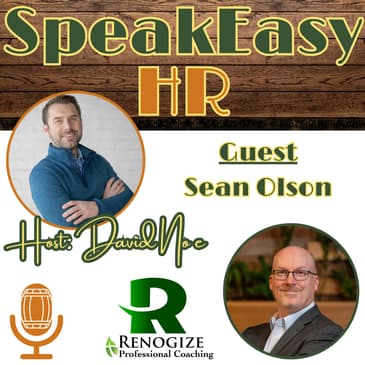
In this episode of SpeakEasy HR, we sit down with executive coach Sean Olson, a leadership development expert with over 25 years of experience working with individuals, teams, universities, and organizations ranging from Fortune 100 companies to startups. Much of his work has focused on higher education and academic leadership, helping leaders grow in self-awareness, confidence, and impact.
As an Executive Coach, Sean partners with professionals and teams to build clarity, develop leadership capability, and create practical roadmaps for success. His clients consistently credit his coaching with strengthening their leadership skills, improving their confidence, and positioning them for greater influence, growth, and promotion.
In this conversation, we explore “The Real Path to Promotion: What High-Potential Leaders Miss.” Sean breaks down the often-overlooked shifts that separate high performers from those who actually move up—highlighting the importance of self-awareness, intentional leadership behavior, emotional intelligence, and the ability to lead beyond technical performance.
This episode is a powerful reminder that promotion is not just about doing more—it’s about becoming more intentional in how you lead, communicate, and show up in every role you hold.
Powered by the WRKdefined Podcast Network.
[00:01:01] Hey, what's going on everybody? David Noe with SpeakEasy HR presented by Payroll Partners. We are back for another brand new episode. Not a new guest because this guest has been on SpeakEasy HR for a quick minute at a recent HR conference that I met him at. So today we get him for a full episode and I cannot wait to dive into our topic today. I have the privilege of having on SpeakEasy HR, Sean Olson. Welcome, Sean. How are you?
[00:01:31] How are you today? Sean Olson, CEO of the HR Collaborative Doing awesome, David. Thanks for having me on here again. Yeah, it was a quick minute at a conference, but now we get the full show. It'll be fun. Sean Olson, CEO of the HR Collaborative Yeah, yeah. Going back to April, we were in Cincinnati together at the HR Collaborative. For those of you who don't know what the HR Collaborative is, it's an all-day event. We had 12 speakers, I believe, this year, and Sean was one of those breakout session speakers.
[00:02:00] So I've been there the last two years to interview a lot of the guests and hear about their topics and hear about what they're bringing to the conference. And it was just great. I got to see some people that I've had on SpeakEasy HR before, and they came on to talk about their topics.
[00:03:19] years. And in that, I had two great passions. One was teaching, i.e. preaching. The other one was developing leaders. And so that was always there for me. I love following a lot of the secular as well as Christian leaders like a Zig Ziglar, the John Maxwells, the Cam Blanches of the world. And I came to a point about 15 years ago, the transition in career out of pulpit
[00:03:45] ministry and into leadership development and executive coaching. And actually today is a special day, David. Today is 10 years to the day that my wife and I flipped the switch and went full time in our own business. So it was a side gig for a while. 10 years ago today, flipped the switch, went full time. And now we're blessed to have a team all across North America impacting thousands
[00:04:09] of people around the globe. You're gonna get the mini air horn. There you go. Wow. 10 years. Okay. All right. So, so walk me through that a little bit. So you're working with your wife. Is that, is that what you said? So you're alongside your spouse working. Tell us about that relationship. Like what, what, uh, what did, what'd you learn through that now it's 10 years? Like
[00:04:35] what's, what's been the biggest thing you've learned? We've had to grow through it. She has always been very, very strategic and she's a great marketer. She was doing marketing with like Chick-fil-A and things like that for a long time. And then I got into this realm of the executive coaching leadership development. We started our own business as a side gig. And it was to a point where, I mean, it's just scary to flip the switch. And so I remember specifically we're sitting down in the family room
[00:05:01] and she's like, can you actually sell $75,000 of this stuff so we can make a living? You know? And I was like, yeah, I think we can do this. And so we had a game plan. We built out a three-year strategic plan. We hit it after about 18 months, built out another three-year strategic plan, hit it about two years later. And now we're to a point where it took us a long time to find a rhythm together. Uh, because
[00:05:25] it's different being husband and wife and business. Uh, we have an office outside of the home on purpose because I like going to work and we like the separation there. And, uh, she's also been a full-time stay at home mom too. And our one and only child is actually getting married this Saturday. So this is a huge week for us, um, in a lot of ways, but here's what we've realized is in any business and or marriage, it's about their relationship and going through all the steps and all the growth,
[00:05:56] right? We're not the same people when we got married 33 years ago, our business is not the same business. It was 10 years ago, constantly communicating about who are we now? And what's next? We can't just sit back and think it's the same cause it's not. Right. Absolutely. That is so, that is so cool. I, I, I applaud you both for that. And you've got a big, big week coming up with, with a wedding for your daughter. So hope that all goes well. You got
[00:06:23] a speech prepared or you having to, you know, get up there and say a few words. No, I'm not going to do that part of it. I'll walk her down the aisle. I'm doing an opening prayer for the service and stuff. Okay. Okay. There you go. I'm, this is her day. I'm just going to step back a little bit and enjoy the whole thing. Yep. Absolutely. Well, great. Well, uh, appreciate you sharing all that. Another question I ask is about advice that you have received along the way.
[00:06:55] And really it comes to maybe somebody that's been a mentor of yours or maybe your spouse, somebody gave you this advice. So what's been the biggest piece of advice you've received so far, Sean? So many of them. I mean, there's like a multitude to pick from. Um, I think if I was going to go to one that's really helped set me up for where I am today and it comes out in our coaching on a regular basis, it was from a mentor when I transitioned into this industry. And this was hard
[00:07:24] for me because coming out of ministry, it's all about people and having people like you being that presence. And I grew up as a people pleaser. And today I say I'm a recovering people pleaser, not recovered, um, better, but not right in it. Um, here's what he said. He said, if you really want to be effective in business and leadership, your goal is to be respected, not liked your goals to be
[00:07:52] respected, not liked. And that was so hard for me to internalize and process. But here I am years later, I'm like, he was spot on. And we catch this with leaders all the time. If your goal is to be liked, you're gonna have to be something different to everybody, which means there's no consistency. There's no authenticity. The goal is to be respected. So I may never want to go have dinner with you, go play around a golf, but if we respect one another professionally, we can execute at a high
[00:08:18] level. Everybody wins. Yep. Yep. Love that. Yep. Thank you. Ivory Davies for that insight. There you go. Great advice there. Definitely. So we are live on LinkedIn and YouTube. For those of you who are watching, we are going to talk a little bit about promotions and, and how to walk through that, uh, the real path to promotion and what high potential leaders miss. Before we get to that,
[00:08:45] I've got a couple of, of things to bring up. If you are watching live and have any questions along the way, put them in the chat. Would love to hear from you. If you haven't been to speakeasyhr.com, I've got some great blog articles out there. Just put one out there about HR trends to focus on this summer. So there are five, check those out. And you have a contest for people watching live Sean and up until 24 hours after this records.
[00:09:13] So it's June 20 or June 15th. So as of June 16th, 2026 at 2 PM, we're going to go in the comments. Sue who added this word promoted, and you will be in a drawing for a free copy of Sean's book. So tell us about the book and, uh, you know, what will someone learn from that book, Sean?
[00:09:33] Sean. And to some connectivity issues. Uh-oh. Can you hear me? Okay. There we go. We're back. We're back now. All right. Okay. It's great. It's great being live. Um, I don't know where we, uh, got disconnected, but I heard you talking about the book, but I don't know if you asked me a question out of it.
[00:09:57] Yeah. So for those of you who will go into the drawing, put the word promoted in the chat, uh, section and Sean, tell everybody about your, your book and what will people learn from that? Sure. The book is called, this is how I roll R O L E little play on words. My wife came up with that subtitle seven strategies to accelerate your leadership growth and promotability. It's all
[00:10:21] about that promotability thing. Okay. And so it's seven strategies to dive into that. And the reason we wrote this book was because of our business. We found that over 40% of our clients get promoted during or within a year of their coaching engagement because they're learning key traits in their leadership that sets them up for success to where their company notices, notices what they're doing, how they're doing it and gets them promoted. So great book, seven strategies, very applicable.
[00:10:49] It's a quick read. Uh, the best feedback I've received from it is just the practicality of it. It's not theoretical. It's practical. Definitely. Uh, Albert is watching live. So welcome Alberts. Uh, he is a regular watching live. So appreciate you coming on and, uh, don't forget, put the word promoted in the chat and you will be into that drawing. So, all right, Sean, we played this game. I'm going to
[00:11:18] transition to it. Just think of a number one through 15 in your head and I will get it here in a minute. Finding a new employee takes time and money for one position. Uh, oh, wrong slide, wrong slide. All right. We got to play the world famous envelope icebreaker game first. Uh, before we hear from payroll partners. Okay. Envelopes one through 15. What is the number?
[00:11:50] Well, we're talking seven strategies. So let's go seven, seven. There we go. Seven. Whoops. Seven. There it is. We got, all right. What's a TV show or movie you quote way too often? Hmm. Hands down Seinfeld. There's a Seinfeld isn't for everything in life.
[00:12:15] Newman. Yep. It's, uh, it's pretty good. No soup for you. It is. And you know, the Newman one there, we have a client we had come into our office for an interview and stuff and his name was Mr. Newman. So the whole day we're like, hello Newman. Keeping it going. Oh, that's awesome. That is awesome. Okay. Now we will hear a little bit from our sponsor payroll partners, and then we're going to dive into
[00:12:42] Sean's topic all about the real path to promotion. So hold on one second. Finding a new employee takes time and money for one position on a single job board. You could easily spend a minimum of five to $10 a day advertising a job post. It's worth noting that the average time it takes to hire a new employee is 36 days. However, it can take longer than that. You could find yourself paying hundreds of dollars a month for a single job board. And if you're using multiple job boards
[00:13:09] for multiple positions, this could add up to thousands of dollars a month. There is a much simpler and more affordable way of finding the right candidate at payroll partners. We offer an applicant tracking system to help manage your hiring process. Our ATS is customizable, allowing you to decide which days you want to run the job and when to close it. So you don't break the bank. And this feature lets you e-blast your network, hosting jobs on multiple boards at once,
[00:13:36] all managed in one location. Payroll partners elevating your payroll and HR experience. So if your job at your organization is to find the right software, the right service, technology for payroll and HR, it's complex. You don't want to be wasting time and efforts in implementing a software that just won't work for your business. So if you're looking for something
[00:14:03] better, better service, better software, something that will fit for your business, better customization, all that fun stuff, look us up payroll partners.net or look me up on LinkedIn and I would love to hear about your situation. So, all right, Sean, we are talking about the real path to promotion and I've got some rapid fire questions to get this going and then we'll get into the meat of it. So, um, these are quick five second answers, uh, to these questions. So what's
[00:14:33] one leadership habit everyone should start today? Start today. Take time to think as a leader, pause your clock for 10 minutes, sit down and think about your people, where they are, where they're going. That 10 minutes will transform your leadership. What's one leadership trait every future leader must have? Emotional intelligence.
[00:14:59] Love it. What's the biggest mistake people make when seeking a promotion? Bragging about what they think they can do, not backing what they've done. Okay. Who had the biggest impact on your leadership journey? My grandpa. Okay. Guiding me on the way. Give me the pat on the back and encouraging me.
[00:15:29] Yeah. Sweet. Love that. All right. Fill in the blank. Great leaders always think of others first. Very good. These are a little bit more in-depth questions so we can, we can dive into these. So again, if you're watching live on LinkedIn and YouTube, throw in the chats, the word promoted. You don't have to be watching this live. If you're listening to it as a recording,
[00:15:57] you have 24 hours to go in the chat section and put in the word promoted and be into a drawing for a copy of Sean's book that he will sign and we'll send you. So, um, okay, Sean, so you've spent 25 years developing leaders and really what, uh, what I want to know is what first drew you to leadership coaching and, and really the development. Yeah. So I've always loved reading about leadership.
[00:16:25] It's always been intriguing to me, but it was actually one of those things that, uh, when I was in preaching, I ended up working with the superintendent of schools where I was. Okay. And I went in there really just to develop a relationship from a spiritual level. But then we started talking about different things. I'd read a lot about leadership and I was running a business. A church is still a business with hundreds of people and volunteers and staff. And I ended up
[00:16:51] vicariously kind of coaching him and then ended up bringing me in to coach his executive leadership team. And that lit my fire for this. I think it was always in me and I was bringing that out through the ministry side of it. But then I'm like, this is something that I can do to have a larger impact than just with a set group of people, but people all across the country. And so from that, I really began to say what else is out there and how can this be pursued? And so now it's to a point where all
[00:17:20] my preacher friends say, I'm still in ministry. I've just got the biggest church I've ever been in. And it doesn't mean on Sunday. Yeah, definitely. So when you hear the word, or I'm sorry, when you hear the term high potential leader, what does that actually mean? Yeah, great question. So when people inside an organization are evaluating their talents,
[00:17:45] they're looking at their talent, not just to see who's executing well, but one of the great hidden aspects of this for being a hypo is they're asking questions that doesn't have anything to do with their job. So let me give an example. Let's say it's you, David. Okay. You're in payroll, you're in HR, but you're talking to the CFO about financial aspects. You're going down to the shop floor and you're trying to figure out, okay, how do we actually create this widget? Where does it go through?
[00:18:12] How is marketing sales? High potential employees are showing interest and asking questions that has nothing to do with their role. And it shows them this person has the potential to actually become something much greater in our organization. Yeah. Okay. So many people believe promotions come from working hard and producing results. So why is it that only part? So why is that only part of the equation? Do you think?
[00:18:43] Yeah, it's, it's a crucial part, right? If you're not competent, if you're not executing, you're not even going to be in consideration for it. And so I always tell people on the seeking of promotion, make sure you're executing first, do your job well, and then they promote you. Now there's two sides of this coin, the good and bad. The bad is this is you're a great salesperson. So they make you a sales manager and they promote you out of effectiveness because you're not selling
[00:19:09] anymore. You're leading people that are selling and it's not always a new job. And so the key piece to this above and beyond your execution is developing the key relationships. Leadership's about people. It is not about process and it's processes, but we lead people. And so if I'm going to get into a leadership position, I need to have influence. My favorite definition of leadership is this,
[00:19:35] David, is that leadership is influence. Influence is behavior. Am I behaving like a leader? And so if I execute those leadership behaviors, in addition to what I do, that's when I'm going to be set up for success at the next level, whether they see it or not, I'm still going to have success at the next level. Yeah. Yeah. So what's the biggest thing high performing employees miss when trying to move
[00:20:04] into leadership roles? There's a couple of different pieces. One is they think that what they do is not going to change. They just have direct reports now. Nothing else changes when in fact everything changes. You probably heard the old axiom that what got you here won't get you there. And so what's gotten to this point is success is not going to make you successful at the next level.
[00:20:30] People think if you envision like two vertical continuums, one is a technical skill, one is a leadership skill. They think, okay, I'm a nine technically, so I'm going to be a nine in leadership. No, they're two totally different skill sets. And so what happens in that is they think I'm going to just automatically transfer all of this over. The ones that are actually set up for success are the ones that are curious, asking questions, realizing I have a lot to learn about leadership
[00:20:58] to deserve that promotion. It's not just about my technical skills. And so that's their biggest miss is thinking technical translates to leadership, not even close. Hmm. Yeah. Makes, makes total sense. So in, in your experience and what you've seen, you know, working with, with individuals and businesses, you know, what, what really separates someone who gets promoted from someone who gets stuck despite
[00:21:25] being talented? Yeah, that's a really tough one. I'm going to lay the groundwork for this for a second and assume that you're in a healthy organization. And so here's what I mean by that. There are unhealthy organizations where the loudest person gets promoted or the longest serving person gets promoted. Yeah. That's not an effective organization. Effective organizations look at who those people are. So if you're in an effective organization, you're trying to really figure out,
[00:21:55] you know, what do I need to do on this is understand this. Your boss does not hold the use to your future. Your boss's boss does. So we call it your one over one. And here's why many bosses, some intentionally, unfortunately, many unintentionally slow the progression of their people. A lot of different reasons for that. So let's just assume David, you're my boss and I'm
[00:22:22] going to get promoted, right? I can go to you and have conversations with you, but you might think, well, if Sean gets promoted, is he going to take my job? Are people going to think he knows more than I do? And so the insecurity of your direct boss can actually limit you. Okay. But when you get to have a relationship, catch it, people, relationship, relationship, it's the key to everything. With your boss's boss, that person actually holds the keys to your future because they're looking at
[00:22:48] the whole organization. They're not worried about the particulars of competition or are you going to be better than me? So develop their relationship with your one over one. It opens the doors for future success. Yeah, definitely. So you focus heavily on self-awareness and so why is self-awareness such a critical component of leadership growth? Because most people don't have it.
[00:23:16] That's the sad part of it, right? So, you know, I said earlier on the rapid fire that emotional intelligence was so crucial. When it comes to leadership, it's EQ over IQ every day. EQ over IQ every day. Well, if you think about emotional intelligence, what is EQ? It's self-awareness and it's others' awareness and it's navigating that to understand where things really lie.
[00:23:41] It's amazing how many people aren't aware of how they're perceived by others. They don't have a true picture of how they're actually seen and how they actually execute. And so that self-awareness is everything because you can be going to your boss or your boss's boss. You can be doing the right things to get promoted. But what if you're viewed in the organization as one who talks ad nauseum and drives everybody crazy? What if you're viewed in the organization as one who takes credit for things that
[00:24:11] really was your team's, not yours? If you don't have the awareness of how you come across and how you're perceived, you're never going to get where you want to go. The hard part is most of us learn those the hard way by somebody saying tough truth to us. I was in an organization the other day, David, and we were talking about trust because trust is a key factor in this. And one of the senior leaders said there are
[00:24:40] people in this room that have been just flat out betrayed by their bosses. Betrayal happens, right? Well, why does betrayal happen? Maybe that boss isn't self-aware, but are you self-aware of how you're coming across to your boss and not saying that you caused the betrayal, but you're a part of the puzzle. Nothing's 100% one direction. It's usually more 50-50. And so self-awareness of your gifts and your strengths. So like, let me ask you, David, really quick. I know you're running a small
[00:25:05] business. You do awesome with payroll partners. If I was to come in and ask your people, not you, ask your team, what is David's secret sauce for success? Like what's his secret sauce that God-given gift as a leader, what do you think your people would say? Not you, what would they say? David Morgan That's a good question. I would think that they would say,
[00:25:31] I'm there as their advocate in the company to help them in their development on a daily basis. And I'm basically a resource for them while they're with us and I'm helping their employee experience be more positive within the business that we're growing. So, you know, I don't sit behind the desk all day. I'm approachable and, you know, I try to relate to
[00:26:00] them and meet them where they're at, you know? Awesome. I love that. And so imagine actually getting that feedback from your team to see how they view it. Okay. My guess is, I think you're pretty self-aware. My guess is probably 50, 60, maybe even 70% of the people would say what you just said in their own way. Yeah. Well, what's that other 20 to 30% going to say? Remember that feeling,
[00:26:26] the first day of school, looking for your table in the cafeteria? Do you know anybody? Where are you supposed to sit? You don't know, but you definitely feel like there's toilet paper on the bottom of your shoe. Ugh, this is the worst. Well, you know what they say, high school never ends. I'm Anna Morgan, former corporate recruiter turned entrepreneur, and I know the workforce can feel just as complicated and clicky as high school. Trust me, I've been there. The layoffs, the imposter syndrome,
[00:26:53] the what the hell am I doing moments at 3am. It all brought one point into focus. We all deserve a place to belong and learn. So I started this podcast just for us. Welcome to your career BFF podcast, a place where everyone has a seat at the table, complete with masterclasses, no BS advice, and candid conversations with some of my favorite people. It's the breakfast club meets
[00:27:19] the boardroom. So whether you're the rebel challenging the status quo, the brain strategizing your next move, or the quiet wizard making magic behind the scenes, you have a seat. So grab your backpack, find your spot, and get ready to learn, laugh, and lead together. Because in this classroom, everyone's got to BFF. Class starts soon. See you there. Bye. Bye. Like, where they see something in you, catch this, that you don't even see in yourself right now. Right.
[00:27:49] Right? There's something about you. I mean, I don't know you that well. We met in person a handful of times on that one particular day. We've been online together, you know, but the persona you put off, the aura you put off is like, people want to be your friend. Yeah. That's good. So if people want to be your friend, but they don't get time with you to actually build a relationship, they all feel rejected in a way, right? This is all going to that realm of self
[00:28:18] awareness. We'll take it off of you for a second. But this is why self awareness is so key of how do I see myself? How am I viewed? If those two are in misalignment, that's where I'm like, I have some serious work to do. If they're in alignment, I need to maximize the impact of those things. So what's a good exercise for someone to really hear more from their team and their peers? Is it,
[00:28:48] you know, just asking them or sending out some kind of like quick two or three question pulse survey to get some quick reactions? Like what, what have you seen work? So people really have a better understanding of what other people think about them? Yeah. You can do things like full surveys. This again goes to the climate of the organization, right? There's some organizations where they don't feel they can speak truth. It's going to be held
[00:29:16] against them. There's going to be retribution, right? Yep. Yep. There's other organizations that they're like, no, we share openly and we actually go after those things. Yeah. We have people flip it. Um, one of the greatest executive coaches in the country who's now retired was Marshall Goldsmith. He came up with a formula called feed forward process, not the feedback process, feed forward process. And it's a vulnerability based thing where you as a leader think, okay,
[00:29:44] here's two or three areas where I'm really struggling and I know I need to grow as a leader. Okay. And they go to their people, not just their direct reports, but the full 360, you know, direct reports, peers, leaders, and they ask a question about it. So let's just say for instance, that I know I'm not the best at delegation and empowerment, a very common weakness of leaders. Okay. I saw the big smile there. Okay. So it's a common weakness of leaders.
[00:30:10] So they go to this group of stakeholders in the full 360 and they say, Hey, so I'll just pretend it's me. And you're one of my people I'm talking to David. Hey, David, as I've been going through my leadership, I have learned that I'm not the most effective person at delegation and empowerment. Give me an idea of how I can get better at that. And then I'm going to have you share an idea with me.
[00:30:37] And when you share the idea with me, I'm going to simply say, thank you. I appreciate it and move on. But I'm going to talk to eight, 10, 12 different people out of that. I might get only three or four ideas. People are going to say the same thing. No matter what they say, I say, thank you, because it means I'm open to receiving what they have to say. But now I've got this list of like, here's some things I can do to get better. Right? Well, after I've done that a few times, it opens up the door where I can actually come to you and say, Hey, David, I know I've talked about
[00:31:06] delegation and empowerment. I've talked to you about prioritization. What questions should I be asking you to give me input on that? I'm not. And it opens the door then for them to give me developmental feedback. But I've broken down all the walls because I've already asked them for positive feedback a few times. They're willing to give me developmental feedback because they know actually they listen and execute around it. So that is a process over time, but it builds relationships.
[00:31:36] It builds trust. It builds awareness and everybody gets better. And what we've also found is this, after you ask a few questions, they usually flip it. Wait a minute, before you leave, I'm trying to get better at this. What do you think? Opens up incredible doors for collaboration and growth. Right. Yeah. That's got to be difficult, I believe. And maybe you've seen this in your experience, but when people are remote and they're
[00:32:01] not in an office, I feel like a lot of times the connection, the human connection is not there. So when you're trying to delegate and build trust as a leader, what would you give people advice on that when they might be in more of a hybrid or virtual environment right now? And when you talked about just giving feedback and stuff and sharing feedback, it's got to be different when you're
[00:32:27] not like in an office, when you're like actually speaking and talking in person, right? It is because it's all built on relationship and it's hard to have virtual relationships that have the same impact. So a couple of things, and we're challenging organizations on this. If you are in a decentralized environment, a hybrid environment, you have to have some intentional in-person gatherings with purpose. And here's what I mean by with purpose. A lot of those hybrid teams,
[00:32:57] when they do come together, it's the pizza party. It's going to see the ball game, things like that. Those are great events to build fun, but that's not intentional versus everybody comes in for a day. We're going to have the fun pizza party at lunchtime. We're going to do the ball game at the end of the day. But during the day, I'm 30 minutes face-to-face with every single team member. And I'm having a group meeting, but I'm actually going into relational type things, real things, because it's really hard in
[00:33:25] the hybrid environment. But here's what we've found. People that are effective in person are effective virtually. People that are ineffective in person are ineffective virtually. Why? It's the same skill set of developing relationships and caring about people. A phrase that I use, it sounds really harsh, but it's the truth of this. If you don't care about people and their success, don't lead.
[00:33:55] Don't lead. People think leadership's about position. It's about the higher paycheck. It's about the title. Those things are fake. They don't last, right? If you don't care about people, don't lead. And here's the point. When I do care about people, I'm going to pay attention to the small things and I'm going to notice things and I'm going to see when they're off. So our phrase is get to know your people well enough to know when something's not right. I can do that virtually. I can do that in person. So let me
[00:34:25] give you an illustration from our executive coaching. We always launch in person. So I'll go meet somebody for the first time. We spend three hours with them. It's very in-depth. I'm not going to go in the whole process right now. The rest of the engagement is virtual. So how can I take a single three-hour face-to-face and understand enough and build enough to where I can follow them virtually and know where they're coming from and know what's going, know if they're holding out on me, know if I need to pull
[00:34:53] some strings because I'm paying attention when we're face-to-face. So those occasional face-to-face drive the hybrid success. And I'm sure you run into this all the time. I know your business is stretched out. You have a mixed group of people as far as hybrid and in-office and things like that. Most organizations do. Take advantage of the in-person time to be meaningful and relational, not just fun.
[00:35:22] Yep. Definitely. Definitely. How have you done it? Because you have a mixed workforce, right? We have a lot. Or they're all in office? We're all in office. Okay. So we get a chance to see everybody. And a lot of companies aren't that way. And I interview people and I say, why are you looking for a job? They said, because I want more human connection. I want to be in an office versus I want to be remote. There have been people working remote for five plus years,
[00:35:51] six years, seven. So it's like they want to change in scenery. They want to get out of their house, even though gas prices are high. And we have some construction around this in this Cincinnati market right now with the bridge and everything going on. So people are wanting to go back to the office if they haven't. They're missing it. So there are people like that. So it's just, it's going to figure, you know, everyone's going to figure out what's going to work for them as an organization,
[00:36:20] you know, as, as we move along with different technology and the way we interact and, and communicate, especially with the younger generation that some, some would rather not be in person and communicate versus being in front of a screen. And that's just how they were raised. It's interesting. It's the great irony and misnomer of today, right? That we have more connectivity and more tools than we ever have. Be it Slack channels, pick your, whatever app platform
[00:36:48] you want to use. We have more connectivity than we have ever. And we have more isolation and loneliness than we ever have. Yep. Because this is not connectivity. It's not even communication. It's really just rapid fire. Here's where things are. Here's what I found about the younger generation that comes into the workforce. Now they like to work independently slash alone or hybrid,
[00:37:16] but they're dying for connection because they feel isolated. And so when we pose the premise to them about here's the benefits of being in person, here's the benefits of their relationships versus you have to be in office in office sounds like punishment. It's like detention versus this is for your benefit. We want to know you, we're going to be connected, right? Changes everything. Yep,
[00:37:41] definitely. So Sean, what, what leadership behavior signal to executives that someone is ready for the next level? One thing I already mentioned was that thing about asking questions you don't normally ask shows your high potential. Yep. The other thing I would say is this, and I like to give a baseball analogy to it. You all may not be baseball fans, but I'll use this anyway. And really quick, you know,
[00:38:10] in baseball, when somebody signs a professional contract, they have to go through the ranks. There's rookie ball, a ball, double a triple a major leagues, right? So like the Cincinnati reds is the major leagues. Their triple a affiliate right now is Indianapolis. Is that right? I don't remember. They always switch to the triple a affiliate, maybe a little, I don't know. Here's the thing. If I'm in double a ball, my goal is to get to the major leagues. And so I think to myself in double a
[00:38:38] ball, in order to get to triple a in the majors, I need to act like that. And so they're watching major league players saying, this is what I need to do. This is how I need to act to get on that level. They're wrong. That's not what it is. So here's my phrase, be an all-star where you are and you will get promoted. Be an all-star where you are and you will get promoted. Here's a mindset problem that a
[00:39:03] lot of people have when they want to get promoted. I'm better than the job that I'm doing. That's kind of like the negative side of wanting to get promoted. I'm better than this job. I deserve more. Okay. You might be right. You might be right. It doesn't matter. Be an all-star where you are. If you're better than that job, then you should be an absolute all-star hitting it out of the park every time. And if you do that, guess what they're going to do? They're going to notice and move you up,
[00:39:31] ask questions. No one else is asking, be an all-star where you are. That paves the way for success. Yeah, definitely. So how can professionals begin demonstrating leadership before they have the title or authority? I know you just kind of talked a little bit about that, but maybe going deeper into that, let's say young professionals, young professionals that are in the first five years
[00:40:00] of the workforce, what can they demonstrate where they have potentially what it takes to move up? Yeah. Well, I love the way you phrased the question without title or authority. Title and authority are not leadership. Yeah. There's something that was given to you from an organization. So I'm going to go back to that definition I gave of leadership, that leadership is influence, influences behavior. Are you behaving
[00:40:30] like a leader? You are influencing everybody every single day, whether you realize it or not. Right? So when you walk into your facility, so like I've seen the marker for the building you're in, it looks like it's a mixed use building with other companies and stuff like that. So let's just assume it is. So when you walk in, you might have the scanners, you might have some security there based on whatever the case is. You've got janitors, you've got cafeteria workers. Are you influencing them?
[00:40:59] Are you showing them respect? So if you develop leadership behaviors of influence where I listen to you, I care about you, I treat you as an equal without title, without authority, because we're people, that's where we begin to have an impact. So you don't need a title or authority to be a leader. Leadership is influence. And so my next book that I'm writing, I'm in process right
[00:41:25] now, it should come out early in 27, is moving from fixer to influencer. Because most of us think we're going to elevate by fixing all the problems because I'm great at doing. No, you get moved up in leadership because you influence others to become the best version of themselves. And so when I think about you, David, and I think about like your podcast and just kind of watching you with your team that day, and how you describe yourself, your secret sauce, right? Your heart,
[00:41:54] your passion is for other people. Your heart and your passion with this podcast is not just to benefit your listener, but it's to promote your guests, right? And so you are casting a wide range of influence that has nothing to do with the fact you're a business owner. Yeah, that's where it plays in. And young people, especially, you are influencing others every day for good or bad and how you treat
[00:42:24] them. Yeah. Yeah. One of my previous guests, we talked about reverse mentoring and how it's the younger generations are helping teach the older generations, certain certain things that they are better at. And then the older generations are training the younger. So it's that mix of like mentorship in the program that that really when it comes to like helping develop people,
[00:42:50] that could be an easy way to do that if you don't. So any leader, any business owner listening to this, obviously, take what Sean is saying, and really see if you can implement it into your organization, but also look at mentorship and how you handle that. It's something we're working on, you know, right now and how to make the experience of an employee and a client better than it was
[00:43:15] yesterday. And that's really what we're solely focused on. So, Sean, for someone who feels overwhelmed, or I'm sorry, for someone who feels overlooked for promotions, what questions should they be asking themselves, do you think? Someone's being overlooked for promotions, what questions should they ask themselves? That is a great emotional intelligence response, right? I have to look in the mirror.
[00:43:45] Why might I not be getting these promotions? I'm going to ask themselves questions. I'll go to the negative side first. What am I not doing well? What am I not really acknowledging that I need to get better at? But on the positive side, which is a lot more fun to focus in on, am I taking advantage of opportunities? Meaning you're sitting down in
[00:44:10] the meeting, your entire team is there, we have this new project we want to go. Am I raising my hand? Am I stepping up? Because one of the greatest signs of leadership is initiative. And there's so many people, and I've actually not seen as much of the younger generation, I'm going to say more like the 30 plus, where they're like, well, I would expect you to tap me on the shoulder. I would expect you to just ask me to do it. If you wanted me to do it, why didn't you ask me to do it? Because a lot of times
[00:44:39] leaders are trying to find out who has initiative and drive, who's willing to stick their neck out there. So ask yourself questions like, am I stepping up when no one else is? Am I sharing credit, even if I did all the work? Am I really being a part of an organization, the team or making about myself? So you notice a lot of this is the we aspect and the team aspect and the others aspects.
[00:45:08] That's what you need to ask yourself because we put these blinders on of, I want to get promoted. I need to push myself. I need to let them know what I'm doing. Catch the I, I, I, I, I. That's not what leadership is about. Leadership is about them, not me. I do a joking thing. I think I actually did it at HR collaborative where I'm like, repeat after me. It's not about me. It's like,
[00:45:32] it's a hard thing for us to say. It's not about me, but it's not. And so it's kind of like one of these conundrums of life. The less I make it about me, the more opportunity I'm provided. It's counterintuitive, but it's true. Yeah. We are live on LinkedIn and YouTube with Sean Olson, CEO and co-founder of Renegize. We have a contest going. So if you are watching live,
[00:46:00] put in the chat promotion or I'm sorry, promoted. We already have Albert in there. Thanks for putting that in there, Albert. He is part of the contest. So, uh, someone will, uh, win a book, uh, unless someone else puts their, uh, puts promoted in the chat. So have some time still, if you are watching live or you have up until 24 hours of this recording to get into the contest. So Sean,
[00:46:27] you talk about promotions and, you know, I'm in the world of recruiting and, and, you know, developing people that we bring on board to our organization. And I've seen over the last several years, people get promoted and that's because we're growing 20% year over year, but some companies are not growing. They're shrinking, they're losing people. They're doing reduction in force layoffs. You know, those companies are not probably in a position to be promoting people maybe
[00:46:57] because people quit. Um, so people might get promoted because a position opens up because someone quit and left or a job has to get created and they, and they promote somebody. So talking to the people that are, uh, currently looking for a job. Um, I kind of asked this in my interviews to people, but what would be some good questions for somebody to ask in an interview
[00:47:24] when they're talking to a company to see if it's a good fit for them when it talks, when it's relative to promotions and not ask, well, how many people got promoted in the last 12 months? Or how can, how can people phrase those questions? So if they really go to that company in the next five years and they want to get promoted, what's their likelihood, you know what I mean? So how can they phrase those questions? Yeah. Great question. We are in a weird time right now where there are
[00:47:51] companies that are right sizing, there's risks taking place. Um, we've also been in an air in the last decade where people, organizations, excuse me, are saying we're flat as an organization. They're saying that's a positive thing, right? We don't have all this hierarchy and there is positivity to that if they actually execute collaboratively. So in those environments, it's hard to say, how am I going to promote it? And I want to loop this back to your second part of your question about that person looking
[00:48:20] for the job. What do I ask during the interview process to find out it's really about opportunities for growth? Because there are organizations that have career mapping, they've got multiple layers, they could say, here's the map for you, you could go. But in some of those organizations, it's so systematized. It's not even about you. It's about them filling holes, right? Yep. I want an organization and you should want an organization that actually cares about you and cares about your
[00:48:48] growth. And so the questions I would be asking during the interview process is I see the different levels you have in the organization because interviewees, you should have done your homework, right? You should know what levels there are in that organization. How might I move up that chain over time? What programs do you have in place? How can I take advantage of those programs? Who makes me aware of those things? Because sometimes it's the boss, sometimes it comes out of HR, comes from different
[00:49:16] places. If though in your reviews, you find there's not many levels and there's not much upward mobility as far as hierarchy goes, it goes straight to the question of, I really have a passion to learn and grow. How does your company help foster growth? And then what does that look like? The what does it look like question is about, do you send me to conferences? Do you do tuition reimbursement?
[00:49:41] Ask those specific questions. And the reason I'm saying go specific is most interviewees make this mistake. I'm sure you've seen this, David, you have a ton more experience than I do. Is they'll say, do I have growth opportunities here? Close ended question. Yes, you do. And they're like, cool. They don't have a clue what that means. And then two years later, they're like, there's no growth opportunity for me here. So be specific. Do you send me to conferences, courses,
[00:50:08] what's internal, what's taking place there? You are interviewing the organization as much as they're interviewing you. You need to make sure there's a compatibility factor. That's when success really comes into play. Absolutely. Yep. I talk about it on most interviews. I ask, why are you looking for a job? And a lot of people say, I'm looking for more growth opportunities, advancement with my career,
[00:50:36] working with a company that supports certifications and getting, you know, getting promoted. And so I talk about it, it seems like on a regular basis. So definitely asking about the career growth, you know, what does success look like in this organization, with this company, with this department and all of that. So a lot of ways you can phrase that. Yeah. I want to add one more thing to that really quick. Let's assume in the interview process, you get to the point where you're being
[00:51:02] interviewed by your future boss. Okay. Cause it happens a lot, right? Cause the boss oftentimes makes the final decision. Perfect question based on what we're talking about here. So you're the boss, David, I'm the interviewee. Hey David, if you bring me onto your team, notice how I phrase that number one, what do our one-on-one meetings look like?
[00:51:27] Great question. Here's why a vast majority of the time, the boss is going to talk about tactical things. I'm going to ask you what you're doing in your timelines. It's all tactical, tactical, tactical versus that boss that says, that's a great question. We're going to talk about these tactical things, but I'm also going to ask you and look at where you want to grow and develop and how can I invest in you and ask that future boss, what do one-on-ones look like? It'll tell you so much.
[00:51:55] Yep. Definitely. We've got Beth put in the comments promoted. So thank you, Beth. You are in the drawing for the free book of Sean's signed by him. So, um, so yeah, that that's great advice, Sean. And I, and I think, you know, the, the more people that really are intentional with their recruiting process and find the right company to work for, um, you know, it just, I had a
[00:52:24] conversation today. The person, um, had assumed in the next two months she was going to get laid off. And she said, yeah, last Friday, I was told I got two months and it's, they're giving them two months to find a job. They're a nonprofit. And so there's, there's companies like that, they give people a notice that far in advance. And then there's some that just say, today's your last day, right? So you've always got to be prepared. And, uh, if that were to happen
[00:52:51] and be out in the job market, uh, just like everybody else, you know, that are going through those situations. So, all right, Sean, I'll leave you with this last question. If you could leave, uh, listeners with one action that they could take this week to increase their leadership influence and promotion potential, what would it be?
[00:53:14] Let me go back to something I said earlier. Take your one over one for a coffee and pay for it. And here's how you phrase it though. Because we're all human. We all feel the same way. So I'll assume David, you're my one over one. So it may be by email, probably by email, maybe it's face to face. Hey David, I would love to have 20 minutes of your time in the next month to take you
[00:53:40] to coffee and pick your brain about how you leave in this organization. And here's why you phrase it like that. Number one is notice the timeframe I gave 20 minutes. It wasn't 30 or an hour. It was a distinct and different timeframe. It stands out to them. But when you use a phrase like pick your brain, gain insights from it taps into their psyche. I don't care how busy they are. They are never going to say no. It may take two months or three months to get it in because of schedules.
[00:54:08] They're never going to say no. Take your one over one for coffee and start setting your path for promotion. Yeah. Got to leave. Got to leave you with that. That was, that was amazing. Yeah. I think that is some great advice and I really, really encourage people to do that. If you can, people are traveling over the summer, people are busy on vacation. So like Sean said, it might take more
[00:54:33] than a month, but if you can get that time one-on-one with that person, your boss's boss, figure out how you can do that, make it happen and might help you get promoted. So you can go back and say, Sean helped me get here everybody. So absolutely. Yeah. Well, uh, Sean, I wish you all the best. I hope the wedding goes fantastic. I hope your, your summer goes well. Uh, let's
[00:54:59] certainly stay in touch. Don't be a stranger and excited to hear more about your book that's coming out next year. So we'll stay, stay in touch and, uh, we'll be definitely promoting that, but, um, um, we'll definitely contact the person who wins the contest for the free book of Sean's and, uh, Sean, thanks for coming on today. This was really fun. Oh, thanks for having me, David. I appreciate it. Speak easy listeners. Thanks for taking some time to listen in and, uh, go after it and lead well.
[00:55:28] Absolutely. You can scan the QR code on the screen to hear more about Sean and his business. So, uh, Sean, thanks again. And we'll talk to you soon, my friend. Take care, everybody. Thank you. Bye. Bye.
Sponsors
