
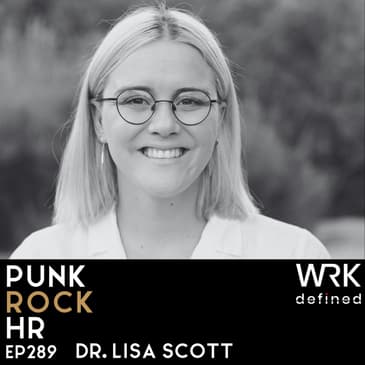
Could understanding autism help create more inclusive spaces—at work and in life?
On this episode of Punk Rock HR, host Laurie Ruettimann talks with Dr. Lisa Scott, an assistant professor of psychology at Utah Tech University. Dr. Scott has spent her career teaching, practicing therapy, consulting with businesses, focusing on important topics like autism and neurodiversity. Together, they explore the concepts of autism, ADHD, and learning disabilities—what they mean, how they show up, and why understanding the nuances matters.
Dr. Scott explains how a late-in-life autism diagnosis can be life-changing, not just for self-acceptance but for navigating professional spaces. She and Laurie discuss how most workplaces are designed for neurotypical and non-autistic employees and what needs to change—from better management strategies to seeing accommodations as a way to unlock talent rather than a “compliance issue.” They also examine the rising trend of women, particularly in midlife, self-diagnosing autism and how social media has played a role in raising awareness.
At the heart of their conversation is a simple idea: curiosity and empathy create better workplaces and stronger communities. Dr. Scott challenges listeners to rethink neurodiversity not as a problem to fix or work around, but as a perspective to embrace.
This episode offers fresh insights and practical takeaways for anyone looking to build a more inclusive workplace.
In this episode, you will hear:
- What neurodiversity really means beyond the buzzwords
- How an autism diagnosis can shift someone’s career and life
- Why flexible work isn’t just beneficial—it’s essential
- The connection between self-diagnosis, social media, and late autism discoveries in women
- What companies—especially in tech—can do to better support neurodivergent employees
Resources from this Episode
- Dr. Lisa Scott, Psychology Today: www.psychologytoday.com/us/therapists/lisa-scott-saint-george-ut/1152464
- Connect with Dr. Scott on LinkedIn: www.linkedin.com/in/lisa-scott-b3aa50100
- Dr. Scott on Instagram: www.instagram.com/dr_everybrain/#
Follow and Review:
If you haven’t yet, we’d love for you to follow us. Click that purple ‘+’ in the top right corner of your Apple Podcasts app. We’d love it even more if you could drop a review or 5-star rating on Apple Podcasts. Simply select “Ratings and Reviews” and “Write a Review,” then a quick line with your favorite part of the episode. It only takes a second, and it helps spread the word about the podcast.
Powered by the WRKdefined Podcast Network.
Powered by the WRKdefined Podcast Network.
[00:00:00] Yeah, so, and this is part of why it's hard to really get, you know, fully familiar with autism is because it's so many things. And also a really famous phrase in the autism community is, if you've met one person with autism, you've met one person with autism, because there's so much diversity on the spectrum. But I'm going to give you the basic definitions of when I say that person is diagnosed with autism, this is concretely
[00:00:30] what I mean.
[00:01:02] If you're just curious about what really goes on at work, you are here in the right place. On this episode, I'm joined by Dr. Lisa Scott, assistant professor of psychology at Utah Tech University, and a seasoned business consultant and psychologist. Today we're diving into a topic that's been on your minds and mine too, and has sparked loads of questions in my inbox over the years. It's autism at work. What exactly does it mean to be neurodivergent? Why are so many adults
[00:01:32] adults receiving an autism diagnosis later in life? How can managers effectively accommodate these employees, and how might these accommodations benefit the entire team? Dr. Scott thankfully meets us where we are, well, at least me. I'm somewhat familiar with these topics, but I've always been really unsure of how to manage all of this in the workplace.
[00:01:54] So if you're curious about navigating neurodiversity and creating inclusive work environments, you're in the right place. Sit back and enjoy this conversation with Dr. Lisa Scott on this week's Punk Rock HR. Hey, Dr. Scott, welcome to the show. Thank you. Good to meet you, Lori.
[00:02:19] I'm so happy to invite you onto the podcast because we're going to talk about the brain today. We're going to talk about the brain at work. But before we get started with all of that, why don't you tell everybody who you are and what you're all about? I am an assistant professor at Utah Tech University. I teach psychology and I research about psychology.
[00:02:41] I am also a psychotherapist and a business consultant. So kind of a range of things, and I love all of it. Wow. Well, you've got a bit of a portfolio career, as we like to say in the career advice business. You do a little bit of everything. Why do you do what you do? Oh, wow. Well, specific to autism, I kind of just stumbled upon it.
[00:03:10] I have autistic folks in my family and grew up around it before we even had the label of autism. So I think that it was a familiar way of showing up, even before I realized that I really loved professionally working with autistic folks.
[00:03:32] Well, I love that we're right out the gate with the word autism, because in the world of work right now, there are many people who are identifying as autistic or neurodivergent. And I thought maybe we can get like some basic definitions here. We can use clinical definitions. We can use definitions for someone like me to understand, like whatever you want to do. But what does it mean to be diagnosed with autism? And what does it mean to be neurodivergent?
[00:03:59] Yeah, so neurodivergent, neurodiverse, people use it differently. But what they're typically referring to is what we call neurodevelopmental disorders. And I'll simplify that. So neurodevelopmental disorders are brain differences that you have from birth. And they're things that you'll always have.
[00:04:22] So things like ADHD, autism, Down syndrome, learning disabilities, etc., etc. That's what is meant by neurodiverse, neurodivergent. And before we get into it, I do want to just own that I am not on the spectrum. But I do have ADHD. And yeah, I don't offer a lived experience when we're talking about this stuff. It's professional.
[00:04:51] Well, wait, I want to interrupt with that because you mentioned two terms in there, ADHD and on the spectrum. So before we kind of talk about what autism specifically is, I think a lot of people get kind of confused navigating in and out of the language. So we talked about like the bigger classification of being neurodiverse. And it can accompany a lot of different conditions that are there from birth, if I understand it correctly.
[00:05:18] But what does it mean to then say you have ADHD? And what does it mean to be on the spectrum? So when I say the spectrum, I'm referring to the autism spectrum. So I don't have a diagnosis of autism. I do have a diagnosis of ADHD. Yeah, so spectrum is just shorthand for autism spectrum disorder because people get diagnoses for autism one, two, or three. And each of those diagnoses have differences.
[00:05:46] So that's why we call it a spectrum because there's different options for what your autism looks like. Interesting. Okay. So if you have ADHD, you may be considered neurodiverse. Okay. And so you also, if you have autism one, two, or three, you're also considered neurodiverse. Okay. Tell us what, just in a general sense, what is autism one, two, and three? Yeah. Okay. Well, I have a list because there's a lot.
[00:06:16] And I've tried to narrow it down and make it really bite-sized and digestible. Yeah. So, and this is part of why it's hard to really get, you know, fully familiar with autism is because it's so many things. And also a really famous phrase in the autism community is if you've met one person with autism, you've met one person with autism because there's so much diversity on the spectrum.
[00:06:43] But I'm going to give you the basic definitions of when I say that person is diagnosed with autism, this is concretely what I mean. So the first thing is differences in social behaviors. This can be what we call reciprocity. So back and forth conversations, these are examples. These are not true for everybody. But back and forth conversations might be hard.
[00:07:10] Sharing emotion or feeling similar emotions. Like if someone's telling you a sad story, someone with autism may or may not quickly feel sadness along with that person. So that's, those are some examples of what we mean by reciprocity. Another social difference is in nonverbal behavior. So some people with autism have unique tones or kind of ways that they're speaking.
[00:07:39] Sometimes it's a bit more flat or there's just less diversity in the cadence and the tone. And then sometimes people can struggle to interpret other people's nonverbal signals. Understanding nuances of social relationships. There's a lot of unwritten rules socially that autistic folks tend to miss, which is when you think about it, missing unwritten rules is pretty valid. Yeah. Yeah.
[00:08:07] Like I can say that for myself sometimes. Yeah. Yeah. Yeah. Absolutely. You miss that cue, right? But for a lot of people on the spectrum, they're missing more cues. Okay. And then the other big bucket is particular or repetitive behaviors. This can be physical movement. So some people on the spectrum will flap their arms. It can be routines.
[00:08:34] So really liking specific routines and rituals. It can be repeating words or sounds. It can be what we call special interests. Where they focus in and have one really intense interest. So maybe it's trains and they become an expert on trains because they're so fascinated with it. And then over or under sensory sensitivity.
[00:09:02] So sounds are too loud or, you know, on the under sensitivity, maybe you're not smelling things that other people smell. And then the final piece is that these characteristics show up in early development. So you can't get autism as an adult and not have had it as a kid. You might get diagnosed as an adult. And look back and realize, oh, this is how that showed up in childhood as well.
[00:09:31] But it is something that you're born with. So what I love about the Workforce Agility Limited Series by Cornerstone was we talked to executives and customers all about skills. Skills, skills, skills, skills, skills, skills, skills. Cornerstone has a wonderful background in learning and development, training, et cetera. Their LMS is world class.
[00:09:55] But they've centered the business now, not just on that, like building upon that, but building upon how everything has moved to the skills economy. So check out the limited series called Workforce Agility, and you can get it wherever you get your podcast. And it's just a wonderful series where we talk to their executives on the shift of why and also their customers that are using it. So check it out whenever you get a chance. Appreciate it.
[00:10:23] These days, many adults are being diagnosed with a version of autism. And I don't know if it's autism one, two, or three, but they'll come into work and they'll say, I've got a new development in my life. I've been diagnosed with autism or I'm on the spectrum and I may need accommodations or I may not. But you, manager, I just want to let you know. And many managers who my coach are like, what do I do now?
[00:10:49] So I want to talk a little bit about that because it seems like there's an increased number of adults who are being diagnosed. Is that true or is that just something I'm noticing anecdotally? It's true. And the reason for that is that the school systems, the public school systems are better at catching autism two and three than autism one. So wait, can we stop right there? What's the difference between one, two and three?
[00:11:16] So autism one, folks are more likely to be able to hold down a 40-hour job, to have a group of friends, to do these things, kind of hold down adult life. And autism two and three, there may be more supports needed or differences in how they're living their adult life.
[00:11:40] And so with autism two and three, it's more likely that the autism is going to be obvious from a young age. And those support needs are going to be obvious from a young age. With autism one, you have folks that have masked and accommodated and kind of contorted themselves into living in our world that wasn't built for them.
[00:12:07] And oftentimes when you get an adult diagnosis, it's because something shifted in your life. Your coping mechanisms couldn't handle that shift. And then you go looking for help and you find the answer of autism. So yeah, it is happening more frequently, especially with women. We have more research about what autism looks like in women.
[00:12:34] And so yeah, we're seeing more and more, both because there's more research and because there's more acceptance. Even the fact that we're having this conversation on your successful podcast. I mean, this is a symptom that our culture is shifting and becoming more and more accepting, not fully there, but definitely shifting. Hmm.
[00:12:59] I was really struck by your comment around autism and women that we're learning more and more about what it looks like in women. Because specifically, I do work with successful women leaders and women entrepreneurs who have been masking. And I would love a definition of that as well, but who have been going through life, getting it done, getting promoted, maybe had some struggles along the way.
[00:13:23] But, you know, for the most part, I've just been grinding and they hit perimenopause and something shifts within them. And that's when I'm seeing many of the diagnoses being revealed in the workplace. So can we talk a little bit about masking and also what's happening in perimenopause? Maybe if you know, if you could speak on that. So masking is basically coping for autistic folks.
[00:13:47] I hope and many people hope that masking doesn't have to be such a prominent coping mechanism in the future. But it basically means playing pretend and fitting in with your environment. So our world was built for what we call neurotypical brains, which means brains that are not neurodiverse or neurodivergent.
[00:14:12] And people are shifting away from that term to things like non-autistic brains because what is typical? Yeah, I mean, who in this world is quote-unquote neurotypical? Yeah. Yeah, I think like when I think of the word neurotypical in my mind immediately, I'm thinking of like a successful middle-aged white dude. But they're like, don't put that on me, you know, right? Yeah, yeah.
[00:14:40] I like the phrase non-autistic. Non-autistic, yep. So our world was built for non-autistic folks. And so autistic folks learn that to fit in these, you know, the social differences, the differences in their interests, all those things. There's bullying that happens. There's rejection that happens. And so autistic folks learn to mask and to hide. And it takes a toll on mental health.
[00:15:08] And so it's really profound and important for a lot of people when they get their diagnosis because they can finally say, okay, who am I really? And how can I unmask? Where are environments that I'm safe to unmask and be myself? Yeah. Visionary voices, bold breakthroughs. This is Shally's Alley, where top recruiting minds spill their best-kept secrets live every Friday at 1 p.m. Eastern.
[00:15:37] Raw, unfiltered conversations on sourcing, hiring, and the future of talent, where we ask the tough questions no one else will. Tune in and level up. Hey, everybody. Tim Sackett, host of HR Famous, a new podcast on the Work to Find Network. Am I famous? No, I'm HR famous. My wife says I'm a micro-celebrity, and 13 HR ladies around the world want their picture with me, which I think is funny. So, hey, what do we talk about on the pod?
[00:16:04] We talk about all the dumb stuff we do in HR in any given day, week, month, and we have fun with it, and we have some great guests. Come check us out. We're not famous. We're HR famous. One of the things that I want to touch upon really quickly before we move on to what happens during paramedopause is that when a manager is presented with this conversation, with this idea, I want to move away from the idea that it's extra work.
[00:16:32] Extra work to manage someone with an autism diagnosis. Can you talk a little bit about that? Yeah. I mean, I do think in ways there is extra work, especially for a manager that's completely unfamiliar with autism. There may be extra work, but the thing that I think is important to highlight is how skilled autistic adults can be.
[00:16:58] And oftentimes rigid and uncurious kind of ways of managing autistic adults is missing out on the talent and missing out on the ability. I mentioned special interests earlier and the need for routines. Those are great examples of autistic folks can excel, not just in similar ways to other adults, but also with their autistic traits.
[00:17:27] So special interests, they at times can become experts in certain areas. If they can lock into a routine, many autistic people are super successful at sticking to routine. So there's different ways that autistic folks can be extremely loyal, extremely committed, extremely organized. And this is all, you know, depending on the autistic person.
[00:17:53] But these are some examples of just the kind of superpowers that come with autism, that if you can get creative and work as a team to figure out how do we harness your abilities, you can do that. And yeah. And I do think speaking of workload for the manager, I mean, I do think there's the collaboration of how do we do this realistically, right? What's on my plate? What's on your plate?
[00:18:21] What are some shifts that are doable for both of us? I also want to pick up on a point that you seem to have made, which is that you should approach this with curiosity and flexibility. But I would imagine and tell me if I'm wrong, that if you're uncurious and you're inflexible, it might make things worse. Is that correct? Yeah, absolutely. Yeah.
[00:18:47] I mean, even if you're coming in with, you know, say you're trying to help, but you're assuming, you know, you listen to this podcast and Lisa said that you should, you know, flexible hours or what they need. Right. That we can't say, I can't tell you exactly what your autistic employee is going to need. Um, I can talk about trends and that's where, um, just staying curious is helpful.
[00:19:17] Yeah. Yeah. I like, um, the caveat that there's not one way to treat an employee who comes to you and expresses that they've been diagnosed with autism. So that's a really important point to make. I will say, I want to move on to employees who are discovering this later in life and specifically women in the workforce who are now perimenopausal. Am I also correct in saying that there's somewhat of a correlation there?
[00:19:45] At least I'm seeing it in my professional experience. So tell me about that. Yeah. Well, I think, um, I think you're seeing that partly because now is the moment, like the last five, five, 10 years. Now is the moment we have been talking about autism. We have been, um, having more and more research come out. So I think that's probably part of why you see that pattern.
[00:20:07] But I think the other thing is just what we talked about earlier is that perimenopause for many women brings shifts in their body and their mind. Um, and it's different for different women. I'm not an expert on perimenopause, but what I do know is that it absolutely can bring shifts that can with those shifts, the current coping mechanisms may not be adequate.
[00:20:34] And so surprise shifts for people with autism mean, I mean, for all of us, surprise shifts can be overwhelming, but they tend to be more overwhelming for people with autism because, um, a lot of folks with autism have navigated the world through formulas and coping mechanisms that they've built up over a lifetime of learning.
[00:20:56] And people without autism have, uh, often have a bit more of kind of flexibility and spur of the moment problem solving. Autistic folks can do that too, right? Like I don't want to ever generalize what I'm saying, but commonly.
[00:21:13] And so if, if an autistic person doesn't have a formula yet and has a new situation sprung on them, even if it's perimenopause, um, that can be a friction point and a point where they, they realize they need more support. Yeah, that makes sense. So the other thing I was thinking in that moment of perimenopause or really any moment with change, sometimes there's more medical intervention, right? And more resources thrown at what's going on.
[00:21:42] So it may be an opportunity that women are having while they're in there and they're having conversations with their doctors. It naturally leads to other conversations about mental wellbeing, cognitive overload, right? Cognitive overwhelm of what's going on in the world. So maybe that's leading some women down a path of self-exploration to then go get that diagnosis. So I can, I can certainly see that. And I don't know if I'm making an incorrect assumption, but I think that's probably logical. Yeah. Yeah. I think so too. Yeah.
[00:22:12] Well, I do want to talk a little bit about, um, the prevalence of autism in our society, because you made a comment earlier that in the past five years, we've really been building towards this moment, right? Where it's out there and people are talking about it. We've also had the, um, convergence of Instagram and TikTok. And I think there are people out there who just like self-diagnose all sorts of stuff are also self-diagnosing autism.
[00:22:38] And I want to talk a little bit about that because in many ways, I think that's healthy, but in many ways, I think that may not be the right path for a lot of individuals. So am I crazy in that people are using the internet to self-diagnose? No, not at all. I see it all the time in my students. We talk about TikTok and social media all the time because yes, it is kind of this front line of information for mental health and different diagnoses. And it's not typically great information.
[00:23:09] I do like it for like people sharing their experiences. I think getting on there and following autistic folks is a great way to get more education about what it's like to be autistic. But yeah, so social media, self-diagnosis, I think it can be useful. It's actually really common for people to come to me for an autism assessment that have first started to relate to things posted about autism online.
[00:23:38] So in that way, it can be a resource. The only thing I guess I would caution against, I think it's fine to resonate with any diagnosis and you can learn about yourself as you ask those questions. But just to recognize that diagnoses and especially self-diagnoses aren't, it's not a solution. It's a starting point.
[00:24:02] And it's helpful to think of, I want to get to the right starting point, right? If it's autism, then we can connect you with the right resources. If it's ADHD, we can connect you to the right resources. But yeah, self-diagnosis can be kind of like the first question on the journey toward diagnosis. But yeah, for sure, there's some limitations to what you can access and if you're accessing the right things or not. Yeah, really interesting.
[00:24:31] You know, you mentioned early on in this conversation that you have a bit of a varied career, right? You're a professor and you're a therapist and you're also someone who's a business consultant. Can you tell us a little bit about like more of each of those buckets? So what's your research been like and how do you work as a therapist and what's your business consulting model? Yeah, so I'm kind of unique. Most people that decide they want to be therapists decide they want to be full-time therapists.
[00:25:00] But from my young 20s, I always wanted to be a professor. I just really love teaching and I love research. I love asking big questions and looking for new answers. So that's all I'll kind of say about that. But yeah, I teach general psychology courses a lot related to psychotherapy in undergraduate level.
[00:25:28] Therapy, I'm trained as a general psychologist and most people don't know what that means and that's okay. Yeah, so psychologist is a PhD level therapist. So we're trained in research and clinical work. And I was trained generally to work with a broad range of mental health concerns.
[00:25:49] But during my training, I found I kind of stumbled into working with a bunch of autistic folks and really loved it. I experience working with autistic folks as a non-autistic person. It feels like I'm working with someone from a different culture in the sense that they are interpreting and experiencing the world in valid and very different ways.
[00:26:16] And anytime I work with any client that is literally from another culture, it takes a lot of curiosity and openness and even self-discovery of how do I show up best for this client? Because I'm unfamiliar with kind of their rules for the game of life.
[00:26:38] And so translating that to autism, I find it really similar that there's always new experiences they share or struggles they're going through that I might not understand on the surface. And it takes time for me to understand it.
[00:26:57] And I just, I find it really rewarding to do that work and to get to know each other and eventually value what we, what my clients bring and the unique perspective they bring. What I'll just say really quickly, one of my favorite aspects of people with autism is that they, many of them are ignoring the social norms. And not all of them, but a lot of them.
[00:27:27] And they're, they're just doing their authentic life. And a lot of us not on the spectrum are so caught up in all of the little unwritten social rules and social expectations. And I find it really refreshing to sit across from somebody that's not bogged down by that. And that has an ability, I think, to show up more authentically than the average person. Hi there.
[00:27:56] I'm Peter Zollman. I'm a co-host of the Inside Job Boards and Recruitment Marketplaces podcast. And I'm Steven Rothberg. And I guess that makes me the other co-host. Every other week, we're joined by guests from the world's leading job sites. Together, we analyze news about general niche and aggregator job board and Recruitment Marketplaces sites. Make sure you sign up and subscribe today.
[00:28:20] The type of psychology you just described where, you know, people with autism are like part of a different culture reminds me of people who come from different countries, right? Different regions of the world. And they're faced with American capitalism. And they're like, oh my goodness, how do I survive? Right? So can you talk a little bit about those different intersections, especially around autism and how it maybe changes your approach to psychology? Yeah.
[00:28:48] So I was trained in the area of multicultural psychology. I'm hearing that's an outdated term. Sometimes academics are a bit behind of like pop culture. And anyway, but cross culture. There's other ways we could describe it. But it just essentially means that I look at systems when I'm looking to understand any individual human. And so that includes culture. That includes family system.
[00:29:17] That includes political climate, work environment, all of those things. And so when I look at what is the solution for somebody's struggles, I'm not first jumping to their thinking incorrectly. They're acting incorrectly. So we're going to reframe their thoughts and we're going to coach them to behave differently. I think bigger than that. And I think about, yeah, I think about capitalism.
[00:29:45] I think about American culture. I think about, you know, different systems of power and how those impact individuals. And talk with clients about how do we navigate systems that are may or may not privilege who we are. So, yeah. Does that answer the question? What a time to be alive, right? Just as anybody. My goodness. Well, you had mentioned also that you do some business consulting. Can you tell us about that? Yeah.
[00:30:15] So that's it's almost like mental health for a workplace. So analyzing the system of the workplace and specifically I've focused on diversity issues at work.
[00:30:28] But really, I, yeah, I can help with if there's any leaders or HR professionals that are wanting to understand some kind of basics of how do I think about a diverse workplace? And how do I support people? How do I do it in an efficient way that doesn't overload me?
[00:30:52] But really allows everybody to feel that they are safe at work and able to do what they do best without having kind of hidden barriers that maybe leadership isn't aware of. Really beautiful. You know, as we wrap up the conversation, I'm wondering if you can give some examples about what is really helpful in the workplace for people who are diagnosed on the spectrum. Do you do you have anything to share? Yeah. Yeah.
[00:31:20] So in preparing for coming on your podcast, I asked my sister and my partner who are both on the spectrum, their thoughts. I think, you know, I think it's always important and helpful to hear from people that have autism themselves. Right. Oh, yeah. Not just from a clinical standpoint, like what's working boots on the ground. Yeah. I'd love to hear. Tell us more. So my sister said something and they said a lot. They had a lot of great ideas.
[00:31:49] But I want to give two examples that I think are great. So my sister said something that was really fascinating to me. She said her team at work, she's a marketing professional. They all took personality tests and those were very insightful for Stacey. She was able to say, OK, this person, this makes this person feel motivated. This is how they work. This is how they filter and experience the world.
[00:32:17] And so if they're really relational, I'm going to approach things very relational. Or if they're very analytical, I'm going to approach things analytical. And just like going back to the formulas, like it gave my sister this concrete formula for this is how I relate to my coworkers. So I loved that example. What a good idea.
[00:32:37] If there's a member of your team who reveals that they have this diagnosis, maybe that could be a tool that you can use to create a harmony or create understanding or deepen the relationships among your team. That's a really awesome tip. All right. Thank you for sharing that. What else? What else you got? And then my partner, Jen, I mean, she loves the flexible work. She's a work from home employee. Another thing that she really likes is structured social time.
[00:33:07] This is common for a lot of people on the spectrum. And that sounds kind of like academic structured social time. Dr. Scott, are you telling me she's asking for team building? Yeah. Yes. Yes. Literally like things, social engagement that you know exactly what's going to happen. A lot of folks with autism struggle with social anxiety.
[00:33:32] So if you know, we're going to get together socially and we're going to play settlers of Catan, or I don't even know if I said that right. Or we're going to play wingspan. And they have these concrete rule based ways that they're going to engage with coworkers. It can really reduce social anxiety for autistic folks because there's so much ambiguity in social settings.
[00:33:58] If you can have this concrete activity or even an agenda, if you can't provide complete concreteness, just even an agenda. So they can visually know what they're getting into socially. Those things can be really helpful. So smart. And I think that breaks the idea, the stereotype that anybody diagnosed with autism doesn't want to socialize or that those situations are just too much for them.
[00:34:24] In fact, you are telling me that this is actually something your partner wants. And that would be very helpful as long as there's some structure to it and some expectations that are laid out. Correct? Yep. And I'm so glad you brought that up. That's a really pervasive myth that people on the spectrum are uninterested in relationships. By far, that has not been my experience.
[00:34:47] Most on the spectrum want relationships just like non-autistic folks, and they just have different ways of getting there. That's really lovely. Well, I'm glad we ended on that. You know, if people want to learn more about you, your research, your goings on, all the fun things about Dr. Lisa Scott. Where do I send them? Where do they go? Yeah. So I just recently started an Instagram page. You can reach me personally or professionally through that.
[00:35:18] It's Dr. So Dr underscore every brain. Oh, I love that. I love that. And by the way, we'll include that in the show notes. And we're just so excited that you came on and like met us as an audience where we are and like understanding the brain, understanding autism, the term neurodivergent, neurotypical, and breaking that down.
[00:35:41] And all of it is just so important that we all just kind of get a little bit smarter and we all drop being embarrassed. Because I think if you're an adult and you're embarrassed to ask questions, then you're not a good learner, right? So I appreciate everybody who in anticipation of this episode sent questions. That was really great. So thank you, everybody who's listening. And Dr. Scott, thanks again for being a guest. Thanks so much for having me. This is awesome. Hey, everybody. Thanks for listening.
[00:36:10] A big shout out to Work Defined. They're my friends who host this show on their network. And thanks to longtime production partners and friends at Emerald City Productions for making this show happen and sounding fantastic in the process. Now, don't forget, like and subscribe on YouTube or Apple Podcasts or wherever you listen to stay up to date on the show and leave a five-star review. That would be great, too.
[00:36:34] And because you're still listening, I'm going to tell you it is my fucking nightmare to ask people to like and subscribe. It's just not very punk rock. It doesn't seem very cool, but here I am doing it. And that's because I appreciate you and I want you to hear each and every episode. Regardless of whether or not you like and subscribe, thanks for tuning in. And guess what? I'll catch you next time on Punk Rock HR.
Sponsors
