
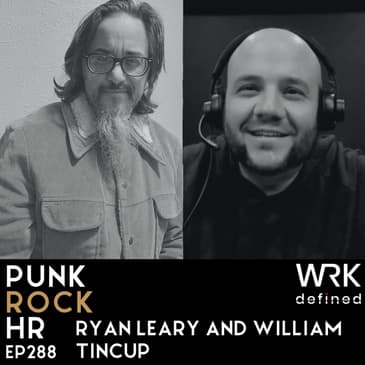
On today’s episode of the Punk Rock HR Podcast, Ryan Leary and William Tincup are Laurie’s guests. They share their fascinating journey to building the WRKdefined Podcast Network.
They spotlight the power of podcasting by revealing how meaningful content can be created without extravagant equipment. It is a thought-provoking exploration into the essence of authentic conversations, where we aim to challenge the status quo and foster impactful dialogues.
Ryan and William reflect on their personal journeys and the evolution of their network, which is dedicated to exploring work-related content. Ryan shares his adventurous career transition from Enterprise Rent-A-Car to recruiting and how it ultimately led us to collaborate on this podcast network. As they expand, they’re embracing a diverse array of shows, including the popular BARF show. The goal is to grow to 100 shows by the year’s end, creating a vibrant community enriched by deep analytics, promotions, and community building while keeping their commitment to valuable content.
And they offer aspiring podcasters insights and advice on crafting their podcasts, including theme development, setup, and technology tips. They emphasize authenticity in podcasting, drawing inspiration from celebrated interviewers like Terry Gross and Phil Donahue. Focusing on creating a supportive and collaborative environment, Ryan and William discuss their vision for 2025, which includes integrating wellness and leadership topics into their programming.
Ryan and William are excited to attract advertisers and build a hub for innovative ideas and engaging conversations related to work and its many facets.
Powered by the WRKdefined Podcast Network.
[00:00:00] Yeah, you don't always need to be high quality. If you're a podcast and as long as you're doing pure audio, just focus on good audio. And you can do that. I mean, gosh, a lot of phones have fantastic audio if you're in a good quality room. That's really the key there. But you can get started literally for $50. It's not a lot of money.
[00:00:25] And I mean, realistically, if you're just doing audio, if you want to go high end, $500. You know, get yourself a solid microphone and you're good.
[00:00:39] Hey, everybody. I'm Lori Rudiman, and this is Punk Rock HR. It's a show where we talk about work in a raw, real and refreshingly honest way. From disruptors and innovators to everyday folks like you and me, we're here to cut through the business jargon and figure out how to make work better.
[00:00:56] Sometimes we take a break and talk about life, relationships, well-being, kids, pets, and everything that makes work worth it. Whether you're an HR pro, a leader, or just curious about what really goes on at work, you are here in the right place. On today's episode, I'm sitting down with Ryan Leary and William Tinkup from the Work Defined Podcast Network.
[00:01:20] Punk Rock HR joined their network earlier this year. Why? Good question. I feel like they bring together a community of communicators and listeners to cut through the noise and the chaos of your typical nine to five. In fact, a podcast doesn't make the cut if it doesn't challenge the status quo or make a real difference. So today, Ryan and William are here to share how they curate transformative conversations that matter.
[00:01:50] So if you're ready to learn more about my new podcasting colleagues, and really, they are my friends, enjoy this enlightening conversation with William Tinkup and Ryan Leary on this week's Punk Rock HR. Hey, guys. Hey, William. How you doing? Good. How are you? I'm great. I'm so glad you're here. Good call. Yeah. All right. Ryan, how's it going?
[00:02:20] I am fantastic. Happy to be here. Yeah. We're here because I'm doing this thing on the Work Defined Podcast Network. I want to talk about that. I want to talk about what it is, the show's on there, why it's cool, why it may be dorky. I don't know. Like all of that. But I want to start with getting to know the two of you. So, William, can you tell us who you are and what you're all about? Sure. I started my career in marketing until I found out that I don't really like people in marketing
[00:02:49] or don't like people like me. Maybe it was a combination of both. Fell in love with recruiting, fell in love with HR, and transitioned from a marketing career that was actually pretty fun, quite frankly. Agency Life, if you've ever watched Mad Men, nothing's really changed. There's a lot of that that still exists in modern advertising.
[00:03:13] And I just, I love HR because they know all the darkness in a firm, yet they're still hopeful. At their core, they're still, I mean, they know the sexual harassment claims, the pay inequities, they like all the darkness. All the darkness, but they're still hopeful. All right. Is that the theme for today? A little bit of self-loathing, a little bit of darkness, but also a little bit of optimism. I think that...
[00:03:41] If you have me with optimism, that's... I don't know if that's ever happened. We're going to make it happen. That's a unicorn. Yeah. Well, that's what we do on Punk Rock HR. Well, I'm glad you're here. Ryan, you know, I've known you for a lot of years, but I don't know really anything about you. So who are you and what are you all about? Yeah. Neither does most people. I, you know, I, I, I, I, way back. So I grew up in recruiting and sourcing and RPO world.
[00:04:09] But prior to that fun story, I was working with enterprise, run a car like every young lad does coming out of school to wash clothes or wash clothes, wash cars with your suit on. But I got in too many accidents. Yeah. Got stuck in a car wash from my last accident. So it had to dismantle that thing around me. Awful. Third accident, had to sit there for hours as they, I knew I was losing my job as they did that. So that was cool. And then I fell into recruiting from there.
[00:04:37] And it's been recruiting ever since. And, you know, been through some, some agencies type stuff. And then here we are now, William and I finally together. Although we worked together for probably about 10 years or so. Yeah. Yeah. It's dog years. Well, wait a second. Were you the guy at enterprise who picked me up? I, I, you know what? I was. No, I love it. I was that guy. Drove me into a tree. That was always, that was always a little awkward for me. I'm not sure I signed off on that,
[00:05:06] that behavior where they come with you and then you got driving back. I'm like. It was, it was, they were ahead of their time with Uber. Yeah. Yeah. Yeah. That's well said. Well, I'm so glad to have you here. Who wants to tell me what the hell work defined is? Sure. So as a, as a tech advisor, I love giving people advice and then not having to do any of the stuff that's related to the advice.
[00:05:35] And every tech company, uh, pretty much every tech company in the world ever, there's always a pivot, right? There's always kind of a moment where they have to, Oh my God, we're going to go and work in the fashion industry. And I've been able to avoid that because I just give advice and then I can go back to like, you know, the stuff I do day to day. When we created work to find, it was really the thought was let's do our five shows.
[00:06:05] Let's go sell some marketing services, really just have our five shows and do advertising. And then once we got into it, pivot, we, uh, six months into it, we started adding other shows and all of a sudden we started to learn the world of, uh, podcast networks. So the wonderies, the iHeartRadios, there's, there's tons of them that are really, really great.
[00:06:33] And there really wasn't one that captured all things work. So every aspect of work, early stage careers, leadership, coaching, you know, all that stuff. And then we started researching. There's thousands of independent shows all over the world and they don't have a home. And so we said, well, why don't we create our home? Okay. Well, what would be the value of that? And, uh, the value that we came back to is kind of four prong, uh, deep analytics.
[00:07:02] So we can help them build their demo because eventually we're going to have inbound advertisers that want specific demo demographics. The promos of really kind of getting everybody up to a place. So somebody that just started a show like Brent Skinner, Bob Pulver, they just started a show. They don't have an audience. Well, other shows can help promote them. So that's the potential of monetization.
[00:07:25] Your show is by far on our network is by far the closest to actual modernist monetization. People want to sponsor you. They love you. They love your show. They love the demographic. Like it, you're way ahead of, uh, everyone else and a sense of community. So the fourth thing is just, we started in Slack, which Ryan and I agreed when we started
[00:07:52] the company that we would never use Slack up until again, pivot. We had four or five different hosts that say, Hey, we would like to talk with the other hosts. We're like, ah, email can't do that. And then we looked around. It's like, okay, there's this thing called Slack. Let's do it. But we eventually want to do training there as well and do more collaborations.
[00:08:16] Right now, as we, as we talk, we have 34 shows on the network and, uh, we've got about another seven to onboard here in the next week or so. Wow. Wow. So we want to be at a hundred shows by the end of the year. Have you ever wondered what really makes a generation tick? Who gets to pick the name and why the slang keeps changing? Don't worry. I can help. My name's Dr. Megan Grace on hashtag Gen Z. I share the voices and experiences of generation Z, how they're different from other generations,
[00:08:46] what moves them and why they do what they do. In each episode, we go beyond the buzzwords and the stereotypes to dive into real conversations and the insights that matter to making intergenerational collaboration a reality. You can catch hashtag Gen Z on the work defined podcast network and wherever you listen to podcasts.
[00:09:32] Well, thank you for the kind words about punk rock HR. Um, man, I, I don't know what I've built here, but I know that people keep coming back and they want to learn and they want to grow. So I appreciate the recognition. You know, Ryan, I wonder what were those first five shows and what were they like and who's come along since? So the first, the first five shows, the original shows in the network, we have our, our news show, which we do every Sunday. That's the barf, which is pretty popular now.
[00:10:02] And it's, it's, uh, it's, it's taken hold, which is, wait, why is it called the barf show? It's just, you know, it's breaking news acquisitions, funding and research, and it just spells barf. And there you go. So nothing special, but, um, it's a great show because PR people with the name. Yeah. I think there's a, they, they get the, Hey, we want your CEO to be on the barf. And they're like, I feel like you can scare PR people just by showing up. 100%. I'm going to send you some questions in advance. No, no, no. You don't really need to.
[00:10:31] No, no. Yeah. We've got, we've got the barf show, which is like the anchor show of the network. Okay. What else were in the first five shows? Yeah. So the, the idea was to create shows where we can learn about people in the space. So inside the C-suite, the practitioner corner, uh, and the use case as, as well. And so we have those shows. Am I missing a show? I feel like I'm missing a show. You should know that you should know podcast, which is actually always forget that one. The you should know podcast, which is interesting because it's, it's one of our most highly listened to shows.
[00:11:01] On the network. And it's, um, it's got to, it's just got a way to attract people because we're talking about things that people should know younger demographic. So it's like an 18 to 25 year old demographic majority, 70% female. So it's like way up there. And what we're finding is that they just consume the content and their early career. And a lot of the content is early career related type content. So what's your favorite episode, both of you from the, you should know podcast. I'll let you take that one.
[00:11:31] Oh, that's a great question. Probably one of the more recent ones with, uh, I think published last week, it was the chairwoman of the board of directors of Deloitte. And it was just talking to her about all the things that are going on and that she's seen, like she's got 40 years at Deloitte. So it's like, she's got stories and she was wonderful. I mean, as a guest, she was just, she was funny inside the suite, uh, C suite.
[00:12:01] We had, uh, the CEO of love sack on. Oh, and I didn't know the, yeah. I didn't know the furniture that well. Ryan, Ryan did, but he went, he, he took us through zero. He was just making beanbag chairs for his friends, went to college. He's Mormon. And I, so I thought there was a lot of weed involved, but evidently not. So he took it all the way public and he runs it.
[00:12:26] It was like a $700 million company and he all the way through all. And he's just a funny guy. He kind of reminds you of like a Jeremy Renner. He's got kind of that look high energy. Uh, he, that was just a fun show. Cause it was just wind them up and watch them go. Oh my God. We didn't have to do much. Have you sat on a love sack sofa? I never have. I have. Dude, I don't know if I could get up. We have, we have, we have a store. We have a love sack store.
[00:12:56] That's less than three or four miles. So I just opened it up not long ago. And I went in there and I, I fell in love with them. They're so good. They're so fizzy. They got all the speakers in them and stuff. And then I saw the price tag and I said, oof, let's get Sean on. And yeah, let's, let's get Sean on an interview. Maybe we'll get a nice fat discount code. Oh, he asked for a discount. Ryan shameless. He asked him at the end, at the end of the show, we weren't recording. He's like, Hey, do you have like a code or, you know, some other, I'm like, dude, really?
[00:13:26] He gave me one. I still haven't bought one. Cause it's still like, Whoa. I feel like that's like the podcast way to go though. Every show you get like an advertisement and then you get like the discount code, like 30, 35% off away luggage. Right. You know? So I love that you asked and you received and that you've got this like really diverse an interesting group of core podcasts that you started with then Ryan, how did it expand? Like, tell me about some of the shows that joined. Yeah.
[00:13:55] So that's a, that's an interesting question because we've, we've been in this space forever and we, all of our friends have shows and people we don't know have shows. Right. And so it, it, we started to add friends and family, right. Bring them in. Let's, let's give them a home. Let's, you know, do something, try to do something special. But now we're starting to get a lot of shows that we've never heard of. These are shows that are on other networks, larger networks that really just want to be
[00:14:22] at a home for work, or at least have an audience that's geared towards that, the marketing and all the collaborations and all that stuff that we can bring. So great example of that was yesterday, Lori. Guy reached out to us. We have a button on our website says added your show, which is just a form. And he reached out, he's in Calgary and he has a podcast. He's got 70 episodes in and it's on leadership and a working well podcast. Nice guy.
[00:14:50] I mean, Canadians, of course he's a nice guy. And, you know, but like, we didn't know him. We don't even know people that know him that know him. Like he, this isn't a Kevin Bacon thing. Like we, we don't know anything. Those shows are fun, but we started with like the Devin group that up next at work and Mark Pfeffer people tech that we developed. Brent Skinner show, small talk window and Bob full Pulver show, elevate your AIQ.
[00:15:18] So some of those shows were just like, we liked the people. They didn't have a show. So we're like, all right, well, let's teach you how to do a podcast. I think that's the really interesting part of the story because you've got podcasters at very different stages and also people who are podcast curious. So if there's someone out there right now, who's like, oh, I've always wanted to start a podcast and I have an audience. What do they do? Like, what are the first steps?
[00:15:44] Contact us, contact us and we'll help them develop the, their theme. Like if they don't come with a, like a theme, like an idea, because there's a lot of niche. I mean, just work in general is, is very niche compared to like true crime. So, you know, somebody comes to, to us just goes, you know what? I've been working in compensation for 20 years. I'm just fascinated with all the different things that go on with compensations.
[00:16:12] Like, well, then build a show around what, you know, what you like. Do you want to have guests? Do you want to, so the cadence, is it video and audio, you know, like, like just helping them kind of work through those kind of things. And, you know, we're not, we're not right. In fact, we tell them it's like, we'll give you advice. Take it or don't. Well, yeah. And Ryan, that's my question to you. So someone comes and they're like, all right, I work in the world of compensation. I know a lot of people.
[00:16:41] I want to have some conversations about the things I love. I don't know anything about podcasting. Do you have resources, Ryan, that you use on your backend to help these people launch? We do. We, we have options for them. So we, we use Riverside as well. For, for us, we use Riverside. So we have options there. We, of course, provide hosting and things like that, but we'll help them with, with their gears. Well, how do you set up? What microphones do you need? What, you know, if you're using a headset, old school air traffic controller, like William
[00:17:09] and I, how to, how to set that up. But yeah, we, we do have resources and we have coming up in the network. Now we do have a couple of people who outside companies and firms that do this professionally, and they're going to come in and help with the community at no cost. Just come in and help provide training into, into the community now that we're, that we're building. And I think a lot of people, especially within this like work, HR tech, you know, kind of
[00:17:34] world are afraid that starting a podcast is going to be so expensive. Like they're like, Oh my God, I don't want to spend the money. Like what, what's like a lift for someone who's new to this industry? Well, for years I used blog talk radio, which was a free hosting. It just did the bit. Then I recorded in zoom for audio podcast. I would just record in zoom, take the MP3 and publish. Like it was super, super easy. And I didn't even, you know, I do shorter episodes.
[00:18:04] So I didn't even have to have a premium account. Like, so it's like, if you want to kind of a hack it, uh, you can really hack that. If you're doing video there, it is a little bit, it is a little bit different because of the quality of, of the image as well as your audio quality. Ryan's really, really good, better than anybody that I know at helping people get their setup right, like get the tech, right.
[00:18:31] You know, I use a, a Brio, uh, cam and a headset that I got at, you know, at Best Buy. So like I'm low tech and, but there are people like Felicia's show. Ryan can explain it, but like, she's got a setup, setup, like, you know, Lars, he has a wonderful setup in his office. Lars Schmidt has a wonderful setup, like a professional setup. Uh, you don't need to start there.
[00:19:00] In fact, I would suggest to a lot of people starting out, don't do all that. You don't always need to be high quality. You really don't. If, if you're a podcast and as long as you're, if you're doing pure audio, just focus on good audio and you can do that. I mean, I mean, gosh, I mean, a lot of phones have fantastic audio. If you're in a good quality room, I mean, that's really the, the key there, but you can get started. I mean, literally for, you know, 50 bucks. It's not a lot of money.
[00:19:29] And I mean, realistically, if you're just doing audio, if you want to go high end 500 bucks, get yourself a solid microphone and you're good. Yeah. I don't know about you, but I don't know very many people that are hopeful about the world of work. And I'd like to change that. My name is Marcus Mossberger and I started the Hope at Work podcast where you'll find two things. Number one, really interesting guests.
[00:19:56] And number two, innovative ideas about the future of work. Check it out.
[00:20:44] You know what you should know? You should know that you should know podcasts. That's what you should know because then you'd be in the know on all things that are timely and topical. Subscribe to the, you should know podcast. Thanks. Okay. So Ryan, you mentioned Felicia. And so take us through who Felicia is and why her podcast is so great. Yeah. So Felicia is the host of the CPO playbook and she's wonderful.
[00:21:13] She's a fantastic interviewer, has great guests on there, really top level guests. Just everyone's prepped really well. And it's, it's just a professional, really fun conversation. And the information is fantastic at that. I don't know her full demo on, on her show, but I mean, I've listened to random one, you know, not, I don't listen every week, but I listened to random ones and they cover so many different areas. They really do from leadership to just stories to, you know, just in between things you
[00:21:42] don't even know that you need help with. And she digs in. She's a really strong interviewer. But William loves her setup. I do. I do. I've known her for years back when she was in LA. She's in the Bay area now, but like she does prep, like, you know, you know, you know, cause you've done this a long time and you've been on a lot of other people's podcasts as well. Some people are preppers, right? Like they'll give you a kind of list of the things.
[00:22:10] And, uh, she does a, she does a, she does a call. So she sends you all that stuff. And then she does a prep call and then she does a podcast. So it's well executed, um, for people that like prep. Yeah. Yeah. I think there's more of those people that like prep. I was on her podcast and I felt like, Oh, this is a job and not in a bad way. Like I need to show up and give my best.
[00:22:37] And that episode, I really absolutely appreciated because I felt like the conversation was easy to have because of the amount of work that she did beforehand. But I like the idea that she's our example of a beautiful visual landscape, like the way she's set up Ryan, what makes her video so great? Her, her setup. I mean, she's got, if you, if you want to invest in video podcasting, she's got a great setup. I forget the exact camera she's got.
[00:23:04] It's like a Sony a 6400 or something or other, but again, it's not crazy, right? You're talking 800 bucks for a camera, another five or 600 bucks for a solid lens to, to really get it where the money is, is in the editing and production team. So, but you can, you can do a high end setup and that no one's ever going to beat for you for less than two grand. It's really not a line. And she, and she's done really, really well. And she's worked hard on it. She's worked hard on it. She researched it.
[00:23:34] Her background's phenomenal. Lighting's fantastic. Not sure what she's doing for, for editing, but we, editing can get very expensive if you're using a, you know, a third party. I love when people actually like do something with integrity, unlike punk rock HR, where I just show up in front of my computer and talk to people. But I think like that's, that's the beauty of podcasting. There's enough open space for all of us. Like I never want to take anything so seriously that I'm like obsessed with it. Cause then I get weird, you know?
[00:24:03] Then it sounds like work. Correct. Correct. And we all know I'm team never work, but there are some really beautiful podcasts out there. And William, you mentioned Laura Schmidt, who's not on the network and actually is not podcasting anymore, but his amplify talent examples of his podcast were just beautiful. And he worked with LinkedIn to really dial that in and make that profesh. So there's a whole landscape out there of people who are doing it.
[00:24:30] But one of the things that I want to get both of your reactions to this is that years ago, when I was blogging with Chris Dunn, one of the things I heard my dear friend, Chris Dunn, who's now CHRO of Marriott say, is just get started. Nobody's going to listen or read or pay attention to the first 50 you do of anything, keynotes, blogs, videos, whatever. So what do you, William, tell me what's your reaction to that? And do you want to expand on that? Oh, a hundred percent. The thing is, is don't overthink it. Don't have analysis paralysis.
[00:24:59] I think when we say quality, we've talked about video quality. We've talked about audio quality. Very important if you're doing those things, but really it's content quality. And so for those first 50 episodes, if you could just focus on creating something that's entertaining, inspirational, educational, et cetera, whatever your bid is, then just do that. Some people, uh, podcast and they podcast in a persona.
[00:25:27] Uh, I can't pull that off. So I just podcast as myself and it is what it is, but some people have that persona. And so they put that persona forth, which is great. But the first 50, I would advise just get the content, right? That you like the content. Don't worry about other people liking the content. Cause then you'll get caught up in what people like and what they don't like.
[00:25:52] Like disregard, just do you and create, if you're going to do interviews, have really interesting people on your show. It's one of the things I like about both yours and Felicia show and, and, uh, Jean and Kate's show with up next. They just have really interesting guests and they just explore stuff. And it's like, I just, I like that. Yeah. I like that approach too. Ryan, what do you think about that? You know, so everything William said.
[00:26:20] And, and one of the things that I always recommend, if you're video changes you period, if you're on video, you've got to look straight. You could look often. I, I look wherever I want to look, but yeah, you're right. Yeah. CNN has you looking at the green dot. Yeah. Yeah. And a lot of people, they clam up with that, right? Like they can't think I use, it took me for when we, when we hit COVID and I couldn't walk around the house with a headset on. I literally, or have a mouse in my hand.
[00:26:48] I literally became stupid on phone calls. That was my thinking power. And so it took me a while to get on video and actually be productive. So I tell people forget video. Like if you're not comfortable, you don't know who you want to be yet. Shut the camera off and talk into the microphone and be anything you want to be. Pretend your family's on the other side of the country. You're getting on stage and talking and you're a totally different person.
[00:27:18] And, and it's just, just cause you can shut the microphone. You can shut the camera off and just talk into the microphone, close your eyes if you want. But if the, ask the questions you really, truly want to ask and ask it, you know, with, with emotion, like actually ask the question. And it's, I don't, I mean, I'll never be a William on stage cause I don't have his William personality. However, my family. That's really a backhanded compliment. What you, what you got there. Yeah, basically.
[00:27:48] But if my family ever traveled with me and saw me do anything that I do, they wouldn't know who I was because at home I'm reserved. I don't talk. I'm very reserved. I sit down and I talk and I'm very monotone, but if they travel to be very different, same thing with a podcast. You're not comfortable, shut them, cut the camera off and just do what you want to do or just do a solo podcast. Don't even interview people. Just be a solo podcast and go be one of the leadership coaches or the motivational that
[00:28:18] people that you want it to be and just mimic them until you get your, your, your cadence down and then bring people on. Not everyone is a great interviewer. And it's, and so one of the things that when we develop shows with people, we don't start with interviews. It's like, what do you, what, what do you want to tackle? What's the bit that you want to have future work? Okay, cool. Flying cars type stuff. Okay, cool. You want to go, you want to dig into something.
[00:28:44] One of our hosts that's launching a show, she's going to tackle an AI product every show. So she's just going to go into the product and play with it and do whatever, and just like demo it and show people stuff. And so she, that she's learning what's going on with these AI products. But while she's learning, she's also bringing people with her.
[00:29:08] I think if you are going to do interviews, you've, you need to have kind of a, a model of someone that you love that does interviews. And for me, that was Tom Snyder and Charlie Rose and Terry Gross. So the combination of those three people, and what I love, especially about Terry Gross is she can be interviewing old dirty bastard from Wu-Tang Clan.
[00:29:34] And you wouldn't know that she's just like, okay, like on this record, and you said this. Okay, so what were you trying to take the audience through? It was like, it's old dirty bastard. Like, what are we doing here? But she can pull it off is what's amazing is, and it's legit. I mean, she's very good at interviewing people and pulling out of them. Wonderful content. But again, if you're going to interview, I think you need to get, you need to find your
[00:30:03] favorite interviewer or interviewers plural, and then try to figure out like, okay, how did they do that bit? So I'm thinking about my favorite interviewer and it was Phil Donahue, especially when he had callers who called in and he's like, caller, are you there? I used to love the callers. Oh my God. And you never know what's going to come next. I like him walking around with the mic. Correct. He has random. The randomness is what I absolutely appreciate about punk rock HR. The things that come out of people's mouths.
[00:30:32] I'm like, okay, let's go with that. You know? Let's run down that road. Yeah. Why not? And I like your point about how there's no new art. Like you can mimic someone, especially acknowledging the fact that you will mimic someone, I think is so incredibly important. I don't know, Ryan, what do you think about everything that William and I just tackled right there? Well, I've been mimicking him. How's that going for you? Again, not good. Not great career advice. Not good.
[00:31:02] No, it's, it's, um, you know, I, I've learned a lot actually. I mean, I've done podcasting, I've done the interviewing thing, but I haven't quite mastered the level of smoothness, right? That, that are you, that you would have or William would have. And so when I, when I look, I love Terry Gross. I watch her stuff, Joe Rogan. I love his kind of matter of fact. I don't like his content. So I might, I like his matter of fact kind of approach, you know, but, but I, I watch all of these interviews and I've always have always been like backstage at the
[00:31:30] plays, you know, stuff like that and seeing things work. And so I agree a hundred percent, like just latch on to something you like and dig in and learn the style, learn the style. Well, as we start to wrap up, um, one show that you mentioned was from our dear friends at the Devon group and you mentioned Jean and Kate. And so William, take us through what that show is. Can you describe it? What's it all about? Yeah. The, they've, uh, they're, they're actually rebranding the show.
[00:31:58] Uh, Katie has said, you know, in the coming months. So, um. Like me, I'm always rebranding, you know, like Madonna, right? You're always like just changing it up. Yeah. Lady Gaga. Yeah. The same bit. Right. So right now it's currently up next. They take a person like, uh, Ben Eubanks and they're talking about, okay, not just now, what's next and what should we be looking at? And again, they're conversationally, they're going into what they're doing, what they're
[00:32:27] finding, who they're talking to, what they're talking about, that type of stuff, which is good for people that love the space. And then, and then it kind of goes to, okay, let's, let's take it to where you think it's going to go next. And, uh, it's, it's a wonderful show because Jean does some of the interviews. Katie does some of the interviews. And so you get a different vibe because they have two different hosts. And what's the relationship between the hosts?
[00:32:56] Well, mother, daughter. Yeah. Outside of that. Boss employee. Yeah. I think Katie Ryan and I talked about this, uh, the other day. I think Katie needs to get out on the road and do more stuff. She's very comfortable behind the scenes. I think that's PR in general. On the road, not on your own. Her own. Yeah. I thought you said on your own. Well, both on the road, on the road. Yeah. On the road. Yeah. Getting her out there.
[00:33:24] I think pushing her out there would be really good for her because she's, she's not, she's funny. She's knowledgeable. She doesn't take herself too seriously. Like Ryan and I had her on, uh, the barf. So we did a recording. We did it on a Friday and we had her join the show and we didn't, there was no prep. It's just be on the show. We're going to pitch stories to each other and then let her respond to them as well. Wheels off funny.
[00:33:52] Cause she's got great humor, a lot of insight into our space and all that stuff. So just, just a wonderful person. I think, uh, getting her out on the road and letting her do more stuff. I think that's going to be really good for her and her growth. I'm sure she really appreciates that. We're speaking about her personal and professional development. Oh, a hundred percent. Well, she can like deadlift a, like a Volkswagen. So, I mean, you know, like. She's my lifting hero. Like, I think like, oh, I hit a new PR. I'm like, ah, Katie, Katie kills it. No.
[00:34:23] Oh my God. She lifts heavy. I see those videos on Instagram and it scares me. Yeah. She's great. We're going to put some of those links in the show notes. Yeah. Yeah. So Ryan, as we start to think about like what's new and what's next for the work defined network, like see that segue there. It's almost like I know podcasting. Yeah. Like what's new? What's next? What are we doing in 2025? Yeah. Right now it's all about growth. We're going to be at a hundred shows by the end of the year.
[00:34:48] And so right now it's just, let's grow and get the best shows and the best content that we can and grow outside of just work. Right. It has to touch work. Not, we're not going to get into true crime or anything like that. Yeah. True crime gothic. Let's do that. Yeah. They're good. That could work. I mean, we could make it. As long as they're killing people at work. Victorian era deaths. Yeah. I mean, look, look, it could work. It could work.
[00:35:13] But yeah, the idea now is to expand outside the circle and now start to bring, which we have started, but now start to bring in a more established show shows that are touching the peripherals of work, wellness, leadership, executive coaching, more B2C style podcast as well. Expand the network, expand download. I think 25, Lori, is this tween phase for work defined. 24 was just like, get off the ground.
[00:35:40] We literally launched the 15th of February, 24. So selling to our network, people will recognize like we've been in the space. We know a lot of vendors. We could go out to vendors and talk to them and say, hey, we're doing this bid. And we got a lot of people that actually just kind of underwrote us, if you will. Like they didn't even know what we were doing in some cases. They're like, oh, we like you. Yep. Sure. We'll figure it out. This year is about the growth of the shows, growth of the network and all that other stuff,
[00:36:10] as Ryan said. But it's also this weird phase of a 12-year-old where we're selling to our network. So it's all the people we've worked with over 20 years, but we're also starting to get inbound media, people that are podcast advertisers that are skilled in buying media for that.
[00:36:32] So we want to, in 26, we want it to be not selling to our network and kind of almost 100% selling to the media buyers. So we're in that weird phase. Is your show is actually going to help us the most of the shows that we have right now? Because we can go into your analytics and say, hey, if you're trying to ping this, this is what it costs. And they're cool because they're sophisticated. They're just trying to hit a demographic downloads.
[00:37:01] And it's not always about the downloads is what we've learned. From the media people, it's about the demographic. It's got to be the demographic. The Use Case Podcast is where technology vendors get to talk about themselves. And it's a wonderful place for vendors, investors, and practitioners to listen to the story of the solution, the features, the benefits, the attributes, et cetera.
[00:37:27] And we get to know the CEO or founder during the call. And we also get to know the tech. So subscribe to the Use Case Podcast.
[00:38:13] So if 25 is really about growth, both of podcasting and our advertisers, right, and setting a stage where in 26 sophisticated agencies can come and buy, what do you want people to know and to think about when they think about work-defined network right now? Is this the place where they can go and hear new ideas? Is this the place where they can go and experiment if they want to podcast? Like what's the message out to the marketplace? And maybe, Ryan, let's start with you.
[00:38:41] Yeah, so I think there's two sides to this. I think one is, I'll start on the podcaster side. If you're in work or you're in leadership or executive coaching or anything that touches work and you have a voice, everyone has a voice. If you want to share your voice or you want to extend your voice from one platform to another, you want to go from video to just audio or you want to bring video over,
[00:39:07] we would love to talk with you because we're building that community of podcasters now where it's not just necessarily our podcasters. We want other podcasters to come in and learn and grow with this. The second part to that is the community of people that are listening. In some cases, and William will have thoughts on this as well, in some cases, payroll. We have shows on payroll that just blow it away, but they're not going to have 400,000 downloads a month if they do.
[00:39:37] That's a problem, in my opinion. There shouldn't be that many people wanting to learn payroll. But the content that we've been able to put together so far with the host is, I mean, it's really top level. It's really top level. And there are opportunities for people to really, truly learn by listening. It's not just passing the time anymore. And especially as we get in, I think, more into some of the others like executive coaching
[00:40:04] and leadership and motivational and training, wellness. There's a lot of learning opportunities for people. So we're not just going to be an audio network. We'll have opportunities for people, I think, once they start to really listen to see that there are other opportunities there for learning and just expanding knowledge. Really interesting. William, what do you think? Well, it's the written... I mean, you started a blog 150 years ago, and it was really important.
[00:40:32] You did it anonymously at the beginning because you had like a legit job and all that. Remember that when I had a 401k match? What was that all about? Dude, crazy. Crazy. So, but like that time period, the written word, the blogs, the articles, et cetera, that's how people learned. We're past that. I think that the audience is past reading. They've, and again, it kind of breaks my heart on some levels, but at the same time, it's just easier to listen.
[00:41:01] It's easier to scroll. It's easier to consume video, et cetera. And so that's their learning. That's how they learn. And they'll have it on. They're driving around in their lawnmower, and they're listening to podcasts. And so the content meets them where they are. They don't have to go to a destination. They don't have to read and stuff like that. So I think, again, I think the consumption is right.
[00:41:27] I think Spotify for video is actually quite fascinating. They've just turned it on for us. And for those that have podcasts that are also video, they've been using YouTube as the outlet for that content, which is great. But now they can also publish to Spotify video podcast. And that thing is going to take off. I mean, they're going to put so much money and energy behind it, but it's just going to take off because they want it to be successful.
[00:41:57] So I think it's, you know, again, not everyone wants to do a video podcast. And so don't force yourself. It's like Ryan, I think, said it earlier. If you're not comfortable on video, don't be on video. Just do audio and you're great. Don't think twice about it. I think being comfortable on air, however that is, I think is super important. Well, I am comfortable in my pajamas, wearing my reading glasses and drinking a bottle of champagne without a glass, just drinking it.
[00:42:26] So if anybody wants that podcast, just let me know. I think that would be amazing. That's hopefully my 2026 plans, guys. That's really what I'm looking forward to. I got to give you one last story. We recorded with Megan Grace, who has a Gen Z podcast on the network, and she just, her and her cohort just wrote a book on generations at work. And it was on video. So we're doing kind of the bit. It's a You Should Know podcast, topical.
[00:42:55] And she had a cat that was in frame pretty much the entire time, like walking past her and walking past her. Like the cat knew that the video was on, just trying to get some moments on. And it was hilarious because I thought of you the whole time. I'm like, Lori would love this. Because Megan, I mean, Megan, she's pretty down to earth. And so she just kind of rolled with it. She didn't try to shut it. She just like, let me stop.
[00:43:24] Let me put it in the next room, like a lot of people. And she was just like, yeah, it's a cat. Yeah, I think that's right. The future of a lot of this is just being yourself to your earlier points, showing up and rolling with it. And I'm really glad you both did that with me today. You know, Ryan, if people want to connect with you, where do they go? How do they find you? Yeah, they can. So find me on LinkedIn. I'm on LinkedIn. All the socials for, you know, for, you know, that's just where you're going to find me. You can also just send me an email, just ryanatworkdefine.com. Amazing. Amazing.
[00:43:54] And William, I mean, you're everywhere and nowhere at the same time. An enigma, a mystery, a guy who. Only fans. That's really where I'm getting a lot of traffic right now. His channel is pretty kick-ass, by the way. I believe it. I mean, I like your feet. They're fine. He's got to shave the big toe, though. That's true. When they published the report that their OnlyFans content creators were making more money
[00:44:19] than the entire NBA, it's like, oh, we should probably pay attention to this. I don't know. Yeah. I mean, you and I have talked about that as an outlet for Punk Rock HR. And I have some people in my life who are like, that's not a good move for you. I actually don't hate that idea. I don't either. I thought it was a great idea. Yeah, yeah, yeah. But we can talk about this offline as we talk about the 2025 rebrand of Lori. Right. Mine's super easy. Just put my name into, thankfully, there's not another William Tedko.
[00:44:49] Right. Well, we'll make sure we include all the good stuff in the show notes. And I just want to say thank you both for hopping on and talking about the Work Defined Network. And thank you for both including me. I know I'm a special soul. There are a lot of reasons to say no, but you said yes. And I just wanted to say thank you. Well, we're privileged to have you because we can point to you for a lot of other people aspirationally.
[00:45:17] Like when they're trying to figure out like what's the next. It's like go look at Lori's. Lori's show art. Our show art on the Work Defined Network is a solid C plus. Other than like yours. Maybe one or two other people. And so like when those things happen and we have a podcast host that will ask us, it's like look at her show. Listen to her show. Go look at her art. Go look at her description. Go listen to her podcast promotion.
[00:45:48] She is all about quality. And if you can just kind of orient yourself towards what she's doing, you might not ever be able to catch up to her. However, it'll put you on the right path. There are plenty of people who can catch up and surpass my half-assed attempt at podcasting. So thank you both again for coming on the show and we'll see you next time. Hey, everybody. Thanks for listening. A big shout out to Work Defined. They're my friends who host this show on their network.
[00:46:16] And thanks to longtime production partners and friends at Emerald City Productions for making this show happen and sounding fantastic in the process. Now, don't forget, like and subscribe on YouTube or Apple Podcasts or wherever you listen to stay up to date on the show and leave a five-star review. That would be great too. And because you're still listening, I'm going to tell you it is my fucking nightmare to ask people to like and subscribe. It's just not very punk rock. It doesn't seem very cool, but here I am doing it.
[00:46:46] And that's because I appreciate you and I want you to hear each and every episode. Regardless of whether or not you like and subscribe, thanks for tuning in. And guess what? I'll catch you next time on Punk Rock HR.
Sponsors
