
Can AI revolutionize how we lead and manage teams?
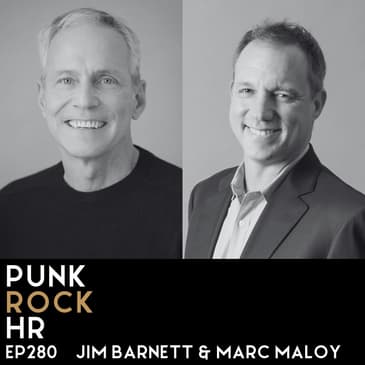
On this episode of Punk Rock HR, Laurie sits down with Jim Barnett and Marc Maloy of Wisq to explore this question. From their successful stint with Glint, where they became leaders in employee engagement, to their current mission at Wisq, Jim and Marc share how AI is opening up continuous, personalized coaching to a broader audience. This episode uncovers the pivotal manager-employee relationship and how AI can create a more dynamic and thriving workplace.
We'll also unpack the practical applications of Wisq, a groundbreaking AI tool that provides managers with personalized coaching and expert advice within platforms like Slack and Teams. By focusing on soft skills like trust, authenticity, compassion, and empathy, Wisq aims to transform managers into more effective and people-centric leaders. Jim and Marc passionately discuss how these skills can be developed with the right tools and mindset, ultimately creating better workplace dynamics.
Don't miss this deep dive into the evolving landscape of AI in leadership and management!
In this episode, you will hear:
- AI-powered coaching for managers: continuous, personalized support
- The importance of manager-employee relationships and enhancing workplace dynamics
- Introducing Wisq, an AI tool integrated with Slack and Teams for managerial coaching
- An emphasis on soft skills: trust, empathy, and a service-oriented leadership approach
- A discussion on whether good management skills are innate or can be learned
- AI's role in making difficult conversations easier and encouraging honest feedback
- Insights on the ideal customer profile for Wisq
- The impact of AI on managerial effectiveness
Resources from this Episode
- Visit the Wisq website: wisq.com
- Connect with Marc Maloy on LinkedIn: www.linkedin.com/in/marcmaloy
- Connect with Jim Barnett on LinkedIn: www.linkedin.com/in/jim-barnett-a5312
Follow and Review:
We’d love for you to follow us if you haven’t yet. Click that purple '+' in the top right corner of your Apple Podcasts app. We’d love it even more if you could drop a review or 5-star rating over on Apple Podcasts. Simply select “Ratings and Reviews” and “Write a Review” then a quick line with your favorite part of the episode. It only takes a second and it helps spread the word about the podcast.
Episode Credits
If you like this podcast and are thinking of creating your own, consider talking to my producer, Emerald City Productions. They helped me grow and produce the podcast you are listening to right now. Find out more at https://emeraldcitypro.com Let them know we sent you.
Powered by the WRKdefined Podcast Network.
[00:00:00] It's really the promise of AI. We, for managers, we, we don't, we don't, we don't have any desire to replace, you know, human coaches for managers, it's just the average. The average manager doesn't have a human coach, you know, a very small percentage
[00:00:16] of leaders and managers have human coaches. And even the ones that do only work with that coach on an average, a little less than twice a month. So the opportunity is for the AI to be ever present in our lives,
[00:00:31] continuously reminding us and nudging us and helping us along to be the best version of ourselves that we can be. Hey everybody, I'm Laurie Ruettimann and this is Punk Rock HR. In each episode, we take a realistic but slightly cynical approach to fix and
[00:00:49] work, bringing you raw and honest conversations with disruptors, innovators, and even random working people like you and me with one goal, to reshape the workplace as you know it. But sometimes we take a break from all that and talk about real life,
[00:01:05] like relationships and wellbeing and kids and animals. And along the way, we drop a few F-bombs too. Whether you're an HR professional trying to do the right thing, a leader looking to connect with their people or just fascinated by workplace dynamics, this is your destination to fix work.
[00:01:24] Once and for all. This week's episode is sponsored by WISQ, W-I-S-Q, an AI guide for managers that develops effective and inspirational leaders. More than just training, WISQ delivers personalized manager coaching, real time guidance, and expert advice resulting in more engaged and successful teams.
[00:01:47] My guests today are two of WISQ's leaders, Jim Barnett and Mark Malloy. They're legends in the HR tech space and they're on the show today to discuss leadership, why the manager employee relationship is pivotal, and where AI intersects with all of this.
[00:02:03] For more information, you can visit WISQ.com, but for now, sit back and enjoy this fun and interesting conversation with Jim and Mark. Hey fellas, welcome to the podcast. I've got two of you on today, so I'm a bit of an air traffic controller.
[00:02:23] So we'll start with you, Mark. I'm so glad you're here. Why don't you tell everybody who you are and what you're all about? Hey everybody. My name's Mark Malloy. I live in Salt Lake City, Utah, four kiddos with my wife, Erin.
[00:02:38] And I'm really passionate about building interesting companies that help people thrive and flourish at work. Lovely, lovely. And Jim, you're a partner in crime here. So what do you do? What are you all about?
[00:02:52] Well, what I love to do is help people be happy and successful at work. That's sort of been my life mission for quite some time now. And Mark and I started working together at Glint, and so we've been partnering for over 10 years. Wow.
[00:03:07] Well, who wants to tell that story? Because I love a good partnership story. How'd the two of you meet? And, you know, tell me like that Batman origin story. Who's got that? Well, I can tell you how we found Mark, and then maybe Mark can fill in
[00:03:20] and say why, why it worked. So actually one of our investors said there's this incredible leader. And we were looking for someone to lead the sales team to the next level and grow, grow our revenue. And they recommended Mark and we got together the first time and started
[00:03:37] completing each other's sentences around culture and HR and the importance of building and sharing beautiful software. And so we partnered together to build Glint into really an industry-wide company best practice around listening to employees. And Mark, I know, you know, a love story has two sides.
[00:03:58] So what's your side of this? Yeah. So I met Jim, I was a customer of Glint when I was running revenue for a company called Instructure and Instructure is the major company in And Instructure is the maker of the software platform Canvas that helps,
[00:04:18] you know, students be successful in school K 12 through higher ed. You know, as a customer, we used to do a quarterly pulse and we took it really, really seriously at Instructure to where you would report out your
[00:04:34] results to your peers, to your team, to your company, et cetera. And then I got a, it was a pretty random phone call from Jim one evening. He's like, you know, gosh, sorry for calling out of the blue, but I just had
[00:04:50] dinner with Christina Shen and Byron Dieter over at Bessemer and they mentioned you and I had to give you a call right away. When are you going to be in the Bay area next?
[00:05:00] And so I, I happened to be going to the Bay area within the next two weeks. And we had, we went out and had dinner together and I think we were scheduled for an hour and a half.
[00:05:10] And I think we went two hours and two hours and a half and had just a fantastic time and I was like, okay, I can learn a lot from this guy and I can't wait to get started.
[00:05:21] And one thing led to another and it was the start of a really, really fun partnership and friendship. Well, that's really wonderful. And Jim, I wonder if you could talk a little bit about Glint.
[00:05:29] I mean, it's an industry example of just what a great company has done in the world, but can you tell us a little bit more about it and what was its trajectory? What happened to it? Our initial vision with Glint was actually pretty simple.
[00:05:43] You know, we just, we just had this vision myself and my co-founder, Gotham Kura, we had this vision, like what if, what if we could give managers a dashboard for their teams? It's like CEOs and managers had dashboards for everything else, you know, sales,
[00:05:57] productivity, engineering, productivity, marketing, scoring, et cetera. And, but there's no doubt. Everyone says people are the most important part of your, your, your organization, but they never really had dashboards for the health of their people. And I said like, what if we could create a real-time dashboard
[00:06:15] for the health of your team? And that was really the beginning of Glint. And of course we later discovered that there was an industry called employee engagement that we stumbled our way into, but at the time it was pretty
[00:06:28] much a do a long survey and then a few weeks later, you're going to get a PDF email to the CHRO. And we said, well, that's crazy. If the people who actually drive engagement at a company are all the line
[00:06:43] managers throughout your organization and all the employees, let's actually give them the dashboards for their teams. So the radical sort of idea was how about real-time dashboards for managers instead of a PDF to CHRO?
[00:06:59] And that, that led to a lot of change in the industry and a lot of, a lot of growth in the industry. I feel like people don't appreciate just how bad things were in the old days. And Mark, you can probably understand where I'm coming from, from this
[00:07:11] perspective, I mean, back in the old days, Jim, you were right, there were just surveys and we just made a lot of wild assumptions and once we started really putting some rigor around the data, not only were we able to empower
[00:07:24] HR, but we were able to empower managers and leaders and Mark, I would love for you to pick up the story there because Glint was really just a leading edge in this and really at the vanguard of something really cool about this. It really was.
[00:07:38] I mean, Glint was a fantastic company and it had a fantastic culture. And I think, you know, what it, what it allowed people to do for the very first time is it, you know, at the highest level, it's a great diagnostic, it's a
[00:07:55] great action planning platform too, but it fell a little bit short, honestly, in action taking. And so we kind of interwoven some of these concepts that we learned at Glint for our new startup with regard to kind of this intersection of learning plus engagement, plus coaching.
[00:08:18] And so, you know, in some, in some ways we've got a lot of the same team members from Glint building WISC with us now. And in a lot of ways it's, it's almost like a Glint 2.0, but it's not really focused on engagement. It's really focused on effectiveness.
[00:08:33] Well, I'm so glad you gave us that segue because it's really important. We're here today to talk about building a new future of work, right? And really rethinking the world of work. And that history lesson is important because if we keep doing the same
[00:08:47] things over and over again, we make no progress. And so you're both here today to talk about your new startup and Mark, why don't you pick up the story and tell us a little bit about what you're doing today? Yeah, sounds great.
[00:08:59] So our company is called WISC and it is kind of in the intersection or the braiding of learning plus engagement through a nudging engine, plus coaching. And now that we have large language models, you can build on top of those
[00:09:16] an incredibly differentiated product that really helps people be happier and more effective at work. I mean, the truth is, is that managers have such an incredibly disproportionate impact on engagement, team morale, happiness, productivity, creativity, innovation, and when you have a lousy manager, it's awful.
[00:09:41] And when you have a great manager, that manager creates a halo effect around him or her. And it leads to just an incredible experience for both the people on the team, the cross-functional partners.
[00:09:55] And Jim and I thought to ourselves, okay, well, how can we make a really big impact for companies by doing something in service of managers? And that's what WISC is. Jim, I'm often accused of having software executives on the show and they never
[00:10:08] actually say what their software does. Like how's it work? What do they do? How does it all come together? So if somebody is a customer of WISC, exactly what are they buying? What, what is it? Well, WISC is an AI guide for managers. It was designed for managers.
[00:10:26] And what that means is it gives personalized coaching, guidance, and expert advice on really any topic that they might have a question about. But we've gone beyond that. We built things like guides that give structured conversations. So there's, you know, a number of skills that managers should have.
[00:10:48] That unfortunately not all managers have. And we've built guides for each one of those. So if a manager decides that they're not particularly good at say recognition or one of these 12 skills, they can use the guide to help them improve their skills in that area.
[00:11:06] Well, I love that. Why focus on the manager? You could have done anything Jim when building a new product, right? You're building anything, right? You can build anything in the world and you decide to build something for managers.
[00:11:19] So can you tell us why you picked the manager segment to really focus on and to develop rigor around and expertise? It really, as Mark says, sort of goes back to our Glint days. We could see through data the incredible impact that both good and bad managers had
[00:11:38] on their teams. And, you know, when we were, you know, Glint today is an important part of Microsoft Viva. But when we were leaving Microsoft and LinkedIn, you know, one of the things we reflected on was.
[00:11:54] We felt like in some ways we were keeping score more than we were actually driving impact for managers. And so part of it was we're passionate about managers and part of it, we felt like our job wasn't done.
[00:12:09] Like we actually are really passionate about helping managers be better managers. And, you know, with really the introduction of open AI and chat GPT, it really showed the world the promise that AI has in so many different areas.
[00:12:28] But we could we could see the promise that it had for helping managers be better managers. I love that perspective. And Mark, I want to talk to you a little bit about what makes a good manager before we even get to AI and LLM enablement.
[00:12:44] I think we first have to determine what the capabilities are for those individuals who are really driving change, driving culture, driving profit and revenue and all of that in our organization. So, Mark, what does make a good manager? You know, it's really interesting.
[00:12:59] The vast majority of managers become managers because they're incredible direct contributors in their role. And so they're very good at the hard skills associated with whatever the job is. And oftentimes, the only way that they're trained in the soft skills that are super
[00:13:17] critical to building thriving and flourishing teams is they do that because they themselves had a great manager and they were able to observe these behaviors. But it's really not been formal training.
[00:13:32] And it's tough to get this in the moment, in the flow of work, guidance and help to become really fantastic at the soft skills, which are the differentiating skills for the best managers in the world. So you'll hear things like the ability to build trust, authenticity, having compassion,
[00:13:53] empathy. I'm a huge believer in having a service oriented bent, but I think that's not the right word, service oriented bent in your personality because really your team is your customer as the manager.
[00:14:09] And when you view it like that, it really does unlock kind of this new gear and helping people thrive and flourish at work and helping them navigate their career paths. So I think it's a combination of these really critical soft skills that people just
[00:14:25] don't get into informal training in or learning in. And, you know, WISC is going to change that. Well, I'm excited for that. And Jim, I saw you nodding your head, especially around that servant bent. So what are you so excited about?
[00:14:42] Well, that's sort of my thing back to happiness. You know, there's been a lot of data around what leads to a happy life, but one of the things that can lead to a happy life is seeing your vocation or your life purpose as being
[00:14:54] in service of others. So that's probably why I was smiling. But I agree with what Mark said. And, you know, for me, the best managers are really good leaders. They inspire the people they work with.
[00:15:11] And the second thing I would say is one of the hard things, especially for new managers, is finding the middle way. So there are some skills that they need to develop. Empowerment and empathy are two examples of important skills for managers.
[00:15:32] But if you're too empathic or you're completely hands off, you've gone too far. On the other hand, if you're a micromanager or you're not empathic, you won't be a good manager either. So one of the things that make good managers good managers is they
[00:15:50] master the art of the middle way. I like that. And Mark, you're nodding your head to that. What do you have to say about that? I agree. The managers I have loved working with the most personally are very, very centered. They're not pushovers.
[00:16:06] They're not easy. They challenge you, but they make the journey super fun, super rewarding. You celebrate team success and you have a ton of fun doing it. But they do it in a kind of a calm, cool, collected, centered way. And that's where I personally thrive.
[00:16:24] You know, we are talking about manager training and manager development and really leadership training and leadership development. There is that old question of are you born with it or can you develop it? And I wonder if either one of you have an opinion on it.
[00:16:38] Who wants to take this question? Born with it or can you learn it? I'm super passionate about this. So. All right, Jim, it's yours. You can definitely learn this. Right. I mean, there are certain people that are born with sort of leadership talent that they have with them.
[00:16:59] But these are the kinds of things that you can definitely. I'm a huge believer in the growth mindset. You know, I wouldn't say anybody can be a good manager because some people just hate being a manager. It's just very stressful for them.
[00:17:12] But I would say that if you're committed to being a good manager, most people could be a good manager. Oh, I like that distinction that you made. If you're committed to it, if you're committed to the growth, if you're committed to the journey, you can pick it up.
[00:17:26] You can learn it. You can enable yourself to become more educated in that topic. That's that's a nice way to frame that. The one thing I wonder, though, is you both have talked about great leaders in your life who have modeled these behaviors.
[00:17:40] And yet what you're offering is an AI LLM solution, technology solution to teach people. So, Mark, I wonder, is technology the answer? Is that where we start with training managers? It's a chicken and an egg question, I guess, because how do you get good managers if you
[00:17:57] don't teach them? What are your thoughts, Mark? I think so. I mean, the way my brain works is if we just take a fictional company, let's just say it's a 10,000 person company.
[00:18:08] And we ask this question of what do we what do we do to support the people in the company? Well, if we laid it all out on a bell curve, what you're going to find is is
[00:18:20] the vast majority of these 10,000 people companies for one end of the bell curve, call it the high performing high potentials. We buy dedicated one to one coaching, your special high performance workshops, cohorts, training, etc.
[00:18:37] And then on the other end of the spectrum, oftentimes at any given time, five to 10 percent of the company are actually suffering and oftentimes clinically. So depression, anxiety disorder, substance abuse problems, etc. And what do we do for them? We buy EAP platforms like Spring, Modern, Lyra, etc.
[00:19:03] And then everybody else is this enormous middle. And what we do to help them is we do the workshops and the training and leadership development things. We buy learning management systems or LXPs. But what we're what we're learning is, is oftentimes those systems just aren't used and
[00:19:22] there's got to be a better way to infuse in the moment, in the flow and bite sized chunks of help and guidance for these gnarly problems that people just don't know how to navigate on their own.
[00:19:34] So I think the right way to think about WISC is it's an extension of how you help people at unbelievable scale and in the moment they need it. So it's not intended to replace the humaneness that makes us all human.
[00:19:50] It's really intended to just help them navigate this journey with almost like a 300 plus IQ robot sitting on their shoulder. I would like to talk a little bit about how it actually works again. That's all like when I hear from people who are like, Lori, love your podcast.
[00:20:07] You talk to this founder. How does this, how does it actually work? Like I'm a manager. How am I interacting with WISC? What's the experience like on a daily basis? Can you give a story or an example? Either one of you. Sure.
[00:20:22] Well, there are multiple ways that you can interact with WISC. One of the things we're excited about it is because it's literally in the flow of work. So you could interact with WISC and Slack or Teams.
[00:20:34] You could pick up your cell phone and interact through a mobile app. You can talk to WISC or you can type in at your desktop as well. And so what we find, what we find is that people ask WISC a really wide range of questions.
[00:20:54] It could be everything from I have a new hire and I'm not sure which designer to assign this new hire. It could be about setting expectations. It could be about a conflict they have. Could be an issue they have with their manager.
[00:21:11] Could be an issue similar to, you know, I notice that my manager regularly interrupts me in meetings, but I'm not sure how to give her or him that feedback. How might I do that? One of the most popular topics on WISC for managers is having difficult conversations. Wow.
[00:21:35] I wonder what it is about technology that gives people the bravery to start to dig in on that. I don't know, Mark, what do you think about that? It's really interesting. You know, there's a couple of studies done by the International Coaching Federation
[00:21:48] about using AI coaching and guiding versus human to human. And one of the things that really sticks out to me is that people are more truthful because they feel safer. They don't feel that they're judged. Or even existential topics. Yeah, speedy topics.
[00:22:05] And so it turns out that when you're able to deliver the coaching construct or the coaching conversation in the moment when it's fresh for someone as opposed to holding it, putting it on your agenda for your next conversation with your human coach or your human mentor,
[00:22:22] you're able to deliver that conversation in a way that's more engaging. It unlocks this kind of new gear of playing around with AI, using it to kind of help you navigate your day, helping you get more creative, more productive.
[00:22:37] It turns out that people generally are very, very truthful with it. And as Jim mentioned, navigation of difficult conversations is one. And one that's coming up constantly is growing the careers of others too. Like just thinking about how do I get to the next level?
[00:22:53] How do I, you know, what's the right format? How do I standardize it? What are the correct ways to do this? And so it's pretty fascinating how quickly the platform is learning and it's becoming pretty incredible for people. Wow, that's amazing.
[00:23:07] So tell me a little bit about your current customer experience. So you're a customer service manager. You're a customer service manager. You're a customer service manager. You're a customer service manager. And you're a customer service manager. And you're a customer service manager.
[00:23:21] So tell me a little bit about your current customers and who this is a good fit for. Like who uses Wisk and who do you want to buy Wisk? Like who's your target customer? Our ideal customer right now is,
[00:23:35] we think it's kind of this lower end of mid-market. So, you know, maybe a thousand to 5,000 employee companies that are people centric organizations. Oftentimes they'll be in technology, consulting, financial services, et cetera. We do have customers on both ends of the spectrum though.
[00:23:54] We've got several pretty large enterprises kicking off interesting proof of concepts with us for very large populations of people. And then we have what I would call higher end SMB customers, you know, a hundred to 200 employee companies. But I would say the people centricity component,
[00:24:14] like if you really want to help your company help itself, then focus on the manager. The manager is the biggest lever for every single company in the world. You make them incredible and you've got a better shot at hitting your vision, your mission, your value.
[00:24:30] Well, it's really interesting how you've narrowed in on your ideal customer, your ideal partner as someone who's people centric. And it gets to this idea of culture which kind of comes and goes. It's in vogue, it's not in vogue. People are talking about it.
[00:24:44] They're not talking about it. But what is culture if not really prioritizing the needs of your workforce? So do you still use that word, Jim? Do you use the word culture these days or is it out of your vocab? Oh, it's completely in my vocab.
[00:24:58] I use the word culture all the time. I think it's just so critical to the success of most companies. You know, I cringe sometimes because in the press and in the outside world, sometimes we see leaders behaving badly and doing things that are inconsistent
[00:25:20] with building a people centric, authentic conscious culture. And they're successful despite that, unfortunately. And so I think they set really bad examples. But the good news is we have plenty of positive examples as well and of companies run by great leaders that are committed to their people
[00:25:41] and developing their people. And those are the ones that we focus on and tend to be interested in the types of products that we create. Sure, I see you nodding your head, Mark. Any thoughts on that? Yeah, I mean, I couldn't agree more.
[00:25:56] Like we have some of these examples of what we would call a hard nose culture. You know, I'm here to hold you accountable and that's my job. And in some of those companies, very few, albeit, are successful. But it doesn't sound fun to me.
[00:26:14] And you know, life is about enjoying this journey. And for me personally, doing things with people you love doing things with, like building companies and helping people thrive is super fun and it's super rewarding. And I wouldn't have it any other way. I wouldn't wanna be like autocratic,
[00:26:35] dictatorial, charge, take the next hill. My job is to manage your energy and hold you accountable. No, my job is to build a bridge between your individual reason for doing this and the company reason. And that bridge is really what purpose is all about.
[00:26:51] And I enjoy doing it. Well, as we start to wrap up the conversation, we can't leave without really addressing AI and where things are going right now. I mean, we're at a very pivotal point. I mean, there's announcements about AI every single day,
[00:27:09] the development of platforms, layoffs, right? Thoughts from CEOs, thoughts from world leaders. It's just a crazy world. But when it comes to enabling managers, I know you both have a POV. So where is this all going? I know you're both very bullish on where this is going.
[00:27:28] Maybe Jim, share your thoughts on where you see that intersection of AI and managers headed. Yeah. When I think about it, there's really two profound areas that AI is going to impact the life of managers. One is in terms of productivity
[00:27:46] and the ability to just accomplish a great deal more. So it's helping managers do their jobs as well as helping employees do their jobs. So that's probably the most obvious one that people talk about more frequently. We're really more focused on helping managers
[00:28:05] be better at doing their jobs. As Mark talked about, the soft skills, we're building more of what you might think of like a management operating system to help managers execute better on their job and grow and learn. And that's really the promise of AI.
[00:28:24] We talked a little bit earlier about whether sort of management is a born or learned skill. And I think the challenge historically has been that either managers get no training or they go off to a week of training and now we expect them to be managers.
[00:28:43] But that, the analogy I like to compare it to, that's sort of like looking at professional athletes and expecting them to go to tennis camp or basketball camp for a summer and come back and win the US Open or the NBA finals, right?
[00:28:56] The truth is that they have a team of coaches that they work with continuously throughout their careers to achieve excellence. And I think that's really the promise of AI. For managers, we don't have any desire to replace human coaches. For managers, it's just the average manager
[00:29:19] doesn't have a human coach. A very small percentage of leaders and managers have human coaches. And even the ones that do only work with that coach on average a little less than twice a month. So the opportunity is for the AI to be ever present in our lives,
[00:29:36] continuously reminding us and nudging us and helping us along to be the best version of ourselves that we can be. Really well said. Mark, what are your thoughts on this moment of convergence that we're having around the world of AI in business?
[00:29:50] I think we have an incredible decade ahead of us. It's gonna be absolutely fascinating to see how this all unfurls. Just to build off of what Jim mentioned, I think it's gonna usher in a new era of productivity. I think it's gonna help humans get more creative,
[00:30:08] more innovative. It's gonna save us time. It's gonna help us see things that we might not otherwise see. Our strengths, our weaknesses help us better understand ourselves. And I think there's gonna be something really cool that happens, especially in traditional learning, tutoring.
[00:30:27] We see some just incredible use cases of how AI is already additive to society. And I think what we're seeing is we kind of have this concept of, there's pilots and passengers right now. If you're in the pilot seat, you're experimenting with it, you're learning,
[00:30:46] you're having fun, you don't view it as scary. And if you're kind of in this passenger seat, you're a little worried about it. You're worried, how is this gonna impact my job but I'm not gonna experiment and play. And there's gonna be two really different population types
[00:31:03] between those two distinctions. And I would say the vast majority of the CHROs I talk with are really in the R&D mindset right now. They're thinking of them and their cultures and their people. Like my job is to do research, development,
[00:31:19] learn about how we might use AI to be more effective in our company and help our people. And it's just fascinating time to be in this business. Well, I have to tell you, I'm both a passenger and a pilot. I actually feel like a fighter pilot
[00:31:36] and I'm both petrified and also in it, committed to winning but they're taking a lot of flack right now. So it's a crazy world out there but I'm so pleased to have you both on the show to talk about WISC, to talk about your perspective in the marketplace.
[00:31:52] And if people want to learn more, I'll ask both of you and I'll start with Jim. Jim, where should they go and how should they connect with you? Thank you so much. Well, they can either go to wisc.com, W-I-S-Q.com
[00:32:05] or they can connect with me on LinkedIn. Well, we'll make sure we have your LinkedIn link and all that stuff in the show notes. And Mark, how do you prefer if people wanna reach out and learn more about WISC or your journey, where should they go?
[00:32:18] I personally respond to every demo request on our website and I commit to doing that in the day they click it. So that's probably the best way and then just send me a LinkedIn invite. Love it. We will make sure we have all the good stuff
[00:32:32] in the show notes and I wanna thank you both again for being a guest today. Thanks so much. I really enjoyed the conversation. Thank you. Great. It was fun. Hey everybody, I hope you enjoyed this episode of Punk Rock HR.
[00:32:46] Show notes and more can be found on punkrockhr.com. This episode was expertly produced by Emerald City Productions and we would all appreciate it if you left us a five-star review. So go to wherever you stream your podcasts like Apple or Spotify or iHeartRadio
[00:33:05] and leave that five-star review and your thoughts on the episodes themselves. Now that's all for today and I really hope you enjoyed it. We will catch you next time on Punk Rock HR.
Sponsors
