
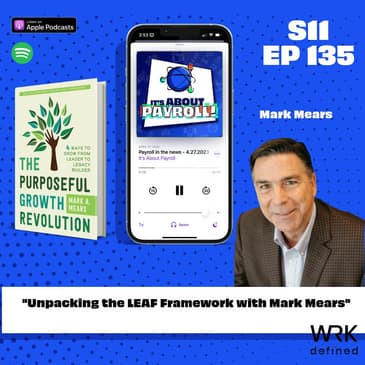
In this engaging podcast episode, hosts Brian and Walt dive into a discussion on innovation, engagement, and fulfillment with their guest, Mark Mears. Mark, a seasoned business leader with over 20 years of experience at top-tier companies, introduces his book 'The Purposeful Growth Revolution: Four Ways to Grow from Leader to Legacy Builder.' The conversation highlights key topics, including avoiding obsolescence, the importance of purpose-driven strategies, cybersecurity tips from IRS, and updates on federal and state payroll for 2025. Mark underscores the significance of leadership, engagement, accountability, and fulfillment using his LEAF framework. Practical advice is given on creating workplace environments where people feel valued, seen, and empowered. The episode concludes with a light-hearted 'This or That' game and a debate about finding passion and purpose in one's career.
00:00 Introduction and Purpose
00:15 Special Guest Introduction
00:47 Listener Appreciation
01:42 News and Updates
03:16 Cybersecurity Tips
09:03 Sponsor Shoutout
11:28 Introducing Mark Mears
13:04 Mark Mears' Journey
17:12 The Concept of Branding
27:58 Servant Leadership in the C-Suite
38:40 The LEAF Framework
46:43 The Leaf Metaphor: Leadership and Growth
48:18 The Higher Power of Fours
49:19 The Four C's of Leadership
49:54 Accountability and Innovation
50:47 Fulfillment and Environment
51:47 The Role of Business in Society
52:25 The Power of Purpose and Profit
55:16 Overcoming Fear, Uncertainty, and Doubt
59:55 Transformational Leadership
01:04:54 The Importance of Listening and Observing
01:08:56 Valuing and Empowering Your Team
01:14:33 The Future of Human Resources
01:15:06 Fun and Personal Insights
01:22:56 Final Thoughts and Gratitude
Powered by the WRKdefined Podcast Network.
[00:00:00] Brauchen wir wirklich noch einen Computer? Alle wahrscheinlich nicht. Aber wenn du Musik mit der Power eines Neuralprozessors neu erfindest oder unterwegs Migrationsmuster mit einem ganztägigen Akku analysierst oder deine Ideen mit dem KI-gesteuerten Co-Creator zum Leben erwächst, dann kann ein Co-Pilot Plus PC einen Unterschied machen. Nicht alle brauchen einen leistungsstärkeren KI-Computer. Aber wenn du versuchst, die Welt zu verändern, auch wenn es nur deine eigene ist, haben wir einen für dich entwickelt. Microsoft Co-Pilot Plus PC mit Snapdragon. Die bisher schnellsten und intelligentesten Windows-PCs. Die Akkulaufzeit variiert je nach Nutzung und Einstellungen.
[00:00:30] Who can we study that's going to help us do what we currently do, the best of our ability, and then obsolescence, which you want to avoid by innovation?
[00:00:38] Seeing around the corner to say what's next so we can keep this train moving. Does anyone know what happened to Blockbuster Video?
[00:00:45] Welcome back, folks. We got a very special episode today. We have an amazing guest that I came across really by accident, but as he would say, no coincidence.
[00:00:56] But before we get into all that, how you doing, Walt?
[00:01:00] I am good, my brother. I cannot complain. I'm still feeling grateful from the holidays.
[00:01:07] No doubt.
[00:01:08] Glad to be here, man. Glad to be here with you. Glad to be connected with Mark today.
[00:01:13] And I'm grateful for our listeners.
[00:01:15] Yes.
[00:01:16] We tell that to you people that are listening to us, wherever you're at in the U.S. or across the globe.
[00:01:25] We appreciate you and we're grateful for you.
[00:01:27] So I just wanted to say that.
[00:01:29] How about you, Matt? How are you doing?
[00:01:30] Absolutely. No, I like that. I just want to say we do love you. It's no joke. It's the few of you.
[00:01:36] Not enough. I wish more of you would reach out on LinkedIn.
[00:01:39] And even if you got a complaint, like we want to hear the good, the bad, the ugly.
[00:01:42] We want to make this show better.
[00:01:43] And it's those little tidbits that push us through because we have full-time jobs.
[00:01:50] This is not our, this is a passion for us.
[00:01:52] And yeah, we love you. Thank you so much for keep listening.
[00:01:55] We see you. Thank you.
[00:01:56] Today's guest is named Mark Mears.
[00:01:59] He wrote this great book called The Purposeful Growth Revolution.
[00:02:03] Four Ways to Grow from Leader to Legacy Builder.
[00:02:07] Again, really great. We'll get into more of that and hear all about them.
[00:02:12] But before that, man, let's get into some news.
[00:02:15] Yes, let's do it. Mine's going to be short and sweet.
[00:02:19] And I want to preface anything that I say by validate and check any resources that we give you.
[00:02:25] Fact check it.
[00:02:27] Go to the official websites of any agency.
[00:02:30] Go to pay.org.
[00:02:32] Go to the irs.gov, your state site, whatever it is.
[00:02:36] To find out this information.
[00:02:38] But I found a site called onpay.com.
[00:02:43] And they had some federal and state payroll updates for 2025 that they're listing out there.
[00:02:49] I'm not going to go through all of them.
[00:02:50] They talk about the health FSA limit increasing.
[00:02:54] Okay.
[00:02:55] From 3,200 to 3,300.
[00:02:58] Oh, nice.
[00:02:59] Individual HSA limit is increasing from 4,150 to 4,300.
[00:03:04] Different things like that in there that they break down.
[00:03:07] And they have a map on the screen of the United States that you can click on your state.
[00:03:13] And it will tell you if any updates are happening in your state or on the horizon for 2025.
[00:03:18] So it's onpay.com.
[00:03:20] The link will be in the show notes.
[00:03:21] Just wanted to share that.
[00:03:22] And it's one of the many tools that we have out there.
[00:03:25] Yeah.
[00:03:26] Shout out to Christina.
[00:03:28] Her team over at Valor.
[00:03:29] She also has a great resource accessible for you and others.
[00:03:33] Check it out.
[00:03:34] Oh, dope.
[00:03:35] Love it, man.
[00:03:36] Thank you.
[00:03:37] Mine is coming from irs.gov.
[00:03:40] They put out, I'm on their email subscription, their email feed.
[00:03:44] And this is one of the tips that they sent out.
[00:03:46] And we always talk about cybersecurity, scams.
[00:03:50] We did it last year.
[00:03:51] And we'll do it every year because this is the holiday time is when scammers and hackers,
[00:03:56] and they really ramp up their efforts because folks are in the giving mood,
[00:04:02] but also not paying attention enough.
[00:04:04] They're overwhelmed with work and shopping and cooking and this and that and all the things
[00:04:09] that are happening during the holiday season.
[00:04:11] Oh, wait, I got my big eyeglasses on.
[00:04:13] Hold on one second.
[00:04:15] Can I add something there, Brian?
[00:04:16] Absolutely.
[00:04:17] Of course.
[00:04:17] A lot of times, especially for those of us in the U.S. or even maybe across the globe
[00:04:23] that may live paycheck to paycheck during the holidays is when we consume and buy a lot.
[00:04:30] Right?
[00:04:30] Yeah.
[00:04:31] A lot of people get loans, pay their advances.
[00:04:35] Oh, yes.
[00:04:35] And so when you sign up for those services, you get a lot of noise and you may click on
[00:04:42] something saying, oh, you're approved.
[00:04:43] Yes.
[00:04:44] If you, especially if you apply through some site that doesn't have all the bells and
[00:04:47] whistles and security in place and, you know.
[00:04:50] I'm so glad you're saying all that.
[00:04:51] You know what I'm saying?
[00:04:51] Like you can click on one of those things and next thing taking you for the little bit
[00:04:55] that you do have.
[00:04:57] Right?
[00:04:57] Yes.
[00:04:57] So just be careful about that.
[00:04:59] And you bring up something important as well for folks who can't do anything monetarily
[00:05:06] this season and may feel bad and click on that.
[00:05:10] Oh my gosh, I could afford that.
[00:05:11] Oh wow.
[00:05:12] And again, like I think I probably speak for us both that where we, there were Christmases
[00:05:18] and we couldn't do anything.
[00:05:20] You know what I mean?
[00:05:20] You're getting hugs this year.
[00:05:22] You know what I mean?
[00:05:22] Like we've been there, I've done that.
[00:05:24] And because of that, I, me and my wife have tried to like make it all conservative, make
[00:05:29] it very purposeful.
[00:05:31] No pun intended for all of us out there.
[00:05:33] But for those who are shopping and online and things like that, IRS put out safety tips
[00:05:39] to remember during the holiday season and throughout the year, right?
[00:05:43] Time of year for online shopping.
[00:05:45] The security summit reminds taxpayers of some important steps to protect themselves and their
[00:05:50] information from data thieves.
[00:05:53] Just like Wolf said, shop at online sites with the web addresses that begin with HTPS.
[00:05:59] The S stands for secure communications.
[00:06:04] Okay.
[00:06:05] Also look for a padlock icon in the browser window.
[00:06:09] Okay.
[00:06:10] Don't shop on unsecured public wifi in places like a mall or a restaurant.
[00:06:16] Ensure security software is updated on computers, tablets, and mobile phones.
[00:06:22] Watch out and help protect devices of family members who may not be technologically savvy.
[00:06:27] And that goes from young children to older adults to maybe you.
[00:06:31] I used to be really savvy once upon a time, but I feel it slipping away because the technology
[00:06:36] is just going way faster than that we can all keep up with.
[00:06:39] Make sure antivirus software for computers have a feature, stop malware, and that there's
[00:06:45] a firewall enabled to prevent intrusions.
[00:06:47] If you don't know what these things are, take the time and look them up.
[00:06:51] Okay.
[00:06:51] Use strong, unique passwords for online accounts.
[00:06:56] Use multi-factor authentication whenever possible.
[00:06:59] So glad that they got rid of the two, two, two fat, two FA.
[00:07:02] Like you couldn't say it, right?
[00:07:03] Two factors.
[00:07:04] And then simple, simple steps that can protect taxpayers as well.
[00:07:08] Because right after the holiday season, what is it?
[00:07:11] It's time to prep for taxes, right?
[00:07:14] For most folks, they're starting to think about the next day.
[00:07:16] Ooh, April 15th is going to come.
[00:07:18] Um, so that's a few things for that is look out for phishing or they even said smishing,
[00:07:24] phishing emails or SMS text messages.
[00:07:26] No, that's smishing.
[00:07:27] Ooh, a new word.
[00:07:28] Here we go.
[00:07:28] See?
[00:07:29] So I just learned this now.
[00:07:30] Clicking on, and my mom always calls me with these things.
[00:07:33] Oh, they're calling me.
[00:07:34] And I'm like, don't touch it.
[00:07:35] Don't do anything.
[00:07:36] Spear phishing.
[00:07:37] This is a specific type of phishing scam that bypasses emailing large groups at organizations
[00:07:43] instead of identifying potential victims and delivering a more realistic email known as
[00:07:48] a lure.
[00:07:49] Okay.
[00:07:50] And this, I will shout out to my, to finance folks, payroll folks, HR folks, because if
[00:07:57] they think you have the keys to the register or any access to the money, they are going
[00:08:02] to spear phish you.
[00:08:03] Okay.
[00:08:05] Clone phishing, a newer type of phishing scam that clones a real email message and resends
[00:08:10] it to original recipient, pretending to be the original sender.
[00:08:15] Folks, they're getting really sophisticated.
[00:08:19] And again, yep.
[00:08:20] Again, shout out to splunk.com, S-P-L-U-N-K.
[00:08:24] They have a free download manual book that goes into the top 50 methods that these hackers
[00:08:31] will take to do this.
[00:08:33] And then the last one is called whaling.
[00:08:35] Whaling attacks are very similar to spear phishing, except these attacks are generally
[00:08:39] target to leaders or executives with access to large amounts of information.
[00:08:46] This is probably the C-suite organization or business.
[00:08:48] Whaling attacks can target people in payroll offices, human resource personnel, and financial
[00:08:54] office.
[00:08:54] So I take that, but I stand corrected.
[00:08:57] Whaling is the one that they're going after us for.
[00:09:00] So please, this will be in the show notes.
[00:09:03] Yeah.
[00:09:04] Go copy it.
[00:09:05] Go look at it.
[00:09:05] Right?
[00:09:05] Just a little tidbit that, that will help us get through the season, both holiday and
[00:09:10] the tax season.
[00:09:11] And there are a bunch of helpful links here.
[00:09:14] If you get, if you feel like you've been a victim, there's links that you can go and report
[00:09:18] this and put it on the radar because you want to give the authorities as much data as they
[00:09:23] can to try to figure out who's doing the attacks.
[00:09:27] Yep.
[00:09:27] Yeah.
[00:09:28] That was all I had for the right.
[00:09:30] Yeah.
[00:09:31] Yeah.
[00:09:31] Let's pay the bills, man.
[00:09:32] I'm crazy.
[00:09:33] It was cool.
[00:09:33] Yeah, man.
[00:09:34] Shout out to TimeTrackGo.
[00:09:35] It got me excited.
[00:09:36] I was like, wow, this is really good information.
[00:09:38] That's great.
[00:09:39] I get excited with the info, sharing the info.
[00:09:41] We got to share it, man.
[00:09:42] Shout out to TimeTrackGo.
[00:09:44] If you're tired of messy timesheets and complicated time clock software, TimeTrackGo is an intuitive
[00:09:51] solution that makes managing employee hours simple and efficient.
[00:09:55] But don't take our word for it.
[00:09:56] Customers have given TimeTrackGo a 4.7 out of 5 stars on Capterra, and they have been awarded
[00:10:04] badges for best ease of use and best customer support again in 2024.
[00:10:10] That's right.
[00:10:11] Again.
[00:10:11] And here are a few things that the customers are saying.
[00:10:15] Great value.
[00:10:16] Best clock in app on the market.
[00:10:19] Great time clock for the modern office.
[00:10:22] Intuitive and efficient.
[00:10:24] Simple to use.
[00:10:25] Priced right.
[00:10:26] And customer support is awesome.
[00:10:31] Nice.
[00:10:32] So to learn more about a simply better solution for time tracking, real-time reporting, PTO
[00:10:37] automation, those payroll integrations that we all love, or more, you want to go visit
[00:10:43] www.timetrackgo.com.
[00:10:47] That's T-I-M-E-T-R-A-K-Go.com.
[00:10:52] And start your 14-day free trial today.
[00:10:57] Let's go.
[00:10:58] Let's go.
[00:10:59] Also, look out for their doing now.
[00:11:03] They're hosting webinars more often.
[00:11:05] So look out for that.
[00:11:06] Go on to their LinkedIn page because they're starting to host more webinars where folks
[00:11:10] can jump on and just learn more about the app without having to go through the trouble
[00:11:15] of booking a day and hit my calendar and do these things.
[00:11:18] Right?
[00:11:18] It's annoying sometimes to make these appointments.
[00:11:20] And even though you need it, you're like, oh, I got to go jump through these hoops.
[00:11:24] Right?
[00:11:24] When you want to just maybe jump on sometimes and let me look, no pressure, no salespeople
[00:11:29] beating down your door.
[00:11:30] And honestly, the folks over there are family.
[00:11:33] They're great.
[00:11:33] It's not even that type of environment with them, like with the sales and all that is there.
[00:11:38] Again, the customer support, the 4.7 out of five, all the things that customers are saying.
[00:11:43] We know it firsthand before we even got involved with them like that.
[00:11:47] We pressure tested the app.
[00:11:49] We, you know, we look point.
[00:11:51] We did try to break it and ask questions and all that.
[00:11:54] And then they came on the show and then they were great guys.
[00:11:58] We're still, again, very in touch with them and talk to them all the time.
[00:12:02] And you got to go take out the show that we do because I always talk about the wooden time
[00:12:06] clocks.
[00:12:07] Yeah.
[00:12:08] So as we move on today, folks, super excited.
[00:12:11] Today, we are thrilled to welcome Mark Mears to the podcast.
[00:12:16] Mark is a visionary business leader and self-proclaimed growth junkie with over 20 years of C-level
[00:12:24] leadership experience at world-class brands like PepsiCo, McDonald's, Frito-Lay, JCPenney,
[00:12:32] NBC Universal, and the Cheesecake Factory.
[00:12:35] Mark is passionate about transforming workplace dynamics during what many call the great resignation.
[00:12:42] He challenges us to reframe this period as the great repurposing.
[00:12:47] Leveraging purpose-driven strategies to reignite engagement, drive innovation, and cultivate
[00:12:54] meaningful growth across teams and organizations.
[00:12:58] As the author of the bestselling book, The Purposeful Growth Revolution, Mark introduces
[00:13:04] us to the transformative power of his LEAF framework for leadership, engagement, accountability,
[00:13:13] and fulfillment, helping individuals and organizations unlock their true potential.
[00:13:19] We can't wait to dive into Mark's insights and explore how to embrace purpose to achieve
[00:13:25] great things together.
[00:13:27] Welcome to the show, Mark Mears.
[00:13:30] Thanks for joining us today.
[00:13:33] How are you doing?
[00:13:34] Before we get into everything, give us a little bit about yourself and how you got to this point
[00:13:39] and we'll dig into the book a little bit.
[00:13:41] First of all, Brian and William, it's so great to be with you and appreciate the opportunity
[00:13:47] to have some good conversation and some fun along the way.
[00:13:50] I like to keep things light and give people a little something to smile about as well.
[00:13:57] And your first question certainly is a loaded one.
[00:14:00] How much time do we have?
[00:14:02] We got a little bit of time.
[00:14:03] I think, look, the way I've heard you speak already, I believe that you can craft a great
[00:14:10] answer in a short amount of time.
[00:14:12] All right.
[00:14:12] I think you got something about a marketing background.
[00:14:14] I think I heard about.
[00:14:15] A little something like that.
[00:14:17] But it didn't start out that way.
[00:14:19] I grew up in Wichita, Kansas and Northgate University of Kansas and thought I was going
[00:14:24] to be a lawyer.
[00:14:25] Oh, wow.
[00:14:26] And so you can't major in pre-law.
[00:14:29] So I asked her, your honor, and said, well, what would be the right curriculum to prepare
[00:14:33] me?
[00:14:34] Not only to get in law school, but succeed there as well as a lawyer after that.
[00:14:39] And they said, you're going to do a lot of reading, a lot of research, writing, presentations,
[00:14:46] and really a lot of critical thinking.
[00:14:47] I said, okay, great.
[00:14:48] Sounds good.
[00:14:49] But what curriculum should I look to enroll in at KU to prepare me for that?
[00:14:54] I said, have you thought about the school of journalism and mass communications?
[00:14:58] And I said, no, tell me more.
[00:15:00] And they said, well, you're going to do a lot of those things there.
[00:15:03] So I got into the school of journalism and mass communications.
[00:15:06] I did really well.
[00:15:07] I was enjoying my marketing communications side of it on the mass communications more than
[00:15:12] the news editorial side.
[00:15:13] Not that there was anything wrong with that.
[00:15:15] That just wasn't what interested me.
[00:15:18] It was really about crafting communications based on the way people think and act.
[00:15:24] And I thought that was cool to bring psychology into communications.
[00:15:29] One thing led to another.
[00:15:31] And one of the professors I had was Dr.
[00:15:34] Tim Bengston, who became a mentor of mine and saw something in me that I didn't see in
[00:15:38] myself.
[00:15:40] He said, hey, are you sure you want to be a lawyer?
[00:15:42] I think he'd really be good in marketing.
[00:15:45] And I said, oh, no, I'm just doing this to get into law school.
[00:15:49] But I went out and talked to people that were either in law school, maybe recently out.
[00:15:53] Some even had their name on the letter.
[00:15:56] Nobody was having any fun.
[00:15:58] And nobody was encouraging me.
[00:16:00] So I set up another appointment with Dr.
[00:16:03] Bengston and he said, tell me more about this grad school.
[00:16:07] And he said, there's some really good schools.
[00:16:09] I think you should go to Northwestern.
[00:16:11] I asked him a couple other professors.
[00:16:13] And they said, Illinois has got a good program.
[00:16:14] Texas has got a good program.
[00:16:16] And I got into all three.
[00:16:18] And Northwestern was my top choice because it's still to this day, the very best program
[00:16:26] for marketing communications.
[00:16:28] As a matter of fact, the next mentor was a Dr.
[00:16:31] Don Schultz at Northwestern who came up with the concept of integrated marketing communications,
[00:16:37] which is now shortened to IMC.
[00:16:39] And there's programs literally all over the world that have IMC programs.
[00:16:43] But I was able to learn at the feet of the master when it was just taking shape.
[00:16:49] And that then got me into marketing and became the foundation for my kind of ethos or how I
[00:16:58] viewed building teams and building brands.
[00:17:02] And I always say that in that order because I love building teams, because if you don't have a good team,
[00:17:07] you're not going to build a great brand.
[00:17:10] And Dr.
[00:17:11] Schultz vision for integrated marketing communications wasn't just looking externally at what the guest
[00:17:17] or customer sees or client sees if you're being to be.
[00:17:22] It was the internal brand.
[00:17:24] Because again, if you don't have a strong internal brand, the rest of it could be a bunch of empty
[00:17:29] promises that now marketing is making and operations and trading have to go keep.
[00:17:35] But if you are aligned with the brand on all of its levels, now I'll say there are four brands.
[00:17:42] There's your personal brand, which answers the question, who am I?
[00:17:45] Every one of us has a personal brand.
[00:17:48] And we're more and more comfortable today in this new world of work being able to express it.
[00:17:53] Then there is the internal brand, which is the collective we asking the question, what do we stand for?
[00:17:59] This is our vision, our mission, our values.
[00:18:02] And then it's the external brand that most people think is the brand, which is really just a value exchange.
[00:18:07] I don't care if you're in sales or marketing, but all get a value exchange.
[00:18:14] What do I get for what do I pay?
[00:18:17] But most importantly, how do I feel about that?
[00:18:21] And I don't care what industry you may be in.
[00:18:24] I'll say until the zombies or robots or chat GPT takes us away.
[00:18:30] The AI.
[00:18:31] We're all in the people business.
[00:18:33] And if we're in the people business, we have to be in the feelings business.
[00:18:37] We'll come back to that later.
[00:18:38] And then there is now the brand.
[00:18:42] That answers the question, do I belong here?
[00:18:45] So in this world of DEI, where people think diversity, equity, and inclusion are boxes to check,
[00:18:53] and they don't truly understand the power of diversity in creating a competitive and leverageable advantage for your firm.
[00:19:03] And I say, do I belong here?
[00:19:05] Because really belonging is the most important part of it.
[00:19:09] Diversity just gets us in the door.
[00:19:11] Equity gives us an equal voice.
[00:19:13] That's good.
[00:19:14] Inclusion gets us a seat at the table better yet.
[00:19:16] But if we don't feel we belong, then we're likely not going to feel psychologically safe enough to be vulnerable enough to give our very best.
[00:19:26] We're just going to be happy to be in the room where it happens.
[00:19:28] So I looked at the total brand in four parts, personal, internal, external, and employer brand that all have to be aligned,
[00:19:39] like the four-circle-then diagram outlined in my book.
[00:19:42] It's not linear.
[00:19:43] We don't go from A to B to C to D.
[00:19:46] It's all got to be integrated, all revolving around purposeful growth.
[00:19:51] What's the purpose of our firm, and how do we grow up into it as an aligned team?
[00:20:00] Amazing.
[00:20:01] I love the stuff that you just dropped some knowledge on us, and I'll try to take some copious notes to make sure I'm getting all this down.
[00:20:09] I'm going to also purchase the book on Audible.
[00:20:12] I'm more of a listener than a reader myself, but I'm going to purchase it because Brian was really just telling me how impactful it's been for him so far, and he's the only six chapters, six or seven chapters in it, like you said.
[00:20:23] You know what you can do, William, is I just today announced on Giving Tuesday a special offer that if someone buys a copy of my book in any form, I will gift them a code for a free audio book.
[00:20:39] Oh, nice.
[00:20:40] If your partner Brian just bought one, all he has to do is go back to the thread that just went out today and post a picture, a little selfie of him with his book.
[00:20:50] Have you ever been to a webinar where the topic was great, but there wasn't enough time to ask questions or have a dialogue to learn more?
[00:20:56] Well, welcome to HR and Payroll 2.0, the podcast where those post-webinar questions become episodes.
[00:21:02] We feature HR practitioners, leaders, and founders of HR, payroll, and workplace innovation and transformation sharing their insights and lessons learned from the trenches.
[00:21:10] We dig in to share the knowledge and tips that can help modern HR and payroll leaders navigate the challenges and opportunities ahead.
[00:21:17] So join us for highly authentic, unscripted conversations, and let's learn together.
[00:21:22] And then he will qualify, and I will DM him a code for the audio book.
[00:21:29] Now, he can keep it for himself, or if he's truly a good partner, he'll forward it on to you, and that will be your Christmas present.
[00:21:38] How does that start?
[00:21:38] Oh, that sounds great.
[00:21:40] That's four.
[00:21:41] Yes.
[00:21:42] Yep.
[00:21:42] It's amazing that so many people, when I wrote the book, and I thought I'd never write one book.
[00:21:46] Here I am working on my second, but Mark, I'm just not a reader.
[00:21:50] If you had it in an audio book, I consume podcasts on my commute, or I listen to audio books when I'm on the road, on vacation, or wherever, or I'm out walking, or I just absorbed it better that way.
[00:22:05] So I went and recorded one last year.
[00:22:09] And I thought writing a book was the hardest thing I'd ever done.
[00:22:11] I was recording an audio book.
[00:22:13] Wow.
[00:22:14] Oh, you did the audio yourself?
[00:22:16] Yeah, I did.
[00:22:17] Oh, that's great.
[00:22:18] And I wanted to complete the creative process.
[00:22:21] That's great.
[00:22:22] I wanted to become Goldie Throat voice actor to do it.
[00:22:25] Although, given my voice, I should have.
[00:22:27] I think you got a great voice.
[00:22:28] But I wanted to complete the process and say, you know what?
[00:22:31] I wrote every word.
[00:22:33] I had an editor for grammar, but I wrote every word in the book, and I said every word in the audio book.
[00:22:40] Amazing.
[00:22:40] Whether it's right or it's wrong, it's good or it's bad, I own it.
[00:22:44] Actually pretty proud of the way it came out.
[00:22:46] I didn't mean to interrupt you, William.
[00:22:47] You were going to ask a question.
[00:22:48] No.
[00:22:49] No, I was good.
[00:22:50] I was just saying I'm taking copious notes, and I'm just excited to learn more about what's inside of the book.
[00:22:58] And I know, Brian, we do have some questions for you, but I know Brian's questions are first, and that I do have some questions for you lined up.
[00:23:06] So, Brian, you want to go ahead?
[00:23:08] Yeah, for sure.
[00:23:09] One of the first ones, I'm going to go off a little track here, but because you said it, can you break down the brands for us again?
[00:23:18] And personal life is easy to understand.
[00:23:20] It's you.
[00:23:21] It's us, right?
[00:23:21] Personal brand.
[00:23:23] Correct.
[00:23:23] Internal brand, do you mean the internal brand in a company?
[00:23:28] Is that company culture maybe?
[00:23:29] It is, but we're going to talk about the importance of words.
[00:23:32] Now, I got enough knowledge in my journalism and mass communications background to really dig into words, and I believe words matter.
[00:23:42] At KU, we had a legendary professor named John Bremner, whose specialty was editing, but he actually wrote a book called Words on Words.
[00:23:52] No way.
[00:23:53] And so he looked into the etymology of words and the meaning behind this and where they came from and why they're important.
[00:24:00] It's up to how words are either misunderstood or often overused.
[00:24:05] And so one of those is culture.
[00:24:07] I believe that we have the ability to go better and do better in culture.
[00:24:14] You think about it, a culture may just be a place someone feels merely a part of.
[00:24:20] That's not bad.
[00:24:22] But a community is a word I'd prefer.
[00:24:25] A community is a place someone feels they belong in.
[00:24:28] Notice that word belong.
[00:24:29] If you feel you belong, think about the community you may be in, right?
[00:24:35] Whether it's your business community, whether it's your church, whether it's a sports team that you play on.
[00:24:41] But there are roles that you play where you feel valued as a member of the community.
[00:24:48] And when you feel valued, you tend to do better.
[00:24:53] You'll speak up and you'll give of your very best.
[00:24:56] The internal brand is a collection of all that, but it starts with the personal brand.
[00:25:02] I'm a little older than you guys.
[00:25:04] Back in my day, we were basically told, don't bring that weak crap out here.
[00:25:09] I don't want to hear about your personal life.
[00:25:11] I don't want to hear about you talking about, you know, religion or politics.
[00:25:16] Just get your work done.
[00:25:17] Keep your nose to the grindstone and come back tomorrow and do it all again.
[00:25:21] Almost in that tone and words, exact words.
[00:25:25] I'm just saying.
[00:25:26] Those words.
[00:25:26] I think younger people have gotten more free to be who they are.
[00:25:31] And you'll even hear certain coaches.
[00:25:33] I live in Kansas City, the home of the Kansas City Chiefs.
[00:25:37] Andy Reid.
[00:25:38] Andy Reid.
[00:25:38] Let his players express their personality.
[00:25:43] To a point.
[00:25:45] Most people see Travis Kelsey today and they see him saying the right things.
[00:25:50] He was young in his career.
[00:25:52] He was a bit of a hothead.
[00:25:53] And you would push Andy just to the brink.
[00:25:57] We don't want to do that in the workplace, but we do want to express our personality because
[00:26:02] that's what makes us.
[00:26:04] Be authentic.
[00:26:05] When I talk about diversity, I talk about it in terms of total diversity.
[00:26:10] Well, what's that mean?
[00:26:11] Yes.
[00:26:12] Thank you.
[00:26:12] What does that mean?
[00:26:12] Right?
[00:26:13] Because most people think diversity is what I refer to as outward diversity.
[00:26:17] It's maybe our gender, our race, creed, color, our political affiliation, maybe, or our sexual
[00:26:25] orientation or preference, maybe our religious orientation or not, maybe.
[00:26:30] But those things are part of who we are and part of where we come from.
[00:26:35] And they're very important.
[00:26:36] But you don't stop there.
[00:26:38] The inner diversity, now think of this as a bit of a kind of a yin-yang symbol, right?
[00:26:44] It's the melding of the two together that creates total diversity.
[00:26:48] Inner diversity is how we think and then how we share ideas that benefit the team.
[00:26:56] Because that's the only way you get true value out of diversity is if the team wins.
[00:27:01] And the team can't win if you're in the room where it happens and you've been given an equal voice and you don't use it, right?
[00:27:08] Because you maybe fear recrimination.
[00:27:10] What if I say something stupid and they throw me out of this room and I work so hard to get into, right?
[00:27:15] So that's why if you build a community of belonging, people are going to feel safe to bring their best.
[00:27:22] Even if it's not the greatest idea I've seen it, it could be, you know what?
[00:27:26] It's like the improv comedy group who uses an approach called yes and.
[00:27:33] Yes.
[00:27:34] And it could also be this.
[00:27:37] Oh, that just took an idea and made it better.
[00:27:39] But you were the catalyst that started that.
[00:27:43] And if you wouldn't have said what you said, who knows if we would have ever gotten to that big idea that could prove businesses, that could help change careers and lives.
[00:27:54] And I think that's really the most important part is we as leaders have to be able to create communities where people feel they belong in and not just cultures, which means maybe we bring in a food truck once a month or maybe we have a happy hour.
[00:28:10] We celebrate birthdays.
[00:28:12] All those are good things.
[00:28:13] Don't get me wrong.
[00:28:14] That's not what I'm talking about.
[00:28:16] And to the whole love model that has become now the sequel to this book in a bit, because I really want to hit on that.
[00:28:23] But I want to make sure I go through the leaf growth model and what is in the purposeful growth revolution that you're reading now.
[00:28:30] Because it really serves us the foundation for where is the future of work going?
[00:28:35] And how do we move someone from a doer to a manager and a manager to a leader and a leader to grow into a living legacy builder?
[00:28:46] Where they have the ability to pay it backwards and help others along their growth journey.
[00:28:53] Absolutely.
[00:28:54] Love it.
[00:28:54] So one of the things that I wanted to ask is what was one of the biggest lessons you learned working in the C-suite?
[00:29:01] Oh boy, there's so many.
[00:29:04] I think it molded and shaped my leadership style to be more of a servant leader because I had some really great role models.
[00:29:15] And one of them was David Novak when he was the head of marketing at Pizza Hut.
[00:29:20] And I was in marketing and working with him.
[00:29:23] I never say anybody works for me.
[00:29:25] I say you work with me.
[00:29:26] And now I actually change it to say I work for you.
[00:29:29] And that's what a servant leader does.
[00:29:32] Okay.
[00:29:33] And let me break it down.
[00:29:34] Where does it come from?
[00:29:36] It has to start with humility.
[00:29:38] One thing I've learned in the C-suite, there's a lot of smart people, but I would never admit they were wrong.
[00:29:46] There's not a sense of humility.
[00:29:48] There's a sense of I've got mine.
[00:29:51] I worked hard to get here and I don't want to show a chink in my armor.
[00:29:55] If I admit that maybe I was wrong on that decision or I made the wrong call in that situation.
[00:30:02] And so there's a lot of defensiveness and protectiveness instead of humility, which is, you know what?
[00:30:10] I don't know at all.
[00:30:12] And asking good questions.
[00:30:13] And I didn't start off this way.
[00:30:16] I learned.
[00:30:17] I had some caring mentors say, Mark, you need to ask more questions.
[00:30:22] You don't have to be the smartest guy in the room.
[00:30:25] As a matter of fact, you're probably not.
[00:30:28] And they would be right.
[00:30:30] Don't act like you have to prove yourself.
[00:30:32] You've already got the job.
[00:30:35] Now what I want you to do is work well as a team.
[00:30:40] And if you work well as a team, you've got to be humble.
[00:30:43] And that doesn't just mean in an aw shucks way, you self-deprecating one.
[00:30:46] That means the humility to know that I don't know it all and I don't have to.
[00:30:51] I shouldn't.
[00:30:52] But I have to be willing to serve others.
[00:30:56] And by serving others, I'm getting the best out of them while they're getting the best out of me.
[00:31:02] And I have been in some tremendous C-suites.
[00:31:05] I will tell you probably the best example was when I was the senior VP of marketing or chief marketing officer for the Cheesecake Bar.
[00:31:15] That was such a respectful culture.
[00:31:18] Everybody in that room cared deeply about the brand and total brand.
[00:31:25] It's team members.
[00:31:27] It's guests, not customers because words matter.
[00:31:30] And I learned that.
[00:31:31] Brought me the hard way.
[00:31:32] David Overton, another mentor who's the founder and CEO and chairman of the Cheesecake Factory.
[00:31:40] He had people go through a rich Carlton trade about ladies and gentlemen serving ladies and gentlemen because he said, we know we've got great food.
[00:31:48] We spend a lot of time perfecting our recipes and nothing's ever good in nothing.
[00:31:53] While we have two different times a year that we launched new annual items, they also take time out to refine and refresh existing recipes that he doesn't deem are as good as they can be.
[00:32:06] So that level of excellence that will never achieve it, that's where humility comes in.
[00:32:12] Here's a guy that is worth more money than you and I could even count, right?
[00:32:18] He doesn't have to work as hard as he does every day.
[00:32:21] But I know for a fact he's still doing it.
[00:32:24] And when I was there, he was well known for carrying around a stack of four or five different yellow badge, all with hand scratch notes on different areas of the business that could be improved.
[00:32:39] And I was able to learn from David Novak how to inspire people that big ideas move businesses and reward and recognition became his calling card.
[00:32:51] David Novak then became the co-founder and CEO of Yum Brands when he co-divested the restaurant group, Pizza Hut, KFC, and Taco Bell.
[00:33:02] A big part of his leadership style was reward and recognition.
[00:33:06] And I remember back at Pizza Hut when I worked in that department, he had what was called the silver pan award that was given out once a month to somebody in marketing that the values and came up with a big idea that moved the business.
[00:33:22] And I remember one month when I was called to the front of the room and he was telling everybody as to why I was selected that month to win the silver pan award.
[00:33:32] It was a dinky little pan, probably didn't cost more than two or three bucks, but etched on that was my name and the month and all that kind of good stuff.
[00:33:42] I believe I still have it in my garage store box.
[00:33:45] It was that meaningful to me so that when it became my turn to lead, then I use that same approach to reward and recognition.
[00:33:54] I will never measure up to David.
[00:33:56] David, he would take a picture of everybody.
[00:33:58] Now there was the silver pan award became the cheese hat award for Pizza Hut, the rubber chicken award for KFC, and I think the sauce packet award for Taco Bell.
[00:34:11] And he took pictures with all the winners, but instead of just giving them to them, he proudly displayed them in his office in Louisville, Kentucky.
[00:34:20] And when he couldn't have any more room on the walls, he put them on the ceiling.
[00:34:25] And when he wanted a room on the ceiling, he put them up and down the hallways leading into his office.
[00:34:31] Wow.
[00:34:31] It became part of his leadership style, much like David Overton at the Cheesecake Factory.
[00:34:40] Leadership style was always reaching higher for excellence and challenging each of us.
[00:34:47] So those were the good things that I learned in the C-suite that I've incorporated into my own leadership style.
[00:34:54] And some days I'm better than others.
[00:34:56] But I also learned from some stinkers who were truly bosses.
[00:35:01] And I learned that's not who I wanted to be.
[00:35:04] Yep.
[00:35:04] So it's a little of both, actually, Brian, but mostly the good.
[00:35:08] And to me, that's what has now given me the impetus to want to pay it backward to help others along their growth journey.
[00:35:16] Avoid some of the stinkers that I had.
[00:35:19] Grow into not only a leader, but a legacy builder.
[00:35:22] And that is how you will be measured.
[00:35:26] Nobody will remember what your revenue was in the third quarter of 2017.
[00:35:33] But American poet Maya Angelou once said, I've learned people will forget what you said.
[00:35:41] People will forget what you did.
[00:35:43] But people will never forget how you made them feel.
[00:35:46] Feel.
[00:35:47] And one of the satisfying aspects of looking back, and again, I made many mistakes along the way,
[00:35:53] but when I'll see somebody at a conference or someone will reach out to me and tell me that they remembered this or they appreciated this about what I did for them.
[00:36:03] Most of the time, I didn't remember it.
[00:36:05] But the point is, as a leader, you're always under a microscope.
[00:36:10] People are watching everything you do, everything you say, and they look up to you.
[00:36:15] And you have to earn it.
[00:36:17] That's why I say a boss is merely a title on a business card.
[00:36:21] For every, if you truly are a boss, right?
[00:36:24] Look up the etymology of the word boss.
[00:36:27] And it's not pretty.
[00:36:29] So when people just throw it out like that, they don't truly understand the underpinnings of where it came from in history.
[00:36:37] And likewise, when you look at leader, it's a leader because that person has to earn it every single day.
[00:36:46] Right?
[00:36:46] You don't get to call yourself a leader.
[00:36:49] It's how you show up and how you treat people.
[00:36:52] They will call you a leader.
[00:36:54] That's right.
[00:36:55] That's awesome.
[00:36:56] Could I ask you a question here?
[00:36:58] I'm going to ask a question, Brian.
[00:37:00] Yeah, go for it.
[00:37:01] You mentioned something, Mark, about paying it backwards.
[00:37:05] Paying it backward.
[00:37:06] Yeah.
[00:37:06] Can you please explain what that is?
[00:37:09] Can you do it?
[00:37:10] Yeah.
[00:37:11] It's, again, one of those phrases that most people will say, Mark, isn't it?
[00:37:14] Pay it forward.
[00:37:16] I think there was even a bad movie with Adam Sandler.
[00:37:19] Yeah.
[00:37:19] It's called Pay it Forward.
[00:37:21] Right?
[00:37:21] Yeah.
[00:37:21] So it's in lexicon commonly used.
[00:37:24] But I like to look at things almost like looking at light through a prism.
[00:37:28] And if you twist it a different way, you'll get a different light pattern.
[00:37:32] And so where it came to me as an epithety was not only am I a growth junkie, I love growth in all of its forms, but I'm a coffee junkie.
[00:37:41] And other than my favorite local coffee shop or shout out, I'm a huge Starbucks fan.
[00:37:47] But have been literally since it started years and years ago.
[00:37:52] And when I go to Starbucks, I'll go through the drive-thru and I'll pay for the car behind me.
[00:37:58] When I get up to the window and I'll ask him, can I pay for the car?
[00:38:02] And I'll say, oh, that's so nice of you.
[00:38:03] And I said, just do me a favor and tell them, God bless you.
[00:38:07] Your debt has been paid.
[00:38:09] And then I'll drive away and I'll say a silent prayer for them.
[00:38:13] I don't know them.
[00:38:14] I don't know what they're going through that day.
[00:38:16] They don't know me.
[00:38:18] But I got to believe that in that moment, they feel valued.
[00:38:24] They feel seen.
[00:38:26] And that they matter to somebody who they'll never meet.
[00:38:30] Right?
[00:38:31] And there is something called the law of reciprocity.
[00:38:34] And it says, basically, if someone does something nice for you, you feel a deep-seated urge to do something nice for someone else.
[00:38:42] And oftentimes in greater measure.
[00:38:44] So now imagine the people in that car talking about what just happened.
[00:38:50] The barista in the window talking about what just happened.
[00:38:54] And I've heard that it often is a catalytic event that starts a chain reaction.
[00:39:00] So it's not just me paying it backward because I can't physically pay for the car in front of me.
[00:39:06] They've already gone.
[00:39:06] So I can't pay it forward, but I can pay it backward.
[00:39:10] And that creates this ripple effect, that law of reciprocity.
[00:39:15] And I'm told that it happens where the car behind me, who I was generous to, decided they would do likewise.
[00:39:22] They would do likewise.
[00:39:24] And they would do likewise.
[00:39:25] So it really is paying it backward when you start and think about it.
[00:39:31] And don't just take words or phrases on face value the way a lot of people do.
[00:39:37] Wow.
[00:39:39] All right.
[00:39:40] Been mad to that?
[00:39:41] Yep.
[00:39:41] I love it.
[00:39:42] So tell us about this, about the book, Leaf.
[00:39:45] What does Leaf mean?
[00:39:46] What does a Leaf have to do with purposeful growth revolution in the business world?
[00:39:51] At a glance, it seems like a business book.
[00:39:54] It's both.
[00:39:55] It's designed to create an intersection between personal and professional growth that inspires individuals, teams, and organizations to find purpose in fulfilling their true growth potential.
[00:40:06] And in doing so, help make the world a little better.
[00:40:09] Right?
[00:40:10] Right.
[00:40:11] And it fits my purpose statement that I wrote, I don't know how many years ago, but says, I don't want to just make money and retire.
[00:40:19] I want to make a difference and inspire.
[00:40:22] And that means making a difference in the lives of others, inspiring them to want to do likewise.
[00:40:26] And while I believe I always had that ethos, it really hit home on February 21st, 2013.
[00:40:36] At the time, I was the president of about a half a billion dollar casual dining restaurant concept that was owned by a food company that had its own restaurant company.
[00:40:51] It's on food products group and was publicly traded.
[00:40:53] And I was recruited from the Cheesecake Factory to come and become president and chief concept officer with three key goals.
[00:41:02] Turn the brand around.
[00:41:04] It's double digit negative in sales.
[00:41:07] Research and put out there a refreshed contemporary brand positioning that we can rally around.
[00:41:15] And create a concept extension that could earn the right to grow through capital.
[00:41:22] We're a publicly traded company.
[00:41:24] We've got money to spend, but we need to be able to spend it behind the winning horse.
[00:41:28] Right?
[00:41:28] Right.
[00:41:29] So I'm a competitive son of a gun and I decide, you know, I never would have left the Cheesecake Factory otherwise.
[00:41:34] But here was a chance for the top job.
[00:41:36] Here was a chance to lead a turnaround.
[00:41:39] Here was a chance to build a team and create a vision and use all of the skills and abilities and talents and experiences I've gained at this point and get us across the finish line.
[00:41:52] And I believe at the time in something called the rule of threes, which says essentially if you focus on three things, you're going to have better results.
[00:42:03] My three things were leadership, engagement, and accountability.
[00:42:08] And I would use them as a mantra, literally with every communication.
[00:42:15] I'd say William's doing a wonderful job of leadership.
[00:42:18] Look what his team is accomplishing.
[00:42:19] Or Brian is engaging his team on a deeper level and look what they're doing.
[00:42:25] Or William is holding his team accountable for results.
[00:42:28] And look what they're doing to turn around sales in their restaurants.
[00:42:31] Right?
[00:42:32] Leadership, engagement, and accountability.
[00:42:34] Everybody knew it.
[00:42:35] It was part of my own recognition and reward platform.
[00:42:39] And it was working.
[00:42:42] Until I got a fateful call from the CEO who said, Mark, the board has decided to move in a different direction.
[00:42:51] Instead of giving you the capital to grow that we promised you when we recruited you from the Cheesecake Factory.
[00:42:57] And you promised other people who joined the team.
[00:43:00] They feel like you guys have turned this around faster than they thought.
[00:43:02] And they want to strike while the iron's held.
[00:43:04] But don't worry.
[00:43:05] You're going to lead the sales process.
[00:43:06] And if we don't find the right buyer or don't get the right multiple, we're going to keep the brand and nothing's going to change.
[00:43:14] You know what you should know?
[00:43:16] You should know the You Should Know podcast.
[00:43:19] That's what you should know.
[00:43:21] Because then you'd be in the know on all things that are timely and topical.
[00:43:25] Subscribe to the You Should Know podcast.
[00:43:28] Thanks.
[00:43:30] And I'm like, oh, okay.
[00:43:32] Oh, and you can't tell anybody.
[00:43:34] So this was in Southern California.
[00:43:36] The offices were in Orange County.
[00:43:38] I lived in Valencia.
[00:43:40] So if you know anything about LA, it's huge, right?
[00:43:43] That part you do know.
[00:43:44] But you may not know where Valencia is.
[00:43:46] It's north and downtown.
[00:43:48] And Orange County is south and west of downtown.
[00:43:51] So this would have been a two-hour and 15, two-hour and 30-minute commute each way.
[00:43:56] Couldn't do that.
[00:43:57] And I decided I'm committed to this opportunity.
[00:44:01] I will get a hotel.
[00:44:03] There was a Hilton right across the street from John Wayne Airport and literally catty-corner to our offices.
[00:44:09] So Sunday night after dinner and putting the kids to bed, I would drive down to the hotel, work a long day, Monday, Tuesday, and Wednesday, and Thursday.
[00:44:19] And about the time rush hour abated sunlight, which it hardly ever does, but before road construction, which is key.
[00:44:27] I remember.
[00:44:27] It's worse than road construction because they're shutting down lanes, right?
[00:44:30] Because that's when they do road constructions at night.
[00:44:32] I would then come home that Thursday night and be around for my family, Friday, Saturday, and Sunday.
[00:44:37] That's when I wasn't in Ohio where the parent company was based.
[00:44:41] Traveling there for board meetings, conference calls, follow-up meetings.
[00:44:46] You name it.
[00:44:47] Or in one of our 145 restaurants in 24 states.
[00:44:51] Wow.
[00:44:52] So what I learned through this process was, yeah, a sacrifice is being made, but look what we're doing.
[00:45:00] Isn't this a noble, career-defining moment if we succeed?
[00:45:05] And we did.
[00:45:06] Everything we were asked to do, we accomplished.
[00:45:09] We turned the brand around within two years, double-digit negative sales deposited.
[00:45:14] We crafted a brand-new brand positioning that was contemporary, that we all could rally around, new menu, new uniforms, new design, decor.
[00:45:22] And we put a concept extension that created a new growth platform for the future.
[00:45:29] And so we found a buyer, and instead of it being a private equity firm, which, God forbid, we know what happens when they get involved, we found a strategic play.
[00:45:40] Someone that we thought would be our perfect parent, the rightful owner of this concept,
[00:45:45] and that would take and fulfill the promises that were made from the prior parent.
[00:45:51] That after a long courtship, the deal closed on a Friday.
[00:45:55] We're drinking champagne, celebrating over the weekend.
[00:45:58] Monday morning at 8 o'clock, I'm scheduled to meet with the new CEO to plot our new future together.
[00:46:03] At 8.05, I'm out the door.
[00:46:06] We've decided to move in our direction.
[00:46:08] I'm like, what?
[00:46:09] Over the weekend?
[00:46:11] Unremeavable.
[00:46:11] So I get five minutes to grab whatever I can, throw it in the box, and have my assistant throw the rest in a box and send it to me later.
[00:46:18] But I'm like, wow.
[00:46:20] Again, this was February 21, 2013, just a little over 10 years ago.
[00:46:25] And at the end of February in Southern California, not other places, certainly, not Kansas City where I live,
[00:46:32] that's about the time the first signs of spring start to emerge.
[00:46:38] And after a fitful night of sleep, I take the dog out back to do his business.
[00:46:42] And in the backyard, we had a fig tree that was barren from the four or five or six weeks of winter that we do get in Southern California.
[00:46:49] And guys, as God is my witness, as the sun was coming up over the wall in that backyard, it's shown on that fig tree.
[00:46:56] And on the end of one branch was this tiny little green sprig of a leaf just starting to emerge.
[00:47:05] And I got this epiphany right then that a leaf is a symbol of growth and rebirth.
[00:47:10] And I took the dog inside because this was bugging me.
[00:47:13] All of a sudden, you know how you hear it's always darkest before the dawn?
[00:47:16] That happened for me.
[00:47:17] You have no idea what that day and night was for someone who had put himself as well as his whole team,
[00:47:25] who also got let go within two weeks, through a ringer to again accomplish this noble goal that we all could be proud of together.
[00:47:35] Yep.
[00:47:36] And I got to thinking something was missing with the rule of threes.
[00:47:40] But we need leadership.
[00:47:41] We need engagement.
[00:47:42] We need accountability.
[00:47:43] But what's missing?
[00:47:44] For me, it hit me like a ton of bricks.
[00:47:47] Fulfillment.
[00:47:48] And I wrote it down.
[00:47:50] But we weren't very fulfilled.
[00:47:52] We were chasing numbers for the sake of numbers.
[00:47:54] We were all shocked.
[00:47:55] At the end of the day, the rug got pulled out from underneath us.
[00:47:59] We didn't get to get the spoils of victory.
[00:48:03] And as I wrote it down, I then said, oh, my gosh, a leaf is not only a symbol of growth and rebirth.
[00:48:09] It's a metaphor which stands for leadership, engagement, accountability, and fulfillment.
[00:48:14] And I drew this four-circle-then diagram, thinking about that fig tree in my backyard,
[00:48:20] that its purpose is to grow fig leaves.
[00:48:24] As we all learned probably in middle school, I might have been asleep that day,
[00:48:28] but I think I remember that all growth happens through the leaf of a plant or a tree through the magic of photosynthesis.
[00:48:34] Right?
[00:48:35] Mm-hmm.
[00:48:36] And as I was thinking about that, not only does that fig tree only know how to be a fig tree,
[00:48:42] it can't be a maple, it can't be an oak.
[00:48:44] Its purpose is to be a fig tree, to not only grow fig leaves to help it grow sturdy and strong,
[00:48:50] but also to bear fig fruit.
[00:48:54] And not only is fig fruit sustenance for people, I love me some fig jam, and wools.
[00:48:59] If you cut it open, you'll see there are seeds inside that can be scattered for future growth.
[00:49:05] That is when I got this whole idea of the purposeful growth revolution,
[00:49:10] as the word revolution has three definitions.
[00:49:13] An uprising of the people, a dramatic change in the status quo, and an object encircling another.
[00:49:21] And I got this idea.
[00:49:23] I started working on a treatment on my computer and started talking to different people.
[00:49:26] So all of a sudden, I got this sense of adrenaline.
[00:49:31] And I got to thinking, instead of the rule of threes, isn't there something different out there
[00:49:36] that I could latch on to?
[00:49:37] And there is.
[00:49:38] It's called the higher power, the force.
[00:49:41] Wow.
[00:49:41] Think about it.
[00:49:42] There's four seasons, not three.
[00:49:44] Mm-hmm.
[00:49:45] We wish there were winter, but if we didn't get winter, we wouldn't have spring.
[00:49:48] You have to have all four seasons.
[00:49:50] There are four directions, not three.
[00:49:53] There are four chambers to the human heart, not three.
[00:49:56] There are four elements to an atom, the source of all life, not three.
[00:50:01] And I could go on and on with this foreplay, but you get the idea.
[00:50:04] As you probably have read.
[00:50:05] You got a whole list in the book.
[00:50:06] It's all of them.
[00:50:07] Right.
[00:50:07] And actually, my editor made me cut a couple of other pages.
[00:50:11] Oh.
[00:50:11] And so the higher power of fours got me to this model of the four-shookle-band diagram.
[00:50:17] And I'm not going to say it's the be-all, end-all for everything, but it fits a lot of things.
[00:50:22] And as a different aspect of belief, leadership has four subcomponents.
[00:50:28] Leadership represents the seed and root of that brand or that tree.
[00:50:36] And that leads to alignment.
[00:50:38] And there are four C's.
[00:50:40] There's clarity.
[00:50:41] There's connection.
[00:50:42] There's communication.
[00:50:43] And there's commitment that goes through that leadership element that's connected to engagement,
[00:50:49] engaging one's heart, head, hands, and habits.
[00:50:52] And the engaging aspect of the tree is its trunk, branches, and system of nourishment,
[00:50:59] which I learned is called savia, that in Spanish translates to English as lifeblood.
[00:51:04] Well, what's the lifeblood of any organization?
[00:51:06] It's people.
[00:51:07] The engagement leads to empowerment.
[00:51:10] And we know that empowered teams are more profitable teams.
[00:51:13] That then leads to accountability.
[00:51:16] Well, again, that fig tree's accountability is the leaf and it's the fruit.
[00:51:20] Like in an organization, it's about your achievement.
[00:51:24] Like, how do we measure what matters most?
[00:51:29] So outcomes or obstacles, what happens when we're off plan or something major happens?
[00:51:35] Well, I don't know, COVID or outliers.
[00:51:39] Who can we study that's going to help us do what we currently do, the best of our ability,
[00:51:43] and then obsolescence, which you want to avoid by innovation.
[00:51:47] Seeing around the corner to say, what's next?
[00:51:49] So we can keep this train moving.
[00:51:50] Does anyone know what happened to Blockbuster Video?
[00:51:54] Mm-hmm.
[00:51:55] BlackBerry, even Kodak.
[00:51:57] Innovate or die.
[00:51:58] High Flyers, Circuit City that were leaders in their category, but didn't innovate and died.
[00:52:03] Right?
[00:52:04] Yep.
[00:52:05] So then it leads to fulfillment.
[00:52:07] Ah, this is the delicate, nurturing ecosystem.
[00:52:11] The soil, the sun, the rain that allows photosynthesis to occur to get the full value out of that plant
[00:52:19] or that person if they're in a community.
[00:52:22] Right?
[00:52:23] And that's all about environment.
[00:52:25] So it's the people, it's the place, the processes, and the performance that ties it all together.
[00:52:32] And so now you've got this leaf growth model.
[00:52:35] And then the goal is always to scatter your seeds to help others along their growth journey.
[00:52:42] And so why I say it's about inspiring individuals, teams, and organizations to find purpose in fulfilling their true growth potential,
[00:52:50] I couldn't stop there.
[00:52:51] But I say, and by doing so, make a positive lasting difference in the world.
[00:52:57] And I say that because all of this, the stuff going on in the world, governments have proven ineffective at getting after and solving these.
[00:53:05] Because religious organizations and nonprofits can only do so much, but businesses actually have the resources and the wherewithal to make changes that are necessary to sustain our planet and our way of life long into the future.
[00:53:22] So we don't become obsolete.
[00:53:24] Right?
[00:53:25] Right?
[00:53:25] Which is why I'm proud to be a member of the Senior Leader Network of Conscious Capitalism Incorporated, which is a global organization whose mission was very much aligned with mine.
[00:53:36] And that's elevating humanity through business.
[00:53:39] And that's what I talk about throughout the book is it's not just about profit, it's purpose and profit.
[00:53:47] And purpose leads to profit.
[00:53:49] And so many don't see it that way.
[00:53:51] They just see it's a bottom line business.
[00:53:54] We don't have time for that, you know, Bambi, Pambi, feel loving, tree hugging, area, very candy mark.
[00:54:02] And we're a bottom line business.
[00:54:04] We're publicly traded.
[00:54:05] We get investors.
[00:54:06] Yeah, I know.
[00:54:07] I've had P&L responsibility.
[00:54:09] But I'll tell you, when you align behind a powerful, common, shared purpose, all of a sudden, oh, let's look at our four stakeholders.
[00:54:19] Our team members.
[00:54:22] They're going to want to come work for us.
[00:54:24] They're going to want to give more discretionary effort.
[00:54:27] They're going to want to be more engaged.
[00:54:28] They're not going to want to quietly quit.
[00:54:30] They're going to have a stake in the outcome.
[00:54:32] And they're going to feel a sense of empowerment.
[00:54:35] Right?
[00:54:36] Our guests or customers or clients, if you're on B2B, they're attracted to companies that want to give back in the community, that have better quality products, that are more sustainable, that allow them to feel good about the purchase.
[00:54:49] Remember how I said external brand and marketing and sales is really all about a value exchange?
[00:54:54] What do I get for?
[00:54:55] What do I pay?
[00:54:55] But it's most important, what do I feel like as a result of that?
[00:54:59] How do I feel?
[00:55:01] People will pay more for.
[00:55:03] They'll buy more for a product or service they feel is aligned with their values.
[00:55:11] Right?
[00:55:12] Your business partners.
[00:55:13] I didn't say just shareholders or investors.
[00:55:15] But your business partners are anyone in your business ecosystem.
[00:55:19] They could be manufacturing partners, supplier partners, distributor partners, agency partners.
[00:55:24] Notice I say the word partners a lot because I have worked with companies that supported our brands and we wouldn't be where we were without them.
[00:55:33] And by sharing our vision with them and making them feel like they're an owner with us, we're going to get their best work.
[00:55:39] And oftentimes these companies have greater resources than we can afford on our own.
[00:55:44] And they have their own research labs or in the restaurant world, their own test kitchens or research they could get a hold of to give to us.
[00:55:53] And then our communities giving back in our communities, it makes everybody feel better.
[00:55:59] And that's the idea behind the book.
[00:56:04] I love it.
[00:56:06] Yep.
[00:56:06] And for the listeners, I could absolutely attest that it is as good as he frames it.
[00:56:14] The book is great.
[00:56:15] It's an easy read.
[00:56:16] It doesn't seem like it should be so easy, but it's a really easy read.
[00:56:21] And, but it does, you do cover complex topics that are pulled hard pull.
[00:56:28] Like it has, like you said, it has a little bit of everything in there.
[00:56:31] And again, great job.
[00:56:32] And I can't wait to finish it.
[00:56:33] I really appreciate that, Brian.
[00:56:35] And when you, when you put yourself out there and you mentioned mindset, I have a whole chapter devoted to get the thought out.
[00:56:42] Yeah.
[00:56:43] Fear, uncertainty, doubt, and delay.
[00:56:47] If you don't think I had fear, I've never written a book before.
[00:56:51] What if I fail?
[00:56:52] What if it's not any good?
[00:56:54] What if it tarnishes the reputation I've worked so hard to build in the industry?
[00:56:59] The uncertainty, am I willing to risk an unsatisfying status quo, even though a comfortable C-level experience, to give that up for something I feel called for?
[00:57:11] Remember, this idea came to me, February of 2013.
[00:57:17] It chased me for a lot of years because I wasn't certain that I had takes to go from corporate America team guy to solopreneur with actually three employees, me, myself, and I.
[00:57:32] And often times we don't get along, so I'm sure how well that woke you up.
[00:57:36] That was great.
[00:57:37] It's a leap of faith.
[00:57:39] And then you have this, the doubts to creep in and wet cement.
[00:57:43] They start to harden if you give them power.
[00:57:47] Nobody knows who I am.
[00:57:49] I'm not some rock star CEO that's on the cover of magazines and featured on Fox News or business or whatever, right?
[00:57:56] And then it leads to delay, right?
[00:57:59] Yeah.
[00:58:00] And you just put it off and say, I think this is good, but I don't know if it's great and I should be doing this.
[00:58:06] I should.
[00:58:06] And you should all over yourself.
[00:58:08] Wow.
[00:58:08] And, but finally I realized in going through this final leg of the journey that I had the antidote and I knew it all along.
[00:58:19] And the antidote to FUD is that faith is greater than fear.
[00:58:26] Yes.
[00:58:27] Not the faith in a higher power, but the faith in you, the faith in your idea.
[00:58:31] And then hope is greater than uncertain.
[00:58:35] It's said that hope is not a strategy.
[00:58:37] I think it's BS.
[00:58:37] I think hope with action is you don't take action.
[00:58:41] You're just dreaming and then you're right.
[00:58:43] It's not good.
[00:58:44] But hope of that richly imagined future.
[00:58:46] So for all of you who are entrepreneurs out there, maybe I've gone through the same FUD.
[00:58:51] How do you picture your life to look like at some point in the future?
[00:58:57] And then what actions do you have to take every day to get there?
[00:59:01] Knowing it's not a linear straight headline.
[00:59:04] It's going to zig.
[00:59:05] It's going to zag.
[00:59:06] You're going to go two steps forward, three steps back, three steps forward, two steps back.
[00:59:10] I know I did it.
[00:59:11] Right.
[00:59:12] But then now you're building up a belief system.
[00:59:15] I can do this.
[00:59:16] I am worthy of success.
[00:59:18] I no longer have those doubts that creep in the back of my voice.
[00:59:22] Or if I do, I know how to get myself out of the funk.
[00:59:25] Right.
[00:59:26] Out of the FUD.
[00:59:27] And that's to take action.
[00:59:29] Indeed, purposeful action will overcome the paralysis of delay.
[00:59:33] And I know when I was going through times, it was like, Mark, when you feel like you're walking through hell, keep walking.
[00:59:39] Moving forward and all of a sudden you'll accomplish something, maybe small.
[00:59:45] And then something a little bigger.
[00:59:46] And then all of a sudden the weight is layer by layer.
[00:59:50] It's taken off your shoulders and you feel lighter.
[00:59:52] And so that's something I just want to make sure that I express to your viewers and listeners is get the FUD out.
[00:59:59] But know there's an antidote, right?
[01:00:01] It's not just about buck up, not just about I'm going to go listen to some shelf help, this and that.
[01:00:06] I get myself a little sugar, a little candy that's going to give me a boost of adrenaline for the moment.
[01:00:13] But really take time out to know that faith overcomes fear.
[01:00:18] Hope overcomes uncertainty.
[01:00:20] Belief overcomes self-doubts that are self-limiting.
[01:00:24] And action, indeed, purposeful action will help you overcome the paralysis of whatever delay is making you put off that richly imagined future that you have for yourself and your family and those you love.
[01:00:38] Mark, you have me a little over here.
[01:00:41] Over here because I told you.
[01:00:42] All that stuff you're saying is striking a chord with me because Brian and I talk about that amongst ourselves, even with our podcasts.
[01:00:48] And that is amazing to hear.
[01:00:51] I can't wait to dig in and listen to the audio book.
[01:00:57] Matt, this is truly amazing.
[01:00:59] I'm so honored to have you here.
[01:01:01] You've created a model for bringing the human back into human relations based on love.
[01:01:09] Yeah.
[01:01:10] Can you tell us more about that and how it can be incorporated at all levels?
[01:01:14] I'm glad you brought that up because it's really where I'm going next with this whole purposeful growth revolution is I've seen toxic work environments, right?
[01:01:25] I've seen the great resignation where research that blew me away came from the Sloan School of Management at MIT.
[01:01:34] When they researched 34 million people who left the workforce during COVID globally.
[01:01:39] Asked a question.
[01:01:40] Wow.
[01:01:40] Simple question.
[01:01:41] Why?
[01:01:41] The number one most given answer by 10 times greater than the second most given answer.
[01:01:48] COVID gave us all a bit of a timeout to reflect deeply on not only what, but who matters most in our lives.
[01:01:55] So whether you got COVID yourself, maybe a family member was hospitalized or God forbid someone you know died.
[01:02:02] I do.
[01:02:04] I do.
[01:02:04] And I know that it gave me pause to reflect on my mortality and say, what am I going to stand for?
[01:02:12] What boundaries am I going to set going forward?
[01:02:15] Because I don't want to just go back to the same status quo.
[01:02:18] I want to do something different.
[01:02:20] I want my life to have more meaning.
[01:02:22] And so now we're seeing research and specifically among millennials and Gen Z, according to Deloitte, who just published a study this in a summer saying nearly 90% of them want purpose at work.
[01:02:34] And so this really fueled my idea for what can we do to put the human back in human resources?
[01:02:45] I say, all we need is love.
[01:02:46] And people look at me funny.
[01:02:49] Not the kind of love that's going to get you a quick call from HR and escort security.
[01:02:54] Security, I'm talking great have eight different definitions for love.
[01:03:01] And you probably know that heroes is more sexual love and fellows is more.
[01:03:08] We got the word Philadelphia from fellows, which means brotherly love, right?
[01:03:13] And agape is unconditional love.
[01:03:15] So what I'm talking about more is the fellows, which is this notion of listen, observe value and empower.
[01:03:26] So I broke down love just like I broke down leaf into a four circle Venn diagram.
[01:03:31] And I went and studied the Gallup state of the global workplace studies that come out every year.
[01:03:39] And in the last several years, they're touting the fact that engagement is at historically low levels.
[01:03:45] And you know what the kids are calling client quitting, right?
[01:03:48] And now with hybrid and remote workplaces, we don't have the same dynamic at work.
[01:03:54] And so it's easier for someone to check out for a while.
[01:03:58] And so the goal is, why would they want to?
[01:04:01] According to Gallup's millions and millions of responses, again, all over the world,
[01:04:06] it comes down to some pretty basic humanistic traits and situations.
[01:04:12] The number one through, I don't know, six or seven reasons why people are lacking engagement at about 50% at any given time are actively looking to leave their current employer.
[01:04:25] Yeah.
[01:04:26] If you are a leader in that organization, how's that going to make you feel?
[01:04:30] And if you realize the cost that goes into not only the cost of having to replace somebody through recruiting and hiring, training, recognition, reward, obtaining and all that.
[01:04:42] But what about the lost productivity costs?
[01:04:46] Gallup suggests that nearly $9 trillion with a T dollars in gross domestic product globally is unrealized because of lack of engagement.
[01:05:00] I think that's terrible.
[01:05:03] So I went and studied what are the other factors that they cite as lack of engagement, lack of connection to purpose and mission at work,
[01:05:14] lack of feeling cared about at work, lack of the ability to do what I do best,
[01:05:20] lack of clarity as to what I'm supposed to do on the front end,
[01:05:23] and lack of frequent feedback to let me know how I'm doing throughout the process.
[01:05:27] And on, I'm like, those are fixable.
[01:05:31] Well, how do we fix it?
[01:05:33] Because some of us of a certain age grew up in a command and control management style.
[01:05:38] Well, yet we know younger people that dog don't hunt anymore.
[01:05:44] So what's going to have to change?
[01:05:47] They're going to change because now they have more options.
[01:05:50] The gig economy, they can do a number of different things that we didn't have the opportunity to do.
[01:05:55] We tolerated it because that's just the way it was.
[01:05:58] Now they're saying, I'm not tolerating that old, tired, toxic command and control management style.
[01:06:06] They're looking for a more humanistic, more relational leadership style that will benefit all four stakeholders who I mentioned earlier.
[01:06:13] So listening is the first step though.
[01:06:16] Even though it's not linear, you need to be able to listen to your team member.
[01:06:21] Notice I didn't say employee because words matter.
[01:06:23] Those of you who ever put growing up, you know what I'm talking about.
[01:06:26] Or maybe you were in a band or orchestra or choral.
[01:06:29] When you have a role to play, that it makes you feel more dutiful to the person on your right and your left.
[01:06:36] You want to make sure you don't let the team down, right?
[01:06:39] If you're an employee, it's easy to feel like just a faceless, nameless employee ID number.
[01:06:44] But by listening to somebody, if you're the leader, not a boss, a leader,
[01:06:50] you're listening to what they're saying with empathy and understanding.
[01:06:54] But you're also listening for what they're not saying.
[01:06:58] It would be naive to think that people are maybe going through something outside of work that may impact the quality of their performance at work.
[01:07:08] And so if you're a leader, what you're trying to do is build trust.
[01:07:11] Because right off the bat, someone's going to say, I don't think I can tell, Mark, that I'm caring for my elderly mom.
[01:07:17] And it's taken me away from work and it's causing me a lot of mental stress.
[01:07:21] And I have a sick kid who needs surgery and I just don't know how we're going to pay for it.
[01:07:25] Possibly I'm going through a relationship issue and it's really making me struggle at work.
[01:07:30] If you're creating that safe space of belonging and a community, you're listening to someone, you're hearing what they're saying
[01:07:38] and what they're not saying and asking questions by developing curiosity.
[01:07:43] It may be, William, I don't know if there's anything I could do, please let me know.
[01:07:49] Or Brian.
[01:07:51] And you say, no, I don't think there really is.
[01:07:54] But you feel better now that you trusted me with what's going on in your life.
[01:07:58] Because we're about building a relationship now.
[01:08:00] This isn't about a manager who it's transactional.
[01:08:03] This is about a leader and it's relational.
[01:08:06] And if they're truly a legacy builder, that means it will be transformational.
[01:08:11] Here's what I'm saying.
[01:08:12] And if I work for a manager or a boss, I'm going to say, I must obey you.
[01:08:19] If I work for a leader, I'm going to say, I will follow you because that's relational.
[01:08:24] So I go from transactional to relational.
[01:08:26] But transformational is when it's my turn to lead, I will lead like you.
[01:08:31] Remember those mentors I talked about earlier in our show with me?
[01:08:35] So I want to be that kind of leader that someone wants to willingly follow, not just do the lead, salute and execute.
[01:08:41] But someone who wants to hopefully lead even better than me when it's their turn to lead.
[01:08:47] So now imagine if I have four, five, six direct reports.
[01:08:52] See the multiple ripple effects?
[01:08:54] That's what I mean by transformational.
[01:08:56] That's how we're going to get rid of the tired, old, ineffective command and control management style.
[01:09:02] And transform our workplaces into a more relational, humanistic leadership style.
[01:09:09] So I'm listening and I'm observing.
[01:09:12] I mentioned Andy Reid before.
[01:09:14] He doesn't wait for the end of the season like we do with the performance appraisal, which I hate that word appraisal.
[01:09:21] Sounds like you're a piece of real estate.
[01:09:22] Yeah, real estate.
[01:09:24] He's coming on the practice field, in the team room, in the film rooms, for games, during games, halftime, after games, right?
[01:09:32] And so observing means coaching, encouraging, mentoring, even critiquing in real time.
[01:09:39] People want to know how am I doing, right?
[01:09:41] Are you clear on what I'm supposed to be doing and you've told me?
[01:09:45] Or are you holding me to a standard?
[01:09:46] You really haven't told me, but you're going to ding me when it comes to review time, which is a dacha that a lot of people go through.
[01:09:54] I've been through it.
[01:09:54] And then it becomes, maybe this is going to impact your ability to earn a bonus in a bonus pool or to get a raise of a certain level because there's only so much money in the raised pile or only so much money in the bonus.
[01:10:06] And I got an end of the year dacha instead of observing, mentoring, coaching in real time.
[01:10:15] And then value is so important because when you feel valued more than just fair and equitable compensation and benefits, that's the green space.
[01:10:25] And even reward and recognition for when I do something well, that's good too.
[01:10:31] But when you value something, guys, don't you want to invest in it?
[01:10:35] Don't you want to grow it like an investment?
[01:10:38] Okay.
[01:10:38] Hey, I could put my money under the mattress and it's not going to grow interest, but at least it's safe.
[01:10:45] Or I could invest it in things that I have seen historically will multiply that money.
[01:10:53] And people are the same way.
[01:10:55] By investing them, it may be that you're saying, hey, William, you mentioned something about AI and curiosity about AI.
[01:11:03] There's a conference that's going on in the Bay Area, and I think it would be really good if you went there and learned a little bit more and then came back and talked to us about how we can invest in some of those techniques to help improve productivity or even job satisfaction at work.
[01:11:21] All of a sudden, you now feel that you're valued, but you're not just a faceless, nameless employee ID number.
[01:11:30] But you are a valuable member of the team with a role to play and now the ability to learn and grow, which is what I said earlier that Gallup says are dissatisfiers.
[01:11:41] I don't feel like I have the ability to learn and grow.
[01:11:45] And then empower the E.
[01:11:47] This is the best of all.
[01:11:48] We could stop at LOB, but think about this.
[01:11:52] I don't know about you guys, but when I learned to ride a bike, I remember one birthday, I got this beautiful Royal Blue Schwinn Stingray bike.
[01:12:01] I had a banana seat, anabars, mag back wheel, the whole nine yards.
[01:12:06] But I had training wheels because I wasn't ready to ride it by myself just yet.
[01:12:10] But I would tool around the neighborhood because I couldn't fall because I had the training wheels on.
[01:12:14] Right.
[01:12:15] But I remember one Saturday morning, my dad woke me up and said, son, it's time to take the training wheels off.
[01:12:20] Are you ready?
[01:12:22] And one part of me wanted to be really ready because I want to be like the big kids.
[01:12:26] Right.
[01:12:26] Sorry.
[01:12:27] Going to be doing something I've never done before.
[01:12:29] So he takes me out in the garage and get the bike out and he's taking the training wheels off.
[01:12:33] And all the while he's talking to me, he's reassuring, I know you can do this.
[01:12:37] Here's what you do.
[01:12:38] And then we get on the sidewalk and he's not just telling me what to do.
[01:12:41] He's holding onto the bike with me, walking with me, talking and saying, Reverend, you got to keep pedaling.
[01:12:48] And if you start to wobble a little bit, don't overcorrect because you're going to, you're going to fall.
[01:12:54] And of course, I stopped pedaling and of course that wobble and fell a few times.
[01:12:58] But I remember when he would push me and say, okay, I'm going to let you go now.
[01:13:04] And I say, okay, you've told me what to do.
[01:13:07] You've walked alongside me.
[01:13:09] It ran alongside me as I do it.
[01:13:10] It's up to me to now do what I'm capable of doing and what you've taught me.
[01:13:15] And I remember when I finally got it and I rode down to the end of the street, I was able to stop on my own, turn around and come back.
[01:13:22] And I got to the edge of the driveway where my dad was standing and I don't know whose grin was bigger, his or mine.
[01:13:30] That sense of freedom that I felt.
[01:13:33] Not only did my neighborhood get bigger, my world got bigger.
[01:13:36] I lived on that bike that summer in such a good socks, but it was all based on the importance of empowerment of somebody helping me do what I'm capable of doing.
[01:13:47] But if they didn't give me the opportunity to learn and grow and fall down a few times and hit me back up and encourage me to keep going, I don't know what would happen.
[01:13:56] So now you're coming back from the Bay Area in that conference.
[01:14:00] I say to you, will you?
[01:14:02] Hi, I'm Steven Rothberg.
[01:14:04] And I'm Jeanette Leeds.
[01:14:05] And together we're the co-hosts of the High Volume Hiring Podcast.
[01:14:09] Are you involved in hiring dozens or even hundreds of employees a year?
[01:14:13] If so, you know that the typical sourcing tools, tactics and strategies, they just don't scale.
[01:14:19] Yeah.
[01:14:20] Our bi-weekly podcast features news, tips, case studies and interviews with the world's leading experts about the good, the bad and the ugly when it comes to high volume hiring.
[01:14:30] Make sure to subscribe today.
[01:14:32] In the next couple of weeks, we have a team meeting.
[01:14:36] Would you be open to putting together a presentation for the team that could outline some ideas that you learned that could maybe help make our respective jobs more productive and maybe more satisfying?
[01:14:51] Also, now you go, wow, yeah.
[01:14:55] And I say, as your leader, what do you need from me?
[01:14:59] Are there resources that you need?
[01:15:01] You take something off your plate.
[01:15:03] Yeah, I'm working on three projects and there's one that it's almost across the finish line, but man, it'd be great if Bob or Sally could finish that up for me.
[01:15:11] That'd give me time to get work on this.
[01:15:12] Okay, done.
[01:15:13] What else?
[01:15:14] I'm going to need the room.
[01:15:15] I'm going to need the projector.
[01:15:16] I'm going to need all.
[01:15:17] Okay, great.
[01:15:18] So now comes the big day and you present and all of a sudden your team members are looking at you going, wow.
[01:15:27] And they're giving you a standing ovation.
[01:15:29] How are you going to feel?
[01:15:31] So that level of empowered field can last a lot longer than a spot bonus, right?
[01:15:39] And we've seen all studies are showing that, yes, we need to earn a fair, equitable living for sure.
[01:15:45] But incentivizing people just financially has never proven to work.
[01:15:51] Or if someone wants to leave saying, oh, I didn't know.
[01:15:55] You're a really valuable member of the team.
[01:15:56] What if we bumped your salary on 2% or whatever?
[01:16:00] They might stay for a little bit longer, but then they're probably going to bail and then you'll have lost that money.
[01:16:05] And it's never about the money.
[01:16:09] And anybody who tells you it is, it's not.
[01:16:12] It's about the value you feel as a member of a team that is listened to, observed, and valued, and empowered to be your very best.
[01:16:22] And to me, that's the new book I'm working on.
[01:16:25] It's a sequel to The Purposeful Growth Revolution in a way that really just builds off the foundation that has been laid with that bigger, broader tone that's maybe admittedly 100 miles wide, 10 feet deep.
[01:16:37] This one's going to go even deeper into this goal of putting the human back, the human resources, and to do all we need is love.
[01:16:46] All right.
[01:16:47] Amazing.
[01:16:48] Amazing.
[01:16:49] That's a, yeah, it's a perfect place to end, Mark.
[01:16:52] And again, we can't thank you enough for joining us today.
[01:16:55] And we do have a game that we'd like to play with folks.
[01:16:58] Our guest is called This or That.
[01:17:00] Just some random thing just to folks who get some, get to, get to know you beyond the book and beyond these things.
[01:17:07] And we do have a debate that we want your input on.
[01:17:12] Yeah.
[01:17:12] No pressure.
[01:17:13] No pressure.
[01:17:13] We'll get into it though.
[01:17:15] Walt, you want to do the first three and then I'll do the last?
[01:17:17] Sure.
[01:17:18] Yep.
[01:17:18] So number one.
[01:17:19] So you can answer either one of these or you can say neither.
[01:17:24] Either.
[01:17:25] Or else, whatever.
[01:17:25] Okay.
[01:17:26] So college or pro sports?
[01:17:30] College.
[01:17:31] Okay.
[01:17:33] Wow.
[01:17:33] All right.
[01:17:34] Number two.
[01:17:35] Would you, do you prefer?
[01:17:36] Well, college is becoming pro.
[01:17:38] Yeah.
[01:17:38] That's true.
[01:17:39] For a little bit longer, I'm going to hold on to this image of college athletics being pure and raw and do it for the team.
[01:17:47] And, and, but it's quickly becoming a business that I'm not sure I'm we're out.
[01:17:52] We're going to recognize it a few years, but yeah.
[01:17:54] I'll start with college for now.
[01:17:55] Go ahead.
[01:17:56] You can't part that.
[01:17:56] Yep.
[01:17:57] That's a good one.
[01:17:57] Um, so do you prefer news on the television or NPR?
[01:18:03] I, I'm more of a digital person.
[01:18:06] I'll get my news.
[01:18:07] Like every day I get a feed from the wall street journal and I read that as part of my day and try to find sources.
[01:18:13] I, I feel, uh, coming from a journalism background, uh, are as unbiased and professional and look at both sides as equally as humanly possible, even though we all know we all have the tarot biases.
[01:18:27] But I try to get the news that, um, New York times, wall street, neural, uh, Reuters, AP that are tried and true and tested that have no obvious political agenda.
[01:18:42] Crossing a little bit.
[01:18:42] And my last one for you is, uh, number three, hiking or sailing.
[01:18:51] That's a tough one.
[01:18:52] I grew up as a swimmer and half my life, I played football and other sports, but swimming was something I did.
[01:18:59] It was two hours in the morning for school, two hours in the afternoon after school.
[01:19:04] Wow.
[01:19:05] Same thing.
[01:19:06] So I spent, um, a good part of my childhood.
[01:19:10] In water.
[01:19:12] And for me, there is nothing better than being on a boat sailing or, you know, water skiing or jet skiing or just being out with the spray of the, of the water hitting your face and the wind and the sun.
[01:19:28] But I love a good hike too.
[01:19:29] That's tough.
[01:19:31] It's tough.
[01:19:32] It's tough.
[01:19:33] Okay.
[01:19:35] That's a boat.
[01:19:36] Sounds like a boat to me.
[01:19:37] Simon Sinek or Gary Vaynerchuk?
[01:19:40] Okay.
[01:19:41] I love me some Simon Sinek.
[01:19:43] And the whole start with wine movement and what we didn't get to earlier, I'm going to get to now real quickly.
[01:19:48] And you may have already come to it in the book.
[01:19:51] The whole start with wine movement is great.
[01:19:53] It says people want to know why you do what you do.
[01:19:55] And they care about that more than even care how you do it.
[01:19:58] And even what you do.
[01:19:59] And I buy that to a point, but I really believe, especially if someone from a marketing background, that I believe in who.
[01:20:06] We should start with who and specifically who you serve.
[01:20:10] And to me, there are four realms of service.
[01:20:13] Personal, relational, professional, and spiritual.
[01:20:16] We're whole people.
[01:20:17] And we need to be able to be in service.
[01:20:20] Note, we talked earlier about servant leadership.
[01:20:23] Once you're in service to those four realms, then that often leads you to your why, which is your purpose and your motivations.
[01:20:30] That leads you to your how, which I define as how you're uniquely gifted.
[01:20:36] And how you invest those gifts is what leads you to your, what are you doing with it all?
[01:20:42] What results do you get?
[01:20:46] So, tough to argue that he's a brilliant guy, but I think he missed something that I find personally very obvious.
[01:20:53] And I think Gary is someone who just keeps it real.
[01:20:56] There's no pretense.
[01:20:57] There's no fluff.
[01:21:00] It's here's what I've learned.
[01:21:01] Here's what I think.
[01:21:02] Here's what I know.
[01:21:04] Here's what I don't know.
[01:21:05] And I want to share it with you because I want you to be better as a result.
[01:21:09] I'm going to lean, I'm going to lean towards Gary.
[01:21:12] All right.
[01:21:13] So, did I win?
[01:21:15] No, no, no, no.
[01:21:16] No, that's coming after this.
[01:21:18] Don't worry.
[01:21:18] It's a good one.
[01:21:18] You're going to love it.
[01:21:19] Me and Walt were debating something before we, as a preparation.
[01:21:24] And we're like, no, I was like, you know what?
[01:21:25] That's the question.
[01:21:26] Hold on.
[01:21:27] Uh-oh.
[01:21:28] David or Samson?
[01:21:32] David.
[01:21:33] Easy.
[01:21:34] I knew you were going to say that.
[01:21:35] Easy.
[01:21:35] Yeah.
[01:21:35] Think about a young shepherd boy.
[01:21:40] All against the Philistines.
[01:21:42] And all of the older people in the tribe were like, we're taking this guy on.
[01:21:49] And you got Goliath going, come on, give me your best shock.
[01:21:52] And David says, I'll do it.
[01:21:54] And he had faith.
[01:21:55] And all he had was a dang slingshot.
[01:21:57] Right?
[01:21:58] And sure enough, he got one right between the eyes and he slew Goliath.
[01:22:04] But he did it based on using his training, being fearless, but being faithful.
[01:22:11] And then ultimately conquering the unadded cheating, something that no one thought was possible at a young age.
[01:22:18] And I just, plus Samson allowed himself to get his hair cut and then lost his shit.
[01:22:22] He had us.
[01:22:24] Yes.
[01:22:25] Not that David was without fault either.
[01:22:27] He blew it too.
[01:22:28] But every day David, King David.
[01:22:31] I'm going to take it for Solomon.
[01:22:34] Sorry.
[01:22:35] Amazing.
[01:22:35] I love it.
[01:22:36] The last one is corporate or like you put it, solopreneur.
[01:22:43] I'm going to be honest, guys.
[01:22:45] I'm still working into this whole solopreneur thing because I was a corporate American team guy for years.
[01:22:51] And when you strike out on a new path, you've got to give yourself grace.
[01:22:56] I didn't do it.
[01:22:58] I'm a type A plus plus serial achiever and still recovering perfectionist.
[01:23:05] And I'm going, well, I'll just slay this.
[01:23:08] I'll just, I've written this book and I'll just do this and I'll do that.
[01:23:11] And I'll build this brand and this, this personal brand.
[01:23:14] And it's happening, but it's just not as fast as I was expecting because I'm doing something I'd never done before.
[01:23:20] And so when you talk about humility, I've been humbled.
[01:23:24] Like you wouldn't believe.
[01:23:26] Um, and it's been in a good way because it's helped me understand that I need to rely on people.
[01:23:31] I've met people such as yourselves who have been able to learn from and grow with.
[01:23:37] God's put people in my path every single day that have helped me along my journey.
[01:23:42] And so when I talk about paying it backward, there are countless people who've paid it backward to help me along mine.
[01:23:48] I would start with corporate team guy, but I'll tell you what's really fulfilling is when you are on a podcast like this, you feel like what you're saying and sharing is going to make a difference in the lives of people that you will never meet.
[01:24:02] And it fits more perfectly.
[01:24:04] My purpose statement, which is don't want to just make money or retire.
[01:24:08] I want to make a difference and inspire.
[01:24:10] Yes.
[01:24:12] I'll share that with anybody.
[01:24:13] It doesn't have to be just mine.
[01:24:15] But if you have that mindset, you will be profitable in all ways, not just financially, but the way you look at yourself, the legacy that you leave and the seeds you sow into others and help them along their growth journey.
[01:24:30] And it is a, it's a path that I'm on and I feel good about.
[01:24:34] Um, you should, I got to keep moving forward along that path though, guys.
[01:24:38] So thank you for this platform.
[01:24:40] I really, please keep going.
[01:24:41] Please keep going.
[01:24:42] For being on.
[01:24:43] Please keep going.
[01:24:45] What me and what we're at.
[01:24:46] So we always end the show with a question to just get something between passion and purpose.
[01:25:01] And, but we came down to.
[01:25:07] Your purpose is your passion, but also your passion is your purpose.
[01:25:12] So I believe they're inextricably late.
[01:25:15] You can't have a purpose and not be passionate about it.
[01:25:18] God doesn't do that to people.
[01:25:19] He gives us gifts that be so in our heart that this is your passion, but also your passion.
[01:25:46] Gotta be both.
[01:25:47] One fuels the other.
[01:25:48] If I'm passionate, it'll lead me to a purpose to find an outlet that makes my passion mean something.
[01:25:55] Right.
[01:25:56] I could be passionate about golf and I am, but I'm right.
[01:26:00] I'm a professional golfer.
[01:26:01] Right.
[01:26:02] But if I have a purpose, then I can make it a passion and I could look at that, that prism and twist it a bit differently.
[01:26:12] And see that I've made for more than just myself.
[01:26:16] Okay.
[01:26:18] Boy, do you remember how you had it phrased before this?
[01:26:21] Yeah.
[01:26:21] So the question, the original question was more, more tailored to say, should we as payroll professionals or corporate employees, our people in general focus more on our passion or our purpose?
[01:26:36] And it's like, I think you answered that already because the two are intertwined for you.
[01:26:42] So that's where we, Brian and I got into the debate.
[01:26:44] Because Brian was in walks.
[01:26:45] He said, before I read Mark's book, I would have agreed with you, but William, but now I think I'm leaning towards what Mark is saying in his book.
[01:26:54] I want to directly address your, your listeners and viewers and those who work in payroll.
[01:27:00] Because we really haven't done, and I want to make sure I don't leave before I say you have the most important job in the company.
[01:27:08] And I say that not to pat you on the head and pay lip service to it.
[01:27:14] I truly believe it.
[01:27:15] And again, as someone who's had full P&L responsibility, if people don't get paid, work doesn't get done.
[01:27:21] And we are able to keep our promises to all of our stakeholders, our team members, our customers, guests, or clients, depending on your industry, our business partners and our communities.
[01:27:34] Try looking at it the other way.
[01:27:36] You ever see when there's a glitch, maybe sometimes in the software or the banking and someone misses payroll?
[01:27:44] Oh yeah.
[01:27:45] Well, now all of a sudden you see how important you are, right?
[01:27:50] Oh yeah.
[01:27:50] So my point is, I see you and I feel you and I appreciate you.
[01:27:56] And all the stuff we're talking about today, you might say, I'm not sure that is directly applicable to my day-to-day job.
[01:28:02] I believe it is.
[01:28:03] It definitely is.
[01:28:04] It's how you work at it.
[01:28:05] And people say, I just don't know.
[01:28:06] I feel like I'm, I'm not really living into my purpose or I'm not passionate about this.
[01:28:11] Another industry, I had a conversation with a young lady and she's, I've read your book.
[01:28:16] I love all this.
[01:28:17] I'm trying to get my team to understand that what they do matters.
[01:28:21] And she works for a large global business services firm.
[01:28:27] And her job and her team's job is serving as marketing for the sales team.
[01:28:33] And I said, can you give me an example of some of your clients?
[01:28:37] If there's so-and-so Pfizer and so-and-so, wait, stop.
[01:28:40] You mean to tell me Pfizer is one of your clients.
[01:28:43] This is a few years ago.
[01:28:45] That is on the forefront of COVID vaccines.
[01:28:50] Now, your team is supporting the sales function that allows those people to do their jobs better, more efficiently, more productively.
[01:29:00] Basically, you're part of the solution of a cure or at least the ability to mitigate the damage of COVID.
[01:29:09] Right.
[01:29:10] And she all of a sudden brightened up and said, oh my God, Mark, I've never thought of it that way before.
[01:29:14] And she went back and talked to her team and they had the best meeting they've had in a while.
[01:29:19] And she said, engagement has risen.
[01:29:21] Everybody feels like they now see a bigger part of their job and the ecosystem that they're a part of and the important role they play.
[01:29:30] And the same thing I'll say is for payroll.
[01:29:33] If people don't get paid, work doesn't get done.
[01:29:35] Right.
[01:29:36] And if work doesn't get done, nobody achieves their goals.
[01:29:39] And what you do matters.
[01:29:41] It matters a ton.
[01:29:43] And I just want to say thank you.
[01:29:45] Oh, no.
[01:29:45] Thank you very much.
[01:29:46] I didn't address it specifically because being that I've dug in already, this is applicable to everyone, period.
[01:29:55] I think you can do any show, any platform that's out there because it's applicable.
[01:30:01] Yeah.
[01:30:02] It's across all everything.
[01:30:04] But thank you for addressing our folks.
[01:30:07] Our payroll folks know that we're passionate about serving them and bringing the best show we can.
[01:30:13] We actually don't veer from payroll often.
[01:30:18] Right.
[01:30:18] I think this is like the second guest that we've had that is not specifically a payroll person.
[01:30:25] And I wouldn't have had you come on if I didn't think it could be applicable.
[01:30:30] Right.
[01:30:30] Because that's not we just don't we've promised our listeners that we will like be wardens and diligent to the product that we put out for them.
[01:30:39] So I stand behind it 100 percent and it's applicable.
[01:30:43] We talked a little bit about it, Mark.
[01:30:44] And I think I'm in the winter of my a winter, not the winter.
[01:30:49] Right.
[01:30:49] Because it can be a winter of my life.
[01:30:52] And I'm happy to have seen that and had that clarification.
[01:30:56] I know that Walt now understands why I was so impacted, why I told him he was going to love this.
[01:31:02] By the way, his full name is Walter William Duncan III.
[01:31:04] That's why Walter William is in the chamber.
[01:31:06] Yeah, I was wondering.
[01:31:07] I thought everybody does.
[01:31:08] I hear Walt.
[01:31:08] Yeah, I know.
[01:31:10] He's trying to rebrand as William and I just keep pulling him back to Walter.
[01:31:14] But yeah, I can't thank you enough.
[01:31:16] And I look forward to following the journey and keeping on the next book.
[01:31:20] And yeah, man, keep going.
[01:31:23] Thank you very much.
[01:31:24] Well, my pleasure.
[01:31:26] And remember, you've got to send me a pic with your book.
[01:31:29] Yes.
[01:31:30] And that way you can gift William the audio book.
[01:31:34] And it'll be a great testimonial also.
[01:31:36] And I look forward to hearing, William, what you think when you have a chance to dig into it yourself.
[01:31:42] And it's been a pleasure meeting you both.
[01:31:45] I can tell we're like-hearted.
[01:31:47] And being like-hearted leaders is so different than being like-minded, which means we think alike.
[01:31:53] That's how we have a lot of division in our country, right?
[01:31:55] People that think alike and stay.
[01:31:57] But when you're like-hearted, you have the ability to listen and understand where other people are coming from.
[01:32:04] You may not agree with it, but you at least have an opportunity to listen and understand.
[01:32:09] And to me, that makes all the difference for us as human beings.
[01:32:12] So thank you, guys.
[01:32:13] I really appreciate it.
[01:32:14] Thank you, Mark.
[01:32:16] It's been amazing.
[01:32:17] It's been amazing.
[01:32:18] My pleasure.
[01:32:19] We'll leave it there.
[01:32:20] And as always, folks, we love you.
[01:32:24] Before we sign off, here are a couple quick things.
[01:32:27] Don't forget to follow It's About Payroll on LinkedIn.
[01:32:30] And it's about your paycheck on Facebook and TikTok.
[01:32:34] Thank you for being part of our payroll community.
[01:32:37] And thank you for being a part of this journey with us.
[01:32:40] Until the next time, keep learning, keep growing, and most importantly, keep going.
Sponsors
