
https://www.timetrakgo.com/signmeup?utm_source=SMB24&utm_medium=IAP&utm_id=SBM24
5 HR Predictions for 2025: This article explores key predictions for HR in 2025, including the centrality of growth in engagement strategies and the strategic implementation of AI. Read more here
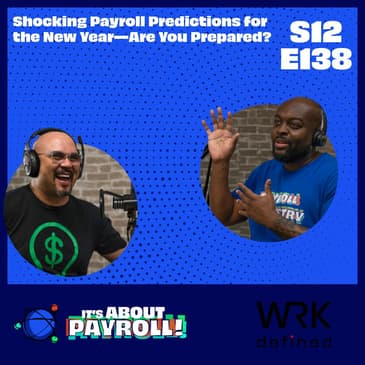
New Year Payroll & HR Predictions 2025 | Episode 138
In episode 138, join Brian and Walt as they dive into New Year planning for payroll professionals. The discussion ranges from transitioning to cloud-based payroll solutions, enhancing cybersecurity measures, and the rise of AI and automation in payroll and HR. They also cover workforce planning strategies, employee self-service portals, and the importance of staying updated with regulatory changes. Tune in to get valuable insights and predictions for HR and payroll trends in 2025, along with tips on how to maintain the human touch in an increasingly automated world.
00:00 Introduction and New Year Planning
01:19 Current Events and Bird Flu Concerns
02:21 HR Predictions for 2025
03:31 AI and Its Implications
05:26 Manager Support and DEIB Commitment
07:26 Culture and Mergers in Payroll
09:51 Sponsor Message and New Year Planning Tips
14:40 Enhancing Cyber Security
15:39 Adapting to Regulatory Changes
16:58 Implementing Employee Self-Service Portals
20:56 Preparing for Real-Time Payroll Processing
22:35 Addressing Global Payroll Changes
23:47 Strategic Workforce Planning
24:42 Automation and AI in Payroll
25:00 Employee Well-Being Initiatives
26:11 Balancing Technology and Human Connection
29:52 Concluding Thoughts and Reflections
Powered by the WRKdefined Podcast Network.
[00:00:04] Welcome to our podcast, It's About Payroll. We're your hosts, Brian Escobar and Walter William Duncan III. Whether you're new to the payroll game or a seasoned veteran, we have something for you.
[00:00:20] Welcome back, folks. This is episode 138. Man, we're at the end of the year, beginning of the new year. We're talking about some new year planning, what you're going to get done for the new year. Not New Year's resolutions. As a payroll pro, we got to figure out a plan for the year. Get ahead of things. But before that, what's up, Walt?
[00:00:39] Hey, what's up, bro? How are you doing, Brian? I'm good, man. I'm good. Thank God.
[00:00:45] Happy holidays to everybody listening. New Year, if you celebrate.
[00:00:49] When does this hit? That's a good question, though. Even though folks don't, do people not celebrate the new year?
[00:00:57] Some people may not. I know some people that they just, you know, some other day to them.
[00:01:03] You think, really? Yeah.
[00:01:05] That's interesting. That's interesting. See, for Latinos, it's crazy because it's like, what? Reason to party?
[00:01:12] Yeah.
[00:01:15] Another year. Turn up time.
[00:01:16] Yeah, another year.
[00:01:19] Yeah, man.
[00:01:20] That is very interesting. I never even thought about people not celebrating New Year's.
[00:01:25] Yeah.
[00:01:26] Some people may not.
[00:01:26] In some way.
[00:01:27] Yeah, I get that. All right. Yeah, because this drops right before the new year.
[00:01:31] Hey, hey, Festivus for the rest of us.
[00:01:33] Festivus for the rest of us in the new year.
[00:01:36] Yeah, man.
[00:01:38] Oh, man. Anything interesting before we get into the pay news?
[00:01:41] No, I think just talking about current events, what's going on out there. Did you hear about the freaking bird flu stuff? Not to be like, Donnie Downer or whatever.
[00:01:51] No, but still, that's relevant.
[00:01:53] Yeah.
[00:01:53] But they always talk about something. Why? So what's new?
[00:01:55] Apparently, it's serious out there. A couple of, they say some pets have died because it's been in like some of the pet food, like a cat died. And then I think a kid in California got sick or passed away from bird flu.
[00:02:08] Really?
[00:02:09] Yeah.
[00:02:11] Eggs and stuff. Like Costco had some big recall, huge recall for eggs.
[00:02:17] Through the bird flu.
[00:02:18] Really?
[00:02:18] Yeah.
[00:02:19] Something to pay his attention to then.
[00:02:20] Yeah.
[00:02:20] No doubt.
[00:02:21] Yeah.
[00:02:22] All right. I'll stop being.
[00:02:23] What you got?
[00:02:24] Yeah, yeah.
[00:02:26] You're trying to bright hopes for the new year.
[00:02:29] My bad.
[00:02:30] My bad.
[00:02:31] No, I'm just kidding.
[00:02:32] No, but.
[00:02:32] You got to balance everything out, right?
[00:02:33] Yeah.
[00:02:34] Bad to ugly.
[00:02:35] Yeah, we got to be real here, which is one of the things that we do.
[00:02:38] Just be careful, everyone.
[00:02:39] Pay attention.
[00:02:40] Word up.
[00:02:41] Pay attention.
[00:02:41] All right.
[00:02:42] So my article, switching gears back to payroll, is from lattice.com.
[00:02:48] And they basically, it's an article that says they have five HR predictions for 2025.
[00:02:55] Oh, okay.
[00:02:56] Interesting.
[00:02:57] I'm just going to go through what these five predictions are.
[00:03:01] So the number one prediction was that growth as a key engagement strategy.
[00:03:06] So people are going to use growth as a key engagement strategy.
[00:03:10] Okay.
[00:03:11] So they're going to be supporting employee growth and development will be central.
[00:03:15] I hope that's true.
[00:03:17] Satisfaction and motivation high.
[00:03:19] No doubt.
[00:03:20] That's true.
[00:03:21] Number two is practical and strategic AI implementation.
[00:03:27] Yep.
[00:03:27] So AI adoption and HR and payroll will be more practical and strategic.
[00:03:34] While task-based uses like writing job descriptions are common, leveraging AI for analytical purposes
[00:03:41] such as identifying biases and predicting promotions is expected to provide a greater value.
[00:03:48] That's interesting.
[00:03:49] You had a thought.
[00:03:50] What were you thinking?
[00:03:51] Yeah.
[00:03:51] Not a thought.
[00:03:51] I just read something that Anita Latink commented on, right?
[00:03:55] So anytime she's a legit influencer, whenever she's commenting on things or whatever, post things,
[00:04:01] I try to tend to pay attention.
[00:04:03] And they were talking about AI and what she said, I hadn't thought about, right?
[00:04:08] She said something like, she doesn't understand how they haven't applied regulations to AI development.
[00:04:16] Yeah.
[00:04:17] Much like they've applied regulations to big pharma.
[00:04:21] That's interesting.
[00:04:21] That's a good call.
[00:04:22] Right?
[00:04:23] And that's what I said.
[00:04:24] I was like, wow, great comparison.
[00:04:25] Great call.
[00:04:26] I've never thought about it that way.
[00:04:27] And I think they should.
[00:04:29] I think not that I don't love some AI, but if the implications, the technology of it, the evolution
[00:04:37] of it, unregulated, we're in Terminator Skynet world, basically.
[00:04:43] Yep.
[00:04:44] Shoot.
[00:04:44] We're watching Dune, right?
[00:04:45] You saw how Dune came out with a series?
[00:04:48] Yeah.
[00:04:48] And it's a prequel series.
[00:04:50] Mm-hmm.
[00:04:50] So right out the gate, they talk about how the humans defeated thinking machines.
[00:04:57] And now thinking machines were banned.
[00:05:00] You can't have a thinking machine in this world in Dune series.
[00:05:05] Yep.
[00:05:05] Of course, perfect timing, perfect tie-in to the world.
[00:05:09] Yeah.
[00:05:09] You know, think about all of the AI movies.
[00:05:13] If that is the evolution of it, we definitely need some regulation of it.
[00:05:16] Just a thought.
[00:05:17] Yeah.
[00:05:17] That's a good call.
[00:05:18] I think that there's more capability that AI can do.
[00:05:23] I think that they're giving it to us in small doses.
[00:05:27] Small doses.
[00:05:28] Yeah.
[00:05:28] Small doses, right?
[00:05:29] Because I think that there's a lot more that AI can do that they have.
[00:05:33] And I think the things that we do have access to now, I think they have their years in advance
[00:05:39] already for what they have in development can already be done.
[00:05:44] So that's a good call.
[00:05:45] Number three, manager support as an indicator of success.
[00:05:50] They're saying that the success of an organization will heavily depend on its managers.
[00:06:01] So that engaged managers will lead to engaged employees.
[00:06:06] Number four.
[00:06:08] Number four.
[00:06:09] Number four.
[00:06:09] And I don't know if you agree with this one.
[00:06:11] And this is the first time I've heard it called this because they added an initial to it.
[00:06:15] And so it's increased demand for DEIB commitment.
[00:06:22] Diversity and...
[00:06:23] I forget the E.
[00:06:25] What is it?
[00:06:26] Diversity, equity, inclusion.
[00:06:29] And belonging.
[00:06:31] Belonging?
[00:06:32] Yep.
[00:06:33] Okay.
[00:06:35] Bring it down.
[00:06:36] They're saying that employees will demand more commitment to those things, right?
[00:06:42] And that HR is going to have to integrate those initiatives throughout the employee experience
[00:06:50] from leadership and from other teams, right?
[00:06:54] Because think about it.
[00:06:55] Isn't inclusion belonging?
[00:06:56] I'm sorry to cut you.
[00:06:57] Go ahead.
[00:06:57] I think being included...
[00:07:00] You can be included in something, but you can probably still feel like you don't belong.
[00:07:05] Like you don't belong?
[00:07:05] Yeah.
[00:07:06] Go ahead.
[00:07:06] Because this is a good one.
[00:07:07] Go ahead.
[00:07:07] Finish your...
[00:07:08] I think that it has to do with the person in the...
[00:07:12] I think it's more the psyche of the person.
[00:07:14] But that's like my decision.
[00:07:16] Maybe.
[00:07:16] That's a personal...
[00:07:17] It's a good topic to discuss these things, right?
[00:07:20] Because I know there's been some pushback from organizations.
[00:07:23] Like I think Walmart is saying that they're getting rid of their DEI.
[00:07:28] DEI.
[00:07:29] Why?
[00:07:30] Because of pressure.
[00:07:32] From there, yeah.
[00:07:34] Pressure.
[00:07:34] Yeah.
[00:07:34] Weird.
[00:07:35] Yeah.
[00:07:36] It's all sorts of stuff out there.
[00:07:37] So...
[00:07:38] I feel...
[00:07:38] It feels like affirmative action all over again.
[00:07:41] Oh, when they got rid of it?
[00:07:42] Yeah.
[00:07:42] Yeah.
[00:07:43] Yeah.
[00:07:43] When it came, it came and gone, you know.
[00:07:46] And then number five is culture as a support mechanism.
[00:07:50] So they're saying that culture will play a crucial role in supporting employees amid ongoing challenges like layoffs and remote work policy changes.
[00:08:00] So they're saying that a strong culture will help meet employees' needs and foster a supportive work environment.
[00:08:06] So those are the five predictions that they're saying they're going to impact HR and payroll in 2025.
[00:08:12] We'll see.
[00:08:15] So what do you got?
[00:08:16] Yeah.
[00:08:16] Those are good ones.
[00:08:17] I like it.
[00:08:17] Yeah.
[00:08:18] What do you got for us?
[00:08:19] I like it.
[00:08:20] Real quick, just another merger acquisition to call out.
[00:08:24] And I think that the biggest takeaway for payroll folks is pay attention to your vendors, right?
[00:08:29] Because the tools and vendors we use are subject to an M&A, a merger and acquisition.
[00:08:35] It could change the way you use the tools and then have whatever it does.
[00:08:39] Like you need to pay it.
[00:08:40] And if your vendor is being bought, right, you need to bring it up because it could mean new and exciting features or things could go away into that.
[00:08:49] But FISERV, F-I-S-E-R-V, is acquiring Payfair Inc.
[00:08:56] And it's set to significantly enhance its embedded finance capabilities, particularly in serving gig economy workforces.
[00:09:04] FISERV is already a fintech product that offers financial tools and wage access, right?
[00:09:12] You know, kind of fill that void of getting that earned wage access to FISERV.
[00:09:17] One of FISERV's products is Paycards, right?
[00:09:19] We went down that road.
[00:09:21] Remember when we were trying to use Paycards as an on-demand product, we realized that it's not really a good on-demand product.
[00:09:29] It's a good product.
[00:09:30] Paycards as a whole is a great product, but not as an on-demand product.
[00:09:37] Whereas Payfair is that EWA, earned wage access, on-demand product.
[00:09:43] So that, you know, again, just one fintech buying another fintech, trying to wrap up the offerings into one portfolio instead of going somewhere else.
[00:09:52] They're probably losing business to people getting earned wage access stuff.
[00:09:56] So just pay attention.
[00:09:57] You know, as a payroll, pay attention to the vendors you use and what's going on in the market.
[00:10:01] I love to share these little nuggets of companies doing the M&A stuff.
[00:10:06] So a lot of articles.
[00:10:08] Yeah, there's something to pay attention to.
[00:10:10] Okay.
[00:10:11] And before we get into the main topic, let's pay some bills.
[00:10:14] Pay some bills.
[00:10:15] Shout out to Timetri.
[00:10:20] Nice.
[00:10:22] If you're tired of the messy timesheets or complicated time clock software, TimetriGo is an intuitive solution that makes managing employee hours simple and efficient.
[00:10:33] But don't take our word for it.
[00:10:35] Customers have given TimetriGo a 4.7 out of 5 on Capterra.
[00:10:40] And they've been awarded badges for best ease of use and best customer support in 2024.
[00:10:46] And they've won that award multiple times.
[00:10:49] So here's what customers are saying.
[00:10:51] Great value.
[00:10:53] Best clocking app on the market.
[00:10:57] Great time clock for the modern office.
[00:11:00] Intuitive and efficient.
[00:11:01] Simple to use and price right.
[00:11:03] And customer support is awesome.
[00:11:06] Man, those are all great things.
[00:11:08] Keep at it.
[00:11:09] Time track go.
[00:11:10] So to learn more about a simply better solution for time tracking, real-time reporting, PTO automation, payroll integrations, and more, go visit www.timetrackgo.com.
[00:11:28] That's T-I-M-E-T-R-A-K-go.com.
[00:11:33] And start your 14-day free trial today.
[00:11:37] Let's go.
[00:11:39] Let's go.
[00:11:41] All right, man.
[00:11:42] Let's go.
[00:11:43] Let's get into the nitty-gritty.
[00:11:44] What do you got for us today for New Year planning?
[00:11:47] So we're talking about New Year planning.
[00:11:49] It's payroll professionals.
[00:11:50] So we talked about your last episode was year-end, right?
[00:11:53] What do you need to do?
[00:11:53] Wrap up your year.
[00:11:55] Don't forget.
[00:11:56] Checklist.
[00:11:56] Blah, blah, blah.
[00:11:57] But then we're talking through it.
[00:11:59] And the last couple of years we did year-end, but didn't really talk about new year.
[00:12:02] What can we think about as payroll pros to get ready for the new year?
[00:12:07] Get things on our calendar.
[00:12:09] Put it on your outlook.
[00:12:10] Build a plan.
[00:12:11] Get some things out there.
[00:12:13] And here are some things that you can think about going into the new year to stay prepared.
[00:12:18] Be proactive, right?
[00:12:20] Be proactive.
[00:12:21] I think the most frustrating times for me as a payroll pro is when I'm reactive and not proactive.
[00:12:27] Yeah.
[00:12:27] So with that in mind, here are a few things.
[00:12:32] One is embracing automation and artificial intelligence, AI, like we just spoke about, right?
[00:12:37] We continue to say we have to be the ushers.
[00:12:40] We have to be the wardens.
[00:12:42] We have to help bring it in, not be afraid of losing our jobs or anything like that.
[00:12:47] We are way off.
[00:12:48] I think folks that are working now are way off from losing our jobs to AI, right?
[00:12:54] Especially if you are helping to bring it in and usher it in.
[00:12:58] Because companies, think about it.
[00:13:00] If you're not the, companies are not spending, they're not, oh my gosh, yeah, how do we do AI and payroll?
[00:13:04] No, they're depending on the payroll person to do that.
[00:13:06] What are you thinking?
[00:13:06] No, I agree.
[00:13:08] But I also want to caution everyone to not get complacent either, right?
[00:13:12] Because you are very right that there is a ways off, but you don't want to get so complacent that you're just like, it's such a ways off.
[00:13:21] No, no, no, no.
[00:13:22] It's not that far off.
[00:13:23] It's not that far off.
[00:13:25] If you get complacent and put it to the side, you're going to be the first to go because you're not going to have any idea how to deal with it and bring it in and help integrate it into your process.
[00:13:33] That retirement might come earlier than you're thinking.
[00:13:35] That's right.
[00:13:37] That's right.
[00:13:37] What do we say?
[00:13:38] Don't be a laggard in your technology.
[00:13:41] Transition to cloud-based payroll solutions.
[00:13:44] Now, you might think, oh gosh, that's old.
[00:13:46] It's not.
[00:13:47] I promise you there are still companies out there that are operating on paper, that haven't digitized their filing systems, that still print, right?
[00:13:59] I myself just transitioned off of writing notes.
[00:14:03] I no longer keep notes in paper.
[00:14:07] I have digitized my work note process, right?
[00:14:12] And just in this past year.
[00:14:14] So there are companies that – there's people and there are companies that still operate manually.
[00:14:19] So please transition to the cloud-based, digitize your processing, enhance cybersecurity measures.
[00:14:26] Oh my God, that should have been number one.
[00:14:28] If you don't think – if you don't – if you're not – if you don't know what's around your cybersecurity, I don't even know, then get – forget about enhancing.
[00:14:38] Get smart around what type of cybersecurity you have.
[00:14:41] And then if you don't have any, enhance, right?
[00:14:44] Work with your IT leaders.
[00:14:46] Reach out to them and, hey, look, payroll is very critical, crucial where payroll folks are targeted.
[00:14:52] Payroll HR and accounting firms are highly targeted by hackers.
[00:14:58] So like how – reach out, right?
[00:15:01] Reach out to them and get help on enhancing your cybersecurity measures.
[00:15:04] Let me say something here really quick.
[00:15:05] Yeah, of course.
[00:15:06] You made a good call out, right, about these last two things that you mentioned, the transition to cloud-based and enhancing cybersecurity measures.
[00:15:14] Because they go hand in hand, right?
[00:15:15] Because we mentioned faxing earlier, right?
[00:15:18] And I just – while you were talking, I just Googled it just to see if there are payroll services that allow that.
[00:15:23] And I found one, right?
[00:15:25] I'm not going to say the name, but there are still payroll services out there.
[00:15:29] It says that you can –
[00:15:31] But that's not a bad thing for them.
[00:15:32] They're accommodating.
[00:15:33] They're accommodating.
[00:15:34] It says you can do your – there are multiple ways to enter and run your payroll.
[00:15:38] You can do it online, by phone, or by fax.
[00:15:42] Yep.
[00:15:42] Wow.
[00:15:43] Yeah, it's still a thing.
[00:15:45] Yep.
[00:15:45] And then shout out to that company that's accommodating that because folks, again, still need to transition.
[00:15:52] Yep.
[00:15:52] Oh, this is a big one too.
[00:15:54] And again, these things are still real.
[00:15:57] These are really good – no, I'm skipping.
[00:15:58] Sorry.
[00:15:59] Hold on.
[00:15:59] Number four is adapting to regulatory changes and compliance.
[00:16:05] I think this is something that happened – this is rule of thumb for payroll.
[00:16:10] We should always be adapting to regulatory changes and compliance.
[00:16:13] I think that's part of the job.
[00:16:14] Yeah.
[00:16:15] But it's good that it's called out because, again, something you can't get complacent on.
[00:16:20] You can't just sit back.
[00:16:21] Oh, I know it all.
[00:16:22] No, you don't.
[00:16:22] Look at – oh, my gosh.
[00:16:24] Christina from Valid Payroll.
[00:16:25] She did an update.
[00:16:27] Remember that reporting thing that I told you that we are also subject to that I was like, oh, I don't have to do it now?
[00:16:32] Nope.
[00:16:32] Now it's back.
[00:16:34] Now we do have to do it again.
[00:16:36] And they gave us an extension until mid-January or something like that.
[00:16:39] It's back.
[00:16:40] So it's a great call-out adapting to regulatory.
[00:16:44] Like you have to stay on top of regulatory changes and compliance.
[00:16:47] It's an average change.
[00:16:48] It's like a roller coaster sometimes.
[00:16:50] It really is.
[00:16:51] It's up and down, especially this time of year with the IRS.
[00:16:53] They literally call it the IRS cliff or something like that because folks like us are waiting for what they're going to – all these last-minute changes that are going to hit as the new year rolls in.
[00:17:06] And they don't care about calendar year.
[00:17:08] They'll make the change in February, March.
[00:17:11] They don't care.
[00:17:11] And then retro went back to Jan 1.
[00:17:14] You have to stay on top of these things.
[00:17:17] Number five, implementing employee self-service portals.
[00:17:21] Believe it or not, every company has employee self-service portals for their employees.
[00:17:26] That is very true.
[00:17:27] That's big business.
[00:17:28] Small business, it's just getting there.
[00:17:30] Because technology is so advanced, because it's now cheaper to offer these products at a smaller business level, I think what's worth keeping in mind is that America runs on small businesses.
[00:17:44] Right?
[00:17:45] It's not.
[00:17:45] All right.
[00:17:46] I know.
[00:17:48] Nope.
[00:17:49] And Duncan.
[00:17:50] But it runs on small businesses.
[00:17:52] They're more small businesses than there are large businesses.
[00:17:55] What's up?
[00:17:55] Yeah.
[00:17:55] So I just – while you're – again, just pulling up a stat here.
[00:17:58] I know.
[00:17:59] It's said around 30% of businesses do not have ESS capabilities.
[00:18:05] Wow.
[00:18:05] You see what I'm saying?
[00:18:06] 30%.
[00:18:06] That's a big chunk that don't have employee self-service.
[00:18:10] Forget about manager self-service.
[00:18:12] You don't have employee self-service.
[00:18:13] You definitely don't have manager self-service.
[00:18:15] Implementing employee self-service portal, top strategic kind of priority for the new year.
[00:18:21] Yeah.
[00:18:22] Okay.
[00:18:22] Number six.
[00:18:23] Can you speak to why that is some of the reasons why?
[00:18:26] Because I don't want to nail down.
[00:18:29] One of the things – the first thing that comes to my mind is if you're having your employees fill out a bunch of documents and doing stuff.
[00:18:36] The onboarding process.
[00:18:37] The onboarding process.
[00:18:38] And you have them faxing or taking pictures.
[00:18:42] However you're receiving the information from your employees may not be secure like some of these other things that you mentioned.
[00:18:48] And that increases – opens up another loophole or another area for hackers or those people that want to scam to get in there.
[00:18:56] You could really – you can literally talk it through the whole employee lifecycle.
[00:19:01] From onboarding to offboarding and retirement.
[00:19:05] There are employee self-service tools throughout that whole piece where if the employee are doing the things, it's less for the payroll HR teams to have to, one, do it for them.
[00:19:19] And then, two, be responsible.
[00:19:21] Oh, you keyed in my direct deposit wrong.
[00:19:23] Are you kidding me?
[00:19:24] Beginning of my career, I had to key in people's direct deposits.
[00:19:27] If it went wrong, it was on me because I had to key it in.
[00:19:31] Yep.
[00:19:32] As opposed to now, self-service.
[00:19:35] I'll tell on myself, I'm entering a bunch of changes on the off week that we're not processing or the designated time to make those changes.
[00:19:43] And I forget to put in the other person's name.
[00:19:47] And I'm entering the new information, the new direct deposit information on somebody else's record.
[00:19:53] Yep.
[00:19:53] In the beginning of my career, I successfully put one person's money in somebody else's account.
[00:20:02] And back then, before they had – this was before – I don't know what they call it.
[00:20:06] I think different banks call it different things.
[00:20:09] I call it positive pay where they verify whose money – whose account it is before it goes in.
[00:20:18] Yeah.
[00:20:18] Right?
[00:20:19] This was before that.
[00:20:21] Money went into somebody else's account because the wrong information that I entered was legit somebody else's account at the same bank.
[00:20:28] Oh, wow.
[00:20:29] Yep.
[00:20:29] At the same bank.
[00:20:31] It happens, bro.
[00:20:31] I had to go through a whole process to get the money back.
[00:20:36] Thankfully, there was a process that was successful.
[00:20:39] But it took maybe longer to go through the paperwork, to go through the waiting game for this money to come back.
[00:20:45] Yep.
[00:20:45] And in the meantime, I had to – we had to pay the other employee, right, the initial employee their money.
[00:20:51] So now the company's out twice as much.
[00:20:53] Mm-hmm.
[00:20:54] But little things like this is why you really want employee self-service.
[00:20:58] You want to push digitizing where I think folks should get their stuff digitally, pull it down from their portal themselves, save it onto their computers, delete the whatever.
[00:21:09] Get – and not put your W-2 in the mail.
[00:21:12] Those type of things.
[00:21:13] That's what employee self-service is good for.
[00:21:15] Yeah.
[00:21:16] Number six, preparing for real-time payroll processing.
[00:21:20] Whoa.
[00:21:20] I feel like we are getting to a place where, yeah, there will be a check date, but it's every few days payroll will run.
[00:21:30] I think it's going to get to a point where every few days you're running a batch for payroll because of things.
[00:21:37] I think people – part of that is it may be something to do with earned wage access for people.
[00:21:44] I was going to say or –
[00:21:45] Yeah.
[00:21:46] Or it becomes more –
[00:21:49] ...earned wage access.
[00:21:49] More common.
[00:21:50] Thank you.
[00:21:51] And it just – it's just – yeah, I think, again, yeah, it's a great call-out preparing for real-time payroll processing because what it does for the payroll pro is you got to do more reconciliation.
[00:22:03] Yep.
[00:22:03] It changes the way we process.
[00:22:05] It changes the way we process.
[00:22:07] We become maybe more auditors of the things because if they're doing it, if everything is just happening automatically, we become the auditor now.
[00:22:15] Yep.
[00:22:15] You know?
[00:22:16] So think about that.
[00:22:19] Focusing on – perfect segue.
[00:22:21] Focus on skill development and upskilling.
[00:22:25] Upskilling.
[00:22:25] What's upskilling?
[00:22:26] Upskilling.
[00:22:27] I know, right?
[00:22:27] I know.
[00:22:29] It's redundant, really.
[00:22:31] Yep.
[00:22:31] Skill development and upskilling.
[00:22:33] Just new skills, right?
[00:22:36] And just like I said, if payroll is becoming automated and we become the auditors, we need to learn how to become good auditors.
[00:22:43] Okay.
[00:22:43] We need to learn how to pull the data from the systems better.
[00:22:47] You know what I mean?
[00:22:48] Yep.
[00:22:48] Leveraging – there we go.
[00:22:50] Leveraging analytics and reporting as we – that could be the upskill thing.
[00:22:55] Yep.
[00:22:55] And then the last one is addressing global payroll changes.
[00:22:59] Yeah.
[00:23:00] I think one of the things that just came to mind is the brick that you were talking about.
[00:23:04] That new currency.
[00:23:05] Bricks.
[00:23:06] That's a global payroll change.
[00:23:08] So look it up.
[00:23:10] And we talked about it in many episodes.
[00:23:12] I'm going to pass it off to you, sir.
[00:23:14] Thank you, sir.
[00:23:15] That was great.
[00:23:20] So for me, I only have five things I want to talk about.
[00:23:24] And it covers some stuff for mainly payroll, but it does have some HR stuff in here because as we know, in payroll, you can be in the HR department and you can do some of these different things, right?
[00:23:34] So you may wear multiple hats.
[00:23:38] That's right.
[00:23:38] You may have an auditing hat.
[00:23:40] You may have an HR hat.
[00:23:42] Upskilling.
[00:23:42] That's right.
[00:23:44] All right.
[00:23:44] So number one, you want to look at agile payroll systems, right?
[00:23:51] You want to have agility in payroll systems to adapt to those regulatory shifts that Brian mentioned, right?
[00:23:57] And those can highlight how to stay compliant and adaptable and potentially offer a competitive edge in 2025.
[00:24:06] You know what I'm saying?
[00:24:06] And so, but then also number two is strategic workforce planning.
[00:24:11] So this might be more geared towards the HR side of things.
[00:24:15] Explore strategies for effective workforce planning, focusing on competitive pay structures and employee development to retain talent.
[00:24:23] So Brian and I, we don't, again, Brian always says that we don't really compare notes like that, but while we're prepping, that's on what Brian, one of Brian's topics there, right?
[00:24:32] That he mentioned about employee development and making sure that you keep them trained up and upskilled.
[00:24:39] Number three is data-driven HR decisions, right?
[00:24:43] You want to emphasize the role of data in HR payroll decision making, especially when it, in regards to that talent acquisition and performance management, right?
[00:24:53] This can lead to informed, more informed and strategic planning for 2025.
[00:24:59] Brian mentioned this earlier.
[00:25:01] I have it here as well.
[00:25:02] Automation and payroll.
[00:25:04] You know, you want to discuss the integration of AI and machine learning and payroll processes to reduce those errors and enhance efficiency.
[00:25:13] And this trend is expected to grow in 2025 as we lean more towards automation and AI.
[00:25:19] And then the last one is employee well-being initiatives.
[00:25:23] Highlight the importance of incorporating well-being programs into payroll strategies to enhance employee satisfaction and retention.
[00:25:31] Look, as Brian and I know well, and those of you that are listening, payroll can be a thankless job.
[00:25:39] Even HR can be a thankless job.
[00:25:41] Yes.
[00:25:42] Yes.
[00:25:42] Because if we do it well, nobody thinks about it.
[00:25:46] No.
[00:25:46] Nobody thinks about it, right?
[00:25:47] And then some cultures are good about giving you pats on the back and giving you your kudos or giving you your flowers.
[00:25:54] And then there's other times where you don't hear from anybody until something goes wrong.
[00:26:00] And then it's like everybody's blowing up your phone, your email, whatever communication systems or taxes you use.
[00:26:07] And so sometimes that can mess with your mind and it can mess with your morale.
[00:26:12] So you want to find different ways to incorporate those well-being initiatives.
[00:26:19] And that's it, man.
[00:26:21] Before we close it out, as we always do most times, last week I caught Brian with a pop quiz, but this week is back to the normal format, asking a question.
[00:26:31] As reliance on automation and AI increase, are there risks of losing the personal or human connection?
[00:26:42] And how can this be mitigated?
[00:26:48] It's interesting because you made me think about a book that I read called The Shallows by Nicholas Carr.
[00:26:56] And sure enough, when I went to, I was just curious because I didn't remember the name of the book and I forget it.
[00:27:03] Like I always get his name messed up.
[00:27:04] Sure enough, I go look him up and he just wrote a new book, Super Bloom, How Technologies of Connection Tear Us Apart.
[00:27:16] As automation and AI increase, are there risks of losing personal connection?
[00:27:19] How can we mitigate it?
[00:27:22] I don't know how it's been.
[00:27:23] We definitely lose personal connection.
[00:27:25] We continue to lose it because of smartphones and technology and all that stuff.
[00:27:33] Honestly, when I read this question the first time, all I could think of was being intentional.
[00:27:37] Yeah, that's good.
[00:27:39] Look, man, I think that we have to be careful, right?
[00:27:45] That we don't, there's not an over-reliance on technology.
[00:27:49] That we forget the human aspect, right?
[00:27:51] And that we become so dehumanized that we start putting those things in our policies and our processes.
[00:27:58] We take that out of things too.
[00:28:00] Where I think we have to train these AI learning machines to do what's best for the company, but also do what's best for the people as much as possible if we can do that.
[00:28:13] Yeah.
[00:28:14] And I think that takes balance.
[00:28:15] And look, this is a discovery period.
[00:28:20] Yes.
[00:28:20] You know, this is a discovery time.
[00:28:22] We are.
[00:28:22] Just think about when the internet first came out.
[00:28:24] Oh my gosh.
[00:28:25] Yeah.
[00:28:26] It was a discovery.
[00:28:27] Where can I, what can I access?
[00:28:28] What information can I gain off of the internet?
[00:28:31] Now you can Google anything and find anything on the internet.
[00:28:34] Forget about it.
[00:28:35] Yep.
[00:28:35] Now discovery is the evolution of how much better we can discover things.
[00:28:42] Yeah.
[00:28:42] And I think we have to focus on emotional intelligence too, right?
[00:28:46] Yeah.
[00:28:47] It's the soft skills that are becoming the hard skills.
[00:28:49] Yeah.
[00:28:50] And you mentioned that you said that before in many episodes.
[00:28:53] And that's going to take like us focusing on empathy.
[00:28:57] Yep.
[00:28:58] And interpersonal.
[00:28:59] Maintaining communication channels.
[00:29:01] Yep.
[00:29:01] To people.
[00:29:02] Yep.
[00:29:03] And then we have to foster a culture of being connected and staying connected.
[00:29:08] Yeah.
[00:29:09] We have to foster that culture.
[00:29:10] As we implement these new AI and automation, let's make sure that we don't lose that.
[00:29:17] Because the thing that a lot of people love about their jobs may be the culture because
[00:29:23] of how everyone is connected.
[00:29:26] Yep.
[00:29:26] You and I have said this before for places that we both work collectively and individually.
[00:29:31] Oh, I love this place.
[00:29:33] Work is stressful, but it's the people.
[00:29:35] It's the people.
[00:29:37] That's right.
[00:29:37] As we know it today.
[00:29:39] It could change.
[00:29:40] Yeah.
[00:29:41] It is going to change, but it hasn't changed yet.
[00:29:43] Yeah.
[00:29:43] But yeah, no, you're right.
[00:29:46] I'm guilty of it as well because my first go-to, I have an escalation as far as communication
[00:29:53] is concerned.
[00:29:54] I'm always emailing you first.
[00:29:56] If we can't get it done on email, then I got to call you or I got to set up a Zoom or
[00:30:03] something like that to take it to the next level.
[00:30:06] But yeah, I'm guilty of it as well because I'll use technology as a kind of comforting
[00:30:11] tool.
[00:30:13] I remember, you brought up such a good thing, and I hate to drag it on here, but you brought
[00:30:17] up such a good point there because do you remember when you first started processing
[00:30:21] payroll?
[00:30:22] Not a lot of people that we, the people that we service, not a lot of them had emails.
[00:30:28] No, not at all.
[00:30:29] That you could reach out to.
[00:30:31] Yeah.
[00:30:31] You had to pick up the phone and say, hey, I'm missing this time card or this doesn't
[00:30:36] balance out or this time, this sign off is not signed or whatever.
[00:30:41] You had to connect with them.
[00:30:43] It wasn't until the smartphone that really, right?
[00:30:45] It wasn't until the smartphone hit the market that forced email.
[00:30:51] Now, if you got a smartphone, you got an email.
[00:30:55] So yeah, that's true.
[00:30:57] That's a good call out.
[00:30:58] And we're dating ourselves like a mofo.
[00:31:00] We've seen a lot.
[00:31:01] Yeah.
[00:31:02] We have.
[00:31:03] No, we have.
[00:31:04] It's crazy.
[00:31:05] It's crazy.
[00:31:07] Yeah.
[00:31:07] Great show, man.
[00:31:08] Awesome.
[00:31:09] Thanks for joining us, folks.
[00:31:10] As always, we love you.
[00:31:13] Peace.
[00:31:14] Before we sign off, here are a couple quick things.
[00:31:17] Don't forget to follow It's About Payroll on LinkedIn, and it's about your paycheck on
[00:31:21] Facebook and TikTok.
[00:31:24] Thank you for being part of our payroll community, and thank you for being a part of this journey
[00:31:29] with us.
[00:31:30] Until the next time, keep learning, keep growing, and most importantly, keep going.
Sponsors
