
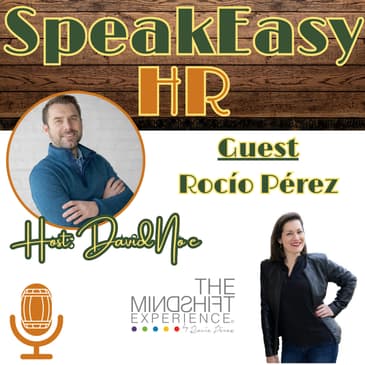
Every person brings more to work than their job title, experience, or résumé. Behind every employee is a story, a mindset, and potential that may not yet have been discovered.
In this episode of SpeakEasy HR, David sits down with Rocío Pérez, Founder and CEO of Veertuous, LLC, international bestselling author, speaker, coach, and creator of The MindShift Experience©, to explore the power of identity, mindset, and human potential.
Rocío shares her incredible journey of overcoming adversity, transforming her own identity, and helping more than 60,000 professionals discover what they are capable of achieving.
Together, David and Rocío discuss:
1. Why leaders must look beyond performance and understand the person behind it.
2. The difference between someone's current identity and their future potential.
3. How mindset impacts confidence, leadership, and growth.
4. Why traditional approaches to developing people often miss the human element.
5. How HR leaders can unlock potential within their organizations
6. The importance of leading from the inside out
7. Because before someone can become a great employee, leader, or teammate — they first have to understand who they are.
To learn more about her work, visit:
https://www.skool.com/the-mindshift-experience/about
Powered by the WRKdefined Podcast Network.
[00:01:01] Hey, what's going on everybody? David Noe with SpeakEasy HR, presented by Payroll Partners. We are back for a brand new episode, episode 83. I can't believe it's flying by this fast. Brand new guest, and I've had her scheduled for quite some time and very, very excited to have on SpeakEasy HR today, Rocio Perez. Welcome and how are you today? Rocio Perez- Amazing. Thank you so much for having me on your show.
[00:01:30] I have been such a huge fan of your work, so thank you. Yeah, well thank you very much for coming on. This is exciting and you're just coming off an exciting weekend getting married, so congratulations. That's really exciting. Absolutely. Thank you so much. It's been a lot of fun. Many events planned around the wedding and including a virtual wedding reception as well in addition to a live one, two separate events. Wow. Yeah, that takes a lot of planning, I bet.
[00:01:58] A lot of coordinating, lots of time zones. Let's just put it that way. Yeah. A little different than a podcast, I guess, but people can watch this live as they are. I already see people on there watching live. We are on LinkedIn and YouTube right now live, so if you are joining and tuning in, the chat section is open, fire questions along the way as we get into it.
[00:02:23] So, I wanted to hear a little bit about your background. I know we've talked a little bit so far about your topic you're going to bring to the show today and some of the work that you've done. So, kind of tell us about your background and what did you want to be when you were younger and is that what you're doing now? You know, it's very interesting because I'd say when I was a kid, I always wanted to be a teacher from the age of five.
[00:02:47] I'm like, when I grow up, someday I'm going to become a teacher. I was like fascinated by this teacher on TV and she would teach little children and I'm like, oh, that's what I want to be. You know, little did I know that I would become that in a way as a consultant, as a leadership consultant, that I would be sharing thoughts and insights and guiding people through their life experiences so that they can understand themselves even better.
[00:03:11] I think it's been a fascinating world. I've been doing this since I was 19 years old, okay? It's been a moment. Let me just say that. And it's been an exciting moment to share in these journeys with people. Yeah, yeah. And you have written, you're an author, right?
[00:03:31] So, it's one thing I've had in my past guests is a lot of authors. So, that is exciting. So, what got you to write? Like, when did you first like think about, okay, I've got something I want to actually turn into a book? Absolutely. It was many, many years ago and it was through my own leadership journey and saying, how can I share these life experiences so that people can be moved to do their own inner work?
[00:03:57] We all have something to work on, right? I know for me, at the top of my career, I felt like an imposter at times. And thinking of going on that self-journey of exploration, I decided, I'm like, wow, I've been guiding people for so many years. The things always show up. It doesn't matter how much time, energy, money, resources, education, things that we have accessible to us.
[00:04:23] There's a point in time in our lives that some people call them a midlife crisis or some people call it an identity crisis. I call it an identity crisis, right? There's something for us to work on. So, many years ago, I had committed to doing that. I started off with being a contributing author. At the age of 27, I was a contributing author to many different works.
[00:04:45] And then I decided to bring out my books in 2019, the first one I decided to release, which is Unstoppable, Seven Steps Are Becoming a More Intentional Leader. And then I launched an anthology titled The Hispanic Journey in 23. And in 24, I had launched, was it 24? I think it may have been 25. See, like so many things are being launched. I launched Fortalesa.
[00:05:13] And then most recently this year, I launched Identity Alchemy, Turning Pain Into Gold, which is the whole genesis of my work with entrepreneurs, with leaders, HR directors, and individuals who are ready to level up. Yeah, very, very fascinating. And so take us back to the beginning. What was happening in your life that led you to create this mind shift system? You know, was there a specific moment or experience that really sparked that idea?
[00:05:43] Absolutely. I'm completely open here. I was in my early 30s, and I had been diagnosed with a brain tumor. 34 years old, wake up to a root awakening. And that led me on a journey of self-discovery. What's going on? Okay, first commitment, number one, being told you're going to have a stroke and die any moment. I said, okay, what would I do? If this is like my reality, what am I going to do?
[00:06:13] Literally, that was October 19th, one year. October 20th, less than 24 hours later of being diagnosed. I said, okay, what would I do? I had a marketing company. I had an inventions company. And I decided to leave it all to do what made my heart sing, which is leadership development. I'm like, I love watching people be successful. They have better relationships. Their work is better. Their marriages are better. Their communication with their children.
[00:06:43] Like life is so much better. And that's what made my life worthwhile. And so that's where I began my journey. And then one day I had a reflection because it wasn't just about others. It is about others. And what about me as a leader? I got to a point, I sold everything, went on this, I call it a spiritual journey, moved to California, San Diego of all places.
[00:07:10] And I remember looking, people were calling me like, Rocio, I need your energy. Like, help me, help me. We get through this situation. I'm like, why do these people who I lead have the lives that I desire? And it wasn't about the time, the energy, the money, the resources, the accolades. I had all of that. What I discovered is that there were some life experiences within me that I had not transcended.
[00:07:37] And until I transcend those, hence why I was always, I was going after the PhD, like my life depended on it. I was going after everything. It was like so intense. And I'm like, why this intensity? So I started off with, hey, how about I turn coaching onto me? How about I develop my, nobody had developed me. I'm talking about 17 years into my career and nobody had developed me. I was like this warrior.
[00:08:07] I call it this guerrera that was warrior around life and leading people. I'm like, okay, I've got to, let's go here. Who's got me? Nobody has me. So this is the genesis of the MindShift experience where it began and where it's at today. It was to take the same modalities that I was using with my clients, applying to myself, and then now make them accessible to the world. Yeah.
[00:08:36] We are live on LinkedIn and YouTube. It is August 10th. Crazy how fast the summer is flying by. But I'm excited. Kids are going back to school and get back in the routine of the school season and all that that goes with it. I'm just not a big fan of the summer. But so, okay, one more question. And then we're going to dive into the world famous Envelope Icebreaker and the other questions that we have for today.
[00:09:02] So what's the biggest piece of advice you've ever received in your career? Well, take a look at self. There's always something there to look at. And I would say the other piece, bonus piece, we always put meaning towards things.
[00:09:23] And unless we know what meaning we give it ourselves, we can't connect with others and really get into the meaning of why they're doing the things that they're doing. Got to give you the mini air horn for that one. All right. Might be more where that came from. So, well, great. Well, we're going to shift gears and go to the Envelope Icebreaker game. So let me shift to that.
[00:09:48] All right. So question one through 15 or envelope. So you get to pick one through 15. Well, three. Three. Love it. Pick number three. What do we got? Mystery question. Mystery question. Okay. If your resume had a fun fact section, what would it say? Wow.
[00:10:18] Adventurous. Fun facts. She loves to cook. She loves to entertain and really enjoys watching people thrive. Okay. What do you enjoy cooking? Is there like one of your favorite things to cook when you have people over? Oh, my gosh. It's a huge undertaking. Let me just say that. Yeah. I love to cook fusion. Okay.
[00:10:45] And so I'll mix different types of food and cuisine and fusion. You just put it out there. I didn't realize that I love healthy cooking. People don't know that. Okay. Yeah. Everything is like either cooked in water or baked or something. And people are like, oh, my gosh, this is like the best ever. I'm like, they have no clothes. Absolutely. Well, good. Well, for those of you who are new to Speakeasy HR, my name is David Noe.
[00:11:13] He started this a couple of years ago as more of an idea to just bring HR leaders and business professionals into the world of podcasting. And so it's been a lot of fun and such a journey to meet with people and interact with guests and authors and everybody that's come on. So SpeakEasy HR is where you can find a ton of blogs, a ton of topics and all of the prior episodes up to this point.
[00:11:37] A recent blog is about the seven HR trends every company should be preparing for right now. So take a look at that at SpeakeasyHR.com. So just a couple of words from our presenting sponsor, Payroll Partners, and then we're going to get into this topic and just hold on one minute and we'll be back. Finding a new employee takes time and money. For one position on a single job board, you could easily spend a minimum of five to ten dollars a day advertising a job post.
[00:12:06] It's worth noting that the average time it takes to hire a new employee is 36 days. However, it can take longer than that. You could find yourself paying hundreds of dollars a month for a single job board. And if you're using multiple job boards for multiple positions, this could add up to thousands of dollars a month. There is a much simpler and more affordable way of finding the right candidate. At Payroll Partners, we offer an applicant tracking system to help manage your hiring process.
[00:12:33] Our ATS is customizable, allowing you to decide which days you want to run the job and when to close it so you don't break the bank. And this feature lets you e-blast your network, hosting jobs on multiple boards at once, all managed in one location. Payroll Partners, elevating your payroll and HR experience.
[00:12:54] So if you're in the business of HR technology, payroll technology for your company, if that's part of your job is to explore what's out there. If it's not working for you and what you have right now, look me up on LinkedIn. Let's connect. Would love to hear about your situation and see if we can help. So, all right. So we're going to get into this topic that we when we first started talking, you and I had had kind of collaborate on some ideas.
[00:13:21] And so we came to this and it kind of works very well with and really complements some of the work and some of the identity topic that you had recently talked about in your in your intro. So the identity alchemy, unlocking human potential at work. So we're going to get a little bit just warmed up with some rapid fire questions for you. So these are like the five to seven to ten second responses. So short, quick to the point. So what's one word that describes your leadership style?
[00:13:50] Intentional. What's one belief about people that you wish every leader understood? That we're all unique. What is a book, a person or experience that has shaped how you lead? Identity alchemy. What's one leadership habit you believe more people need to practice? Awareness. And finish the sentence. Great leaders don't just manage people. They.
[00:14:20] Engage with them. Love that. All right. So we are live on LinkedIn and YouTube. If you do have a question, throw it in the chat. Would love to hear from you. And I've got plenty. So we will have plenty to talk about. So your story is one that is about transformation and resilience.
[00:14:42] And so before we talk about leadership, you know, take us back to the beginning and the moments in your life that helped shaped really the person leader you are today. I know you had talked a little bit about what you were experiencing. But, you know, anything else that you wanted to add to that as it comes to your transformation, resilience that's really shaped who you are? Absolutely. I grew up believing that anything and everything was possible and probable. And people would always come around like, that's impossible.
[00:15:11] It can't be done. And I'm like, I keep on thinking of it. And as I think of it, I know that it's possible. So even as a child, people would think that things were impossible. Growing up, you know, I grew up from a very rough background and made the best that I could. Like I knew that the world that I lived in would not be the world that I would live in because I knew that instinctually.
[00:15:37] And so I was a runaway at the age of 13. Entrepreneur very early on as well. I was pregnant at 14, mom by 15. And again, these things that people didn't think were possible for a child that age, a teenager to raise a child, a teenager to go on to university with a sixth grade education. And on top of that, lead others at the age of 19, professionally leading others.
[00:16:07] From the age of 15, I was leading people. And yet by the age of 19, this was, well, 17 because I was in management by the age of 17, leading individuals so that anything could be possible. I just saw possibility, you know, talk about Napoleon Hill and all of these amazing people who saw people for who they could be. And I did the same in my own way without even knowing about these people.
[00:16:35] I read about them years later after I was leading people for such a long time and saying, OK, this is pretty amazing. And so those are the things that people keep on thinking, like, what's possible? Is it possible? It's impossible. I'm like, anything is possible. Yeah. Wow. So where do you get your inspiration from? Like, was there somebody or something or like, how did that play out?
[00:17:01] I'd say my inspiration comes from within the connection that I have with myself. And of course, you know, there's people that I've read about that I'm like, wow, this is pretty amazing. It makes me think like Henry Ford. It makes me think about Gandhi and other individuals. And this scene, what resonates with me? I get my inspiration from sometimes the simplest things that I love window shopping. Yeah. And it's window shopping in a different way. It's window shopping for creativity.
[00:17:31] What it inspires from me, that to me is magic. I get my inspiration from watching people, watching myself, observing myself. They call it stalking ourselves, right? When we're checking out, you know, how am I showing up in these environments? Yeah. Absolutely. So you've helped thousands of professionals through your work. What is the biggest barrier you see that keeps people from reaching their true potential?
[00:18:00] Well, I'd say that a lot of us think that this is who we are. And what I believe is this is who we became to be as a result of our life experiences and who we are. We start to know that when we hit an identity crisis or a midlife crisis as people. I'm like, okay, I'm done. You know, that's the author that becomes a lawyer. That's the doctor that becomes a massage therapist.
[00:18:28] That's the baker who used to be an attorney, right? This is where I see that we haven't figured out, you know, even myself being there. I thought that in order for me to be loved and belong in my home with my family, that I had to have all these degrees. Okay. So I became this super attentive, meticulous person in many, many ways. In reality, it's unnecessary.
[00:18:58] And I see that with my clients and it doesn't matter what stage I'm on, right? Whether it's MDs, PhDs, one, two, threes, whatever it is, people always say the same. Well, I became this because of my mother or because of my father or because of whoever. I mean, I was going after a dual PhD because of a professor who said something to me. And I'm like, was that even my dream? It wasn't, right? That wasn't my dream. It was somebody who said something to me. Yeah.
[00:19:30] So in HR, we often talk about developing skills and competencies. So why do you think or why do you believe mindset and identity development are just as important in creating successful teams? Absolutely. Because we let go of things. Take it, for instance, I'll give you some examples.
[00:19:51] Somebody has a belief system that, hey, you're here to take my job, right? Because it's happened in the past to them and they may be showing up in a way that's very destructive internally with the other employees. Okay. So you start to create a toxic relationship, toxic environment and so forth. But imagine that this person is there to do sales for your company.
[00:20:21] And I'll give you a perfect example. It's inside of identity alchemy. Look towards the back. There's a section right there on clients. One particular client, Jennifer, didn't like the color black. So anytime anybody showed up with the color black, she disregarded this person. She came to me because she was struggling in her business. They were about to close the doors. Why?
[00:20:47] And when we went through this journey and she discovered that it was the color black that she had a problem with, not success. Yet the color black, if somebody wore it, she wasn't going to close that deal. Bottom line. So the next time that I saw Jennifer after we walked through this experience and she had a number of reflections, she was wearing black pants and had two black pants.
[00:21:15] Not only that, she retired early. Let's just put it that way. Because of the work that she did, she ends up retiring early. Everything is great. Life is amazing. How? How does that happen? It's through that seeing our own identity, becoming that observer of self. Where is my mindset? Where are the things that I'm not seeing? See, we have anywhere from 60,000 thoughts to 70,000 thoughts a day. Okay. Okay.
[00:21:41] You and I have had anywhere from 35 to 48 thoughts every minute that we've been on here. Not only that, we make anywhere from 35,000 to 40,000 decisions a day. Do you think we missed one of them? And probably it's not the big decisions that we missed. Those are easy to see. It's the small, the minimal decisions that we're making one moment, right?
[00:22:11] From one moment to the next that we're blinded to. And all of that creates our reality. So you can give somebody the time, the energy, the money, the education, the leadership development. Yet until we give them the internal knowing of how am I even using these tools that I've been given? Because I could be blinded to them.
[00:22:35] And like those stories, there's many, many different stories of my clients and how they were showing up in their world. That's amazing. So every employee walks into work carrying a story that leaders may never know. So how can organizations create environments where people feel seen, valued, and empowered?
[00:23:01] I think if we were to get to know, imagine a new family member. If we were simply sitting down, breaking bread, having a conversation, getting to know them authentically as opposed to like, what are the numbers? You know, what are the metrics? What's KPIs? One, two, three, whatever it is. Take a moment and get to know them. Just break bread. Great. We're going to talk about business when we get to business.
[00:23:31] Right now. I want to know you as a human being. I think if every leader took that moment to be vulnerable, to authentically connect with each individual, life would be different. Because now I know there's a human on the other side of the screen in this virtual world. There's another human being. David's been through a lot. Rocio's been through a lot. We're both committed to this process. He knows me as a human. I know him as a human.
[00:23:59] There's a different connection that happens. And now the work can get done. I'm always really getting curious about the other individual. That's awesome. So leadership requires understanding people as individuals. And you had talked about how quickly in your career, young career, you were managing and leading. So what is the secret to leading every person differently while still creating alignment within a team?
[00:24:29] And that's great. To me, I take it back to the basics. It's like a family. We have, you can have 20 different children and they're all going to be different. Yet still the family unit is the same. We're still, think about the family unit as the culture that we're creating inside of the organization. And to really connect with each one of them to know, okay, this person's visual. And I remember the first time that I sat down in front of an individual. I'm like, okay, this is great.
[00:24:58] You know, I have this amazing presentation. A lot of words. And he's like, I can't see it, Rocio. I'm like, what do you mean you can't see it? It's all there. Everything you're asking for is there. Right? Even in my own awareness. And then when I realized that this person's visual. And then realizing, okay, this person's more of a type A personality, the way that I engage with them and the mixture of it. Right? And somebody may be more auditory, getting to know them.
[00:25:27] And a person may be more from a nurturing perspective. Or a person may be even triggered. Let's just put it out there. Right? This is unfiltered. Authentic. Uncut. I get it. Yeah. And I'm going to put it out there. Some people get triggered and we don't even know that they're being triggered. And we think that more words or more of this, more of who we are is going to get to them as opposed to getting into their world. If I know this person's visual, why am I trying to explain it in words?
[00:25:59] Right? And if I know this person is auditory. Or if they're not as empathetic as others, how do I find a way to communicate with them? And to me, when we start to master, when we master ourselves, we can actually hear the things that we haven't been hearing and see the things that we haven't seen in other individuals. I think that's huge when it comes to being a leader. Who am I working with?
[00:26:29] How do they operate? And to know that we have reward systems. Okay, great. You're giving me a day off. Well, I don't need a day off. I want more money. I have a friend who works for like a high tech company, like at the highest levels. And he went to his boss and he said, hey, at this point, I'm working for free. And instead of getting into his world, his boss goes to his boss and says, well, can we pay him overtime?
[00:27:00] He's not interested in overtime. He makes plenty of money. He wants time, energy, freedom. He wanted to leave on vacation early instead of getting paid a few more hours. So that's the difference between them, understanding what drives each individual.
[00:27:18] Maybe for me as a mother, when my son was growing up, give me those four hours to go home with my son, go to parent teacher conference, go to an event, really understand and understand too that what is important to me today may not be as important or such a leading priority tomorrow. It really depends where I'm at. Yeah. Yeah.
[00:27:41] And I think the pandemic really showed us that companies had to evolve the way they managed, what kind of work environments they provided and how to be competitive. Because there's a lot of industries that are still working remote hybrid. Right. So, you know, finding the right way to treat your employees the way they should be treated, understand they have a life outside of work and families and important life events that they just don't want to be missing.
[00:28:11] So the more you can do that and know your team and what motivates them, you're going to be successful. And that just goes personally with me and what managers I've had and what managers I've liked to work with and not work with and, you know, how I've been managed. It really plays a part in my overall job satisfaction, how I feel waking up on a Monday morning to go to work. You know, those Sunday scaries and just like, oh, gotta go back to work tomorrow.
[00:28:41] Absolutely. And I think one of the things that's so important to know is that the days of leave your problems at the door no longer exist. Okay. Now let's talk about humanity. We work with humans, not with robots. And as much as we want to think about in this world of AI, hey, the creativity comes from human beings and it comes with everything that we have, the diversity of thought.
[00:29:08] And if the diversity of thought is locked in, if I can't freely say it, I wasn't working for a corporation, I was working for myself when I was diagnosed to say, hey, I need to go home early. Right. I have this medical, I don't need to give the entire explanation. I just, I have a need. It's a medical need. I need to go home early on a Friday. Okay. Whatever it may be.
[00:29:35] And I've had bosses, people that I work with who were ready to fire people. Why? Your employee didn't even have the wherewithal of what's happening. They just can think about the emergency room getting medical care immediately. You're getting ready to fire them. How about you get curious? And I remember one particular leader who was absolutely amazing.
[00:30:03] They couldn't afford to lose him and they couldn't afford to lose a team. And finally, one day he stops after we're doing our work together. And he asked, he was about to fire him six months into the job. Is everything okay? I noticed that you left early a couple of times. And it was then that to him, it was disclosed that he had a medical condition. How about we get to know that?
[00:30:30] How about we get to see the human in front of us? And when we take care of human, human takes care of everything else, right? When we feel heard, seen, understood, connected with that we are important because we are. We are the leaders that make a huge difference. And the way that we show up and not show up is going to either make or break our business as well. Got to give you that. Definitely.
[00:31:00] And going back, this was one of my first questions that I skipped. I'm so sorry. I should have asked this at the beginning, but this is where I'm at. This is uncut, unfiltered, authentic. Uncut, unfiltered. How about that? So you talk about identity alchemy and the power of transformation. So what does that really mean? And why is understanding our identity so important for personal and professional growth? Absolutely.
[00:31:29] So why identity alchemy is so important is the reason why we have created our belief systems based on our life experiences. And because of those life experiences, we see the world through a particular lens. So if I had a very optimistic life experience, I'm going to see it very optimistically, right? I'm going to show up and I'm like, hey, how are we going to make this possible? We're a team. We're going to figure it out.
[00:31:54] And if I had some situations where, for instance, with me, I had bosses that I was like, oh my gosh, I'm not sure about this person. We're wasting a lot of time in meetings. This is not happening. I want to move forward. And we see the world through that lens. And when we start to observe and take apart and say, okay, what is it about me that I'm always running across this situation?
[00:32:20] For instance, I work with a lot of very amazing individuals in the high-tech world, medical world and high-tech world and financial world. And they're leaving their jobs. Why is identity important? They believe, these amazing individuals believe that somebody is doing something to them. Yet when they sit back and reflect, they start to recognize, this is me.
[00:32:49] How we get there is a different story because it's a lot easier for people to say, hey, well, you're doing this because of that. No, it's not because of that. What you do and I do is different. For instance, for me, if, let's just say the part of identity. If somebody walked up to me and said, hey, Rocio, just like that, pointed the finger. Hey, Rocio, you're doing a great job. I would have been, now mind you, uncut and unfiltered.
[00:33:20] I would have been like, how dare this person? Yet that was a trigger of mine. Why? Why? Because when I was being reprimanded, somebody would shake their finger at me and like, you are misbehaving or whatever. You're not doing what I expect you to do. And so automatically what we see is our minds already made a decision about that person in front of us. This is why that part of identity is so important.
[00:33:47] Why is this person, I keep on hearing burnout. Why does this person burning out? Why? Why? Some people are taking on more projects than what they can handle. Why? Because they're trying to prove something on a subconscious level. They're not even conscious of it. Yet if as a leader, we can ask the right questions, tell me, how are the work projects going? What does it look like? What's quality of life look like for you? As opposed to like, hey, you're working too much. You shouldn't do that.
[00:34:17] If information was already transformative, then we wouldn't need more information. We need experience in combination with information. And that's what I feel is important to help people walk them through a process of self-reflection. Because what you think and what my reality are, are two very different things. If it comes from you, you're bringing in that life experience into me.
[00:34:46] And it may not even be true for me. And I can guarantee you like 99.9% of the time, it's probably not true. Okay. I'm just going to say that because I could have told you that with Jennifer sitting down there for 25 minutes and exploring. I'm like, hmm, let's explore. Do you want to explore? Let's go ahead and explore. And you could have laid down every wishlist I had over those next 25 minutes to discover the issue was the color black.
[00:35:13] You could have laid down minute after minute, my dream car, my dream vacation, my dream life. I would have never guessed it because it's not about guessing. It is about helping people uncover and discover what it is that is inside of them that is leading them to make the decisions and to show up the way that they're showing up. Okay. I'm not being a perfectionist because I like things perfect. No. Sometimes we're being a perfectionist because of safety.
[00:35:41] It wasn't safe to not be perfect in a former life, in a former business, in a former whatever. But understanding and discovering that leads us to have better connection with others. Yeah. So your journey required a lot of mind shift or major mindset shifts. And so moving from what others may have believed about you to what you believe about yourself. So how can leaders help employees rewrite the stories they tell themselves?
[00:36:12] Wow, that's a great question. I'd say one of the ways of helping people rewrite is to listen to their stories, listen to what they're not saying. You know, what would you do? I remember this time, David, that we were hired to come on board an organization. There was no way for people to grow. Some people had been there 25, 30 years. There was nowhere else for them to grow.
[00:36:37] And I remember facilitating a number of retreats where we're prepping for the major retreat. And sometimes I heard voices. I'm like, where's that coming from? I don't see anybody's mouth move. Where's, like, you could have just told me there was a speaker on the wall and it's speaking. But that's how upset some people were. They wouldn't even move their face when they were talking. I'm like, wow. Like, talk about bringing triloquists at the best, at its best.
[00:37:07] And in our major retreat, when we walked in there, we talked about the experience of what this job was. Let's talk about our dreams. People literally decided that it was the best thing in that retreat for them to move on to other companies. And they were excited because they reconnected with what made their hearts sing. They saw that there's no growth. So why get upset over where there's no growth opportunities?
[00:37:35] Let's go out and do what we want. People danced out the door, like, literally danced out the door. Like, how does that happen? Right? It's called self-agency. It's called that opportunity for people to self-reflect, for people to become aware in their own process. As a matter of fact, every Monday morning, I lead a session called the Mindshift Reset.
[00:38:01] I have a number of things that are important that we allow people to express themselves. I run them through a visualization. What came up for you? It's not what came up for me. It's not what came up for whoever's in the room. What came up for you? That is what's important. And that's what we honor inside of the work that we do. I love it.
[00:38:22] So many organizations struggle with engagement, retention, developing future leaders, showing there is growth opportunities, right, within an organization. So how does unlocking someone's identity and purpose impact those challenges? I think we go from survivor, from warrior mode to authentic. And really connecting with ourselves, discovering that, hey, I didn't want to do this to begin with.
[00:38:51] I did it because of the money or because of the title or because I have a family or because of whatever reason it was. And so coming into passion, maybe that they're the best entrepreneurial person inside of your organization. Maybe they just want to share ideas. Maybe they want to lead in a different way. Maybe this person was simply in survival mode inside of their position that they were in as opposed to thriving mode.
[00:39:17] Now that they've been given the freedom to be in that space, they could be the person that takes the next invention to another level or even bring those inventions or opportunities. Changes even the culture to even more positive culture. What is that worth? Yeah, absolutely. So I've got one more question. And before I get to it, I have on the screen a QR code.
[00:39:46] This is to your site. So tell everybody what they would find when they go out to your site. Absolutely. So we have two sites and one of them is, and you can get to the first through there. There's a MindShift experience. What you'll find is that we have a school platform for people to come in and they can learn on there. I facilitate all the courses. At this point, we do have some of our amazing experts that will be facilitating additional courses.
[00:40:14] You'll find things like the Identity Alchemy Leadership Group. You'll find the MindShift Reset. You'll find other things that are very helpful for individuals depending on where they want to be. The other thing that you'll find is the MindShift University. That is a self-study course. You can come in, partake in any of our 12 courses, all 12 courses.
[00:40:38] For me, it's foundational to come in and understand what is the whole identity alchemy part of it. Like what is self-sabotage? How are we creating our own reality? When we have that understanding, we can start to look at the world through a different lens. So you'll find a number of things there. You'll also find our podcast TV show as well, the MindShift TV show. And also the MindShift game. We have a game.
[00:41:07] It's a leadership game that allows people to create their own neural pathways. The game is designed so that each individual can play it the way that they want to play it. For instance, a lot of organizations are offering opportunities. This is a great opportunity. Maybe I just want to work on my own leadership style. Maybe I'm afraid of speaking in public. You know, I was afraid of speaking in public. Imagine that. Now you can't take me off the stage because it's something that I love to do.
[00:41:36] And so finding a way that people could hone in on their craft in a safe environment. I can see my patterns once I'm scoring myself and seeing what I've done and what I haven't done. I can see those patterns over and over again and make those changes. Yeah. Well, we'll have that in the podcast summary notes if you are listening on demand in the future. So you can check out all of the work. So final question for you.
[00:42:05] So if you could give every HR professional and leader one challenge to take away from this conversation, what would it be? Ooh. Ooh. Lead yourself. Lead yourself. I feel like a lot of us have been put into leadership. As a matter of fact, 93% of people believe, according to Gallup, have shown to come into leadership. And they don't use the leadership skills.
[00:42:32] Most people don't feel equipped to lead because we're great at project management. We've been put into leadership and we don't necessarily have the knowledge, the skills, the abilities. It's important for us to know ourselves first and foremost. Okay. It's great. Put us through a leadership program. And if I don't know myself, first and foremost, what triggers me? What inspires me? What's going to set me back? Do I suffer from imposter syndrome?
[00:43:00] And virtually everybody does, okay, unless we've done our inner work. And then there's layers upon layers within that to understand, like, why am I showing up as a perfectionist? Or why am I like this natural genius who is telling people it's easy, yet it's not? It's not easy for them. So that's what I would say. Lead ourselves first. So then that way we can have the empathy.
[00:43:24] Because it's not information that is necessarily going to help our people 100% of the time. We need experience. We need experiential learning where people can be guided through experiences where they start to have their own awarenesses and say, Oh, this is what I'm doing. Yet, if we don't do it for ourselves, how can we expect somebody else to do it? Absolutely.
[00:43:52] No, this was very fascinating to listen to and hear your insights. And I learn every time I have a guest on. And, you know, it's just so fascinating to hear people's backgrounds and where they came from. And, you know, you just dug a little bit into your story from growing up and, you know, having, you know, a child young and being able to go into leadership and management early. So I just I really enjoyed being, you know, on today with you.
[00:44:21] And thanks for coming on and spending your part of your day with us right after your wedding weekend. So thanks for your time today. This was really, really fun. And thank you so much. And thank you for the privilege to be on your platform and everything that you do. I'm really excited about your work and looking forward to hearing more about the magical things that you're creating. Yeah, absolutely. If you're not connected, connect on LinkedIn with both of us and just follow along.
[00:44:50] But again, really appreciate your time today. And best of luck with everything you have going on. And don't be a stranger. Hopefully we'll talk soon and have a great rest of your day. Okay. Absolutely. Thank you so much. Thanks, everybody. Take care. We'll be back next Monday. Bye, everyone. See you later.
Sponsors
