
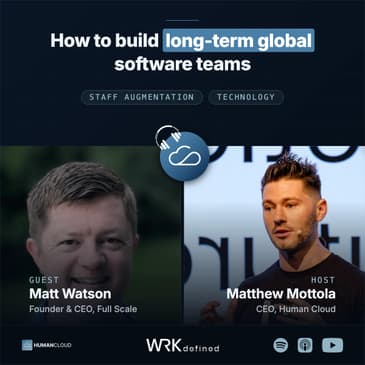
Almost everyone who tries offshore software development has a horror story. Matt Watson heard those stories for years before he built a 300-person engineering firm that works, and his conclusion was that the failures had nothing to do with talent, cost, or time zones. They came from a structural choice: putting a project manager between the client and the engineers, so the people building the product never talked to the people who understood the problem.
Matt is a four-time founder who built and sold three SaaS companies, then created Full Scale in 2018 because he needed developers he could actually afford. He hired a hundred people in twelve months, faster than any software company he ever started, and spent the next eight years learning what separates a global team that compounds from one that quietly stalls out. His clients include AMC Theaters, which has a team of twenty-one and flew six of its own employees to the Philippines just to build the relationship.
We're building Human Cloud so companies can find and deploy the right flexible talent solutions in minutes instead of months, so building a global team becomes a repeatable strategy rather than a gamble.
In this episode, Matt Watson shares:
- Why most offshore software development fails, and why the project-manager layer between client and engineer is the single point of failure
- How to build a long-term global team without long-term contracts, and what commitment level actually produces compounding results
- Why AI made proximity to the problem more important, not less, and what "the speed of context" means for how you structure a team
- Why English fluency, not cost, drove the Philippines decision, and why communication-heavy work follows different geography rules than task-based work
- The management habit that quietly kills distributed teams, the cultural dynamics behind it, and what to ask instead
- What changed in how clients think about headcount: the backfill reflex is gone, and what that signals about fixed seats versus flexible capacity
- Why services businesses are easy to start and brutal to scale, the exact inverse of SaaS, and what buyers should look for in a partner because of it
Matt Watson is the Founder & CEO of Full Scale, a four-time founder with three SaaS exits, author of Product Driven, and host of the Startup Hustle podcast.
Listen now on Apple Podcasts, Spotify, or wherever you get your podcasts.
About Human Cloud: We help companies find and deploy the right flexible talent solutions in minutes instead of months. We automate discovery, compliance, and orchestration across 1,000+ workforce platforms, so business teams move fast, procurement teams stay in control, and rogue contractor spend turns into a strategic advantage.
Powered by the WRKdefined Podcast Network.
[00:00:05] All right, Matthew. Well, listen, thanks for hopping on. So for you listeners out there, you know, I always look for multiple founders and I look for clear, explicit specialization. And when it came to you, I saw, okay, there's a Forex founder here and there's someone who's very clearly stating we have Philippine talent. Now, what I love about that is you don't say we have everything under the sun. You are very clear about that.
[00:00:32] And so for you listeners out there, literally, we've only talked for what, two minutes, Matthew? And so this is going to be a great sort of great to meet you. And then also having our listeners learn about you. But let's just start off with a quick intro on you, Matthew, and Full Scale, and then we'll kind of dive into some questions. You know, I once interviewed somebody and asked them the same question, and they gave the favorite answer that I ever got. So I always like to say the same thing.
[00:01:01] It's like, I'm just a guy looking for something to do. Yeah, what are you looking to do? You know, and that has always been my career. I'm a problem solver. And I love a big challenge. And that inevitably has turned me into an entrepreneur. And, you know, so I started three different tech companies that built SaaS products that were sold. And along the way, with one of them, I created Full Scale because I needed to hire software developers.
[00:01:26] And they were extremely affordable and very hard to find. And that's what led me to building Full Scale along the way. But my background is in software development, but I'm really a problem solver. I love to solve problems, which makes me a pretty good CEO, I guess. I like solving business problems, too. People problems, process problems, all of them. But yeah. And Full Scale, so eight years, and you are not small. Tell our listeners how big y'all are and how long in business and the full spiel.
[00:01:54] Yeah, so we started this company in 2018, because I needed to hire some software developers, as I mentioned. And I had no idea what we were starting at the time. I partnered with another gentleman then who he had already had about five to 10 employees in the Philippines. And he convinced me, he's like, Matt is a great place to hire people. You know, let's give it a shot.
[00:02:15] And I set it up as like a 50-50 partnership with him. Like, okay, well, I'm basically just gonna be a customer, but I'll help provide some capital and funding to, you know, buy the equipment we need and the office space we need or whatever. And little did I know, we were gonna hire 100 people in the next 12 months. It grew faster than any SaaS company I've ever started. And there was just a lot of demand locally here in Kansas City from our network of people that we knew.
[00:02:44] Just people said, hey, Matt, if this works for you, I think it'll work for me. I'm interested. And it just grew like crazy, man. And, you know, professional services kind of businesses like this are very different than a SaaS business where you can spend years potentially trying to build a product and getting customers and getting that recurring revenue and versus in a professional services business, right? And call somebody up like, yeah, I need a software developer and I can go find them and we're making money the next week, right?
[00:03:12] So it's a totally different kind of business, but it doesn't seem like it'd be very capital intensive, but it costs a lot of money to buy offices and desks and chairs and computers and everything else too. But it's been a very fun business. It's a great business because ultimately we put people to work. We give people opportunities, which is also the best part of it. Yeah. So I kind of want to dig into that. So like going from being a SaaS founder, which how glad are you not to be a SaaS founder right now?
[00:03:39] Like talk about a tough year for all SaaS founders, I would say, and tech employees and you name it. But I kind of want to dig into what you mean by, you know, not capital intensive, not capital intensive, but capital intensive. And the reason the way I'll frame this is my sort of my experience with this, I told you a little bit was I started in the tech side as well. So I started as an SDR, then a self-taught developer, and I love the tech angle.
[00:04:09] But then getting into this industry, you know, what we would call flexible workforce, it quickly turned into like an HR procurement talent industry. And I was like, oh my God, kill me. This is horrendous. Now, the tough part was it. And when looking at founders in the space, I think it's easy to start, but extremely difficult to scale, which is kind of the opposite of SaaS, right? It's like SaaS is actually like really hard to get really hard to start, right? Really hard to get zero to one.
[00:04:37] And I don't want to say it's not hard, but like it's a lot less hard to go one to a hundred. The talent industry, easy to go zero to one. It's hard every step of the way. It never really gets that much easier. Yeah. So tell me about it. And we talked to the pre-show a little bit about like customer success reps and how important that is. But so why? Why is it capital intensive? What makes it really work? And also from the buyer's shoes, like what should they be looking for in all of their solutions to make sure that they have what you're going to tell us?
[00:05:07] Yeah. So we talked about SaaS for a minute. I mean, you can spend millions of dollars building software. I mean, especially if you go back before AI. I mean, it's not, it was not hard at all to spend millions of dollars and, you know, a couple years, three years grinding away, trying to get a product off the ground and getting a few customers, especially if you're only charging a hundred bucks a month or 200 bucks a month or whatever it is, right?
[00:05:31] Like it takes a lot of customers to get past that flywheel of all the expenses and the overhead. And most people don't realize how many famous companies there are today. And I don't remember who all the stories are, but they'll be people like Slack and Canva and all these different companies that worked for years behind the scenes that are now all of a sudden some giant company, but they don't realize like how, how long and how hard it was before they finally reached that success.
[00:05:57] Right. And that is the story of SaaS. A lot of times it's so hard to get, to get it going. Now AI has made it simpler. It's easier to prototype software. It's easier to build software and you can kind of more rapidly validate an idea now, right? Like I can prototype something over a couple of weeks. I can put it in front of a customer and figure out, do they really care about this thing? They can kind of touch it and feel it a lot better than they could before. Like it was a lot harder before.
[00:06:22] Um, now if you compare that to the professional services side of it, it's a lot easier if you're any kind of freelancer or consultant of any form, right? Like I found a customer. Now I just go do the work and there's not near as much like capital involved in it. Um, the reason it was more, more involved for us at full scale is we think about hiring a hundred people. I had to go buy an entire floor of a building to put a hundred people in.
[00:06:48] And in the Philippines, that means you have to pay the first three months of rent plus three months of security deposit plus pay all the tenant finish. So now all of a sudden that's basically six months of rent and all of the construction, all of the furniture, plus all the laptops for a hundred people. So all of a sudden it's like, wow, we need like a million dollars or something. Now, now potentially that's not the same as a SAS company where in the past you've had to raise, you know, millions of dollars for software development. Don't get me wrong.
[00:07:15] But point is like professional services company, when you're having to outfit your team and potentially buy office space, there, there is, you know, real capital expenses to it. Now they don't have the same margins though, right? They don't have the same margins either. You know, a good SAS company is 70 to 80% margins. A lot of times gross margins where a company like ours, maybe those margins are 20, 30, 40%, whatever, depending on the type of business you have. Um, but they, they definitely scale a little different. You're really right.
[00:07:45] It's really hard to get a SAS company off the ground. It's a lot easier to get any kind of consulting or professional services company off the ground, but it's a lot harder to scale. It's really hard to go from where we're at where it's like, I want 350 employees to a thousand. Like that feels like a giant mountain, like to think we're going to hire 600 people. Which, so let's, let's dig in. Um, and you know, the example of Slack that I love is like, if Slack didn't have the agency, they would have been screwed. Right.
[00:08:12] And so the agency bought them what five plus years of, it was like a side product. It was a side product that they internally use. So, so let's dig in. So first tell us about your model. Um, and then we're going to dig into why Philippines, because this is something we are always hearing. Right. And definitely I'm going to say contesting of like, all right, we have Latam, we have Philippines, we have Africa, all these solutions. Right. So tell us about your model first and then let's dig into why Philippines. Yeah.
[00:08:42] So when we started doing this, I think we, we did a lot of research around how people did offshore and we heard all the horror stories about what worked and what didn't work. And honestly, if I'm being super honest, 80, 90% of the time when you talk to people, they had done offshore software development in India and had a bad experience with it. That's what we hear over and over and over. That's the story here over and over. So our, our thought was like, well, why did that fail? And what do we have to do differently to, to make it work?
[00:09:11] And the main thing is doing actual staff augmentation. So the team members work directly for the client. Where historically, if you go back a long time ago, most outsourcing was you had like a technical project manager. You would give them the requirements. The technical project manager would oversee the work and oversee the team. And that just doesn't work because we, we know this is especially clear with AI today for developers to be good at their job. They got to be as close to the problem as possible. They got to be able to ask questions and iterate quickly.
[00:09:41] Now, when writing code was very, very slow, maybe that was more, you know, even less important. But today is never been more important, right? We've got to be as fast as, or we've got to be as close as possible to the problem and ask a lot of questions. We're in this world of now where it's all about context. It's like the speed of context. Like if I know what needs to be done and I can ask all the questions and I can figure it all out, like the code almost writes itself. Right? So these older models, they never worked very well before, but they definitely don't work now.
[00:10:10] You need the staff augmentation model where the team members are working directly for you. And I would say that that's the true. It doesn't matter if it's software development, it's everything, right? Like the closer the team member is to the problem and you can manage them and have influence about how they do their work, you're going to have more success. So that, that was the first key to what we were doing is like, okay, we're doing this staff aug sort of model. That makes total sense. And, and on the, so the directness, right?
[00:10:39] So this is one of the things that this, this, this industry where it kills me is there's so many different definitions. In the end of the day, it's, I need to get work done, right? It's all the person cares about. If I'm a, if I'm a CTO, if I am, you know, three levels down, even if I'm just a basic, you know, software, I still need to get work done.
[00:11:01] Now let's, let's get into why the Philippines region specifically, like, was it intentional that we're going to go after this region versus LATAM? Was it, hey, we had an opportunity and we're just going to be the best at sourcing this region? What are some of like the unique characteristics of, of Philippines specifically? Well, first of all, I would say there are smart people all over the world. Okay. There are smart people all over the world.
[00:11:29] One of the things we like specifically about the Philippines, specifically for software development is English fluency was one of the number one things. Because software development is all about communication and a lot of communication. It's not like, let's say video editing where it's maybe like I train you and you do the same job every day, like editing the podcast or whatever, right? Software development is a lot of communication every day. Why are we doing this? I need to ask a lot of questions. I need to validate assumptions. I need to push back on the design.
[00:11:57] Like a lot of communication needs to happen. And so, you know, English fluency is really critical. Like the communication part of it is really critical. So again, a lot of people that struggle with hiring offshore, it's dealing with language barriers and all that. It causes a lot of challenges. That is not a problem in the Philippines. Like you could fly to the Philippines tomorrow and only speak English. And I promise you the taxi driver that picks you up at the airport speaks English.
[00:12:25] Where here in the United States, there's a chance that your Uber driver doesn't speak English or your taxi driver in New York doesn't speak English. If you go to the Philippines, your taxi driver is going to know how to speak English. Every road sign is in English. Like it is not a barrier. And so that's a big, that's a big part of it. Right. It's like whoever you hire, it's not a challenge. Except let me say my mother-in-law who does not speak English, who is in the Philippines. That's, that is my only real struggle. So I don't know if that's a blessing or a curse, but my mother-in-law does not speak English. Yeah, it's got both, man.
[00:12:55] She grew up in the countryside and like, you know. Yeah. That's a, which I didn't tell you this in the show notes. I lived in Singapore for a while. So like very familiar with the region in general. One of the craziest things to me in that region is it can be 2 a.m., but it looks like 2 p.m. So like you walk outside and everything's there, right? So it's, it's nuts. Now let's, let's kind of hit the head on like, where do you see things not working?
[00:13:20] So, and maybe it's helpful to kind of put ourselves in the shoes of, of a CTO, CIO. I got a million plus in funding and I just want to make sure I, I place the chips in the right place. And what, what can go wrong? Cause we know in the BPO and the sort of old MSP model, we know what can go wrong. We know that deadlines are going to get pushed. We know that we're going to get the same answer over and over. We know that they're going to own having 10 people, but it feels like it's just one.
[00:13:48] Like we, we know all the things that can go wrong. In your case, what do you see? Like, is it scope is not properly there? Is it cultural misalignment? Kind of what are the biggest barriers that like we can, we can hit right now and just prepare for? Yeah. So I'd say the challenges are no different wherever you hire employees. It's the same challenges, right? If it's about communication and building a team, like I got to build a team and I got to
[00:14:18] communicate to them. Why are we doing this? How are we doing it? All that kind of stuff. And making sure that they actually understand that, right? And over communicating all of that on a weekly basis. And again, it doesn't really matter where your employees are. It's the same challenge when you're building a team. But I think part of the challenge when you're hiring offshore or global employees is they don't invest enough in them being a team, like the team building part of it.
[00:14:48] Um, so a counter example of this is like AMC theaters. Who's one of our clients last year. They sent, uh, sent six of their employees to the Philippines, to our office, to meet with a team, to do karaoke, to go watch a movie together, to go to the beach, to do all that stuff. It's about building a team and building rapport, rapport with the team. Right? So, you know, when their managers are meeting with these team members every day, the team
[00:15:13] members are more likely to speak up and ask questions and do all this stuff because they have a relationship with the, with the team members. Right? Versus a lot of companies, when they hire people offshore, they just give them work to do. They never really build a relationship with them and a team, like a team with them. Like a lot of times I was going to say they, they, they may not even really show them a lot of respect or whatever, or they're, they're just treating them like an order taker and giving up work to them.
[00:15:41] And if you really want, and again, this goes for many employees, if you really want to get to the next level, you've got to treat them like a team and build a relationship with them and build that rapport with them because inevitably they, they need help. They need to ask questions. They need all that stuff, but they got to feel comfortable doing that. And you got to build that relationship with them. And then you talk about the culture part of it, right? So in different cultures around the world, people are even less likely to speak up. They're less likely to speak up. So Americans are very direct.
[00:16:11] Like if I'm not happy about something, I'm more likely to just tell you like, I don't like this. We need to change this, whatever. And a lot of other cultures around the world, that is not the case. Like they're much more focused on being respectful or they don't want to create friction. They don't want to create problems or they think they have to talk. So they're manager. And then their manager is the one who would deal with that. And they won't talk to anybody else. Like when you're hiring people all over the world, you're dealing with all sorts of like
[00:16:39] weird cultural frictions of things and weird things that you're not going to understand. And until you do understand them. And I mean, Matt, you probably understand if you've hired global employees for some of these kinds of things. But wherever you're hiring people, if it's in the Philippines or Egypt, Latin America, Russia, wherever it is, understand the culture and then some of those nuances. And because more often than not, those stereotypes are true of the people that you're dealing with.
[00:17:08] And just understanding like humans are very different from one country and culture to another. They're very, very different. There's so I the biggest shock was I did a program in China, actually. And it was at what was it now? Tongji and and Peking, I'm pretty sure, were the universities. And the professors were like, the toughest part for us is that the students aren't engaged. And that's their perception, right?
[00:17:35] They're like, they're not asking questions like they don't seem engaged yet. These students go home and they study for like five hours. Right. And so they are extremely engaged. Yeah. Versus right. Versus the American who is studying for, I don't know, maybe 30 minutes. But the difference is they're just pestering the professor with questions. And so over there, it was seen as, OK, it's not respectful to show up my professor by asking a question that might delegitimize. Right. In front of other people.
[00:18:05] In front of other people. Yeah. And and then you play that out and you look at like, OK, so what are the cultural implications of that? Well, if I'm not having, you know, structured one on ones, my Asian employee will not tell me what's wrong. Literally because they think they're that's that. That's what. Yes. So. So I. That's common in a lot of Asian cultures. Of course. Of course, of course, versus the American who's like, I don't care who's next to me. I will tell you what's wrong.
[00:18:33] And and I'll tell you the reverse, man. So I've I've done the reverse where being too young, pissing off even Europeans because they're like, whoa, why are they moving so fast? And you're like, well, I thought that's what you wanted. Right. I don't want to waste your money. Yeah. And then you go to other cultures in a world where a stranger might walk up to you and tell you you're fat to your face. Yes. China. Right. Right. Like very, like very different. It's great. It is.
[00:19:01] And so my so you're so your wife, I'm assuming, you know, mine is Persian. And so if oh, man, if anyone did that to my wife, she would freak out. She would be, you know, scarred for me. And I grew in Boston. So I'm like, yeah, whatever. You're getting a little fatter. Totally OK to say. If anything, I think I'm helping. But it's a perfect analogy. Different culture. Culture. Different cultures, man. So OK, so something that is not is culturally relevant for everyone. And here's here would be my biggest.
[00:19:30] Yep. If you're managing other employees, especially other employees that you don't have the greatest relationship with, you don't have the best rapport with and you're worried about the performance. Never, ever ask them a yes or no question. You don't want to ask them, like, do you need help? Yes. They're not going to say yes. You have to frame the questions in different ways. Contact. Pull it out of them and get them talking. Don't ask yes or no questions.
[00:20:00] That's the biggest mistake that people make. So so this is a good dovetail. So I do want to dovetail as we get to the last later portions. I do want to dovetail into the impact of AI that you're seeing. And I'll throw some data at you and why. So, you know, one really important part that you're bringing about, no matter what culture you're hiring from, is the context and providing context. Now, anyone that's very deep in LLMs, whether it's Codex or Claude or whatever yours is, you also realize context is crucial.
[00:20:28] If you tell Claude, do this, it will do it. But if you don't give the context, then the success criteria and the loops, it'll just it'll do the exact wrong thing. So, you know, delving tail into there. But part of one thing I want to hear before we go into this is from your perspective, Matthew, what what is the expected commitment? Let's say for when your customers want to work with you, like, are you saying, hey, try this out for three months?
[00:20:56] Are you saying, no, no, no, this needs to be a 12 month investment. What is like your expected commitment that you help them with? And then we'll get into sort of the impact of AI. Sure. So at full scale, our goal is to help people build long term teams, but we don't have long term contracts. So people can, you know, hire three developers and if whatever reason it's not working out or they finish the project, they can, you know, give those resources back with 30 days notice.
[00:21:25] But that said, we're not upwork. You know, if you need a WordPress developer for three weeks, like we're not, we're not really the right solution. That's not really what we do. We help people like AMC Theaters build a team of 21 people to help grow for the long term. Now, if AMC comes to us tomorrow and says, hey, you know, we need two less mobile developers now, but now we need two more front end developers for this. We're like, no problem. That's fine. But we're not really designed to do like short little projects.
[00:21:55] It's not really our goal. And you mentioned, um, and all, yeah. And you mentioned, you mentioned a couple of times now, um, the office. So what, what do you guys do? Like, are you actually all remote? Yeah. And we didn't start that way. Do you provide the, the fill it, the employ. And then, so there are employees of you, I'm assuming, but so do you give them offices? Like what level of, of commitment do you guys have for? Okay. Yeah.
[00:22:22] So when, when we started this, uh, back in 2018, we, like a lot of people went into it like, Hey, we need an office. We're not everybody in the office. We're not sure about having people work remote. And, but we were trying to treat our employees a lot better, uh, in the Philippines where a lot of software development firms there even almost treated developers like they were call center employees. And a little bitty desk they would give them would be like a tiny little booth and they would give them really crappy computers and whatever.
[00:22:51] Like, so we're like, Oh, we don't want to do any of that. We want to give, you know, a lot nicer equipment and nicer workspaces and all that stuff. So we were trying to do all of it the right way back then. And then COVID happened. So then when COVID happened, it forced us to go remote. And then we just never went back to the office. Like we, we were very successful proving it could work remote. And that helped us because now we can recruit people nationwide.
[00:23:16] And that's especially important in a country that has 7,000 islands, you know, so we can recruit people all across the country. Now we still have an office there, but it's very tiny. It's basically like a showpiece. It's like a meeting room. No, so even that helps dovetail into, okay, like what? Cause even, I think there's been two shocks. COVID was definitely a shock to say, Hey, remote work is possible. There's been a bit of a backlash, right? So like there has been some contraction back to the office.
[00:23:44] With that said, we now know you can do whatever you want remote. And if you miss people, you know, seeing people, all right, do a once a month offsite or a once a quarter offsite or whatever it is. But so when, when we talk about sort of, you know, the impact of, of LMs and AI and whatever, we're seeing that software development as a whole is actually growing faster than it was before. With that said, full-time recs, meaning in office, full-time in SF, Seattle, New York, Boston,
[00:24:14] Boston, you name it. That is not growing anymore. That is frozen and that is contracting, but everything that is not just full-time in office is doing really, really well. And so what are, what are you seeing? And, and what do you think the real impact on, on every single org and team will be because AI? Well, first, let me say I'm in Kansas city.
[00:24:39] So hiring a software developer in Kansas city versus San Francisco is at least like 50% more expensive. So my entire career, I've, I've never understood like, why would I hire developers in Silicon Valley for like so much more money than I would hire them here in Kansas city? Like I've never understood it. Now I add AI to it where the developers are so much more productive. It's like even more so, why would I hire a developer in San Francisco who spends most of their time
[00:25:06] staring at Claude all day, having Claude help write code, right? So it, it, it has never made complete sense to me. Like why would you would hire people in the most expensive place on earth to hire them? So I would understand why San Francisco is, is struggling that way, Seattle and different big cities. But, but again, now I think about globally, right? Like people have been hiring offshore global. Of course, India is, is the big one that people always talks about.
[00:25:34] There's, there's huge, huge offshoring done there and using AI. Like now those developers are more productive than they've ever been before. And so at full scale, we continue to grow. We've grown about 25% year over year, which for us and our type of company is really good growth. Like it's very, very good growth. I mean, we're not growing a thousand percent a year, like some crazy SaaS company or anything, but 25%, very good growth, very happy with it.
[00:26:02] I would say the number one thing that we're seeing that is a little different now is when a, was if, if one of our employees resigns for whatever reason, we have over 300 employees. So naturally we have somebody resigns every month, right? It's just natural for whatever reason. Our clients are less likely to backfill the position. I think that's, I think that is one thing that we've seen change where the clients, they love our employee. They'd hate to see them leave. But if they do leave there now, maybe they're thinking, hmm,
[00:26:30] maybe now with AI, we can save that budget for some reason. I think we're seeing more of that than we ever saw before, where before it was like 90% of the time they would have backfilled that person. And they would have replaced them. And what are the implications of that, Matt? Does that mean you just got to be better from a sourcing perspective? Does that mean that, like, are they going to go back to that person in six months potentially? Or do they, like, what, yeah, what do you think a year from now the implications will be? I'm not sure.
[00:26:56] I think it just goes to show some companies are being a little more budget sensitive. Maybe they're thinking they can get more done with AI. Maybe they could do without one team member and still try and maintain the level of productivity. And maybe for some small teams, maybe that's true. But at the same time, I think now it's never been a better time to build software, right? Like, software is more affordable to build now than it's ever been before.
[00:27:22] And so now projects that companies wouldn't have done in the past make more sense to do today. It's more affordable to do them today. And you can simply just do things today you couldn't do before. So here's a good example of this. So at FullScale, we ask every one of our employees every day to submit a daily report. What did you do today? What do you plan to do tomorrow? What kind of blockers do you have? What kind of help do you need with, right? A lot of development teams do this kind of stuff. We ask all of our employees to fill these out.
[00:27:51] As you can imagine, it's really difficult to review 300 of those reports every day and then think about, well, what did they say they were going to do yesterday? And did they actually do that? You know, and try and hold them accountable to all that is really difficult. But guess what's really good at doing that? AI. Of course. And a chief of staff skill. That is literally our chief of staff skill. Yeah. And so that's part of the point of like AI has made it so we can do projects and do things in the past
[00:28:21] we just simply could not do before. So, I mean, it is helping developers be more productive and maybe we need slightly less developers because of that. But it's also enabling us to do work that we couldn't do before or do things more affordably that we couldn't do before so we didn't do them before. Right? So I fully agree. And I think, you know, man, when I first was exposed to the freelance world, it was in 2012.
[00:28:49] And since then, I still believe this. There's two first principles that I still believe, even though I don't believe that freelance is necessarily it. I think freelance is like one aspect of a much larger trend, which is flexible work. But so the first principle was the best talent needs to be quantified, digitized in a way that their work is more meritocratic. So it's not just this paper resume that has a couple of bullets that are mostly made up.
[00:29:18] The second is that there should be a more direct relationship with the impact and outcomes that you create. Now, the impact of both of those that I think we're finally seeing is middle management is the ones that should be worried. And so if your job was basically just maintaining the roadmap, maintaining the 8 to 15 person team,
[00:29:43] if that is you, you should be terrified because now that's literally Claude Skills or whatever it is that you're using. Now, the one caveat I throw at is I think this is where solutions like you are literally the answer. Because if you're managing a team of 100 to 500, rather than hiring a manager, I would recommend partnering with someone like you because to your point, you're doing the daily status reports.
[00:30:10] So you're doing all the stuff that management used to do just in a way that the company who's hiring you doesn't have to deal with. So that's why. Well, actually, what we find is we do a way better job of all these things internally behind the scenes than 90% of our clients would ever do. Of course. Even if you're a development team that has 10 developers, odds are you're probably not really good at training and mentoring
[00:30:36] and holding them accountable and all the processes that you would have behind the scenes to do that. Now, clearly Google and Microsoft and stuff are probably good at those things. Like they're giant, giant companies. But most small to medium sized companies are not really good at it. Like they're not going to be experts at like how do we train our developers to use AI and all these different things. Like they're not experts at how to do that. We have to. I have 300 people. I have to figure out how to train these people. Like we have people dedicated to training. Exactly. Listen, that's the basic consulting pitch, right?
[00:31:06] Was, hey, do you want to do something yourself that you don't do that frequent? Or do you want to go with this consulting? Right. So some things never change. Right. Go with me. And we're less expensive. Exactly. Well, listen, man. Final question, which is probably the most important. Where can our listeners find you? And what is the one thing you want them to do? Do you want them to just whip out their credit card or a PO or an invoice? Or what's the one thing you want them to do? Well, hopefully they already know who I am or I'm everywhere. That means our marketing works really well.
[00:31:37] That's good. All right. Now they know. And they'll see you with the green shirt and the full scale on the back. So whoever's done your work from home office branding, give them a massive, I assume it's your wife, but give her a massive shout out. Just me? Just me. Yeah. If you want to learn more about me, you can definitely check us out at fullscale.io. That's our company. Follow me on LinkedIn. I have a huge following on LinkedIn. I have 80,000 followers on LinkedIn. I post on LinkedIn every day. I have a newsletter.
[00:32:05] You can look up from LinkedIn as well. I wrote a book called Product Driven, which is very much about the things you just talked about, like getting people to understand the outcomes of their work, not just the output of their work. That's what the whole book is about, actually, kind of in the lens of software development. Yeah, you can check us out. And then I host a podcast called Start a Puzzle as well. I love it, man. All right, Matt. We'll put the show links. Hopefully I'm everywhere.
[00:32:31] So listeners, if you want to see them, literally the green polo, which Matt, you're looking very corporate Midwest, which I love. Thank you. All right, man. It was great to have you. All right. Thank you so much.
Sponsors
