
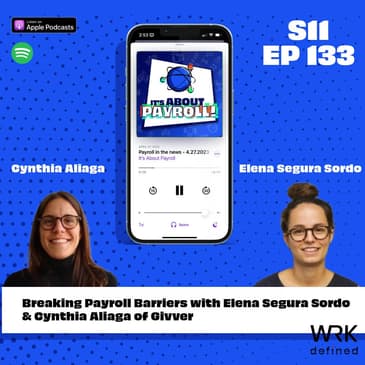
In this episode of 'It's About Payroll,' we dive deep into the complexities of payroll and how new technologies are reshaping the industry. Joined by the innovative founders of Givver.io, Elena Segura and Cynthia Aliaga, we learn about their mission to simplify payroll processes through advanced technology and AI. They share the origins of Givver.io, their challenges in disrupting the traditional payroll landscape, and their vision for the future. Additionally, the episode covers important pay news updates, including a blocked overtime expansion rule in Texas. Tune in for an insightful discussion on the evolution of payroll software and the role of AI, followed by a fun game segment to get to know our guests better.
00:00 Simplifying Payroll: The Mission
00:20 Introduction and Episode Overview
00:57 Pay News Updates: Overtime Expansion Rule
05:11 Discussion on Payroll Job Titles
07:21 Sponsor Message: TimeTrakGO
08:41 Introducing the Guests: Founders of Givver.io
10:44 The Journey to Building a Payroll Engine
16:57 Challenges and Evolution in Payroll
22:32 Overcoming Initial Challenges in Business
22:56 Adapting to New Challenges with a Growing Team
23:45 Educating Clients on New Tools and Technologies
25:17 Facing Industry Giants and Staying Bold
26:01 Simplifying Payroll with Technology
29:05 Future Plans and Embracing AI
33:51 Fun Q&A Session
36:50 Conclusion and Final Thoughts
Powered by the WRKdefined Podcast Network.
[00:00:00] For us, the main thing is we want to simplify payroll. Why payroll is so complex? Why everything that you talk to someone and you say payroll is not sexy. No one wants to do payroll. People run away, right? And this is what we want to do. We want to simplify payroll. We want to use the technology to reduce this complexity and improve accuracy.
[00:00:20] Welcome back folks. This is episode 133. It's about payroll and we have some amazing guests today. But before we get into it, how you doing?
[00:00:31] I'm excited for our guests. I'm looking forward to talking with these wonderful individuals that we have planned to join the show and a few. So how about you man?
[00:00:42] I'm good man. Yeah, yeah. Same thing, man. I'm excited. We've actually trying to get them off for a while now and just schedules and timing.
[00:00:49] And things like that. I'm super excited. But before we get into the main subject today and have our guests on, what do we have up for some pay news updates?
[00:01:00] So let's see.
[00:01:01] So that is the thing I think that everybody's been talking about. I've been seeing it on all over social media, LinkedIn, especially with some of our associates.
[00:01:10] Our connections, yeah.
[00:01:11] I've seen Christina Valor post something. I've seen her post something on there and seen a lot of it. And that propose overtime expansion.
[00:01:20] That was the Biden administration had put out there and it was going to be effective January, 2025. So a federal judge in Texas blocked it.
[00:01:30] Judge Sean Jordan of Texas ruled that the Department of Labor exceeded its authority. So he found that the proposed rule improperly prioritized salary levels over job duties, which undermined the core intent of the FLSA.
[00:01:51] Yep.
[00:01:52] Yep. What else did it do though? There's another big call out on that.
[00:01:54] Yeah. It's reverting to the salary threshold back to the 2019 level.
[00:02:00] So it's reversing what was already done in July.
[00:02:03] Push the debt back down to 35, 568.
[00:02:09] Man.
[00:02:10] How do you feel about that?
[00:02:11] It was all over social.
[00:02:13] It was like the ringing thing on the last, since it's been announced on the 15th. And I think that it, it's a double-edged sword.
[00:02:22] It's yeah. It may be good for employers to manage their budgets a little better and make better decisions on their own and give folks raises on merit and performance.
[00:02:32] And not just cause I have to, but on the flip side for the companies that made big adjustments, July one, that hurts them.
[00:02:40] Cause what if they did give these folks big increases?
[00:02:44] Yep.
[00:02:46] Now we're going to do, you can't take it. You shouldn't take it away.
[00:02:49] Not that you can't, but you shouldn't.
[00:02:52] You should.
[00:02:53] So I don't even know.
[00:02:53] Is there a right to take it back?
[00:02:56] I don't know.
[00:02:57] I don't know. I don't know if that, because the word you're saying they're right.
[00:03:00] That means legally they can. And I don't know that answer.
[00:03:04] Okay.
[00:03:05] Yeah.
[00:03:06] If legality gives them that, then clearly they have the right. Should they do it?
[00:03:11] No, I don't think they should.
[00:03:12] I agree with you.
[00:03:13] But yeah, man, that's a, it's a big calling there and more to come because it's going to have ripple effects throughout the next six months on things like that.
[00:03:21] Another person on LinkedIn had mentioned something about benefit impact on that, that I hadn't even thought about.
[00:03:27] Yeah.
[00:03:27] And I was like, oh my gosh, that's right. She's right.
[00:03:30] That's actually with Jennifer Lee. Shout out to Jennifer Lee. Worked with her in the past and stuff.
[00:03:35] But yeah, man, it's just, it's crazy that it's a, and that's what happens. And that's why when we teach this stuff, it's always stay on top of the legislation.
[00:03:44] It's great to have these references and sources from all these websites and companies and things that aggregate the data for you, but you still need to go check the federal websites, go check your state websites, go check your locals to stay on.
[00:04:00] Keep your finger on that pulse yourself.
[00:04:03] Double check.
[00:04:04] If you're looking at a encyclopedia of things or reference of things, make sure you double check it.
[00:04:08] Yep.
[00:04:09] Yeah, man. What do you think about it?
[00:04:11] No, I share your same sentiment.
[00:04:13] I don't know if a lot of employers made the move in July because a lot of them were saying, oh, we're just going to wait until the first of the year to do it.
[00:04:23] Because it may not have impacted some businesses.
[00:04:27] Like they may have been like, we're already above that, you know, or whatever.
[00:04:29] So yeah, for sure.
[00:04:30] You know, so it didn't impact every single business.
[00:04:33] No, no, no, no.
[00:04:33] But like for the ones that were impacted already, man, they might be in a tough spot.
[00:04:39] Yeah.
[00:04:39] They might be in a tough spot.
[00:04:40] Like we were already added to the bottom line and now you're telling us that we didn't have to add to the bottom line.
[00:04:45] Oh man.
[00:04:46] Come on.
[00:04:47] Hey everybody.
[00:04:48] I'm Lori Rudiman.
[00:04:50] What are you doing?
[00:04:50] Working?
[00:04:51] Nah.
[00:04:51] You're listening to a podcast about work and that barely counts.
[00:04:55] So while you're at it, check out my show, Punk Rock HR, now on the Work Defined Network.
[00:05:01] We chat with smart people about work, power, politics, and money.
[00:05:05] Are we succeeding?
[00:05:06] Are we fixing work?
[00:05:07] Eh, probably not.
[00:05:08] Work still sucks, but tune in for some fun, a little nonsense, and a fresh take on how to fix work once and for all.
[00:05:16] Yeah.
[00:05:17] Look, we actually, we should actually do a show about it because there's a lot of impact.
[00:05:23] There's a lot of considerations.
[00:05:24] There's a lot of what ifs in the interest of time.
[00:05:28] Is that, was that it?
[00:05:29] That's all right.
[00:05:30] All right.
[00:05:32] Yeah.
[00:05:32] No, it's great.
[00:05:33] Yeah.
[00:05:33] That's what I'm saying.
[00:05:33] Cause I'm like thinking about so much more, but anywho, I just wanted to share.
[00:05:36] And as we, we read the feeds, we keep our finger on the pulse.
[00:05:39] And one of the things that we've talked about on this show, I feel like we did a whole episode on job titles for payroll, right?
[00:05:45] Like how it's no standardization of payroll job titles, especially as it relates to the income matching.
[00:05:53] You could be a payroll manager and be way high.
[00:05:56] You could be a payroll director and make, not make six figures.
[00:05:59] And you could be a payroll manager and make six figures.
[00:06:01] And there's no, you could be a payroll admin, a payroll clerk and make, there's no direct correlation of job title to salary.
[00:06:09] Or then there's no direct correlation of job title to actual job duties.
[00:06:15] One of the, somebody on LinkedIn was kind of like complaining.
[00:06:18] She's in the market.
[00:06:19] She's looking and she was like complaining about how do you put these titles together in these?
[00:06:24] How do you justify the duties and this, that, and the third is just frustration.
[00:06:28] And I think it's just something to look out for and something to keep in mind as a payroll professional, when you are looking for a job to be just to not get caught up in the titles, not get caught up in the
[00:06:39] JD's, not get caught up in any one thing, figure out what's the most important for you and then help that, let that drive your navigation and your journey.
[00:06:48] Yeah.
[00:06:48] Just wanted to point that out.
[00:06:49] That's good.
[00:06:50] Because I think some people do not take certain jobs because they might feel like it's a step down, even if the pay is a step up.
[00:06:58] Cause I've been a payroll manager in title, but I didn't manage any people.
[00:07:03] Right.
[00:07:04] You just manage the payroll.
[00:07:05] I manage the process.
[00:07:06] Right.
[00:07:06] Like I've been in that position.
[00:07:08] And then made less money than I was previously making at a, you know, payroll administrator level or job title.
[00:07:16] So I think sometimes we could get caught up in a title.
[00:07:19] Like I said, Hey, I'm at this level and stuff like that.
[00:07:22] It may not necessarily mean anything about your acumen as a payroll bro or anything like that.
[00:07:29] Exactly.
[00:07:30] Exactly.
[00:07:31] Yeah, exactly.
[00:07:31] And when they started like blending titles, oh, payroll and this, a man of payroll and that.
[00:07:37] And it's like, how do you even connect those two things?
[00:07:40] Yep.
[00:07:41] So it's just interesting, man.
[00:07:43] It's just, I just shout out to payroll folks who are out there grinding it out and in the hunt and in the search and things like that.
[00:07:49] And that's it, man, before we get into our guests, let's pay the bills.
[00:07:53] You're so.
[00:07:53] Shout out to Time Track Go.
[00:07:55] If you're tired of messy timesheets or complicated time clock software, Time Track Go is an intuitive solution that makes managing employee hours simple and efficient.
[00:08:07] But don't take our word for it.
[00:08:08] Customers have given Time Track Go a 4.7 rating out of five stars on Capterra, and they have been awarded badges for best ease of use and best customer support again for 2024.
[00:08:23] And here's just some of the things that the customers are saying.
[00:08:25] Great value, best clock in time clock app on the market.
[00:08:32] Great time clock for the modern office, intuitive and efficient, simple to use and priced right.
[00:08:39] And above all, customer support is awesome.
[00:08:42] All right.
[00:08:43] So to learn more about a simply better solution for time tracking, real time reporting, PTO automation, payroll integrations or more.
[00:08:52] You want to go visit www.timetrackgo.com.
[00:08:57] That's T I M E T R A K go.com and start your 14 day free trial today.
[00:09:05] Let's go.
[00:09:06] Let's go.
[00:09:08] All right.
[00:09:09] You want to tell them a little bit about the guests we have?
[00:09:12] Yes, absolutely.
[00:09:14] Today's show.
[00:09:15] We're going to have the owner founders of giver.io.
[00:09:22] That's a give that's giver with two Vs.
[00:09:25] We're going to find out why they use two Vs.
[00:09:28] Our guests today, Elena and Cynthia of giver.io.
[00:09:34] Again, they built a payroll engine from scratch.
[00:09:40] It's, it's something that is, uh, oh, to me, mind blowing.
[00:09:44] Like remember when we started it all, we tried to, oh yeah, we're going to build a app and which we did.
[00:09:49] And we're still working on, but we, we were always like, oh, there's no reason to build an engine.
[00:09:54] There's so many out there.
[00:09:55] Why would we do that?
[00:09:56] And blah, blah, blah.
[00:09:57] So today we are going to figure out why these pioneers, these trendsetters, these disruptors have done this and what drives them.
[00:10:06] Welcome to our guests, Elena and Cynthia.
[00:10:10] I was going to try to pronounce your names, but I don't want to mess it up.
[00:10:14] Elena Segura, right?
[00:10:16] Correct.
[00:10:17] And Cynthia Aliga.
[00:10:19] Aliga.
[00:10:19] Yeah.
[00:10:19] That's, that's fine.
[00:10:20] Aliga.
[00:10:20] Aliga.
[00:10:21] I get this.
[00:10:21] I can do the proper pronunciations.
[00:10:26] I just got to hear it.
[00:10:27] Thanks so much.
[00:10:29] For joining us.
[00:10:30] We, as we, we had, again, we gave you guys an intro already and we've been wanting to do this interview so long.
[00:10:35] It was Norma by the way, cause I remember her face that connected us.
[00:10:39] I saw her digging around.
[00:10:40] I said, oh, that is her.
[00:10:41] That connected us initially.
[00:10:43] And I, me and Walt would just also call him Walter.
[00:10:46] Sorry.
[00:10:47] Me and William were very intrigued, like excited about meeting somebody who, true people who have built a payroll engine.
[00:10:56] And we were like, what?
[00:10:58] And again, we, this journey started for us trying to build an app.
[00:11:02] And we were like, oh, we would never try to undertake such a, such a job of doing a payroll engine.
[00:11:08] And so we were like, oh my gosh, we were really blown away and couldn't wait to get you on.
[00:11:12] So again, thank you for joining us.
[00:11:15] And as we start off all of our interviews with folks, we love to hear the origin story.
[00:11:21] Yes.
[00:11:21] So if you got, you know, tell us how, you know, how it was, how you got here, how you got into payroll world and building your own engine.
[00:11:30] Let's do alphabetical.
[00:11:31] So Cynthia first.
[00:11:31] I was going to say, let's Elena is the one that had the idea.
[00:11:34] So I think this will be the one.
[00:11:36] Oh, here you go.
[00:11:37] Even better.
[00:11:38] Okay.
[00:11:39] Thank you for having us in the podcast.
[00:11:42] We are very excited to have here.
[00:11:44] Cynthia and I met at university, so we know each other for so many years.
[00:11:48] After I moved to the UK, I started to work in payroll and it quickly became really good at spotting payroll discrepancies and mastering Excel.
[00:11:58] So you know that every single person that use or is in payroll, they need to be, they are very good at using Excel.
[00:12:06] Yeah.
[00:12:07] And I ended up managing a large payroll for a call center.
[00:12:11] And it was great, but it was very stressful.
[00:12:14] And I think that experience helped me to realize how manual and disconnecting the payroll system.
[00:12:21] Other than the payroll industry, it was because I remember like there was a lot of data coming from different sources.
[00:12:27] And then as well, that data needed to be inputted in the payroll system.
[00:12:31] So it was a lot of minor work.
[00:12:33] Then after I moved to, I started to work for rollbooks and as the first employee in the UK.
[00:12:41] And we were building payroll API.
[00:12:44] So we built a payroll API for the UK, Mexico, Colombia, Germany, Spain market.
[00:12:50] And we were connecting the payroll API to HR system like Personio, Bamboo, Factoria.
[00:12:57] And those HR systems were great and they are great, but they are great for HR functionalities.
[00:13:03] Right.
[00:13:03] But they have not been designed for managing the complexity of payroll.
[00:13:09] Then later, four years later, rollbooks was acquired by Personio.
[00:13:13] And if I think about those years, they were great experience.
[00:13:16] Right.
[00:13:16] If I think I moved from payroll to tech, it was really good for me.
[00:13:21] And I discovered how I may discover the potential of the technology.
[00:13:26] So how the technology could change the payroll industry.
[00:13:29] So for me, I saw a huge opportunity to simplify the payroll processes and to use the technology to reduce the complexity.
[00:13:37] Wow.
[00:13:37] So after I left Personio, I stayed in contact with the payroll industry.
[00:13:41] And that is how, and that is when Giver started.
[00:13:44] So Giver started with the Bishop to simplify payroll, to centralize processes, sorry, to centralize data and to automatize processes.
[00:13:53] So I think that was the Rake of Under because we know each other for so many years.
[00:13:58] And when you are in a big adventure as this one, you need to make sure that you are next to the right platform.
[00:14:05] And with the same mindset and the same values.
[00:14:09] Awesome.
[00:14:11] Awesome.
[00:14:11] Yeah.
[00:14:12] I was going to, I mean like link to what Elena said, right?
[00:14:14] Like we met at uni, but my journey has been slightly different.
[00:14:18] I would say like different fully.
[00:14:19] So I started in recruitment, working kind of fintech companies that hyperscale at that time.
[00:14:26] So Revolut checkout.
[00:14:27] So I was starting in recruitment, but as you're in a startup, you wear many hats.
[00:14:30] You have to do everything that is happening in there.
[00:14:32] And that was even sometimes payable or it's just like manipulating this data to then pass it on to finance,
[00:14:37] who was the impairment in those businesses.
[00:14:39] And when I guess Elena reached out to me was, this has been my experience.
[00:14:43] You can do payroll, but if you don't have kind of the user interface, you don't have the HR functionality that is collecting that data,
[00:14:50] then you can, you will never automatize payroll fully or at least not compliant, like with all the things that you have to have within.
[00:14:56] All the considerations you have to have local, right?
[00:14:58] Like in a country based on like government rules and taxation and all of that.
[00:15:03] So when Elena reached out to me, I was like, great, we can do payroll.
[00:15:06] I think it's exciting, but it has to pass as well.
[00:15:09] That kind of HR component, which otherwise you're not going to be different and you're not going to automatize really how things are meant to be evolving in the industry.
[00:15:18] Right. Like how the industry is suitable because we were actually researching and realized like in the U.S.
[00:15:24] there has been some real time payroll happening for a while, but in Europe wasn't the case when we start researching the market.
[00:15:30] So now it's more and more, but yeah, but that's like how this all got started.
[00:15:33] And I guess that was two years ago.
[00:15:35] And here we are.
[00:15:37] Crazy. Wow.
[00:15:38] Oh, so still, okay.
[00:15:39] You came from the, the HR, a similar field, at least the same, very closely related, let's say, because I did learn that.
[00:15:47] And you tell me if I'm wrong, that in the U.K. or in Europe period, or maybe it's just the U.K.
[00:15:53] I think it was Russell Webb that said that payroll is exclusively reporting to finance.
[00:16:00] Well, there is a mix really.
[00:16:02] It's true.
[00:16:03] It's more closely to finance in some companies, but it really depends.
[00:16:07] Yeah.
[00:16:07] Sometimes.
[00:16:08] Yeah.
[00:16:08] So maybe he was just thinking you, maybe he was just saying, you can, I could have it wrong because here in the U.S., it's almost split 50 50.
[00:16:14] Yeah.
[00:16:15] Payroll could report to finance or HR.
[00:16:17] Both, excuse me, both Walt and I have been at companies where it keeps going back and forth.
[00:16:22] Sweet.
[00:16:23] Oh, now we're reporting.
[00:16:24] Oh, no, we're going to remove them to there.
[00:16:25] So no matter what we say, it's the holy trinity of payroll, HR, finance, payroll.
[00:16:31] Yeah.
[00:16:31] Have to move in lockstep for success.
[00:16:34] So that's amazing stories.
[00:16:36] I love it.
[00:16:37] Thank you for sharing them.
[00:16:38] Yeah.
[00:16:39] Now, does that cover why you built Giver?
[00:16:43] Is it to simplify, like you said, Elena, to just to simplify the complexities?
[00:16:48] Yes.
[00:16:48] Correct.
[00:16:49] To simplify the complexity of payroll.
[00:16:51] Wow.
[00:16:52] Because we truly believe that payroll has not very, has not been defracted.
[00:16:57] And the way that people are doing payroll is the same way that people has been done payroll for the last 20 years.
[00:17:04] Yeah.
[00:17:04] And this is what we are trying to do, to change the way that people are doing payroll.
[00:17:08] I love it.
[00:17:09] I love it.
[00:17:10] Like something you said, Elena resonated with me is that you did it based on your own experience with payroll.
[00:17:17] It's why you saw that there was a problem.
[00:17:19] Hey, we need better solutions for these problems and how you're, how we process payroll.
[00:17:24] And I love that.
[00:17:25] So if you could just segue into the evolution of payroll software that you want to see, that would be great for us.
[00:17:32] So how, how do you think payroll is going to evolve?
[00:17:35] And maybe you could speak to AI and that as well.
[00:17:40] Maybe you can get you want to think how, yes, we do.
[00:17:43] I mean, something that we've noticed and like what Elena said, really, the industry haven't been disrupted properly.
[00:17:51] And for many years has been like the way how we've done things is, it's been always the same.
[00:17:57] And we've noticed when, now that when we go to market and we put our product in front of customers, we see like some companies wanted to change things.
[00:18:04] Like some others just wanted to do it the same way.
[00:18:07] Right.
[00:18:08] And like they, like, not really, we are super willing to, to implement new technology.
[00:18:13] Definitely.
[00:18:14] One of the areas that payroll has is like heavy data, right?
[00:18:18] Like processing.
[00:18:21] So AI is going to come there straight fully and to helping to those tasks.
[00:18:26] And we, when we see that happening, we are already doing part of that work ourself because something that we as well notice is that all these.
[00:18:34] Businesses have been doing payroll in a very old fashioned way, dealing with tasks that are boring, not necessarily.
[00:18:40] Like why other kind of, I don't know, sales, marketing have evolved so much in the technology they use when managing the day to day and other operations and why payroll doesn't have that kind of evolution in the tools they are using.
[00:18:53] So AI is going to come to help there.
[00:18:55] And that's definitely what we see real time, a hundred percent.
[00:18:59] And, and to do that, you as well have to get all the compliance, like the compliance bit of HR and localized because we are getting all these passwords of global payroll, blah, blah, localized.
[00:19:12] Right.
[00:19:13] There is no way that you can create all of a sudden 150, 100 and whatever payroll engines.
[00:19:19] You have to take into account what is happening in those markets.
[00:19:21] Right.
[00:19:22] So yeah.
[00:19:26] You know what you should know?
[00:19:28] You should know the, you should know podcast.
[00:19:30] That's what you should know because then you'd be in the know on all things that are timely and topical.
[00:19:37] Subscribe to the, you should know podcast.
[00:19:40] Thanks.
[00:19:40] We keep building those payroll engines that are close to the source of that data, which for us, we are saying it is, is customers, right?
[00:19:47] Like this employees is those users and it's like signals, maternities, all that information that is impacting a payday.
[00:19:54] That's what we see, like the evolution of bringing payroll to HR.
[00:19:58] I don't know, like, I don't know how you want to put it because people will put it differently, but ensure that the data that is used to process payroll is living within payroll.
[00:20:08] Because otherwise there is like these integrations that might be, you know, like calling APIs, but sometimes they don't speak the same language.
[00:20:16] So we are again having trouble there.
[00:20:18] Seeing more of that, those payroll engines, those payroll products within HR or the other way around.
[00:20:22] I don't mind, but it has to be together because I know there is a huge, as we were discussing before about HR or finance, where is payroll sitting?
[00:20:31] I think that's one of the main problems that payroll function is sometimes sitting in one function in one department, sometimes in another one.
[00:20:40] That makes more difficult even to have a software that truly serves payroll operations, right?
[00:20:45] So just long story short, AI, that's really the real time.
[00:20:50] And then ensuring that kind of compliance HR payroll work together in terms of like how you set up systems, how that system is triggering certain information to then get those calculations right.
[00:21:01] Right?
[00:21:02] So that's, I guess what we see.
[00:21:04] I don't know, Ellen, if I forgot something, maybe add it like data source, right?
[00:21:08] Because this is something what we can now when we are onboarding customers, it's normally like they come to us like with 20 different files.
[00:21:16] Even sometimes the files are in PDF.
[00:21:18] They are not even in Excel, right?
[00:21:20] Oh my gosh.
[00:21:20] Yeah.
[00:21:21] And then when you need to reconciliate the data, then you can see that even sometimes the file are not matching the data, right?
[00:21:26] Yep.
[00:21:26] And this is the biggest point is like, we want to make sure that payroll is about, we want to use the technology in that one, in that way.
[00:21:34] Like we want to solve the complexity of payroll and bringing accuracy because this is key for payroll, right?
[00:21:41] If you don't know the self of truth and the data is not correct, payroll is never going to work.
[00:21:46] And this is something that we noticed since we start onboarding a customer.
[00:21:50] This is something that we noticed.
[00:21:51] Or for example, when we onboard a customer, we always audit the customer.
[00:21:56] And then we can see that maybe the policies that they have are completely different the way that they are paying employees.
[00:22:02] Right?
[00:22:02] That is why it's very important that we partner with the companies.
[00:22:07] We partner with the company and we understand the end-to-end payroll and HR process.
[00:22:12] Yeah, that's awesome.
[00:22:13] Amazing.
[00:22:13] I hear Anita Latink when I hear you guys speak because, right?
[00:22:19] I always go.
[00:22:20] And now I think I'm going to name her the godmother of the modern payroll.
[00:22:24] La Madrina.
[00:22:26] Because she, I always think of that statement in her book where she says payroll starts with the HR data.
[00:22:34] You, we can't get away from that.
[00:22:35] You can't disconnect it.
[00:22:36] And like we spoke about on the preparation call for this.
[00:22:40] In the world, they said even on the, on their side, they have the same problem with leaders and companies understanding that there is, it's a connection.
[00:22:48] And it has to be connected.
[00:22:49] It has to be talking.
[00:22:50] So I just hear that more and more as you guys speak.
[00:22:53] And I'm so excited about seeing the evolution.
[00:22:56] And I know there's a lot of challenges probably, but is there one, give us one example of what was in the beginning a challenge?
[00:23:06] And then maybe now what are the new challenge?
[00:23:09] Because you've grown a lot into what was something in the beginning that was a big challenge?
[00:23:14] And what is something now that you have if it's different?
[00:23:17] Starting a business is a challenge, right?
[00:23:20] And building a payroll infra was a challenge from the beginning.
[00:23:24] And it is still a challenge.
[00:23:26] I will say that the main challenge when we started was that we were bootstrapping and which means managing everything ourselves from product development to the day-to-day operational business, right?
[00:23:36] And sometimes when you are building a business, you don't know if you are in the right direction, right?
[00:23:41] That has been very challenging.
[00:23:44] And now if I think now the challenges are different.
[00:23:46] Now we managed to build a strong team that align with the vision that we have.
[00:23:52] And now the technology that we have developed, we can see that has improved and is more and has improved and as well helping us to reduce those manual operation processes that we were doing internally.
[00:24:05] And then as well, we can see that the payroll infra is able to do, is able or is supporting us to acquire bigger customers, which is good.
[00:24:14] I will say that now the challenges are slightly different.
[00:24:16] It's more like managing customer expectations and then as well the market shift, right?
[00:24:23] For example, we're talking about the AI, right?
[00:24:25] How we can take advantage of the AI.
[00:24:28] So I don't know if I think that maybe wants to add something else.
[00:24:31] You know, I think on that, I think one of the, back to what I said earlier, right?
[00:24:36] Like this has been done in a certain way for so many years that sometimes it's even difficult to go to a client and tell them this is a tool that can do much more for you than what you used to be doing.
[00:24:46] There is a task as well of educating a bit, like, like these tools are new and this is where you're going to see it moving forward because it's where the industry is going.
[00:24:54] And let's be honest, like payroll is taking a huge role now within a lot of like, kind of these processes of HR and for finance.
[00:25:03] So payroll is, it's at the center now.
[00:25:05] So, um, so it's educating on that, on those changes that they as well have to see themselves like happening within the organizations.
[00:25:13] So I think that's a part that it is challenging because again, they are used to the things in a way.
[00:25:18] And sometimes payroll is quite critical and it's a lot about trust.
[00:25:21] And if you trust the process, you might not want to take it, to touch it, and you might want prefer to live it in the way that it is.
[00:25:28] But, but yeah, but technology as well is quite helpful and can make sure that you reduce the amount of time you spend running payroll for by many minutes and hours and days.
[00:25:38] So I think that education is as well part of the challenges that we are seeing with these customs.
[00:25:45] I don't know if you, this resonates with you as well in the sense that.
[00:25:48] Oh, yes.
[00:25:49] Absolutely.
[00:25:49] Yes.
[00:25:50] Absolutely.
[00:25:51] Absolutely.
[00:25:51] We, we find ourselves having to teach our leaders about things.
[00:25:55] No, that's not how it's done and an absolutely big thing in us.
[00:25:59] Yeah.
[00:26:00] With that, it is a big task.
[00:26:03] What gave you guys, how I worded in the question, the audacity to take on big business?
[00:26:09] Because there are big payroll engines out there in the U S for example, ADP processes one out of every $4 that goes through the IRS.
[00:26:19] That's not that you're taking ADP on yet, but what gave you guys, did you get scared along the way?
[00:26:27] Did you want to give up along the way?
[00:26:28] We can't do this.
[00:26:30] Sometimes, like we, sometimes like you get scared and you say, okay, what are we doing?
[00:26:34] Right.
[00:26:34] Then I have a lot of gray hair around here.
[00:26:37] Right.
[00:26:37] We can't see it.
[00:26:38] Don't worry.
[00:26:38] We can't see it.
[00:26:39] That is good, but I can guarantee both of us has a lot of gray hair.
[00:26:43] Since we have started here.
[00:26:45] Yeah.
[00:26:45] Since we have started.
[00:26:46] Oh, right.
[00:26:46] Before, before it was way more better.
[00:26:49] And just like building a payroll infra, because it's not like we are building a payroll processor that is connecting HR and payroll.
[00:26:56] No, we are building a payroll infra.
[00:26:58] It was a bold move and it was challenging, but we felt that it was worth it to take it.
[00:27:05] Both of us are coming from the industry.
[00:27:07] Both of us knew it, how inefficiently and disconnected those systems are.
[00:27:12] Then as well, we know that the HR ecosystem has been disrupted, but not the payroll.
[00:27:18] Right.
[00:27:19] We know that there are big players in the market, as you say, like ADP, but those companies are slow moving.
[00:27:27] Right.
[00:27:27] And sometimes even they are not using the technology to solve the problems they are having.
[00:27:32] And for us, it's the other way around.
[00:27:34] We want to, for us, the main thing is what we want to simplify payroll.
[00:27:38] Why payroll is so complex?
[00:27:40] Why everything that you talk to someone and you say, payroll is not sexy.
[00:27:43] No one wants to do payroll.
[00:27:45] People run away.
[00:27:46] Right.
[00:27:46] And this is what we want to do.
[00:27:48] We want to simplify payroll.
[00:27:49] We want to use the technology to reduce this, this complexity and improve accuracy.
[00:27:55] Accuracy.
[00:27:55] Because this is very important.
[00:27:57] And of course it was like a boldness decision.
[00:28:00] Right.
[00:28:01] But we believe that by building a payroll infra, we've resolved in centralizing data.
[00:28:07] We'll resolve as well in automation, key prophecies.
[00:28:11] Mm-hmm.
[00:28:12] And we want to change the way that payroll has been done until now.
[00:28:16] Right?
[00:28:16] This is the main thing we need to reinvent.
[00:28:19] And that is why we are here.
[00:28:20] Amazing.
[00:28:20] And we can see that every time that we are onboarding, keep in mind that we started this
[00:28:25] with our own money.
[00:28:26] And every time that we onboard a new customer and every time that we see that we are solving
[00:28:30] a problem, that is for us a way to set, or that's a way to validate that we are on the
[00:28:36] right path.
[00:28:37] And we are enjoying it.
[00:28:38] Yes.
[00:28:38] There are very tough moments, but there are very like good moments.
[00:28:43] You're getting the wind.
[00:28:44] Yeah.
[00:28:44] Yeah.
[00:28:45] That's amazing.
[00:28:46] Amazing.
[00:28:48] Yeah.
[00:28:49] So can I ask why the two Vs in the name?
[00:28:53] When you were creating the name, what went into the thought process with that?
[00:28:57] We, I mean, that was, yeah, we were very discussed in which the W is purely just
[00:29:02] to not have giver in the sales light as a one, but we see like HR, payroll as figures
[00:29:11] within companies that many times take a lot of work, but they can give back a lot.
[00:29:15] And sometimes it's not very rewarded because many people think like payroll is just pressing
[00:29:19] a button and it's not the case.
[00:29:20] Yep.
[00:29:21] So like the figure of just that giver that is always there, just everything comes to them,
[00:29:26] but, and they deal with it and they carry on.
[00:29:28] So that's like the origin of the name.
[00:29:30] And that's the Vs is just purely to not have the giver and have something cooler as a tech
[00:29:35] business.
[00:29:37] Oh, cool.
[00:29:38] Thank you for sharing.
[00:29:40] Yup.
[00:29:40] Yup.
[00:29:41] That makes sense.
[00:29:41] That makes sense.
[00:29:42] I love it.
[00:29:43] I love it.
[00:29:44] I'm so excited.
[00:29:44] I can't wait to see you guys come to the U.S.
[00:29:47] I'm in, I'm all in.
[00:29:48] I'm a fan.
[00:29:49] Yes, definitely.
[00:29:50] So tell us what's next for giver and for you.
[00:29:53] As, as Elena mentioned, like we, we did started with smaller businesses.
[00:29:58] We jump into bigger accounts and that's obviously as well.
[00:30:01] The more we get closer to these bigger accounts, the bigger is their pains and the higher are
[00:30:06] their frustrations because honestly, they, none of the customers that we speak with, they
[00:30:10] have a good experience with payroll providers, payroll services.
[00:30:14] We need to ensure that we carry on and serving those customers, like ensuring as well the passion
[00:30:19] the early team has with solving those problems, carry on as we get bigger.
[00:30:23] Because obviously.
[00:30:25] Hey, it's Bob Pulver host you podcast, human centric AI, AI driven transformation, hiring
[00:30:31] for skills and potential dynamic workforce ecosystems, responsible innovation.
[00:30:37] These are some of the themes my expert guests and I chat about, and we certainly geek out
[00:30:41] on the details.
[00:30:42] Nothing too technical.
[00:30:43] I hope you check it out.
[00:30:46] I think if you get bigger, you serve more businesses.
[00:30:49] Sometimes you disconnect a bit from those customers that have real pain.
[00:30:53] So we need to ensure that we stay close to them.
[00:30:55] And because many times we are seeing is the experience, the problem, like with the software,
[00:31:00] with the payroll partners is the biggest frustration, right?
[00:31:04] So we want to ensure that customer experience stays there for a long time here in the UK
[00:31:07] with the customers we have and obviously boarding bigger accounts.
[00:31:10] That's exciting.
[00:31:11] Boarding is important as well for us in the more AI.
[00:31:14] We were chatting about it.
[00:31:15] We are seeing already internal.
[00:31:17] We haven't done a lot of that work yet on the actual product for customers to see it, but we are, as
[00:31:23] Elena mentioned before, as soon as we see something that shouldn't be done a few times, like manually
[00:31:29] it's an admin task.
[00:31:30] We look into ways to automatize this.
[00:31:33] And for instance, like implementations, onboardings, like companies get charged thousands for those processes, right?
[00:31:41] Like when you start with a new partner, a new payroll partner, like we are not doing that.
[00:31:45] We are just seeing that we can do much more with technology instead of just having weeks of implementations, onboardings.
[00:31:52] AI is very important for us in the next few months, I guess for everyone, but for us as well internally and for our product customer facing.
[00:32:01] And then what is different from what we've done so far in the sense that we bootstrap the business.
[00:32:06] What Elena mentioned has been challenging.
[00:32:09] Definitely.
[00:32:10] In one day you have the highest and the lowest.
[00:32:13] So definitely that's, that's, that's been the case, but something is we are doing as well now is fundraising.
[00:32:18] We are not here to do any promotion of that, but, but with one, we brought on board some angels already.
[00:32:23] People from the industry payroll, HR, because they know there is a huge problem.
[00:32:28] There is a still not disruption, like enough disruption in the space.
[00:32:31] And that's as well, I guess it means that we will be growing faster, moving faster as well.
[00:32:37] And in the next few years, months, looking into other markets, which is exciting.
[00:32:42] And obviously when we are talking about other markets, mostly payroll, right?
[00:32:45] Because it takes a lot of time.
[00:32:47] The HR software we have is already growing.
[00:32:50] So you can have employees in any country and that will work.
[00:32:53] Oh, amazing.
[00:32:55] Yeah.
[00:32:55] We've been well surrounded by payroll experts that are still seeing.
[00:33:00] Norma's also in payroll?
[00:33:02] Yes.
[00:33:02] Norma's in payroll?
[00:33:03] Oh, we've got to have Norma on the show.
[00:33:05] Of course.
[00:33:06] Yeah.
[00:33:07] Oh, goodness.
[00:33:08] I'm going to reach out to her.
[00:33:10] She has to.
[00:33:11] Her, I'm funny, say it's amazing.
[00:33:13] Payroll.
[00:33:13] Yeah.
[00:33:13] It's fine techy as well.
[00:33:15] So obviously, I think.
[00:33:16] Oh, okay.
[00:33:16] Things to build quite a few payroll engines or at IBM.
[00:33:19] Yeah.
[00:33:20] Something like that.
[00:33:20] So definitely you still have to.
[00:33:22] I'm going to reach out to her.
[00:33:23] Okay.
[00:33:23] Yeah, for sure.
[00:33:24] Wow.
[00:33:25] This is great.
[00:33:26] Anything, Walt, before we get into the game, we usually like to play a little game with our guests and
[00:33:31] just a little things to get to know a little bit more beyond payroll.
[00:33:35] Um, no, I'm good.
[00:33:36] Anything before you talk?
[00:33:37] No, I'm good.
[00:33:37] I just want to thank you both for sharing your story and your personal stories and about your start in tech and payroll.
[00:33:44] And it was a pleasure having you on.
[00:33:47] And I'm excited for what you and Giver are going to do in the industry.
[00:33:51] Well, thanks so much for having us.
[00:33:53] We're big fans of the podcast.
[00:33:54] Thank you.
[00:33:54] Thank you so much.
[00:33:55] Oh, thank you.
[00:33:56] See, that's, that's our payment right there.
[00:33:58] Cause that's what we've been thriving on is just folks being able to help and impact.
[00:34:02] And you heard it here, folks.
[00:34:03] We had them on the show first, the first in the world, the podcast.
[00:34:08] Yes.
[00:34:09] We keep on breaking ground.
[00:34:10] And to be all paid, it's good, really, to find people that they have the same passion that we have.
[00:34:14] And we are starting to talk about payroll because regardless of the side of the company, every single company need to pay employees and they need to pay payroll.
[00:34:22] And we're going to be able to pay payroll, but there is not enough disrupt disruption in the market.
[00:34:26] So it's good.
[00:34:26] I love it.
[00:34:27] Yes.
[00:34:28] Yeah.
[00:34:28] I'm so excited for you.
[00:34:29] God bless you.
[00:34:30] Good luck.
[00:34:31] Congratulations.
[00:34:32] I'm so excited.
[00:34:33] Keep going.
[00:34:34] Yes.
[00:34:34] I'm a fan.
[00:34:36] Send me a poster.
[00:34:38] I'll put mine up here.
[00:34:39] Do you guys have merchandise at all?
[00:34:43] Not much, really, but I'm wearing the Giver T-shirt here.
[00:34:46] Okay.
[00:34:48] So we'll get you some of these.
[00:34:50] Okay.
[00:34:50] Awesome.
[00:34:51] Yes.
[00:34:51] I would love it.
[00:34:52] We could swap.
[00:34:53] We'll send you guys some stuff too.
[00:34:55] Okay.
[00:34:55] Awesome.
[00:34:56] Cool.
[00:34:56] All right.
[00:34:56] So let's get into this game.
[00:34:57] We call it this or that.
[00:34:58] So we're going to ask you a few questions and both can answer, or you can say one or the other or neither.
[00:35:05] Neither or both.
[00:35:06] Yeah.
[00:35:06] And then we can just go from there.
[00:35:08] So Brian, do you want to start off like the first four?
[00:35:11] Yeah, sure.
[00:35:12] Okay.
[00:35:12] We gave you, we gave you this one, right?
[00:35:14] Spain or London?
[00:35:15] I know.
[00:35:16] And I reply because she doesn't live in London anymore.
[00:35:18] So it's like, for me both.
[00:35:21] Both.
[00:35:22] I love Spain and I love the UK.
[00:35:23] Okay.
[00:35:24] The UK has been an amazing country for me.
[00:35:26] And Spain as well.
[00:35:27] So I cannot choose.
[00:35:28] Okay.
[00:35:29] Okay.
[00:35:29] Fair.
[00:35:30] Cynthia?
[00:35:31] Yeah.
[00:35:31] The same.
[00:35:32] Have this relationship, love, hate with London.
[00:35:34] So it stays balanced.
[00:35:36] And then Spain has so much.
[00:35:38] His family is friends.
[00:35:39] It's home, right?
[00:35:40] Yeah.
[00:35:41] Cool.
[00:35:42] Google sheets or Excel?
[00:35:45] Google sheet.
[00:35:46] Oh, wow.
[00:35:47] Absolutely.
[00:35:48] Okay.
[00:35:49] Absolutely.
[00:35:49] I'll say the same.
[00:35:51] Sheets?
[00:35:52] Okay.
[00:35:52] I mean, don't get, I'm less of a payroll person.
[00:35:55] I'm still a payroll person, but I feel, so I, Google sheets for me is yeah.
[00:35:59] Okay.
[00:36:00] I know like most of you are mostly Excel, right?
[00:36:02] You both probably are.
[00:36:03] That's why I'm so surprised.
[00:36:04] Okay.
[00:36:05] I've been getting more into sheets lately and now they have some new tools that I really
[00:36:09] love cause they were given templates.
[00:36:10] Like they're getting the AI in there a little bit.
[00:36:13] So that has really changed it for me.
[00:36:15] I've been moving more toward Google sheets now because of it.
[00:36:17] Yes.
[00:36:18] The user interface is great and it's very easy to use, right?
[00:36:21] Yes.
[00:36:21] Yes.
[00:36:21] I used to use Excel, but then I moved to Google.
[00:36:24] I just, I just have to get comfortable with the, like where, I know where it is in Excel,
[00:36:30] but I don't know where it is in Google sheets.
[00:36:31] So that's the learning curve.
[00:36:33] That's Apple or Android?
[00:36:35] Apple.
[00:36:36] Apple.
[00:36:37] All right.
[00:36:38] All right.
[00:36:41] Um, WhatsApp or Slack?
[00:36:45] Slack.
[00:36:46] Slack.
[00:36:47] I like Slack quite a lot.
[00:36:49] Really?
[00:36:50] Okay.
[00:36:50] Well, Cynthia's undecided.
[00:36:52] Yeah.
[00:36:52] I think WhatsApp.
[00:36:53] Yeah.
[00:36:54] WhatsApp.
[00:36:55] WhatsApp.
[00:36:55] Okay.
[00:36:56] Yep.
[00:36:57] Cause I hear it's bigger outside of the U.S.
[00:37:00] That was one of the things that drove the question.
[00:37:02] Walt, you finish it all for us?
[00:37:03] Yeah.
[00:37:03] I have three more questions for you.
[00:37:05] Oh, you have many questions.
[00:37:06] Cryptocurrency or fiat?
[00:37:09] Fiat.
[00:37:11] Okay.
[00:37:11] Okay.
[00:37:13] Elena, the same.
[00:37:14] But fiat lady car or?
[00:37:16] The, the, the, the, the, the, the, the, the, the, the, the, the, the, the, the, the,
[00:37:17] the, the, the, the.
[00:37:20] Right.
[00:37:20] If I want it,
[00:37:22] No, I like to leave.
[00:37:22] Yeros, like fiat.
[00:37:23] Fiat.
[00:37:24] Fia currency, yeah.
[00:37:25] Terra is currency.
[00:37:26] Yeah.
[00:37:26] It's a bank.
[00:37:27] Nueva curiosity.
[00:37:28] Okay.
[00:37:29] crypto oh oh okay okay all right paella or the snot show right yes and then i've had
[00:37:38] sorry i'm as fast as far as pablo picasso or salvador dali
[00:37:47] oh i love it okay yes all right yes i love it that was it that was it thank you oh my gosh so
[00:37:54] amazing thank you to come on um thank you for joining us thank you so much and like always
[00:38:01] folks we love you we'll see you next time before we sign off here are a couple quick things don't
[00:38:07] forget to follow it's about payroll on linkedin and it's about your paycheck on facebook and tick
[00:38:12] tock thank you for being part of our payroll community and thank you for being a part
[00:38:18] of this journey with us until the next time keep learning keep growing and most importantly
[00:38:24] keep going
Sponsors
