
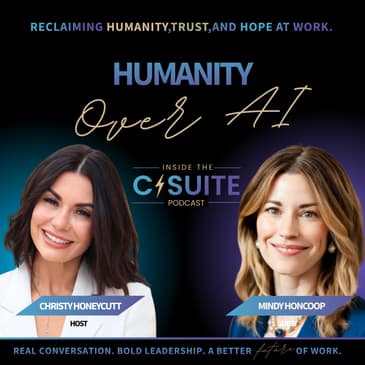
AI is changing everything—but let's be honest, technology has never been the hardest part of transformation.
People are.
Organizations are investing millions into AI, automation, and digital transformation, yet many are overlooking the one thing that determines whether those investments succeed: leadership.
In this episode of Inside the C-Suite, I sit down with Mindy Honcoop—HR executive, executive coach, founder of Agile in HR, and co-founder of Alt HR Hive—to unpack what it really takes to lead through uncertainty without losing your culture, your people, or yourself.
With more than 25 years of helping organizations navigate transformation, Mindy reminds us that AI doesn't replace leadership—it magnifies it. The leaders who thrive won't necessarily be the ones with the best technology. They'll be the ones who know how to create trust, invite curiosity, coach instead of control, and lead humans through change.
Together, we dive into why so many transformation efforts fail—not because the strategy was wrong, but because leaders forgot that every business transformation is, first and foremost, a human transformation.
We also explore why HR has one of the greatest opportunities in decades to move from a support function to a true strategic driver of business growth. If HR can help leaders build trust, navigate uncertainty, and create cultures where innovation can flourish, it won't just have a seat at the table—it will help design the table.
What you'll learn:
Why AI should amplify humanity—not replace it.
The leadership behaviors that make or break transformation.
How fear quietly sabotages innovation.
Why coaching has become one of the most important leadership skills.
The difference between scarcity leadership and abundance leadership.
How self-awareness shapes better executive decisions.
Why trust—not technology—is the real competitive advantage.
The future of HR as a strategic business partner.
How to build organizations where people and performance grow together.
If you're leading through change, wondering how AI fits into your organization, or simply trying to build a workplace where people actually want to show up, this conversation is for you.
Because the future of work isn't just about smarter technology.
It's about becoming smarter humans.
| Connect with Us |
Follow Mindy Honcoop:
LinkedIn – https://www.linkedin.com/in/mindyhoncoop/
Company Page – https://www.linkedin.com/company/agileinhr/
Facebook – Agile in HR
Instagram – AgileinHR (@agileinhr) • Instagram profile
Website – HR Executive Advisor near Austin, TX - Agile in HR
Vibe People Studio | Culture Design and Activation
(Mindy Honcoop is an HR executive, executive coach, strategic advisor, and founder of Agile in HR and co-founder of Alt HR Hive. With more than 25 years of experience guiding organizations through mergers, digital transformation, AI adoption, and organizational change, she partners with leaders to build human-centered organizations that are resilient, adaptable, and prepared for the future of work.)
Follow Inside the C-Suite:
LinkedIn – https://www.linkedin.com/in/christyhoneycutt/
Subscribe on Spotify – Inside the C-Suite
Subscribe on Apple – Inside the C-Suite
Follow WRKdefined:
LinkedIn – WRKdefined
Instagram – WRKdefined (@wrkdefined) • Instagram profile
Facebook – WRKdefined
Website – WRKdefined Podcast Network: Conversations Pushing The Boundaries of Work
Want to be on the show or know someone who would be a great guest?
Podcast Nomination Form – Podcast | Empower Your Leadership Journey — Listen Now — Christy Honeycutt
Powered by the WRKdefined Podcast Network.
[00:00:00] You shared that one of your defining moments for you was finding your voice and letting go of people pleasing. And I think that that's a really beautiful thing. What changed to make that happen? Failing? Yeah, failing did because I was trying to make everyone happy and I had minimized my voice too much that I no longer had the authority that I needed to be able to drive change or be able to shine a light into what the current state actually was and how the board and executive team members were or were not aligned.
[00:00:30] Along with the private equity organization. And what did they really value and want from a people function? And so after stepping out of that, I realized you can't. You can't. By pleasing everybody, dang, you get really good at knowing what motivates them, but you're not keeping the organization at heart or the value that you bring. Like your voice becomes so tiny. Your voice becomes so tiny because you're carrying everyone else's emotional responsibility is on you versus letting them be responsible for their emotions.
[00:01:11] Hi, I'm Christy Honeycutt, your host for Inside the C-Suite, where execs get real about leadership, impact, and what truly drives high stake decisions. Today's guest has spent more than 25 years helping organizations navigate one of leadership's greatest challenges, change. Mindy Honkup is an HR executive coach, strategic advisor, founder of Agile in HR, and co-founder of Alt HR Hive.
[00:01:36] She's helped organizations lead through mergers, digital transformation, AI adoption, and organizational change, all while keeping people at the center of the conversation. Today, we're talking about what it really takes to build organizations that are agile, resilient, and deeply, deeply human in an era where technology is changing faster than most leaders can keep up. Let's jump in, shall we? Mindy, I am so excited to have you on the show.
[00:02:04] Those that are joining may not know, but Mindy has become a very close personal friend of mine and just the woman, the wind beneath my wings in so many areas. So, Mindy, I know that my introduction did not do you justice. I don't think anybody could do you justice with an introduction. I would love for you to share a little bit about who you are and what you do. I always have had such a hard time answering that question because I do a lot of things.
[00:02:26] But I recently realized the quick synthesis of that is I'm a recovering chief people officer that is really passionate about elevating and equipping people in and through change. That is perfectly said, and that, in fact, you do. And a little just shout out to one of our friends. Mindy and I are both in a book, and I know you see my sweet notes on LinkedIn going, you know who you are. But we have a friend named Jen Porter who wrote the book. I'll let you say that the title. Lioness Rising, right?
[00:02:55] Isn't it Lioness Rising? Now I'm so passionate about the book. It's just lioness. I know. We're all bad mamma jamma lionesses. It's basically a collection of stories of women overcoming obstacles, and there's so many beautiful stories in there. So thank you for nominating me to be a part of that work and to Jen for creating such a movement within our industry. I love it. Well, you are so strong. You're so inspiring from when I was really stepping into my voice and learning how to roar.
[00:03:25] Well, we all figure it out every day. So I have so many questions for you. Our origination story was in Austin. Got to meet you actually at Garrett Mintz Ambition in Motion Conference, right? So guys, boys and girls, networking works, but only when you build relationships because there were probably 75 people there. But I walked away with a handful of friends and colleagues, and you were one of them. So very grateful. Shout out to Garrett Mintz on that too, Ambition in Motion.
[00:03:51] So let's talk a little bit about leadership through change because that is your specialty. That is your shtick. You've spent your career helping organizations. You've worked for some really great brands, Navigating Transformation. What's the biggest mistake that you see that leaders make when leading change? The biggest mistake I see is moving too quickly and starting to really stuck in their own head, overthinking,
[00:04:15] and getting into a less than mindset and getting into really short-term thinking and losing sight of the long term. And because we're in less than mindset, the behaviors that come out of that are less than. And then everything we start doing starts to feel like we're working against our own self, but we're not realizing it because we're not taking the time to take a moment, to take a step back, to see that holistic ecosystem of work, of how work even gets done in our organization,
[00:04:45] and how are we helping or getting in the way of that? You actually did a beautiful talk at HR Disrupt, I believe, right? And it was called The Moment HR Stops Doubting Itself, which I love because you are really, really good at the HR stuff. That is also your shtick. I'm going to let you finish it, but you said questions create understanding. Understanding creates awareness. And awareness creates clarity. And that allows you to co-create. So it was a little five-minute, right? Am I right?
[00:05:14] It was about five minutes. It was five minutes. Yeah, Disrupt HR is very, I'm not going to remember. It's like a catapoochia method. I never say that right. But you have five minutes and 20 slides at auto-advance every 20 seconds. I think that math's out It's not girl math, guys. It's actually math math out. No, I watched it and I'm actually kicking myself because I was going to try to be there and I wasn't able to attend. And I also kicked myself because I waited so long to watch the doggone thing. It was only five minutes. It was quite inspiring. It was very theatrical.
[00:05:44] And I love that you guys were dressed the same. You had ponytails on. And it was just like you were portraying kind of your inner voice, if I'm accurate in what I saw. And it was powerful because we all have, if I offend anybody for this term, I'm sorry, but I call that dick energy, right? Like we have this energy. I just happen to name my bad shadow energy dick. And I have conversations with dick all the time. But we do that. We have this lack mindset sometimes that just sits on our shoulder and tells us that we're not good enough. We're not doing it right. We're going to be replaced. We're not smart enough.
[00:06:12] And I think that that's really interesting because I don't know, I don't care what seat you're sitting in. Everybody's had that at one point or another, especially in the current environment. And all these leaders feel like they have to have the answer. But in the current environment, none of us have the answer. And we can't do this alone. That's the thing. We aren't going to be able to have the answer. We have to lean into dialogue. We have to lean into co-creation to be able to inform the next steps forward.
[00:06:39] That is often like when I build on, okay, well, what is happening for me right now? How do I take a step back and look internally at my self-talk and how I am or am I not equipping myself? How am I working with or against myself? And so that doubt and a lot of what that voice is saying is masking deeper levels of shame. And that can be a whole nother conversation for another day. But I got really passionate and started nerding out on shame science.
[00:07:09] Tell me more about shame science. Shame science. And Brene Brown obviously comes to mind for a lot of people, but there's other shame scientists. And really, like, I think one of the things that was an aha moment for me is Brene Brown, like, is so relatable when she talks about it. But it's okay. Why is that? Because she always says you can't connect with others more than you can connect with yourself. But the science behind that is that once we become disconnected, our own brain starts to disintegrate.
[00:07:36] So shame actually disintegrates our brain from being able to function like the neural pathways and it minimizes our capability to use our brain power. And as we start to disconnect, there's that shame that blocks us from wanting to connect with others. But the very thing that we need to heal is in relationship with others. And that's how we heal from shame is by being in community, by being a connection with others.
[00:08:03] And that all of us have levels of shame and shamed people. And fortunately, shame people because we're walking around not knowing it. And we have these less than behaviors. But it's like a double-edged sword, right? Like, we very much need to be in community. Yet right now, we're in such a disconnected world, disconnected from ourselves. The very thing we're not seeing is people showing up and leaning into the discomfort of community. Yes. And the only way through it is through it.
[00:08:32] And so many people just spend so much time just bouncing around and, like, numbing it, right, with various different things, whether it's something that you're eating or drinking or laying around. Or Netflixing. Netflix, yeah. There's so many different things. Like, I will fall into a Zoom. If you get me on my phone, I call it the mummies, like we talk about it. Like, it looks like you're a zombie in our house because you might, like, stop for a second because we're both entrepreneurs in our home. But you stop for a second and you look at an email.
[00:08:58] And then you're just standing there like this, like hunched over at your phone, completely sucked into this digital device. And I saw another podcaster do this. It was quite lovely. It was a red string and they were holding a string, having a conversation with each other. And the second the person picked up their phone, the string dropped because the connection was broken. It was broken. We break the connection all the time. And I think people don't realize the impact their presence has not only on yourself, but another person.
[00:09:27] Like, we joined the call today and both of us, I told you I had the Sunday scaries. I'm like, oh, I've had a really tough week. What do I have today? Because I always check the night before. And when I saw it was you, I was excited. I'm like, I'm going to talk to Mindy today because it's good energy and we connect, right? And it's a quick connection. It's a vulnerable connection, but it's there. And if any of you want to know how vulnerable, go check out The Lioness and you will know just how vulnerable, right? Yeah. Yeah. Let's talk a little bit about what everyone's talking about.
[00:09:55] AI, AI, AI, AI, yeah. Yeah. AI and humanity. Yeah, yeah, yeah. Very few people are talking about humanity. A lot of people are talking about AI. You believe AI should actually increase humanity at work. I do as well, but I'd love for you to explain that. Yeah. Actually, for us to do AI well, we have to increase our level of humanity. And this is really kind of what ended up the so passionate around this liminal space we're in, the shift that we're in.
[00:10:25] My kind of co-hosted podcast with Marnie Robbins around the shift. And it's so surprising. We will have guests on. And the topic will be this, but it ends up being about the balance and tension of AI and human skills. We just recorded three sessions last week, and it was all different ways of looking at the human skills and humanity at work or not or not at work.
[00:10:49] Because AI, which is so interesting, is we've been in this not just with AI, but I think over several years of kind of falling into just doing. Because everything's so heavy, so overwhelming. We just got to get things done. I'm so busy. The activity. I just got to get through the day, right? We're really doing and leaning into how can AI help us do these things better, but at the cost of thinking. As tension of thinking and doing.
[00:11:17] In our organizations, we're being told to do AI. And what does that even mean? What does that even mean? The people above don't know. That's why they're putting it off. They don't. I know. And we're all in uncertainty. And for all the things we just talked about, right? Like the very things that we need in order to maintain that abundance mindset, in order to even like motivation.
[00:11:37] Quality motivation in an organization is really about autonomy, connectedness, and being able to progress and show progress in our competency as an individual, as a team, and as an organization. Those are all how we're built as humans, right? And we need to be connected and aligned to have communication, to have collaboration, to co-create. That's where abundance happens.
[00:12:00] But we so often, if we go into just doing, then we get into compliance mindset and less than mindset and carrots and sticks and very short-term things, right? We're controlling. But collaboration, innovation can't happen there. And so for organizations that are going to survive, we have to have to get really good at human skills.
[00:12:21] And it's the very thing that we've started to say, oh, human skills, leadership and development, organizational development, well-being, all the things that humans have like, that's just a cost. It's an expense. We've got to cut it. It's all the things we've cut. We've literally caused our organizations to have less muscle and foundation to build the very skills that we need to be successful at AI. I could go on and on, but I will stop because it's also generalizations.
[00:12:50] It's different in each company and with each leader. But ever more important is how are we or are we not really thinking about what is our deficit in our human skills for us to actually do the AI, think about the AI well, and what are the outcomes we're looking for from an ecosystem point of view for the AI? It's crazy. I was speaking to a professor the other day at a university, and I asked about how important education is for the future of work regarding AI and technology.
[00:13:20] And he's of the thought that we should no longer have four-year degrees because by the time somebody graduates, everything they learned is no longer applicable in the market. He thinks that we should move to 12-month degrees. So it's just-in-time learning because tech's moving too fast. The way we're working is moving too fast. But I do think we're going to start to see a rise on the skill base. We've heard it before. We'll hear it again. Skill base, human, whatever we want to name it. There was the alphabet soup DEI era. There was that, right?
[00:13:50] Soft skills. Soft skills. I mean, how many other taglines are there? So if you had to make your crystal ball and you said, okay, what would you think, where would you say AI is going to be in the next five years? In relation to humanity. In relation to humanity. Well, maybe this is coming from a really hopeful place, but I think for it to actually excel, I think we're going to get to a spot. If we don't lean into the humanity question, AI is only going to be good up to a point. I think we'll start to get stuck.
[00:14:20] And the people that are going to be successful are the ones that do human well. Or I guess there's the dark side to every story. We don't have to talk about that here. I mean, I don't know the right words to use, but if we don't focus on humanity, then we're going to end up just doing.
[00:14:37] And when we just do, then few people who are thinking, those few people with the resources and the capability are going to be the ones that dictate how society and community and everything starts to look for us that just start to do. And we lose our autonomy. We lose our agency, our connectedness. And now we're relying on fuel for what life looks like. And that's really scary. That's really scary.
[00:15:03] I'm really glad that you said that because I don't know if you're seeing this, but I'm definitely seeing it. There is a bit of a movement in the younger generation, a purist movement, I'm going to call it, right? They're going back to like the old school Polaroids and the old school print. And I don't want to use AI. This is my creative juices flowing. And so when we think about AI and you and I largely are in HR and talent, organizational development and coaching, of course. But every industry is being hit with this.
[00:15:31] Every industry is being hit with, well, what do you think about it? Are you in it? Are you not in it? And it's interesting to me to see how different generations are kind of digging their heels into it. My dad's 70. He uses chat all the time, right? And I love it. Like he'll go, well, I had to fix this thing. So I just chatbot GPT'd it and it gave me the directions. So I think there's an open-mindedness to it, but there's also this balance of keeping it connected, keeping it to help you be better.
[00:15:58] But we're going to start to see, I think, further divisions, especially as these data centers come online and we start seeing the stuff with water and everything that everybody's talking about. So I want to stay hopeful with you, but I'm also a realist. But are you seeing kind of the different, I guess, adoptions or methodology thought process in regards to the technology? Yeah, because we have like a spectrum, right? And it's hard to say, is it generational or not, right?
[00:16:25] Because I have seen a mix of generations on that spectrum within organizations and in industries too. And I think that those that really embrace it as a thought partner versus just doing are able to go further. But I think what we need to do is take a step back and not assume that those are further along in that journey are excited about it. Because I would say some of those that are further along actually have really mixed emotions. Yeah. There's a lot going underneath the surface of that.
[00:16:54] And I think when you were asking about where organizations are leaders getting stuck, it's where we are just reacting at the symptom level. And we're not taking the time to co-create and understand and have the dialogue as humans and lean into everything we're not seeing of how are we feeling about this. And when we're not cued into our emotions where our voices come in, then we actually might have a lot of blind spots. And we might actually be hoarding information.
[00:17:21] Or because we're coming from a place of fear, we may not be open to hearing other people's points of view. We may become really defensive. I mean, these are just a few of the examples. And that starts to break down connectedness, right? When we're not having the dialogue and the trusted environment in which to feel like we can share even that we have these feelings. Because sometimes it may feel like if I show these feelings, it may look like I'm not doing AI or not doing it well.
[00:17:51] And that's the other thing. There's very few organizations even measuring what does success look like to do AI. Most often it's activity and usage base, which is not like outcome based. Or anyways, I know we have so many other amazing questions. And we're like already at 20 minutes. I know it. Doggone it. AI, AI, AI. So the future of HR. So this I know you're very passionate about.
[00:18:19] HR has spent decades trying to get a seat at the table, a well-deserved seat at the table. But they've spent a really long time. What should HR be building instead? This is where I get excited about AI because it is the thought partner that frees them up to finally be able to be the strategic coaching mindset, being able to have a pulse of where is our humanity assessment in our organization? How are our employees feeling about the change?
[00:18:49] Where in the journey are they? They own the employee journey. They own the piece of how work gets done from that people perspective. And people are the central cog of how work gets done, right? Because the technology that they're using is a part of that conversation. But the humans is at the center of all of it. And it's so often like why agile transformations always kind of failed was because the HR team wasn't a part of that conversation.
[00:19:16] Where I got super passionate, we have to enter that conversation. The heart of the agile manifesto is people for a reason. But because HR wasn't often involved, they talked about the process. They talked about technology. They didn't think at the core of how work gets done as people and from a holistic think about that. And that just applies over to AI.
[00:19:38] And so our people function should be having these human conversations and knowing that you're not going to have all the answers. You'll never have all the answers. But your job is to ask the powerful coaching questions with the coaching mindset that others aren't asking. Because you do know that employee journey. You do know that flow of revenue.
[00:20:00] And you're able to create the very dialogue with those powerful questions that bring people together and have connectedness that others may not be thinking to ask. And so I think that as our job, it's the heart of being able to understand what is our current state? Where are we heading towards? What is that future desired state? And how do we create iterative change towards that? That's jar of the future.
[00:20:26] I don't know like what you name that, but we unfortunately became so activity focused and compliance focused that we got stuck in this box, which I've had my hand. Either people were like, we love you or like stay in the box when I was like in house because they're like, why? Why are you part of the agile transformation? Why are you a scrum master on a tech agile team?
[00:20:48] That was the very reason why that change in that organization was successful was because of the conversations that we had and the way in which we held it. Because it's not just about process and technology. Every change management that we step through is about people. So I think what I'm hearing you say is that HR should own the people process. Yes. And speak up for that. There's a lot there because you do see it.
[00:21:13] I've been with vendors before who were selling tech and said, bypass HR, bypass this chief people officer. They don't have the knowledge or authority to make a decision. And that is the mindset of a lot of vendors. And guys, if you're in HR and you're working with vendors like that, you're going to know it. I'm going to tell you you're going to know it because they're going to bypass you and go to those above you, beside you. But what Mindy's saying is very factual.
[00:21:36] Just if you're sitting in an HR seat, you know the storyline, you have really deep information that could be helpful to help move an organization forward. Because people are profit at the end of the day. And if they're leaving, then you're going to have to go hire someone else and spend that time and retrain them. And it's just so costly. And you're losing that tribal knowledge that they're not tapping on. Yeah. It's crazy. So if you were designing an HR team from scratch today, what would it look like?
[00:22:05] What are like your one-two? Hi! It's live, guys. It's live. What's your one-two punch? So you're like, if I'm designing HR today, what would you change? Like firmly, they don't have an HR team yet. Yeah. You're going to design HR in a better way. I mean, what I do when I go in, what I start at is I want to understand how does work get done here today? It's almost like coming through. It's a discovery, right? Before I go and hire anything, most people are going to start like building out the compliance pieces.
[00:22:33] While those things are important, I'm not trying to say they're not important. But for me, it's about understanding how is work getting done here today and or not. And where are the different executives and the leadership team at in that and their understanding of that? And then also like understanding from it, what is our tech stack holistically?
[00:22:53] I really start with that holistic ecosystem and do really a discovery in order to then inform, okay, this is the culture of this organization, whether we've named that or not. These are where are we aligned as executives or not. And do we actually have clarity on what our goals are? Like because often we don't. And so some of those things we need to solve for some of that first in order to build the HR infrastructure to then support the business.
[00:23:23] It's also understanding and speaking with who are our employees? Where are the demographics of our employees? What is our current talent capability? And where are the gaps of what we don't have? And so understanding what is that workforce planning? So the IT leader and the finance leader, actually, those relationships become very important. So the relationship building in the first 90 days is key. Because if you don't have any team members, it's almost beautiful because you kind of then want to design for what are the greatest needs.
[00:23:52] Because maybe the greatest need is, depending on our leadership bench and their capabilities, is a director of HR business partner to really support that leadership, to be able to be the partner, depending on how large the organization is, versus just having someone do payroll and benefits.
[00:24:09] Now, yes, those things need to get done, but I can go hire an outsourced person to be able to help give me time to be able to assure if I only have so much budget and dollars that I'm hiring strategically for the gaps that we have in this organization currently that are keeping us from successfully meeting our future desired state, the blockers that are getting in the way, which is often our leadership bench and the support. So I often really do start with the HR business partner and the leadership capability.
[00:24:38] Yes, that's wonderful. It's a very long answer. No, no, it's a great answer because I agree with you. And so you alluded to this earlier, but if we look at the leader's inner work, the work that we need to do to show up and be thoughtful and have agency over ourselves so we can make really great, thoughtful decisions. I don't know about you, but I don't make any good decisions when I'm emotional, stressed, haven't eaten, haven't slept. I'm not going to make the best decisions. So if we look at that, you share that one of your defining moments for you was finding your voice and letting go of people pleasing.
[00:25:08] And I think that that's a really beautiful thing. What changed to make that happen? Failing. Yeah, failing did. Because I was trying to make everyone happy and I had minimized my voice too much that I no longer had the authority that I needed to really be able to drive change or be able to shine a light into what the current state actually was and how the board and executive team members were or were not aligned along with the private equity organization.
[00:25:36] And what did they really value and want from a people function? And so after stepping out of that, I realized you can't. You can't. By pleasing everybody, dang, you get really good at knowing what motivates them, but you're not keeping the organization at heart or the value that you bring. Like your voice becomes so tiny.
[00:25:56] Your voice becomes so tiny because you're carrying everyone else's emotional responsibility is on you versus letting them be responsible for their emotions and how they feel. And there's only so much you can do in that. I love that. So why do leaders struggle to say no? Leaders struggle to fail no because they believe that they should have honestly all the answers. Like if my CEO or my board is saying something, I better go get that done.
[00:26:27] Like and if I ask questions or I want clarity, are they going to think less than me? And are they going to start to like wonder, am I able to do this job if I say no? Right? Yeah. Is fear of vulnerability and thinking you have to have all the answers. I mean, I do these interviews all the time. And the one thing I hear consistently is it's lonely at the top. I fail all the time from the ones that aren't ego led. And I don't have all the answers. No. And so and that's where you and I and other coaches like us come in handy because we're going to hold space.
[00:26:55] We've got the experience and we're going to hear you out and help you form that decision or help you find somebody outside your organization that's in a similar seat that's going through the same thing. There's so many different ways to elevate and to help find your voice. I know. And it's like one of the number one things. I was a DIY coach, but that's why I went and took the time and the money to invest in actually becoming ICF certified. And I'm finalizing that journey.
[00:27:50] All the time as if you need me. Right. I didn't realize this. I just thought, OK, tell me more. Right. That seems innocent. But then in coaching, it seems like they need you to have all the information in order to tell them what to do. And I was like, oh, my goodness. I never thought about it that way. But how our brains work, that's so true. And so then it's just say more about that. Say more about what's going on there. Say more about how you're feeling.
[00:28:16] And it remains with them being in the seat of control, of autonomy, of agency. I like that. One of the questions that I ask that I find the biggest breakthrough is how did that feel in your body in that moment? Yes. Because it helps you realize, I felt good. That felt good. I'm in alignment. Or, you know, I really felt icky about that. And that's when you kind of can start to say, OK, is it time to stay or go? Is it time to think about this a different way? So I love that.
[00:28:46] And I know we're both so passionate about this. So sometimes it's not learning how to fit in, but it's learning where you no longer belong. A hundred percent. Yeah, yeah. And I think if you follow me and you listen to me, like that was a huge learning for me when I was like in-house, like being able to understand. Even now with my own business, like once you understand what your values are, what your purpose is, what your why is, my yes is yes and my no is no.
[00:29:14] And it attracts the clients that are going to best receive value from you. Isn't it beautiful when that happens? My favorite thing, I was with a client a couple months ago. It was so funny. And he goes, oh, I'm going to write that down. And you can see him pick up a pen and he starts writing it down. And I was like, hey, I didn't say that. You said that. You said that last session. I'm just repeating what you said last session. So it literally is just being a safe space, holding a mirror and reminding them who they are. Right.
[00:29:43] Like it's pretty phenomenal. I have furiously adored this time with you. So I'm going to give you some quick questions really quickly. I would like to ask you about one thing I know is near and dear to your heart and it's abundance versus scarcity. Yes. How do scarcity and abundance show up inside leadership teams? Okay. So the biggest scoop is five dysfunctions of a team is great at that if you want to read about it more. Abundance teams are innovative, collaborative.
[00:30:09] They are giving each other feedback all the time and they don't see it as feedback. They see it as just guidance, right? Guiding principles. They're just like, okay, what's next? What's next? They are full of energy and excitement. Less than a scarcity teams are so full of fear. They probably honor a lot of medical leaves. They're so fearful that they don't know. And you have a lot of groupthink. You may have a lot of nodding heads and people then going off and doing their own thing.
[00:30:39] And you have a lot of leaders that feel like they're saying everything and no one's hearing them and they don't understand why nothing's progressing or moving forward. Why can't anyone get anything done? This is what I'm telling them to do. I'm telling them because now no one's getting anything. I got to tell them what to do. That's what it sounds like and feels like. You dread. You have the Sunday scaries. Yeah, for sure. So I was going to ask you how scarcity impacted culture, but we both know how that works.
[00:31:08] So she's answered all my questions before I got there. All right. Well, this has been so incredibly helpful. I've enjoyed the time with you. I always learn when I spend time with you. So as we wrap up, is there anything that's burning that you'd like to get off your chest or that you'd like to share? And how can these wonderful people that listen to this work with you? Where would they find you? The one thing that I'm always super passionate about sharing is like everything feels so overwhelming right now for both HR and the leaders that I work with.
[00:31:37] And it starts with just one thing. And there's always something that we can is in our realm of control to shift. So if you're having difficulty kind of figuring out what that one thing is, I just launched, I co-authored an e-workbook that is just launching this month. It's a field guide. It's just $35. And you can go to althrhive.com to learn more. You can also listen in to Marnie and I's podcast.
[00:32:06] It's called The Shift. And we talk with other people that are living in this and doing this work and how they're really leaning into the difficult conversations to try and help rethink how we do things differently. I love that. Well, again, thank you for holding space, sister from another mister. I really appreciate you. I so love you. So I'm back at you. Guys, Mindy is a bad mama jamma. So go like, follow, check her out.
[00:32:33] And of course, if you're joining the show for the first time, like, follow, subscribe, and drop me a note if there's someone else you'd like to see on the show. Until next time. Bye. Bye.
Sponsors
