
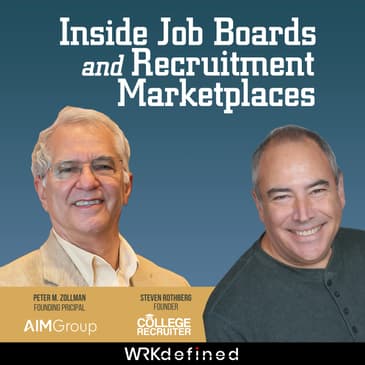
One of the founders of our entire industry is today's guest on the Inside Job Boards and Recruitment Marketplaces Podcast: Doug Berg, who likes to call himself the chief matchmaker at Match2.
Doug has founded, invested, and otherwise been a key player in dozens of start-ups and well-established players in the TA tech space. Cohosts Steven Rothberg of College Recruiter job search site and Peter M. Zollman of AIM Group talk with Doug a little about some of those, including Techies.com, Jobs2web, and Indeed but focus on how Match2 is using AI to solve the problem of poorly qualified candidates applying to jobs, yet also being mindful of the need for that AI to be assistive and not assumptive.
If you're sorting, matching, or ranking applicants in an effort to improve quality, or even just considering it, some of what Doug tells us might come as a surprise.
Powered by the WRKdefined Podcast Network.
[00:00:12] Welcome to episode 142 of the Inside Job Boards and Recruitment Marketplaces Podcast. I am one of your co-hosts, Steven Rothberg. I'm the founder of College Recruiter Job Search Site. Peter, I'm not going to totally steal your thunder here, but I would be sad if I couldn't at least give people a hint about who's going to be here.
[00:00:33] We are both longtime residents of the Minneapolis-St. Paul area, which means that we live in one of the best places in the world, and yet we're also crazy because we are here in the winter as well. You betcha. You betcha. Peter, over to you. Thanks. I'm Peter M. Zollman. I'm with the AIM Group. We do consulting, conferences, and content for job boards, recruitment marketplaces, and people like that.
[00:00:59] So we have Doug Berg, who calls himself the chief matchmaker at Match 2. That sounds like in Yiddish the word is shidduch, orienta, but no. But Match 2, 14 people in the company. I was shocked that you never got a letter, a cease and desist letter from match.com, but apparently you've managed to work your way through that.
[00:01:25] Tell us briefly about what is Match 2, and then we'll ask the questions about what can't AI do, etc. Yeah, super. So look, I've been in the industry on both sides. With Jobs2Web, I created hundreds of companies end-to-end platforms for the enterprise, and one of my companies got bought by Indeed. And so I've sat on the candidate side and watched how they try to deliver candidates to companies, but mostly applications.
[00:01:51] And yet what I noticed was there's still this massive chasm between the two sides, and nobody's built the connection layer between the candidate side and the company side.
[00:02:00] So if you look at consumer models like OpenTable, like Pinterest, like Shopify, like MyCharts, every other market in the world allows the consumer or the consumer candidate to have an application, a universal profile that travels with them, allows them to have control over their data, and provides hyper-personalization when they visit any of the sites that participate.
[00:02:21] And so we built Match 2 to help match candidates to jobs at any career site, instantly show up, it greets them by name, matches them to jobs, helps optimize their application, and then helps keep them connected between them and the employers that they want to stay connected to over time. So it really integrates the candidate and company and the hiring platforms into one unified experience. Does the candidate pay? Do the employers pay? What's the business model?
[00:02:51] If you have 14 people working for you, I hope you're collecting some money somehow. Yeah, yeah. Look, we will never charge a candidate a dime to be a part of this, right? In every other consumer-based model, you give the application away for free to the candidate, give them a ton of value. And really what you're trying to do is enable them to make it easier to do business with the employer side of the market. And then the employers pay a subscription fee, but we actually solve most of their biggest problems.
[00:03:19] You know, 90% of candidates that visit career sites don't engage. They don't apply. But if you allow them to have a one-click connection, now all of a sudden I'm capturing 60% of the candidates that visit my site, not 3%. If you allow them to match to jobs, now I'm helping your quality of candidate because I'm only showing jobs that match the candidate. If you help them pre-apply and basically qualify to apply for jobs so they can optimize their applications, I'm taking your number of non-qualified application rates way, way down.
[00:03:47] And ghosting is a big issue because candidates apply to a bunch of companies on Monday. They're gone by Wednesday and my recruiters are still chasing them. We provide post-visit connection as a part of our app. And so the candidate can turn off and say, look, I took another gig, take me out of the running. And it solves basically the marketplace data and availability issues in a really powerful way.
[00:04:07] So the employers are happy to pay a subscription fee to get basically this Facebook marketplace-like new enhanced market data relationship with their candidates that they're interacting with. So I've been fortunate enough to have a demo and for you to kind of show me like how it works both from the employer side and also the candidate side. And one of the things that struck me is it's, I definitely would not call it a job board, right?
[00:04:35] It is at least today, and you're still relatively early in this journey. At least today, it's more of a, it sort of sits on top of the ATS, right? So the candidate has already found a job. They've already come and said, hey, there's this job with this company. I'm interested. And they basically go through the application, upload their resume or CV, enter their information.
[00:04:59] And then Match 2 comes back and says like, you're a 77% match, but here are some things I don't know about you that might get you to 90%. Talk about the value of that to both to the candidate and to the employer. And also, what happens if they're poorly matched for a particular role? Yeah, that's a great, great question, Stephen. So think of what we're doing as kind of like a universal profile. So the candidate sets up what would almost be like their LinkedIn profile, but it's in their own personal application.
[00:05:29] You and I do this in our shopping life, right? Imagine if I showed up and I like golf shoes. I'm a size 10 and a half. I need the wide foot, right? Like we love that kind of experience when we go places. And as you guys know, career sites, every one of them is a micro job board. And yet when I search for jobs, the titles are different. The locations are different. What they call acronyms are different. We remove all of that frustration by providing the AI matching translation so that when a candidate shows up, we can actually show them.
[00:05:58] If you're an account manager, an account executive, a salesperson, like all of that goes away because we have the ability to take the job feed from the company and do contextual matching. And then we try to be transparent with the candidate up front. So we're not scoring them after. We're keeping them in the loop and letting them see how the system thinks they're a match and then allows them to correct that. So we're using AI to help them to score themselves. We're not scoring them after the fact and rejecting them and things like that.
[00:06:26] So it's an AI compliant method that once candidates see that they're not a fit, 90% will opt out. They'll just say, look, I know I'm not a good match right now, but I'm on your wait list. And so you can engage with me later when there is a good match. So it's a really powerful way to hand deliver to the recruiters this match report for why every candidate matches. Now, candidates apply to anything. This is a big problem. They just apply to the first thing that comes up. And recruiters are constantly having to say, why did this candidate apply to this job?
[00:06:55] They're way better for that job if they have time. We're just solving all of those problems up front pre-apply so that we can route people to the best quality jobs, show them why they're a match, and really broker a much better data relationship pre and post visit for every candidate. So instead of the ranking, sorting, matching, whatever you might want to call it happening after the candidate applies, which would be sort of at the ATS point, you're doing it before they apply. That's right. Yeah.
[00:07:23] If you look at what the big ATS systems are doing, a lot of them are buying assessment technology and scoring technology like Workday Bought Hired Score. And so in a way, it's like they create this easy apply concept, which avalanches a whole bunch of synthetic AI resumes, which then negates the need for me to have to buy a scoring system or an assessment thing because you're going to need that on the back end, which argue about the legal problems they're having with that.
[00:07:49] But we think that having a pre-apply filtering and a pre-apply informed experience for the candidate is more informed. It's more transparent. It allows them to advocate for themselves, and yet they know they need to be accountable and respectful because an interview is coming. And if I actually say I have a certain certification or a certain skill set, I know the interview is going to put me to task on whether I can do that. So we're just really providing this as a very powerful and differentiated experience.
[00:08:17] But what's really interesting is now the candidate owns and controls their record. So imagine you guys could log into CRMs and say, hey, I want to take control of my record. I want to decide whether you send me job alerts. I want to let you know whether I'm in the market and you should call me and consider me or not. Today's talent community systems don't do that. It's one way. You captured me once and you're sending me the stuff and I can unsubscribe, and then that kills our data relationship.
[00:08:41] We think having a truly connected, interactive, living talent experience between candidates and platforms is going to usher in the next level of innovation for the whole industry. Sounds fair. You mentioned that AI can do some things but can't do certain things, too. You know, right now, AI everywhere. I'm doing a presentation in a week and a half about use of AI and on and on and on.
[00:09:07] And what can one not do with AI and why should we make sure we don't try to do that? Yeah, look, I think one of the most important things that AI can't do is it can't update data on my behalf without me knowing about it. Right. So when I apply to a job on Monday at Walmart's career site and I take another job on Wednesday, the AI agent might say, hey, Doug, looks like he's a good fit. Let's schedule an interview.
[00:09:36] Well, that interview is going in the trash can because the candidate's already gone. So the infrastructure problem is a bigger problem where AI can't work against data that it doesn't have. So those are the kinds of things that we think are more infrastructure related problems than AI problems. And, well, AI can be assistive and say, hey, here's why we think you match. But it can try to infer things and it can try to suggest things.
[00:10:02] But when you don't confirm, in other words, when AI is assumptive and not assistive, that's when big problems start coming up, especially during the matching, the application, the verification types of things. It can't know who a candidate is before the candidate identifies themselves on a career site.
[00:10:20] So you have to be able to show up at a site with a pre-verified, pre-validated Google Auth-like thing where I can inform a visiting site that I'm at who I am, what my interests are, what I might want to get matched to. AI can't just make assumptions about that with people because I show up to your site. So we just think that there's a lot of different – every career site is a siloed experience. Every candidate starts from scratch on every career site.
[00:10:47] You can't solve – AI can't solve those problems until you finally create a universal traveling candidate-controlled type of an experience. You and I have known each other, I think, since the 90s. You were the founder or one of the founders of techies.com, which was one of the first really great job boards.
[00:11:07] One of the things that strikes me is we're going through a time as an industry where everything has changed a lot and very quickly. And it's not unlike what we saw in like kind of the 2000 with the dot-com bubble, which obviously impacted every organization that had anything to do with technology and techies certainly wasn't immune to that.
[00:11:32] But forgetting what happened 30 – what is it, 35 years ago, knowing that the successes that you've had working in your own businesses, working at Indeed, and now with Match 2, what advice do you have for job board leaders that are going through this sort of radical transformation in our industry? Yeah, look, I think the thing that's always served me really well, Stephen, is having a balanced approach.
[00:12:01] In other words, I can't provide value to one side of my equation without reciprocal value on the other. And so I can't advantage a candidate at the expense of the employer. And when you look at certain job boards in the market, right, they're making a lot of decisions lately that advantage them over even what some people believe is the candidate or the company side of things. And I think that's when you start to create a lot of heartburn in the marketplace. Don't be shy. Tell us which one you're talking about.
[00:12:31] He may be contractually or hopefully contractually prohibited from doing so. Okay, go ahead. Anyway. It's multiple. And I mean, look, we're in an industry that as job boards and as job aggregators, there's still a lot of really bad, like, I mean, do a search on Google Jobs even. And see, I was on with an engineering firm. He's a friend of mine. He called me up. He said, look at, search for my jobs. These are my civil engineering jobs. But this one goes to BD Jobs. That one goes to civil engineering jobs.
[00:13:00] And then no one ever gets to me because they're going from site, aggregator site to aggregator site to aggregator site. And I don't know how to get my jobs directly into Google Jobs so that people just come to me because they're going eight other directions. And so I think there's still a lot of interesting problems to solve that can straighten the lines in the market. But again, I would just say be true to solving the problems you want and really listen hard to what your customers are asking you for. When I was at Indeed, I'll say it.
[00:13:27] I asked 10 or so of their biggest customers, what would you like from us? And it was when the recession was really bad and going down. And they said, I used to pay you to send me high priority candidates, but is there a way I can pay you to not send candidates? And I brought that back to the teams and it blew their fuse box. They were like, what do you mean? Like, how would we even price this or whatever? And I said, well, again, that would be a collaborative, highly partnered way to solve a problem that maybe even you're creating.
[00:13:55] But it would be an interesting it's a product opportunity that we could balance and go to market with and look at. And so that's an example of how you can help lean in and really understand if you're creating problems, how can you solve them? How can you partner better and then really bring next level innovation to the market as opposed to just bumbling along and trying to get more clicks or more volume or more data? So. And ordinarily, we say we have time for one more question, but A, we don't.
[00:14:24] B, that was a perfect answer to wrap up on. Awesome. So. I was so hoping, Peter, that you would let that one stand as the closing. There you go. Mr. Berg, Mr. Rothberg, Mr. Zollman signing off. Thank you, guys. Thanks for having me, guys. Awesome. Thank you for joining us. Thanks.
Sponsors
