
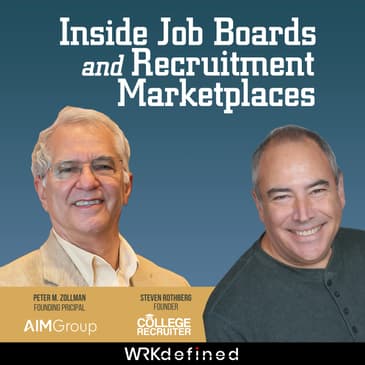
Today's guest on the Inside Job Boards and Recruitment Marketplaces Podcast holds a patent related to what we now know as programmatic job advertising. Jason S. Gorham is the co-founder of TalentXi-TalentXtended Intelligence, which is bringing consumer-style, true programmatic advertising to the world of job advertising.
Cohosts Steven Rothberg of College Recruiter job search site and Peter M. Zollman of AIM Group talk with Jason about how TalentXi takes a job posting ad, converts it into a display ad, hyper targets candidates on consumer sites such as Amazon.com, and takes them from pre-passive to passive to engaged to applicants.
If all of your employer customers are receiving more than enough well-qualified applicants to all of their roles, they probably don't need TalentXi. But virtually no employer does, and that's probably why they're working with you, and might also want to work with TalentXi, either directly or through you.
Powered by the WRKdefined Podcast Network.
[00:00:12] Welcome to episode 140 of the Inside Job Boards and Recruitment Marketplaces Podcast. I am Steven Rothberg. I'm the founder of College Recruiter. And if you hear me talking fast, it's because I had way too much caffeine this morning. Peter, good to see you.
[00:00:25] Talk about ADHD. Good golly. I'm Peter Zollman. I'm a founding principal of the AIM Group. We do consulting conferences and content for job boards and recruitment marketplaces. And today, sitting in beautiful, sunny Naples, Florida, we have with us Jason Gorham, founder and CEO of Talent XI.
[00:00:50] I wondered whether it was Talent XI or Talent XI, but Steven set me right. Welcome aboard. Thank you for joining us. And we're going to get right into the question of the reaching the passive and pre-passive candidates. I don't know that there is such a thing as a pre-passive candidate. Let's get to that in a minute. Tell us about how you plan with Talent XI to do that. To reach the passive and pre-passive?
[00:01:20] Yeah. Yes, sir. Hey, guys, thanks for having me, Peter and Stephen. So we do true programmatic. I'm going to throw some words out at you that are different for our industry, but we actually reach passive and pre-passive using programmatic advertising.
[00:01:41] So we don't distribute jobs. We have taken a page out of the marketing playbook and we use tools like the DSP. And the DSP, like what I'm hearing you say, Jason, is you don't take in job postings and then publish the text job postings on your site or on other job boards. You're getting that traffic in a different way. So what do you do with the job postings?
[00:02:11] Yeah. So we do not distribute job postings because mainly of fraud. That's one reason. But we also hyper-personalize. So we turn a job posting into a job ad. And then we build an audience before anything goes live. We have a great AI media planner tool that tells us exactly the audience that that job should be served to.
[00:02:39] We build an ad and then that ad goes into the DSP. So the DSP is a demand side platform. And these are things like the trade desk. So the trade desk is, I believe it's the largest DSP in the world. And then you have StackAdapt and Amazon. But I think, I don't know how those stack rank. My co-founder knows that.
[00:03:07] And so the ads you're talking about are display ads. They're graphics. Correct. But we do full omni-channel. We do inline content. We do display ads. We do connected TV. We do digital at home, in-game, and audio podcasts. In-game is fascinating. Are you able to insert ads into things like Roblox or Minecraft or those sorts of things?
[00:03:35] You got it, sir. It's interesting. Target nerd. Yeah. Well, we get even more specific than that, right? Like age group, demographic. We stack all of our data together. And I spend more time in the ad tech, martech world than I spend in the HR tech world.
[00:03:56] Electronic Arts just came out with their in-game platform. So coincidentally, guess what else is coming out? College football for EA Sports. There you go. Now, you work for a big bank and for several other companies as a talent acquisition specialist. Is this an outgrowth of what you did there? You said to yourself, if only I could.
[00:04:22] So I invented programmatic job advertising. It's actually, I started in 2003. I did Google pay-per-click. Sorry, I just got my hair cut yesterday. And it's not at all. You're looking sexy as hell. Especially compared to the two of us. Yeah, that bar is pretty low.
[00:04:45] So not getting in my way back time machine, but in 2003, I did pay-per-click. I then filed a provisional patent. I was awarded the patent in 2007. The patent is called an integrated online job recruitment system.
[00:05:02] I sold that patent in 2013. Excuse me, I was awarded the patent in 2007. I sold it in 2013. And then somebody in the industry around that time said the word programmatic job advertising. And it stuck within our industry, but it's not true programmatic. So this is an outgrowth of, where did the idea come from?
[00:05:30] In December of 2023, so to your point, I went back in-house as a practitioner. I'm a workday SME. I've implemented Phenon. And so I've always built solutions as problem solutions, not necessarily technical. And in December of 2023, I started thinking, there's still got to be a better product to serve the right ad to the right person at the right time.
[00:05:56] And I started just digging into MarTech, ad tech, programmatic, and realized that we can do it. And so lots of work since December of 23. In March of this year, we got our first customer. And I never knew that fraud would take off as much as it has. So Jason loves fraud. I'm just kidding.
[00:06:24] Are you talking about frog or fraud? Yeah, well, you know. Yeah, when you're in France and you're having frog legs. So, you know, so college recruiter, it just, you know, full disclosure, we're working on a pilot with TalentXI. And it's kind of like neither here nor there. But one of the things that I've learned from talking with you about the product, and I think the first time you and I talked was about a year and a half ago at a TA Tech conference in San Diego or near San Diego.
[00:06:54] Again, more recently, kind of in your backyard near where you live. It seems to me that the solution that you're bringing would allow employers and other advertisers of jobs to reach candidates who are not on the job boards. Not exclusively because some, you know, if you go to a job board, you're also going to go to CNN.com and, you know, other content sites. But there are most people are not on job boards.
[00:07:23] A lot of people who are searching for jobs actually even aren't on job boards. So from the candidate's perspective, let's say you're on like a news site and one of, quote unquote, your ads shows up. Paint a picture for us. What's the what? What do they see? What do they do? Yeah. So it's a great analogy. So we serve the ad. We also day part it in the programmatic world. It's called day parting.
[00:07:51] So we will reach somebody in the morning while they're commuting. Hypothetically, they're on the train commuting. We reach them in the morning. They see the ad. And that's really to get their interest going. It's the first ad. And then we will day part and target them at lunch and say, hey, reminder with a separate ad and say, hey, here's a reminder that you were looking at this job.
[00:08:18] And then we will also serve them in the evening when they get home. And typically that's the time that they will convert. Yeah. Top of funnel conversion. So, you know, it's an old marketing trick three times. Right. Like you have to see something three times and then it'll actually take an action. And so the candidate sees the display ad.
[00:08:43] It might have like a photo or something of what it looks like when they're doing the job. You know, construction. It's going to show construction workers pouring concrete or whatever. They click and then they go to whatever page your customer provides to you, whatever that URL be. So it might be an ATS. It might be a job board posting or whatever. Do your customers, the advertisers, do they pay you? Is it per impression, per click, per application? How does the money work?
[00:09:13] How does the money work? And how can we pay much less and get much more? I've been spending a lot of money building this for two and a half years. It really depends on the model regarding the money. So we have agency clients. We have job board clients. And we're just now starting to roll it out to direct clients. So the money is kind of all over in a place.
[00:09:42] The biggest challenge for us is we are advertising as a CPM. And we are optimizing a CPM to a conversion. And that conversion could be a lead conversion, right? Top of funnel, first name, last name, email, phone. That could be a start apply or it could be a full apply.
[00:10:09] Peter, I think we've got time for one more good question. So it shouldn't come from me. It should come from you. I thought you were about to say you're going to take it. So you started in March. You have obviously some very, very limited, very, very early results. You haven't even been able to get Stephen to pay enough attention to get it working at his company yet. We are fully engaged, Mr. Zollman.
[00:10:38] I talk to Stephen a lot. Okay. So what are you finding and is it working? So what we are finding, our early findings are that it works. We are releasing our first case study for healthcare next week. Actually, back to back. Sorry. We're releasing back to back case studies.
[00:11:04] We do find that if everything is in place, that it works. And we've been actually able to capture two times ROAS, which is return on ad spend. One of the other things that's really interesting is we capture pre-passive candidates. And if you guys have never heard of that, I was literally on the call with the head of TA and said that word.
[00:11:33] You got 15 seconds to say what is a pre-passive candidate? Because by definition, anybody who is a candidate is a passive candidate. So you got 15 seconds. Go. A nurse goes into Amazon, types in, is getting their licensing or their certifications. They type in Amazon to find a book to help them study, to get their certifications. We serve them a job ad.
[00:12:00] When they find that book, they click apply and we capture them. Got it. Okay. That makes sense for pre-passive. Very cool. Stephen, it has been fun. It has been pleasure. I'm glad you settled down from the beginning because you're a wild man today. Jason, from what Stephen tells me, you are always a wild man. You're down the block from me. I'm in Orlando. You're in Naples. One of these times when you're driving through, shoot me a note and we'll catch up. On that note, gentlemen, me too.
[00:12:31] Thanks very much, guys. He's clearly thinking he's on a different podcast because he called us gentlemen. Have a good day, guys. Cheers. Thanks, Jason. Thanks, Peter. See you later. Thank you.
Sponsors
