
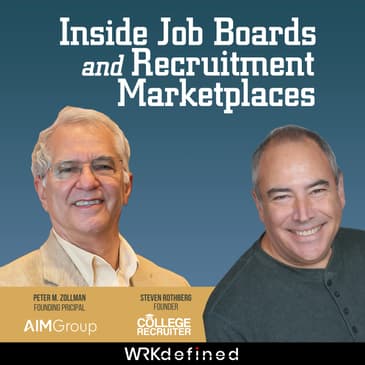
The earliest job boards, including Online Career Center and TheMonsterBoard, grew out of the pre-web bulletin boards. Our guest today on the Inside Job Boards and Recruitment Marketplaces Podcast is Jeff Taylor, founder of TheMonsterBoard, which re-branded as Monster and was instrumental in creating our industry.
Our cohosts, Peter M. Zollman of AIM Group (Marketplaces / Classifieds) and Steven Rothberg of College Recruiter job search site, talk with Jeff about what caused him to found Monster, some of the early challenges, how our industry is still struggling with some of those challenges, and what is coming next.
Jeff's new venture, BoomBand is set to launch this fall. It promises to push AI/machine learning to map the talent landscape and re-imagine the tools, user interface, and career flows to present candidates and employers with new ways to engage.
Powered by the WRKdefined Podcast Network.
[00:00:00] Du bist immer am Puls der Zeit und gerne up to date? Dann ist der Now Brief des neuen Samsung Galaxy S25 Ultra genau das Richtige für Dich. Stau auf dem Weg zur Arbeit? Dann wird Dir automatisch geraten, früher loszufahren. Es regnet am Zielort? Dann empfiehlt es Dir, den Regenschirm mitzunehmen. Mit dem Galaxy S25 Ultra kannst Du einen Schritt voraus sein. Neugierig? Erfahre mehr auf Samsung.de.
[00:00:43] Recruitment Marketplaces Podcast. This is one of your two co-hosts. I'm Stephen Rothberg, the founder of College Recruiter Job Search Site, where we believe that every student and recent grad deserves a great career, and that it should be easy and inexpensive for employers to hire them. We've got a pretty interesting guest today. Pretty excited about this conversation. But before we get to our guest, let's get to our other co-host. Hey, Peter, good to see you.
[00:01:07] Good to see you. I'm Peter Zollman. I'm with the AIM Group, founder of the AIM Group. We started out 27 years ago following something called the Monster Board. And now we provide business intelligence and information and conferences for job boards and recruitment marketplaces. And the guy who started the Monster Board, he couldn't even get monster.com as the URL at the beginning, is Jeff Taylor.
[00:01:37] And he's with us today. He's an absolute legend in the industry. The Monster Board was the second job board online. The first was Online Career Center. And then they got combined in 1996. So if you've got enough fingers and toes, it's like almost 30 years ago, they got combined into monster.com. Number one job board in the U.S., which made it number one in the world for a long time.
[00:02:06] Now it's kind of a shadow of itself. I'm really sorry to say that, but there's not much left. But Jeff is moving on to new things, and he's going to tell us about Boom Band in a couple of minutes. But we're going to reminisce first and talk about the history of job boards and all that good stuff. You know, Monster was a long time number one.
[00:02:29] What did you do to get it there and briefly tell us, you know, what you think of the job board industry today? And then we'll get to Boom Band. So always had Monster.com as a web address. We named it the Monster Board because we originally designed it as a bulletin board system, a BBS online career center. Was also a BBS and Monster.
[00:02:58] There were only 200 websites in the world when I started. By the time we were able to register it at an MIT crawler, we were the 454th.com and the first.com on the World Wide Web. So we always went by the address Monster.com, but the Monster board actually survives because of the bulletin board system, which is where the idea originally came from.
[00:03:21] What is cool is the job board industry today actually started out and is named because of the Monster board. That's where the board comes from in it, which is cool. I don't know. You know, starting out was incredible and very awkward. Trying to teach people about the idea of doing recruiting on something they never heard of before was really awkward at the beginning.
[00:03:49] My first two salespeople were in tears as they would teach people about the Internet and people would say, thank you very much. They had no interest in actually posting on Monster.com. I remember the first interview with Adweek. I had a thousand people. I wasn't sure if I had a thousand visitors or a thousand page views. I had a thousand. That's what I knew. And so there was this kind of very creative start. I had 396 jobs on the site. We went home for the weekend.
[00:04:18] I had five job orders sitting on the desk. We could have been 400 jobs, I remember saying, on Monday. And then at one point, I had 1.1, 1.2, even 1.3 million jobs on at any given time. And so a very exciting kind of transition. A couple of interesting spots along the way. The idea of having a buyer-seller marketplace, right? The idea that we had companies that were posting and seekers that were looking. There was no such thing as that before the Monster Board was created.
[00:04:48] And so that initial patent and that idea is something that still lasts today. Also, resumes behind a paywall. The only way you worked with a resume was you had it printed out at Kinko's or something. And then you actually sent it to the company. And so the idea of putting resumes in a place, I put the first resume on the World Wide Web. And what was exciting is to watch that resume database grow. We had a form-based resume. So you typed in your address in one area.
[00:05:17] You typed in your current job in another area. You typed in your education in another area. For a long time, we did this to up to, let's say, close to 100 million resumes. You couldn't do that today. But it gave us probably the best resume database through time on the World Wide Web because everything was in the right places. Parsing was nowhere. And in fact, until AI has been introduced, parsing really hasn't been good enough, in
[00:05:46] my opinion, to make it so that you could actually go to more of a machine-based assist around your resumes. So that's a lot of information going in different kind of regions of this experience. Monster went on the Super Bowl. That was a big defining moment. You know, 30 times our traffic overnight. A poorly rated Super Bowl commercial that ended up being one of the top 10 of all time Super Bowl commercials.
[00:06:13] So many exciting experiences as we opened the U.S. and then Canada and then in London and then expanded to 20 countries in Europe and into Asia. The brand experience for me, being a Pied Piper for something this exciting, was an unbelievable defining experience in my 30s and 40s. Hey, it's Bob Pulver, host Q Podcast.
[00:06:38] Human-centric AI, AI-driven transformation, hiring for skills and potential, dynamic workforce ecosystems, responsible innovation. These are some of the themes my expert guests and I chat about, and we certainly geek out on the details. Nothing too technical. I hope you check it out.
[00:07:37] Oh, that's awesome. So one of the things that you said that I want to just pick up on is the thousand, was it sessions? Was it visitors? Was it something else? I remember the very first version of our site went live in November 96 and the webmaster, as we used to call them, talked about hits. What's a hit? And there wasn't a good standard definition for it. Every developer that you talked to thought that their definition was the only correct one. But there you put a thousand of them into the room and you had a thousand different definitions.
[00:08:06] The analogy that I've heard people use, it's like, okay, if you're building a brand new suburb and laying down streets through an open field, for somebody to say, why don't you know how to get from A to B? It's like, because there is no road yet. We're deciding what the road's going to look like, where the road is going to go, where it's going to go. Is it going to be paved? Is it going to be gravel? Is it going to have stripes? And it was just, that's how it was. There wasn't a roadmap at the time.
[00:08:32] So let's take the conversation because from the early job board years, the struggles, the how do we do this? What makes sense? What doesn't make sense? What parallels do you see from the 1996 to 1999 kind of era to today, to the 2025 era? What are you seeing that's similar, different? And keep it short because we definitely have just a fairly limited time. It's a great question, Stephen.
[00:09:01] I think the founding of Monster was caused by the failure of the Help Wanted section. I had big clients, mostly in New England. They were placing bigger and bigger Help Wanted ads in the newspaper. They weren't working. And so my equivalent of TA leaders, directors of HR were coming to me and saying, the ads aren't working. What are we going to do? And there was a lot of pressure on me. I owned an ad agency that placed Help Wanted ads.
[00:09:29] And so the founding of Monster was the beginning of a solution for my customers. But I realized early on, I needed to build this site for the job seekers. And so Monster was half about a better job, half about a better life. There's a better job out there. All of our marketing was to seekers. And that's counterintuitive because the companies paid us. But the companies needed a better solution. And they were panicked about it.
[00:09:58] If I jump forward to 2025, what's crazy is the current systems, I think, are almost like melting down before our eyes. I think it's a failure that is a bit like a frog in the boiling water. It's like the water was warm and then hot. And then at some point, the frog just doesn't know to jump out. Right? And so we're experiencing that, I think, over the course of 20 or 30 years of using the same
[00:10:26] post and pray, the same resumes on a paywall. Now, what's happened with the advent of AI, I think the agentic layering on top of our kind of Model T tools, you know, I did this. But 30 years later, there hasn't been much change. A lot of kind of lipstick on the pig, a lot of middleware to some of the, what I think are really failing tools. We'll talk a little bit more about that maybe.
[00:10:55] But that has created the same kind of environment where there's anxiety, there's frustration, and there's a failure to make a match. And the tools are jammed up and not facilitating that match that we all talk about, that we dream about, that perfect match between a job opportunity, a future career for a seeker,
[00:11:24] and the kind of talent companies need to really excel. And that's your perfect opportunity to tell us about Boom Band and how it's going to change the world because we've got exactly a minute and 30 seconds left. So tell us about Boom Band and then we'll wrap up. So I'm building right now. So let's just say that we're somewhat stealth, but I'm just, I'm going to share like... It's okay. We won't tell anybody. It's just the three of us.
[00:11:55] If you want to just chat the passwords and stuff, we can do that. Okay. Okay. So the idea basically is there hasn't been a new consumer brand from a talent perspective in 20 years. We want to build one and we're going to focus on the tools. The job posting as a tool. It is a summary of the job requirement.
[00:12:18] That summary with AI, starving for more detail, is failing to actually provide a real description to match the resume. By definition, resume means summary. It's French. And the AI system does not want a summary of a person. It wants a much more detailed version of a person. So those tools are getting jammed up right now.
[00:12:46] And then you add the AI layer on top. And what we're seeing, I was using this prop. Well, this will work for video. I have an orange. This is a job posting. I have this orange coffee mug. This is a seeker. What's happening is the posting is going out in the marketplace. The seeker is putting it in the LLM of their choice. And they're saying, make my resume look like the posting. And then what's coming out the other side looks like a resume like this that's going back over to the company.
[00:13:13] And so what we're seeing is what I've been calling airbrushing of people's talents and abilities. And so it's completely stuffing the applicant tracking systems. So I see an opportunity to potentially eliminate the job posting and go to a more predictive engine. And I see an opportunity using the new technology to begin to predict what someone will do next
[00:13:42] and then create a matching system. And I'm calling it an arena where buyers and sellers can come together without the classic posting, without the classic sending your resume off into the black hole and to have a more natural match. I also think the resume, after the pandemic, people realized that companies are not going to take care of them. They've been knowing it for a while, but it really happened during the pandemic.
[00:14:11] People changed. And now they need a better document than even a LinkedIn resume. It's still a commercial resume. For 90% of users of LinkedIn, they're not content creators or engagers. They look around, maybe use it kind of like an Instagram or a Facebook, but their old resume is just sitting there. And we've got to fix that. And LinkedIn is closed and narrow. And the idea is to see if we can create an open platform that encourages links out to your
[00:14:41] experience, bring your whole self into the platform. So that is the kind of center. So build a new destination site, reinvent these tools, and then try to open a communication line, which is very different. Not that dissimilar to the way I did it in 1993. Well, August is your timeframe for now. If it doesn't slip, we'll talk to you again in August.
[00:15:07] You're planning to launch in the Boston area, which is roughly where you're from, where Monster launched originally. And we got a lot more questions, but we don't have a lot more time. So we're going to wrap up here and talk to you again in a few months. Launch in the fall, but we'll talk again in August. Sounds good. That sounds awesome. Jeff, thank you for your time. Thank you for the industry. Take care. Appreciate it. Okay. Bye.
Sponsors
