
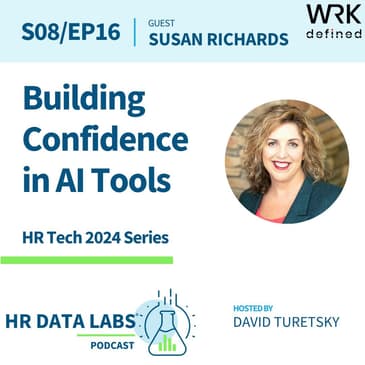
Susan Richards is the Founder and Managing Partner of Sapient Insights Group. In this episode, Susan discusses the evolution of HR tech over the past year, the role consultants play in helping organizations effectively implement AI into their HR workflows, and how to prepare AI models to assist with administrative tasks.
This conversation took place at the HR Tech 2024 conference in Las Vegas.
[0:00] Introduction
- Welcome, Susan!
- Today’s Topic: Building Confidence in AI Tools
[5:14] How has HR tech evolved in the last year?
- The innovation cycle of HR tech companies
- The growing importance of support services around new technology
[11:53] Do organizations need consultants for AI implementation?
- Why training AI models on clean, reliable data is essential
- Building trust through strong data governance
[21:47] How does HR use AI for administrative assistance?
- Ensuring AI models are properly trained
- Building confidence in working with AI tools and delegating repetitive tasks
[32:32] Closing
- Thanks for listening!
Quick Quote
“I believe there are a lot of compliant-related tasks that could be handled by an [AI model], and it could be done consistently, on time, and keep us out of hot water.”
Resource:
Sapient Insights
Contact:
Susan's LinkedIn
David's LinkedIn
Dwight's LinkedIn
Podcast Manager: Karissa Harris
Email us!
Production by Affogato Media
To schedule a meeting with us: https://salary.com/hrdlconsulting
For more HR Data Labs®, enjoy the HR Data Labs Brown Bag Lunch Hours every Friday at 2:00PM-2:30PM EST. Check it out here: https://hrdatalabs.com/brown-bag-lunch/
Produced by Affogato Media
Powered by the WRKdefined Podcast Network.
[00:00:00] The world of business is more complex than ever. The world of human resources and compensation is also getting more complex. Welcome to the HR Data Labs podcast, your direct source for the latest trends from experts inside and outside the world of human resources. Listen as we explore the impact that compensation strategy, data, and people analytics can have on your organization.
[00:00:25] This podcast is sponsored by salary.com, your source for data, technology, and consulting for compensation and beyond. Now, here are your hosts, David Turetsky and Dwight Brown.
[00:00:38] Hello and welcome to the HR Data Labs podcast. I am your host, David Turetsky. We are here at the 2024 HR Technology Conference in beautiful Mandalay Bay Exposition Center in Las Vegas, Nevada.
[00:00:51] And I'm here with one of my good friends, Susan Richards. Susan, how are you?
[00:00:57] Hey, David. How are you doing?
[00:00:58] I'm tired, but I'm good. It's been a very long show already.
[00:01:03] And we're only 24 hours in.
[00:01:05] Yes, I know. Well, but it ends tomorrow from the exhibition perspective. So it's a little bit of a bummer, but yeah, to me, it's really more than halfway over.
[00:01:15] Yeah, so we're packing in a lot in a short amount of time.
[00:01:18] Oh, and it's a breakneck pace. It's really fast.
[00:01:23] So, as you know, because you've been a guest on the show before, we always ask, what's one fun thing that no one knows about Susan?
[00:01:30] Oh, so somebody asked me what my spirit animal was about a week ago, and I didn't have an answer for them. But I now have an answer for that question.
[00:01:44] And?
[00:01:45] My spirit animal is an octopus.
[00:01:48] Really?
[00:01:49] Yes.
[00:01:51] Yes.
[00:01:51] Okay, so there's a lot of things to unpack here, but let's start with, is it because multitasking?
[00:01:59] Well, I think a lot of it has to do with how an octopus is able to adapt to just about anything.
[00:02:10] They're problem solvers.
[00:02:12] Okay.
[00:02:13] They can make anything work the way they need it to.
[00:02:18] Interesting.
[00:02:18] They can adapt to whatever the environment is that they're in.
[00:02:23] That's right.
[00:02:23] And I spent about 30 minutes over the weekend observing the octopus at the Monterey Aquarium.
[00:02:33] Really?
[00:02:34] Yes.
[00:02:34] And absolutely fell in love.
[00:02:38] Wow.
[00:02:38] Because he went from this bright red color and being very small to extending his tentacles and moving around in the aquarium and changing colors from this bright red to this interesting gray color to almost a green color when he went into the kelp forest.
[00:03:00] Wow.
[00:03:00] And I'm like, yeah, that made a lot of sense to me.
[00:03:04] So it's very funny you mention this because there was an article in Apple News just the other, actually it may have been today, that says that octopuses like to boss around fish.
[00:03:15] And when they don't fall in line, they literally punch the fish.
[00:03:21] I have seen that video.
[00:03:23] That is fascinating.
[00:03:25] And I laugh out loud every time I see it.
[00:03:28] Fascinating.
[00:03:29] Fascinating.
[00:03:30] Absolutely fascinating.
[00:03:31] But you still in line with the octopus?
[00:03:35] Well, I don't think I've punched anybody recently, but I do like to tell people what to do.
[00:03:42] Well, you are the boss for Sapien Insights.
[00:03:45] So one of the bosses.
[00:03:46] One of the bosses.
[00:03:47] Yes.
[00:03:48] One of the bosses.
[00:03:48] So you do get to do that.
[00:03:50] I do.
[00:03:51] But not the punch part.
[00:03:52] No, I'm not going to punch anybody unless they make me really mad.
[00:03:56] It's good to know.
[00:03:58] Very good to know.
[00:04:00] And now everybody who listens to the HR Data Labs podcast will know that as well.
[00:04:06] That's a good thing to know.
[00:04:08] Well, so let's transition to the now the probably one of the fascinating things talking to such an amazing, brilliant person such as yourself.
[00:04:19] And no, I'm not trying to blow smoke.
[00:04:20] I really do hold not only all the people from Sapien in very high regard, but most especially my two best friends, Terry and Susan.
[00:04:29] But when you listen to even Stacey talk about the HR technology survey and whatnot, you learn so much.
[00:04:38] And that's why I value the moments I get to spend with all of you.
[00:04:41] So obviously, if we look around the HR technology show, there's lots of themes.
[00:04:46] A lot of stuff going on.
[00:04:48] But one of the most important themes is obviously artificial intelligence and how it's impacting the world of HR.
[00:04:54] Yes.
[00:04:54] Given that every single, literally almost every single booth here, except for Omaha Steaks, they don't actually have AI.
[00:05:02] Give them another year.
[00:05:03] Yes.
[00:05:04] Yes, I will.
[00:05:14] So the question that we wanted to ask, though, was the one that we have here, which says, how has HR tech evolved and transitioned really in the last year, year and a half?
[00:05:26] Interesting question.
[00:05:28] And what we're seeing with clients that we're working with and with the vendors that we work with is it's like the world of HR tech is expanding again.
[00:05:44] So, you know, I think we go through these cycles where you see a lot of innovation and lots of cool new organizations, a cool new tech springing up because there are problems that need to be solved.
[00:06:00] And you have great thinkers and folks who can put things together and solve that problem.
[00:06:07] And lots of energy and lots of money.
[00:06:09] Lots of energy and a lot of money.
[00:06:11] And we're not seeing as much money out there as we were a few years ago, but there's still money out there to be had.
[00:06:18] So you go through these cycles where there's a lot of innovation and then those organizations get gobbled up by our friends who have been in the business for a long time.
[00:06:32] And as that happens, there's another cycle of innovation that starts to spring up.
[00:06:39] Right.
[00:06:39] And so what I have seen in the last year is more of that innovation around anything that is AI.
[00:06:50] Yeah.
[00:06:51] And an energy around things that in the past have been like human centric and starting to see some of those things get automated or augmented.
[00:07:08] You know, seeing a lot of energy around coaching.
[00:07:12] So, you know, better up was one of the first online coaching platforms.
[00:07:17] We're now starting to see organizations like Cloverly and Hutrix spring up where their assessment platforms and then using that data to nudge, nudge the client along to make behavior changes.
[00:07:36] So I'm really excited about this particular area.
[00:07:41] We love working with our clients who are doing leadership development and coaching.
[00:07:46] And how can we leverage some technology to make that process more straightforward and get it farther into the organization?
[00:07:57] So it's not just at the top of the house anymore.
[00:08:00] And I was going to ask you about services because with all the technologies that are here, it kind of expects that all of the people that are going to buy this technology know how to implement it and implement it well.
[00:08:13] And it's not necessarily the case.
[00:08:16] And I'm talking more about the consumer side of that.
[00:08:18] Yeah.
[00:08:19] You know, the company that buys the technology more than the company that is hiring, they're hiring to implement it and the companies that are selling it.
[00:08:28] I'm talking about the people that need to get augmented on the on that consumer side of that of that equation because they don't have the people and the people are doing their day job.
[00:08:38] Right.
[00:08:38] They're doing their day jobs.
[00:08:40] And that's one of the things that we found in our data this year in the HR technology survey, that services are incredibly important now.
[00:08:53] That customer satisfaction level has gone down significantly.
[00:08:58] And it's not that the technology isn't performing.
[00:09:02] It's that the services around the technology are not meeting the needs of the client.
[00:09:08] More than ever, the client is expected to do way more with way less.
[00:09:13] And that's headcount and that's also budget.
[00:09:17] And, you know, services are expensive.
[00:09:19] And if you've spent millions of dollars on the technology, you oftentimes are not thinking about how many more hundreds of thousands of dollars do I need to spend on the services.
[00:09:31] Yeah.
[00:09:32] Yeah.
[00:09:32] And that's the hole that I find in a lot of ROI analysis is that they're not doing that extra step to make sure that they're ready and that they have all of the important either insight or they have all the important basically experience to be able to make it work inside their environment.
[00:09:50] Right.
[00:09:50] Right.
[00:09:51] And we have to be really careful because, you know, our salespeople and I love salespeople.
[00:09:58] One of the value propositions that a lot of our software salespeople bring to the table is you're going to be able to do more with less.
[00:10:04] Right.
[00:10:05] And that's no matter how many times they say it, we still fall for it.
[00:10:10] Yeah.
[00:10:11] And the reality is you can do the same with less, but when it comes, you know, when push comes to shove, you're going to be expected to do more.
[00:10:22] Absolutely.
[00:10:22] And as your clients or as your users learn more about the technology that you're deploying, there is going to be a pull for more.
[00:10:32] Right.
[00:10:32] So the more you do, the more you implement, the more you roll out, the more you're going to be expected to do.
[00:10:39] And it is, it happens every single time.
[00:10:42] Well, we fall for it.
[00:10:44] And it's the really great salespeople, their pitches.
[00:10:48] And we use that as part of our ROI.
[00:10:51] We use it as part of our justification for buying the technology.
[00:10:56] And, you know, to your point, we just fall in that trap every single time of, yeah, we can do this.
[00:11:02] And the salesperson goes, yeah, yeah, you don't need to add staff.
[00:11:05] You don't need to get services.
[00:11:06] You don't need to hire consultants to do this.
[00:11:09] We'll do it for you.
[00:11:09] Our professional services team will help you through everything.
[00:11:12] Right, right.
[00:11:15] And the professional services are great.
[00:11:17] A lot of times they know a lot about the system that they're implementing.
[00:11:21] They probably don't know about your business.
[00:11:23] Right.
[00:11:24] And that's where having a business advisor can go a long way to help you sort out what is real versus what is smoke and mirrors.
[00:11:35] Right.
[00:11:35] Versus, you know, what you need to do right now and where you need to put your priorities and what can go on the back burner.
[00:11:43] Like what you hear so far?
[00:11:44] Make sure you never miss a show by clicking subscribe.
[00:11:48] This podcast is made possible by salary.com.
[00:11:51] Now, back to the show.
[00:11:53] But Susan, isn't all those professional services people, they're order takers.
[00:11:58] They're not consultants.
[00:11:59] They're not going to be able to ask you the question of where are you going with your functions in the next five to ten years?
[00:12:06] Because when you implement this, it should have a lifespan for you.
[00:12:09] I mean, your license is for that long or your service contract.
[00:12:13] So, you know, don't you need to hire a services or a consultant like Sapient or salary.com to be able to or both to be able to get through those implementations and make sure that they're actually achieving the goals that you'd set forward in the beginning?
[00:12:29] A lot of times, yes.
[00:12:31] You could use those services.
[00:12:34] And the advisory services can be a light touch or they can be a more significant touch to the project or the program.
[00:12:46] It's always good to get an independent third-party perspective from someone that you trust.
[00:12:56] Somebody who's been there, done that, has actually lived in the trenches, who has actually done the work of HR or has done the work of payroll.
[00:13:07] Right.
[00:13:09] And, you know, that's why I love the work that we do because we can actually work with our clients and advise them from the perspective of those of us who have been in the trenches with our clients.
[00:13:24] And you do, and again, we don't sell on this program.
[00:13:28] This is all thought leadership.
[00:13:29] So, this is thought leadership here.
[00:13:31] Sapient does selection through implementation, right?
[00:13:35] Yes.
[00:13:37] You help companies decide what's right.
[00:13:39] Yeah.
[00:13:40] So, we use our research to help organizations figure out what products are going to best meet their needs.
[00:13:51] We also do some work with clients around looking at things beyond just the technology.
[00:13:57] So, you know, I can tell you what the top five products are in HRMS, and those top five products might not be the top five for your organization.
[00:14:09] So, it depends on what's happening in your organization.
[00:14:12] What kind of culture do you have?
[00:14:14] Right.
[00:14:14] What kind of IT strategy do you have?
[00:14:17] And where are you going?
[00:14:18] Do you need to be prepared to scale or, you know, double what you are today or what you are tomorrow?
[00:14:24] So, asking those critical questions can help.
[00:14:28] And then from an implementation standpoint, we're agnostic.
[00:14:33] And we're going to advise our clients on good practices for any sort of implementation.
[00:14:39] So, things like making sure that you have a project manager on the ground.
[00:14:45] Things like including change in the implementation so that you do recognize that return on investment.
[00:14:52] Right.
[00:14:52] And also looking at your processes.
[00:14:55] You know, so many times I've been in engagements where the implementer says, how do you want this to look?
[00:15:04] Right.
[00:15:05] And the person on the other end of that conversation only knows what it looked like in the last situation versus what would be great and what would take them forward into the next iteration.
[00:15:19] Right.
[00:15:20] It's like taking the paper form from the personnel action change form and actually putting it into the system instead of saying, well, what's the possibility here?
[00:15:29] What could we do?
[00:15:30] Hmm.
[00:15:32] Yeah.
[00:15:33] Yeah.
[00:15:34] Remember the manila envelope that had the really, really secure red thread that went through?
[00:15:38] Oh, yes.
[00:15:39] I love those red threads.
[00:15:40] Yes.
[00:15:41] Yes.
[00:15:41] Yeah.
[00:15:42] One of the other things that I typically will consult with people on is the data that gets kind of, I don't want to say it gets left behind, but a lot of times people will just say, oh, we're just going to port the data from the old one to the new one and not take advantage of some of the really cool new either strategies or features or the architecture of the new technology.
[00:16:07] Like, was the old one a flat hierarchy and now can you do more of a stratified hierarchy?
[00:16:13] Can you do more matrix hierarchies as well?
[00:16:17] Right.
[00:16:18] You know, because that's kind of a newer thing for systems to be able to accommodate.
[00:16:22] But, you know, a lot of times they just say, no, we're just going to take it from there to there and then we'll get to that eventually.
[00:16:28] And it never happens.
[00:16:29] No, never.
[00:16:29] You never get to it.
[00:16:30] So you get in your new system exactly what you had in your old system.
[00:16:36] And I'll tell you, that's one of the things that is being uncovered in the move to artificial intelligence is if my data is garbage, then whatever model it is that I'm training is going to give me garbage.
[00:16:54] Absolutely.
[00:16:55] So, you know, for those organizations who are heading into the AI pool, get your data in order and take a look at what you have in your system and ask the questions, does this really make sense?
[00:17:10] Does the way my data is organized meet the needs of my business and not just HR, but my real clients who are those managers and those frontline employees that are doing the great work of our organization?
[00:17:30] And dying for answers.
[00:17:31] And think about the crap that they're going to get if that data doesn't support the answers that they require.
[00:17:38] Oh, my goodness.
[00:17:38] That would be awful.
[00:17:40] That would be absolutely awful.
[00:17:43] And for those of you who don't or haven't heard the program before, we talk a lot about bad data.
[00:17:50] And it's unfortunate that hygiene isn't part of the normal data.
[00:17:56] Hygiene isn't part of how people run their HR messes.
[00:18:00] But, you know, we sing it from the mountaintops as much as we can.
[00:18:03] Yeah.
[00:18:03] We launched a cohort recently for HR system strategy and are working with a lot of HR technology managers, leaders, folks who are in the trenches.
[00:18:20] And one of the first things that we talk to them about is making sure that they have good data.
[00:18:27] They understand their data.
[00:18:28] They understand where it's coming from.
[00:18:31] They understand how it's being used.
[00:18:33] They understand where it's going downstream.
[00:18:35] Yeah.
[00:18:35] And really map that data out and clean up what's not good.
[00:18:42] Right.
[00:18:42] Because if you do that, then it's going to give you a lot of the information about your current state and also going to inform where your gaps are that you need to fill in order to get to that future state.
[00:18:54] I know it sounds like an onerous process, but we like to talk about that in terms of data governance.
[00:19:01] Yes.
[00:19:02] And being able to build a good data governance strategy and have owners of data and be stewards of the data.
[00:19:08] Yes.
[00:19:08] So that the recruiters, you know, while they know they own the recruiting process, you know, somebody in the recruiting stream needs to be a good steward of the recruiting data.
[00:19:19] Yeah.
[00:19:20] Yeah.
[00:19:20] And so forth.
[00:19:21] And, you know, and if you are a client that is on the front end of an implementation or a re-implementation or an upgrade, it's a great time.
[00:19:30] Absolutely.
[00:19:31] To take a look at your data.
[00:19:33] And if you don't have a data governance solution in place, go ahead and build one.
[00:19:39] They're not that hard.
[00:19:40] They're not that hard to build.
[00:19:42] They are hard to adhere to.
[00:19:44] Yes.
[00:19:44] But I'll tell you, I was with a client last week, one of my old clients that I hadn't seen in years.
[00:19:52] They went live with a new platform about 10 years ago.
[00:19:56] They implemented data governance when they went live.
[00:20:00] Good.
[00:20:01] And they have maintained it over 10 years.
[00:20:04] And so it's no longer a question of if they do it.
[00:20:08] It's who do I need to transition this to when I move into my next role?
[00:20:14] And it's not perfect, but it works a heck of a lot better than it did when they started.
[00:20:20] It takes so much discipline.
[00:20:22] But it takes so much pressure off and gives you so much more credibility and confidence.
[00:20:29] So when my board comes to me and says, you know, what do you mean we need to do an across the board, you know, 6% increase in order to get to market?
[00:20:41] I can back that up with not only the market data, but the data that we have inside.
[00:20:46] And I can stand behind it in a way that I might not have been.
[00:20:52] Because you have confidence that the things that you've been doing support not only the data, not only the decisions, but that everybody understands that because they now they all are signatories to that data governance.
[00:21:05] Right.
[00:21:05] They all have a hand in it.
[00:21:07] Exactly.
[00:21:07] Exactly.
[00:21:08] Trust.
[00:21:09] I think that builds trust.
[00:21:10] Yeah.
[00:21:10] Yeah.
[00:21:11] And, you know, that's that's a that trust goes across a lot of different areas, not just within HR, but what throughout the business.
[00:21:21] Hey, are you listening to this and thinking to yourself, man, I wish I could talk to David about this?
[00:21:27] Well, you're in luck.
[00:21:28] We have a special offer for listeners of the HR Data Labs podcast.
[00:21:32] A free half hour call with me about any of the topics we cover on the podcast or whatever is on your mind.
[00:21:38] Go to salary.
[00:21:39] Go to salary.com forward slash HRDL consulting to schedule your free 30 minute call today.
[00:21:47] And so this is a beautiful part where we can now transition and talk about how does HR utilize artificial intelligence to become more of an administrative assistant.
[00:21:59] And, you know, we can talk about agents.
[00:22:02] We can talk about agents.
[00:22:04] We can talk about other things because now that you have trust in your data and you ask it certain things, it'll do it because the data is there and it's ready.
[00:22:12] Right. And you don't have to go behind the agent and verify that all of that data is correct because you know that it went in the right way.
[00:22:22] You've trained the model in the right way.
[00:22:25] You've utilized all of those years of experience that you've gained in the organization and knowing what kinds of questions that your employees ask.
[00:22:35] So you're able to have a lot more confidence in transitioning that that what was tier one now to tier zero really freeing up the time of the HR team.
[00:22:53] Right. To deal with all of those new questions that are coming in from the organization and the higher level inquiries that now that we have good data, now that we have good systems and now that we've exposed the organization to all the great things that we have to offer.
[00:23:10] The organization comes to us and and looks to us to be that business partner to help them solve problems.
[00:23:17] Absolutely. There's a old commercial in New Jersey from a clothier called Sims where Cy Sims was the owner.
[00:23:29] And this is a hundred year old clothing company.
[00:23:33] And he used to say that an educated consumer is his best customer.
[00:23:38] Ah.
[00:23:39] And I know it took a long time to get to that.
[00:23:41] So I apologize.
[00:23:42] But but but that I mean, if you're in the New York metropolitan area, you might remember that because it made you feel like I'm educated.
[00:23:52] I know what I'm looking for.
[00:23:54] I know, you know, I know how to buy a suit.
[00:23:57] I feel like I can go and see, you know, this is a good thread count.
[00:24:02] It look good on me.
[00:24:04] That's what they meant.
[00:24:05] Right.
[00:24:05] Right. And so in this case, now that we know the data, we know what we can ask it.
[00:24:10] We're now going to get brave and start asking it new things.
[00:24:13] Right.
[00:24:13] Push it in new directions.
[00:24:14] Absolutely.
[00:24:16] And then we can train the model to advance with us.
[00:24:20] And I think this even goes back out to our vendors, our software vendors.
[00:24:26] So if our customers, our buyers are educated.
[00:24:31] Yes.
[00:24:32] They they know where they are.
[00:24:35] They know where they're trying to go.
[00:24:37] They understand where their gaps are and they know what questions to ask the vendors.
[00:24:42] And the vendors can be realistic with them to say, yes, we can do this.
[00:24:48] And it's, you know, and there's an extension for that.
[00:24:53] Let's have that conversation so that those service levels go back up to where they want to where we want them to be.
[00:25:02] Well, and it's really hard to have those conversations when you're not being realistic and you don't have that handle.
[00:25:10] And you go to a vendor and the vendor says, and I've never heard a vendor say this.
[00:25:14] I don't think you're ready.
[00:25:16] Your data is not in order.
[00:25:17] Your processes aren't in order.
[00:25:18] You don't have a data governance strategy.
[00:25:20] Never heard that.
[00:25:21] So that's where we can be really helpful.
[00:25:23] Yeah.
[00:25:24] Because we are that independent third party.
[00:25:27] We don't have a dog in the fight.
[00:25:30] We are interested in making sure our clients are ready and successful.
[00:25:35] And I know you guys are the same way.
[00:25:38] And if a client isn't ready, then we can have that conversation with them and give them that roadmap to how do you get there.
[00:25:45] Right.
[00:25:46] And work with the vendors along the way as well.
[00:25:49] Yeah.
[00:25:50] In our environment, it's like somebody says, I want to become a pay equity certified company.
[00:25:56] I want you to do a pay equity analysis for us.
[00:25:59] And the consulting team will then start investigating their data and start looking at, do you have all these artifacts and blah, blah, blah.
[00:26:05] And then we'll have to be realistic with them about all the holes that we find and then take those steps to remediate that before we ever go toward the, oh, we see significant gaps that have statistical significance or not.
[00:26:19] Absolutely.
[00:26:20] Absolutely.
[00:26:20] It goes back to that whole credibility conversation.
[00:26:23] Because if we don't ask the questions and we don't help fill the gaps, then when we get to our executive level with our analysis and our reporting, they're going to ask us those questions.
[00:26:36] Yeah.
[00:26:36] And we're not going to have the right answers.
[00:26:38] Because they're going to have to sign off on it.
[00:26:40] And if they don't feel comfortable that they've asked those questions, they're not going to sign off on it.
[00:26:46] Of course not.
[00:26:47] Yeah.
[00:26:47] I wouldn't.
[00:26:50] That was funny.
[00:26:51] So let's talk a little bit about those AI bots, though.
[00:26:54] And how do we get to the comfort level that they are doing what we ask them to do?
[00:27:00] Now, I've talked a number of times today about agents.
[00:27:03] I've talked a number of times about bots.
[00:27:05] I've talked a number of times about just generative AI and its place in an enterprise environment that fits for HR, that works for HR.
[00:27:16] What are you seeing in terms of how companies are adopting artificial intelligence with a focus on HR?
[00:27:24] Yeah, there's a lot of AI already embedded in HR.
[00:27:31] There's a lot of automation that's already there.
[00:27:34] And sometimes clients don't even know it's there.
[00:27:37] So one of the first things is figure out what you have.
[00:27:41] Right.
[00:27:42] Figure out what's already working.
[00:27:44] And then dream a little bit and figure out what it is that you want to offload.
[00:27:52] What is it that is time intensive that could very well be automated or something that you could do the same way over and over again and not have to take up the time of a human to do?
[00:28:11] So do you think this is really being relegated to non-value-added repetitive tasks or are there others as well?
[00:28:19] No, no, no.
[00:28:20] I know.
[00:28:21] Compliance is at the very foundation of HR.
[00:28:25] Right.
[00:28:26] And I believe there are a lot of tasks that are compliance related that could be handled by a bot, by other AI functions.
[00:28:39] And it can be done very consistently.
[00:28:42] It can be done on time.
[00:28:45] It can keep us out of the hot water of, you know, all kinds of opportunity to keep us out of hot water and do the things that I think of as hygiene.
[00:28:58] Yeah.
[00:28:59] In the HR function.
[00:29:00] It's the table stakes.
[00:29:02] It's the stuff that you got to do.
[00:29:03] You got to do it well.
[00:29:04] You got to do it well consistently.
[00:29:06] Right.
[00:29:06] Because when you screw it up, invariably it's going to get caught and you're going to end up in a situation where you're paying a fine or somebody gets fired.
[00:29:15] Yeah, I'm thinking the use case in my mind right away because I'm a comp dude is like minimum wage audit and making sure that the effective rate of pay for each person in every municipality around the U.S., for example, is, you know, meeting minimum wage requirements or, you know, I mean, that's one easy one.
[00:29:37] But, you know, I'm sure that everybody who's listening is thinking, hmm, I have a better one.
[00:29:42] You know, there's another example in my mind.
[00:29:44] But, Susan, let's talk a little bit about that assistant, you know, the AI assistant that could fill in a lot of gaps that we've been dealing with.
[00:29:53] Like, for example, for recruiters and being able to schedule interviews.
[00:29:58] Yeah.
[00:30:00] Scheduling interviews, making sure that calendars are up to date and are cleared.
[00:30:05] You know, grouping candidates into cohorts for panel interviews.
[00:30:12] Right.
[00:30:13] All kinds of opportunities there.
[00:30:15] I don't want my bot screening my resumes.
[00:30:19] Hmm.
[00:30:19] But I would be okay with them doing scheduling.
[00:30:23] Yeah.
[00:30:24] I would be okay with them making sure that all the questions that we needed to have answered were captured and prepared.
[00:30:34] Transcribed?
[00:30:35] Yeah, absolutely.
[00:30:37] All the things that I wouldn't have to worry about bias being introduced into.
[00:30:43] Sure.
[00:30:44] Sure.
[00:30:44] I always want to be really careful about, you know, training our AI with the bias that we have as humans.
[00:30:53] That's another thing I worry about in our data, that a lot of decisions in the past have been so biased that, you know, especially from a pay equity perspective or, you know, hiring or promotions,
[00:31:05] I worry that it's going to use the past as a, you know, precursor for the future.
[00:31:10] Right.
[00:31:11] Right.
[00:31:12] And, you know, way to do that is do the research.
[00:31:17] Um, you know, take advantage of all of the, you know, the opportunities that are out there to learn more about pay equity.
[00:31:27] Um, you know, let's, let's don't repeat the past.
[00:31:30] Yeah.
[00:31:30] Well, humans are really crap about repeating things from the past.
[00:31:33] So we are, but hope springs eternal.
[00:31:36] It really does.
[00:31:37] Well, and let's, let's hope that, you know, when we start talking about the artificial intelligence world, that we're not just replacing people because there are costs.
[00:31:48] We're giving people the tools to be able to do more, like you were describing before, value added activities that, that enable them to do more better.
[00:31:57] Absolutely.
[00:31:57] I, I have, um, I have a lot of faith in, um, in the next generation.
[00:32:05] I think they're very creative and I think they are going to come up with things that we would have never dreamed of.
[00:32:13] I hope you're right.
[00:32:14] I am.
[00:32:17] Well, you're the one who kind of helps set how companies are going to be using this.
[00:32:21] So hopefully they're listening to you, especially on this podcast.
[00:32:32] So Susan, thank you so much for being with us.
[00:32:35] You're awesome.
[00:32:35] I really look forward to every HR tech because I get a chance to speak to you.
[00:32:39] I love hanging out with you, David.
[00:32:41] You always make me think.
[00:32:43] And you always make me learn.
[00:32:45] So thank you for that.
[00:32:48] And no, I really appreciate it.
[00:32:49] We make a good pair.
[00:32:50] Yes, we do.
[00:32:51] And we should get together more often then.
[00:32:52] I think we should.
[00:32:53] All right.
[00:32:54] I'm going to hold you to that.
[00:32:55] All right.
[00:32:55] Thank you again.
[00:32:56] Thanks, David.
[00:32:57] Take care and stay safe.
[00:32:59] That was the HR Data Labs podcast.
[00:33:02] If you liked the episode, please subscribe.
[00:33:05] And if you know anyone that might like to hear it, please send it their way.
[00:33:09] Thank you for joining us this week and stay tuned for our next episode.
[00:33:13] Stay safe.
Sponsors
