
Summary:
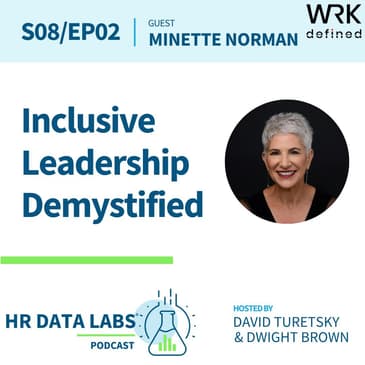
Minette Norman had spent three decades working in the Silicon Valley software industry when she realized that companies needed a new model for leadership. The outdated leadership styles of the mid-20th century were not going to attract and retain the up-and-coming talent of a younger generation. Today, Minette is an international speaker on inclusive leadership and the award-winning author of The Boldly Inclusive Leader.
In this episode, Minette talks about what it means to be an inclusive leader, the challenges organizations face when embracing inclusive leadership, and why inclusive leadership benefits everyone in an organization.
Chapters
- Welcome, Minette!
- Today’s Topic: Inclusive Leadership Demystified
[3:54 - 13:34] Minette’s career pivot from working in the software industry to becoming an award-winning author
- There is no one size fits all management style
- How management has (and hasn’t) changed in the last 75 years
[13:35 - 20:44] Key points from Minette’s book, The Boldly Inclusive Leader
- Why leaders should not tiptoe into DE&I
- Why psychological safety is necessary for DE&I
[20:45 - 28:25] The challenges organizations face when embracing inclusive leadership
- Attracting talent when younger workers expect inclusivity
- Why diverse hires alone cannot “solve” inclusivity
- Thanks for listening!
Quotes:
“You’re never going to get it all right as a leader, and so that openness to learning . . . is what we need more of.”
“Organizations that have a higher level of diversity and an inclusive culture have better innovation, better financial performance, and more engaged employees.”
Resources:
The Boldly Inclusive Leader
The Psychological Safety Playbook
Contact:
Minette's LinkedIn
David's LinkedIn
Dwight's LinkedIn
Podcast Manger: Karissa Harris
Email us!
Production by Affogato Media
To schedule a meeting with us: https://salary.com/hrdlconsulting
For more HR Data Labs®, enjoy the HR Data Labs Brown Bag Lunch Hours every Friday at 2:00PM-2:30PM EST. Check it out here: https://hrdatalabs.com/brown-bag-lunch/
Produced by Affogato Media
Powered by the WRKdefined Podcast Network.
[00:00:00] [SPEAKER_00]: The world of business is more complex than ever. The world of human resources and compensation is also getting more complex.
[00:00:09] [SPEAKER_00]: Welcome to the HR Data Labs podcast, your direct source for the latest trends from experts inside and outside the world of human resources.
[00:00:18] [SPEAKER_00]: Listen as we explore the impact that compensation strategy, data, and people analytics can have on your organization.
[00:00:25] [SPEAKER_00]: This podcast is sponsored by Salary.com, your source for data, technology and consulting for compensation and beyond.
[00:00:33] [SPEAKER_00]: Now here are your hosts, David Turetsky and Dwight Brown.
[00:00:38] [SPEAKER_03]: Hello and welcome to the HR Data Labs podcast. I'm your host David Turetsky alongside my friend, co-host, partner, buddy, best friend in the world, Dwight Brown from Salary.com. Dwight, how are you?
[00:00:50] [SPEAKER_03]: I am wonderful. How are you doing, David?
[00:00:52] [SPEAKER_03]: I'm good. So we have the baritone today.
[00:00:57] [SPEAKER_03]: And we have with us Minette Norman. Minette, how are you?
[00:01:02] [SPEAKER_01]: I'm doing well and happy to be here with both of you.
[00:01:05] [SPEAKER_03]: Minette, tell us a little bit about your background.
[00:01:07] [SPEAKER_01]: Yeah, my background is that I unexpectedly spent 30 years in the software industry in Silicon Valley.
[00:01:13] [SPEAKER_01]: Wow.
[00:01:14] [SPEAKER_01]: Started as a tech writer, ended up as a VP of engineering and did a lot of things in between.
[00:01:19] [SPEAKER_01]: Did that for 30 years, learned a ton.
[00:01:22] [SPEAKER_01]: And then I left in 2019 and decided to start my own business.
[00:01:26] [SPEAKER_01]: So now I am an author, a speaker and a consultant and I focus on inclusive leadership.
[00:01:31] [SPEAKER_03]: And Minette, you've actually published a few books and what we'll do in the show notes is actually have links to those books.
[00:01:38] [SPEAKER_01]: Right? Yeah, two. Two to be specific.
[00:01:41] [SPEAKER_03]: Perfect. That's wonderful.
[00:01:42] [SPEAKER_03]: So Minette, one thing we always do with our guests is we ask one fun thing that no one knows about you.
[00:01:49] [SPEAKER_01]: Well, I think there are a few people who know this, but many don't.
[00:01:52] [SPEAKER_03]: We can't use it then.
[00:01:54] [SPEAKER_01]: Well, it's only the people who have done this one activity with me.
[00:01:57] [SPEAKER_01]: Oh, OK. OK.
[00:01:58] [SPEAKER_01]: Is that OK?
[00:01:58] [SPEAKER_02]: We'll let it fly.
[00:02:00] [SPEAKER_01]: OK. What people don't know when they meet me and kind of see my personality is that if you play a board game with me, I am fiercely, fiercely competitive.
[00:02:10] [SPEAKER_01]: So don't, you know, better be prepared if you're going to play Scrabble or Boggle or Code Words or any of those games with me because I play to win.
[00:02:19] [SPEAKER_03]: OK. But you don't toss the table if you're losing.
[00:02:21] [SPEAKER_01]: I don't know and I'm a very gracious loser, but I'm all in when I play.
[00:02:26] [SPEAKER_03]: So we're going to keep all weapons off the table.
[00:02:29] [SPEAKER_03]: Yeah.
[00:02:31] [SPEAKER_01]: I don't even let young kids play like a win when I play with them.
[00:02:34] [SPEAKER_01]: I played with my best friend's nephew at Weez to Play Risk.
[00:02:37] [SPEAKER_01]: And I'm like, no, I'm not going to let you win.
[00:02:39] [SPEAKER_01]: I'm like, you got to learn to play.
[00:02:40] [SPEAKER_01]: And he respected me for that.
[00:02:43] [SPEAKER_03]: Aren't there the weapons in the game?
[00:02:45] [SPEAKER_03]: Oh, no, that was Clue.
[00:02:47] [SPEAKER_03]: That was Clue, not Risk.
[00:02:48] [SPEAKER_03]: Yeah.
[00:02:49] [SPEAKER_03]: Thank goodness.
[00:02:50] [SPEAKER_03]: I'd be worried for my life if I was like that.
[00:02:52] [SPEAKER_03]: With the lead pipe.
[00:02:53] [SPEAKER_03]: Exactly.
[00:02:54] [SPEAKER_03]: She can only play with soft boards.
[00:02:59] [SPEAKER_03]: Well, Monopoly used to be either the shoe or the racing car.
[00:03:04] [SPEAKER_03]: Those have been known to fly across the room.
[00:03:08] [SPEAKER_01]: I hear you.
[00:03:11] [SPEAKER_03]: In fact, I've also gotten a lot of the houses in the hotel stuck in my foot as I walk across the floor from.
[00:03:17] [SPEAKER_03]: Oh, haven't we all?
[00:03:19] [SPEAKER_03]: Probably, yeah.
[00:03:20] [SPEAKER_03]: That and Legos.
[00:03:21] [SPEAKER_03]: So today's topic is one that we love talking about.
[00:03:25] [SPEAKER_03]: It's one that strikes the heart of us because we want to always be better and try and improve every day in how we interact with people.
[00:03:33] [SPEAKER_03]: We're going to be talking about is inclusive leadership demystified.
[00:03:37] [SPEAKER_03]: What does it take to become a boldly inclusive leader?
[00:03:41] [SPEAKER_03]: What specific skills and behaviors will create a team environment in which everyone can fully contribute?
[00:03:54] [SPEAKER_03]: So our first question for you, Manette, is can you connect the dots for us here?
[00:03:59] [SPEAKER_03]: What is it about your long career in the software industry that led you to your current career as an author and focusing as a speaker on inclusive leadership?
[00:04:08] [SPEAKER_01]: I will do my best to connect those dots for you.
[00:04:10] [SPEAKER_03]: Please do.
[00:04:11] [SPEAKER_01]: Yeah.
[00:04:11] [SPEAKER_01]: And the way it came to be was, I would say gradual, is that when I started my career, I was an individual contributor.
[00:04:18] [SPEAKER_01]: But about 10 years into that 30-year career, I started taking on management and leadership roles and increasingly bigger and bigger leadership roles.
[00:04:27] [SPEAKER_01]: And what I noticed was that first of all, I had very few role models for what I thought was a really great leader.
[00:04:34] [SPEAKER_01]: I had many role models that I would have said were negative role models.
[00:04:38] [SPEAKER_01]: You know, like I don't want to behave like that.
[00:04:40] [SPEAKER_01]: That is really awful.
[00:04:42] [SPEAKER_01]: That's not bringing out the best in me.
[00:04:44] [SPEAKER_01]: It's shutting me up.
[00:04:45] [SPEAKER_01]: It's silencing me.
[00:04:46] [SPEAKER_01]: And so I was trying to figure out like what does it mean to be a great leader?
[00:04:50] [SPEAKER_01]: And I was doing a lot of experimentation myself because here I was leading from the get-go almost very global teams,
[00:04:57] [SPEAKER_01]: very diverse teams in terms of cultures and backgrounds.
[00:05:00] [SPEAKER_01]: And I realized I have no clue, but I'm going to try to get an education and learn everything I can.
[00:05:05] [SPEAKER_01]: And so I read voraciously and I really started to understand that most people who go into leadership,
[00:05:12] [SPEAKER_01]: we get into those positions because we're good at something.
[00:05:15] [SPEAKER_01]: And it's not necessarily leading teams of people, right?
[00:05:19] [SPEAKER_01]: I was a great technical writer and then I got promoted to lead technical writers.
[00:05:23] [SPEAKER_01]: Then I led engineers and localizers and all these different people.
[00:05:25] [SPEAKER_01]: And I was very badly prepared.
[00:05:27] [SPEAKER_01]: And I think one of the things that I saw is that there's one style, there's this sort of myth that there's one style of leadership that fits all.
[00:05:34] [SPEAKER_01]: And first of all, I dispute that.
[00:05:36] [SPEAKER_01]: But second of all, what I realized in leading teams is that you have a team of individuals and each person needs something different.
[00:05:43] [SPEAKER_01]: It's not a one size fits all management style.
[00:05:47] [SPEAKER_01]: So I got really interested in how can we as leaders bring out the best in every single member of our workforce,
[00:05:54] [SPEAKER_01]: no matter where they come from, no matter what their background.
[00:05:57] [SPEAKER_01]: And I just realized that there's not much of this in the workplace.
[00:06:01] [SPEAKER_01]: And what happens when we are not boldly inclusive, like we don't bring out the best in everyone,
[00:06:07] [SPEAKER_01]: is that many people stay silent.
[00:06:10] [SPEAKER_01]: They don't fully contribute and they aren't able to do their best work.
[00:06:15] [SPEAKER_03]: They disengage.
[00:06:16] [SPEAKER_01]: They disengage, right?
[00:06:17] [SPEAKER_01]: Because you engage when you feel like you're appreciated, you're seen, you're respected and you can do great work.
[00:06:23] [SPEAKER_01]: And when you feel that your voice is not welcome, your viewpoint is not welcome, just kind of withdraw.
[00:06:28] [SPEAKER_01]: And I think honestly, in the last few years we heard that term quiet quitting.
[00:06:32] [SPEAKER_01]: Well, that's been going on forever because it's like I'm not fully appreciated.
[00:06:36] [SPEAKER_01]: I'll just sit back and do the minimum.
[00:06:38] [SPEAKER_01]: So fast forward, let me finally connect the dots for you, which is that in my last five years in tech,
[00:06:44] [SPEAKER_01]: I was VP of engineering at Autodesk.
[00:06:46] [SPEAKER_01]: I had a thousand people on my org chart and I was responsible for another twenty five hundred.
[00:06:51] [SPEAKER_01]: I had a very, very big job.
[00:06:52] [SPEAKER_01]: I had a position of power and I had a position of privilege.
[00:06:57] [SPEAKER_01]: And even still, what I noticed is that I'd be sitting in a staff meeting with my manager and my peers.
[00:07:03] [SPEAKER_01]: And I often felt like my voice wasn't welcome.
[00:07:06] [SPEAKER_01]: And I thought, you know, even when you get to this level, because I sort of thought like when you get to a certain level,
[00:07:12] [SPEAKER_01]: then it's different.
[00:07:13] [SPEAKER_01]: It wasn't the same dynamics of insiders and outsiders were present.
[00:07:18] [SPEAKER_01]: And finally, I had enough because I felt like I was being silenced.
[00:07:22] [SPEAKER_01]: And I said, I have to I have to do something about this.
[00:07:25] [SPEAKER_01]: I need to help leaders do better.
[00:07:27] [SPEAKER_01]: And so I left the industry and I decided, you know, I'm going to write, I'm going to speak on this and I'm going to help
[00:07:32] [SPEAKER_01]: leaders to understand what it means to be inclusive to all and really bring out the best in everyone.
[00:07:39] [SPEAKER_01]: So that's that's sort of the long version of connecting the dots for me.
[00:07:43] [SPEAKER_03]: Well, that's a really well done.
[00:07:45] [SPEAKER_03]: The question I'd ask is, and it might seem like an obvious question.
[00:07:49] [SPEAKER_03]: Is it harder for a female in the tech world, obviously?
[00:07:55] [SPEAKER_03]: Or do you think this is more of a universal problem?
[00:07:57] [SPEAKER_03]: And a lot of leaders, especially rising through the Peter principle, don't get that kind of information to be able to be a good
[00:08:05] [SPEAKER_03]: inclusive leader.
[00:08:07] [SPEAKER_01]: I think the answer to that is a both and.
[00:08:09] [SPEAKER_01]: I think it's certainly harder when you are in, you know, often the only I was often the only woman in the room, you know,
[00:08:16] [SPEAKER_01]: and then do you conform to the group norms or did you stay true to who you are?
[00:08:20] [SPEAKER_01]: Those things are really hard.
[00:08:21] [SPEAKER_01]: But I think to the second part of your question, I think this is hard for everybody and that, you know,
[00:08:27] [SPEAKER_01]: often women feel like they have to act more like men to fit in, to be part of the culture.
[00:08:32] [SPEAKER_01]: But men, I mean, I am not faulting men.
[00:08:34] [SPEAKER_01]: No one is trained really to do this well.
[00:08:37] [SPEAKER_01]: And the models of leadership that we've all seen have been, you know, the traditional command and control.
[00:08:42] [SPEAKER_01]: I know what's going on.
[00:08:43] [SPEAKER_01]: I have all the answers.
[00:08:45] [SPEAKER_01]: I cannot show any vulnerability.
[00:08:47] [SPEAKER_01]: And honestly, this is this is what we've seen for decades and centuries.
[00:08:51] [SPEAKER_01]: And so I think we are all trying to unlearn that and figure out what is this new model of 21st century
[00:08:58] [SPEAKER_01]: leadership that that we need going forward?
[00:09:01] [SPEAKER_03]: And frankly, the stereotypes that we even see on TV and in movies, whether it's Michael Scott in the office,
[00:09:06] [SPEAKER_03]: whether it's, you know, wolves on Wall Street.
[00:09:11] [SPEAKER_03]: It's, you know, guys can do what they do because they're guys.
[00:09:16] [SPEAKER_03]: And it's just, first of all, stupid.
[00:09:19] [SPEAKER_03]: It should be seen as the comedy and parody that it is.
[00:09:22] [SPEAKER_03]: But it also gets seen as in some cases, it gets seen as, you know, just normal activity, which is horrible.
[00:09:29] [SPEAKER_01]: It's stupid. Exactly. Exactly.
[00:09:31] [SPEAKER_01]: And I feel like we really have to challenge those those norms because they will continue and they they have continued for a really long time unchecked for the most part.
[00:09:41] [SPEAKER_02]: Yeah, I mean, I was talking with with somebody that I know who's going through this right now where they're now working with somebody who's very old school.
[00:09:51] [SPEAKER_02]: And, you know, this gentleman has been at it for almost 50 years now.
[00:09:58] [SPEAKER_02]: And and the actions are so rooted in the 1950s.
[00:10:04] [SPEAKER_02]: And sometimes you even outside of that, sometimes it seems like we haven't gotten very far from the 1950s.
[00:10:12] [SPEAKER_01]: And we really haven't. We haven't.
[00:10:14] [SPEAKER_01]: I find that so I mean, I don't want to be a downer because I really I am optimistic that we can change this or I wouldn't be doing the work.
[00:10:21] [SPEAKER_01]: I'm doing. But one of the questions I got, you know, I have someone who spent 30 years in the software industry is, oh, it must have changed so much in your 30 years.
[00:10:29] [SPEAKER_01]: You must have seen so much change.
[00:10:31] [SPEAKER_01]: I'm like, not really. And even the demographics have not changed that much in 30 in those 30 years.
[00:10:38] [SPEAKER_01]: Like when I when I got started in tech, you know, the women were the minority, but not so differently than they are now.
[00:10:44] [SPEAKER_01]: People of color. Same thing. You know, it's just we didn't talk about it then.
[00:10:47] [SPEAKER_03]: I think there is a little bit of a different demographic, which is now we're a little bit more global in where we're getting our resources from.
[00:10:56] [SPEAKER_03]: Obviously, we've been outsourcing and getting phenomenal resources from India.
[00:11:01] [SPEAKER_03]: We've also been getting wonderful resources from China.
[00:11:04] [SPEAKER_03]: And in many cases, we're getting it from Eastern Europe as well as now South America.
[00:11:09] [SPEAKER_03]: So the sources of brilliant talent who are able to help us with what we thought we had the advantage on, which was development and programming and program management skills.
[00:11:21] [SPEAKER_03]: We're actually seeing that other cultures are being able to be brought in, which is probably one of the other challenges we have right is knowing how as an American U.S.
[00:11:39] [SPEAKER_02]: You know, it's interesting we have that.
[00:11:42] [SPEAKER_02]: But at the same time, at least from what I see, we still have this holier than now or greater than thou attitude toward OK, that's just that's a team from another country.
[00:11:56] [SPEAKER_02]: And, you know, I see that.
[00:11:59] [SPEAKER_02]: So it seems like it's just perpetually playing the loop.
[00:12:03] [SPEAKER_02]: The tape is on loop, it feels like.
[00:12:06] [SPEAKER_02]: And I think we are getting more integrated into a multicultural environment, but I think we still got a ways to go.
[00:12:14] [SPEAKER_01]: Yeah. And that was one of the things that I saw a lot because from pretty early on in my management career, I was managing teams all over the world and, you know, use the word David outsourcing.
[00:12:23] [SPEAKER_01]: And I think that's how we thought about it early on as we're outsourcing this to China or India.
[00:12:28] [SPEAKER_01]: But I did see this change.
[00:12:29] [SPEAKER_01]: This is a positive change.
[00:12:31] [SPEAKER_01]: And I think that's what I did see.
[00:12:31] [SPEAKER_01]: It used to be that, yes, we had these teams all over the world, but the headquarters in the U.S. was the center of gravity.
[00:12:39] [SPEAKER_01]: And I think, you know, in many companies, that is still true.
[00:12:41] [SPEAKER_01]: But I have seen this shift where we couldn't in the early days when I was leading international teams, the workers were outside the U.S. and the leaders were in the headquarters.
[00:12:51] [SPEAKER_01]: And that has changed.
[00:12:52] [SPEAKER_01]: And I think that, you know, to many companies and organizations' credit, they have realized there is incredible talent all over the world and we cannot be so U.S.-centric.
[00:13:03] [SPEAKER_01]: Some countries, some companies have gotten better at that.
[00:13:06] [SPEAKER_01]: And I think that recognition has been really important.
[00:13:08] [SPEAKER_01]: But to your point, David, yeah, it was about outsourcing.
[00:13:11] [SPEAKER_01]: And to your point, Dwight, like we are the ones who really have the innovation skills or whatever it is, and we're going to send this work overseas.
[00:13:20] [SPEAKER_01]: I think that has changed.
[00:13:21] [SPEAKER_01]: And thank goodness that has changed.
[00:13:25] [SPEAKER_00]: Like what you hear so far?
[00:13:26] [SPEAKER_00]: Make sure you never miss a show by clicking subscribe.
[00:13:30] [SPEAKER_00]: This podcast is made possible by Salary.com.
[00:13:33] [SPEAKER_00]: Now, back to the show.
[00:13:36] [SPEAKER_03]: Let's go to question number two and let's talk more specifically about what's in your book, The Boldly Inclusive Leader.
[00:13:42] [SPEAKER_03]: Can you give us a few of the ideas that you have and kind of give us some, shed some light on what you mean by what is boldly inclusive?
[00:13:52] [SPEAKER_01]: Sure. I'd be happy to do that.
[00:13:54] [SPEAKER_01]: I use the word boldly deliberately because I think that what I've seen a lot of people as they enter into the world of diversity, equity, inclusion is it's and you've seen the backlash recently.
[00:14:05] [SPEAKER_01]: But it can be a very daunting topic and people, what most commonly do is they tiptoe into the work like, oh, we're going to do a training on unconscious bias and then we're going to call it quits for now.
[00:14:17] [SPEAKER_01]: And the reason I use the word boldly is because I think we cannot go softly into this work.
[00:14:22] [SPEAKER_01]: We have to go boldly in what I mean is we cannot hesitate.
[00:14:27] [SPEAKER_01]: This work is important.
[00:14:28] [SPEAKER_01]: As you said, how can we work with different cultures if we don't even know how to communicate?
[00:14:33] [SPEAKER_01]: How can we be leaders of global and inclusive teams if we don't know how to listen to people who challenge us?
[00:14:42] [SPEAKER_01]: So I think we have to go all in and we have to be unflinching in the face of resistance and we will get resistance.
[00:14:49] [SPEAKER_01]: And we also have to be willing to make mistakes and get uncomfortable because this work is uncomfortable and we're not going to get it right.
[00:14:57] [SPEAKER_01]: None of us are perfect.
[00:14:58] [SPEAKER_01]: And so to be willing to embrace the failures and the mistakes along the way and still be committed to creating an inclusive culture and being inclusive leaders.
[00:15:08] [SPEAKER_01]: That's what I mean by boldly.
[00:15:10] [SPEAKER_03]: Well, people are very afraid for being imperfect because they're worried about the things they say, the things they do and whether it's going to potentially wind up into lawsuits.
[00:15:19] [SPEAKER_01]: Yes.
[00:15:19] [SPEAKER_03]: In the world of inclusivity, we're trying to be better.
[00:15:24] [SPEAKER_03]: But yet we're still worried about those areas and those issues that could get us into quote unquote trouble.
[00:15:31] [SPEAKER_03]: And there is some trouble here.
[00:15:34] [SPEAKER_03]: Are there are there guardrails or do we just have to start worrying about not just what we say, how we say it, what we do, how we do it, but also just be willing to be more, I guess the word is vulnerable.
[00:15:47] [SPEAKER_03]: To be able to say, oh, crap, I'm sorry.
[00:15:50] [SPEAKER_03]: I'm just I'm still learning in this, you know, please forgive me.
[00:15:53] [SPEAKER_03]: I didn't mean anything by it and be able to learn how to be be more available, be more open, be more honest about it, I guess.
[00:16:03] [SPEAKER_01]: I think we do.
[00:16:04] [SPEAKER_01]: I think that's exactly right.
[00:16:05] [SPEAKER_01]: We we aren't going to get it right.
[00:16:07] [SPEAKER_01]: We will make mistakes.
[00:16:09] [SPEAKER_01]: And that is just part of the journey that we're all on in doing this work.
[00:16:13] [SPEAKER_01]: And honestly, in being human beings and being leaders, right?
[00:16:15] [SPEAKER_01]: You're never going to get it all right as a leader.
[00:16:18] [SPEAKER_01]: And so that openness and that is a big part of what I talk about is, first of all, the self-awareness of like how am I showing up?
[00:16:25] [SPEAKER_01]: And also the openness to learning, to saying I screwed up here.
[00:16:29] [SPEAKER_01]: Of course, that was not my intent, but I recognize the impact on you was damaging and I want to repair that damage and I'm learning.
[00:16:36] [SPEAKER_01]: And please stay with me as I do better.
[00:16:39] [SPEAKER_01]: That kind of thing.
[00:16:39] [SPEAKER_01]: The way you said it, David, was was exactly right.
[00:16:42] [SPEAKER_01]: I think that's what we need more of.
[00:16:44] [SPEAKER_01]: And instead, we get people who just say like, I'm not going to take that first step because I am afraid of the misstep and that thing I'll get wrong.
[00:16:51] [SPEAKER_02]: There's a lot of fear built around it.
[00:16:53] [SPEAKER_02]: And there's a lot to some extent to be fearful love.
[00:16:56] [SPEAKER_02]: I mean, the psychological safety component of this topic is it's it's oftentimes not there.
[00:17:03] [SPEAKER_01]: Yeah, you know, I the other book that I wrote was about psychological safety.
[00:17:07] [SPEAKER_01]: And I believe the way I see these two playing together is that I do not think you get to inclusion without a foundation of psychological safety, because if people do not feel that their voice is welcome, that they can make a mistake, that they can be human, then they are not going to feel that they are heard and valued and respected for who they are.
[00:17:26] [SPEAKER_01]: So I see them as sort of there's this foundation of psychological safety.
[00:17:30] [SPEAKER_01]: And then inclusion is possible only when you have that.
[00:17:34] [SPEAKER_03]: Do you see through your meteoric rise in the technology industry?
[00:17:39] [SPEAKER_03]: And I'm being serious here.
[00:17:41] [SPEAKER_03]: Do you see that your sphere of influence as you rose through organization?
[00:17:46] [SPEAKER_03]: Do you see that that sphere of influence changed how you could be boldly inclusive, or do you think that you can be no matter what level you're at?
[00:17:54] [SPEAKER_01]: I think it's certainly informed where I'm coming from today because I do have that history.
[00:17:59] [SPEAKER_01]: However, I also think that wherever you are, you can be boldly inclusive.
[00:18:04] [SPEAKER_01]: And one of the questions I get a lot when I work with teams is that, well, I care about inclusion and diversity equity very, very much.
[00:18:12] [SPEAKER_01]: And it's really in my heart.
[00:18:13] [SPEAKER_01]: But my senior leadership doesn't necessarily embrace this.
[00:18:17] [SPEAKER_01]: So I'm realistic like you may not be able to influence your C staff if they are not open minded.
[00:18:22] [SPEAKER_01]: However, even wherever you are in an organization, you can have a positive impact on the people who report to you,
[00:18:29] [SPEAKER_01]: even if you're a first line manager and you can have a positive impact on your peers who you work with day in, day out.
[00:18:36] [SPEAKER_01]: So, yes, you may not be able to change an entire organizational culture, but you still can make a difference in your sphere of influence.
[00:18:43] [SPEAKER_01]: And so I never want to discourage everyone anyone, even if they are just a first line manager,
[00:18:48] [SPEAKER_01]: because, in fact, those people have such an impact on the people who work for them.
[00:18:53] [SPEAKER_02]: And I would imagine that sometimes you got to get creative to be able to do that.
[00:18:57] [SPEAKER_02]: For example, if I work for a leader that just isn't bought into the concept,
[00:19:04] [SPEAKER_02]: then I kind of back to that psychological safety where I may not have the kind of work environment where I can be outwardly more inclusive in things.
[00:19:15] [SPEAKER_02]: Whereas if I'm creative, I may find other ways to do that. Is that would you say that's accurate?
[00:19:22] [SPEAKER_01]: Yeah. I mean, I think, you know, if let's say you are a manager of a team of eight people and you report to someone who is not particularly open minded.
[00:19:31] [SPEAKER_01]: But with that team of eight people, you can create an environment where every one of those eight people feels they are welcome to the table and that their voices are welcome.
[00:19:40] [SPEAKER_01]: You can brainstorm. You can bring in all these innovations within that team of eight.
[00:19:45] [SPEAKER_01]: Maybe possibly you can share some of that with the next level and maybe they will recognize that there's some goodness going on in this team.
[00:19:52] [SPEAKER_01]: Maybe not, but at least within those eight people, you have made a positive difference in how they are experiencing work day to day.
[00:19:59] [SPEAKER_03]: And as they go through their organization, they'll hopefully take that example with them.
[00:20:04] [SPEAKER_01]: Exactly. Because, you know, as I said, like I didn't have many good role models.
[00:20:07] [SPEAKER_01]: This is what I think leaders need to be doing is being the role model so that they are helping raise up the next level of leader and the next level of leader who will change the world of work.
[00:20:45] [SPEAKER_03]: So let's go to question three, which is going to be talking a little bit about some of the things we've already discussed, which is what are the biggest challenges you see in getting organizations to be able to embrace inclusive leadership as it should be a business imperative?
[00:20:59] [SPEAKER_01]: Well, I think there's you know, there's so much data and data doesn't always work.
[00:21:05] [SPEAKER_01]: But but if you want a lot of organizations need data to show that if I invest in this, there's going to be some payoff.
[00:21:11] [SPEAKER_03]: Tell me the ROI. Right. Tell me the ROI.
[00:21:14] [SPEAKER_01]: And the ROI, I mean, there is there is lots of data to show that organizations that have a higher level of diversity and an inclusive culture have better innovation.
[00:21:24] [SPEAKER_01]: They have better financial performance and they have more engaged, motivated employees and better employee retention.
[00:21:32] [SPEAKER_01]: There's tons of data to back that up.
[00:21:34] [SPEAKER_01]: And some people will be moved by that data and some won't.
[00:21:37] [SPEAKER_01]: But of course, when you need the ROI, I'm happy to share all the stats with you.
[00:21:42] [SPEAKER_01]: I think also, though, you can't look at it just from a data perspective.
[00:21:45] [SPEAKER_01]: I think you also have to look at this is, you know, this is front of mind for people now is like, what is the employee experience?
[00:21:52] [SPEAKER_01]: Like, how are you going to attract talent today when especially the newer workers, the younger generations are demanding empathetic leadership, inclusive cultures.
[00:22:03] [SPEAKER_01]: They're not going to go to a company that has a bad reputation.
[00:22:06] [SPEAKER_01]: Right. And so you cannot rest on your laurels because the workforce is different now.
[00:22:11] [SPEAKER_01]: And so I think that's another thing to think about is that who do you want to attract and retain?
[00:22:16] [SPEAKER_01]: And if it's people who care about this, well, then you better focus on it.
[00:22:20] [SPEAKER_02]: Do you anticipate we're going to see a shift and a change as the new let's just say the new college grads are coming in with a whole different focus?
[00:22:30] [SPEAKER_02]: Do you are you hopeful for change for the long term with that or do you think that's not going to have an impact unless we're doing something different?
[00:22:36] [SPEAKER_01]: I am hopeful because I do think that, you know, even when I speak to my nieces and nephews and people who are of that generation, they are demanding something different and expecting something different.
[00:22:47] [SPEAKER_01]: But I also think we need to be very intentional about who do we promote?
[00:22:53] [SPEAKER_01]: You know, this is this is one big part of my book is like we have to get away from this affinity bias that everyone who we feel comfortable with are the people we surround ourselves with.
[00:23:02] [SPEAKER_01]: So if I look at the tech industry, which I know best, and you see, you know, predominantly white male leaders who promote and reward and give great assignments to more white males in the organization, then nothing's going to change.
[00:23:16] [SPEAKER_01]: And so we have to get out of that. We have to deliberately look for people who challenge us, who are different from us, who have different backgrounds, whether it's gender or race or ethnicity or sexual orientation or identity.
[00:23:28] [SPEAKER_01]: All of those ways were different. We have to be deliberate because if we aren't, we're going to just keep perpetuating the same demographics where you'll bring in more diverse employees at a lower level, but they will not rise to the most senior ranks of leadership.
[00:23:43] [SPEAKER_01]: And we still see that today. So that's why I think we have to be very intentional in not just our cultures and behaviors, but our systems of how do we hire?
[00:23:52] [SPEAKER_01]: How do we promote? How do we reward? Because I remember being in discussions with like, oh yeah, that guy has great potential. And you know, this woman is a little bit too aggressive, right?
[00:24:02] [SPEAKER_01]: You know, those biased conversations why someone got promoted or someone got the plumb stretch assignment and someone didn't.
[00:24:10] [SPEAKER_01]: And so those are the ways we very much have to challenge our, of course, it's our innate human thinking. This bias is just ingrained in all of us.
[00:24:17] [SPEAKER_01]: So we have to be aware of it and we have to challenge it. But I am optimistic because I do see that people are saying no more of this.
[00:24:24] [SPEAKER_01]: I'm not going to put up with a culture that is not inclusive and is not open minded. Makes sense.
[00:24:29] [SPEAKER_03]: The changing demographics of the U.S. and because this is mostly a U.S. program, the podcast is mainly U.S., you know, we've seen the changing of demographics very, very dramatically.
[00:24:42] [SPEAKER_03]: And how the predominant groupings of people, especially ethnicities are going to become much more Latina, Latino or Latinx, however you want to describe it.
[00:24:53] [SPEAKER_03]: So we're going to see the change in the workforce, not just in a very small way, but in a very big way as the next generation start to take over for the baby boomers.
[00:25:06] [SPEAKER_03]: And that should help, shouldn't it? Or are we just going to get different cultures that come in with their biases unless we actually continue to have the inclusivity as being a focus?
[00:25:19] [SPEAKER_01]: I don't think it happens magically just by changing demographics.
[00:25:23] [SPEAKER_01]: And this is part of, again, our biology is that because we're drawn to people like us, you know, you bring in a whole new demographic.
[00:25:30] [SPEAKER_01]: Let's say it's Latinx, black, Asian, whatever it is. We are most comfortable with people from our tribe. That is just our innate bias.
[00:25:38] [SPEAKER_01]: So we I think every single one of us, no matter what our background and ethnicity is, has to challenge ourselves to not surround ourselves with people who look, behave, act, think just like us.
[00:25:50] [SPEAKER_01]: So that's why we do have to be deliberate about it. It doesn't happen automatically.
[00:25:54] [SPEAKER_01]: And one of the things that people often think is that if I hire a diverse team, everything will magically be better.
[00:26:01] [SPEAKER_01]: You know, it's actually no. I mean, first of all, it's harder to work with a diverse group of people.
[00:26:05] [SPEAKER_01]: So you have to deliberately create the culture where everyone can fully participate.
[00:26:10] [SPEAKER_01]: And then, you know, if you have this homogeneous group, how do you get out of it?
[00:26:14] [SPEAKER_01]: So there's a there's a lot of complexity. I do think it's all possible.
[00:26:20] [SPEAKER_01]: And we have to be really intentional and deliberate about how we create these these workplaces and cultures.
[00:26:26] [SPEAKER_03]: And that's why I wrote the book. Just to go back, though, to the question for one second.
[00:26:32] [SPEAKER_03]: Have you ever been asked to write an ROI for this kind of to creating an inclusive culture?
[00:26:40] [SPEAKER_01]: I have not been asked specifically for an ROI, like if I put in a proposal or if I talk to someone.
[00:26:45] [SPEAKER_01]: But I have been asked for what are the benefits? So maybe you call it an ROI.
[00:26:48] [SPEAKER_01]: Like I haven't been asked to quantify it in terms of financials.
[00:26:52] [SPEAKER_01]: But yeah, I have been asked for those and I'm always willing to provide them.
[00:26:55] [SPEAKER_01]: And, you know, the thing is, there's there's lots of I have an Evernote.
[00:26:59] [SPEAKER_01]: I use Evernote and I have just lists of links that I curate so that if someone says,
[00:27:04] [SPEAKER_01]: can you give me some ROI on inclusion or diversity, whatever?
[00:27:07] [SPEAKER_01]: I have statistics at my fingertips and they're always being updated.
[00:27:11] [SPEAKER_01]: And so, yeah, I sometimes have to share those as part of when I'm working with a leadership team or,
[00:27:16] [SPEAKER_01]: you know, pitching something to an organization.
[00:27:19] [SPEAKER_01]: And I think, you know, some some people are I guess I should say some organizations are bought into the idea
[00:27:25] [SPEAKER_01]: without needing the ROI and some are earlier on their journey and they're like, what's in it for me?
[00:27:30] [SPEAKER_02]: And it's a shame that it really for some organizations, it does come down to just exactly as you said,
[00:27:39] [SPEAKER_02]: what's in it for me or the fact that they ask you for an ROI.
[00:27:43] [SPEAKER_02]: The ROI is it's the right thing to do. That's it. End of story.
[00:27:50] [SPEAKER_03]: Well, that's not been a really that's not really been the mission critical.
[00:27:54] [SPEAKER_02]: Yeah, no, and I recognize the absurdity of what I'm saying.
[00:27:57] [SPEAKER_02]: But at the same time, there's yeah.
[00:28:00] [SPEAKER_01]: You know, I think it's OK. I think I mean, you got to meet people where they are.
[00:28:04] [SPEAKER_01]: And if they need the ROI, you need the ROI.
[00:28:07] [SPEAKER_01]: And at the same time, it's the right thing to do.
[00:28:08] [SPEAKER_01]: So I would say it is the moral imperative that we must do this.
[00:28:12] [SPEAKER_01]: And here are all the business benefits you're going to get.
[00:28:15] [SPEAKER_01]: The two are not mutually exclusive.
[00:28:16] [SPEAKER_01]: So let's embrace it all right.
[00:28:26] [SPEAKER_03]: Well, this has been a phenomenal and fascinating discussion.
[00:28:30] [SPEAKER_03]: And I think we could talk about this for hours.
[00:28:33] [SPEAKER_03]: But what we're going to try and do is fit it into 30 minutes.
[00:28:36] [SPEAKER_03]: So Minnette, thank you so much. You're awesome.
[00:28:39] [SPEAKER_03]: This has been really fun.
[00:28:41] [SPEAKER_01]: Thank you so much for having me.
[00:28:42] [SPEAKER_01]: I feel like we could talk all day, too.
[00:28:43] [SPEAKER_01]: And I hope we'll have another opportunity.
[00:28:45] [SPEAKER_03]: But yeah, let's we're definitely going to have to bring you back
[00:28:48] [SPEAKER_03]: because now now we're going to want to talk a little bit about measurement of all these things.
[00:28:52] [SPEAKER_03]: And how do you measure our data geeks after all?
[00:28:55] [SPEAKER_03]: Yes, we are data geeks.
[00:28:56] [SPEAKER_03]: So we're going to want to measure the inclusive leadership and how it impacts the business.
[00:29:00] [SPEAKER_03]: But that will save that for another episode.
[00:29:03] [SPEAKER_01]: OK, I look forward to that.
[00:29:04] [SPEAKER_03]: All right. Well, thank you so much, Minnette.
[00:29:06] [SPEAKER_03]: And thank you very much, Dwight.
[00:29:08] [SPEAKER_03]: Thank you. Thanks for being with us, Minnette.
[00:29:10] [SPEAKER_00]: Thank you.
[00:29:11] [SPEAKER_03]: And thank you all for listening.
[00:29:12] [SPEAKER_03]: Take care and stay safe.
Sponsors
