
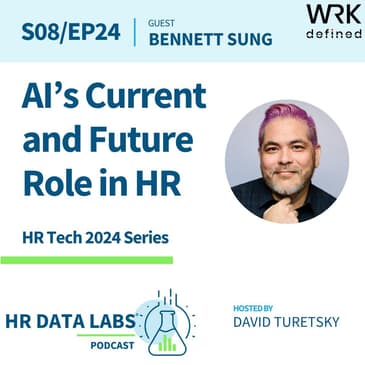
Bennett Sung, Strategic Marketing Advisor at Restworld and Fractional CMO at MeBeBot, joins us in this episode to explore AI’s current and future role in HR. He talks about where AI best fits within existing HR tech stacks and shares exciting prospects for AI implementation, while also considering how pay transparency is transforming recruitment strategies.
This conversation took place at the HR Tech 2024 conference in Las Vegas.
[0:00] Introduction
- Welcome, Bennett!
- Today’s Topic: Exciting Prospects for AI Implementation
[7:36] How will AI fit into existing HR technology stacks?
- HR’s evolving relationship with finance may include learning to “follow the money”
- The increasing intersection of HR and IT through new data governance requirements
[15:51] Will pay transparency be a game changer for recruitment?
- Leveraging total compensation statements as strategic recruitment tools
[21:31] Will 2025 be a breakthrough year for AI in HR?
- Financial investment enabling HR to “do more with less” through AI
- The importance of succession planning as baby boomers exit the workforce
- The emerging potential of AI agents
[39:45] Closing
- Thanks for listening!
Quick Quote
“Following the money is important for HR to master . . . to build business cases for the long term.”
Contact:
Bennett's LinkedIn
David's LinkedIn
Dwight's LinkedIn
Podcast Manager: Karissa Harris
Email us!
Production by Affogato Media
To schedule a meeting with us: https://salary.com/hrdlconsulting
For more HR Data Labs®, enjoy the HR Data Labs Brown Bag Lunch Hours every Friday at 2:00PM-2:30PM EST. Check it out here: https://hrdatalabs.com/brown-bag-lunch/
Produced by Affogato Media
Powered by the WRKdefined Podcast Network.
[00:00:00] The world of business is more complex than ever. The world of human resources and compensation is also getting more complex. Welcome to the HR Data Labs podcast, your direct source for the latest trends from experts inside and outside the world of human resources. Listen as we explore the impact that compensation strategy, data, and people analytics can have on your organization.
[00:00:25] This podcast is sponsored by salary.com, your source for data, technology, and consulting for compensation and beyond. Now, here are your hosts, David Turetsky and Dwight Brown.
[00:00:38] David Turetsky Hello and welcome to the HR Data Labs podcast. I'm your host, David Turetsky, live at the HR Technology Show in Las Vegas, Nevada. And I have with me one of my best friends for a very long time, Bennett Sung. Bennett, how are you?
[00:00:51] David Turetsky I am doing well. Thank you for having me back on the podcast.
[00:00:55] David Turetsky It is absolutely a pleasure and especially when I get to do it in person.
[00:00:58] David Turetsky Right.
[00:00:59] David Turetsky And actually see your face, your smiling face, and see your new hair color.
[00:01:04] David Turetsky Newest hair color, yes.
[00:01:05] David Turetsky And it is a orange-ish, reddish yellow.
[00:01:09] David Turetsky Yes.
[00:01:10] David Turetsky With gray highlights.
[00:01:11] David Turetsky It sure is. This is a three, it's three months old, but it's still showcasing its color.
[00:01:19] David Turetsky Yes.
[00:01:20] David Turetsky I don't mind.
[00:01:21] David Turetsky Gray is great.
[00:01:22] David Turetsky Yeah.
[00:01:22] David Turetsky Gray is trendy.
[00:01:23] David Turetsky I love it.
[00:01:24] David Turetsky Well, it shows your maturity.
[00:01:25] David Turetsky Right.
[00:01:26] David Turetsky I'm sorry.
[00:01:26] David Turetsky Exactly.
[00:01:27] David Turetsky I didn't do that.
[00:01:28] David Turetsky Don't worry.
[00:01:29] David Turetsky So what we do for every one of our guests on the HR Data Labs podcast, Bennett,
[00:01:34] what's one fun thing that no one knows about you?
[00:01:37] David Turetsky Ooh, any new fun thing?
[00:01:38] David Turetsky You need a new fun thing.
[00:01:39] David Turetsky I've already told probably the most hilarious one, fainting from formaldehyde
[00:01:45] in an animal science class. That was just to bring everybody back to the old bit.
[00:01:50] David Turetsky Back to the future.
[00:01:51] David Turetsky Back to three years ago.
[00:01:52] David Turetsky Yeah, right.
[00:01:53] David Turetsky Well, this time, you know, I had a bit of an instant getting to HR tech
[00:01:57] in a context like I tripped on these amazing new shoes of mine that are red.
[00:02:03] David Turetsky Yeah, they're pumas.
[00:02:04] David Turetsky They're really nice red pumas.
[00:02:06] David Turetsky You know, so but I tripped over them and I had to like, like brace myself
[00:02:11] for a face plant.
[00:02:13] David Turetsky No.
[00:02:13] David Turetsky Yeah. And now I can barely shake hands.
[00:02:16] David Turetsky So when was this?
[00:02:18] David Turetsky From Seattle to Las Vegas.
[00:02:20] David Turetsky No.
[00:02:21] David Turetsky Yeah. So I got off the train in Seattle and boom, I was on the ground.
[00:02:27] David Turetsky Oh no.
[00:02:27] David Turetsky I said, oh my goodness, what's going on here?
[00:02:29] David Turetsky This is not how I wanted to start my HR tech travels.
[00:02:33] David Turetsky But nonetheless, it is what it is.
[00:02:35] David Turetsky But you look okay.
[00:02:35] David Turetsky Yeah, I'm fine.
[00:02:36] David Turetsky Show me your hands.
[00:02:37] David Turetsky No.
[00:02:38] David Turetsky Oh yeah.
[00:02:39] David Turetsky Do they look bruised?
[00:02:40] David Turetsky No, they did not at all.
[00:02:41] David Turetsky That's why I thought.
[00:02:44] David Turetsky So for those of you who don't know Bennett, Bennett's a brilliant guy.
[00:02:48] David Turetsky I met him a long time ago when we were working for ADP.
[00:02:51] David Turetsky His company had just gotten acquired and my company had just gotten acquired by ADP.
[00:02:55] David Turetsky And we kind of bonded over that newness.
[00:02:58] David Turetsky But also, we did a lot of conversations around talent management and how working in an environment
[00:03:05] David Turetsky And how do you get more people thinking about the world of not just at that point applicant tracking or talent management, but also what does that really mean in the context of business?
[00:03:17] David Turetsky Right.
[00:03:17] David Turetsky So that's been a while ago.
[00:03:19] David Turetsky It has been a while and things have changed.
[00:03:20] David Turetsky Priorities priorities definitely have shifted yet at the same time stayed relatively the same.
[00:03:27] David Turetsky Yes.
[00:03:27] David Turetsky Because I think when I began to kind of look, do a reflection of, you know, the since back in 2006 when we were together.
[00:03:36] David Turetsky Right.
[00:03:36] David Turetsky You know, so many things have stayed the same.
[00:03:39] David Turetsky Right.
[00:03:39] David Turetsky So many of the topics have relatively stayed the same.
[00:03:42] David Turetsky Right.
[00:03:42] David Turetsky Candidate matching.
[00:03:43] David Turetsky We're still struggling to figure out why that we can't figure that out.
[00:03:47] David Turetsky Right.
[00:03:47] David Turetsky Right.
[00:03:47] David Turetsky Right, and there's just a lot of small little-small little mini-milestones we all have to accomplish in order to get that piece of functionality right.
[00:03:57] David Turetsky Right.
[00:03:57] David Turetsky And I'm not sure if we ever will be happy with it anyways, so…
[00:04:00] David Turetsky Well, it's so difficult and especially in the world now where – and we want to talk a little bit about artificial intelligence, but within the world of applicant tracking and recruiting there's still so much complexity with where am I hiring people, who am I going to hire
[00:04:14] And who do I actually get to talk to, given the fact that a lot of the AIs are actually filtering people out?
[00:04:19] Yeah, for sure.
[00:04:20] I mean, AI is definitely helping with getting through the volumes of candidates, especially in the employer-driven world we're living in today.
[00:04:29] I'm sure next year will be a candidate-driven world again, and that is going to be a different strategy.
[00:04:35] But nonetheless, I think AI certainly has been helping folks out in the context of, I'm getting work done for you.
[00:04:42] I'm getting work done.
[00:04:43] I'm looking at people.
[00:04:45] I'm not sure if they're correct, but I'm looking at people and I'm thinking and predicting that this person should be put in your interview bucket and not the disposition bucket.
[00:04:55] So we're going to continue to see how that evolves over time in terms of its accuracy and its context of not making sure that decisions are not based on previous biases and such.
[00:05:11] Which has been the case.
[00:05:13] Which is why on the recruiting side, it's very much, for me, one of the biggest hurdles and challenges going to face in recruiting technologies today.
[00:05:26] All of them are quoting AI.
[00:05:28] They're making recommendations.
[00:05:30] Right.
[00:05:30] You go talk to EEOC, which I have.
[00:05:33] They are very critical about decision-making capabilities that don't have a human in the loop.
[00:05:40] Right.
[00:05:40] Right.
[00:05:41] So I think one of the keys there is, have the artificial intelligence help create the artifacts, but have a human review them?
[00:05:51] I mean, the artifacts are still honestly kind of subjective.
[00:05:58] I mean, you look at resumes.
[00:06:00] Oh my God.
[00:06:00] We have no control over the resume or the CV, however you want to talk about it.
[00:06:05] Yep.
[00:06:05] You look at the content piece created by recruiters and hiring managers, the requisition, that's flawed.
[00:06:14] Primarily because there's no process of collecting it.
[00:06:17] Right.
[00:06:18] Well, actually, a lot of that's being built by ChatGPT because managers and recruiters are, sorry, recruiters, they're a bit lazy about this.
[00:06:24] Yeah.
[00:06:25] I mean, for sure.
[00:06:26] And then you have to think about, is it inclusive?
[00:06:29] You know, then you have to look at the languages associated, you know, that are being used.
[00:06:33] But more so, it's the actual process of intake.
[00:06:36] Right?
[00:06:37] You know, because the whole notion is, I as a recruiter and you as a hiring manager, really, this is our SOW to each other.
[00:06:45] That's right.
[00:06:45] And if we can't agree upon this, then the first step of the process of going out there and looking at candidates and say, yes, no, yes, no.
[00:06:55] I think sometimes humans probably could do it a little bit better than AI in terms of getting it right.
[00:06:59] We'll see.
[00:07:00] Well, but go back to your original point about the bias.
[00:07:03] Yeah.
[00:07:04] Sometimes we have not gotten it right.
[00:07:06] And hopefully what we're not training these models on are what had been happening in the past that had gotten us into trouble in the past.
[00:07:14] Oh, yeah.
[00:07:15] For sure.
[00:07:15] Yeah.
[00:07:16] By the way, we're recording live at the HR Technology Show and it hasn't opened yet.
[00:07:22] So you're hearing a lot of the work that's being done to get it to be open.
[00:07:26] Yes, exactly.
[00:07:27] In an hour or so.
[00:07:36] Let's go to one of the questions that we were going to ask you, which is, to me, one of the fun things about doing these kind of conversations, especially at the beginning of the HR Technology Show, is I think your opinion might be changed by the time the end of the show happens.
[00:07:52] Yeah.
[00:07:52] Maybe not too much.
[00:07:53] So one of the questions is, beyond the hype cycle, where does AI land in the HR stack right now?
[00:07:58] So interesting enough, so I've been consulting with a company called Mimi Bot.
[00:08:03] Me, be, bot.
[00:08:05] One of the harder names to say, but still a fun name.
[00:08:07] But we did a survey of HR folks to get a pulse check on have they made progress since 2016 when we first did the survey on whether or not they're ready for AI.
[00:08:18] Well, there's a lot of things that haven't really moved the needle forward.
[00:08:25] Right.
[00:08:25] There are obstacles in the way.
[00:08:27] AI adoption on the HR side in comparison to the recruiting side is much slower, much more methodical.
[00:08:35] And it's because, you know, one of the big, one of the challenges is that now IT has gotten, they are driving in a co-shared relationship with HR.
[00:08:46] Good.
[00:08:46] They are driving the initiatives.
[00:08:48] Good.
[00:08:48] Together.
[00:08:49] So they're both kind of like, you know, obviously, you know, pros and cons and, you know, having their conversations and, you know, debates about, you know, where do we want to take this?
[00:09:00] What do we want to use?
[00:09:01] You know, have we set up the processes and the policies at front?
[00:09:05] Like, do I have an AI steering committee?
[00:09:08] That's brand new.
[00:09:09] Yeah.
[00:09:10] To a lot of things.
[00:09:11] And, you know, that's just, but it's all, it's all for good.
[00:09:14] Right.
[00:09:15] Right.
[00:09:15] It's all for ensuring that AI is treated, is done in a responsible capacity.
[00:09:21] Yeah.
[00:09:22] Or ethically or however you want to use it.
[00:09:24] Right.
[00:09:24] Right.
[00:09:24] And it's like, so, so I think for the most part, there are a number of things that are challenging HR in the context of moving this needle forward faster.
[00:09:35] Right.
[00:09:35] First and foremost, they're not following the money.
[00:09:39] By not following money, I mean, they are not partnering as well as they should be with their CFO.
[00:09:46] Why is that?
[00:09:48] There just hasn't ever been that kind of relationship.
[00:09:51] But the reality is the CFO holds the purse strings.
[00:09:55] Absolutely.
[00:09:55] Purse strings.
[00:09:56] Right.
[00:09:56] It's like, but, you know, so the things like, well, you know, we want to invest in this technology, but it's a new line item.
[00:10:03] How am I going?
[00:10:04] What is that?
[00:10:04] What do you need from us to, to, you know, get you to sign off on it?
[00:10:09] What's the business case?
[00:10:09] What's the business case?
[00:10:11] What are the, what are the outcomes?
[00:10:13] And by outcomes, we don't mean how much more what the kind of experience is.
[00:10:18] Because CFOs will not buy things based on experience.
[00:10:21] In fact, they're cutting technologies that are exclusively to experience because there's nothing on the, on the, at the tail end that shows me how much revenue I've even created or how much cost cutting I've been able to save.
[00:10:34] Right.
[00:10:35] Right.
[00:10:35] So following the money is important for HR to really master and build that relationship.
[00:10:40] And then you'll be able to realize when you have, when you find the tools that you're looking for, you work with the, you work with CFOs to then go and really build a case that's going to be for the long term.
[00:10:51] Not like this is a, this is not one that it's going to be cut for the next year.
[00:10:55] Sure.
[00:10:55] I would like to think about this though.
[00:10:58] There's also another side that the CFO will be interested in, which is the risk side.
[00:11:02] Yeah.
[00:11:02] And what are the risks to not only the adoption, but what are the risks to non-adoption?
[00:11:08] Right.
[00:11:08] Because so many of their competitors might be adopting AI tools.
[00:11:13] Yeah.
[00:11:13] And an AI stack.
[00:11:14] Yeah.
[00:11:14] But, but also we've seen a lot of AI in the consumer world.
[00:11:18] For sure.
[00:11:18] And chat GPT-4O is available for people to kind of sign up.
[00:11:22] Yeah.
[00:11:23] What happens if people do it and they expose data?
[00:11:27] I'll be talking about this a lot.
[00:11:29] And it's not been done with IT's knowledge or involvement.
[00:11:32] And so it's being done rogue.
[00:11:35] Yeah.
[00:11:35] I think the reality is we all, we already know that it's already being done.
[00:11:39] Yeah.
[00:11:39] So you have to just realize that it's a good, it's actually a really good thing that individuals are using AI for their, for purposes of just getting themselves acclimated to what, what is my, what's the day in the life of what I'm doing today?
[00:11:56] How is that going to change?
[00:11:58] Until they start experimenting, they will really not really feel the impact.
[00:12:02] And that's one of the major benefits and kind of missions of AI.
[00:12:05] Yeah.
[00:12:06] At this stage, we're about changing the behaviors of work.
[00:12:09] Right.
[00:12:09] Right?
[00:12:10] And if we, like, so, so I, we're encouraging folks to experiment, but we have to experiment with, with guardrails.
[00:12:17] Well, they have to develop these skills because they have to, if not, it's going to overtake what they're doing and everybody else is going to be doing it.
[00:12:26] And they're going to be like, well, why didn't we invest in?
[00:12:28] Yeah.
[00:12:29] I mean, we're, we're seeing that.
[00:12:30] And I think there's also the reality is like, you have to understand the problems you're trying to solve.
[00:12:36] This is not like, I mean, if you keep on layering technology on technology and they're not really solving any real, real issues, then there's, then again, we're not going to, when it comes to the renewal and they ask for the outcome, that's never going to be very clear.
[00:12:52] Let's look at a consumer technology in the world of AI that everybody adopts.
[00:12:56] And I'm not talking about Siri or Alexa.
[00:12:58] I'm talking about like a Grammarly.
[00:13:00] Like, or, or think about it.
[00:13:02] You're just a spell checker or the grammar checker that you use in word or whatever.
[00:13:05] For sure.
[00:13:06] There are so many people that think that a Grammarly is a, what lazy person uses it or someone who's uneducated.
[00:13:15] No, no.
[00:13:16] A lot of people use it so that they, they, you know, what's the right then versus then or, or then or what's the right, you know, spelling of right or higher or the context.
[00:13:28] Yeah.
[00:13:28] I mean, and getting it right in a, in a business context is so important.
[00:13:32] Exactly.
[00:13:33] But, but, but that's a consumer version of an AI tool.
[00:13:36] Yes.
[00:13:37] That people have just kind of built into a lot of tools, whether it's making emails work or.
[00:13:43] Yeah.
[00:13:43] I mean, it's all anything that is content generation is probably going to have a Grammarly, a Grammarly like functionality built into it without you maybe even knowing.
[00:13:53] Exactly.
[00:13:53] Right.
[00:13:54] And so a lot of times there's a lot of tools that we're probably using that we don't ever realize.
[00:13:58] Right.
[00:13:58] Like, you know, we'll take a step back into the days of virtual edge.
[00:14:02] That, I mean.
[00:14:03] Virtual edge, that was one of those technologies that got bought by ADP.
[00:14:07] Yeah.
[00:14:07] They brought Bennett to ADP.
[00:14:09] Yeah.
[00:14:09] But what, what, what folks didn't know is that it had a built in candidate matching tool that was using a machine learning natural logic, natural logic processing, you know, algorithm called ingenuum back in the days.
[00:14:22] It was like a desk.
[00:14:23] It was like a premise based like machine learning tool.
[00:14:26] It wasn't even put into the cloud yet until, until virtual edge got ahold of it.
[00:14:30] But the reality is not many folks knew about that in the days.
[00:14:34] And, and so, you know, it's, we, it's been around.
[00:14:37] Let's just be real.
[00:14:38] I mean, AI has been embedded in so many different things.
[00:14:40] I mean, you talk about, you know, Grammarly being lazy.
[00:14:44] Isn't a calculator the same way?
[00:14:46] Oh yeah.
[00:14:47] Absolutely.
[00:14:47] Yeah.
[00:14:48] Excel.
[00:14:48] I mean, like my mathematical capability of comprehending mathematical equations have definitely slowed down.
[00:14:54] Oh sure.
[00:14:55] Right.
[00:14:55] But nonetheless, it's the, we, we know in the back of our heads, it's made us more productive.
[00:15:00] Yep.
[00:15:00] Right.
[00:15:00] We can get to answers faster.
[00:15:02] Absolutely.
[00:15:03] Right.
[00:15:03] But when it comes down to investments in technology and we're asking for lots of new money, like sometimes efficiencies and experiences will not cut it.
[00:15:15] Like we have to, again, not to use the term, the phrase, follow the money.
[00:15:20] The reality is CFOs are looking, how much are you going to rate, how much more revenue are you going to give me?
[00:15:25] Right.
[00:15:25] Or how much money are you going to reduce?
[00:15:27] Right.
[00:15:27] Those are the two things that all they care about.
[00:15:30] So, so you have to have your, you have to have that business case tight and really focused on those two line items.
[00:15:38] So.
[00:15:39] Absolutely.
[00:15:40] Like what you hear so far?
[00:15:42] Make sure you never miss a show by clicking subscribe.
[00:15:45] This podcast is made possible by salary.com.
[00:15:49] Now back to the show.
[00:15:51] I want to take us in a little bit different direction.
[00:15:53] This is, this is a little bit selfish for me.
[00:15:55] Sure.
[00:15:56] But, but you've been in the recruiting space for a long time and now we're seeing pay transparency.
[00:16:00] I have to take you this direction.
[00:16:02] Pay transparency is really huge in a lot of different states and it's, and it's going to be huge across many organizations who are using the, well, let's call it the highest common denominator.
[00:16:13] Whatever the state is that has the most rigorous regulations.
[00:16:18] Yeah.
[00:16:18] How does it change the game in recruiting when now they have to disclose the pay range when they're in the midst of the requisition and in that candidate cycle?
[00:16:29] Yeah.
[00:16:30] I mean, I think in the long term it's leveling the playing field, right?
[00:16:35] It's giving, it's going to make candidates, you know, maybe it's going to be a vehicle for screening candidates out or in.
[00:16:42] Absolutely.
[00:16:43] Right.
[00:16:43] Because they, you know, they have their own personal expectations of kind of money that they want to make.
[00:16:48] Right.
[00:16:49] Right.
[00:16:49] So I do feel from a recruiting perspective, it's, it can be used as a absolute attraction.
[00:16:56] Absolutely.
[00:16:57] You know, and, and the reality is, I think it also reflects culture.
[00:17:02] Yep.
[00:17:02] But transparency is one of those, one of those cultural elements that employees value, you know?
[00:17:10] And so I think it's, you know, it's also then aligning, like if it is something you really put forth and prioritize and it's going to be reflected in your company's entire, entire way of communicating.
[00:17:20] So, so that, those are the things that when I look at transparency or anything that's transparent, AI, you know, AI is a, it's all about transparency.
[00:17:29] It's nothing, it's not about hiding anything.
[00:17:32] Right.
[00:17:32] Right.
[00:17:32] And it's only going to get, it's only going to get more granular and more visible and more accessible.
[00:17:37] Absolutely.
[00:17:38] So when I think about transparency in the world of recruiting, I also think about what are the programs and how do I educate the candidate and the employee as to what is it the value proposition is
[00:17:49] that they're working here for?
[00:17:52] What are the rewards there they have the opportunity to get?
[00:17:54] Right.
[00:17:55] And also making a more mature relationship between the employer and the employee because now you're trusting your managers, all the stakeholders in this, you're trusting them to make the best business decisions for the company.
[00:18:07] Totally.
[00:18:08] And the person.
[00:18:08] Yeah.
[00:18:09] You know, I think one of the things that candidates and companies don't prioritize or it's very rare to see,
[00:18:17] they focus exclusively on salary and never really bring in all of the other influencers of compensation, how much they put towards your benefit programs,
[00:18:29] our contributions to your 401k, all of these things that don't, what they call total compensation statements.
[00:18:35] That's right.
[00:18:35] Yeah.
[00:18:35] Those seem to be, those are amazing recruiting tools.
[00:18:39] If you, you know, when you put it into, when you put it into play, I just don't see a lot of folks, they say, here's your, here's your offer and salary.
[00:18:47] And here's how many days you get off.
[00:18:49] Right.
[00:18:50] It does.
[00:18:50] I just don't feel like I have a full understanding of like what I'm, what value I'm getting from the company.
[00:18:57] Right.
[00:18:57] I know what I could bring to them, but I really don't feel like I have a good sense of the end to end understanding of how much they're investing in me.
[00:19:04] And I think once we get beyond the regulations in pay transparency, what you're going to start to see is that more companies are going to be much more open about their other benefits and other pay payments and things like that.
[00:19:17] Because the regulations that exist only talk about base pay.
[00:19:21] Why?
[00:19:21] Because it's so complex in the world of everything else.
[00:19:25] You know, what is an incentive?
[00:19:26] What's a sales incentive versus a commission versus just a shorter long-term incentive?
[00:19:31] Right.
[00:19:31] Because those things are so variable by company, by culture, as you mentioned before, that the, a lot of the regulators and one of the regulators I was speaking to last week said, look, we thought about doing beyond base pay, but we really couldn't get what a good definition of those other things are.
[00:19:46] Yeah.
[00:19:47] So to me, what's going to happen is once we get beyond the regulations, companies are going to use their culture.
[00:19:52] Yeah.
[00:19:53] And they're going to, and they're going to say, well, our culture is a total compensation culture.
[00:19:57] And then people are going to learn more from the beginning.
[00:19:59] More about it.
[00:20:00] Yeah.
[00:20:00] You know, I also just feel like it's an education for candidates and employees.
[00:20:04] It's like, let me tell you what, let me help you understand the total investment.
[00:20:09] And, and that's, once they hear that, I think they're going to be very, like, they're going to embrace a lot of the things that they're talking about.
[00:20:17] And they're going to like really revalue the organization that they joined.
[00:20:22] And it's going to give them more motivation and, and, and, you know, and they're going to feel more, you know, belonged in the organization and valued and such.
[00:20:29] So, and that, and that will be a better tool for retention than trying to change their pay or giving more of something.
[00:20:37] Right.
[00:20:37] I mean, you know, I think, I think there's some folks that no matter what is always going to be the base pay and the salary and that's all they can look at.
[00:20:44] Right.
[00:20:44] I mean, right.
[00:20:45] I think there's a good part of the bills.
[00:20:47] They have to pay the bills.
[00:20:48] Right.
[00:20:48] I got to keep the lights on.
[00:20:50] Right.
[00:20:50] But, but, you know, I think over time, hopefully as more folks do like start to kind of think about their large, the larger picture in life.
[00:20:59] Then they're going to realize the importance of all of those additional pay elements.
[00:21:03] Absolutely.
[00:21:05] Hey, are you listening to this and thinking to yourself, man, I wish I could talk to David about this.
[00:21:10] Well, you're in luck.
[00:21:11] We have a special offer for listeners of the HR Data Labs podcast, a free half hour call with me about any of the topics we cover on the podcast or whatever is on your mind.
[00:21:21] Go to salary.com forward slash HRDL consulting to schedule your free 30 minute call today.
[00:21:31] So let's talk beyond transparency.
[00:21:33] Now let's go back to our list of questions and get one last one, which I think a lot of people are thinking about is 2025 the year that we see AI break into HR in a major way.
[00:21:45] I know you have an opinion on this.
[00:21:48] We're going to wait another year.
[00:21:49] It's going to be 2026, I believe.
[00:21:52] So you think 2026 will be the year that HR really adopts AI in a major way?
[00:21:57] In a, in a, in a more, in a scalable way.
[00:22:01] Okay.
[00:22:01] We're still asked.
[00:22:02] There's, there's way too many organizations who haven't even done basic things around using AI.
[00:22:08] Like, again, I'll kind of reflect back on Mimi Bot, which does employee, AI employee support.
[00:22:14] There are 24, 24 digital HR generalists.
[00:22:18] Who does it like who, what organization, HR people ops teams want to answer repetitive questions every day?
[00:22:25] None of them.
[00:22:25] They hate it.
[00:22:26] They hate it.
[00:22:27] Yeah.
[00:22:27] But slows everything else down.
[00:22:28] But yeah, no investment.
[00:22:30] So there's kind of this like double-edged sword of like do more with less yet.
[00:22:35] They never get the investment to actually augment the team to help do more with less in terms of like the overall headcount.
[00:22:44] Right.
[00:22:44] So it feels, so for me, I feel like there's still a big stride away.
[00:22:49] There's a lot of cool things happening here at HR tech.
[00:22:52] Oh yeah.
[00:22:52] Right.
[00:22:53] I mean, there's a lot of innovation, but so much is like many, like a lot of things.
[00:22:58] It's all about timing.
[00:23:00] It comes down to time.
[00:23:01] Last year, we saw a lot of hype cycle here at HR tech around AI.
[00:23:06] Yeah.
[00:23:06] This year is no exception.
[00:23:08] Yeah.
[00:23:08] We're still in the delusional stage.
[00:23:10] Oh my gosh.
[00:23:11] Belong delusional.
[00:23:12] We just don't, because what, what we don't see is there's not enough, like there's not enough ability to play with the technology.
[00:23:22] So the AI, the difference between AI and applicant tracking system is in the case of AI, you have to vet, like,
[00:23:30] is it doing the job as it's designed?
[00:23:33] So, which means you have to get access to that AI algorithm.
[00:23:36] Right.
[00:23:37] And you have to play with it.
[00:23:38] That's right.
[00:23:38] Else you'll never know if that piece of functionality is actually what it, what it's being marketed for.
[00:23:43] You have to turn the dials and make sure that you...
[00:23:45] You have to turn the dials to the extreme.
[00:23:47] QA it till the cows come home.
[00:23:49] Exactly.
[00:23:49] And that's a major difference.
[00:23:51] That's between traditional software and what we're seeing today in this AI software.
[00:23:55] And it is definitely kind of flipping or changing the dynamic of how the solution providers are actually selling.
[00:24:02] Well, you have to make sure the decisions it's making would be the same decisions you would have wanted it to make.
[00:24:07] No, exactly.
[00:24:08] No, and that's what...
[00:24:10] And that's the hope.
[00:24:11] That is why also the solution providers are going to be pressured to provide transparency on how the algorithm works.
[00:24:20] Right.
[00:24:20] Which I think a lot of folks feel like, oh, that's like secret sauce.
[00:24:25] I can't give that away.
[00:24:26] Well, you're not going to have much choice because you're going to have legislation telling you...
[00:24:31] Legislation is going to tell you, you've got to expose this all.
[00:24:33] Absolutely.
[00:24:34] You cannot hide...
[00:24:35] This cannot be hidden.
[00:24:36] Well, if you don't have it through legislation, you're going to have it through lawsuits.
[00:24:41] Right?
[00:24:42] Do you want reputation?
[00:24:43] Exactly.
[00:24:44] You want...
[00:24:44] Like we already see in the consumer side.
[00:24:46] Yeah.
[00:24:47] Right?
[00:24:47] I mean, the consumer side just saw Air Canada get through, go through a lawsuit because their chatbot was delusional about bereavement travel policies.
[00:24:58] Yes, I heard that.
[00:24:59] Right?
[00:24:59] And then you hear the same thing happening in, I think, New York City.
[00:25:03] They're giving wrong information about everything because their chatbot is ingesting outdated information.
[00:25:11] So the reality is we want to hold everybody accountable.
[00:25:15] So you got...
[00:25:15] But you have to realize that you have to understand, again, what are the problems you're solving?
[00:25:19] How would you go about solving that?
[00:25:21] And it's nowhere different from the days of assessments, right?
[00:25:24] Yeah, of course.
[00:25:25] Assessments were one of those tool, early AI tools that were done on paper.
[00:25:29] Yeah.
[00:25:29] And...
[00:25:29] But nobody...
[00:25:30] They had to provide the evidence and the receipts to defend what potentially could be a lawsuit or a reputation issue.
[00:25:38] Well, we also saw Workday get eviscerated.
[00:25:41] We're still...
[00:25:42] We're waiting for that judgment to happen, right?
[00:25:44] We kind of...
[00:25:45] It's been exposed.
[00:25:46] It's nothing secretive.
[00:25:48] Right.
[00:25:48] But now it's going to be, you know, who's accountable...
[00:25:52] Right.
[00:25:52] ...for the algorithm itself.
[00:25:54] And I think this, again, this is history repeating itself.
[00:25:58] It comes full circle.
[00:26:00] Like, we're here again, 20 years later, 10 years later, still talking about the same things.
[00:26:06] Yeah.
[00:26:06] Maybe in a slightly different context.
[00:26:08] Right.
[00:26:08] But the ramifications and the thought process is all the same.
[00:26:12] But I think you mentioned before, transparency helps provide that layer of trust.
[00:26:18] Yeah.
[00:26:19] Whether it's talking about a chatbot, whether it's talking about an AI assessment of a candidate, and why did you choose this one over that one?
[00:26:25] And why did you choose to, you know, let this one go from the process?
[00:26:29] Or pay transparency or whatever.
[00:26:31] Yeah.
[00:26:31] Treating people with respect and providing them the insight to understand why a decision was made or how it was made.
[00:26:37] Everybody wants an answer.
[00:26:38] Has to.
[00:26:38] They have to.
[00:26:39] Or we'll get legislated or we'll get a lawsuit.
[00:26:42] You know, and we're just going to be where we are today with frustrated employees and candidates.
[00:26:46] Yeah.
[00:26:46] Where, you know, it's like, why didn't you choose me?
[00:26:49] Well, you can't really say.
[00:26:51] I already, like, there are these, there is these communication, like, kind of restrictions about what you can say, what you cannot say.
[00:26:59] It's like, you know, let's, we have to open this up.
[00:27:02] Like, there is no reason why you couldn't tell somebody they were not chosen for this particular reason.
[00:27:07] The problem is that they actually, and probably the AI doesn't actually know the reason.
[00:27:12] Right.
[00:27:12] They just made it up.
[00:27:13] They probably just made it up.
[00:27:15] Well, and for those of us who have gone through the process of trying to apply for a job.
[00:27:19] Oh, gosh.
[00:27:20] And getting an email back five seconds after you hit submit that said, thank you very much.
[00:27:25] You've got really great experience, but we've gone on with other candidates who are better suited than you.
[00:27:30] Bullshit.
[00:27:31] Right?
[00:27:32] Come on.
[00:27:32] What they probably forgot to do is close the requisition.
[00:27:36] That is going to be my guess, that the requisition for us forgot to be closed.
[00:27:40] Oh, that's hysterical.
[00:27:41] And so what they're saying is, ooh, we've got a dismissive of these people in the same way.
[00:27:45] And this is how we're going to do it.
[00:27:46] We're going to give them the most generic email that you can possibly use.
[00:27:49] But doesn't that, I mean, talk about reputational risk there, though, Bennett.
[00:27:52] I mean, isn't that like really embarrassing?
[00:27:55] It's embarrassing, but you know what?
[00:27:57] Who's talking about it?
[00:27:59] Like, you'll get a few of these naysayers on TikTok.
[00:28:02] Yeah.
[00:28:02] We've heard them all.
[00:28:03] Yes.
[00:28:03] Right?
[00:28:04] I mean, some of them are very, very self-promotional and will put themselves out there saying, oh,
[00:28:09] my goodness, can you believe what just happened to me?
[00:28:11] Right.
[00:28:11] Right.
[00:28:12] Versus, you know, but most people just, you know, they're accustomed to it.
[00:28:16] They're just like, oh, okay.
[00:28:17] Yeah.
[00:28:18] Right?
[00:28:18] I mean, there's nothing else I can do about it.
[00:28:21] Right?
[00:28:21] Right.
[00:28:21] I mean, I can call them.
[00:28:23] Nobody answers the phone.
[00:28:24] Nobody even responds to emails.
[00:28:25] Right.
[00:28:26] So there's like...
[00:28:26] Oh, there's no phone number.
[00:28:27] You can't call a recruiter and say, why?
[00:28:29] I'm going to find a way to figure out a way to reach the recruiter.
[00:28:32] Why did you choose me?
[00:28:34] I'm the best candidate.
[00:28:35] Exactly.
[00:28:36] You know?
[00:28:36] So, I mean, it's just, you know, it's a vicious cycle of things.
[00:28:40] It is.
[00:28:40] There's like legacy practices that are still in play that just have to be kind of like, well,
[00:28:44] let's find a way to tell people why they never got the job.
[00:28:49] Why they were...
[00:28:50] Yeah.
[00:28:50] Why their compensation is where it's at.
[00:28:53] Right.
[00:28:54] Right?
[00:28:54] Or why the answers to these questions are the way they're at.
[00:28:57] Right?
[00:28:58] So it all comes down to, again, changing the behavior to change the culture, to reflect
[00:29:05] and get different outcomes.
[00:29:08] Absolutely.
[00:29:09] And let's just say this, because I did crap on recruiters before and I apologize.
[00:29:14] I wasn't calling them lazy.
[00:29:15] I was joking.
[00:29:16] But recruiters have a tough job, especially these days, trying to find the best candidates
[00:29:22] in a very, very big sea.
[00:29:24] And these tools are trying to help the recruiter get the best person, because it's about their
[00:29:30] reputation.
[00:29:31] It's about the recruiter's reputation.
[00:29:32] Equally as that.
[00:29:33] Yeah.
[00:29:33] For sure.
[00:29:34] And they're looking for these technologies to be able to make their lives a little bit
[00:29:39] more livable.
[00:29:41] Yeah.
[00:29:42] To be able to do that.
[00:29:43] I think some of the technology, you know, at the end of the day, you have to look at the
[00:29:47] people processes and tools, right?
[00:29:50] So the people is not the issue, usually.
[00:29:54] The process, it can be improved a little bit.
[00:29:56] The technologies are the ones that, you know, have much further to go because expectations
[00:30:02] are just greater.
[00:30:03] Oh, yeah.
[00:30:04] Right?
[00:30:04] It's like, I just don't want you to tell me the exact match.
[00:30:08] Well, now also expand that exact match.
[00:30:10] Yeah.
[00:30:10] Who could do, who potentially could do this?
[00:30:12] Like, there should be tiers of candidates in your pool that until you talk to them and
[00:30:17] talk to them, you'll never be able to get a full sense of whether or not they'll be a
[00:30:21] good fit.
[00:30:22] That's right.
[00:30:23] Fit into the organization, the role of the team, right?
[00:30:25] So at the end of the day, some of the technologies have to understand, like, how do I build a
[00:30:29] pool of candidates that are based on potential?
[00:30:32] Right.
[00:30:33] Well, and God knows we also need succession plans, right?
[00:30:36] Oh, yeah.
[00:30:36] And so somebody moves on.
[00:30:38] That term is still used.
[00:30:39] Well, yeah.
[00:30:41] People leave.
[00:30:42] Oh, I know.
[00:30:42] People go.
[00:30:43] Yes.
[00:30:44] And then, and actually, that's a really important thing.
[00:30:46] People are going to be going a lot more now because the bubble of baby boomers, the people
[00:30:50] in my generation, you know, Gen X, we're going to be retiring.
[00:30:55] Yeah.
[00:30:55] I mean, I'm 57, so I got, I got at least 20 more years.
[00:30:58] Right.
[00:30:59] We'll be doing 20 more years of podcasting.
[00:31:01] Yeah.
[00:31:01] Yeah.
[00:31:02] I'll be talking to Bennett in like 2037.
[00:31:04] Yeah.
[00:31:05] Where is that going to, where is that, is it smaller going to still be in the same
[00:31:07] facility?
[00:31:08] Probably.
[00:31:09] HR detection will still be here in Vegas.
[00:31:11] It will.
[00:31:12] It will never go away.
[00:31:13] Never.
[00:31:13] But, but, but I mean, seriously though, there's going to be this demographic bubble that is
[00:31:18] leaving and there are going to be a lot of holes left in organizations.
[00:31:23] Yeah.
[00:31:23] I mean, look at recruitment, retirement statistics are going to go through the roof soon.
[00:31:27] And, and the recruiter's job is going to be not just about filling today, but also filling
[00:31:31] tomorrow.
[00:31:32] Yeah.
[00:31:32] I mean, and I think this is why organizations need to really get a handle on retention,
[00:31:36] right?
[00:31:36] Because the reality is I am, it's like retention that you can control.
[00:31:43] Right.
[00:31:43] And so, because the, the, the, it's just recruiting and retention are the same coin, but on the
[00:31:50] opposite side.
[00:31:50] Absolutely.
[00:31:51] So we need to continue, you know, when, when retention is high, recruiters are just strapped
[00:31:56] to refill seats.
[00:31:58] Absolutely.
[00:31:59] Versus refilling for the future.
[00:32:01] Right.
[00:32:01] So, so we got to help recruiters.
[00:32:04] We all have to help each other by really addressing, being rigorous on retention so that recruiters
[00:32:10] can actually recruit for the future, recruit to, to fill, find the folks to be able to come
[00:32:16] in to support or replace, or, you know, replace the, the retirements that are, that are going
[00:32:22] to happen in droves.
[00:32:23] Absolutely.
[00:32:24] And they need skills.
[00:32:25] They need experiences.
[00:32:27] And so organizations have to figure out, well, how do I get these individuals, the experiences
[00:32:33] that they need?
[00:32:35] Yep.
[00:32:35] Right.
[00:32:35] And that's not much saying they need technical skills.
[00:32:38] Sometimes it's just, it's just, they just need the experiences of being in leadership,
[00:32:41] the experiences in doing specific types of projects.
[00:32:44] Or mentorship too.
[00:32:45] Or mentorship.
[00:32:46] Being able to do it the right way, not just being able to do it.
[00:32:48] Yeah.
[00:32:49] But yeah.
[00:32:49] Exactly.
[00:32:50] So.
[00:32:50] So we're going to be talking about this for another 20 years.
[00:32:53] So next, for the next 20 years, we're going to talk about how AI took over the world.
[00:32:57] Yeah.
[00:32:58] It took over the, took over the world.
[00:33:00] But you know, what's also interesting is this new genre of chatbot called AI agent.
[00:33:05] Yes.
[00:33:05] We've heard about it from Workday, Salesforce and such, right?
[00:33:10] There's all these agents coming about.
[00:33:12] What's really exciting about that is that it's really going to change.
[00:33:14] It's really going to, this version of AI that's currently being pushed out,
[00:33:20] it's going to be able to be proactive in seeing the areas of gaps in organizations,
[00:33:27] organizational systems.
[00:33:28] Right.
[00:33:28] To then fill it, figure out how to get them back in order.
[00:33:32] Right.
[00:33:32] So, which is one of the hardest things, which is, you know,
[00:33:35] why a lot of companies have struggled with their, you know, their HR tech stacks
[00:33:39] is that they're so kind of non-integrated.
[00:33:42] Data is all kind of all over the place.
[00:33:44] And so it's very hard for them to realize, oh my goodness, this, I, I have all these gaps
[00:33:50] in compliance because people moved or we went from remote work to you, you better get your,
[00:33:56] get back into the office folks.
[00:33:57] Right.
[00:33:58] Which means it's going to have a trickle down effect on taxes.
[00:34:01] So, and all sorts of other things, but nonetheless.
[00:34:03] So what you're talking about agents are, these are little AI bots that, that serve a specific
[00:34:09] purpose.
[00:34:09] They do a specific job and they're trained on one thing.
[00:34:12] Yeah.
[00:34:13] And they fill that gap or it may be, it may be what someone used to do, or it may be something
[00:34:18] completely new.
[00:34:19] So it's probably somewhat in somewhere in between.
[00:34:22] It's because I mean, anybody, if we had the time and the time enough more time and, you
[00:34:29] know, to be able to go into our systems and figure out the data and then look at it and
[00:34:33] then realize, oh God, here are the 20 compliance gaps that we have right now.
[00:34:37] And here's a list of things that we need to do to fix them.
[00:34:40] All of that's very routine.
[00:34:42] That can, those are all routine things that can be nicely performed by an AI agent.
[00:34:46] Right.
[00:34:47] And so, so, so a lot of times the noncompliance is because our systems are just out of order.
[00:34:52] Right.
[00:34:53] Right.
[00:34:53] Because they're missing something.
[00:34:55] They're missing things.
[00:34:56] They're missing.
[00:34:56] They're not talking to each other.
[00:34:57] They're missing data points, all sorts of things.
[00:34:59] And so, so we have, it's, I think it's the AI agent is a great way to maybe scale the
[00:35:05] fixing of a lot of systems because the AI agent can't be really, you know, do its like
[00:35:11] true automation until they get the data straight.
[00:35:16] So, so what you're saying is, is that we need another layer to help fix the data and then
[00:35:23] things will be okay.
[00:35:24] I think it's a good, it's a good, you know, it's not a, it's not a path.
[00:35:30] But it's a good thing that it's a good starting point because I don't think people know where
[00:35:33] to do, instead of like starting from ground zero and implementing new systems and importing
[00:35:38] all this data.
[00:35:39] It's like, okay, I think we can, we can fix existing data through these AI agents and you
[00:35:45] really get the actual integrity of the data in the, in the, in the way that we need it
[00:35:50] to be so that we can now just move on from that and then look at other AI tools to be
[00:35:56] able to layer on top of that.
[00:35:57] Well, and those, those agents don't stop.
[00:35:59] They continue doing their job.
[00:36:01] Refining, refining, refining.
[00:36:03] Always refining.
[00:36:03] Yeah.
[00:36:04] And that is, that is a job in itself.
[00:36:06] Right.
[00:36:07] That's worth, it's priceless in my books.
[00:36:10] Well, and since it's an AI, it's probably relatively inexpensive compared to people that you would
[00:36:15] have been paying for doing that.
[00:36:17] Yeah.
[00:36:17] Exactly.
[00:36:18] And they'd be bored out of their freaking brains.
[00:36:19] Yeah.
[00:36:20] Talk about things, probably some jobs that will cause them to want to leave.
[00:36:24] Yes.
[00:36:24] Right.
[00:36:25] Unless they really, I don't even think the most obsessed data person would, would want
[00:36:30] to stay for that kind of job.
[00:36:32] Nope.
[00:36:33] You know?
[00:36:33] Nope.
[00:36:34] I think you're right.
[00:36:35] But that's kind of, that's kind of exciting part of like where AI is, where AI is today
[00:36:40] that compared to last year.
[00:36:41] Like, I mean, these are just this, all of this AI agent conversation and we're seeing it
[00:36:46] in real life is, um, is really kind of another layer of vision and it's a refinement.
[00:36:52] It's a refinement.
[00:36:52] Yeah.
[00:36:52] And I think it's also going to help refine the employee, the employee engagement.
[00:36:56] So when you think about, remember the days of employee self-service portal?
[00:37:00] Oh, sure.
[00:37:00] ESS.
[00:37:01] Yeah.
[00:37:02] Well, well, they're still here, but yeah, they're going to get replaced.
[00:37:05] They're going to be replaced by these CHOP, these AI agents for employees.
[00:37:07] So the AI agent is going to contact the employees and say, Hey, have you updated your W4 in
[00:37:13] a long time?
[00:37:13] Mm-hmm.
[00:37:14] It's going to, it's going to enable them to go in there and say, tell me how, tell me,
[00:37:18] I need to fill out my expense report.
[00:37:20] Well, this is how you do it.
[00:37:21] And I'm going to lead you through.
[00:37:23] Don't worry.
[00:37:24] You don't have to log into Concur.
[00:37:25] You don't have to log into Expensify.
[00:37:27] We're going to, we're just.
[00:37:28] Here's an expense that we found on your Amex.
[00:37:31] Give me the, did you take a picture of the, of that receipt?
[00:37:34] Yep.
[00:37:34] If you did.
[00:37:35] Great.
[00:37:36] Send it to me.
[00:37:36] Yeah.
[00:37:37] Yeah.
[00:37:37] Send it to me at this address.
[00:37:38] Yep.
[00:37:39] Yeah.
[00:37:39] So it's really going to, you know, because when you pull back the IT applications that is
[00:37:46] being supported in organizations, it's, it's astounding.
[00:37:50] Yeah.
[00:37:50] Like there are some companies that have 600 employees and have 600 applications.
[00:37:54] Hmm.
[00:37:55] Like it's, it's like application.
[00:37:57] It's, it's, it's, it's suffocation.
[00:37:59] Yes.
[00:38:00] Of applications.
[00:38:01] And like, these are applications, like maybe once a year I use it.
[00:38:04] Yeah.
[00:38:04] Right.
[00:38:05] It's like.
[00:38:05] Who's the expert in this?
[00:38:08] Yeah.
[00:38:08] AI agent.
[00:38:09] Hey, help me figure out how to use this.
[00:38:12] The one tool that I do once a year.
[00:38:14] Right.
[00:38:14] Benefits enrollment.
[00:38:15] Yeah.
[00:38:16] The benefits are all the thing.
[00:38:17] So, you know, I mean, there's some exciting things coming down when it looks, when you
[00:38:20] look at like trying to stream, simplify the, simplify the employee engagement in these
[00:38:26] technologies.
[00:38:27] And then also most importantly, really helping leadership and operations teams really get
[00:38:33] the things that they need to get done.
[00:38:34] The things that they need to get done so that they can, so not to, so they can focus on things
[00:38:38] that, you know, maybe move their career, their career forward or help bring in new,
[00:38:42] new solutions to address other problems.
[00:38:46] Well, scalability.
[00:38:46] Scalability.
[00:38:46] It provides them with scalability that they wouldn't have had because they have to call
[00:38:50] every employee to make sure that they're doing their benefit enrollment.
[00:38:53] Right.
[00:38:53] Well, instead, train the bot to do it and then you don't do it.
[00:38:56] Yeah.
[00:38:57] Bot, keep reminding these folks.
[00:38:59] Go into the system.
[00:38:59] Oh, who hasn't done it?
[00:39:01] Yeah.
[00:39:01] Send them another reminder.
[00:39:02] Oh, you need help?
[00:39:04] Let me help you recommend, I can recommend you something.
[00:39:07] Have your dependents changed?
[00:39:08] No.
[00:39:09] Next step.
[00:39:09] Yeah.
[00:39:10] Yeah.
[00:39:10] So exciting things.
[00:39:11] I mean, that's what they're calling, at least in the healthcare world, they've called
[00:39:15] this digital front door.
[00:39:17] The digital front door to employee engagement, which just enables organizations to still have
[00:39:23] all these disparate systems in the back office, but really could provide a seamless one
[00:39:28] one user interface to the employee, which is really kind of what employees crave because
[00:39:34] it's a consumer approach.
[00:39:36] That's right.
[00:39:36] Right?
[00:39:37] That's right.
[00:39:45] Well, Bennett, I think we could talk about this forever.
[00:39:48] Oh, yeah.
[00:39:49] Give me a couple more hours.
[00:39:51] But I know the show is going to start soon.
[00:39:54] Is it really?
[00:39:55] Yes.
[00:39:55] How long have we been here now?
[00:39:57] Well, we've been doing this now for 38 minutes.
[00:39:59] There we go.
[00:40:00] Isn't that before?
[00:40:00] We're actually 39 now.
[00:40:01] Right.
[00:40:02] Right.
[00:40:02] Bennett, thank you so much for your insights.
[00:40:04] It's such a pleasure to talk to you.
[00:40:07] Thank you and take care and stay safe.
[00:40:10] That was the HR Data Labs podcast.
[00:40:13] If you liked the episode, please subscribe.
[00:40:15] And if you know anyone that might like to hear it, please send it their way.
[00:40:19] Thank you for joining us this week and stay tuned for our next episode.
[00:40:23] Stay safe.
Sponsors
