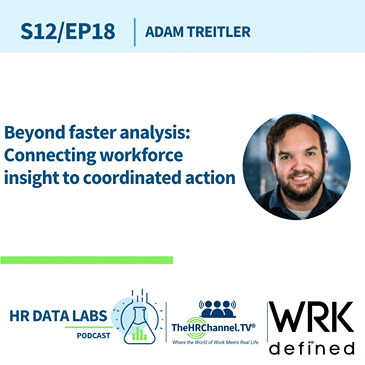
David and Adam discuss how AI is changing workforce analysis—from finding information in HR systems to identifying patterns and shaping possible responses. They emphasize that faster analysis is only a starting point: useful insights require people who understand the business, can validate what AI produces, and can coordinate across HR, IT, finance and other teams to turn findings into action.
Key topics and takeaways
- AI speeds up analysis, but expertise still matters. Adam describes using natural-language conversations with AI to investigate databases, troubleshoot code and find where information lives. The hosts stress that people with relevant expertise still need to check whether the results make sense and catch errors or missing context.
- Start with the right question—and keep asking better ones. Adam suggests using analysis to uncover what information is available, what’s missing and what questions to ask next. He also describes using AI-generated visual examples to help leaders see the value of collecting data they don’t yet have.
- Use workforce data to identify patterns. Adam gives examples including classifying jobs, determining which employees work on-site from available property and job data, and identifying a business area where a quarter of employees were leaving within their first 180 days. He notes that data can show a pattern without explaining why it’s happening.
- Move from insight to intervention. The conversation explores the need for HR professionals who can investigate signals, ask follow-up questions and plan interventions—not just produce dashboards or analyses.
- Give people choices when gathering feedback. David and Adam discuss different ways to learn why employees leave, including a form, a conversation with AI, an HR call or a third-party interview. They emphasize that the approach should be thoughtful and give people options.
- Work across organizational boundaries. Adam says HR needs to learn the business and collaborate more effectively with IT and finance. Inconsistent data structures, unclear ownership and disconnected systems can limit analysis and encourage workarounds.
- Treat governance and access as part of the user experience. Adam says organizations need to understand what people are trying to do, provide appropriate access, and govern data carefully. When people can’t get the information they need through approved channels, they may seek their own tools or contracts.
- Use AI to improve decisions, not just explain them. The guests caution against using AI to create polished narratives for decisions that may be poor or unsupported. They discuss the potential for AI to help make performance goals clearer and connect individual work to organizational objectives—while recognizing that it can also produce arbitrary goals or justify results that didn’t happen.
- Design for how people understand information. David and Adam discuss whether charts are always the right way to present data. A useful analytics experience should help people understand what matters and make better decisions, rather than assume everyone prefers the same visual format.
Names, organizations and tools mentioned
- Related Companies — Adam’s employer, described in the conversation as working in property management, affordable housing and data center development.
- Check out on some of Adam Treitler's works here.
- Work Carousel — mentioned by the host; the spoken address is workcarousel.com/join.
- AI assistants and tools: Claude, ChatGPT, Copilot, and AI agents.
- Data and analytics tools: Cognos, UKG, R, Python, RStudio, Excel, Access, Snowflake and Power BI.
- Other organizations and platforms: Pandora Jewelry, Burger King, Workday, Zendesk, Coursera, OpenAI and Anthropic.
- People mentioned: Morgan Debenbush, described as a former people analytics professional at Google; John Sumser; and Cole Napper.
Powered by the WRKdefined Podcast Network.
Sponsors